|
NEMWI Weekly
Update
June 9th, 2025
| |
| |
NEMWI, GLFC Host Sea Lamprey Event
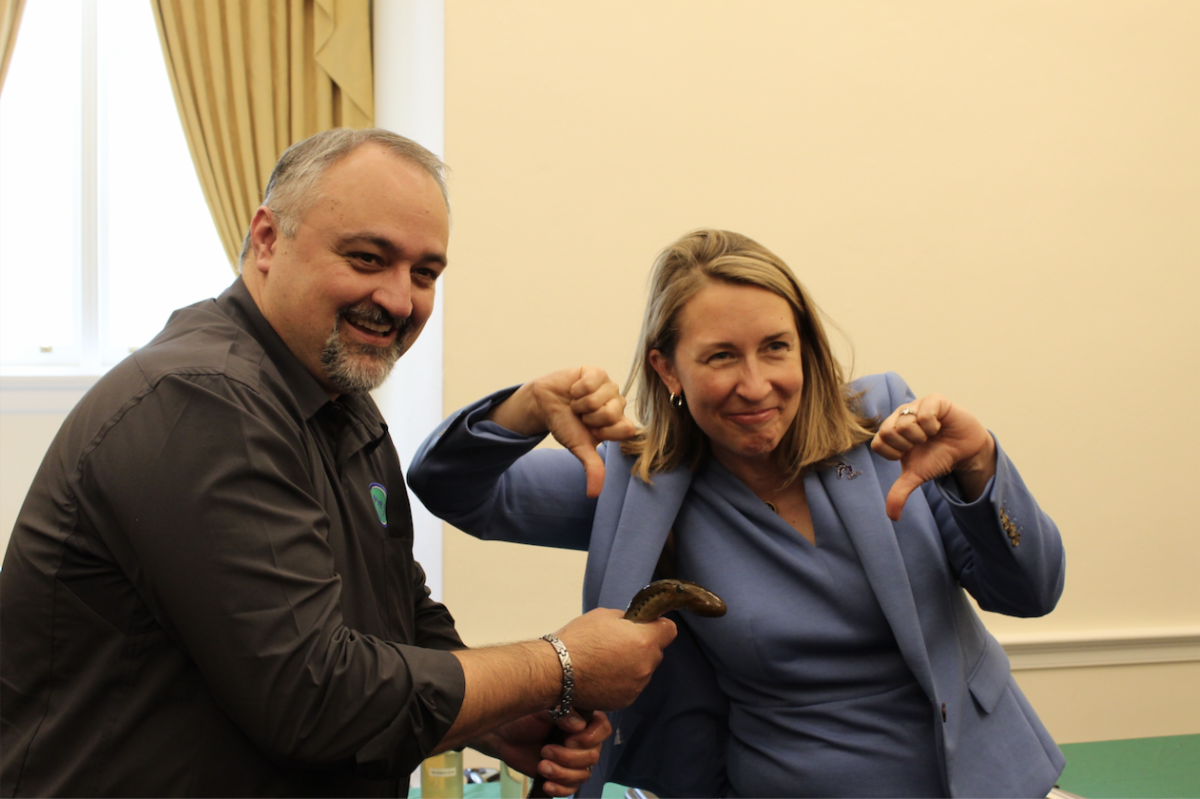
The Northeast-Midwest Institute (NEMWI) and the Great Lakes Fishery Commission (GLFC) co-hosted a live sea lamprey encounter on Capitol Hill last week. The event, held in cooperation with Rep. Marcy Kaptur and the Great Lakes Task Force, gave attendees a chance to see these invasive species up close (or, for the bold, a chance to have a lamprey attached on them). Over 100 people attended from 35 Congressional offices, including Congresswoman Hillary Scholten (pictured above).
Sea lamprey, invasive to the Great Lakes, pose an existential threat to the Great Lakes fishery. Lamprey attach themselves to fish and drain their blood, killing the fish. One sea lamprey can kill 46 pounds of fish in its lifetime. They are controlled by the lampricide TFM, deployed by the Great Lakes Fishery Commission, that kills sea lamprey larvae without harming anything else in the ecosystem and has reduced lamprey populations by 90% from their peak. This control must continue; in its absence, sea lamprey populations would quickly rebound and imperil the $5.1 billion Great Lakes fishery.
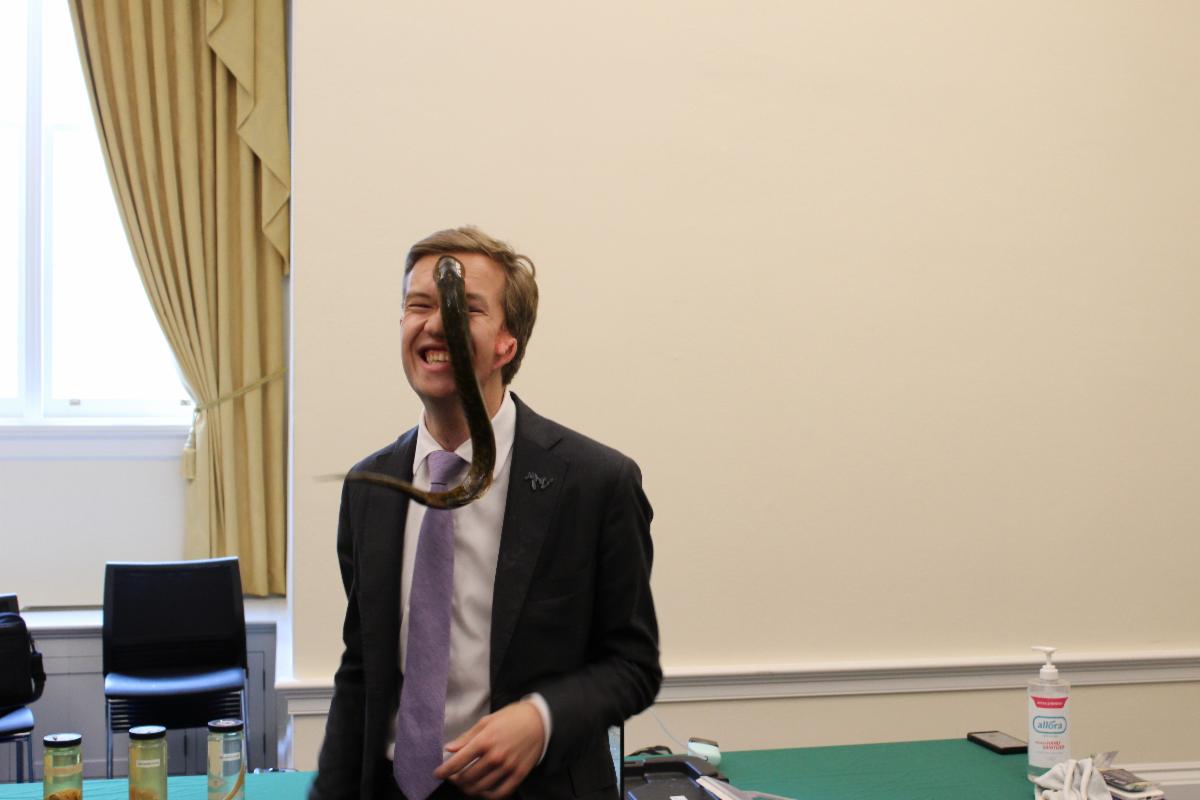
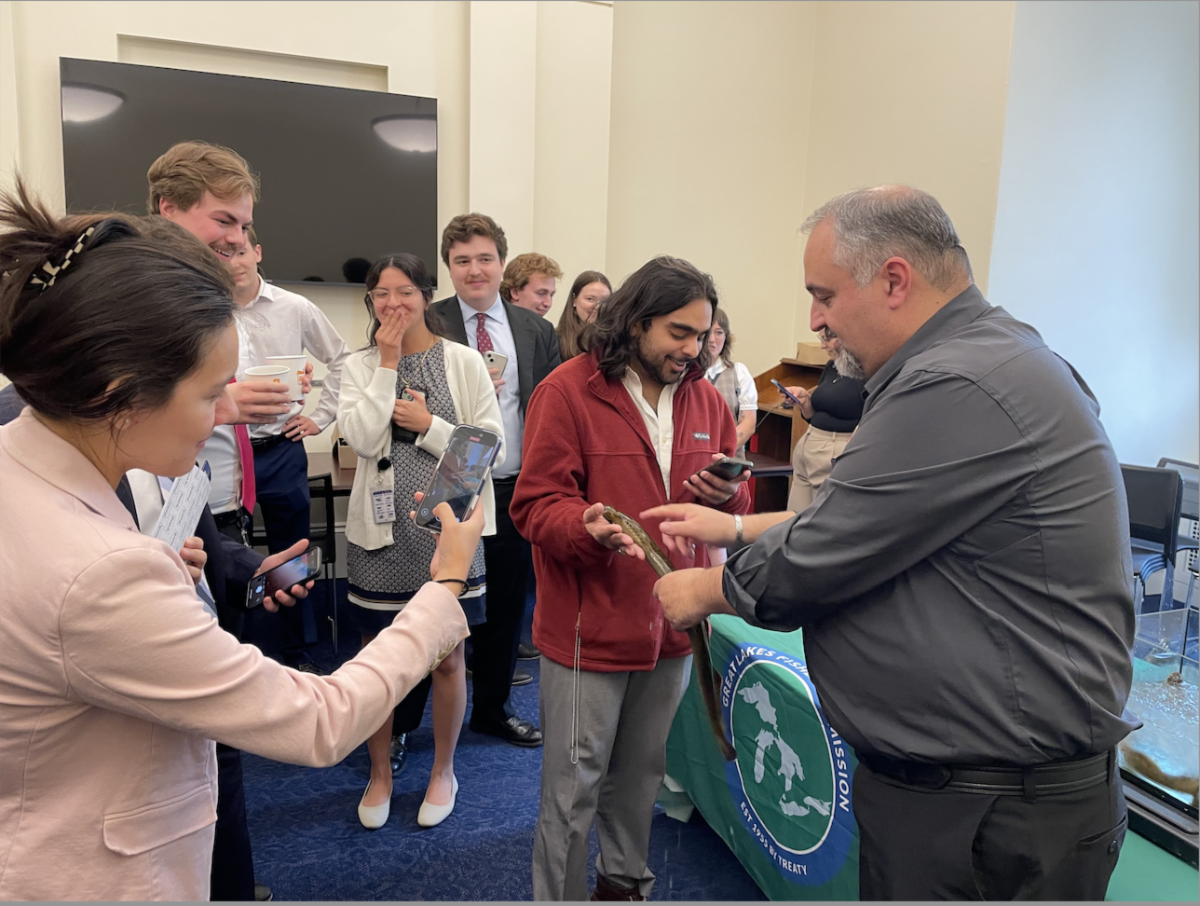
| | NEMWI Great Lakes Program Manager Alex Eastman takes a sea lamprey to the face | |  | Greg McClinchey, Director of Legislative Affairs and Policy at the GLFC, teaches a crowd about sea lamprey | | | |
NEMWI Releases Updated Great Lakes and Water Legislative Tracker
Recent legislation relating to the Great Lakes and water policies has resulted in 11 new additions to the Institute’s Great Lakes and Water Legislative Tracker, including the Water Affordability, Transparency, Equity, and Reliability Act of 2025 and the Water Resources Technical Assistance Review Act.
A bill of particular note in this update is the introduction of the bipartisan Protecting Firefighters and Advancing State-of-the-Art Alternatives Act (PFAS Alternatives Act) by Rep. Debbie Dingell (D-MI-6), co-chair of the PFAS Task Force. This legislation aims to eliminate per- and polyfluoroalkyl substances (PFAS) from firefighter turnout gear by accelerating the development of PFAS-free alternatives, enhancing oversight, and promoting innovation. PFAS have long been used in fire gear for durability and flame and chemical resistance, but they are linked to serious health issues, including cancer—the leading cause of firefighter deaths. The PFAS Alternatives Act would authorize $25 million annually from fiscal years 2025 through 2029 for research, development, and testing of PFAS-free turnout gear. The act also seeks to provide $2 million annually for guidance and training on the use of the new gear and to mandate partnerships between grant recipients and firefighters to ensure the effectiveness of the gear.
The bill has garnered bipartisan support, with 24 cosponsors to date, including Rep. Sam Graves (R-MO), Chair of the House Transportation and Infrastructure Committee, one of the committees to which the bill has been assigned. Other co-sponsors include Reps. Suzanne Bonamici (D-OR), Tom Kean, Jr. (R-NJ), Dina Titus (D-NV), Anthony D'Esposito (R-NY), Glenn Ivey (D-MD), and Brian Fitzpatrick (R-PA). Endorsements for the PFAS Alternatives Act come from the International Association of Fire Fighters and Globe Manufacturing Company, a leading turnout gear manufacturer. Both organizations emphasize the urgent need for safer, PFAS-free protective equipment for firefighters. As states like Massachusetts and Connecticut move to ban PFAS in firefighter gear by 2027 and 2028 respectively, federal legislation like the PFAS Alternatives Act represents a critical step toward nationwide protection for our first responders.
View NEMWI’s Great Lakes and Water Legislative Tracker here. NEMWI will continue to monitor new legislation as it is introduced.
Reported by NEMWI intern Eloise Wyatt, Bates College
| | | |
House, Senate Appropriations Committees Tackle Proposed Commerce Budget, Including NOAA Cuts
Commerce Secretary Howard Lutnick went to Capitol Hill last week to defend the FY 2026 budget that would cut the department by $1.8 billion, nearly all of which would come from the National Oceanic and Atmospheric Administration, which would lose $1.5 billion of its $6.7 billion budget. The budget would also cut funding for the Economic Development Administration and increase funding for trade enforcement.
The Commerce Department has not released a full budget yet, leaving lawmakers to rely on the FY 26 skinny budget and budget appendix. In her opening statement in the House Appropriations Commerce, Justice, and Science Subcommittee hearing, ranking member Rep. Grace Meng (D-NY) expressed her frustration with this, calling the delay part of “a pattern that we have seen over the last four and a half months, a pattern of significant and often illegal actions by federal agencies including the Commerce Department,” to which she added funding freezes, grant cancellations, and employee firings. Committee Chair Hal Rodgers (R-KY) highlighted the EDA and NOAA’s National Weather Service as critical programs within the Commerce Department.
Chair Rodgers, whose hometown was hit with a storm that killed 18 people, asked Secretary Lutnick about staffing levels in regional offices, some of which have been cut by as much as 35%. He asked, “What steps are being taken to ensure NOAA’s local weather forecast offices have the resources, the technology and staffing to issue timely accurate warnings and protect lives in high-risk communities?” Lutnick responded that “all weather collection technology is in full force and effect,” and said that the National Weather Service is at “full capacity and we will have the best forecasting capacity that we possibly can to protect Americans.” But the NWS has lost a significant number of staff since the start of the year: though NOAA has announced plans to hire 126 people, the agency lost nearly 600 to layoffs, voluntary resignation, or early retirement. In an open letter earlier this month, all five former NWS chiefs said that “NWS staff will have an impossible task to continue its current level of services.” Rep. Glenn Ivey (D-MD) added, later in the hearing, that in talking with former NOAA employees in his district, “I heard a very different story than what you're saying about people being forced out of there.” Rep. Mark Alford (R-MO) asked Lutnick if a regional NWS office in his district would be at risk of closing as the agency seeks to cut staff. Lutnick left that door open, saying that as NWS increases efficiency and automates jobs, offices could centralize, leading some of them to be shut down.
In the Senate, Commerce, Justice, and Science Subcommittee Chair Senator Moran (R-KS) also pressed Lutnick to provide more information about Commerce's budget as soon as possible, especially given the “significant cuts” being proposed. “The limited information to date is insufficient,” he said. Sen. Moran applauded the administration’s exemption to the federal hiring freeze that is allowing the NWS to rehire workers and was “pleased to see that the budget appendix appears to support maintaining funding and operations for the National Weather Service.”
Senator Gary Peters (D-MI) also asked Secretary Lutnick about the “self-inflicted” NWS staffing shortages. He was unable to get a direct commitment from the Secretary that the Marquette, MI forecasting office “would not cease round-the-clock operations.” Lutnick said, “I can commit that we're going to staff those offices but I will commit to you that the next time you see me the concept of having three people at some regional office will be laughable,” because forecasting operations will be consolidated and centralized.
Ranking Member Sen. Chris Van Hollen addressed the firings of probationary employees in his opening statement, decrying “the unprecedented and, in my view, illegal firing of thousands of federal employees, including many at the Department of Commerce, NOAA, and other places.” He added that a letter he sent, alongside Sen. Moran, to Secretary Lutnick asking for the plans for the reduction in force and reorganization of NOAA have gone unanswered. Secretary Lutnick was noncommittal on whether he would submit those plans to Congress, saying only “I will certainly get together with the Department and we will consider what information we can give you that makes sense.” Sen. Van Hollen also discussed the funding freezes and contract delays that have plagued NOAA recently. “We’ve also seen the withholding of funds duly appropriated by this Congress,” he said. “As an appropriations committee, we've got to figure out how, when we appropriate resources for certain purposes, that those are complied with.”
Senator Jack Reed (D-RI) questioned Secretary Lutnick about the wisdom of personally reviewing all 5,700 NOAA contracts over $100,000, calling that effort “a waste of time.” The Secretary was insistent that the reviews were necessary and efficient. “I may have more energy and more time and if you drive by the Department of Commerce late at night, you're going to see our lights on because I'm going through it with my team,” he said. “There are no contracts waiting for me, and if there were, I’ll be there all night making sure they’re turned out.” But reports indicate that the review policy has led to backlogs in contract approval. The web services contract for the Midwest Regional Climate Center, for example, was renewed only after the website went dark, and many other contracts have been delayed for months, getting approved at the last minute.
| | | |
House Hearing Reviews Coast Guard
Programs and Funding
The House Subcommittee on Coast Guard and Maritime Transportation met with Admiral Kevin E. Lunday, Acting Commandant of the United States Coast Guard, and President Trump’s nominee for the position, on Thursday, June 5th.
Throughout the hearing, House Members and Admiral Lunday agreed that the Coast Guard has been historically underfunded. In his opening statement, Subcommittee Chairman Rep. Mike Ezell referenced a recent GAO study, stating “Coast Guard operational hours have fallen by nearly 20 percent since 2017, and mission effectiveness is suffering.” Furthermore, in his statement, Ranking Member Salud Carbajal noted that the GAO found the Coast Guard’s $7 billion estimate of its shoreside infrastructure backlog to be a significant underestimate.
Admiral Lunday echoed those sentiments, and reiterated the need for increased investment. At the same time, he highlighted the successes of the Coast Guard, including border security. Admiral Lunday referred to the budget Reconciliation Bill which has passed by the House and contains $21.2 billion in supplemental funds, which he stated is a good start. The bill contains funding for a Great Lakes icebreaker.
Rep. John Garamendi (D-CA) expressed frustration with the Coast Guard’s longtime inability to meet its icebreaker acquisition priorities. Rep. Jeff Van Drew (R-NJ) conveyed similar sentiments regarding the Coast Guard’s inability to capitalize on priorities. He expressed enthusiasm and optimism for the agency’s direction, which was shared by Admiral Lunday. In response to Rep. Garamendi, Admiral Lunday pointed to Rep. Ezell’s bill that would establish a Secretary of the Coast Guard and streamline the acquisition process to deliver assets in a timely manner.
Other Members commented on Coast Guard operations relevant to their districts. Notably, Rep. Hillary Scholten (D-MI) questioned Admiral Lunday on the acquisition of an additional Great Lakes icebreaker. Specifically, Rep. Scholten expressed concern that funding for the project is not clearly delineated in the Coast Guard’s FY ‘26 request. Admiral Lunday agreed that an additional Great Lakes icebreaker, which already has received partial funding, is a high priority, and pointed to the Reconciliation Bill as a potential opportunity to continue funding the project.
Reported by NEMWI Intern Ben Roman, University of Michigan
| | | |
House Subcommittee Briefing Highlights Concerns Over American Seafood Competitiveness
and NOAA Cuts
The House Subcommittee on Water, Wildlife and Fisheries held a briefing on Wednesday, June 4th entitled “Restoring American Seafood Competitiveness.” This briefing was held amidst recent changes by the Trump Administration including cuts to NOAA staffing and funding as well as the enactment of Executive Order 14276, “Restoring American Seafood Competitiveness" on April 17th. The main provisions of the EO are to level the playing field for U.S. fisheries in a global market and reduce regulatory burdens.
The Subcommittee examined several pressing challenges faced by U.S. fisheries including threats from foreign entities and a lack of accurate and transparent data. The briefing focused on potential policy avenues Congress can pursue to strengthen federal fisheries management and address the problems facing the fishing industry in the U.S. Ranking Member Rep. Val Hoyle (D-OR) began her opening statement by questioning the current administration’s commitment to supporting the domestic seafood industry, noting that the Trump Administration had “spent the last four months haphazardly cutting the funding and workers that our fisheries rely on.” Conversely, Subcommittee Chair, Rep. Harriet Hageman (R-WY) opened the briefing by defending the EO. Its intent, she said, is “to reduce regulatory burdens and restrictions to ensure that the American fishing industry can thrive.”
The Subcommittee was joined by five witnesses. Dustin Delano, Chief Operating Officer of the New England Fisherman’s Stewardship Association raised concerns about federal regulation, arguing that President Trump’s EO was a critical step in reducing regulatory barriers and prioritizing American-harvested seafood. Jamie O’Connor, Deputy Director of the Alaska Marine Conservation Council, embraced many parts of the EO, however, O’Connor expressed worry about language in the EO. “Increasing US consumption of American seafood, investing in infrastructure, and streamlining regulatory barriers are all promising steps, but streamlining can’t mean cutting corners,” she said.
Delano also stressed the need for scientists and fishermen to work in collaboration, stating, “I can’t preach enough the need for better data collection and collaboration.” Rep. Hageman also shared this sentiment, speaking on the importance of improved data in the contexts of both offshore wind development and the preservation of the North Atlantic Right Whale population. The broader theme of enhancing robust and reliable data collection resonated throughout the hearing. However, Rep. Seth Magaziner (D-RI) pointed out that accurate and reliable data collection would not be possible without a fully funded and fully staffed NOAA.
Predominantly, the briefing centered on the impacts of the recent NOAA staffing and funding reductions. According to Rep. Magaziner, one-third of the positions at NOAA Fisheries are now vacant because of DOGE cuts. When asked by Ranking Member Rep. Jared Huffman (D-CA) about the impacts of the NOAA cuts on fishery management, Rick Bellavance stated that cancelled and scaled back stock assessments—as a result of the cuts—”threaten economically important fisheries.” Bellavance, Chair of the Council Coordination Committee in Rhode Island, also mentioned that as a result of the NOAA staffing cuts, there seems to be a lack of personnel available to carry out these critical stock assessments. O’Connor added that, “the impacts of the DOGE cuts have been immediate and concerning,” citing challenges related to survey data collection, and delays in the opening and closing of fishing seasons, particularly with Cod in the Gulf of Alaska and on the East Coast.
In response to these concerns, several members and witnesses emphasized the need for proactive solutions to promote economic vitality and support the success of fisheries in the US. Rep. Debbie Dingell (D-MI) discussed the reintroduction of her bipartisan bill, the “Forage Fish Conservation Act” in collaboration with Rep. Brian Mast (R-FL). Forage fish are a crucial part of the marine ecosystem and their preservation is essential to help improve the economic vitality of fisheries and small coastal communities. According to Rep. Dingell, “this bill respects the role of states in managing the waters closest to home while strengthening national efforts to protect forage species offshore.” This legislation represents one path towards fostering ecosystem resilience and the economic prosperity of U.S. fisheries amid the management challenges the industry is currently facing.
Reported by NEMWI Intern Megan O’Neil, University of Michigan
| | | |
Northeast-Midwest Institute Attends
Capitol Hill Ocean Week
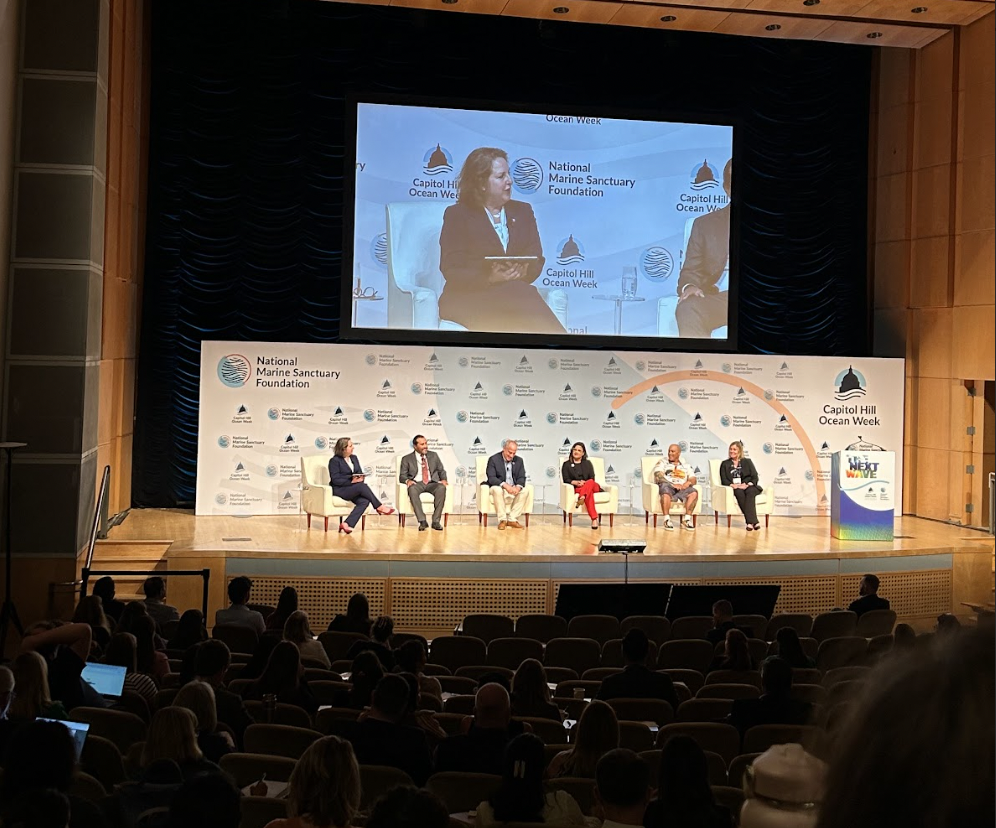
This week the Northeast-Midwest Institute joined policymakers, scientists, advocates, and community leaders from across the country at Capitol Hill Ocean Week (CHOW) 2025, hosted by the National Marine Sanctuary Foundation.
One key event of the programing was a panel discussion entitled, From Sea to Shining Sea: Strengthening Coastal Economies and Communities. The event was moderated by Nicole LeBoeuf, Assistant Administrator for NOAA’s National Ocean Service. Speakers included: Catherine Green, President of the National Maritime Historical Society; Jim Ritterhoff, Executive Director and Co-Founder of FORCE BLUE, INC.; Luisa A. Vázquez-López, Chief of Staff of The Mariners' Museum and Park; Kevin Brannon, CEO of the Reel Angler Network, and; Kenneth Kahn, Chairman of the Santa Ynez Band of Chumash Indians. Congressman Jared Huffman (CA-2) gave closing remarks.
This event highlighted the importance of partnership in making change, particularly among the private sector and nonprofit groups as the federal government discontinues funding for conservation and community development. In forming those essential partnerships and connections with the water and with one another, Luisa A. Vázquez-López, Chief of Staff at the Mariners’ Museum and Park, emphasized that Americans in coastal communities will come to see that we have more in common than what makes us different. The panel concluded with a shared focus on the enduring value of service, especially regarding the work of FORCE BLUE and the Reel Angler Network, highlighting the idea that service remains at the core of our collective purpose and never loses its significance. The panel focused on the future and the necessity of introducing seafood, fishing, and marine history to children.
Congressman Huffman closed the session with a discussion of the importance of our oceans and the benefit they bring to communities throughout America. Huffman also condemned the current administration’s proposed cuts to NOAA. This panel was a reminder that the health of our oceans is inseparable from the health of our communities, economies, and future.
Another notable event was “The Path Towards Ocean Energy Leadership.” The panel included: Jake Kritzer, Executive Director of the Northeast Regional Association of Coastal Ocean Observing Systems; Tershara Matthews, National Offshore Policy Lead at WSP; David Millar, Americas Government Accounts Director at Fugro; Michael Braid, Vice President of Renewables at Edison Chouest Offshore and Board Member of Oceanic Network. The panel was moderated by Ruth Perry, Head of Permitting and Development, Power Generation at Shell Power USA.
In this discussion, leaders of diverse fields of offshore technology reflected on the state and needs of the blue economy. The panelists placed significant emphasis on the importance of partnerships between the public and private sectors, between government agencies, and between different private industries. Specifically, throughout the discussion, the panelists reiterated the potential benefits of improved data integration across these partnerships. Notably, Jake Pritzer of NERACOOS advocated for the federal government to provide for or incentivize increased data integration between stakeholders. Additionally, panelists discussed the importance of emerging technologies, especially artificial intelligence, in shaping the industry going forward. They discussed how these technologies would not only allow for enhanced data collection and analysis but also improve the work and lives of individuals across ocean energy sectors.
Reported by the NEMWI intern team
| | | |
Connect With the Northeast-Midwest Institute
on Social Media
The Northeast-Midwest Institute is on social media with new updates and information on its regional research and policy education program and with announcements for upcoming briefings and events. NEMWI is posting our research reports on current regional issues and ongoing policy education on the page to make keeping up with our policy work easier than ever. The Institute also is updating the page with announcements of upcoming policy briefings and webinars. NEMWI is excited for the opportunity to connect with as many people as possible.
Please check out our LinkedIn here, our Twitter/X here, our Facebook here, and our Bluesky here. Be sure to like and follow us to keep up to date with NEMWI!
On Bluesky, also check out our Great Lakes feed at "NEMW Great Lakes Feed" and if you are a Great Lakes organization on Bluesky, contact Great Lakes Program Manager Alex Eastman at aeastman@nemw.org so that we can add your posts to the feed!
| | | |
|
Great Lakes Events
(all times eastern)
| | | | | |