|
NEMWI Weekly
Update
June 8th, 2026
| |
| |
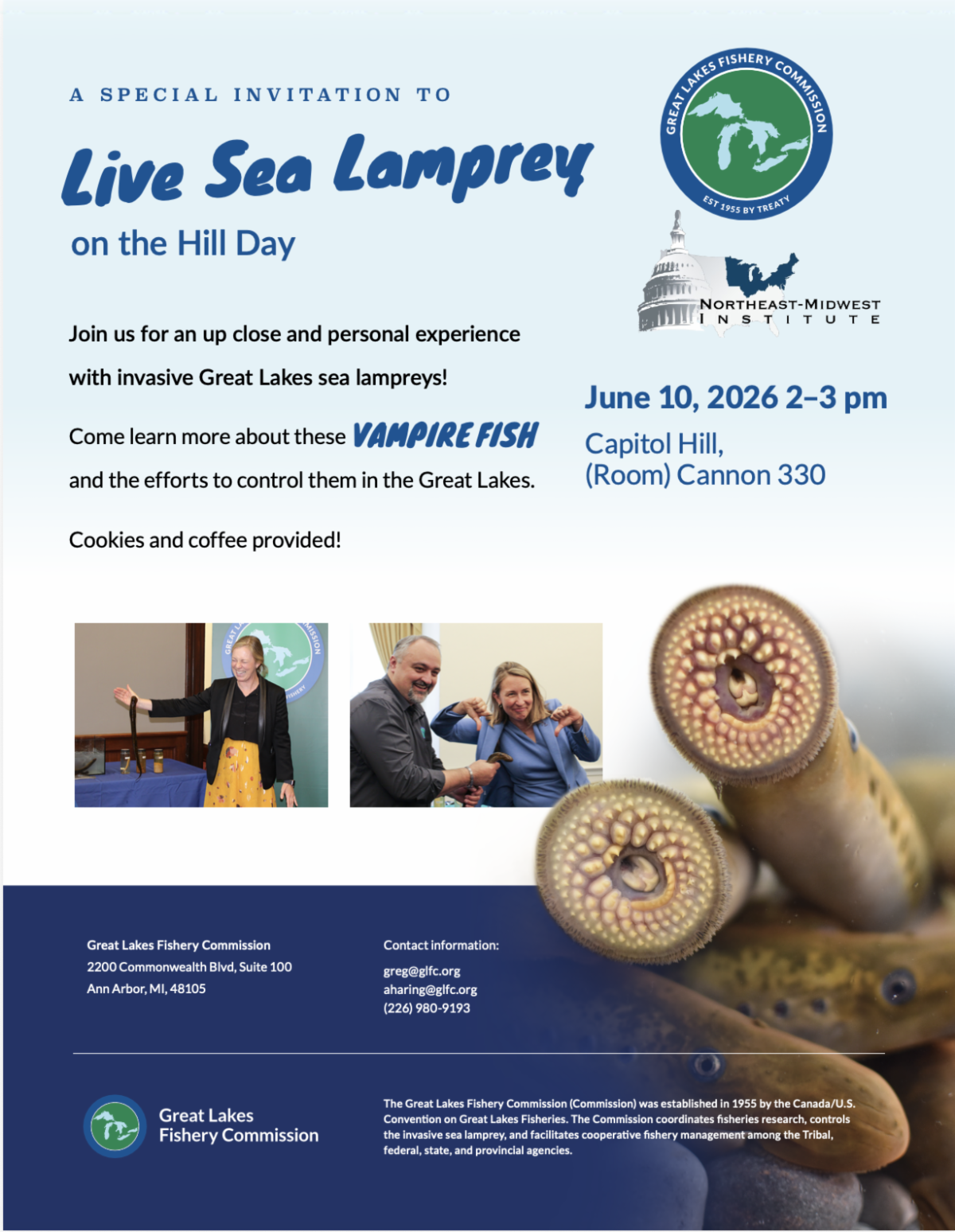
NEMWI and GLFC To Host Sea Lamprey Event on Capitol Hill
Northeast-Midwest Institute and the Great Lakes Fishery Commission will host a sea lamprey encounter next Wednesday, June 10th, from 2:00 to 3:00 p.m. in Cannon House Office Building 330, Join us to see live sea lamprey and learn more about these invasive species. For the bold, you can even have one affixed to you! Refreshments including coffee and sea lamprey cookies* will be provided!
Please RSVP to Great Lakes Washington Program Director Alex Eastman at aeastman@nemw.org
*The cookies are shaped like sea lampreys, but they do not contain any sea lamprey.
| |
| | |
House Appropriations Committee Advances
Funding Bills
The House Appropriations Committee last week passed the bills that fund the EPA, Interior Department, and Transportation Department. The Interior-Environment bill would cut funding for the EPA by 20%, but the bill would fund the Great Lakes Restoration Initiative at $369 million, equal to FY2026 levels. The bill would also restore $1 billion in funding for capitalization grants that would have been cut by the President’s Budget. The Clean Water and Drinking Water State Revolving Funds would be funded at a combined $2.1 billion, down 24% from FY26. These cuts, however, would be concentrated in CDS (or “earmarked”) funds, so the funding going to State Revolving Fund programs would stay largely flat.
| | | | Account | FY 2026 Enacted | FY 2027 House Bill | | CWSRF Account | $1.64 billion | $1.19 billion | | CWSRF Program | $745 million | $667 million | | CWSRF CDS | $893 million | $525 million | | DWSRF Account | $1.13 billion | $911 million | | DWSRF Program | $411 million | $405 million | | DWSRF CDS | $715 million | $506 million | | | The Transportation, Housing, and Urban Development bill would modestly increase funding for the Great Lakes-St. Lawrence Seaway Development Corporation (GLS). It would also fund the Maritime Administration Port Infrastructure Development Program at a level that is effectively a small cut. The PIDP would be funded at $538.2 million as opposed to $553.3 in FY26 ($103.3 million from annual appropriations and $450 million from the last year of Bipartisan Infrastructure Law Funding). $38.2 million of this would go to Congressionally Directed Spending, including a $250,000 project in Buffalo, New York. | | | | Account | FY 2026 Enacted | FY 2027 Request | FY 2027 House Bill | | GLS | $38.1 million | $50 million | $42.2 million | | MARAD PIDP | $103.3 million | $550 million | $538.2 million | | | Find more details in NEMWI’s report on the House Appropriations bills here. NEMWI will continue to cover the appropriations process. | | | |
The Northeast-Midwest Institute at
Capitol Hill Ocean Week (CHOW) 2026
| | | |
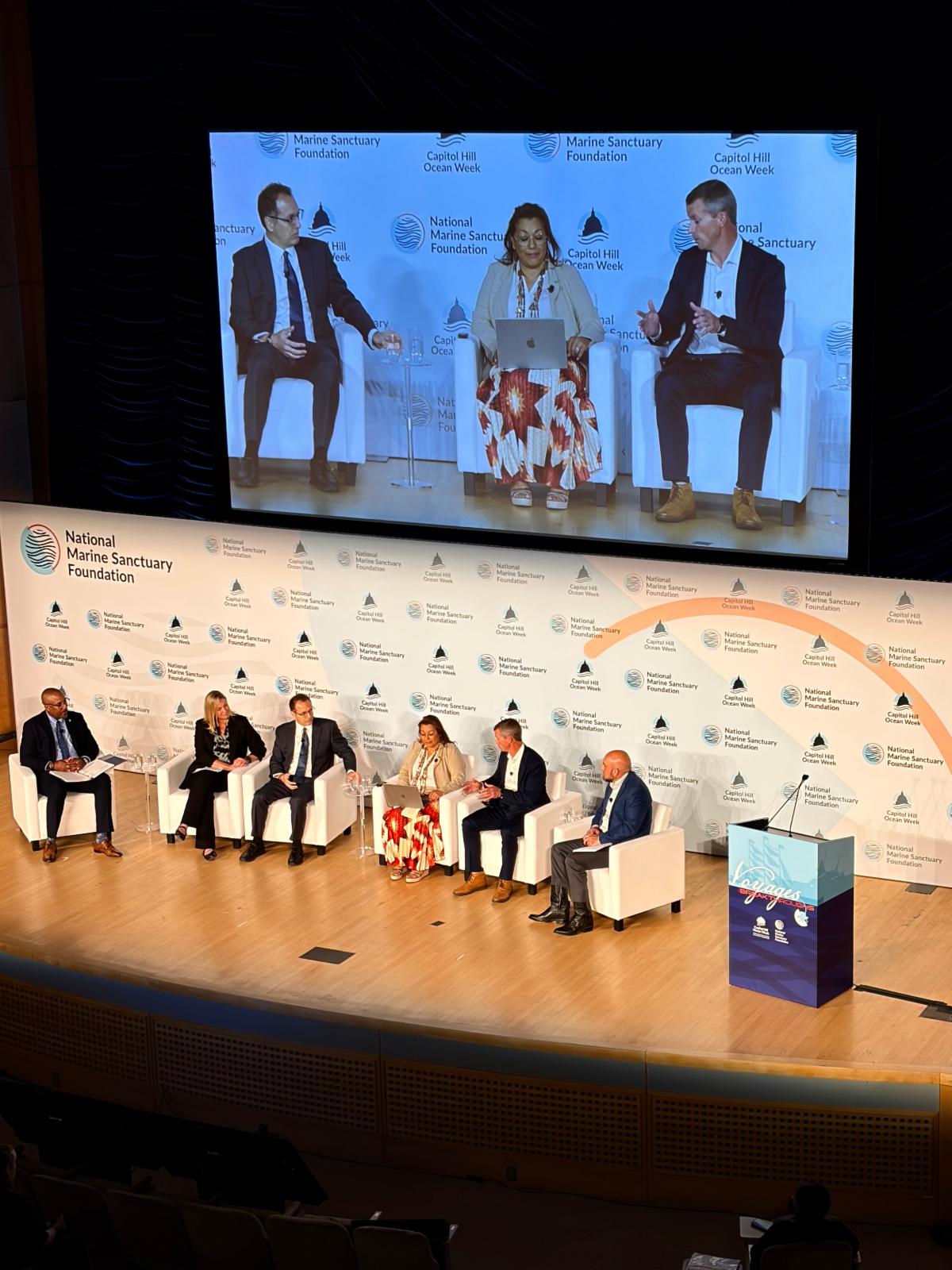
Capitol Hill Ocean Week (CHOW) 2026 celebrated the conference’s 25th anniversary last week. Policymakers, fisheries professionals, and leading scientific researchers gathered in the nation’s capital to address the many existing and emerging climate-driven pressures affecting the world’s oceans. This year, CHOW explored the theme “Voyages and Breakthroughs,” in an effort to commemorate America’s maritime legacy, advance marine conservation, and address climate-driven impacts on ocean health. The conference showcased several successful conservation initiatives, and provided a platform for national leaders to share their perspectives concerning the management of this vast ecosystem.
Starting with the opening keynote, attendees were met with a strong message that ocean health is vital to both our economies and public safety. In 2019, the Census Bureau estimated that 95 million Americans (roughly 30% of the population) live in coastal counties along the Atlantic, Pacific, and Gulf of Mexico.
The “Fishing for the Future” keynote made the point that fisheries along the nation’s saltwater and freshwater coastlines are facing significant strain. Opening remarks by Eugenio Piñeiro Soler, NOAA Fisheries Assistant Administrator, emphasized the need to sustain healthy fisheries in order to enhance economic outcomes. Panelist Tommy Sheridan, Director of the Alaska Blue Economy Center, explained that a healthy blue economy supports revenue growth across maritime sectors such as fisheries, tourism, shipping, and energy generation. Conversely, a declining blue economy can decrease tax revenue, and consequently, limit the public funding necessary to sustain resilient coastal communities. One critical aspect is sustaining thriving fisheries. Panelist Blake Price, Director of the Southern Shrimp Alliance, noted that domestic seafood imports now account for roughly 90% of U.S. seafood sales, while wild-caught production continues to decline.
The discussion then shifted towards potential national solutions. Price called for policies aimed at limiting seafood imports, which would “increase profit margins by promoting U.S. seafood products.” This approach could strengthen domestic markets by increasing demand for locally caught seafood. This goal is already partially supported through existing frameworks such as the Magnuson-Stevens Fishery Conservation and Management Act, the primary federal law governing marine fisheries management in U.S. waters.
A later session, “Restoring Heritage in Nature,” communicated a clear need for targeted environmental policy. Daniel Hayden, President and CEO of Restore America's Estuaries, stated “If we care about air and water quality, we have to have the policies that support it,” emphasizing that current policy does not adequately reflect our dependence on these systems. In the following panel, “New Blue Revolutions: Age of Technology and Investment,” Representative Suzanne Bonamici (D-OR) discussed her BLUE GLOBE Act. Her statement underscored the growing role of ocean data systems and public-private innovation, but she warned about recent actions that would undermine these efforts. The Trump administration recently began removing buoys in Oregon and other locations in the Pacific Northwest, citing a need to cut costs. This is especially concerning, Rep. Bonamici explained, as they collect “life-saving data.” Across subsequent sessions, speakers conveyed that strengthening coastal economies requires sustained public investment in our infrastructure, in order to ensure long-term resilience for fisheries and coastal communities.
The conference also included tabling sessions focused on shipwreck imaging and preservation, oyster reef technology, polymer-degrading bacteria, and open-source mapping tools tracking the spatial distribution of key marine species over time. The conference also looked towards the future of coastal and marine conservation. Panelists made the argument that it is critical to engage the younger generation in conservation and to promote workforce development, and examined the potential impacts of artificial intelligence on ocean science and data analysis. But the biggest need, especially given the current federal funding environment, is increased and sustained funding for coastal research and conservation and management actions.
Ocean Week emphasized that we all have a stake in the health of our coastal environments. Good science and good policy support these systems, thereby creating resilient economies and a healthier environment.
Reported by NEMWI Interns Alexandre Massip, University of Pittsburgh, and Jamaica Rose, Amherst College
| | | |
House Natural Resources Holds Hearing on NOAA Sexual Harassment and Assault Prevention Bill
The House Natural Resources Subcommittee on Water, Wildlife and Fisheries met on June 3 to consider H.R. 2406, the NOAA Sexual Harassment and Assault Prevention Improvements Act of 2025, among other pieces of legislation. Sponsored by Representatives Suzanne Bonamici (D-OR) and Maria Elvira Salazar (R-FL), the bipartisan legislation seeks to close critical gaps in safety protocols for scientists and maritime workers operating in remote environments.
Opening the discussion by acknowledging Capitol Hill Ocean Week, Rep. Bonamici expressed that employees in the public and private sectors alike have a right to a safe and welcoming workplace. "Many of the employees in NOAA work in remote locations and aboard research and survey vessels to conduct cutting-edge scientific research and support U.S. fisheries," Rep. Bonamici stated, noting that isolation often exacerbates the vulnerability of field researchers.
Rep. Bonamici’s impetus for the legislation came several years ago when a fisheries biologist, who had experienced sexual harassment while conducting research on a NOAA vessel, visited her office. After reporting the incident, the fisheries biologist was retaliated against. She was “effectively grounded, her research was derailed, and she was advised against going to sea for her own safety,” Rep. Bonamici recalled. Her colleagues, including the harasser, knew she reported the incident and she did not feel that the complaint was thoroughly investigated.
Rep. Bonamici credited former NOAA administrator Kathryn Sullivan for her leadership in addressing the issue by implementing new training requirements to make it easier to report sexual harassment, and changing the administration's investigation protocol. Despite these administrative strides, Bonamici warned that threats to researchers have remained alarmingly persistent. She cited a recent multi-year study of the North Pacific Groundfish and Halibut Observer Program, which revealed that “one-third of the 400 observers surveyed experience harassment or assault annually. Of those targeted, only 45% disclose the behavior, and female observers are twice as likely to be targeted as men.”
The bill aims to build on past agency progress by expanding NOAA's sexual harassment and response policies to cover contract employees, who are currently excluded from certain protections. Additionally, the bill directs NOAA to establish a clear structure for anonymous reporting, allowing survivors to access safe support services without automatically triggering an active law enforcement or administrative investigation if they prefer to withhold consent.
The bill would also strengthen enforcement capabilities for NOAA’s Office of Law Enforcement. By removing restrictive, antiquated legal stipulations requiring that acts of intimidation or interference against fisheries observers be "forcible in nature" and occur strictly on a vessel to be prosecutable, the legislation updates the legal framework to hold offenders accountable on land and at sea. Overall, H.R. 2406 is meant to strengthen the steps already taken by NOAA to address sexual assault cases.
Reported by NEMWI Intern Chetana Kuchibhotla, Texas A&M University
| | | |
Congressional Hearing Examines EPA
Reorganization Impacts on Scientific Research
The House Committee on Science, Space, and Technology held a hearing on June 4 on "Advancing Environmental Protection Through Science and Technology." The hearing reviewed how the Environmental Protection Agency (EPA) is implementing its science and technology initiatives, with particular focus on the newly established Office of Applied Science and Environmental Solutions (OASES). The hearing centered on the program’s role in advancing the EPA’s long-term research priorities, as well as its efforts to identify emerging environmental challenges.
Environment Subcommittee Chairman Rep. Scott Franklin (R-FL) opened the hearing by explaining that OASES is tasked with facilitating interagency coordination, advancing applied scientific research, and providing regulatory support. At its core, this strategic shift should eliminate siloes, allowing the EPA to operate more efficiently. At the same time, Rep. Franklin acknowledged that the EPA faces growing challenges, requiring the agency to adapt to emerging environmental threats. Today’s environmental challenges, he stressed, mean that the EPA will need to rely on scientific expertise more than ever before.
Rep. Gabe Amo (D-RI) argued that the current EPA has carried out “what might be the most sweeping attacks on scientific independence in history.” Rep. Amo noted that the Trump administration, under EPA Administrator Lee Zeldin, has moved to dismantle the EPA’s Office of Research and Development (ORD), long considered the agency’s scientific and technical foundation. ORD had historically operated independently, allowing scientists to conduct rigorous research free from political interference. Rep. Amo worried that outside interests could exert greater influence over the agency’s priorities, and warned that the loss of scientific expertise could weaken accountability and undermine evidence-based policymaking, leading to worse health outcomes for Americans.
Dr. Maureen Gwinn, Deputy Associate Administrator for Science for OASES, testified before the Subcommittee. While members did not question Dr. Gwinn’s scientific qualifications, several expressed concern that the EPA had sent a career scientist to testify on issues they viewed as involving executive-level decisions regarding the elimination of key agency programs. “My frustration is not directed at you [Dr. Gwinn],” Rep. Amo said. “You have spent over a decade serving the American people as a scientist and public servant.”
Dr. Gwinn opened her testimony, asserting that the EPA’s scientific research is conducted with “clarity, transparency, and peer review.” The Agency, she said, has continued its high standards of research and takes its credibility seriously. However, some members appeared skeptical of these assurances, particularly how the newly formed OASES will maintain its transparency and integrity. Rep. Amo raised concerns about the degree of political influence within OASES and the potential implications for research independence. In response, Dr. Gwinn acknowledged that administration priorities do guide the EPA’s work.
Ranking Member Zoe Lofgren (D-CA) echoed these concerns, focusing on the EPA’s treatment of the Integrated Risk Information System (IRIS). IRIS is a human health assessment program that evaluates information on health effects that may result from exposure to environmental contaminants. Rep. Lofgren emphasized that IRIS assessments are developed through a rigorous, peer-reviewed scientific process. She expressed concern that the EPA is encouraging regional offices to disregard IRIS and develop their own toxicity values rather than relying on the existing criteria, which are grounded in extensive scientific research and review. She concluded that the agency’s reorganization does not represent an improvement, particularly with respect to scientific rigor in these new toxicity evaluations.
Rep. Nick Begich (R-AK) raised concerns about the EPA’s peer review process, noting longstanding scrutiny over “whether panel members have financial or ideological conflicts of interests.” He asked how the agency would insulate scientific findings from regulatory pressures under the new structure. Dr. Gwinn responded that the restructuring “increases dialogue,” without changing the substance of scientific work. She maintains that OASES has a strong scientific integrity program, adding that the program is a cross-agency effort. She confirmed that she currently serves as the acting Scientific Integrity Official, with Deputy Scientific Integrity Officials embedded in each program office.
Rep. Suzanne Bonamici (D-OR) referenced a recent chemical explosion at a riverside plant in Oregon that resulted in 11 deaths, including some of her constituents. She linked the incident to broader concerns about the dismantling of the Office of Research and Development (ORD), referencing cuts to scientific staff and shifts toward politicized priorities which could weaken the EPA’s capacity to respond to environmental disasters. She then asked whether any research priorities had been delayed, modified, or removed in favor of new ones. Dr. Gwinn responded that they had, explaining that some projects had been delayed due to shifts in agency priorities. She cited that certain lines of research were not moving forward as a result of directives in an executive order.
Rep. Matt Van Epps (R-TN) described that EPA’s shift of staff from ORD to EPA program offices, formally establishing OASES, “aligns EPA scientific functions with the agency’s rulemaking authority.” He characterized the changes as a reform aimed at improving accountability and ensuring that scientific work is more closely tied to the agency’s rulemaking authority. He asked how the reorganization would ensure transparency in scientific efforts. Dr. Gwinn explained that OASES conducts applied research in coordination with program offices. The restructuring, she said, is intended to strengthen collaboration between scientists and the policy decisions that their work informs.
Rep. Deborah Ross (D-NC) relayed her concern about the future of EPA facilities in Research Triangle Park (RTP), North Carolina, which houses a research center specializing in the health impacts of air contaminants such as wildfire smoke. Ross warned that the loss of scientific expertise from staffing cuts and the dismantling of ORD could significantly reduce the agency’s capacity to protect human health as North Carolina actively suffers from wildfires.
Rep. Christian Menefee (D-TX) shared concerns of similar nature from his district, including reported cancer clusters near a petrochemical complex. According to Rep. Menefee, ORD had acted as a longstanding “firewall” conducting independent science for administrations with differing priorities. He also noted that several groups have called for the elimination of the Integrated Risk Information System (IRIS), including the Heritage Foundation’s Project 2025. In January 2025, a coalition of over 80 industrial groups sent a letter to Administrator Zelden, asking him to dismantle IRIS and direct responsibility to program offices. Such an action, Rep. Menefee expressed, could prove tragic at a time when human health crises are occurring across the nation.
Reported by NEMWI Intern Alexandre Massip, University of Pittsburgh
| | | |
Senate Commerce, Science, and Transportation Committee Discusses the Blue Economy
The Senate Committee on Commerce, Science, and Transportation held a subcommittee hearing on June 1 regarding the blue economy, which encompasses a wide array of economic activities, including commercial fisheries, seafood, ports, tourism, and more. As one of the fastest growing sectors in America, it serves as a critical pillar of the economy, generating a total of $470 billion and 2.4 million American jobs in 2022. The hearing was led by Subcommittee Chair Senator Dan Sullivan (R-AL) and Ranking Member Senator Lisa Blunt Rochester (D-DE), and members debated the ramifications of the Jones Act Waiver, the future of the FISH Act and Bycatch Reduction Act, and opportunities for growth in the economic vitality, competitiveness, and national security of America’s blue economy.
Senator Sullivan asserted that “President Trump’s executive order on restoring American seafood competitiveness recognizes an important reality: seafood competitiveness is economic security, and even national security.” He endorsed the administration’s ongoing efforts to establish American prominence over the world blue economy, encouraging the House to pass the Fighting Foreign Illegal Seafood Harvests Act of 2025, which would further enforce regulations against illegal fishing by foreign bad actors. In contrast, Senator Blunt Rochester warned of the potential repercussions of recent policy developments, citing proposed NOAA budget cuts of over $1 billion, which would adversely affect the organization’s capacity to pursue its goal of encouraging sustainable seafood production. Moreover, she mentioned the administration’s withdrawal of $672 million in port infrastructure grants for offshore wind, delaying “critical investments in [Delaware] and the expansion of cheap and sustainable energy at a time when Americans need it most.”
Tommy Sheridan, the director of the Alaska Blue Economy Center, claimed that the Alaskan blue economy’s greatest existential threat was coastal exodus, which the administration should address by bolstering K-12 STEM and workforce development, funding for fisheries science and NOAA, and economic innovation. Jeremy Woodrow, executive director of the Alaska Seafood Market Institute, commended the administration’s recent actions such as the establishment of the USDA Office of Seafood and the American First Trade Promotion program, and called for continued investment in science, market development, and trade equity. Nathan Wardwell, managing partner of JOI surveys, revealed that over 46% of U.S coastal and Great Lakes waters and 62% of Alaskan waters are unmapped, posing serious technological limitations and national security concerns, calling for the strengthening of public-private partnerships to achieve greater coverage. The Great Lakes Mapping Act of 2025, introduced by Reps. Lisa McClain (R-MI) and Debbie Dingell (D-MI), would invest $250 million to map the Great Lakes, delivering environmental and economic benefits to the region.
But the most contested policy was the Jones Act Waiver, a 60-day exemption from the Jones Act, which mandates that all goods shipped between U.S ports must be carried on U.S. built, crewed, and flagged vessels. Clayton Heil, the Vice President of Global Government Relations at Crowley Maritime Corporation, staunchly supported the recommencement of the Jones Act, which he said would create a stable and predictable policy environment, providing American corporations confidence to pursue long-term investments. According to Heil, the Jones Act Waiver, which was recently extended 90 days to a total of 150 days – the longest waiver in American history – stands to substantially weaken domestic trade, market certainty, and the long-term viability of the American blue economy.
Reported by NEMWI Intern Irene Chen, Brown University
| | | |
Connect With the Northeast-Midwest Institute
on Social Media
The Northeast-Midwest Institute is on social media with new updates and information on its regional research and policy education program and with announcements for upcoming briefings and events. NEMWI is posting our research reports on current regional issues and ongoing policy education on the page to make keeping up with our policy work easier than ever. The Institute also is updating the page with announcements of upcoming policy briefings and webinars. NEMWI is excited for the opportunity to connect with as many people as possible.
Please check out our LinkedIn here, our Twitter/X here, our Facebook here, and our Bluesky here. Be sure to like and follow us to keep up to date with NEMWI!
On Bluesky, also check out our Great Lakes feed at "NEMW Great Lakes Feed" and if you are a Great Lakes organization on Bluesky, contact Great Lakes Program Manager Alex Eastman at aeastman@nemw.org so that we can add your posts to the feed!
| | | |
|
Great Lakes Events
(all times eastern)
| | | | | |