|
NEMWI Weekly
Update
June 15th, 2026
| |
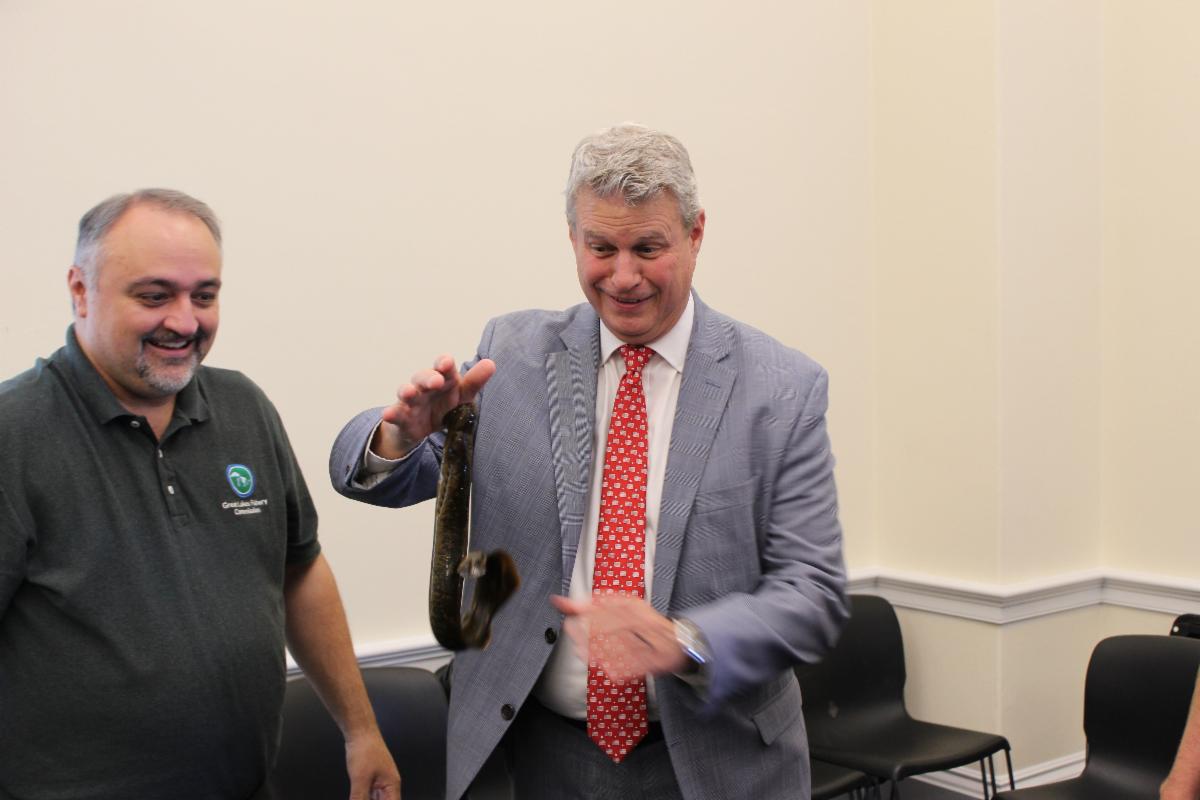
| GLFC Legislative Affairs and Policy Director Greg McClinchey with a sea lamprey | | Congressman Bill Huizenga (R-MI) braves a sea lamprey | | NEMWI Great Lakes Washington Program Director Alex Eastman, seen here running out of creative placements for sea lamprey. | | |
NEMWI and GLFC Host Sea Lamprey Event on
Capitol Hill
The Northeast-Midwest Institute (NEMWI) and the Great Lakes Fishery Commission (GLFC) hosted a live sea lamprey event on Capitol Hill last week, giving attendees a chance to touch a sea lamprey and learn more about one of the Great Lakes region’s most environmentally and economically damaging invasive species.
Sea lamprey have been invasive to the Great Lakes since 1921, and pose a serious threat to native fish populations. They suction themselves to fish and drain their blood; one sea lamprey can kill up to 46 pounds of fish in its lifetime. The GLFC has controlled sea lamprey populations for over 70 years through the development of the lampricide TFM, which targets sea lamprey larvae without harming the broader ecosystem. This work has reduced sea lamprey populations by 90% from their pre-control levels, preserving the $5.1 billion Great Lakes fishery.
This year’s event brought 80 visitors and included a visit from Representative Bill Huizenga (R-MI), who bravely volunteered to let the sea lamprey latch onto his hand! This event underscored the continued regional and policy importance of sea lamprey control in the Great Lakes.
Reported by NEMWI Interns Jamaica Rose, Amherst College, and Alexandre Massip, University of Pittsburgh
| |
| | |
NEMWI Releases Update To Its Manufacturing Legislative Tracker
NEMWI has released an update to its Federal Manufacturing Legislative Tracker. The Made in America Manufacturing Finance Act of 2025, STRIDE Act, and Promoting Resilient Supply Chains Act of 2025 all saw recent activity, including committee referrals and newly scheduled hearings.
Bills added to the tracker include the Semiconductor Superiority Act, which seeks to strengthen U.S. semiconductor competitiveness and domestic chip production amid growing concerns over global supply chain security and competition with China. The Motor Vehicle Modernization Act of 2026 was also recently introduced. This bill would support modernization of the U.S. automotive sector through updates to vehicle technology and manufacturing frameworks. The Protecting Circuit Boards and Substrates Act would incentivize domestic production of printed circuit boards (PCBs), a critical component used in semiconductors and electronics. Proponents say expanding U.S. PCB manufacturing would strengthen supply chain resilience and reduce reliance on foreign suppliers. Rep. Ted Lieu (D-CA) and Rep. Jay Olbernolte’s (R-CA) American Leadership in AI Act, which seeks to strengthen U.S. leadership in artificial intelligence through technology research and workforce development, also has been added. The bill reflects growing bipartisan congressional interest in ensuring AI innovation supports advanced manufacturing.
One standout piece of legislation is H.R.7129, The Water Power Research and Development Reauthorization Act, introduced by Rep. Suzanne Bonamici (D-OR). It would significantly expand DOE programs for hydropower and marine energy while shifting focus toward domestic manufacturing and supply chain development. It increases authorized funding to $300 million annually through 2030, with a major boost for marine energy. The bill also strengthens hydropower modernization through grid integration of pumped storage and environmental data standardization. It also expands applications for marine energy into areas like hydrogen production, desalination, data centers, and coastal resilience microgrids. H.R.7129 places heavy emphasis on workforce training and regional partnerships with universities, tribal groups, and maritime institutions. It also advances federal investment in domestic industrial ecosystems centered around water-based energy technologies.
Find NEMWI’s Manufacturing Legislative Tracker here.
Reported by NEMWI Intern Alexandre Massip, University of Pittsburgh
| | | |
House Committee Meets To Consider Bird Habitat Bill, Other Legislation
The House Committee on Natural Resources met Wednesday, June 10, to consider H.R. 3276, the Local Communities and Bird Habitat Stewardship Act of 2025, among three other pieces of legislation. Sponsored by Representatives Debbie Dingell (D-MI) and John Cline (R-VA), the bipartisan legislation seeks to combat severe avian population declines by empowering local conservation efforts.
Opening the discussion, Ranking Member Rep. Jared Huffman (D-CA) stated that it was "good to have four bills that are expected to be passed with strong bipartisan support on unanimous consent." Turning his focus to H.R. 3276, Huffman framed the legislation as a vital response to an ecological crisis that should be talked about more, pointing out the stark reality that bird populations in the last fifty years have declined by half.
The bill aims to combat this steep decline by shifting the focus of conservation from isolated wilderness areas to everyday environments. "Bird conservation is not limited to remote refuges or far away landscapes," Ranking Member Huffman stated, arguing that the legislation "recognizes that and gives communities and local partners better tools and resources to do their part in conserving bird habitats" in neighborhoods, schools, parks, and community spaces from small towns to major metropolitan areas. Specifically, the bill is designed to support local bird habitat stewardship, public education, and hands-on conservation work to better connect people to wildlife where they live.
While he expressed support for the legislative package, Rep. Tom Tiffany (R-WI) raised concerns regarding alternative energy infrastructure, arguing that its impact on avian wildlife is frequently overlooked. "Estimated 200,000 to one million birds are being killed annually as a result of these collisions," Rep. Tiffany stated, citing data on wind turbine impacts. He further pointed to specific data from the Yuhaaviatam solar plant in California, where an estimated 6,000 bird deaths occur each year. Rep. Tiffany noted that birds flying through the extreme heat generated by these solar arrays are known as "streamers" meaning "they light on fire as they go through this solar array that is out there." He cautioned that there is a "real environmental impact that is oftentimes ignored especially when it comes to birds and bird habitats when it comes to these intermittent sources of power."
But while these numbers might seem large, wind turbines are not very proficient killers of birds. Each year, billions of birds die in the U.S. from flying into windows or being killed by a housecat, 5,000 to 15,000 times as many as die from wind turbines. These are the concerns, Chairman Huffman said, that Rep. Tiffany might take interest in if he was “concerned about protecting birds.” He characterized Rep. Tiffany's critique as an unfair attack on clean energy, though it is also worth noting that turbines tend to be outsized killers of raptors and endangered birds compared to those other hazards. The wind industry is rightfully taking this problem seriously, and has developed a number of innovative methods to reduce bird deaths including visually differentiating one of the blades so that birds can see them. Huffman also dismissed the solar plant example as an outdated talking point, noting that the specific California facility mentioned "is being decommissioned so it can no longer kill birds," and concluded that the example was being used primarily to feed a "narrative that clean energy is killing birds."
Reported by NEMWI Intern Chetana Kuchibhotla, Texas A&M University
| | | |
House Energy and Commerce Subcommittee on Energy
Holds Nuclear Permitting Reform Hearing
The House Energy and Commerce Subcommittee on Energy held a hearing on June 9 on Nuclear Permitting Reform. The committee reviewed several approaches to achieve expanded nuclear deployment: streamlining Nuclear Regulatory Commission licensing and hearings, allowing for more flexible review processes, increasing transparency at the Department of Energy, expanding domestic uranium enrichment capacity, and investing in the nuclear energy workforce. Notably, there was widespread bipartisan support for investing in domestic nuclear energy production while ensuring safety, transparency, and efficiency throughout the permitting process. Throughout the hearing, witness testimony revealed sentiments that nuclear reactors are a secure alternative to typical sources.
The committee evaluated a package of nuclear energy legislation, beginning with H.R. 5549, the Efficient Nuclear Licensing Hearings Act (Reps. Morgan Griffith (R-VA) and Kim Schrier (D-WA)), and H.R. 3978, the Nuclear Recycling Efficient Fuels Utilizing Expedited Licensing (REFUEL) Act (Reps. Bob Latta (R-OH) and Scott Peters (D-CA)). The session also covered H.R. 9084, the Department of Energy Nuclear Transparency Act (Rep. Kathy Castor (D-FL)), alongside several additional proposals, including the Nuclear Advisory Committee Reform Act, the American Enrichment Deployment Act, and the NRC Staff Pay Alignment Act. Testimony regarding these measures was provided by a panel of expert witnesses including Maria Korsnick, President and CEO of the Nuclear Energy Institute; Jeremy Harrell, CEO of ClearPath Action; Jeffrey Merrifield, Chair of the Board of Directors for the United States Nuclear Industry; and Kathryn Huff, Associate Professor at the University of Illinois.
Ranking Member Castor noted that the DOE Office of Clean Energy Demonstrations has deployed $2.8 billion from the Bipartisan Infrastructure Law for advanced nuclear projects. She pointed to nuclear power as one of many clean energy sources that can provide reliable, low-cost power for consumers. Rep. Frank Pallone (D-NJ) highlighted DOE's Reactor Pilot Program, which conducts tests of advanced microreactors. He raised concerns that DOE lacks authority to issue expedited NRC licenses for these test reactors, and that the Department failed to publicly announce its first test reactor or make its licenses publicly available. Rep. Pallone argued that advancing nuclear legislation is difficult without public confidence. He pointed to Rep. Castor's bill (the Department of Energy Nuclear Transparency Act) as a step toward addressing these concerns, and expressed hope for bipartisan collaboration on energy permitting reform.
Chairman Latta opened questions by asking whether the market was responding positively to efforts aimed at reducing reliance on Russian enriched uranium. Ms. Korsnick said that the United States would be “off of Russian supply by January 2028,” as it is legally required to do so. The Nuclear REFUEL Act will help streamline the licensing process and permit domestic fuel recycling, allowing the U.S. to achieve fuel autonomy by the anticipated date.
Rep. Castor questioned Dr. Huff about her efforts to ensure public confidence and transparency in her nuclear energy research. Dr. Huff responded that all of her work is made publicly available, and that social media has proven a useful tool for outreach. She emphasized that “the public has to be bought in.” Rep. Castor also asked about the benefits of nuclear plants being sited on the locations of former coal-fired power plants. Dr. Huff explained that doing so leverages the local workforce and existing expertise, helping those communities continue to thrive through the energy transition. The existing grid connectivity at these sites also makes the process of getting nuclear plants online cheaper and faster. Rep. Pallone expressed alarm over proposals to dismantle the independence of the Nuclear Regulatory Commission. He noted that Congress created the NRC 50 years ago because “the people in charge of promoting the industry and the folks in charge of making sure that that industry was safe should be two different groups of people.” Any threat to this independence, he said, “could endanger the public perception of nuclear energy.” Rep. Pallone also raised concern over efforts to alter the authorities of the NRC's Advisory Committee on Reactor Safeguards (ACRS), an independent body.
Dr. Huff explained that when Congress created the NRC, it deliberately separated it from the Department of Energy “so that the Department of Energy could oversee research, development, and innovation of nuclear energy,” while "the NRC became responsible for separately regulating and overseeing the nuclear industry." She argued that “history shows what safety oversight can be lost when an entity regulating a technical environment like this can lose independence.” Chernobyl and Fukushima, the two largest nuclear disasters in history, were both precipitated by lack of delineation between government bodies promoting and regulating nuclear energy, she said. Rep. Brett Guthrie (R-KY) asked whether streamlined licensing and risk-informed reviews could maintain safety while increasing the pace of licensing. Korsnick was direct in her answer: “The bar for safety hasn't changed,” she said, asserting that speed and safety are not mutually exclusive. Harrell pointed to the 2028 timeframe and the billions already invested, arguing those resources should be directed toward cutting unnecessary steps. With China and other competitors advancing without similar regulatory burdens, he said, the U.S. cannot afford delays driven by process inefficiencies in the race for nuclear energy dominance.
Rep. Peters highlighted a critical missing piece in the nuclear energy conversation: the long-term storage of spent nuclear fuel. He pointed to a decommissioned nuclear power plant just outside his district where, despite demolition, nuclear fuel will remain onsite, sitting near the coast and densely populated areas. Calling out decades of Congressional inaction on the issue, he pressed for a durable long-term solution. His Nuclear REFUEL Act, co-led with Chairman Latta, aims to address this directly by making it easier to recycle and reuse spent fuel, keeping reactors away from communities, and building a reliable domestic fuel supply chain. Rep. Gary Palmer (R-AL) questioned whether it made more sense to invest accumulated funds in recycling technology and advanced reactors rather than continuing to spend on storage, noting that “since 1980 we've collected about $44 billion from energy customers” while “spending about $1.5 million a day for storage.” Ms. Korsnick replied that the current focus is on understanding the cost profile and determining whether recycling is cost-effective.
Later, Rep. Doris Matsui (D-CA) shared that similarly, her district of Sacramento, CA has a nuclear power plant that was shut down over 30 years ago, but spent fuel waste remains. Dr. Huff put the waste challenge in stark terms: the U.S. currently holds over 90,000 metric tons of spent nuclear fuel, adding roughly 2,000 more each year. She noted that one of the world's most advanced recycling facilities, La Hague in France, processes 1,700 metric tons annually. This means that even if a comparable facility were deployed domestically, it would not be enough to keep pace.
When questioned by Rep. Robert Menendez (D-NJ), all witnesses agreed that an adequately staffed Nuclear Regulatory Commission is essential to safety. Hon. Merrifield responded that some of the 400 staff departures could be explained by other outstanding opportunities in the sector, but Rep. Menendez pushed back sharply, stating “400 is a lot. It's a mass exit,” he said, and dangerous and not helpful at a moment when the NRC needs personnel for regulation and faster permitting.
Given this, Rep. Paul Tonko (D-NY) offered a pointed reframe on the NRC's role: “We shouldn't see the NRC as an obstacle to new nuclear development. It is a partner in building and preserving public trust and promoting safety, which are critical to allowing the industry to grow.”
Reported by NEMWI Intern Alexandre Massip, University of Pittsburgh
| | | |
Environment America Publishes Report Highlighting Water Infrastructure Successes
The Great Lakes Region is an astounding natural resource and an integral part of many Americans' identities. Aside from holding approximately 20% of the world’s freshwater supply, the five Great Lakes serve as a prime location for spending time with family and friends–whether it be swimming, boating, or fishing. However, our enjoyment of the Great Lakes is threatened by billions of gallons of stormwater runoff and sewage overflows, which flow into the lakes every year. As a result, beaches are deemed unsafe for swimming. In addition, communities experience backed-up sewers, overburdened systems flood homes and businesses, and algal blooms that jeopardize the health of wildlife and aquatic ecosystems. In 2024, 71% of the 581 tested beaches in the Great Lakes region had one or more days of potentially unsafe bacterial levels.
But with adequate resources, Great Lakes communities can restore their wastewater and stormwater infrastructure to dramatically reduce sewage overflows and/or runoff pollution. Environment America’s recent report “A Path to Cleaner Water: The Great Lakes,” written by Clean Water Advocate Abby Longo, highlights ten success stories from each state across the region that are demonstrating this crucial path to cleaner water. Much more progress is possible - if our nation commits the resources that our Great Lakes deserve.
These projects represent more than local infrastructure improvements. They are direct investments in the long-term health of the Great Lakes basin. Every gallon of properly treated wastewater, every overflow prevented, and every pound of nitrogen or phosphorus kept out of local streams, rivers, and lakes ultimately benefits the interconnected web of waterways that feed into the Great Lakes. As communities across the Great Lakes region upgrade their aging clean water systems and adopt more resilient infrastructure, the cumulative effect is cleaner water, healthier aquatic habitats, and safer shorelines for the millions of people who live, work, and recreate along the world’s largest freshwater ecosystem.
Written by Abby Longo, Clean Water Advocate, Environment America
| | | |
Connect With the Northeast-Midwest Institute
on Social Media
The Northeast-Midwest Institute is on social media with new updates and information on its regional research and policy education program and with announcements for upcoming briefings and events. NEMWI is posting our research reports on current regional issues and ongoing policy education on the page to make keeping up with our policy work easier than ever. The Institute also is updating the page with announcements of upcoming policy briefings and webinars. NEMWI is excited for the opportunity to connect with as many people as possible.
Please check out our LinkedIn here, our Twitter/X here, our Facebook here, and our Bluesky here. Be sure to like and follow us to keep up to date with NEMWI!
On Bluesky, also check out our Great Lakes feed at "NEMW Great Lakes Feed" and if you are a Great Lakes organization on Bluesky, contact Great Lakes Program Manager Alex Eastman at aeastman@nemw.org so that we can add your posts to the feed!
| | | |
|
Great Lakes Events
(all times eastern)
| | | | | |