|
NEMWI Weekly
Update
October 27th, 2025
| |
| |
Judge Mulls Preliminary Injunction in
Federal Workers Case
After issuing a Temporary Restraining Order last week, Judge Susan Illston is now considering arguments from the American Federation of Government Employees, the AFL-CIO, and other plaintiffs on one side, and the Trump administration on the other, about whether to issue a preliminary injunction that would restrain Reduction-in-Force efforts for a longer period of time. The Trump administration issued RIF notices to over 4,000 employees earlier this month, as NEMWI covered here. A hearing is set for Tuesday morning.
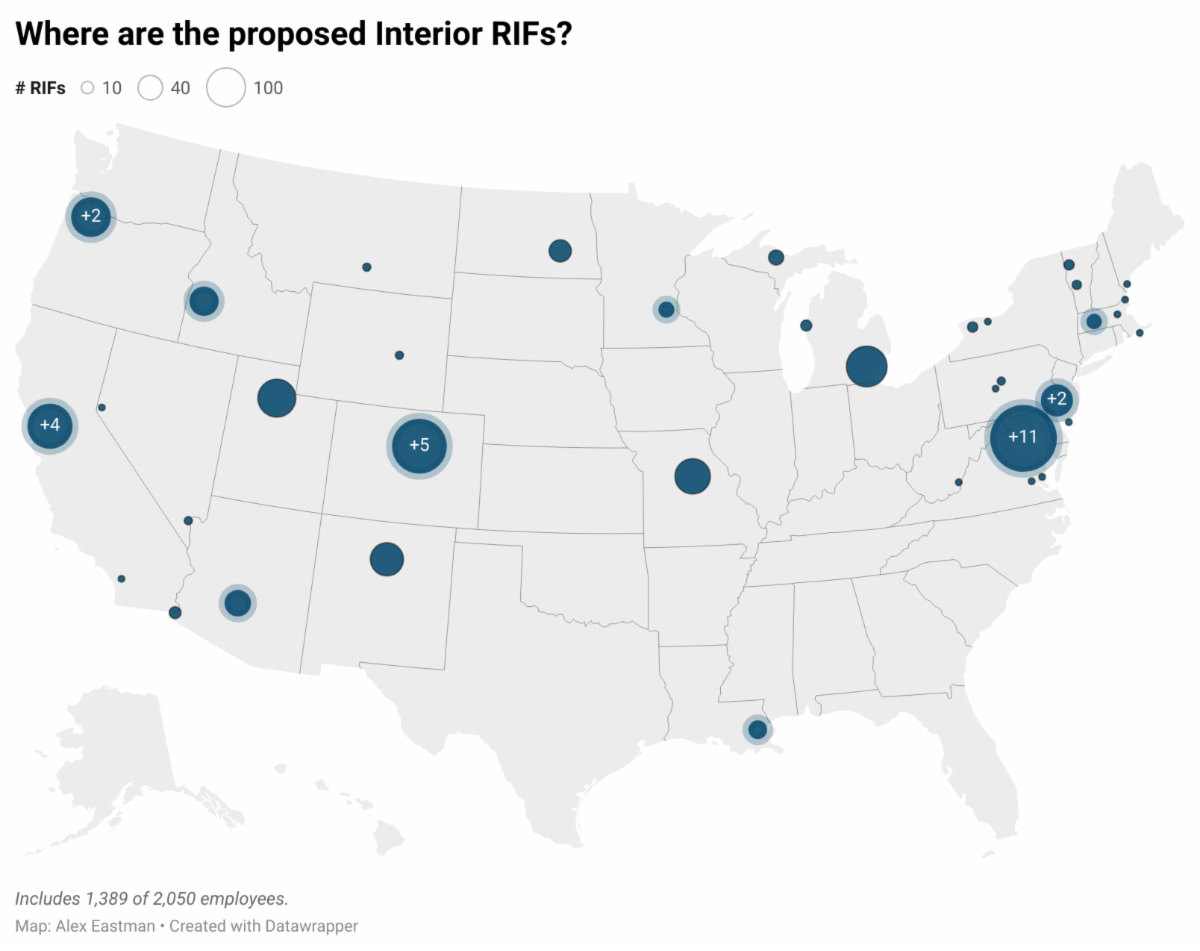
Among these employees are 2,050 at the Department of the Interior, including 108 at the USGS Great Lakes Science Center in Ann Arbor, Michigan, 79% of its workforce. Other layoffs would hit offices of the Fish and Wildlife Service, Bureau of Land Management, and others all across the country. Utilizing court filings, NEMWI has prepared the map below showing where most of these layoffs would be located, though in some cases, the court filings were not specific enough to determine a location.
Access the full visualization and the data here.
| | |
|
Barrett, Scholten, Send Letter to OMB to
Procure Icebreaker
In response to a new agreement with Finland that will provide the United States with 11 new icebreakers, Great Lakes Task Force members Rep. Tom Barrett and Rep. Hillary Scholten sent a letter to Office of Management and Budget Director Russell Vought requesting that he “ensure at least one of the newly procured icebreakers is planned for winter navigation on the Great Lakes.”
The $6.1 billion deal includes four icebreakers built in Finland and seven others built in the U.S. "We're buying the finest icebreakers in the world, and Finland is known for making them," President Trump said, announcing the deal alongside Finnish Prime Minister Alexander Stubb earlier this month.
“The Great Lakes can easily be overlooked by some as part of the Coast Guard’s mission,” the Representatives wrote. “Relentless winters on the Great Lakes often result in heavy ice accumulation that only icebreakers can navigate through.”
The Great Lakes region has just nine icebreakers and cutters compared to 25 for the Atlantic coast, and just one, the USGC Mackinaw, is a heavy icebreaker. Delayed and insufficient icebreaking has lost the region over $1 billion in recent years. “A failure to keep them [the lakes] clear of ice can lead to major economic loss and threaten thousands of jobs, which makes the procurement of a new icebreaker even more significant,” the letter concludes.
Read the letter on NEMWI’s page of Great Lakes Congressional letters here.
| |
Senate Commerce Committee Advances IOOS, Digital Coast Reauthorizations
On October 21, 2025, the Senate Committee on Commerce, Science, and Transportation held a markup to consider a slate of legislative measures and nominations. Key bills included the Integrated Ocean Observation System Reauthorization Act of 2025; the Digital Coast Act, led by Senator and Great Lakes Task Force Member Tammy Baldwin (D-WI); and the PIPELINE Safety Act of 2025. All three were reported favorably – the PIPELINE bill following an amendment (led by Senator Luján) to explicitly include extreme weather events as recognized risks to pipeline infrastructure. The committee also advanced the Young Fishermen’s Development Extension Act, the ROTOR Act, and the Global Investment in American Jobs Act of 2025.
The committee also voted on three nominations: Harry Kumar, of New York, to be an Assistant Secretary of Commerce; Joyce Meyer, of Virginia, to be Under Secretary of Commerce for Economic Affairs; and Seval Oz, of California, to be the Assistant Secretary of Transportation for Research and Technology. All three nominations were advanced roughly along party lines.
The bills and nominees now await action on the Senate floor. For more updates, find NEMWI’s Great Lakes and Water Policy Legislative Tracker here.
Reported by NEMWI Intern Christina Mina, University of Texas at Dallas
| |
Senate Subcommittee Holds Hearing on the
Regulation of Chemicals
The Senate Environment and Public Works Subcommittee on Chemical Safety, Waste Management, Environmental Justice, and Regulatory Oversight held a hearing Thursday to examine the beneficial use and regulation of new and existing chemicals. Witnesses included Peter Huntsman, President & CEO of Huntsman Corporation; Dr. Gwen Gross, Senior Technical Fellow at the Boeing Company; and Dr. Tracey Woodruff, Professor and Director of the Program on Reproductive Health and the Environment at the University of California, San Francisco.
In his opening statement, Chairman John Curtis (R-UT) advocated for updated regulations that protect public health and the environment without stifling American competitiveness. Chemical manufacturing and regulation, he said, lies at the intersection of innovation, safety, and U.S. competitiveness. He expressed concern that regulatory delays and ambiguities in statutes, specifically the Toxic Substances Control Act (TSCA), present challenges to innovation, the production of safer chemicals, and U.S. leadership in chemical manufacturing. The TSCA gives the Environmental Protection Agency (EPA) the authority to require reporting, record-keeping, and testing of chemical substances in order to effectively regulate chemicals that may pose an unreasonable risk to human health and the environment. Under this statute, the EPA has 90 days to review a Premanufacture Notice for a new chemical substance that a company intends to manufacture or import. In practice, however, the EPA has rarely met this deadline.
Ranking Member Jeff Merkley (D-OR) countered in his opening statement that ensuring public safety from dangerous chemicals should take precedence over short-term profits. Since lower regulatory standards may harm public health, the U.S. should remain a leader, not a follower, in regulatory protections for its workers and environment, he said. Sen. Merkley asserted that the EPA struggles to meet TSCA timelines for two reasons: 1) there is a vast understaffing in the EPA to review chemicals, and 2) studies submitted by companies are often incomplete.
Dr. Tracey Woodruff agreed with these points, demanding that the EPA be well-resourced in the future to promote science-based regulations, not industry-dominated policies. Dr. Woodruff also made the point that chemical exposure begins before birth and continues throughout life, and defended regulations as effective tools for increasing life expectancy, productivity, and environmental sustainability. She argued that the EPA should not rush approvals; once a toxic chemical is released, it cannot be taken back.
While Peter Huntsman agreed that the EPA should not cut corners, he also called for a more predictable regulatory process that would encourage investment, and push innovation and competition with other countries.
Dr. Gwen Gross gave perspective from the aerospace industry. She claimed that aerospace manufacturers are impacted by delays in new chemical reviews for their suppliers. Without updated regulations, the aerospace industry and others like it might not be able to find viable chemical alternatives, and products could remain off the market.
Most of the questions presented during the hearing revolved around the regulatory standards. For instance, Senator Boozman (R-AR) questioned the impacts of regulatory delays on finished products, and Huntsman responded, saying that the U.S. is abdicating its leadership in chemistry to foreign players. Dr. Gross added that the EPA’s extended regulatory timeline for approvals of new chemicals leads to stops and starts in Boeing’s development cycle. When a new chemical is suddenly approved, she said, Boeing has to restart product development. She insisted that “...a new regulatory process would help downstream users like Boeing” get new products to market faster. Senator Shelley Moore Capito (R-WV) followed this response with a concern on safety; Huntsman emphasized that new regulatory policy should not be a race-to-the-bottom for safety, and should be balanced with a commitment to speed, innovation, and manufacturing.
Reported by NEMWI Intern Logan Rau, University of Michigan Graduate
| | | |
Great Lakes Commission Holds Webinar on
Climate Resilience
The Great Lakes Commission hosted a webinar titled “What’s Next for the Great Lakes Basin Resilience Implementation?” as part of the Midwest Climate Resilience Conference. The GLC partnered with the University of Minnesota Climate Adaptation Partnership to offer a Great Lakes theme at the three-day conference. This session focused on actionable strategies for 2026 projects designed to promote the long-term sustainability of the Great Lakes region.
One initiative highlighted was the North Sandy Pond Resiliency Project, presented by Olivia Green, Freshwater Resilience Specialist at the Nature Conservancy. At this Lake Ontario shoreline site in New York, a breach in the shorefront has caused an entrapment of sediment at the shoal, displacing more than 700,000 cubic yards of sand. This depletes the shoreline, leading to increased erosion and flood risk. Historically, disruptive stone barriers or walls are used, but this project used nature-based solutions to provide a resilient ecosystem.
In the northern Wisconsin Town of Marengo, efforts to manage natural flood risks are underway through the South Shore Flood Resilience Assessment Project. Researcher Kyle Magyera of the Wisconsin Wetlands Association shared that the project tackles crucial catchment points for flood management, taking into account the region’s roads, culverts, and geology. One challenge is the degrading water retention in headwater wetlands, causing displacement downstream with sediment, erosion, and debris. This research hopes to expand data collection, involve community leaders in prioritizing interventions, and boost workforce engagement in rural and tribal communities.
Nate Kroeze, an ecologist from the GLC and USGS Great Lakes Science Center, shared research on coastal wetland restoration, wetland health trends, and the data collection and interview processes. This research prioritizes a unique feature: allowing partners to narrate their land’s previous environments and land-use documentation. This approach helps bridge information gaps left by limited online documentation and supports more comprehensive remediation planning.
Looking toward economic growth, the Great Lakes and St. Lawrence Cities Initiative has set transformative plans for its “Fresh Coast” corridor. Presented by Senior Coastal Programs Manager Zoë Kuntze, the corridor aspires to foster 500,000 new businesses, generate 18 million jobs, curb water loss, improve water quality, and cut emissions by 300 million metric tons by 2035. The Initiative has seen success in industry attraction and innovative site redevelopment, and will also conduct long-term studies on transportation, trade, and the shift to clean and local energy production.
Overall, the webinar demonstrated a wide-ranging commitment to resilience, emphasizing the value of ecosystem restoration, sustainable economic development, and active community involvement as central strategies for the future of the Great Lakes basin.
Reported by NEMWI Intern Christina Uytingco, University of Michigan
| | | |
Connect With the Northeast-Midwest Institute
on Social Media
The Northeast-Midwest Institute is on social media with new updates and information on its regional research and policy education program and with announcements for upcoming briefings and events. NEMWI is posting our research reports on current regional issues and ongoing policy education on the page to make keeping up with our policy work easier than ever. The Institute also is updating the page with announcements of upcoming policy briefings and webinars. NEMWI is excited for the opportunity to connect with as many people as possible.
Please check out our LinkedIn here, our Twitter/X here, our Facebook here, and our Bluesky here. Be sure to like and follow us to keep up to date with NEMWI!
On Bluesky, also check out our Great Lakes feed at "NEMW Great Lakes Feed" and if you are a Great Lakes organization on Bluesky, contact Great Lakes Program Manager Alex Eastman at aeastman@nemw.org so that we can add your posts to the feed!
| | | | | |