NEMWI Weekly

Update 

November 24th, 2025

https://www.nemw.org/wp-content/themes/NEMW_ATTCK/images/nemw_logo.png
 

Senate Passes Great Lakes Fishery Reauthorization Act


The Senate passed the Great Lakes Fishery Research Reauthorization Act on November 19 without amendment by unanimous consent.


The bill seeks to reauthorize the U.S. Geological Survey’s Great Lakes Fishery Research program, which would otherwise expire at the end of this fiscal year, for five years until 2030. This program supports the USGS’ Great Lakes Science Center, which conducts research to inform fishery management across the Great Lakes Basin, with $15 million yearly. The Great Lakes Science Center performs research critical to the region’s $5 billion fishery.


Continued investment is necessary to safeguard the health of the lakes and protect the industries that depend on them, especially as the Great Lakes face growing pressures from climate change, pollution, and shifting ecosystem dynamics. Reauthorization is especially critical given proposed reduction-in-force notices at the Department of the Interior that would have cut the Great Lakes Science Center’s workforce by 79%. Because of the continuing resolution passed earlier this month, those RIFs have been halted at least through January.


“The Great Lakes Science Center helps protect the freshwater fisheries and habitats that are invaluable economic and ecological assets for Michigan and the entire Great Lakes Region,” said Senator Gary Peters, Co-Chair of the Senate Great Lakes Task Force. “The Trump Administration’s attempt to slash staffing at the Center is outrageous and recklessly endangers the health of our Great Lakes, which is why it’s more important than ever that we pass this bill and put this essential program on sound financial footing.”


With the Senate’s passage by unanimous consent, the onus is now on the House to pass the bill and send it to the President’s desk. Earlier this year, the bill was advanced unanimously by the House Committee on Natural Resources. If enacted, the reauthorization will secure the Great Lakes Science Center’s capacity to deliver the research and monitoring that supports one of North America’s most important freshwater resources. 


In addition to the passage of the reauthorization, Congressman Tim Walberg (R-MI) and Congresswoman Debbie Dingell (D-MI) introduced a bipartisan bill last week to address the urgent, growing crisis of invasive mussels in the Great Lakes. H.R. 6053, The Save Great Lakes Fish Act, would direct federal agencies to work with the Great Lakes Fishery Commission and tribal, state, and local governments on a coordinated effort to combat invasive mussel species.


For these updates and more, see NEMWI’s Great Lakes and Water Policy Legislative Tracker here.


Reported by NEMWI Intern Christina Mina, University of Texas at Dallas

Dingell, Walberg Introduce Bill Aimed at

Invasive Mussels


Michigan lawmakers Rep. Debbie Dingell (D-MI) and Rep. Tim Walberg (R-MI) introduced H.R. 6053, the Save Great Lakes Fish Act of 2025, on November 17. This bipartisan bill would authorize $500 million over 10 years for the U.S section of the Great Lakes Fishery Commission “to develop, in coordination with Federal agencies, interstate compacts, and Tribal, State, and local governments, efforts to combat invasive species of mussels.”


The bill would amend the Great Lakes Fishery Act of 1956, which coordinated efforts to combat sea lamprey. The results have been extraordinary: lamprey populations have declined 90% from their historical peak. The bill would draw from that model in the fight against invasive mussels. Rep. Dingell, Co-Chair of the House Great Lakes Task Force, said “We saw great success after efforts to manage sea lamprey were un-siloed in the 1950s, and this legislation aims to replicate that success. This is critical to protecting and preserving the Great Lakes, not to mention our fishing economy.”


The Great Lakes Fishery Commission, a binational organization that works in Canada and the U.S., leads sea lamprey research and control efforts in the Great Lakes, and plays a key role in fishery management. With support from Congress, the GLFC intends to expand their research to combat invasive mussels, and attempt a moonshot aimed at a problem that has plagued the Great Lakes for decades.


Zebra and quagga mussels were first discovered in the U.S. on the shores of the Great Lakes. Since their introduction in the 1980s, these invasive mussels have spread to all five lakes and all eight Great Lakes states. Zebra and quagga mussels rapidly filter feed on microorganisms in the water, contributing to a significant depletion in phytoplankton. This strains the food supply for native aquatic organisms, which wreaks havoc on the food web and threatens the entire ecosystem. The elimination of plankton also makes the waters clearer. As a result, UV rays now reach greater depths, killing embryonic and baby fish and further disrupting whitefish populations, which have dropped by as much as 80% since the 1990s.


Combatting invasive mussels is key to protecting the environment and economy of the Great Lakes region. “The ecological health and well-being of our Great Lakes fisheries is vital to Michigan’s economy and our way of life… I am proud to join Rep. Dingell on this bipartisan effort to combat the spread of invasive mussels, protect the health of our fisheries, and ensure that future generations of Michiganders can enjoy this national treasure.” Rep. Walberg said.


Reported by NEMWI Intern Christina Uytingco, University of Michigan

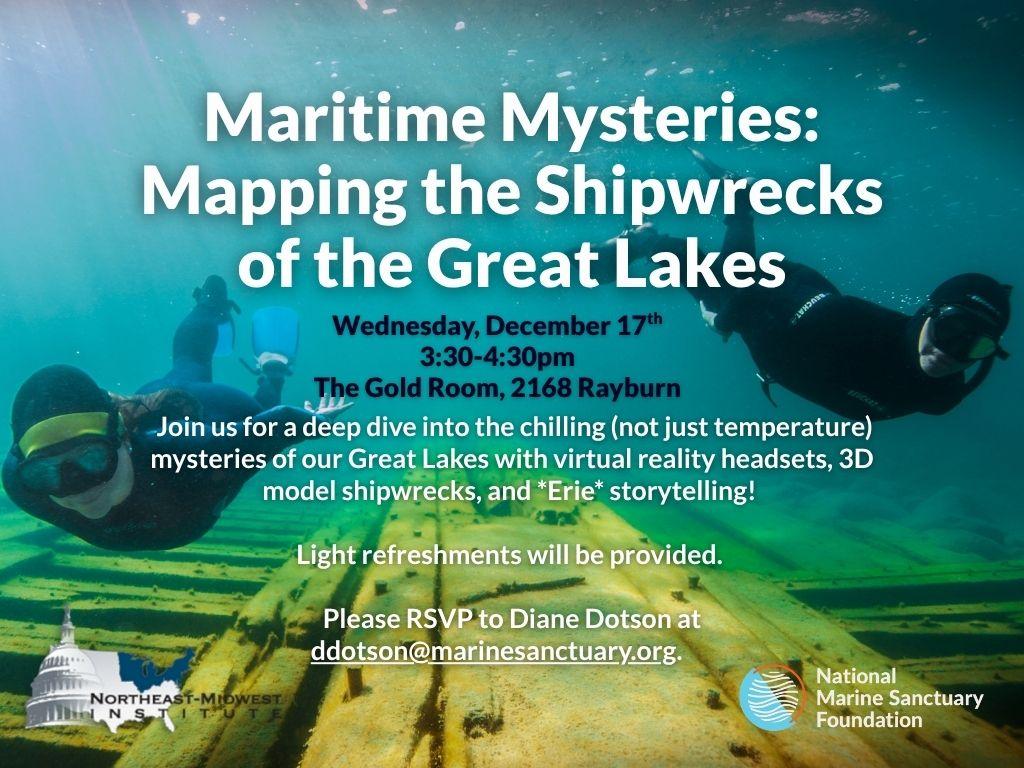
NEMWI To Host Event on

Great Lakes Marine Sanctuaries


The Northeast-Midwest Institute and the National Marine Sanctuary Foundation will co-host a Congressional briefing on Great Lakes marine sanctuaries on Wednesday, December 17th, from 3:30-4:30 p.m. in Rayburn 2168. The briefing is a session of NEMWI’s Great Lakes Primer and Orientation Program, sponsored by the Erb Family Foundation.


Join us for a deep dive into the chilling mysteries of the Great Lakes with virtual reality headsets, 3-D shipwreck models, and *Erie* storytelling!


Covering about 10,000 miles of coastline, America’s Great Lakes serve as gateways for trade and tourism, centers for biodiversity and science innovation, and underwater museums for national maritime heritage. Only about 15% of these lakebeds are mapped to modern standards, leaving huge gaps in the data needed to create updated nautical charts, discover untold stories and shipwrecks, and manage the region’s extraordinary natural and cultural resources. The recent designations of national marine sanctuaries in the Great Lakes have led to intensive mapping efforts and new discoveries by NOAA and its commercial, academic, and federal partners.


The answers to many maritime mysteries lie in the depths of these largely unexplored waters, preserving evidence and glimpses into the past, for those who dare to discover. The briefing will focus on the network of America’s premier marine places in the Great Lakes and the new discoveries, innovative technologies, and immersive experiences benefiting their communities.


Light refreshments will be provided.


Please RSVP to Diane Dotson at ddotson@marinesanctuary.org.

Connect With the Northeast-Midwest Institute

on Social Media


The Northeast-Midwest Institute is on social media with new updates and information on its regional research and policy education program and with announcements for upcoming briefings and events. NEMWI is posting our research reports on current regional issues and ongoing policy education on the page to make keeping up with our policy work easier than ever. The Institute also is updating the page with announcements of upcoming policy briefings and webinars. NEMWI is excited for the opportunity to connect with as many people as possible. 


Please check out our LinkedIn here, our Twitter/X here, our Facebook here, and our Bluesky here. Be sure to like and follow us to keep up to date with NEMWI!


On Bluesky, also check out our Great Lakes feed at "NEMW Great Lakes Feed" and if you are a Great Lakes organization on Bluesky, contact Great Lakes Program Manager Alex Eastman at aeastman@nemw.org so that we can add your posts to the feed!


Great Lakes Events

(all times eastern)


Great Lakes Seminar Series: Matthew Hoffman

Thursday, December 4th | 1:00-2:00 PM | Virtual or NOAA Great Lakes Environmental Research Lab, 4840 South State Road, Ann Arbor | Register here

Host: Cooperative Institute for Great Lakes Research


This Week in Washington

In the House:


The House has district work periods this week.


In the Senate:


The Senate has state work periods this week.

Northeast-Midwest Institute | nemw.org

Facebook  LinkedIn  X