Issue # 933 | October 30, 2026 | | |
In this Issue:
New York’s open government watchdog needs an overhaul; Advance Local looking to hire a Social Media Editor; The New York Times Launches ‘Times Voter Trends’: A New Way of Understanding the Election; How Dow Jones Is Covering the U.S. Midterms; NY court officials release AI guide for lawyers; News Publishers Deliver Letter to Meta Demanding It Withdraw New Harmful Terms of Use; Reflections on newsroom innovation — and why human ingenuity and editorial judgment still triumph; More Americans Say Journalists Manipulate the News Than Report It Accurately - Local News Earns the Most Trust Among News Outlets; Next-generation journalists learn how to turn facts into compelling narratives that engage audiences; Plus, newspaper training webinars and special events.
| | |
New York’s open government watchdog needs an overhaul
From riverheadlocal.com - The Committee on Open Government is the state body charged with overseeing New York’s Freedom of Information Law (FOIL) and Open Meetings Law. By law it must meet at least twice a year. On Thursday morning it was scheduled to hold the second of those meetings and adopt its annual report to the governor and the Legislature.
It never got that far. Not enough of its own members showed up. At 10:10 a.m., 10 minutes in, a slightly embarrassed Kristin Bergin, the committee’s acting executive director, called off the meeting for lack of a quorum.
This was government dysfunction on full display. It was also unprofessional, and disrespectful to the members of the public and the committee members who cleared their schedules and showed up. More
| |
|
Advance Local is looking to hire a Social Media Editor
From journalismjobs.com - Description: Advance Media New York, publisher of syracuse.com, NewYorkUpstate.com (NYup.com), and The Post-Standard, is seeking a competent editor who will lead the company’s social media team.
In this role you will coordinate closely with newsroom leaders to ensure the best content is optimized for all social platforms. The ideal candidate will have a journalism background, video and photo editing skills, experience managing and motivating a team, and proven success growing brands on social media.
The Social Media Editor will also manage content for NYup.com and lead newsletter strategy.
This is an exciting opportunity for a journalist who is familiar with Central and Upstate New York and knows how to present digital content for different audiences.
The base salary range is $65,000 to $85,000 per year.
What you’ll be doing:
- Help create and implement newsroom social media strategy and oversee execution by social producers
- Create compelling social media posts for multiple platforms
- Work with other newsroom leaders on social media efforts
- Build engagement and reach while monitoring performance
- Assign and edit articles written for NYup.com
- Help create audience using AI-assisted tools
- Work with freelancers and external content creators
- Lead newsletter strategy across the newsroom
Click here to apply.
| |
The New York Times Launches ‘Times Voter Trends’: A New Way of Understanding the Election
From New York Times Press Release - Times Voter Trends will surface detailed data in a form that allows readers to explore it like never before, the culmination of multi-year investments in data journalism.
The New York Times is introducing a new way to understand the American electorate. Times Voter Trends, a new data journalism initiative, will break down how different demographic groups voted in races and how they shifted from previous elections.
This project will present more detailed data information to understand how people are voting by race, gender, education, age and more, delivered in a form that allows audiences to explore this data as they never have before. Times Voter Trends is possible because of multiyear investments in data journalism, precinct-level data analysis and The New York Times/Siena Poll. By combining pre-election polling, live precinct returns, voter file data and estimates from “the Needle,” The Times will offer a living demographic portrait of the American electorate months before this type of analysis is usually available.
“This is the natural culmination of the election data journalism we already create — specifically, The Times/Siena Poll, the Needle, our election-night results presentation and the expansive data collection operation powering it all,” said Matthew Ericson, assistant managing editor. “Times Voter Trends gives readers a more tangible understanding of what happened at the ballot box, letting them dive deep into the data and understand the shifts in voting patterns since the last election.” More
| | |
How Dow Jones Is Covering the U.S. Midterms
From Dow Jones Press Release - Across newsrooms, intelligence teams and specialist products, Dow Jones is connecting reporting, analysis and data to help business leaders understand what the 2026 U.S. midterms could mean for markets, industries and communities.
The 2026 U.S. midterms will determine more than who controls Congress. The results could reshape the outlook for taxes, energy, artificial intelligence, Social Security, data centers and the national debt, with real consequences for businesses and investors.
Dow Jones is meeting this moment with the full breadth of our news, data and convening power, helping leaders understand what matters, when it matters and why. From specialist reporting and intelligence to market analysis and audience interactions, each part of the company brings a different lens to the political, economic and business implications of the midterms.
From ballot-box issues to business intelligence
From fuel costs at the pump to the security risks surrounding the election, Dow Jones’s reporters and analysts are examining how the midterms could affect households, markets and business decisions. More
| | |
NY court officials release AI guide for lawyers
From nydailyrecord.com - New York state court officials have released an attorneys’ guide to using artificial intelligence tools.
The Risks of Using Artificial Intelligence in Preparing Court Papers: What Every Attorney Should Know was developed by the Advisory Committee on Artificial Intelligence and the Courts.
The panel, appointed by Chief Administrative Judge Joseph A. Zayas to examine the fast evolving role of artificial intelligence in the judiciary, created the document to guide and support attorneys in the responsible and informed use of generative AI tools when preparing court filings, according to state court officials.
Reviewed and approved for public distribution by the Unified Court System‘s judicial leadership, the guide addresses the opportunities and risks presented amid the increasing prevalence of AI-assisted drafting tools across the legal profession and underscores the critical professional obligations that remain unchanged in this new environment. Officials said.
The document stems from the Committee’s development of a model rule, adopted by the court system earlier this year, which dictates that attorneys who use generative AI tools must understand the capabilities and limitations of those tools and independently ensure the accuracy and reliability of any information generated. More
| | |
News Publishers Deliver Letter to Meta Demanding It Withdraw New Harmful Terms of Use
From newsmediaalliance.org - Late last week the News/Media Alliance, the largest news media trade association representing over 2,000 newspaper, magazine, and digital media publishers in the United States, delivered a letter to Meta CEO Mark Zuckerberg demanding the company withdraw its revised Commercial Terms of Use before they take effect on October 30.
Read the Letter.
Uncovered in a piece by Neiman Lab last week, Meta’s updated commercial terms of use will allow the company to scrape content from any website associated with a business account on its platforms. This would give Meta the ability to scrape news sites and use their content to train the company’s business products, including its AI tools. Over the weekend Meta made minor revisions to language within its terms of use, but legal experts say that the terms still grant Meta overly-broad scraping privileges without explicit limitations.
| |
|
Reflections on newsroom innovation — and why human ingenuity and editorial judgment still triumph
From editorandpublisher.com - When I went to work in a professional newsroom in 1985, before I graduated college, I did a few jobs that don’t exist anymore. In addition to reporting and writing community news, I distributed mail to reporters and answered the phones.
“Snail mail” and landline calls disappeared from newsrooms during the pandemic, when we all started working remotely. And they haven’t come back, even as we returned to the office.
Also not coming back: word processors without internet connections, pads of paper to design pages, and pneumatic tubes to shoot dummies from the newsroom to the composing room.
During the early years of my career, the tech we consider routine today wasn’t widely used. There was no vertical video — in fact, no video of any kind.
We didn’t have email. If you needed to send a written message, you inserted it into an interoffice envelope for a newsroom courier to deliver. If you needed to send a photo from one office to another, you packed up your film, got in a vehicle and took a ride across town.
As a young reporter in the mid-1980s and into the 1990s, I relied on Bic pens and reporter notebooks. My editor once loaned me a cellular phone to use on a big story. It was the size of a car battery. I took it with me to a rural area to report on a crash. When the pilot of a small plane taking me to the scene saw me carry the big, black box aboard, he did a double take and instructed me not to turn it on. More
| |
More Americans Say Journalists Manipulate the News Than Report It Accurately; Local News Earns the Most Trust Among News Outlets
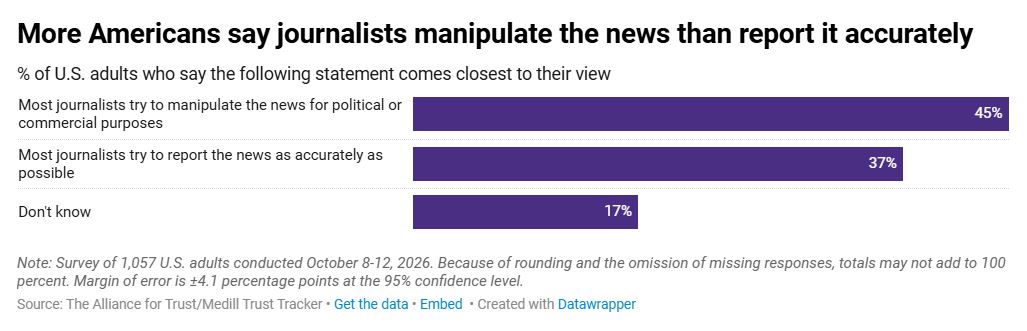
From localnewsinitiative.northwestern.edu - A plurality of Americans think that most journalists try to manipulate the news for political or commercial purposes, according to a poll conducted by NORC at the University of Chicago in collaboration with the Medill Local News Initiative and the Alliance for Trust in Media.
Just more than one-third of respondents said most journalists try to report the news as accurately as possible.
There was a clear partisan split. More than three quarters of Republicans (77%) said most journalists try to manipulate the news, compared with 24% of Democrats. Meanwhile, 61% of Democrats said most journalists try to report the news as accurately as possible, compared with just 11% of Republicans. Democrats and Republicans include respondents who lean toward each party. More
| |
Next-generation journalists learn how to turn facts into compelling narratives that engage audiences
From editorandpublisher.com - Patti Wolter teaches her students at Northwestern University’s Medill School of Journalism that there is a place for narrative in every story, from a short news blurb to a longform magazine feature.
“In a world in which every story has the same hill to climb on engagement, why not stop and say, ‘How can I explain this in a way that makes someone say: I never thought of it that way before,’” she said. “They’re much more likely, even from that one paragraph, to finish the rest of the piece,” she said.
Since the dawn of the digital age, change has been a constant for newsrooms — much of it related to publishing platforms. But despite the advent of websites and mobile apps, social media, vertical video and podcasting, one thing has remained constant: the best journalism is based on adept storytelling.
“Certain things don’t change,” said Juan Manuel Benítez, a professor of local journalism at Columbia University Graduate School of Journalism and a multimedia reporter. “Good reporting, talking to people, finding good sources — relevant sources — and getting to the truth or the best representation of the truth stays the same. So, classic, old-school reporting is still present in the way I teach, and those are the main pillars.” More
| |
In a New York Minute is the weekly electronic newsletter of NYNPA, providing you with member news, money-saving and money-generating ideas, and upcoming events. If you would like to contribute to this newsletter please reply to this e-mail or contact mmiller@nynpa.com. For more on NYNPA please visit us on the web at www.nynpa.com.
Mary Miller
Education Services Director
New York News Publishers Association
| | | | |