Weekly News Roundup - November 2, 2026 | | | |
The Partnership for Male Youth's award-winning Weekly News Round-Up, published since 2013, provides a curated, nonpartisan look at pressing health issues affecting adolescent and young adult males. Each edition highlights timely research, media coverage, and policy updates from the past week—bringing attention to often-overlooked topics to ensure young males are seen, supported, and included in the national dialogue.
| | PMY Releases Research on Young Male Health | | |
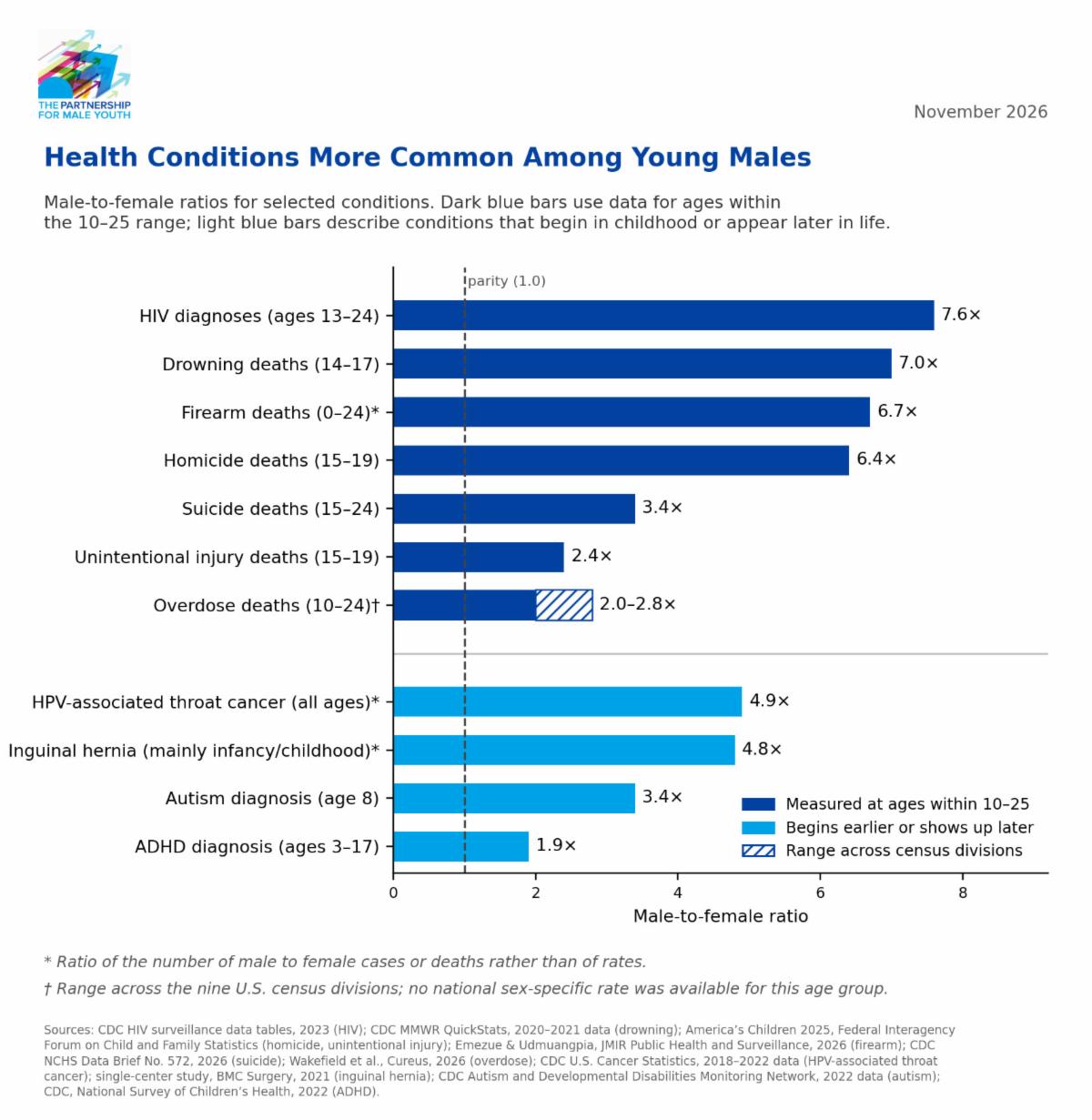
We're excited to announce a new chapter in our work: research on young male health (ages 10-25). Our first research briefs, focusing on health conditions more common among young males, are now available on our website page Research. Bringing together CDC surveillance, federal statistics, and peer-reviewed studies, our briefs show that young males ages 10 to 25 carry a markedly heavier burden than their female peers across injury, violence, suicide, and HIV, in some cases six to eight times greater. Among 15- to 19-year-olds, the male homicide rate is more than six times the female rate. Young males also account for nearly nine of every ten new HIV diagnoses among 13- to 24-year-olds. Many other risks go undetected, including depression that shows up as anger or risk-taking rather than sadness, eating disorders and steroid use, and HPV infections that can progress to cancer with no screening test to catch them.
The risks for young males are compounded by gaps in care. Young males are less likely than young females to have a regular source of care, receive preventive services, or complete recommended vaccines, and only 6% have been tested for a sexually transmitted infection in the past year, compared with 17% of young females. Research like this is how we make the case that young male health deserves recognition as a distinct field of practice, research, and policy, and we look forward to sharing much more in the months ahead. We invite you to explore the briefs and share them with colleagues.
| | |
The Lancet, October 31, 2026
The Lancet’s new three-paper series on men’s health finds that men’s poor health and premature death are not driven by biology alone, but by the environments in which they live and work, yet men’s health receives little attention in policy, leaving it vulnerable to powerful commercial and ideological interests. Analysing health data from 1990 to 2023, the researchers found that years of healthy life lost were 16% higher among men than women in 2023. In most countries, factors such as employment and education strongly shape men’s life expectancy and disability, and incarceration or homelessness widens these disparities. Although some health behaviours have improved, the exceptions are concentrated among men in marginalising conditions, including incarcerated men, men experiencing homelessness, men with mental illness or substance use disorders, men with low income, men who have sex with men, and those who are gender non-conforming.
The authors argue that this ongoing neglect has created a gap that companies and influencers in the manosphere can exploit to shape how men’s health is understood and addressed. In response, the series calls for men’s health to be embedded in existing structures, such as universal health coverage and health and social policies at all levels. It also urges the collection and analysis of intersectional, disaggregated data so that structurally marginalised men are made visible and their needs addressed. The authors stress that attention to men’s health should not be viewed as a competition with efforts to improve women’s health or address wider gender injustices.
| |
Hawkes S, Buse K., The Lancet, 2026; 408: 1912–16.
In a Lancet Viewpoint published alongside the journal’s first series on men’s health, Sarah Hawkes and Kent Buse argue that the manosphere, a diffuse commercial ecosystem and loose collection of online communities united by shared beliefs about masculinity, misogyny, and male victimisation, should be treated as a public health problem, like smoking and ultra-processed foods. They link it to mental health problems in boys and note that it “delegitimises” men and boys seeking help, while platforms profit because outrage and resentment drive profit. The authors stress that boys are not to blame. “The manosphere offers boys and young men belonging, identity and an explanation for why life feels hard,” Hawkes said. “Those needs are real.” Rather than simply removing content, they call for a coordinated government response that includes better access to skills, jobs, and mental health services.
| | |
Melanie McDonagh, The Telegraph, November 1, 2026
In a Telegraph column, Melanie McDonagh criticizes a Lancet article by Sarah Hawkes and Kent Buse, co-founders of the gender justice think tank Global 50/50. The authors argue that manosphere content on sites like Instagram and TikTok has normalized and amplified misogyny, contributing to sexual violence and aggression against women and to increased isolation in men, and so constitutes a public health hazard. McDonagh acknowledges that some men abuse positions of power and that parts of social media are harmful. But she contends that it is one thing to say misogyny exists and another to call it a public health risk like a mass contagion, which she considers a category error that implies all men and boys are potential Tate brothers. McDonagh warns that the phrase “toxic masculinity” makes it easy to equate the two words, so that masculinity itself comes to seem toxic and male sexuality inherently problematic. She points to concerns that young men and women are mingling and marrying less, arguing that if men stay away from women for fear of being called a predator, that becomes a genuine social problem, not a health one. In place of content bans, she proposes offering young men different values, namely courtesy and chivalry, and concludes that the real problem is that masculinity itself is being treated as toxic.
| | |
Eric W. Dolan, PsyPost, October 30. 2026
A qualitative study in the Journal of Sex & Marital Therapy by Jossy Forrest (University of Melbourne), Jessie Ford (Columbia), and Jonathan Herring (Oxford) found something the researchers didn’t expect. Many of the young heterosexual men they interviewed described sex as a source of anxiety, vigilance, and shame rather than pleasure. The researchers analyzed in-depth interviews with 31 men aged 18 to 32, recruited mainly through one Australian university, with some living in the U.S. The researchers say the men understood consent well and wanted to get it right, often requiring several cues to line up before proceeding. The strain showed up anyway. Nearly all (29 of 31) described sex as a space of high anxiety and constant self-monitoring, and the same number expressed deep concern about causing harm, which sometimes tipped into people-pleasing and ignoring their own desires. Most also feared shame and personal ruin, and about half turned that judgment inward as a lasting sense that they were bad people. The authors were most troubled that the men had no one to talk to honestly about consent, believing that admitting any uncertainty would mark them as predators. They suggest that consent education focused only on men’s duty to avoid harm and punishment may teach young men to treat sex as a technical problem. They recommend emphasizing mutual trust, communication, and both partners’ right to express what they want. The study has clear limits: it is small and nonrepresentative, and an outside expert noted that the interview questions’ focus on consent and problematic encounters may have steered the men toward negative experiences.
Bioengineer.org, October 29, 2026
A scoping review in BMC Public Health by Ebenezer Martin-Yeboah and Anabel Quan-Haase synthesizes three decades of research on how adolescent and young adult males find, evaluate, and use sexual and reproductive health information. It focused on males aged 17 to 24, whose elevated risks the authors attribute to rigid masculinity norms, poorly targeted interventions, and reluctance to seek formal care. The final sample was 48 English-language studies published between 1990 and 2024. Most were U.S.-based and quantitative, and they concentrated on STIs, contraception, and access to information. The central finding is a persistent gap between high general awareness and low functional knowledge, especially about non-HIV STIs and fertility. In other words, young males may be encountering more information without becoming better able to understand or act on it. The authors also identify stigma, social and religious norms, and literacy gaps as barriers that providers and policymakers need to address.
Zoe Williams, The Guardian, November 1, 2026
In an interview about his book Your Nuts, reproductive scientist Michael Carroll says sperm counts have probably declined, but the picture is mixed. Some populations show stable or rising counts, sperm count doesn’t measure fertility, and falling birth rates have many causes, including economics, climate anxiety, and parental age. He warns against simplistic narratives, especially manosphere ones that tie testicles to threatened masculinity. Carroll’s main worry is influencer-driven testosterone use, which can shut down the body’s own sperm production. He cites Pete Hegseth’s mandated testosterone testing for servicemen as misinformation reaching policy. His aim is for men to understand their reproductive health, including heat, smoking, obesity, STIs, and medications, and to feel less isolated when facing infertility.
Jillian Wilson, Yahoo Life, October 27, 2026
A study by UMass Amherst and University of Michigan researchers surveyed 601 boys ages 13 to 17. About a third followed Andrew Tate and 11% followed Jordan Peterson. The strongest finding was about home life: boys drawn to manosphere creators were more likely to hear strict gender norms reinforced at home, and that influence outweighed who they followed online. Clinical social worker Jami Dumler, who was not involved in the study, advises parents to lead with curiosity rather than judgment and to set up regular one-on-one time with male role models, ideally during a shared activity. She says boys turn to the manosphere seeking confidence and connection, so meeting those needs in other ways helps.
PR Newswire, October 30, 2026
Mediaplanet has announced a national Men’s Mental Health campaign, published in USA TODAY and on its Future of Personal Health website. The campaign aims to encourage more open conversation about men’s mental health and offer practical resources. Podcaster Jake Shane is the cover story, and Howie Mandel, NBA All-Star Kevin Love, Dr. Mark Hyman, and author Yung Pueblo contribute pieces on mental health, resilience, and personal growth. (The Q&A with Dr. Gregory Scott Brown you shared earlier is part of this same campaign.) The campaign challenges the expectation that men should handle mental health struggles alone and urges them to prioritize their well-being before reaching a crisis. Mandel puts it this way: people should care for their mental health the way they care for their dental health. Participating organizations include Vibrant Emotional Health, Crisis Text Line, the YMCA, the American Foundation for Suicide Prevention, the American Psychiatric Association, and the Kevin Love Fund, among others.
| |
Breaking Literature
From the Knowledge Exchange
| |
Note: Launched earlier this year, the PMY Young Male Health Knowledge Exchange is a comprehensive, continuously updated, open-access database focused on adolescent and young adult (AYA) male health. AYA males are those between the ages of 10 and 25. Designed for clinicians, researchers, parents, and other caregivers, the database is a global repository of resources relating to AYA male health and includes peer-reviewed scientific articles published since 2010, books, and health education materials for clinicians, parents, and caregivers.
Each week the Roundup will highlight a recently released Knowledge Exchange article focused on AYA male health.
Scharrer, E., Ward, L. M., & Volling, B. L. (2026). Following manosphere influencers and endorsement of traditional masculinity beliefs among adolescent boys. Psychology of Men & Masculinities. Advance online publication. https://doi.org/10.1037/men0000573
Abstract
The “manosphere” has been critiqued for its potential to encourage problematic views of gender. However, there are very little data on factors that predict adolescent boys’ engagement with the central figures of the manosphere or whether that engagement is associated with gender-related beliefs. In the present study, we find that strength of boys’ own self-perceived masculinity and exposure to socialization messages about traditional gender roles from their parents/caregivers predict engaging on social media with manosphere figures like Andrew Tate or Jordan Peterson in a sample of 601 13- to 17-year-old U.S. boys. Further, following manosphere figures is associated with holding beliefs that favor emotional detachment, dominance, toughness, and antifemininity as “ideal” masculine gender roles and norms, even under multiple controls. Such findings have implications for adolescent boys’ identity development amid wider sociocultural norms.
| |
Dennis J. Barbour, Esq.
President and CEO
Partnership for Male Youth
Newsletter Editor
dbarbour@partnershipformaleyouth.org
| | | | | |