THE LARGEST ORGANIZATION DEVOTED
TO THE SCHOLARLY STUDY OF FILM AND MEDIA
|
|
Thank you to everyone who submitted their proposals to the 2022 SCMS Conference! We received over 1015 submissions.
As Alfred Martin, the 2022 Conference Program Committee Chair, and his team of readers begin the task of reviewing over 1000 proposals, we want to shed some light on the evaluation process.
Step 1: Evaluation of Proposals:
Once the submission deadline has passed, proposals are clustered according to category (workshop, roundtables, pre-constituted panels, open call papers) and the open-call papers are then grouped according to their topics. Prior to the submission deadline, the Board of Directors appoints a Program Committee comprising pairs of readers for the various categories of proposals. The Program Committee Chair distributes the groups of proposals to the reading pairs for their independent evaluations. Proposals are then scored, and the readers send their averaged scores to the Program Chair. Open-call readers also suggest how accepted papers may fit together into panels.
Step 2: Panel/Workshop/Roundtable Capacity is Determined:
While the readers are hard at work, the SCMS office staff creates a conference grid of all the dates/times/sessions. The grid reflects the total number of panels, workshops, and roundtables that can be accommodated. Once the total number of panels and workshops is determined, this information is communicated to the Program Committee Chair.
Step 3: Proposals are Accepted or Declined:
As soon as the Program Committee Chair has finalized the proposal decisions, the SCMS Home Office notifies participants whether their submission was accepted or declined. These notifications are sent in mid-November.
Step 4: Conference Scheduling:
The Conference Scheduler's Herculean task now gets underway in scheduling panels and workshops. As soon as the task is completed and reviewed by the Program Chair, a first draft of the schedule is posted at cmstudies.org.
We hope this sheds some light on the evaluation process. Learn more about the Conference Program Committee here and if you are interested in being part of it in future years, keep an eye out for our call for volunteers in late Spring! |
|
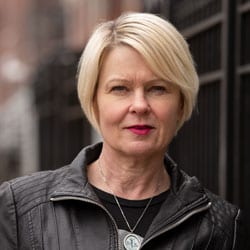
A Tribute by Paula Massood |
|
At the end of June, Pamela Robertson Wojcik rotated off the Board of Directors, after serving for six years as the Society’s Past-President, President, and President-Elect (2015-2021). I join President Priscilla Peña Ovalle, President-Elect Vicky Johnson, and the rest of the Board in thanking Pam for her service. Over the last decade or so, SCMS has experienced several major changes and developments, and Pam’s tenure is a testament to this history of growth and strategic redefinition. During her six years, Pam continued the expansion and professionalization of the Society.
As President, she served as a mentor to former Executive Director Jill Simpson and current and former staff members, including Bruce Brasell, Molly Youngblood, Margot Tievant, and Erfana Enam. She also often worked hand-in-hand with Leslie LeMond on conference-related questions.
Under Pam’s leadership, the annual conference expanded and became more inclusive through the one-role policy, which allows for increased participation by members, and the popular addition of seminars, which invite scholars from all career phases and paths to meet, discuss and imagine new possibilities in Film and Media Studies. She also spearheaded the Society’s increased efforts at diversity and inclusion and global outreach by helping to establish the task force on Anti-Racism, Inclusion, and Diversity (now a standing committee) and on Global Equity. In further expanding the Society’s outreach from the annual conference, Pam designed and helped host, along with Board member Elizabeth Evans, the first of the SCMS Partners, which was held in London in the summer of 2019. She also created SCMS+, an experimental initiative that allows a supported digital space for member curated workshops and seminars. In all stages of her work with the Board, Pam was a model of collaboration, energy, imagination, and generosity. She worked tirelessly to improve the Society and served as a guide for myself, the Board, and the members at large. Pam has been on the faculty of the University of Notre Dame since 1998 and has taught a diverse number of courses on film history, gender, cultural studies, and popular culture.
During her time with SCMS, Pam also served as the head of Notre Dame’s Gender Studies Program from 2009–2015 and began a tenure as Chair of the Department of Film, Television, and Theatre while also serving as Past-President. In 2020, she won the Sheedy Award for Excellence in Teaching from Notre Dame’s College of Arts and Letters. In addition to her institutional and organizational service work, Pam is a prolific scholar, starting with her seminal Guilty Pleasures: Feminist Camp from Mae West to Madonna (Duke 1996), one of the leading studies of Mae West to her most recent work on the under-studied child star, Gidget in Gidget: Origins of a Teen Girl Transmedia Franchise (Routledge 2020). She has also published several books exploring space in American cinema, most notably in The Apartment Plot: Urban Living in American Film and Popular Culture, 1945–1975 (Duke 2010), Fantasies of Neglect: Imagining the Urban Child in American Film and Fiction (Rutgers 2016), and her edited collection, The Apartment Complex: Urban Living and Global Screen Cultures (Duke 2018). Most recently, she co-edited, with Angel Daniel Matos and me, Media Crossroads: Intersections of Space and Identify in Screen Cultures (Duke 2021) and, with myself, a special issue, “Precarious Mobilities,” for Feminist Media Histories (July 2021). Much of this scholarship was produced while Pam served the SCMS community, indicating her generous and multifaceted interests in the fields of Film and Media Studies. This interest is extended in her forthcoming project, Unhomed: Mobility and Placelessness, for which she received a Guggenheim Award in 2021.
We are incredibly thankful for Pam’s ongoing dedication and commitment to SCMS. On a personal note, I wish to extend my deep gratitude to Pam for being such a strong role model and collaborator over the last few years at SCMS, particularly her endless support and guidance through the travails the Society faced during COVID.
|
|
Thank you to everyone who submitted to the 2022 SCMS Awards! We received over 350 submissions across 11 categories. All have been transferred to the committees. Winners will be announced in January.
|
|
The latest issue of Journal of Cinema and Media Studies (JCMS) is now available!
Complete issues with full-text articles (from 1999 to present) are also available to members to read online at Project Muse. Click here to read the latest volume of Journal of Cinema and Media Studies online.
Journal of Cinema and Media Studies is published quarterly by Michigan Publishing, in cooperation with the Society for Cinema and Media Studies. Members of the society receive access to the journal as one of the benefits of membership.
|
|
Reminder: SCMS seeks a new Editor or Co-Editors for its scholarly publication, the Journal of Cinema and Media Studies (JCMS).
|
|
PRESENTING THE PAST, EPISODE 3
August 09, 2021
Indian Country Today
The collaboration between Aca-Media and the American Archive of Public Broadcasting continues with episode 3 of our special series “Presenting the Past: Exploring the American Archive of Public Broadcasting.”
In this episode, Shirley Sneve, Vice President of Broadcasting for Indian Country Today, reflects on her work with Indian Country Today, Vision Maker Media (VMM), and archiving with the AAPB. Sneve also comments on the history of Native American public broadcasting and presents excerpts from a few of the documentaries that VMM has supported that present a diversity of perspectives on traditional and contemporary Native American culture.
|
|
Since May 2020, Aca-Media has been bringing you a special series, “Talking Television in a Time of Crisis,” organized by Hunter Hargraves, Lynne Joyrich, and Brandy Monk-Payton and featuring dozens of prominent academics and practitioners. These sixteen episodes over two seasons have helped us understand the relationship of TV Studies to, first, the COVID-19 pandemic, and then, following the murder of George Floyd, the struggle for racial justice in the context of multiple crises of political legitimacy, climate emergency, and more. In this finale, the organizers reflect on the series as a whole and offer their takeaways from this extraordinary series of podcasts.
|
|
Listen to all new episodes here. |
|
The Society for Cinema and Media Studies (SCMS) Fieldnotes project is pleased to present new video interviews with Kathleen Rowe Karlyn, Linda Mizejewski and Judith Mayne.
|
|
|
|
Kathleen Rowe Karlyn
interviewed by Linda Mizejewski
|
|
|
|
Linda Mizejewski
interviewed by Kathleen Rowe Karlyn
|
|
|
|
Judith Mayne
interviewed by Christina Lane
|
|
Fieldnotes is an SCMS project to conduct, circulate and archive interviews with pioneers of film and media studies. In addition to recognizing the contributions of key scholars, the project also aims to foster knowledge of and interest in the diverse and dynamic developments that have shaped -- and continue to shape -- our expanding field.
|
|
(Myung J. Chun / Los Angeles Times) |
|
The Los Angeles Times interviewed Jacqueline Stewart about her role and important work at the Academy Museum of Motion Pictures. Read the full article here. |
|
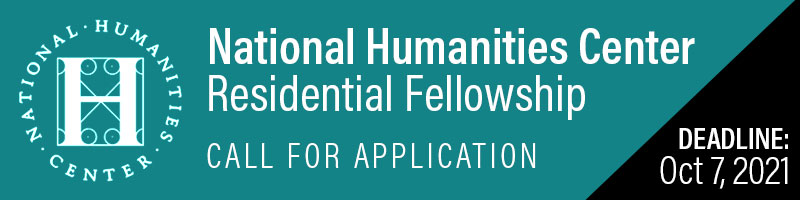
The National Humanities Center offers up to 40 residential fellowships for advanced study in the humanities for the 2022–23 academic year. Help us spread the word about this exciting opportunity. The deadline to apply is October 7, 2021.
|
|
Stay connected - follow SCMS on Facebook, Twitter and Instagram
for news and updates!
|
|
|
|
|
|
|