|
International Civil Liberties Monitoring Group
Coalition pour la surveillance internationale des libertés civiles
March 14, 2026 - 14 mars 2026
| Bimonthly round-up of news about national security's impact on civil liberties in Canada and abroad | |
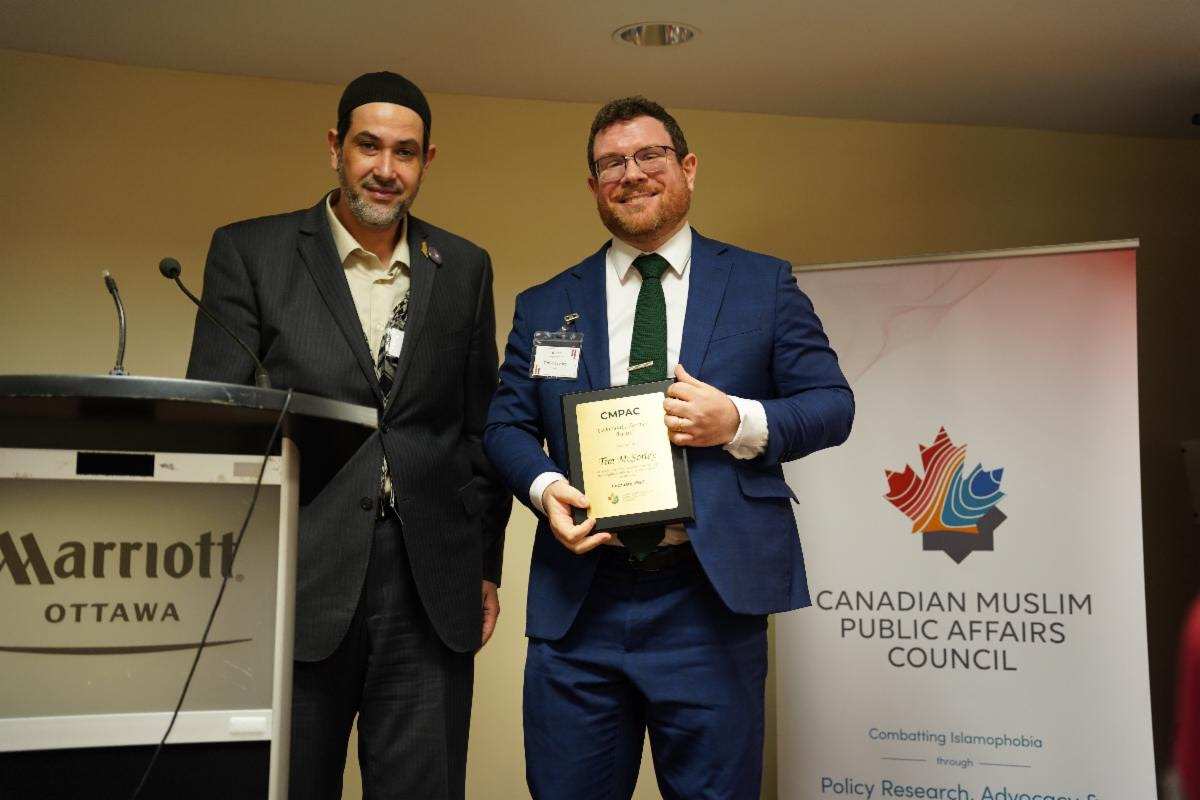
| CMPAC presents ICLMG’s Tim McSorley with its Community Partner Award | | |
ICLMG 04/03/2026 - During the recent Parliamentary Iftar dinner hosted by the Canadian Muslim Public Affairs Council (CMPAC), Tim McSorley, our National Coordinator, was honoured to receive the Community Partner Award for his dedicated partnership and steadfast contributions in service of the Muslim community.
We are deeply touched to receive this award, immensely grateful for the important advocacy of CMPAC (a member of the ICLMG coalition), and looking forward to continuing our partnership of defending the civil liberties of the Muslim community and of all people in Canada. Thank you!
Tim McSorley’s statement on social media:
Last week, I had the honour of attending the Canadian Muslim Public Affairs Council’s Parliamentary Iftar. It was wonderful to sit down to break bread with friends, colleagues, MPs and senators, and members of the broader Muslim community – many of whom I knew and had deep respect for the work that they do in their communities and across Canada to uphold justice and build togetherness. Something we desperately need right now.
So it was incredibly humbling to be recognized with CMPAC’s Community Partner award that night, for the work that I do with the International Civil Liberties Monitoring Group to defend civil liberties in Canada from the impact of national security and anti-terrorism laws, including confronting systemic racism, Islamophobia and racial and religious profiling. It was particularly meaningful to be recognized, given how many organizations and individuals have been doing incredible, tireless work at a particularly difficult time, when we see rising instances of hate, racism and xenophobia both in Canada and internationally. I also can’t talk about the work of the ICLMG, and would never be in a position for this kind of award, if it weren’t for the incredible work of my colleague, Xan Dagenais, ICLMG’s research and communications coordinator.
My award followed wonderful and thoughtful remarks from Imam Sikander Hashmi, Executive Director, Canadian Council of Imams, and MPs Salma Zahid and Jenny Kwan, who both were also presented with awards. It inspired me to think about the importance of coming together and working collectively for peace and justice, and how that is also reflected in the ICLMG coalition, bringing together organizations from across sectors, including human rights, legal, faith based, environmental, labour and humanitarian groups.
It allows us an opportunity to share across sectors and communities, to learn from each other, to build and show solidarity and to take on difficult issues in a thoughtful way, but also in a way that no one group could do on its own. This includes work like addressing systemic racism in the treatment of Muslim-led charities and humanitarian organizations, the push for greater border securitization at the expense of protecting and welcoming migrants and refugees, addressing the secretive and rights-violating tools used by national security agencies, and confronting the genocide in Gaza and Canada’s complicity in that and other human rights abuses around the world.
I’m incredibly thankful to CMPAC for the recognition, and humbled, but also energized to continue working together. And grateful to CMPAC for bringing us together and the work they do for justice, peace and a better Canada and world. Ramadan Mubarak! Source
| | Bill C-9 Was Supposed to Fight Hate. Instead, It’s Being Rushed Through Parliament and Threatens the Rights of Every Canadian | | |
CCLA 12/03/2026 - Anaïs Bussières McNicoll, Director of the Fundamental Freedoms Program, made the following statement after the federal government forced the House of Commons’ Justice Committee to finish the study of the Combatting Hate Act:
Yesterday, the federal government forced the House of Commons’ Justice Committee (JUST) to finish the study of Bill C-9 — the Combatting Hate Act.
No more debate – just get it done, despite the bill’s numerous flaws.
The government is now set to push C-9 through, giving the House of Commons a maximum of two days for the Report stage and Third Reading.
This should alarm every Canadian who cares about democratic practice and free expression.
Antisemitism, Islamophobia, and racism are on the rise. Communities across this country are worried, and they deserve protection. But Bill C-9 doesn’t solve this complex issue. Instead, it hands the government a blunt instrument that history tells us will be turned against the very people it’s supposed to help.
More than 40 civil society organizations, representing communities of various backgrounds, raised serious concerns about this bill back in the fall. They warned that its vague language could be used to criminalize peaceful protest and silence unpopular expression. Instead of meaningfully addressing these concerns, the truncated Committee process did very little to improve the bill and actually made the bill worse by removing the Criminal Code’s good-faith religious defense without putting anything adequate in its place.
Criminal law changes that affect freedom of expression deserve careful scrutiny, not procedural power plays. By forcing the Committee to wrap up without addressing the concerns raised by dozens of faith-based and civil society organizations, the government is sending a message: getting this legislation passed matters more than getting this legislation right.
That’s not how you combat hate or build trust with communities that are already vulnerable.
Punitive laws that criminalize expression don’t stop hatred. They hand governments a tool that, time and again, gets used against Indigenous peoples, racialized communities, protestors, and dissidents.
We urge parliamentarians to reject any piece of legislation that undermines democratic norms and the civil liberties of people in Canada. Source
Open letter to the PM signed by 350+ community organizations across Canada opposing Bill C-9
CMPAC webinar on March 15, 1 PM ET: Bill C-9: Where It Stands and What You Can Do
UPDATED ACTION MPs must stop Bill C-9 at 3rd reading!
ACTION MISE À JOUR Les député-es doivent dire non à C-9 en 3e lecture!
NEW Parliamentary petition against C-9!
Ford denounces Al-Quds rally in Toronto, instructs AG to file injunction - CJPME condemns move as attack on civil liberties
| | Ottawa Repackages Its Surveillance Backdoor in Bill C-22 | | Bill C-22 lays the groundwork for a Canadian surveillance state. | | |
OpenMedia 12/03/2026 - Today the federal government introduced Bill C-22, the Lawful Access Act, its third attempt in under a year to pass sweeping surveillance powers into law. The most dangerous provision from last year's widely condemned Bill C-2 is back — unchanged.
Bill C-22's Part 2 — the Supporting Authorized Access to Information Act — is in no way reformed since Bill C-2. Under Part 2, the Minister of Public Safety can secretly order any messaging app, cloud service, email provider, or platform with Canadian users to engineer law enforcement access capabilities directly into their infrastructure. The orders cover the entire Canadian digital ecosystem — not just telecoms. Companies that receive them cannot tell their users, cannot publicly confirm the orders exist, and face no independent judicial check before they are required to comply. There is no public registry of which platforms have been ordered to build what. Canadians have no right to know it is happening at all.
The security risk compounds the privacy one. Once a surveillance capability is engineered into a platform's infrastructure, it doesn't exist only for Canadian law enforcement — it becomes a permanent architectural feature that foreign intelligence services and criminal hackers can seek to exploit. This is not hypothetical: the UK government issued a similar secret order to Apple in 2025 demanding global access to encrypted iCloud data. During the very public debate that followed, Apple temporarily withdrew its strongest encryption feature from the UK rather than comply, and security experts worldwide warned that any capability built for one government's access cannot be contained to that government alone.
Nominally, companies cannot be ordered to introduce systemic vulnerabilities that compromise user security. But the prohibition has an intentional hole: the government can redefine what counts as a "systemic vulnerability" by regulation, with no parliamentary vote required. Future governments can quietly adjust that definition to permit surveillance capabilities they aren’t mandating today — with no debate, no public process, no further review.
"Our government has not done the work to make Bill C-22 safe for Canadians," said OpenMedia Executive Director Matt Hatfield. "The biggest privacy problem in Bill C-2 has been carried forward intact. Part 2 of C-22 enables secret ministerial orders to any digital service Canadians rely on, with no public registry, no parliamentary approval, and no right for Canadians to even know it's happening. That's not lawful access — that's the architecture of a surveillance state, and it has to go."
Part 1 of C-22 does make real improvements over C-2. Warrantless demands from law enforcement are now limited to telecom companies, and what can be demanded without judicial approval has been narrowed to confirmation that an account exists. These are meaningful changes that reduce the risk of abuse.
"The changes to Part 1 are real — we'll take them," continued Hatfield. "But they don't touch the part of this bill that should alarm every Canadian. Part 2 needs a complete overhaul, and Part 1 still needs work, before Bill C-22 can be compatible with Canadian rights."
These powers were first introduced buried inside Bill C-2 alongside changes to Canada's immigration laws in June 2025. Over 300 civil society organizations — including OpenMedia, ICLMG, CCLA, and CIPPIC — demanded withdrawal. The government shelved C-2 in October 2025 and has now reintroduced the lawful access provisions as a standalone bill.
Beyond the secret infrastructure mandate, Bill C-22 also:
- Allows police to demand confirmation that you have an account with any telecom company without a warrant, with no right to be notified or challenge the demand;
- Enables production of your full subscriber record — name, address, device identifiers, account history — on the lowest standard in criminal law, “reasonable grounds to suspect”;
- Opens a pathway for foreign governments, including US law enforcement, to access the data of people in Canada;
- Never requires any service provider to tell you your records were accessed.
More than 10,000 OpenMedia community members demanded our government drop Bill C-2. OpenMedia is calling on Parliament to strip Part 2 from Bill C-22 entirely and make foundational changes to Part 1 before the bill advances to committee. Source
164 migration scholars and experts said to the Carney government: Withdraw Bill C-12
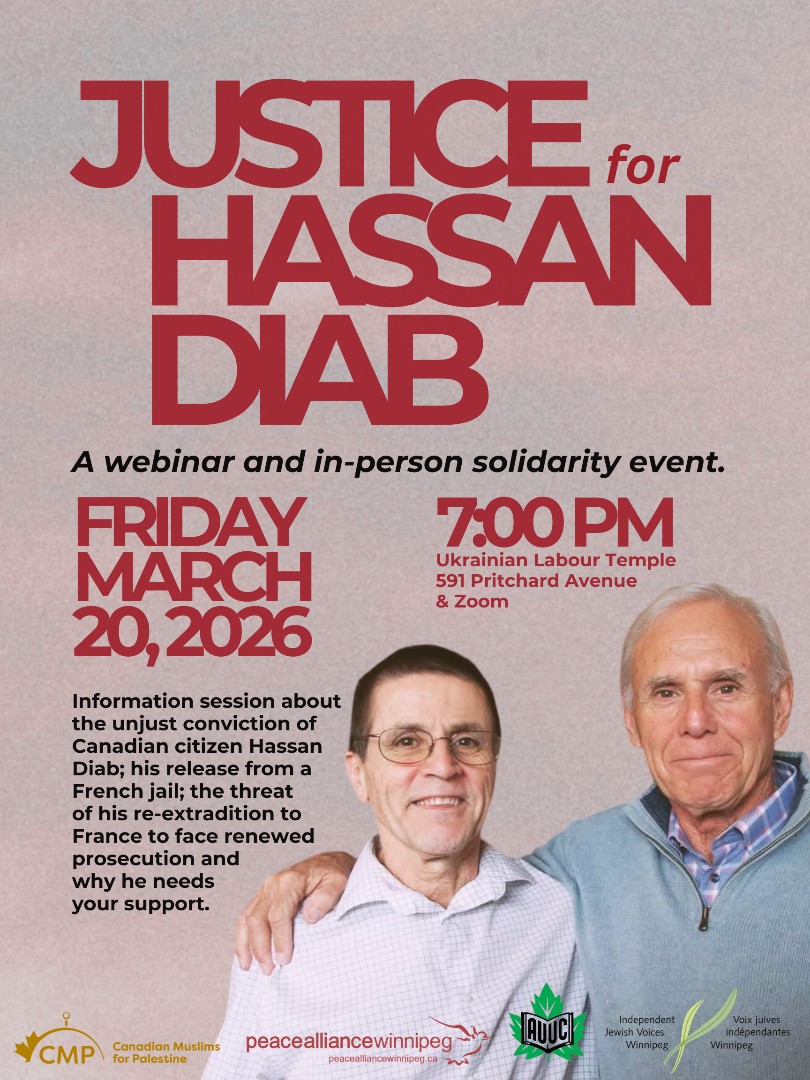
| | Join Hassan Diab for a Webinar and Information Evening | | |
Hassan Diab Support Committee: Dear friends and supporters,
Join us on Friday, March 20, 2026, for a webinar and in-person information session in Winnipeg, Manitoba, hosted by Peace Alliance Winnipeg and other social justice organizations. Guests are welcome to attend online or in person.
Place: Ukrainian Labour Temple, 591 Pritchard Avenue, Winnipeg, Manitoba
Date and Time: Friday March 20, 2026, at:
9:30 pm Newfoundland Daylight Time (St. John’s)
9:00 pm Atlantic Daylight Time (Halifax)
8:00 pm Eastern Daylight Time (Ottawa)
7:00 pm Central Daylight Time (Winnipeg)
6:00 pm Mountain Daylight Time (Edmonton)
5:00 pm Pacific Daylight Time (Vancouver)
Register to attend via Zoom
Hear from Dr. Hassan Diab and his lawyer, Mr. Donald Bayne, as they discuss how Hassan’s case is a troubling example of failures in the Canadian justice system and Canada’s extradition law. Source
ACTION Justice Minister Sean Fraser must act now to end the injustice against Dr. Hassan Diab!
| | Evidence links Indian officials at Vancouver consulate to killing of Sikh activist Hardeep Singh Nijjar | | |
The Globe and Mail 02/03/2026 - Canadian national-security officials were presented with evidence that Indian consular staff operating in Vancouver supplied information to assist in the assassination of Sikh activist Hardeep Singh Nijjar, two sources told The Globe and Mail.
One of the Indian officials worked as a visa officer in the consulate, using his position to gather information about Mr. Nijjar from members of the Indian diaspora in Surrey, B.C., said the sources, one of whom is in law enforcement and one in national security.
Authorities believe the man, Kanwaljit Singh, was also an intelligence officer with India’s external intelligence agency, the Research and Analysis Wing, or RAW, the law-enforcement source said. The national-security source didn’t identify Mr. Singh by name but confirmed that CSIS was monitoring an undercover RAW agent posted to the consulate who was also working as a visa officer.
Mr. Singh worked with Manish, a career diplomat who goes by one name and was Vancouver’s consul-general at the time, both sources said. The Globe is not identifying the sources because they were not authorized to share details of the investigation. Their information is based on the RCMP’s investigation and intelligence from Canada’s spy service and its allies in the United States and Britain.
While Ottawa has accused agents of India of being involved in the assassination, the identities of consular officials and their alleged roles in the Nijjar plot have never been publicly disclosed. The federal government expelled six diplomats in October, 2024, but only publicly named then-high commissioner Sanjay Verma. Mr. Singh had previously been on a Canadian government list of accredited diplomats, The Canadian Press reported at the time, and his name was removed after the expulsions.
Mr. Nijjar, who was a key figure in organizing a referendum urging the creation of a separate Sikh homeland out of what is now the Indian state of Punjab, was gunned down in the parking lot of a gurdwara in Surrey, B.C., on June 18, 2023. The investigation into his death frayed an already strained relationship between Canada and the Indian government of Narendra Modi.
Prime Minister Mark Carney is currently in India trying to restore relations as part of his effort to secure a free-trade deal by the end of the year. India has consistently denied any role in a conspiracy to kill Mr. Nijjar, a Sikh separatist who it long blamed, often without evidence, for co-ordinating violent attacks in his homeland.
India’s High Commissioner to Canada, Dinesh Patnaik, told reporters on Saturday in Mumbai that there was never any foreign interference in Canada by Indian officials, insisting “it never happened.”
The high commissioner’s office declined further comment when asked by The Globe about the allegations against Vancouver consular staff.
Mr. Manish did not respond to messages for comment on social media and an e-mail Saturday to the high commission in Cyprus, where he is now ambassador. The Globe could not reach Mr. Singh, whose location after he was expelled from Canada isn’t known.
Information about Mr. Nijjar was passed to another RAW officer in New Delhi and that officer communicated with the Lawrence Bishnoi organized-crime group, a prominent Indian gang blamed for a rash of extortions and other offences in Canada, both sources said. A Canada-based member of the gang then helped arrange the killing of the outspoken Sikh activist, the sources said.
The New Delhi officer, The Globe’s two sources said, was Vikash Yadav, the same officer named in a U.S. indictment as the mastermind behind a foiled plot to murder another Sikh activist, an associate of Mr. Nijjar’s.
On Monday, Mr. Carney is scheduled to meet with the Indian Prime Minister in an effort to reset the Indian-Canadian relationship, diversify Canada’s international trade and lessen the country’s economic reliance on the United States.
Last week, in a briefing with journalists in advance of Mr. Carney’s trip, a senior government official said Ottawa does not believe India is continuing to interfere in Canada’s domestic politics. Public Safety Minister Gary Anandasangaree later walked that back, saying there’s “a lot more work to do” to ensure agents of the Indian government are not coercing or intimidating people in Canada.
Prior to Mr. Nijjar’s death in June, 2023, New Delhi had long accused him of being a terrorist and unsuccessfully asked the RCMP for years to arrest him and send him to India. [...]
“I think the case should extend to the Indian government. If the government chooses to prosecute only those who pulled the trigger and stop there, that would effectively allow a foreign state to kill our citizens and get a free pass.” Read more - Lire plus
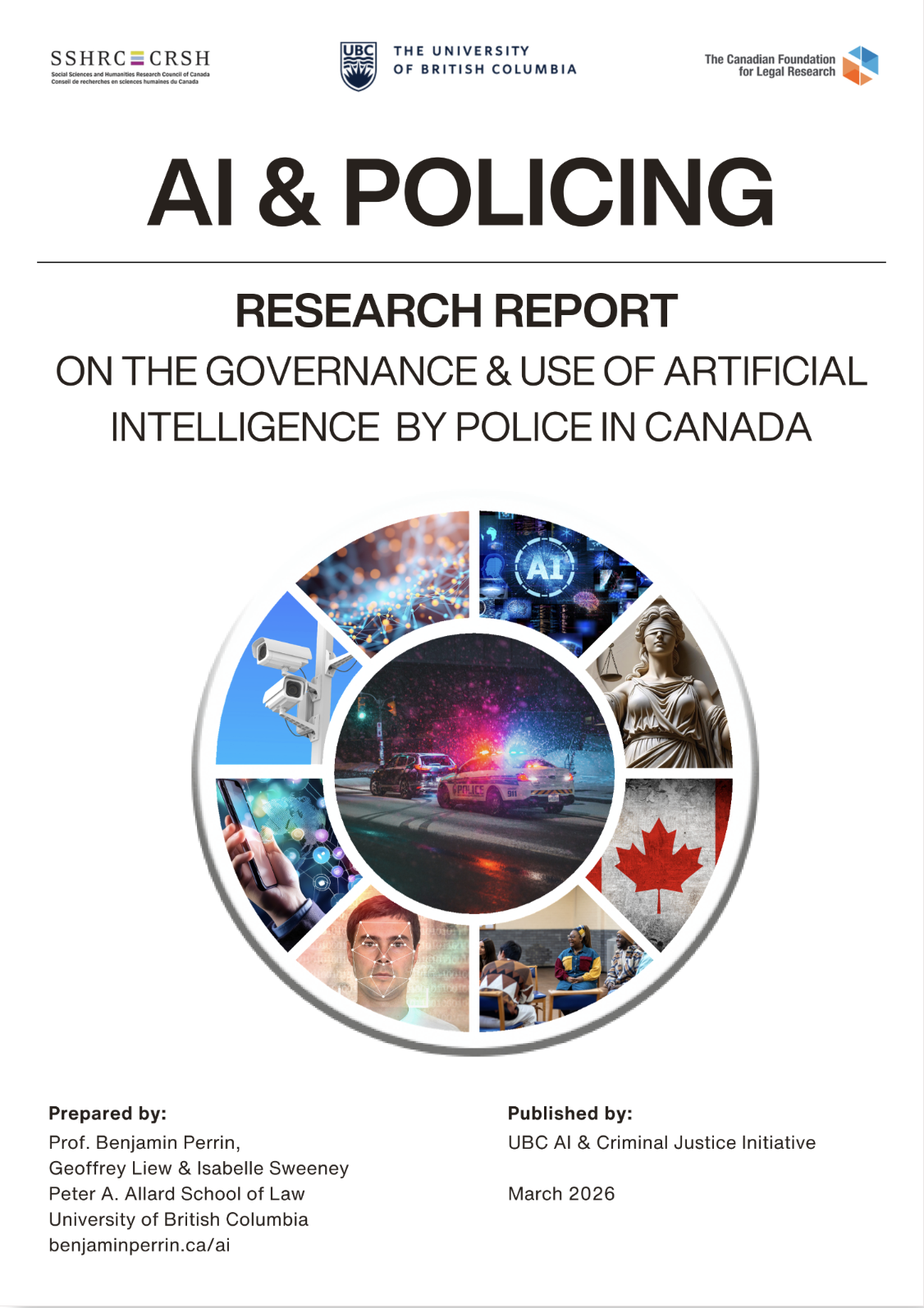
| | AI & Policing: Research Report on the Governance & Use of Artificial Intelligence by Police in Canada | | |
UBC AI & Criminal Justice Initiative 04/03/2026 - This report has explored the growing use of AI by police in Canada in the context of an emerging, fragmented, and largely reactive governance framework. In the wake of the Clearview AI controversy, Canadian police services were initially slow to adopt new AI technologies, allowing valuable lessons to be learned from other jurisdictions such as the United States, where risks manifested in deeply troubling ways that impacted individuals and communities in the absence of robust oversight mechanisms.
Recently, with the chill of the Clearview AI controversy thawing overtime and the adoption of police self-governance AI initiatives, there has been renewed interest among police services in exploring a variety of AI technologies in Canada. These technologies promise public safety, efficiency and cost benefits – all of which are top-level priorities for modern policing agencies.
Not surprisingly, governance has lagged technological innovation. Indeed, there is a widening gap between technological capability and public accountability—one that carries significant consequences for transparency, human rights and privacy protection, accountability, fairness, and public confidence in law enforcement and the administration of justice.
Given that operational uses of AI in policing are high-risk and carry potential consequences for individuals and communities, there is a pressing need to enhance governance systems that work for Canadians in policing. We hope that the key findings and policy implications of this report will assist in this effort, in addition to the knowledge mobilization activities in this project, which are summarized in the companion AI & Policing: Roundtable Report on the Governance & Use of Artificial Intelligence by Police in Canada. Federal and provincial AI policy agendas should urgently add the governance and use of AI in policing to their roster.
Key Findings
Limited independent peer-reviewed empirical validation of police AI tools: There is strikingly little independent scientific evidence demonstrating that many police AI technologies are accurate, reliable, effective or necessary. Despite widespread claims of efficiency and objectivity, significant concerns remain over documented error rates, bias amplification, and false positives. However, there is evidence that some AI tools have led to public safety and efficiency gains, and have demonstrated improvements under controlled conditions as technology improves. As a result, a high degree of skepticism and caution is needed in approaching any AI policing technology.
Widely-documented risks with police AI tools: The most prevalent and persistent risks posed by many operational applications are bias amplification and discriminatory outcomes, privacy infringements, mass surveillance, lack of transparency and accountability, accuracy and reliability concerns, and infringement of constitutional rights.
Police self-governance of AI use varies widely: A wide range of approaches have been adopted by Canadian police services with respect to their use of AI technologies, ranging from formal policies with requirements varying based on risk-level (Toronto Police Service) to public transparency and internal oversight mechanisms (RCMP) to directives on specific AI technologies (Peel Regional Police) to commitments to adopt policies before the deployment of new AI technologies (Vancouver Police Department). However, concerns have arisen over reactive policymaking, disputed risk classification, a lack of independent third-party oversight, insufficient public consultation, and transparency gaps.
Important—but limited—role of impact assessment tools and existing oversight bodies: Privacy and human rights commissions have stepped in to address some of the challenges posed by police uses of AI. This is especially important given the absence of specific legislative and regulatory measures and few judicial decisions to date in this area. Privacy Impact Assessments (PIAs), Algorithmic Impact Assessments (AIAs), and Human Rights AI Impact Assessments (HRIAs) are key operational instruments for risk management of police uses of AI. However, these tools are general in nature and not designed specifically for the coercive, surveillance and evidentiary dimensions of policing. They also do not fully address compliance with the Canadian Charter of Rights and Freedoms (Charter).
Consensus on core AI governance principles: Across AI governance initiatives relevant to policing, consistent themes emerge, including necessity and proportionality, lawful authority, human rights and privacy protection, accuracy standards, bias mitigation, explainability, human oversight, transparency and public notice, public engagement, accountability and access to recourse.
Policy Implications
-
Existing laws of general application should be rigorously applied to police AI tools: The Charter, criminal procedure, privacy law, evidence law and human rights law already apply to any use of AI by police in Canada. While these frameworks are insufficient on their own, they provide a crucial set of standards for immediate application. Criminal justice practitioners, judges and legal scholars play an essential role in safeguarding the integrity of the criminal justice system, making AI literacy and legal competency in this area vital.
- The need for principles on the governance and use of AI by police in Canada, coupled with detailed guidance on specific AI technologies: Consistent, national standards should be informed by a wealth of Canadian and international AI governance initiatives, including those specific to policing, examined in this report. A blind spot in these otherwise insightful instruments relates to the impact on Indigenous peoples of the use of AI in policing. Additionally, detailed guidance on specific AI technologies used by police should be followed in advance of any considered deployment.
- Public engagement and multi-stakeholder discussions are needed regarding the development, procurement and deployment of AI by Canadian police agencies.
- The importance of AI-specific policing legislation and regulations: There is a lack of federal or provincial legislation and regulations that directly address the use of AI by police. This persists despite repeated calls from law reform commissions, privacy commissioners, human rights bodies, and civil society organizations for clear statutory frameworks tailored to address the known risks of AI use by police.
Ultimately, without clear legal standards, independent oversight, and meaningful public engagement, the expanding use of AI in Canadian policing risks causing real harm to affected individuals and communities, undermining public trust in law enforcement. What is needed now is not faster adoption, but a steady, cautious approach relying on comprehensive standards, well-established legal safeguards, robust independent oversight, and democratic accountability to guide – and restrain – how these new powers are used. Read more - Lire plus
Reminder: Participate in Canada's People’s Consultation on AI - Deadline Extended: March 23
People’s Consultation on AI Ad Hoc Working Group: Submission to the House of Commons Standing Committee on Access to Information, Privacy and Ethics (ETHI) for its study of the Challenges Posed by Artificial Intelligence and its Regulation
What do AI firms do when users tell chatbots their dark, violent thoughts?
Eight in 10 popular AI chatbots would help teenagers plan violent attacks, report finds
OpenAI on Surveillance and Autonomous Killings: You’re Going to Have to Trust Us
OpenAI just admitted their AI models deliberately lie to users
US military reportedly used Claude in Iran strikes despite Trump’s ban
AI Firms Can Limit Military Surveillance of Americans. What About of Everyone Else?
How AI is powering transnational repression
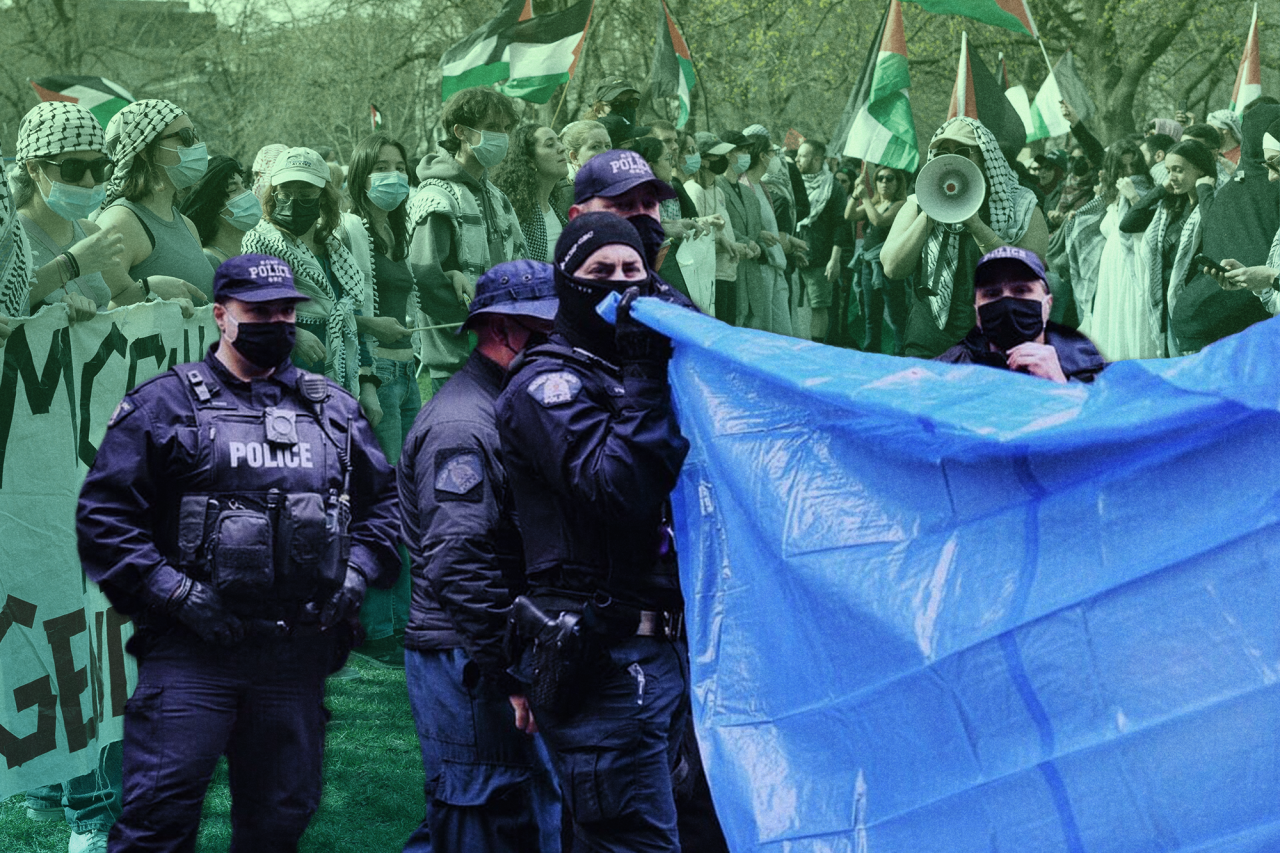
| | A notorious RCMP unit shaped B.C. universities’ reaction to Palestine encampments | |
The Breach 05/03/2026 - In the spring of 2024, as pro-Palestine encampments were still popping up at universities across the country, a student organizer named Kathy got a text she’d long feared: a notorious police unit was now operating on her campus at the University of British Columbia.
In a chat devoted to monitoring police activity, encampment participants left messages saying they had noticed vehicles with the name of the paramilitary Community-Industry Response Group (C-IRG) unit parked outside, and had seen its officers roaming university buildings.
“C-IRG actually were walking all over the campus, not just at the encampment,” recalled Lamya, another organizer. “They were also at this point entering the student union building, student classrooms, and stationed in them 24/7 with binoculars, staring into the camp.” Because they fear university retribution, The Breach has agreed not to use either of Lamya or Kathy’s real names.
In the encampment, student protesters were calling for their university to divest from companies profiting off Israel’s genocide in Gaza. They had become aware of C-IRG’s reputation as a secretive division of the B.C. RCMP specifically created to respond to anti-pipeline protests in the wake of Standing Rock.
Just a few months before encampments had sprung up for Gaza, C-IRG had rebranded and expanded its role to include “civil and public order incidents.” Now operating as the Critical Response Unit (CRU), the unit showed up across B.C. university campuses, including UBC’s campuses in Vancouver (UBC) and Okanagan (UBCO), the University of Victoria (UVic), and Vancouver Island University (VIU).
Not only was the CRU showing up, they were also advising universities on how to respond to them. Documents obtained by The Breach from the universities and the provincial Ministry of Public Safety reveal the significant role that the CRU played in shaping the institutions’ response to a nationwide wave of student activism not seen in decades.
These same records show that the CRU was surveilling student protesters, sharing intel with local police and the provincial government, preparing to clear encampments, and advising universities on how they might punish protesters with consequences ranging from expulsion to criminal charges. Together, these activities form a picture of how the CRU’s role is expanding, as it positions itself as the go-to militarized force to respond to every protest deemed a “public order incident.”
Conor, whose real name The Breach has also agreed not to use, was a UVic encampment participant who encountered C-IRG when he protested old-growth logging at Fairy Creek on southern Vancouver Island in 2021. He recalled that the unit seemed to operate with “a sense of lawlessness and impunity” beyond what he had seen from regular police forces.
“I think when [C-IRG] was first founded, it was like, okay, you can get away with this in a back road on a logging road somewhere where there’s nobody really around, and it’s out of sight, out of mind for the public,” he said. “But you wouldn’t dare do that on the streets of Vancouver. You wouldn’t dare do it at a university.”
Bringing ‘militarized tactics’ to school
When the UBC students noticed CRU units on their campus, they contacted Maryam Adrangi, a member of the Abolish C-IRG network. Having monitored CRU/C-IRG’s actions for several years, this new turn in the unit’s work was something she’d been worried was coming.
“By that point, there had been coverage on how C-IRG and CRU had been monitoring pro-Palestine organizing,” she recalled. “And so it was only a matter of time before they went to the encampments, especially because in Vancouver, the only place that the RCMP really has jurisdiction is on UBC [campus].”
For Adrangi, CRU’s presence at the encampment “was concerning because C-IRG and CRU are known to constantly escalate situations.”
“They are known for their militarized tactics,” she said. “So it was concerning because you have all of these people who are on a university campus trying to talk about issues, progressive thought—that’s what universities are known for—and then they are being faced with a militarized policing unit.”
Through a freedom of information (FOI) request, The Breach obtained access to meeting reports from a working group where police and the B.C. government shared information about “public order incidents,” including Palestine protests. Dating back to April 2024, records show that every week, CRU would compile a list of “public order events” happening within its jurisdiction. This focused mainly on events relating to “Palestine / Israel Conflict, Anti-Sogi [sexual orientation and gender identity] Protests, [and] Anti-Mandate / Freedom Rallies.” And CRU was deployed to attend weekly pro-Palestine rallies across B.C.
On April 30, 2024, the day after the UBC encampment was established, the same working group called an emergency meeting with several municipal police forces to “share intel and messaging” regarding university protests. The CRU updates were provided by Ken Floyd, the former C-IRG Bronze commander who supervised the arrests of Wet’suwet’en land defenders Sleydo’ Molly Wickham, Shaylynn Sampson, and Corey Jocko. The B.C. Supreme Court later ruled that C-IRG had infringed on their rights.
Internal communications obtained through FOI show the CRU arrived early on to assist local RCMP at the UBC encampment, and dedicated extra resources to monitor the protest on campus. At the April 30 meeting, Floyd reported that “RCMP [are] already seeing people, rhetoric, tactics that are similar to Fairy Creek, TMEP [the Trans Mountain pipeline expansion project], CGL [the Coastal GasLink pipeline],” such as “professional protesters, pallets, concrete, [and] barricades.”
But police were waiting for the university’s lead to determine their next steps. Read more - Lire plus
RCMP Discriminated in Abuse Investigation, Human Rights Tribunal Finds
The RCMP vs. the media: Bracken trial approaches its endgame
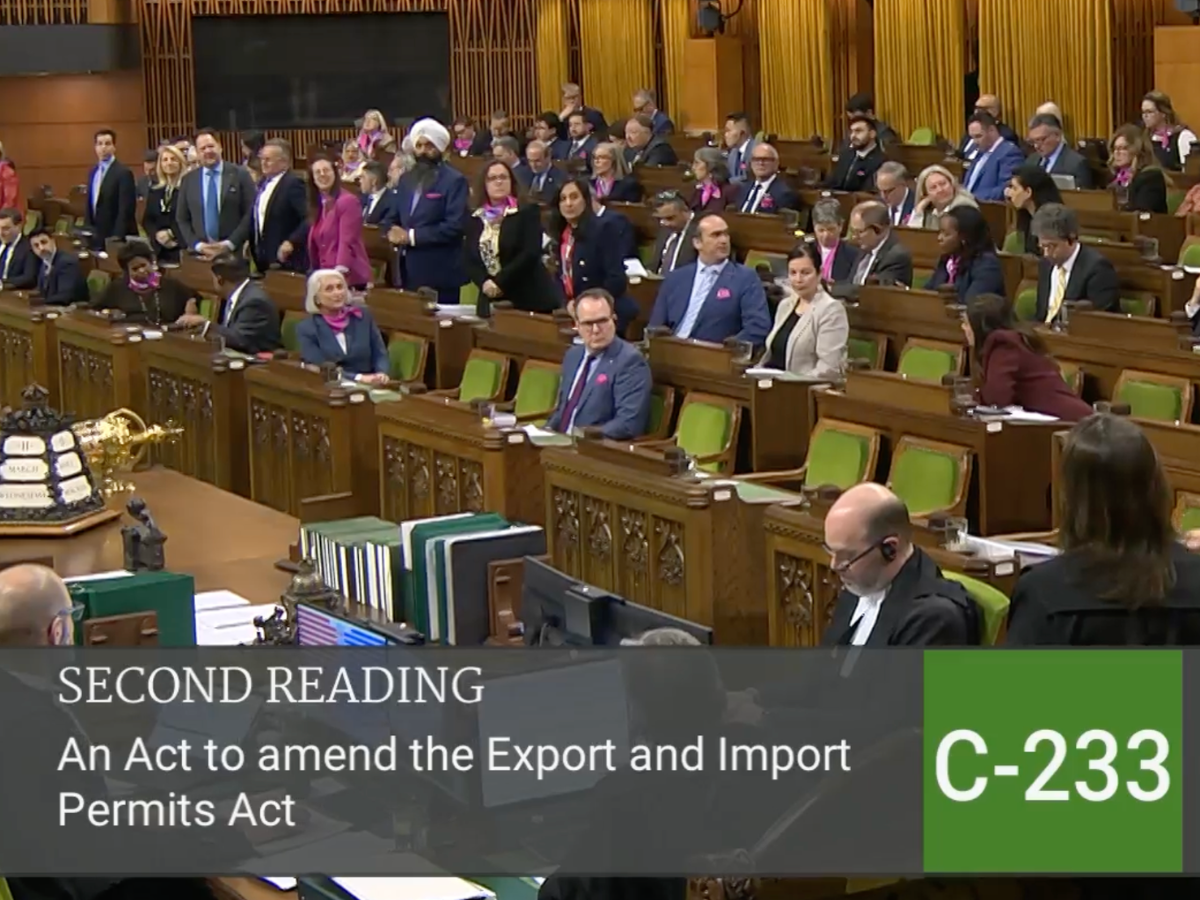
| | Carney government chooses Trump and arming genocide over international law as Liberals vote down ‘No More Loopholes’ Act | |
CJPME 11/03/2026 - The Arms Embargo Now Coalition condemns the Liberal government today after the House of Commons voted down Bill C-233, the No More Loopholes Act, legislation that would have closed a major loophole that allows Canadian military exports to reach Israel through the United States without permits, oversight, or human-rights review.
The vote represents a decisive political choice by the Carney government to maintain Canada’s role in supplying weapons through U.S. military supply chains, even as Israel continues its assault on Gaza and the United States and Israel expand their war across the region.
“This vote was a litmus test,” said Rachel Small, Canada lead with World Beyond War and a spokesperson for the Arms Embargo Now campaign. “The Carney government had a clear opportunity to align Canadian arms exports with international law and human rights. Instead, it chose to align itself with Trump and to preserve the loophole that allows Canadian weapons and explosives to flow into U.S. supply chains fueling Israel’s wars.”
Bill C-233 would have required Canadian military exports to the United States to undergo the same permit requirements and human-rights risk assessments applied to exports to other countries.
The loophole has allowed Canadian weapons components and explosives to move into U.S. weapons manufacturing systems and ultimately into Israeli military operations. In addition, Canadian armoured vehicles have also been witnessed in use by ICE in their deadly operations in Minneapolis, Canadian sensors have been documented being used in the US' attack on Venezuela, and millions of dollars worth of Canadian parts were used to produce every single F-35 fighter jet used in the US and Israel’s bombing of Iran.
“The government has chosen the side of militarism and war profiteering. The side of Lockheed Martin and the arms industry. The side of Trump and Netanyahu’s expanding wars,” Small added.
Grassroots Organizing Fractures Liberal Caucus
Despite the defeat of the bill, a significant political breakthrough: 15 Liberal MPs broke ranks with their leadership and voted in favour of the legislation following months of organizing across the country, while dozens more abstained instead of voting with Carney.
Thousands of Canadians participated in the campaign to close the U.S. loophole, organizing:
- mass email and phone campaigns to MPs
- community canvassing and outreach
- coordinated protests at MP offices
- direct meetings with elected officials
- coordinated media advocacy exposing Canada’s arms exports
This pressure forced the issue into the national spotlight and compelled MPs to publicly take a position.
“For months, communities across the country organized tirelessly to expose Canada’s complicity in war crimes and force their representatives to pick a side,” Boutaïna Chafi, an organizer with the Palestinian Youth Movement said. “Because of that organizing, many MPs broke ranks with their own government to support this bill.”
Evidence of Canada’s Role in the Weapons Supply Chain
The vote took place amid mounting evidence that Canadian weapons components and explosives continue to reach Israel through U.S. military supply chains.
Recent investigative reporting and movement research have documented:
-
Canadian components used in F-35 fighter jets deployed by Israel
-
Canadian explosives used in U.S. weapons manufacturing plants producing bombs and artillery shells exported to Israel
-
That a government agency had itself investigated the risk of Canadian military exports being incorporated into American weapons used by Israel
-
That a key Liberal minister was informed of this diversion
These findings directly contradict repeated government claims that Canada had already halted arms transfers to Israel and that Bill C-233 was thus unnecessary.
“The reality is simple,” Chafi said. “Canada never actually stopped arming Israel. The government simply relied on a loophole that allows weapons to transit through the United States without oversight. They chose industry and profit over the concerns of the majority of Canadians who elected them.” Read more - Lire plus
| | Ottawa’s response to the Iran war exposes the gap between Canada’s rhetoric on international law and its alignment with US power | |
Canadian Dimension 08/03/2026 - On February 28, the United States and Israel launched a war of aggression against Iran. In less than a week, the illegal strikes killed more than 1,000 Iranians. In addition to military installations, the bombings have hit Iranian heritage sites, civilian and energy infrastructure, police stations, and border guard posts.
The attacks destroyed an elementary school in southern Iran, killing 165 children. A New York Times investigation suggested that the US military was responsible for the school bombing, while Al Jazeera found that the massacre of was likely “deliberate.” Meanwhile, the CIA has revealed plans to arm Iranian Kurds against the Islamic Republic government in an apparent attempt to stoke ethnic conflict. The illegal US-Israeli strikes have also risked igniting a broader regional war—precisely the outcome that Iran’s assassinated leader, Ali Khamenei, had warned they would provoke.
Interim NDP leader Don Davies has condemned the war. The Communist Party and the Greens have done so as well. Yet the war has received broad support from Prime Minister Mark Carney, who initially endorsed the US-Israeli strikes and, despite later acknowledging they appear inconsistent with international law, has refused to rule out Canadian participation.
Looking like a ‘lapdog of US hegemony’
The same day the strikes began, Carney and Foreign Affairs Minister Anita Anand published a joint statement declaring Canadian support for the war: “Canada supports the United States acting to prevent Iran from obtaining a nuclear weapon and to prevent its regime from further threatening international peace and security.” The statement also “reaffirms Israel’s right to defend itself and to ensure the security of its people.”
According to Article 51 of the United Nations Charter, UN member states have the right to self-defence only “if an armed attack occurs against a Member.” Iran did not launch an armed attack against either Israel or the United States. That makes the US-Israeli strikes an act of aggression rather than self-defence. Under this framework, the right to self-defence would belong to Iran—the country subjected to the attack—not to the states that carried it out.
Amid criticism from within the Liberal caucus, Carney doubled down on his support for the war several days later. The prime minister acknowledged that the US-Israeli attack violated international law but said he supported it nonetheless, albeit “with regret.” Only later did Carney attempt to frame his position in the language of international law, offering a vague defence of the “rules-based international order” while still refusing to condemn either Washington or Tel Aviv for launching the strikes. The result was a familiar form of Canadian diplomacy: invoking international law in the abstract while declining to apply it to the actions of allies.
This is a striking stance from a head of government who made international headlines in January for his spirited defence of international law and global cooperation at the World Economic Forum in Davos.
Canada’s Defence Minister David McGuinty has effectively endorsed the assassination of Khamenei, describing the late Iranian leader as a “force for evil.” Needless to say, the assassination of foreign heads of state is a clear violation of state sovereignty and the prohibition on the use of force.
On March 4, Carney went further. He stated that Canada could not “rule out participation” in the war against Iran—a war which the prime minister himself admitted was illegal. “We will stand by our allies,” he said. In January 2026, Trump adviser Stephen Miller dismissed the concept of international law as mere “niceties.” Miller said: “We live in a world that is governed by strength, that is governed by force, that is governed by power. These are the iron laws of the world that have existed since the beginning of time.”
By openly supporting a war that he acknowledges is illegal, Carney has tacitly endorsed the Trump administration’s “might makes right” worldview. Since the February 28 attack, peace activists across Canada have organized emergency anti-war rallies—in Toronto, Montréal, Vancouver, Winnipeg, and many smaller cities.
Candice Bodnaruk, a member of Peace Alliance Winnipeg who helped organize an anti-war rally on March 1, told Canadian Dimension: “Canadians do not support this war. A March 3 Angus Reid poll reported that 49 percent of Canadians oppose this war, while only 34 percent support it. Canadians do not want to see Canada supporting an illegal war on Iran—they want money spent at home on social programs.”
There are currently 200 Canadian Armed Forces members stationed in the Middle East. At the time of the US-Israeli strikes, 18 military personnel were serving on exchange at US bases in Bahrain and Qatar. The Department of National Defence denies that any Canadians assisted in the planning or execution of Operation Epic Fury. Regardless, Ottawa has instructed these soldiers to remain embedded with US forces as the Trump administration wages its illegal campaign.
CODEPINK Ontario organizers Anne Kamath and Umer Azad argued that “Ottawa habitually responds to US-led aggression, whether in Venezuela, Palestine, or now Iran, with abstract calls for de-escalation while pointedly refusing to name the United States as the aggressor or condemn its actions as illegal.” Carney’s statement on Iran, however, represents a dangerous escalation:
It moves from passive silence to active endorsement. By explicitly backing what he called the “US-Israeli” military action, Carney abandoned even the pretense of defending a rules-based international order. His Davos rhetoric about international law is now exposed as purely performative, a set of principles to be invoked against states like Venezuela or Iran but suspended the moment a US administration or Israel decides to violate them.
The organizers note that these strikes, in addition to violating international law, are also illegal under US domestic law and are highly unpopular with the American public. “By aligning with the strikes anyway,” they said, “Canada projected weakness, tied itself to a deeply controversial action even many Americans questioned, and undermined its own credibility on the rules-based international order it claims to defend. Mark Carney appeared like a total lapdog of US hegemony.”
Not all Western governments have supported the US-Israeli military action. In the aftermath of the bombing, Spanish Prime Minister Pedro Sánchez evicted US military personnel from Spain’s airbases. Sánchez condemned the attack as “unjustifiable” and “dangerous,” stating that “the world cannot solve its problems with conflicts and bombs.” “It’s not too late,” said Bodnaruk. “Canada could redeem itself and stand on the right side of history by condemning Israel and the US.” Read more - Lire plus
ACTION Tell Carney: Oppose Illegal Attacks on Iran
ACTION Condemn Carney’s irresponsible musings about dispatching troops to Iran
ACTION Withdraw Canadian troops from region assisting US/Israeli aggression on Iran
IJV: No War On Iran
| | Iran: UN experts call for de-escalation and accountability | |
UN 04/03/2026 - UN human rights experts* today condemned the unlawful military attacks launched by the United States of America and Israel against Iran.
“Unprovoked attacks by the US and Israel — launched amid diplomatic negotiations and without authorisation from the Security Council — violate the fundamental prohibition on the use of force, sovereign equality, territorial integrity, and the duty to peacefully settle disputes under Article 2 of the UN Charter. They also violate the right to life,” the experts said.
They also expressed serious concern over Iran’s retaliatory strikes across the Gulf and broader Middle East, reminding that any use of force in self-defence must meet the requirements of necessity and proportionality.
“We cannot pick and choose when international law applies. Unlawful military intervention is not a solution to the nuclear issue, countering alleged terrorism, or the human rights situation in Iran,” the experts said. They warned that the strikes are part of a broader pattern of unlawful unilateral actions by the US and Israel destabilising the entire region including by causing the arbitrary displacement of thousands.
They also expressed concern about the multiple attacks launched by Israel on Lebanon, in clear and repeated violation of international law and the ceasefire agreement, displacing, injuring and killing civilians.
The experts called on all parties to immediately cease hostilities and resume diplomatic dialogue, stressing that there is no viable alternative to the peaceful settlement of disputes.
“These attacks do not strike military abstractions – they strike people,” they said.
“Civilians are bearing the brunt of this war with their lives, their safety, their environment and their health. In a country that has already lost thousands to violent repression following the nationwide protests that began on 28 December 2025, these attacks deepen an already profound human tragedy.”
The experts condemned the strike on a girls’ primary school in Minab, Hormozgan Province, that has killed over 160 schoolgirls and injured many others. Attacks on other densely populated areas, the Iranian Red Crescent, and numerous other hospitals, including Tehran’s Gandhi Hospital and Khatam al-Anbia Hospital, have also been reported.
“The targeting of civilians, educational facilities, and medical institutions constitutes a grave violation of international humanitarian law and human rights law,” they said.
“Unlawful military intervention must not be seen as the solution to the grievances of the Iranian people, nor would any future nuclear deal that does not address these wider grievances be mistaken for one,” the experts said. “Calls by the US and Israel for Iranians to seize control of their own government are reckless and put countless civilian lives at risk.” Read more - Lire plus
Attaque contre l’Iran : Trump et Nétanyahou sont prêts à tout pour rester au pouvoir
No Intel to Support Trump’s ‘Imminent’ Iran Threat, Says Intel Committee Member
‘Bogus Evidence’: Former Nuclear Watchdog Head Debunks US Justification for Iran War
“No Stupid Rules of Engagement”: Ahead of Iran War, Hegseth Halted Efforts to Limit Civilian Deaths
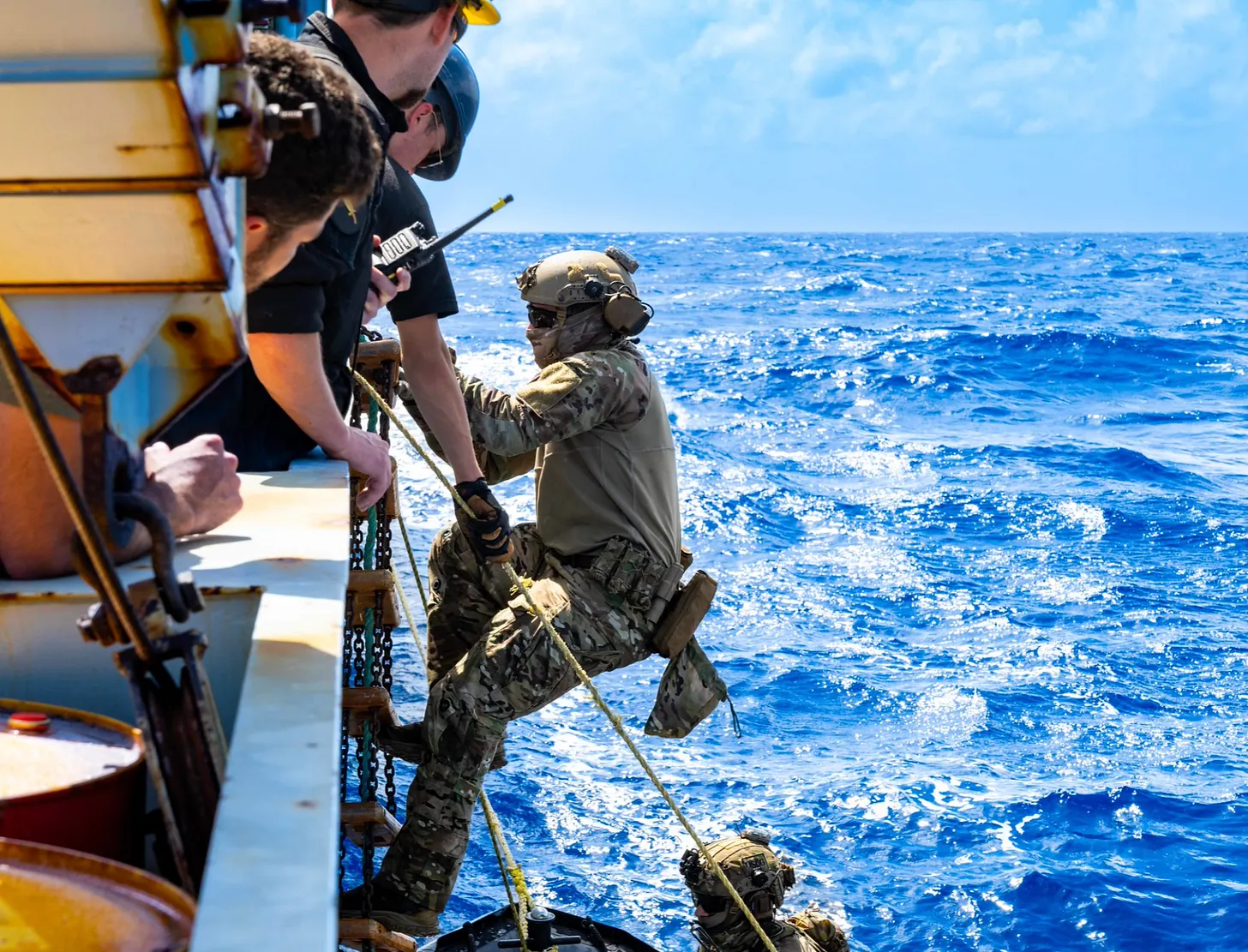
| | Exclusive: Ottawa admits restricting intelligence over Op. Southern Spear concerns | |
The State of Things 07/03/2026 - Sixteen days after my initial email to the media relations team at the Department of National Defence, Ottawa has replied to one of my questions regarding the likely involvement of Canadian Armed Forces (CAF) personnel in the U.S. military’s Op. Southern Spear.
In fact, what they chose to answer says much about the tension those who govern our country must be feeling.
For full context, read my previous piece ‘Blood in the water.’ I have sent back more questions and will update as things come in. The full text of their reply is at the bottom of this piece, but I will focus on the last paragraph specifically.
“The Canadian Armed Forces (CAF) is not sharing intelligence with the United States for the purposes of supporting of their [sic] actions in the Southern Caribbean Sea or on Operation SOUTHERN SPEAR.
The CAF shares information as allowed by Canadian law and authorities. The information-sharing relationship with our allies, including the United States, is governed by policies and procedures aimed at ensuring the respect of our legal and international obligations.
Information and defence intelligence sharing during Op CARIBBE is restricted to JIATF-South and Operation CARIBBE/Operation MARTILLO partners only and will be caveated to not share with any elements of Operation SOUTHERN SPEAR.”
First, let’s unpack what they did tell us:
Ottawa knew they were open to being implicated in Op. Southern Spear due to the close relationship between our militaries and chose to restrict and caveat intelligence sharing to protect our interests.
They’re well aware of the optics of having a Canadian warship deployed on Op. Caribbe while Op. Southern Spear takes place in the same stretch of territory and how that raises uncomfortable questions regarding the level of our involvement - apparently erecting safeguards meant to make us all feel better.
A source of mine explained caveats are “meant to be treated with high seriousness,” and also typically work in reverse, so if the CAF is not permitting any information and defence intelligence sharing with Op. Southern Spear, then Op. Southern Spear would not be allowed to share U.S. intel with Canadians.
The problem is they did not tell the public any of this - in fact it took no small amount of haranguing them on my part for them to even admit there was an issue.
What their answer doesn’t tell us is far more worrying.
None of my questions regarding CAF personnel working under SOUTHCOM and JIATF South were addressed. How can they seal themselves off from crossover between Op. Southern Spear, our personnel working with the U.S. military and Op. Caribbe? Is it possible to compartmentalize at that scale?
What did they do to prevent this? Did they re-assign personnel? Did Ottawa know ahead of time that the U.S. was planning to blast people out of the water? If they ‘war gamed’ all potential problems - why not get ahead of speculation? Fear.
Ottawa fears the breakdown of the relationship between Canada and the U.S. (more than it already has). Saying they will caveat intelligence is easier said than done when SOUTHCOM is in command of Op. Southern Spear and Op. Martillo. JIATF South is included under this umbrella as well.
Speaking of Op. Martillo (which Canada takes part in through Op. Caribbe and other contributions) it’s clear that the Trump administration intends to push further into Latin America. On Tuesday, the U.S. began conducting operations with Ecuador targeting “designated terrorist organizations.”
Los Lobos and Los Choneros, two of Ecuador’s main criminal organizations, were designated as foreign terrorist organizations by the U.S. State Department last September, according to CNN’s Rocio Munoz-Ledo.
Nick Turse from The Intercept managed to get more details: “U.S. Special Operations forces are now assisting in raids by elite Ecuadorian forces on suspected drug cartel “processing and shipping” facilities, according to a second U.S. government official who spoke on the condition of anonymity due to restrictions on sharing the information.”
Turse notes that it’s unclear if the assistance provided by U.S. special forces is combat specific- or if they’re providing intelligence, logistics and mission planning support. Sound familiar? How far will Ottawa be willing to let us be dragged into U.S. military operations that expand by the day? Source
U.S. Military Joins Drug War in Ecuador: “It Wasn’t Going to Be Just Boat Strikes Forever”
| |
Spencer Ackerman: The War on Terror Paved the Way for Trump’s Rise—Now He’s Making It His Own | Only the total abolition of the DHS can restore freedom. |
 | | The Nation 02/03/2026 - [...] Calling people who seek to protect their neighbors “terrorists” provides a crucial clue to the lineage that has led to Minnesota, Venezuela, and now Iran. The so-called War on Terror, a period many think of as having ended, shapes and enables Trump’s aggressions in ways both structural and direct. The Delta Force raid on Maduro’s fortified compound followed on decades of experience—and increased budgets—conducting similar raids in Iraq and Afghanistan. The ICE and CBP agents who have descended on Minnesota are kitted out in the kind of military-style camouflage and body armor that Iraqis and Afghans would recognize. The operation’s initial targets—Black immigrant Muslims from much-bombed Somalia—represent a trifecta of cohorts that were villainized by the nativist politics that the War on Terror revitalized. Both supporters and critics of the Minnesota deployment have compared it to a counterinsurgency campaign. Miller, who was also behind the kidnapping of Maduro, began his rise to White House deputy chief of staff through the ranks of the far right as a campus activist against Islam. Like Trump, Miller has long understood how to take post-9/11 fearmongering about Muslims and direct it toward nonwhite immigrants more broadly.
While many elements of the War on Terror shape Trump’s actions, the significance of the backlash against American power that the War on Terror inspired has, dangerously, not sunk in. After Trump demanded that Denmark cede Greenland to the US as imperial tribute, Canadian Prime Minister Mark Carney drew a rare ovation at the World Economic Forum in Davos for a speech abandoning the “pleasant fiction” that the “rules-based international order” was anything other than a vehicle for US prerogatives. Carney told Europeans horrified at being treated as the sort of foreign possession they themselves used to seize, “We are in the midst of a rupture, not a transition.” But with an insurgency yet to develop in Venezuela, and with NATO hustling to secure a deal to prevent a US move on Greenland, Trump has encountered little to deter him from his mode of imperialism before it reached Tehran. That’s ominous for Havana—and beyond.
Historians will spend decades debating the exact moment when the US empire discredited itself and irrevocably hobbled the international law that it masquerades as. Carney marked it at the Greenland crisis. Many others mark it at the beginning of Israel’s US-sponsored genocide in Gaza in October 2023. I would offer that it’s the War on Terror—corresponding as it does with all but the first 10 years of US global dominance—that defines American power during its period of supremacy. It is an era in which the United States inflicted sustained violence throughout the Global South and called it “order.” But the waves of resistance that US actions generated exposed American weakness. Resentment over the agonies of the War on Terror played an enormous role in Trump’s rise to power.
Every historical era is shaped by its predecessor. The War on Terror was shaped by the Cold War, and it now shapes the empire Trump is constructing. That makes the path of resistance to this new era of imperialism clear: The tools of the War on Terror must be destroyed before Trump uses them to finish building his world order, at home and abroad. [...]
It has become fashionable to speak of Minnesota as the War on Terror coming home. The truth is that the War on Terror was always being waged simultaneously at home and overseas. Federal forces targeted non-Muslim immigrant communities along with Muslim ones as soon as the Twin Towers fell on 9/11. Not only were ICE and CBP created in that climate, but as early as the multi-state raids on Swift meatpacking plants in 2006, ICE was terrorizing working-class immigrants at scale. What is happening now is that US citizens are getting a taste of the treatment previously reserved for noncitizens—and for marginalized communities who live the vulnerable reality of conditional citizenship.
ICE has all but announced that it is beyond the reach of the law. In addition to the slayings and the roundups—if such things can be set to the side—the agency has declared that it needs no judicial warrant to enter someone’s home. On January 28, a judge identified at least 96 court orders that ICE had violated in that month alone. [...]
No amount of retraining can reform agencies that consider Americans an internal enemy. They must be abolished before they kill at greater scale. But the dominant faction in the Democratic Party is doing its best to avoid recognizing ICE for the threat that it is.
ICE is predicated on the post-9/11 idea that the civil offense of being undocumented ought to be met with a deportation force on the hunt in the interior of the country. Such operations cannot be divorced from nativist politics. Similarly, whatever legitimate border-control functions exist cannot be carried out by what the former Border Patrol agent Jenn Budd has called a “notoriously corrupt and racist federal agency.” Alongside abolition must come accountability for the crimes that federal agents have committed during this crackdown. A central lesson of the War on Terror is that impunity for one atrocity—the “absolute immunity” that Vice President JD Vance falsely declared ICE agents to possess—is a green light for the next. Read more - Lire plus
ICE Tried To Turn This Minneapolis Teacher Into An Informant
| | Judge Blocks DeSantis’s Declaration of Muslim Group as Terrorist Organization | |
The New York Times 04/03/2026 - Florida’s move to declare the Council on American-Islamic Relations, one of the nation’s largest Muslim advocacy and civil rights groups, a foreign terrorist organization was unconstitutional, a federal judge ruled on Wednesday.
Judge Mark E. Walker of the Federal District Court in Tallahassee said that Gov. Ron DeSantis’s attempt to withhold distribution of government benefits to CAIR, as the organization is known, or to anyone who provides it with “material support or resources,” violated the First Amendment rights to free speech, petition and free association.
“The First Amendment bars the governor from continuing the troubling trend of using an executive office to make a political statement at the expense of others’ constitutional rights,” wrote Judge Walker, who has frequently ruled against the DeSantis administration. He granted the preliminary injunction sought by CAIR after Mr. DeSantis, a Republican, signed an executive order in December declaring the organization a terrorist group. CAIR sued in federal court a week later.
Mr. DeSantis had followed Texas, which issued a similar declaration in November, though Florida’s declaration did not appear to prohibit CAIR from buying land in the state like the one in Texas. In Florida, Judge Walker wrote that CAIR’s free speech rights were infringed when an audio production company backed out of an agreement to make a podcast with the organization as a result of Mr. DeSantis’s order.
“No governor has the right to violate the Constitution by unilaterally declaring an American organization whose speech he dislikes a ‘terrorist’ group and then punish them and their supporters, all without due process,” Lena Masri, CAIR’s litigation director and general counselor, and Hiba Rahim, CAIR Florida’s executive director, said in a joint statement. Mr. DeSantis’s office did not immediately respond to a request for comment.
While the governor has broad authority to issue executive orders, the order against CAIR went beyond those powers, the judge said. He wrote that Florida’s order had declared CAIR a terrorist organization “with no substantive explanation of his authority to do so, no legislative involvement and no mechanism for judicial review.”
State lawmakers, who are in regular session until next week, have filed bills providing a process to designate groups as terrorist organizations. The American Civil Liberties Union has called the legislation “sweeping” and warned that it could violate the First Amendment. Source
Republican State Attorneys General Call on DOJ to Investigate Climate Change Organizations
Republicans Use Hearing on Foreign Influence to Attack Nonprofit Sector
| | Anti-ICE protesters accused of being part of antifa found guilty of support for terrorism in Texas | |
The Guardian 13/03/2026 - A group of protesters in Texas was found guilty of providing support for terrorism and other charges on Friday in a closely watched case in which prosecutors alleged anti-ICE activists were actually part of an antifa cell.
The case was seen as a major test of the first amendment and whether the government could use a broad anti-terrorism statute to prosecute leftwing protesters. It marked the first time the government alleged individuals were part of an antifa terrorist cell in a criminal prosecution.
Nine defendants – Benjamin Song, Zachary Evetts, Autumn Hill, Meagan Morris, Maricela Rueda, Savanna Batten, Ines Soto, Elizabeth Soto and Daniel Sanchez-Estrada – were all tried together in the case. They faced a mix of charges of providing material support to terrorists, rioting, attempted murder, as well as firearms and explosive charges.
Sanchez-Estrada was the only defendant not at the protest, and was only charged with corruptly concealing a document or record, after prosecutors say he moved leftwing zines following the arrest of his wife, Maricela Rueda, on the Fourth of July. Song also escaped after the incident and there was an 11-day manhunt for him. Several other people were charged with assisting Song during that period.
The nine defendants were convicted on all of the charges they faced, with limited exceptions. Of the five charged with attempted murder and firearms charges, Evetts, Hill, Morris and Rueda were acquitted.. Song was acquitted on two charges of attempted murder and convicted on one. He was also convicted of the firearms charges.
Song faces a minimum of 20 years and a maximum of life in prison, according to the US attorney for the northern district of Texas. Arnold, Evetts, Morris, Rueda, Batten, Elizabeth Soto and Ines Soto each face between 10 and 60 years in prison. Sanchez Estrada faces up to 40 years.
The DFW Support Committee, a coalition that has been supporting the defendants, said in a post on X they were “heartbroken”. The defendants also face state charges.
“This is only the beginning. We will continue to fight the remaining charges until every defendant is home,” the group said. “Everything about this trial from beginning to end has proven what we have said all along: this is a sham trial, built on political persecution and ideological attacks coming from the top.”
“Antifa is a domestic terrorist organization that has been allowed to flourish in Democrat-led cities – not under President Trump,” Pam Bondi, the attorney general, said in a statement. “Today’s verdict on terrorism charges will not be the last as the Trump administration systematically dismantles antifa and finally halts their violence on America’s streets.” [...]
Throughout the trial, prosecutors focused on several protest tactics they said was evidence that the demonstrators coordinated an ambush on law enforcement or should have reasonably expected one to occur. They pointed to the fact that the demonstrators took steps to prevent their cell phones from being tracked.
Prosecutors also pointed to the way that the protesters used Signal, a widely-used messaging application, as evidence of their coordination and conspiracy. The protesters used pseudonyms on the app and had messages autodelete, an increasingly common practice among protesters and journalists who are concerned about government surveillance. They also emphasized the defendants were wearing all black during the protest, sometimes describing it as “tactical” gear. While the defendants were dressed in dark clothing, defense lawyers highlighted that many of the things they wore could be bought by the public at a retail store like Walmart.
But the idea that violence was expected was undercut at times by the government’s own witnesses. Several witnesses who took plea deals testified that they were surprised when the protest turned to violence.
During the trial, the government offered a slew of circumstantial evidence aimed at convincing the jury that the defendants were part of an antifa terror cell. They showed the jury zines and reading lists with incendiary titles that were seized from the defendants. One zine seized was titled The satanic death cult is real. The zine is an essay analyzing the films Hereditary and Midsommar [written by Sophie Lewis, see link below]. They also displayed anti-Trump stickers seized from one of the defendants that said “Make America not Exist Again” and a pamphlet from the Socialist Rifle Association that showed someone putting a swastika into a garbage can.
Attorneys for the defendants argued that the government was punishing protesters because they disliked their beliefs. “The government is asking you to put protesters in prison as terrorists. You are the only people who can stop that,” Blake Burns, an attorney for Elizabeth Soto, said during his closing statement to jurors.
Sanchez Estrada’s attorney, Christopher Weinbel, said he can’t believe jurors “came to this conclusion”. Weinbel said he was deployed as a member of the army several times in the defense of the US, and he’d hoped what he sacrificed “meant something”. “But I feel like it turned its back on justice with this, Weinbel said. “The US lost today with this verdict.”
Even though prosecutors focused on antifa throughout the case, and the justice department touted the allegation in press releases and public statements, it was not really legally relevant to the terrorism charge they face. The statute they were charged under does not require any kind of relationship to a terrorist organization. Instead, it merely says someone provides material support to terrorists if they assist them in carrying out a list of specific federal crimes. In this case, prosecutors said the underlying terrorism crimes were damaging government property and attempting to kill law enforcement.
During his closing statement, prosecutor Shawn Smith told jurors the defendant’s antifa beliefs were not why they were on trial, according to KERA. “They’re here because they used these tactics that assisted in the ambush of a cop,” he said.
Mark Pittman, a US district judge nominated to the federal bench by Donald Trump in 2019, appeared to gesture at the irrelevance of antifa in the closing moments of the trial, asking prosecutors why he should mention it in his instructions to the jury, underlining the gap between the emphasis on antifa and the technicality of the criminal charges they faced. “Whether it’s antifa or the Methodist Women’s Auxiliary of Weatherford, why does it matter?” Pittman said. Read more - Lire plus
Sophie Lewis: I Wrote a Movie Review. Cops Took It From A Protester’s Home to Make the Case That He’s a Terrorist.
How a Broadly Defined Counterterrorism Statute Could Be Abused
Prison-Style Free Speech Censorship Is Coming for the Rest of Us
Islamophobic Think Tank Helped Write Indictment Against ICE Protesters
| | OTHER NEWS - AUTRES NOUVELLES | | ICLMG ACTIONS DE LA CSILC | | UPDATED: Stop Bill C-9 as it will criminalize dissent! | | |
The Liberal government introduced Bill C-9, the Combatting Hate Act, which is aimed at preventing hate crimes but instead threatens the Charter rights and civil liberties of all people in Canada, including those communities that the government wishes to help protect.
- Bill C-9 gives police discretionary powers to determine which symbols are hateful and what are protesters intentions, which will lead to more arbitrary arrests and disruptions of peaceful assemblies, potentially including labour picketing.
- These new broad and discretionary powers, combined with increased jail sentences, will significantly undermine free expression and dissent, sending a chill amongst those who would otherwise take part in protests.
- The removal of the existing requirements for attorney general approval of laying hate propaganda charges, allowing police to make these decisions, compound these concerns.
- This bill is highly alarming, especially in the context of the crackdown on Palestinian solidarity and anti-genocide protests.
| | The Justice Minister must end the injustice against Hassan Diab! | | |
In April 2023, despite clear exculpatory evidence, the French Court of Assize conducted an in absentia trial that unjustly declared Dr. Hassan Diab guilty and sentenced him to life in prison. The proceedings amounted to a sham trial and a mockery of justice.
Since that ruling, Dr. Diab and his family have lived in constant uncertainty, facing the ongoing threat that a second extradition request could be made at any time.
Please click below to send a new letter demanding that Justice Minister Sean Fraser categorically refuse any future extradition request and put an end—once and for all—to this ongoing miscarriage of justice.
| |
Canada: Abolish rights-violating terrorist entities list!
| | |
On October 15, 2024, the Canadian government placed the Samidoun Palestinian Prisoner Solidarity Network on Canada’s terrorist entities list. While ostensibly a tool to protect the safety and security of people in Canada and internationally, the list is an arbitrary political tool that undermines freedom of association, of expression and due process in the courts. Its effectiveness as a national security tool has never been demonstrated in a manner that justifies its use.
Due to these deep flaws, and more, the ICLMG has consistently called for the list to be abolished since the Canadian coalition’s founding in 2002. Please join us in urging the Canadian government to abolish the rights-violating terrorist entities list once and for all. Thank you!
| | Canada must repatriate all Canadians detained in NE Syria/Iraq now! | Every day the government fails to bring these Canadians home, it places their lives at risk from disease, malnutrition, violence, and ongoing military conflicts. United Nations officials have even found that the conditions faced by Canadians in prison are akin to torture. Please click below to urge the federal government to repatriate all Canadians illegally and arbitrarily detained in northeast Syria without delay. | | 23 years of fighting deportation to torture: Justice for Mohamed Harkat! | | CSIS isn't above the law! | | |
In recent years, at least three court decisions revealed the Canadian Security and Intelligence Service (CSIS) engaged in potentially illegal activities and lied to the courts. This is utterly unacceptable, especially given that this is not the first time these serious problems have been raised. CSIS cannot be allowed to act as though they are above the law.
Send a message to the Public Safety Minister demanding that he take immediate action to put an end to this abuse of power and hold those CSIS officers involved accountable. Your message will also be sent to your MP and to the Minister of Justice.
| | Reform Canada's extradition law now! | |
Canada’s extradition system is broken. One leading legal expert calls it “the least fair law in Canada.” It has led to grave harms and rights violations, as we’ve seen in the case of Canadian citizen Dr Hassan Diab. It needs to be reformed now.
Click below to send a message to urge the Prime Minister, the Minister of Justice and your MP to reform the extradition system before it makes more victims. Thank you!
Version française: Le Canada doit réformer la loi sur l'extradition!
| | Canada must protect encryption! | |
Canada, with other G7 nations, continues to push to weaken our access to strong, reliable encryption, after decades of being supportive of strong encryption. We need encryption to safeguard our data, our online transactions, our communications, and to protect the lives of journalists and human rights activists.
Please send a message to the Prime Minister of Canada, the Minister of Public Safety, as well as your Member of Parliament, to urge them to reverse course and once again commit to protecting encryption.
Regardez la vidéo avec les sous-titres en français + Agir
| | Protect our rights from facial recognition! | Facial recognition surveillance is invasive and inaccurate. This unregulated tech poses a threat to the fundamental rights of people across Canada. Federal intelligence agencies refuse to disclose whether they use facial recognition technology. The RCMP has admitted (after lying about it) to using facial recognition for 18 years without regulation, let alone a public debate regarding whether it should have been allowed in the first place. Send a message to the Prime Minister and the Public Safety Minister calling for a ban now. | | What we've been up to in 2025, and our plans for 2026! | |
ICLMG 03/12/2025 - Thanks to the support of our members and donors, we’ve been able to do a lot and work on the following since June:
- Anti-privacy and xenophobic bills C-2 & C-12
- Anti-protest and anti-freedom bill C-9
- Impacts of Countering Terrorism Financing on charities, non-profits, solidarity work and international assistance.
- Canada’s complicity in torture
- Justice for Hassan Diab
- Artificial Intelligence regulatory frameworks & national security
- The gaps in oversight and review of national security agencies
- Consultations on the UN Global Counter-terrorism strategy & definitions of “terrorism” and “violent extremism"
- We were interviewed or quoted in dozens of media pieces
- And much more!
For all details on our activities, and our plans for 2026, click here.
| | Les opinions exprimées ne reflètent pas nécessairement les positions de la CSILC - The views expressed do not necessarily reflect the positions of ICLMG. | | |
THANK YOU
to our amazing supporters!
We would like to thank all our member organizations, and the hundreds of people who have supported us over the years, including on Patreon! As a reward, we are listing below our patrons who give $10 or more per month (and wanted to be listed) directly in the News Digest. Without all of you, our work wouldn't be possible!
James Deutsch
Bill Ewanick
Kevin Malseed
Brian Murphy
Colin Stuart
Bob Thomson
James Turk
John & Rosemary Williams
Jo Wood
The late Bob Stevenson
Nous tenons à remercier nos organisations membres ainsi que les centaines de personnes qui ont soutenu notre travail à travers les années, y compris sur Patreon! En récompense, nous nommons ci-dessus nos mécènes qui donnent 10$ ou plus par mois et voulaient être mentionné.es directement dans la Revue de l'actualité. Sans vous tous et toutes, notre travail ne serait pas possible!
Merci!
| | | | |