|
International Civil Liberties Monitoring Group
Coalition pour la surveillance internationale des libertés civiles
September 12, 2026 - 12 septembre 2026
| Bimonthly news round-up about national security's negative impact on civil liberties in Canada and abroad | | Reminder: The Damage of De-risking: ICLMG report launch with Tim McSorley in conversation with Amira Elghawaby | | |
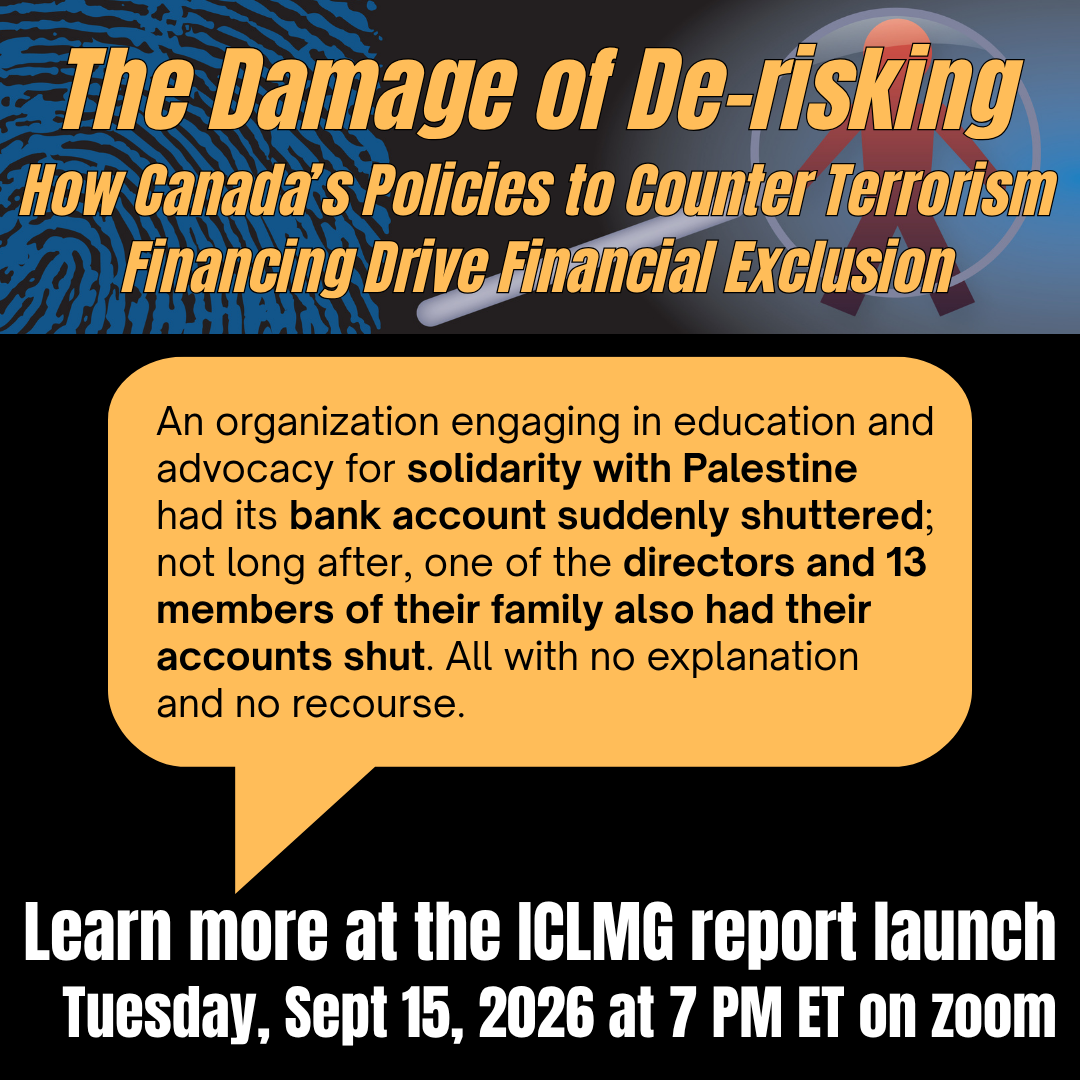
Join us for the virtual launch of ICLMG’s latest report: “The Damage of De-risking: How Canada’s Policies to Counter Terrorism Financing Drive Financial Exclusion”
NEW: ICLMG’s National Coordinator and report author, Tim McSorley, in conversation with former Special Representative on Combatting Islamophobia, Amira Elghawaby
Tuesday, September 15, 2026 at 7 PM ET, online
Register here!
An organization engaging in education and advocacy for solidarity with Palestine has its bank account suddenly shuttered; not long after, one of the organization’s directors and 13 members of their family also have their accounts shut. All with no explanation and no recourse. A humanitarian organization providing aid to civilians in Syria and other populations in crisis is suddenly told that their online donation processor would be shutting their account in 30 days, with no explanation.
This is the reality of de-risking: the practice whereby financial institutions terminate or restrict access to financial services for certain clients or sectors to avoid perceived regulatory, compliance, or reputational risk, rather than managing that risk through proportionate, individualized and evidence-based mitigation measures. This has resulted in unjustified and discriminatory decisions that significantly impact both individual and organizational clients, including non-profits and charities.
Our report shows that the de-risking of non-profit organizations in Canada, particularly those that are active in Muslim communities or carrying out humanitarian activities abroad, is not a series of isolated commercial decisions made by individual banks, but a predictable structural outcome of Canada’s anti-terrorist financing framework.
During the webinar, we will present our analysis of Canada’s anti-terrorist financing ecosystem and its impacts, share case studies from individuals and organizations who have been impacted by de-risking, and outline our recommendations to remedy the situation.
Speakers:
Tim McSorley is the National Coordinator of the International Civil Liberties Monitoring Group. He joined the coalition in 2016. In 2021, he authored the report The CRA’s Prejudiced Audits: Counter-Terrorism and the Targeting of Muslim Charities in Canada, a precursor to this new report.
Amira Elghawaby is a journalist, human rights advocate, and the Founder and Executive Director of the Muslim Communities Research Observatory. She served as the first ever federal Special Representative on Combatting Islamophobia from 2023 to 2026.
Register above to receive the link and reminders before the event. And please share and invite your friends and colleagues: Bluesky + Instagram + Facebook + LinkedIn + Twitter + Source
| | Reprise: Why we need to ditch anti-terrorism and national security | | |
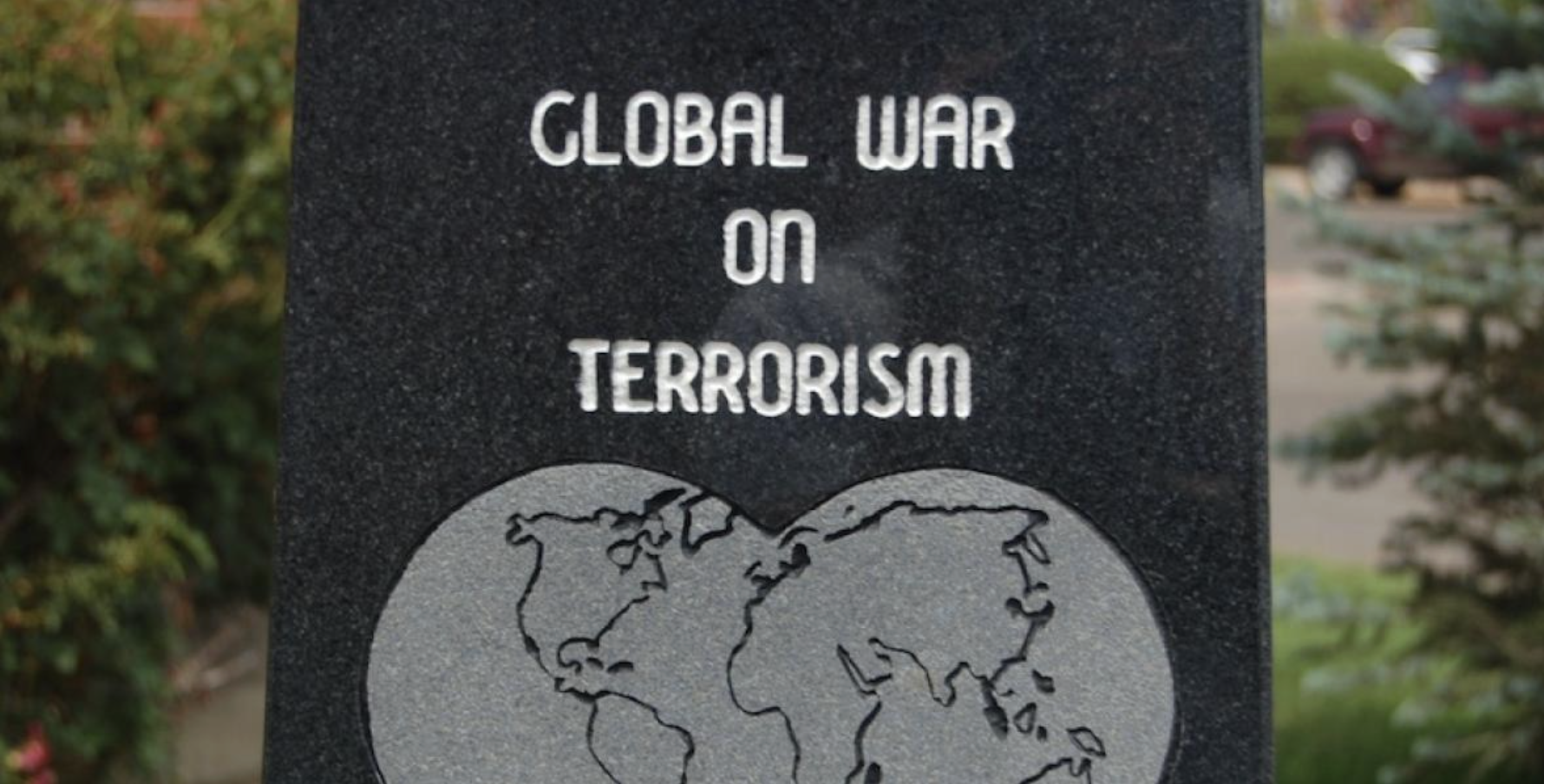
ICLMG 11/09/2026 - On the 25th anniversary of the Sept. 11, 2001, attacks, the International Civil Liberties Monitoring Group remembers the thousands killed that day. We also mourn the millions who have been killed since, as a result of the decades of militarism and state-backed violence that came in response as part of the so-called “War on Terror.”
Today, we continue to see the ever-growing weaponization of post-9/11 “anti-terrorism measures” in Canada, the US and around the world: ballooning watchlists, the banning of organizations, attacks on free expression, dissent and protest, immigration crackdowns, ramped up surveillance, huge investments in military and national security, increased government secrecy, growing racism, Islamophobia and xenophobia, and expanding anti-terrorism laws. Governments also continue to justify new powers and increased repression by relying on old fake threats to public safety, or by creating new ones, including the very existence of trans people, the fight for Palestinian lives, migrants seeking safety, movements against fascism like antifa, climate justice advocates, and political beliefs like anarchism.
Today, we’re re-sharing an op-ed we published 5 years ago, on the 20th anniversary, that we think rings even more true today: we must rethink and challenge what is viewed as “national security” and focus instead on building human safety. Source
Here is an excerpt of the piece:
Concerns around “national security” in Canada have led to:
This is only in Canada. [...]
The words “terrorism” and “threats to national security” are powerful. Thanks to years of relentless fear-mongering from governments and the media, they elicit automatic condemnation of whomever is stamped with those labels. As a result, these labels have become a very effective tool for the state (and other actors) to discredit and/or repress any group, movement or person — especially people who challenge the status quo, oppose government policies and actions, and fight for collective liberation.
How do we fix this? By getting rid of the word “terrorism,” as well as anti-terror laws and tools, and by replacing “national security” and its apparatus with policies and actions that foster human safety.
Why not just reform our anti-terror laws and national security apparatus to fix its abuses and the erosion of civil liberties? Here are five reasons:
1. “Terrorism” and “national security” are easily malleable
2. The myth of the Muslim ‘terrorist’
3. Diversion from states’ monopoly on violence
4. Targeting Indigenous land defenders and environmental activists
5. National security cannot ensure human safety Read more - Lire plus
The U.S. Has Killed 227 Civilians in Boat Strikes During “A Year of Murders”
Somali Migrant With Legal Right to Live in US Sent to Guantánamo
US Imposes Sanctions on 3 “Far-Left Terrorist Networks”: Autistici Inventati or A/I Collective, an Italy-based group that provides internet support to activists and collectives, Palestine Action and Masar Badil, or the Palestinian Alternative Revolutionary Path Movement, a global organization that advocates for Palestine
The British state has recast protest as terrorism
Charlie Kirk died a year ago. Trans people are still paying the price
Greatest Threat to America Since 9/11?
| How 9/11 changed Canada’s approach to national security | | |
The Canadian Press 10/09/2026 - [...] On Dec. 10, 2001, the Chrétien government’s budget allocated $7.7 billion over five years to enhance security. More than $1.2 billion of that sum was aimed at strengthening the border by stopping individuals and shipments that pose a security risk while speeding up legitimate traffic.
Two days later, Manley and Ridge signed the Smart Border Declaration and released a 30-point plan that addressed issues ranging from biometric identifiers and permanent resident cards to aviation security standards and joint border and marine enforcement teams.
On Dec. 18, Canada’s new Anti-Terrorism Act received royal assent. The legislation allowed the federal government to brand individuals and organizations as terrorists, and to impose stiff penalties on anyone who participates in their activities or assists members of terrorist groups.
The law also gave police the power to make “preventive arrests” of those suspected of planning a terrorist attack, and required anyone with information relevant to the investigation of a terrorist act to appear before a judge. Many of the measures drew cries of outrage from civil libertarians.
The government created the Canadian Air Transport Security Authority to carry out airport screening previously performed by airlines, an approach the government said would ensure consistency and accountability. Ottawa also reorganized agencies to create the Public Safety and Emergency Preparedness Department, poured billions of new dollars into security intelligence organizations and assembled a no-fly list. Under a 2011 continental security pact, Canada and the United States agreed to set up co-ordinated systems to track the entry and exit information of travellers.
The effort involves exchanging entry information collected from people at the land border, so that data on entry to one country serves as a record of exit from the other. The data includes the traveller’s name, nationality, date of birth and gender, the country that issued their travel document and the time, date and location of their crossing.
Despite the investment of energy, money and time in remaking the security landscape, Canadian officials often found themselves trying to dispel misconceptions. Manley said one of his assignments was to inform U.S. legislators — including Hillary Clinton — that none of the 9/11 hijackers entered the United States from Canada. “And when corrected, her reaction was, ‘Well, if they didn’t, they could have, and security trumps trade,’” he said.
A quarter century after 9/11, Canadians are reminded of how their world changed every time they’re asked to remove their belt or discard liquids while going through airport security. Many routinely encounter airport-style scrutiny when attending sporting events, or even visiting city hall. If the 9/11 perpetrators hoped to cost the developed world a lot of money and time, “they succeeded beyond their wildest imaginations,” Manley said.
The International Civil Liberties Monitoring Group, a national coalition formed after the adoption of the Anti-Terrorism Act, argued in early 2003 that the association of terrorism with Islam had led to the racial profiling of an entire community.
Manley said the government tried to emphasize publicly that 9/11 “was not motivated so much by religion as it was by a twisted ideology that may have been religiously rooted, but was not characteristic of most Muslims.”
The legacy of 9/11 lives on in the choices made by governments in the immediate aftermath, “and those are also consequences that we continue to live with to this day,” said Steve Hewitt, an associate professor of North American history at the University of Birmingham in England. [...]
Canada’s embrace of the fight against terrorism led to other tragic consequences. Maher Arar, a Syrian-born Canadian, was detained in New York in September 2002. Deported by U.S. authorities, he wound up in a grave-like cell in Damascus. Under torture, Arar gave false confessions to Syrian military intelligence officers about his supposed collaboration with the al Qaeda network.
A federal commission of inquiry led by Justice Dennis O’Connor concluded that faulty information the RCMP passed to the United States very likely led to Arar’s yearlong ordeal. In October 2008, an inquiry led by former Supreme Court justice Frank Iacobucci found Canadian officials contributed to the torture of three other Arab Canadians — Abdullah Almalki, Ahmad El Maati and Muayyed Nureddin — by sharing information with foreign agencies.
Iacobucci concluded the men were abused in Syrian custody and, in the case of El Maati, in Egypt as well.
The former judge said the RCMP, the Canadian Security Intelligence Service and the Department of Foreign Affairs all made mistakes in the cases.
In 2006, authorities foiled a terrorism plot by the so-called “Toronto 18.” Eight years later, a man killed an honour guard at the National War Memorial before storming Parliament Hill. He said his actions were spurred by Canada’s military involvement in Afghanistan and Iraq.
Hewitt, author of the forthcoming book “A History of Terrorism in Canada,” acknowledges these episodes. But he points out that some of the most appalling assaults in Canada since 9/11 — including a mass shooting at a Quebec mosque and a vehicle attack on a family in London, Ont. — have been driven by hatred of Muslims.
Manley said while the recent rise of neo-Nazism and white supremacy is a generation removed from the Sept. 11 attacks, they are “direct results of some of the antagonism and hatred that emerged post-9/11.” “It began pitting citizens against one another,” he said. “I think it’s one of the things that we have to regret in the modern world.” Read more - Lire plus
Twenty-five years after 9/11, there are still questions we’re not allowed to ask
CBC's unattributed use of "terrorist" in reference to 9/11 violates its journalistic standards
| | 25 years since 9/11, Canada is not further ahead on tackling Islamophobia: advocates | | |
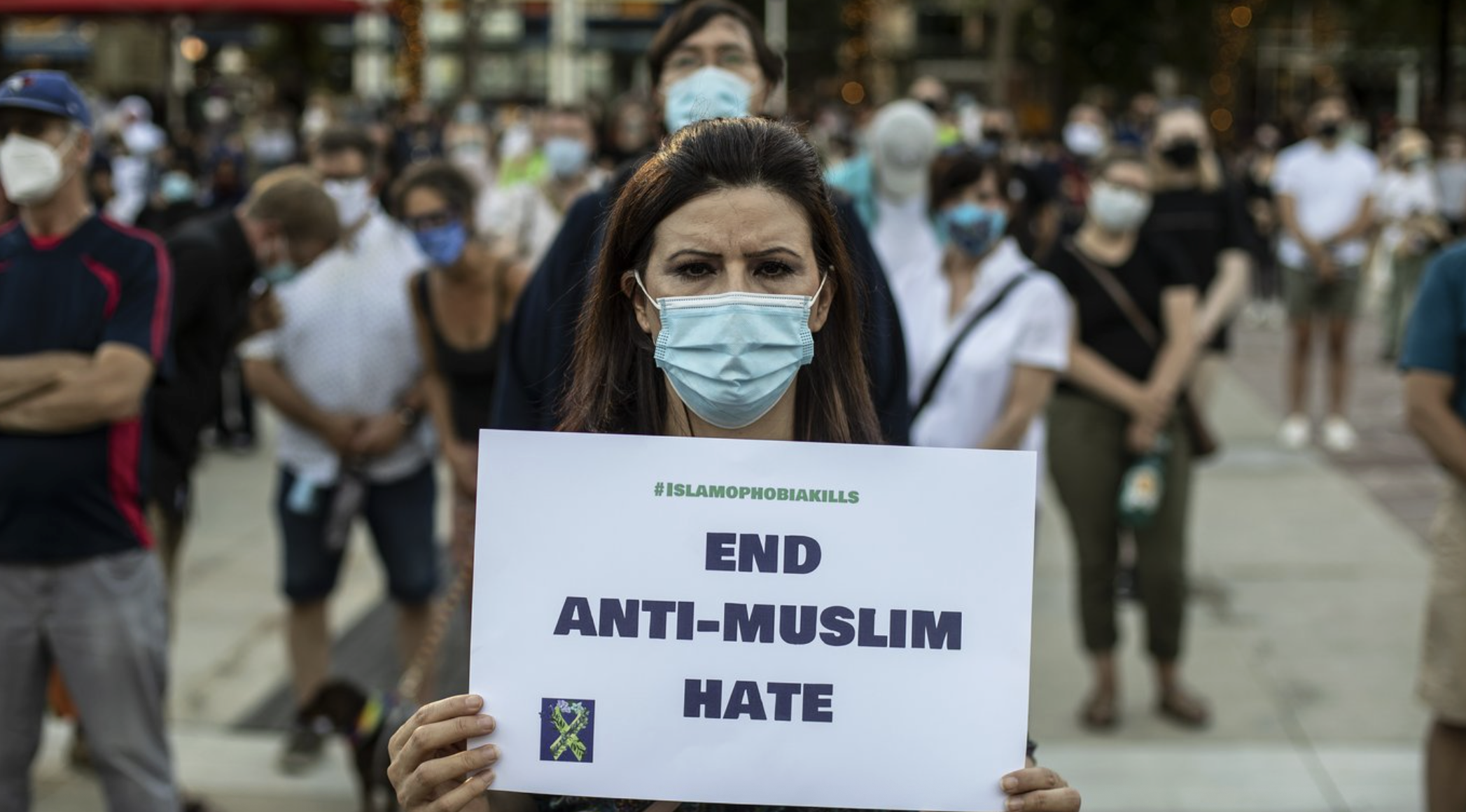
The Canadian Press 10/09/2026 - Twenty-five years after the terrorist attacks on the World Trade Center spurred widespread surveillance and hostility against Muslims around the world, the work of countering Islamophobia in Canada still rests largely on those it targets, a major Islamic organization said in the lead-up to the anniversary.
As Muslims suddenly found their faith wrongly linked with extremist acts in the aftermath of the Sept. 11, 2001 attacks, many Islamic institutions in Canada responded to the growing fear and suspicion by trying to build bridges with their communities, opening their doors to neighbours and joining vigils for the nearly 3,000 people killed.
Those efforts were fuelled partly by a feeling of “collective responsibility to push back at somebody trying to hijack our faith,” and partly by the need to ensure ordinary Canadians and policymakers had a real perspective of Islam outside of what they heard on the news, said Safwan Choudhry, spokesperson for the Ahmadiyya Muslim Jama’at Canada, an Islamic organization with dozens of mosques throughout the country.
“There wasn’t any other platform or narrative available, so you had no choice but to open your homes and open your mosques and send your youth out to blood banks and talk to people and be available wherever the public dialogue was,” Choudhry said, adding that some of those initiatives continue today. While there are now far more avenues for outreach and public education, in many ways, “it feels as though nothing has changed and we’re not further ahead,” he said.
Much like after 9/11, Choudhry said, “(we) recognize that that responsibility lies with us, that we have to do more. … We have to do much more to try and stop this acceleration towards a much, much more dangerous and a much more destructive condition around the world.”
The anniversary comes as the annual number of hate crimes against Muslims remains higher than it was five years ago — 204 were reported to police forces across Canada in 2025, compared with 142 in 2021 — with some experts and advocates pointing to rising tensions amid the Israel-Hamas war as a key contributor, as well as social media’s role as a powerful vector for harmful rhetoric.
At the same time, some experts say, hard-won progress in addressing anti-Muslim discrimination is being rolled back with the elimination earlier this year of the office of the special representative on combating Islamophobia, a position advocates hailed as historic when it was created three years ago.
The decision to replace the office with a broader advisory council on equality and inclusion signals Islamophobia is no longer on policy agenda for the federal government – a “slap in the face” for Muslims who have consistently been sharing their experiences with discrimination over the last 25 years, said Fahad Ahmad, an assistant professor of criminology at Toronto Metropolitan University.
“There was this hope that … we were turning the corner in terms of addressing Islamophobia, but I do think the Carney government has shown that actually we don’t really care about that,” said Ahmad, who co-wrote an op-ed denouncing the office’s elimination with his colleague Asmaa Malik, a journalism professor at the university.
Several new laws quickly enacted by the current Liberal administration, including a hate-crime law that creates new offences for intimidating or obstructing someone outside a religious or cultural institution, suggest a “strengthening of the national security state” and a sidelining of any scrutiny toward these government institutions and their role in perpetuating Islamophobic practices and policies, he said. [...]
As the United States’ war on terror gripped global politics in the wake of the 9/11 attacks, Canada brought in new security measures at airports and borders and passed controversial anti-terrorism legislation that created several new offences and for years allowed police to detain people they believed were about to commit an act of terror without first obtaining a warrant.
The government’s security certificate system also allowed it to detain and deport non-Canadians considered a risk to the country based on classified evidence not shared with the accused. The system sparked lengthy legal battles and was struck down by Canada’s top court in 2008 before the government amended the law.
Meanwhile, hate crimes against Muslims spiked, with the Canadian Islamic Congress reporting 173 incidents in the year that followed 9/11, up nearly 1,600 per cent over the 11 incidents the organization recorded the previous year. “That period, like 2001-2006, was a really heightened dark period where, you know, I think this balance between rights and security was trying to find footing,” Ahmad said, recalling an atmosphere of anxiety that dominated the era.
Later, as prosecutions under the new terror laws began, “essentially, terrorism became analogous with Muslims and Islam,” Ahmad said. The vast majority of terror trials have involved ideology related to international groups such as al-Qaida or the Islamic State, even as security officials increasingly recognize the threat of right-wing extremism and white supremacy.
For years, Muslim community leaders sought to engage with Ottawa but were met with resistance, Ahmad said. The 2015 federal election that propelled Justin Trudeau to power brought “a bit of a shift,” more of an openness to engage on Islamophobia, he said. Then, two mass killings of Canadian Muslims sent shock waves through the country and set many on edge amid renewed fears for their safety.
A gunman opened fire at a mosque in a Quebec City suburb in January 2017, killing six men and critically injuring five others in a matter of minutes. Though Trudeau denounced the killings as a terrorist attack, the gunman wasn’t charged with terrorism offences and pleaded guilty to six counts of first-degree murder and six counts of attempted murder.
More than four years later, a self-described white nationalist mowed down a Muslim family in London, Ont., with his truck, killing four of them and injuring another. The murder of the Afzaal family as they were on an evening stroll in June 2021 scarred the southwestern Ontario community and left some Muslims afraid to go outside in traditional clothes.
A judge later deemed the attack terrorism — the first case to recognize terrorism on grounds of white supremacist ideology. Nathaniel Veltman, the man convicted of first-degree murder in the family’s deaths, was a “voracious consumer of extremist right wing internet content” who wanted to intimidate the Muslim community, the judge found.
At the time, Amira Elghawaby, then Canada’s special representative on combating Islamophobia, said the terrorism finding would have “profound reverberations across Canada” as she called for urgent efforts to tackle the proliferation of online hate.
“It wasn’t until this massacre at a place of worship (in 2017), the first and hopefully last massacre at a place of worship in our country, happened that Canadians really, finally, I think, began to understand the degree in which the hatred of Muslims was proliferating online, as well as in public discourse,” she said in a recent interview.
“And then it actually took the attack on the Afzaal family … for there to be fuller consensus across political lines that Islamophobia needed to be addressed in our country,” said Elghawaby, a former journalist and human rights advocate. More recently, more than 21 violent incidents against Muslims have been documented over four months, including one in which a mosque in Winnipeg was shot with a pellet gun while worshippers and children were inside, she said.
“I often think to myself, thank goodness that we didn’t have the same online climate (in 2001) that we have today because there was an ability to actually create sort of local connection and reconnection and allyship in our communities after 9/11, which was so valuable and helped to stem the hate,” she said. “We were hoping that 25 years on … our kids wouldn’t have to deal with the stigma, with the suspicion, with all that we had to do at that time,” said Elghawaby, who was working at the CBC when the twin towers fell.
In the last few years, and particularly since the Oct. 7, 2023 attacks on Israel that marked the beginning of the Israel [genocide on Gaza], “we have seen this re-emergence of scapegoating entire communities, of looking at our communities within a framework of supporting terrorism simply for speaking up for Palestinian human rights and international law,” she said.
During her tenure as Canada’s first and only special representative on combating Islamophobia, Elghawaby’s office accomplished “historic” work, including the publication of a comprehensive guide on understanding and fighting Islamophobia, she said. Canada, which led the G7 in terms of hate-motivated killings of Muslims, was seen as having taken a leadership role in addressing the issue, she said.
Another report commissioned by her office examined how Muslim charities continued to face disproportionate scrutiny under anti-terrorism and anti-money laundering frameworks, she said. Asked about the government’s decision to scrap the office in favour of an advisory council, Elghawaby said there were “valuable efforts” to promote inclusion and combat hate within the federal government, including the anti-racism strategy and the anti-hate action plan.
For Asmaa Malik, the TMU journalism professor, getting rid of the office marks “a really huge step towards even dismantling the concept of Islamophobia,” she said. Malik, who is researching media coverage of hate crimes against Muslims with Ahmad, said it contributes to what sociologist Jasmin Zine has dubbed Canada’s “national amnesia” regarding Islamophobia. “As long as there’s no one to actually help account for this and you don’t name these patterns, then the work of white supremacy is happening,” she said in a recent interview.
Choudhry, the spokesperson for Ahmadiyya Muslim Jama’at Canada, said that while offices and institutions play an important role in tackling hate, they will never be enough to solve the issue altogether. “We understood early on that combating Islamophobia could not be left to the government or even policymakers, the ultimate responsibility rests with Muslims,” he said. Source
CMPAC: Combatting Islamophobia: A Policy Handbook
How 9/11 helped Israel sell its war on Palestinians to America
| |
Spencer Ackerman: Today We Must Finally Remember What The 9/11 Commemorations Ignore
| | |
Forever Wars 11/09/2026 - THE HUMAN PURPOSE of commemorating the 25th anniversary of 9/11 is mourning. It's to keep in our hearts those who were killed because of forces they did not control. It's to provide comfort to the families and neighborhoods who couldn't ever be the same. For those of us who lived through it, it's to process the trauma of—well, it wasn't the first airstrike in a U.S. city in my lifetime, since that was the Philadelphia police department doing it to the black radicals of MOVE in 1985, killing five children among the eleven dead, but we were hardly encouraged to understand the MOVE bombing like that, certainly not after 9/11, and not today. Processing the trauma of 9/11 can prompt critical questions about how we were and weren't encouraged to understand 9/11.
None of that is the political purpose of commemorating 25 years after 9/11.
The political purpose wears the human purpose like a suit of armor. The armor deflects critical questions—deflects, in other words, the reality of the War on Terror—in order to return the United States to the state of righteous victimhood we were encouraged to inhabit in the weeks after the attack. Righteous victimhood licenses persecution and violence. It's a gambit to consolidate power in the hands of reactionaries. It's why Rudy Guiliani sputters that Zohran Mamdani, the mayor of New York, who was made to grow up in the repressive shadow of the War on Terror, and who unlike Giuliani experienced the War on Terror as it truly was, has no place at this year's commemoration. It's all that Giuliani, who will one day die in disgrace, has left.
For 25 years, even as the reality of the War on Terror has occasionally been so unbearable as to intercede in these commemorations, we've been encouraged to see 9/11 as the shattering of a national innocence, as if the United States were ever innocent. That posture of innocence requires starting the history of 9/11 the moment the planes hit the Towers, the way it is literally on display at the 9/11 Memorial Museum.
That in turn requires us, as Susan Sontag learned, to scandalize and denounce anyone who presents the violent, exploitative history of the United States in the Middle East as the reason that something like al-Qaeda existed in the first place. I remember The New Republic of the era, where I worked as a young journalist, straining to set the uncomfortable and unassailable truths of the blowback hypothesis outside the boundaries of respectable discourse. They did that while calling its exponents the ones taking a holiday from history.
All that, I suspect, lurks in the background of what I gather to be some people's well-intentioned reluctance to remember 9/11. I was surprised to see Jennifer Szalai observe—in a review for which I will forever be grateful—that REIGN OF TERROR "isn’t one of those accounts that tries to play down the trauma" of 9/11. I was not aware there were such accounts. If there are, I suspect it's owing to their authors not wanting to stoke the flames of 9/11-justified violence. I share that (presumed) impulse. But 9/11 really was traumatic, especially for those who come from the cities that experienced it. A DC-native friend messaged me the other day that she watched the Netflix documentary I'm in. She said it alerted her to trauma she hadn't realized she carried.
But trauma is not a license to inflict more.
The horrors of 9/11—of one day of airstrikes—became a relentless, most often useless litany of airstrikes (and more) launched on a gigantic swath of the world for 25 years and counting. Those U.S. strikes became routine, and with only rare challenges to their basic legitimacy. Azmat Khan's reporting showed how the U.S. military lied just as relentlessly about the civilians those strikes killed. On the active battlefields, and during periods of the undeclared ones, the strikes were so frequent that they rarely merited more than an obligatory few lines in whatever The Day At War write-through was required. One of those periods is right now, in Somalia.
Ever talk to the survivor of a U.S. airstrike? I've talked to people who've seen the United States incinerate their grandmothers before their nine-year-old eyes. I've talked to someone who was 13 when the U.S. military maimed him with a drone strike that left him unconscious for 40 days, and abandoned him to his fate, which would turn out to be providing for his family despite his disabilities now that his older male relatives had been killed. His name I know: Faheem Qureshi. You won't find it in Barack Obama's memoir, although Faheem survived Obama's very first drone strike. I doubt Obama thinks about Faheem at all. But I know for a fact that Faheem thinks about Obama. "If there is a list of tyrants in the world," he told me in 2016, "to me, Obama will be put on that list by his drone program."
Faheem's relatives were among what the Costs of War Project at Brown University tallies at between 4.5 and 4.7 million deaths attributable, both directly and indirectly, to the War on Terror. We commemorate the 3,000 Americans slain on 9/11. We do not commemorate the three orders of magnitude more who the U.S.' actions killed. There could be no righteous victimhood for us if we did.
Then there are those who remain locked inside Guantanamo Bay. The many more who bear the wounds of torture at the hands of their American captors. The hundreds of people criminalized, entrapped and imprisoned by the FBI after its informants encouraged them to turn their anger and despair into crime. The tens of millions turned into refugees by the American wars. The hundreds of millions—billions? We don't actually know—whose privacy the National Security Agency violated. The communities terrorized and families broken up by ICE, an agency created and empowered by the War on Terror. The increasing numbers filling the for-profit ICE camps and deportation rendition planes, since the War on Terror was never going to stop at Muslims, even as it still makes time for them. The ones who don't yet know that NPSM-7 will turn them into targets of the War on Terror.
Do you feel righteous? Do you feel like you were the victim?
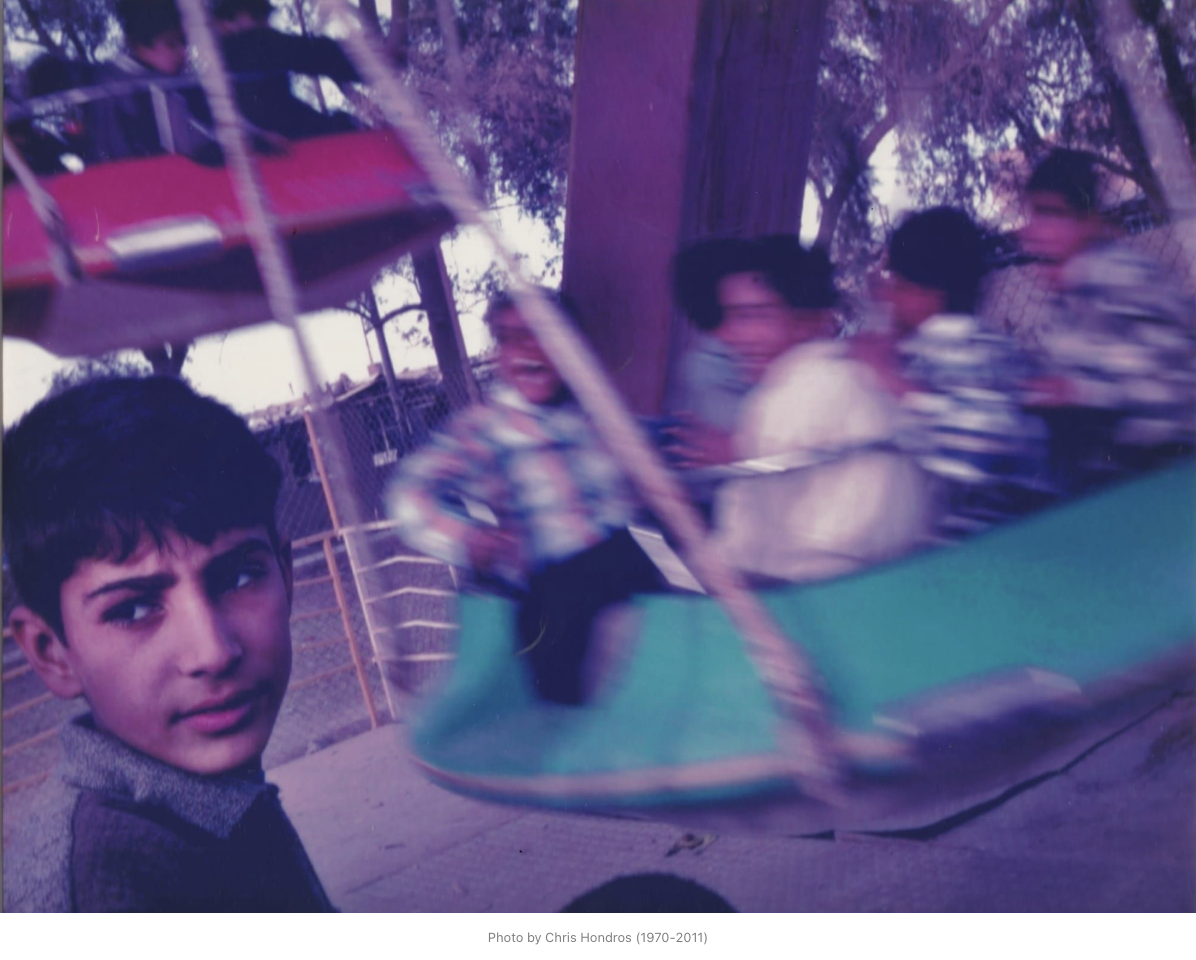
Or do you feel like the little boy in the photograph from Fallujah, unsure where the danger is coming from or when it will arrive, but certain that it will come from those who march under the banner of righteous victimhood?
BUT THE DAWN is breaking through the darkness.
The week of 9/11, I was stuck on the Rutgers University campus, unable to return home. It wasn't until Friday, three days post-attack, that NJ Transit could take me into Penn Station. I went immediately to the 8th Avenue staging ground for Ground Zero recovery assistance. There I met people who had driven all night from places like Kentucky and Massachusetts to help. I heard unfamiliar accents saying the same things. The focus there was not vengeance. It was about getting to work to redress a catastrophe and save whomever might be saved. The same sentiments animated the many more people across the tri-state area, and likely beyond, to give blood. The focus was solidarity.
It's not that bloodlust and the righteous victimhood were absent. It's that, in those crucial early days after 9/11, the leaders of this country, in politics and in the media, encouraged responses that filtered out the solidarity. The bloodlust and the righteous victimhood were what remained. But I saw the solidarity with my own eyes.
And 25 years later, I see it again.
Over the past year and a half, regular people around the country have seen with frightening proximity what remains of the War on Terror, perhaps more than ever. The Trump administration took the War on Terror out of the shadows and beyond the margins of society when it launched its mass deportation crackdown. At every stage, in every city, it encountered popular resistance. When it responded with lethal force, it inspired more intense resistance, echoing both our government’s experience of the War on Terror's foreign occupations and its refusal to accept the bitter lessons of those experiences. Now support for abolishing ICE is a mainstream position, even if the Democratic Party is too timid and oligarch-beholden to champion it.
War on Terror politics, with all their Islamophobia and the bloodlust, are again on the march. Now, twenty-five years later, they march not out of strength but out of desperation. They were unable to stop the people of New York from electing the democratic socialist Zohran Mamdani. They were unable to keep regular people in Michigan from nominating Abdul El-Sayed for Senate, whatever comes of his general election in November. They were unable to stem the nationwide cross-partisan and class-based opposition to mass surveillance and artificial intelligence as represented by Flock cameras and data centers. Without being sanguine about the struggle ahead, the opponents of the War on Terror are stronger than ever, both inside and outside of state power.
War on Terror politics are necessary for their practitioners to maintain their grips on power and gain new ones. They need those politics very badly in 2026. For the future they desire is on display, from the newest quagmire over Iran, to the skyrocketing energy prices, to the working class' lowest share of national wealth in 80 years. It's the effort to end birthright citizenship through judicial fiat, which will permit the machinery of the War on Terror to throw ever larger numbers of Americans into ICE camps and onto rendition flights, some never to return. It's the poisoned New York air emanating from Ground Zero that Giuliani and his successors lied about and covered up. For those who practice War on Terror politics, exploitable symbols matter, not people. People are expendable, no matter how sanctified they were during their phase of exploitation, and no matter how grotesque that expendability is.
But today we remember them all. Tomorrow, fueled by that remembrance, we finally abolish the War on Terror. Read more - Lire plus
25 Years Later: Afghan New Yorker Masuda Sultan Remembers 9/11 & 19 Relatives Killed in U.S. Bombing
25 Years Ago, 9/11 Triggered a U.S. Crusade of Torture. But in spite of the voluminous evidence that documented high-level approval of methodical torture, not a single U.S. official went to prison as a result.
Amnesty International USA: 25 Years Since 9/11, 25 Years of Injustice
Prosecutors Won’t Try to Reinstate Key 9/11 Confession Taken After Torture
Nearly 25 years after the attacks, Supreme Court asked to bring closure to 9/11 case
He Lost His Father on 9/11. 25 Years Later, He Is Part of a Lawsuit Against Saudi Arabia
| | 9/11 anniversary: A quarter century of global counter-terrorism has endangered human rights | | |
OHCHR 11/09/2026 - [...] Too many governments have adopted unnecessary and disproportionate responses that have seriously undermined human rights, civil society, civic space, democracy, and the rule of law. Our worldwide monitoring over the past quarter century has exposed the gravest violations of international law in the name of countering terrorism. Wars of aggression. Unlawful occupations. Countless war crimes and crimes against humanity, and genocide. Assassinations dressed up as “targeted killings”. Torture disguised as “interrogation”. Transboundary abductions, extraordinary renditions, and transnational repression. Secret detention and enforced disappearances. Unfair military trials and special courts, including at Guantanamo Bay. Toxic residues from conflicts have severely harmed human health.
“Wars on terror” have stretched foundational rules of international law beyond their breaking point, including excessive claims about national self-defence and what is permissible under international humanitarian, human rights and refugee law. State violence, foreign intervention, and impunity have counter-productively fuelled terrorism and insecurity locally and even globally, as with the spread of Islamic State in Iraq and the Levant after the 2003 aggression in Iraq.
State violations have also entrenched cycles of violence and impeded the just resolution of protracted conflicts in line with international law, as in the unlawfully occupied Palestinian territory. Other violations have become almost routine in some countries, including the politicized abuse of overbroad terrorism and “extremism” laws, arbitrary detention, ill-treatment including inadequate health care, denial of fair trial before independent courts, the unjustified imposition of the death penalty and disproportionate penalties, and breaches of privacy and other basic rights. Exceptional temporary laws to address public emergencies have increasingly been made permanent.
Human rights have been further undermined by the arbitrary use of restrictive administrative measures. These include security detention, “control orders”, terrorist and “State terrorist” designations and sanctions (some of which affected whole populations), coercive “re-education”, travel bans, migration controls, citizenship revocation, and internet, communications and online content restrictions.
The use of new and emerging technologies, without adequate safeguards, is a key facilitator of violations. This includes drones, online and offline mass surveillance, spyware, biometric systems, and border security tools. Artificial intelligence and the automation of weapons systems pose heightened risks to the right to life and can undermine accountability. Businesses developing, supplying, or deploying these technologies should ensure that human rights are respected throughout their lifecycle, in line with the UN Guiding Principles on Business and Human Rights.
Civil society has been heavily impacted by counter-terrorism measures, which have been used to target, harass, intimidate, threaten and silence many actors. These include human rights defenders, journalists, dissidents, environmental and land defenders, academics, scientists, artists, non-governmental organizations, social movements, minorities, Indigenous Peoples, peasants and migrants, refugees and asylum seekers. Civic space has been eroded by unjustified restrictions on the rights to freedom of expression, association, peaceful assembly, and the right to take part in public affairs.
Terrorism sanctions, financing laws and “support” offences, and bank de-risking and over-compliance, have led to over-regulation of non-profit organizations, contrary to the risk-based, proportionate approach required under international standards. Such measures have impeded and deterred impartial humanitarian activities in conflict zones, preventing assistance to civilians and undermining economic, social and cultural rights. Security Council and Financial Action Task Force standards have not adequately mitigated these risks and have been misused by some States to restrict civil society.
Counter-terrorism measures have violated the rights of vulnerable groups, including by failing to recognize children as victims of terrorist groups, consider their best interests, provide for their rehabilitation and reintegration, detain them only as last resort and for the shortest possible time, and use specialized juvenile justice processes. Women have experienced differential impacts of counter-terrorism and gendered assumptions about their agency as perpetrators, victims, and participants in counter-terrorism and civil society. Religious, racial and ethnic profiling has victimized some groups.
The Security Council has been part of the problem, by requiring all States to adopt highly intrusive measures without defining terrorism, guaranteeing safeguards, or effectively enforcing international law.
The sheer number, breadth, and invasive nature of counter-terrorism measures has strengthened repression and authoritarianism, in an era of backsliding on human rights and democracy. State violations not only cannot defeat terrorism, but can breed it. They also deny justice to victims of terrorism.
We urge States to review their counter-terrorism laws and practices to comply with international human rights, humanitarian, and refugee law, to establish effective independent oversight and accountability mechanisms to prevent and effectively remedy violations, and to protect and assist victims of terrorism and of unlawful counter-terrorism measures alike.
We also call on States to more meaningfully address the conditions conducive to terrorism under the UN Global Counter-Terrorism Strategy. Trillions of dollars have been spent on highly securitized responses, yet terrorism is more prevalent, in more places, than before 9/11. The world must adequately fund long-term initiatives to prevent terrorism, by prioritizing conflict resolution and peace building, good governance and political inclusion, the rule of law, sustainable development, humanitarian assistance, and human rights for all. Source
Israeli Strike in Lebanon Kills 12 People From a Single Family, Including 6 Children
In Small Iranian Town, a U.S. Attack Turns a Wedding Into a Tragedy
Australia: 25 Years of Abusive Offshore Detention
| American weapons and tech firm Axon has Canadian police in a chokehold | |
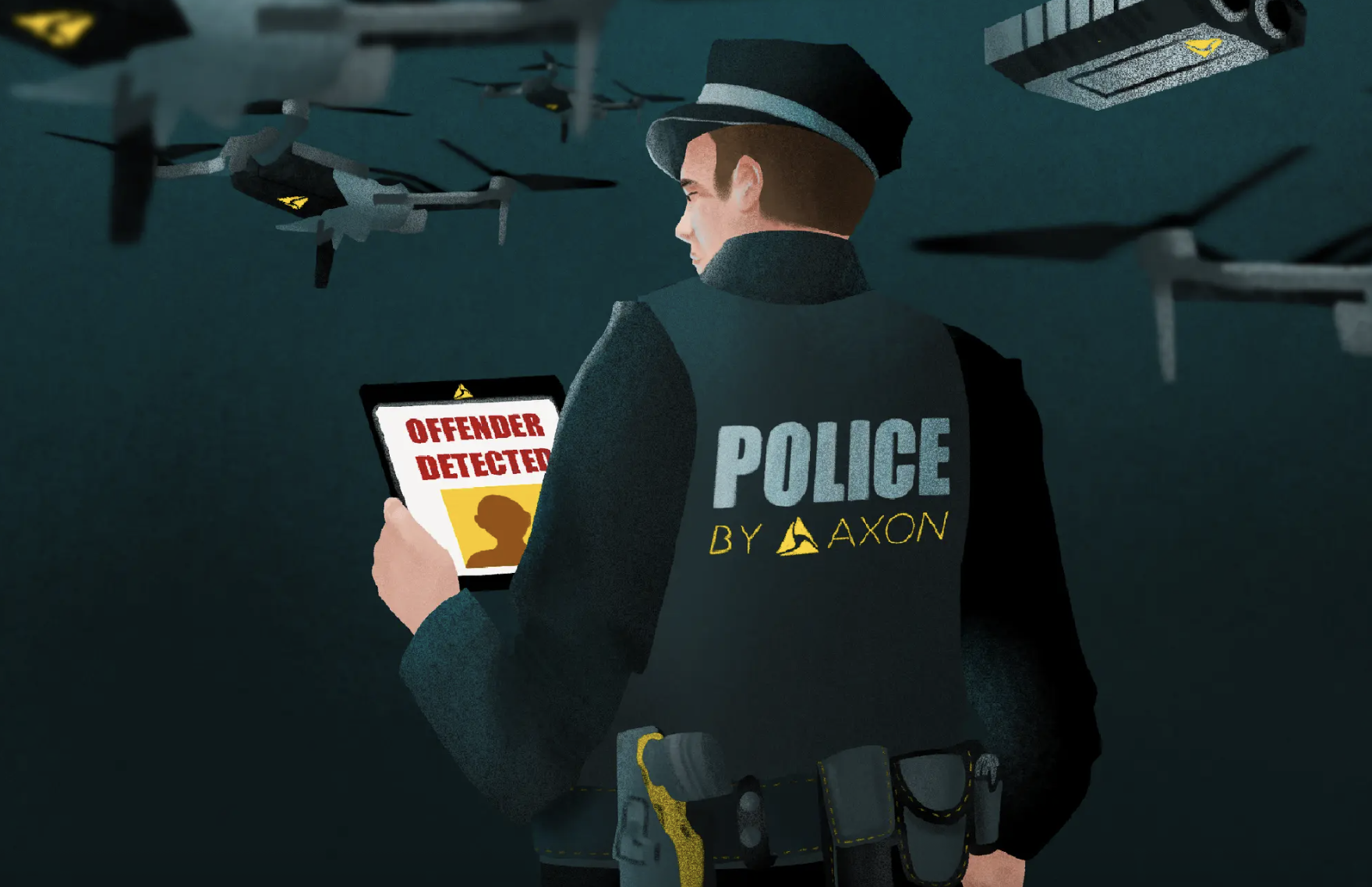
IJF 02/09/2026 - Almost all major police departments across the country have contracts for high-tech surveillance and digital products made by Axon, according to public records. Critics warn the American company's dominance is introducing new threats to Canadians’ civil liberties, but police are welcoming Axon’s controversial technologies with open arms.
An investigation by the IJF has found that at least 17 municipal police departments, three of five provincial police forces, as well as the Royal Canadian Mounted Police (RCMP) are using Axon’s software or surveillance tech.
Based in Arizona, Axon has become a go-to supplier among Canadian police forces for products ranging from body-worn cameras to AI-based report-writing software and automated licence plate readers. The company is testing facial recognition in Canada, a controversial technology that has been banned in some parts of the world.
Axon is also a familiar name to civil liberties experts who warn of the militarization of police.
“A tech company that does surveillance tech, the first people that they are beholden to are their investors,” said David Maass of the Electronic Frontier Foundation (EFF), a digital rights non-profit in San Francisco. “Members of the public are at the bottom of the concern.” [...]
British Columbia’s police information management organization PRIMECorp selected Axon in 2021 as its main software supplier. PRIMECorp’s chief operating officer, Wayne Plamondon, said in a press release that his office was “confident” in Axon “as a common platform amongst the B.C police agencies now and into the future.”
The director of privacy, surveillance and technology program at the Canadian Civil Liberties Association (CCLA), Tamir Israel, described Axon as a “one-stop shop.” The company has been marketing a “complete surveillance package” to police, masking the products’ human rights, civil liberties and privacy trade-offs under the guise of transparency and efficiency, Israel said.
Chris Schneider, a Brandon University professor of sociology who specializes in police tech, cautioned that companies like Axon have been capitalizing on public anger around police violence and police killings to push their technologies in the name of accountability. “Axon saw the writing on the wall early,” he said.
The company rebranded from Taser to Axon in 2017, and in the same year, offered all police agencies in Canada and the U.S. free body-worn cameras and digital evidence management software for a year. “You get used to the technology, you get used to the software, become comfortable with it once you’ve had it for a year, and now Axon’s like ‘Hey, you’re gonna pony up,’” Schneider explained.
Since 2021, Ontario Provincial Police (OPP) has been contracting Axon for its digital evidence management software. To keep up with other police departments and easily exchange information across agencies, all major municipal police forces in the province also use Axon Evidence. In 2024, Axon won a four-year contract worth $32.6 million to supply the OPP’s body-worn cameras. Compatibility with OPP’s software was a requirement in the bidding process. [...]
One of the earliest forces to test body-worn cameras, Montreal police concluded in 2019 that the program yielded inconsistent results and was too costly. Now, a racism scandal involving some officers keeping Black citizens’ hair as trophies has pushed the city to reconsider. The city of Montreal plans to equip 3,500 officers with body-worn cameras within the next year.
While Israel understands the pitch for body-worn cameras, he is critical of how they are implemented. He said for the cameras to act as an accountability tool, an independent third-party must have control of the footage, but that’s not the practice in Canada. “We’re now seeing [body-worn cameras] increasingly being used as more of a surveillance tool,” Israel told the IJF. In Edmonton, Axon is running the first pilot program in the world to combine live facial recognition with its body-worn cameras. [...]
No specific legislation targeting facial recognition technology has been passed in Canada so far. In addition to privacy concerns, Tamir Israel is worried about racial bias and AI exacerbating police use of force. The data used to train AI models is known to be biased, and facial recognition technologies are documented to have a higher false positive rate for racialized people, Israel said. “If you get a false positive and a police officer is being told by this technology that a person four metres away from them is suspected of something violent and maybe armed, this could devolve very quickly,” Israel warned.
Where you go, cameras can follow
The IJF’s analysis shows that at least 12 municipal police departments across Canada and the OPP are using Axon’s automated licence plate recognition systems. The AI-powered licence plate readers pair video analytics software with cameras mounted to police vehicles or other CCTV equipment to track and identify drivers.
A 2020 report from the University of Toronto’s Citizen Lab warned that technologies like facial recognition or automated licence plate readers acutely endanger citizen’s rights to privacy and freedom of expression.
“That is a very egregious shift from the constitutional safeguard that police can’t just randomly ask people for their identification,” Israel said of both the EPS facial recognition program and automated licence plate readers.
“We shouldn't be so gung-ho about putting yet another really powerful surveillance tool in the hands of the police without having the appropriate checks and safeguards in place,” he warned. Read more - Lire plus
Mounties no longer required to wear name tags while on duty
| | Neither Principled nor Pragmatic: Carney Closes the Door on Palestinian Students | | While other countries welcome students from Gaza, Canada has kept the door closed on students accepted into university programs here. This treatment is heartless and discriminatory, argue academics Sean Tucker and Aaron Shafer | | |
The Grind 02/09/2026 - During his acclaimed Davos speech in January, Prime Minister Mark Carney announced that Canada would exercise what he called “principled and pragmatic” leadership on the world stage. Among his government’s pragmatic goals is attracting top international talent to Canadian universities. In keeping with this, Canada implemented an expedited 14-day processing period for PhD students seeking study visas and pledged $130 million (CAD) to assist “top international doctoral students and post-doctoral researchers [to] relocate to Canada.”
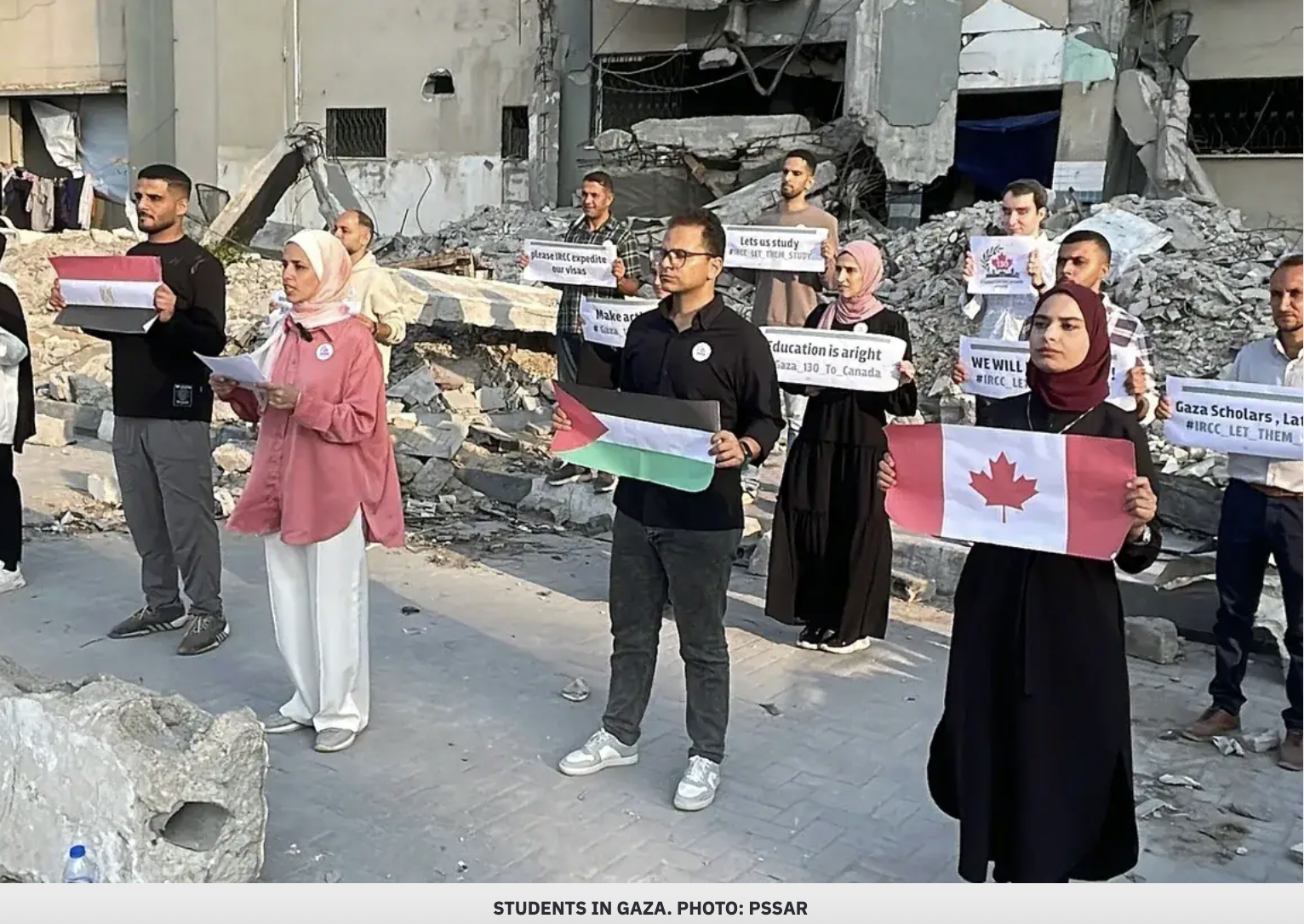
It is hard to square Canada’s enthusiasm for recruiting the world’s best and brightest with its stonewalling of some of Palestine’s most distinguished graduate students. Currently, 130 students from Gaza who have been accepted to study (and in many cases awarded full funding) in masters and PhD programs in Canada are in limbo. Some have been waiting nearly three years for a study visa.
Twin sisters Sally and Dalia Ghazi Ibaid, who were accepted to PhD programs at the University of Waterloo, were killed by an Israeli airstrike in 2024 as they awaited visas.
Other countries have welcomed students from Gaza with open arms. The UK’s Foreign Secretary, Yvette Cooper, recently affirmed her government’s unequivocal support. “Talented young people from across Gaza must not be denied their chance to study because of the horrendous conditions and restrictions they still face.”
In May, Italian University Minister Anna Maria Bernini and Foreign Minister Antonio Tajani greeted 72 Palestinian students in Rome. Later, Pope Leo greeted Palestinian students attending Sapienza University in Rome. The UK, Belgium, Ireland, France and other countries have together supported evacuating hundreds of students from Gaza since 2024.
In Canada, the non-profit organization Palestinian Students and Scholars at Risk (which we have both supported) has led a lengthy campaign to obtain study visas and secure safe evacuation for students trapped in Gaza.
Multiple delegations of professors, students, Members of Parliament, and other supporters have met with senior government officials in Ottawa. There have been op-eds by leading Canadian scholars, a distinguished human rights expert, and the president of Toronto Metropolitan University. The students themselves have repeatedly expressed their desire to study in Canada in compelling social media videos.
Despite two years of sustained pressure, Prime Minister Carney and Lena Metlege Diab, the minister responsible for student visas, remain unconcerned by the distress of these students. For many months, Diab’s spokespeople have claimed that applications for study visas can’t be processed without biometric testing. This is a ludicrous requirement given Israel’s total elimination of all relevant facilities in Gaza and past practices for Ukrainians, Afghanis and Syrians coming to Canada.
In June, Diab publicly committed in the House of Commons to expedite the review of these visa applications, but when asked about it later was vague about timelines. Now there is evidence that Canadian officials are attempting to reject study visa applications by conducting witch hunt interviews to suggest student ties to Hamas.
The approach of the Carney government to Palestinian students has been far from principled or pragmatic. It’s blatantly discriminatory and heartless.
The hopelessness felt by many of these students is reflected in a recent text message to me (Sean) from a student named Riman: “Honestly, sometimes I feel upset and sad because there is no clear path yet, while other countries help their admitted students. I believe in Canadian justice and I hope to start my studies soon.”
A new academic year begins soon, and hope is fading for these outstanding students who made a choice to study in Canada, have satisfied every academic requirement, and just want to get on with their research. They deserve better. Source
EVENT Planning a Public Demonstration: Legal and Practical Considerations - Presented by The Legal Centre for Palestine
Amnesty International Canada: Trade restrictions on West Bank settlements must be followed by further measures to end Israel’s unlawful occupation and apartheid
ACTION Demand Canada finally act by ending all support of the illegal Israeli settlement enterprise
ACTION Parliamentary petition to protect the lives, dignity and human rights of Palestinian children
ACTION Elbit Out of Canada
| | He passed three extensive security checks in Canada. Now, a fourth has stalled his citizenship for 18 months | |
The Toronto Star 02/09/2026 - How many security screenings are needed to ensure a migrant is not a security threat to Canada?
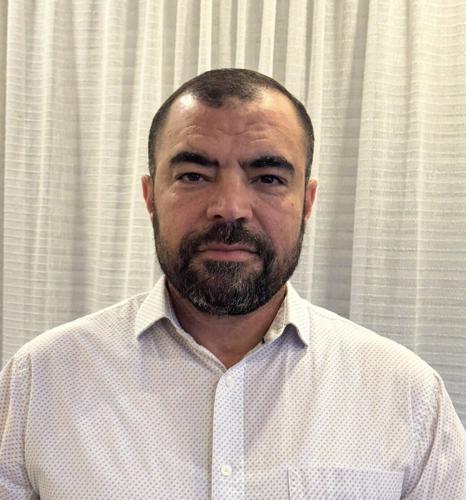
Throughout his nine years in Canada, Ottawa resident Khaled Mohamed has gone through — and passed — three extensive security checks by multiple federal agencies, including one for a job to handle sensitive personal data at the Immigration Department.
Yet, he’s faced with a fourth vetting, this time for his citizenship application, which has already been in the system for 18 months — pending security clearance.
“I respect Canada’s national security requirements,” said Mohamed, 55, a former lawyer and MP in Egypt, who fled political persecution and arrived here for asylum in 2017 by way of Qatar.
“I never imagined that an immigration journey could involve almost a decade of repeated administrative and security-related processes concerning the same individual, involving years of government work and resources, despite successive favourable assessments.”
While Mohamed has no issue with Canada’s repeated security checks, he hopes officials could at least expedite it for those who have already gone through it and been cleared multiple times. With the system already overwhelmed by backlogs, processing delays due to security screenings are causing tremendous stress on applicants.
Mohamed said his drawn-out citizenship processing delay has cost him job opportunities and the repeat screening has exhausted him, leaving him stressed and on doctor-prescribed medication.
Immigration security screening has garnered growing public attention in the last few years as the number of immigration applications skyrocketed after the pandemic, leading to an explosion of files flagged for inadmissibility and security concerns.
While critics question whether the process is rigorous enough, advocates complain that it takes too long and is holding back the lives of migrants, whether they are here for asylum, to study or work, or in the process of becoming permanent residents or citizens.
Immigration security screening has garnered growing public attention in the last few years as the number of immigration applications skyrocketed after the pandemic, leading to an explosion of files flagged for inadmissibility and security concerns.
While critics question whether the process is rigorous enough, advocates complain that it takes too long and is holding back the lives of migrants, whether they are here for asylum, to study or work, or in the process of becoming permanent residents or citizens. [...]
Three security checks, three clearances
Mohamed is no stranger to the security screening process, which includes interviews and thorough documentations. He practised law for more than two decades and was a law-school professor before he ran for public office after the fall of President Hosni Mubarak in 2011. He was a member of the Freedom and Justice Party and briefly served as an MP in the Egyptian parliament, which was dissolved in a military coup in 2013, forcing him to flee.
After spending four years in limbo in Qatar, Mohamed came to Canada with his wife and three daughters in August 2017, made a refugee claim and underwent his first security screening. All adult asylum seekers must pass a mandatory front-end security screening by the border and intelligence agencies before their claims are forwarded to the refugee board.
He was cleared and granted protection in Canada after almost two years, in July 2019. He immediately applied for permanent residence, but again was flagged for security checks by the very same agencies.
It took him more than three years to be cleared by the little-known Centre of Expertise in Security Cases, an internal specialized unit within the Immigration Department tasked with admissibility decisions. He became a permanent resident in February 2023.
In its report, the centre examined Mohamed’s role in the Freedom and Justice Party and its relationship with the Egyptian Muslim Brotherhood, a designated terrorist organization in Egypt, in connection to the protests that led to the fall of Mubarak’s regime. It also weighed his circumstances and assessed if he violated any of the provisions on security and subversion of a government in Canadian immigration law.
The report said neither had the Freedom and Justice Party subverted the Egyptian government by force nor was it an organization that has participated in or will participate in terrorism. As a result, Mohamed was found not to be “a risk to Canadian security due to his former membership and participation in the Freedom and Justice Party.”
After completing a college program to be a paralegal here, Mohamed applied for jobs at the Immigration Department and had to go through the standard federal personnel security screening process. He got his 10-year “reliability status” granted within two months and started working for the department as a program assistant in 2024.
While an immigration employee, he applied for his Canadian citizenship. He was let go last year due to federal budget cuts and now drives an Uber for a living in part because he can’t afford the professional fees to work as a paralegal.
Mohamed said officials have not asked for additional documents, information, travel history, employment history or other materials for the security screening of his citizenship application. The only thing requested was new fingerprints due to the expiry of his criminality check.
The Immigration Department declined to address how the vetting processes vary for asylum seekers, applicants for temporary and permanent residence and citizenship candidates in order to “protect the integrity” of the security screening programs. Read more - Lire plus
| 250+ organizations across Canada are standing with Portage students and defending migrants’ right to protest |
MRN 02/09/2026 - What happened
Portage College students completed programs that were eligible for post-graduation work permits when they enrolled. They were told that students already enrolled would remain eligible as the rules changed. After they graduated, Immigration Canada denied their permits. The students organized and began round-the-clock protests in Calgary and Edmonton.
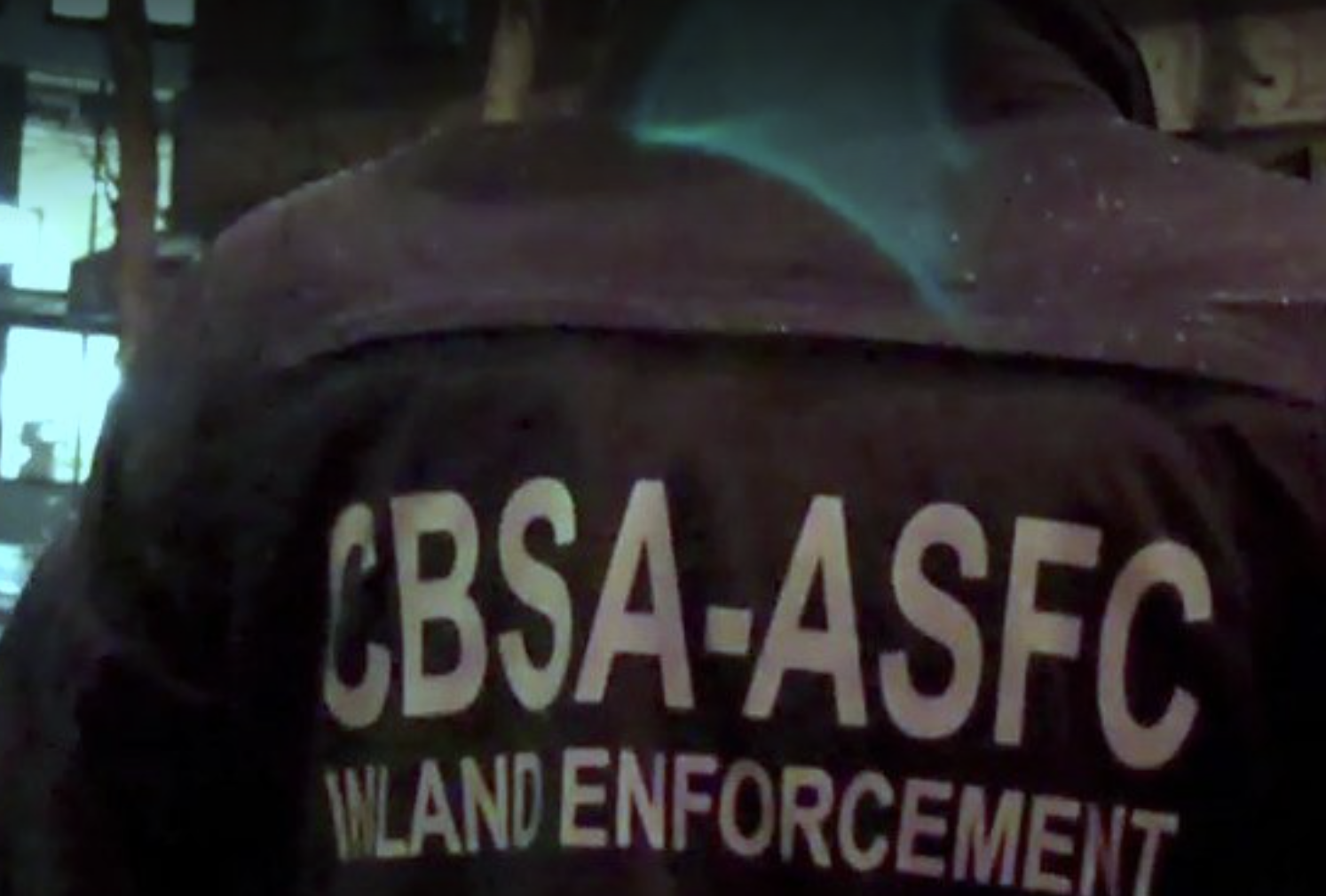
On August 12, Calgary Police called the Canada Border Services Agency (CBSA) to the Calgary protest. CBSA checked protesters’ immigration status, referred 12 people for further investigation and ten were issued exclusion orders.
Together, we are demanding:
01 Protect migrants’ right to protest
Create clear policies so peaceful protests, picket lines and other protected political activity do not lead to immigration enforcement.
02 Investigate what happened
Independently investigate Calgary Police and CBSA’s actions on August 12, with public findings and accountability.
03 Stop the deportations
Suspend the exclusion orders and removal action resulting from the August 12 enforcement.
04 Give the Portage students justice
Assess their work permits under the rules that applied when they enrolled. Source + Action
ACTION Canada: End the Safe Third Country Agreement
EVENTS September 20: Cross-Country Day of Action for Migrant Rights
EVENT Sept 20 rally - Migrant Justice Ottawa
| | OTHER NEWS - AUTRES NOUVELLES | | ICLMG ACTIONS DE LA CSILC | | The Justice Minister must end the injustice against Hassan Diab! | | |
In April 2023, despite clear exculpatory evidence, the French Court of Assize conducted an in absentia trial that unjustly declared Dr. Hassan Diab guilty and sentenced him to life in prison. The proceedings amounted to a sham trial and a mockery of justice.
Since that ruling, Dr. Diab and his family have lived in constant uncertainty, facing the ongoing threat that a second extradition request could be made at any time.
Please click below to send a new letter demanding that Justice Minister Sean Fraser categorically refuse any future extradition request and put an end—once and for all—to this ongoing miscarriage of justice.
| |
Canada: Abolish rights-violating terrorist entities list!
| | |
On October 15, 2024, the Canadian government placed the Samidoun Palestinian Prisoner Solidarity Network on Canada’s terrorist entities list. While ostensibly a tool to protect the safety and security of people in Canada and internationally, the list is an arbitrary political tool that undermines freedom of association, of expression and due process in the courts. Its effectiveness as a national security tool has never been demonstrated in a manner that justifies its use.
Due to these deep flaws, and more, the ICLMG has consistently called for the list to be abolished since the Canadian coalition’s founding in 2002. Please join us in urging the Canadian government to abolish the rights-violating terrorist entities list once and for all. Thank you!
| | Canada must repatriate all Canadians detained in NE Syria/Iraq now! | Every day the government fails to bring these Canadians home, it places their lives at risk from disease, malnutrition, violence, and ongoing military conflicts. United Nations officials have even found that the conditions faced by Canadians in prison are akin to torture. Please click below to urge the federal government to repatriate all Canadians illegally and arbitrarily detained in northeast Syria without delay. | | 23 years of fighting deportation to torture: Justice for Mohamed Harkat! | | CSIS isn't above the law! | | |
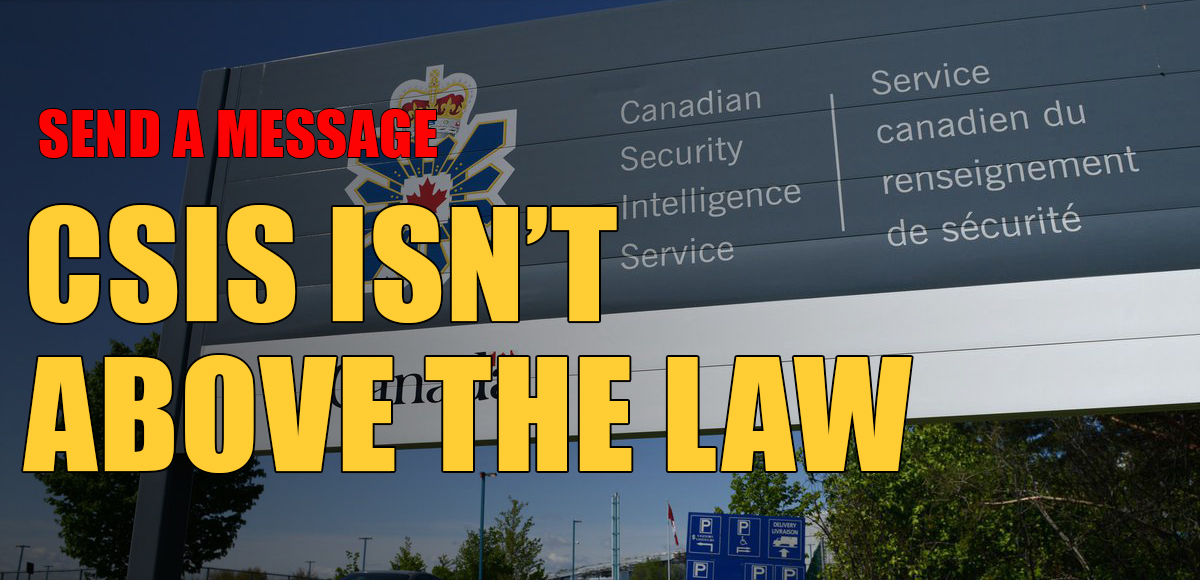
In recent years, at least three court decisions revealed the Canadian Security and Intelligence Service (CSIS) engaged in potentially illegal activities and lied to the courts. This is utterly unacceptable, especially given that this is not the first time these serious problems have been raised. CSIS cannot be allowed to act as though they are above the law.
Send a message to the Public Safety Minister demanding that he take immediate action to put an end to this abuse of power and hold those CSIS officers involved accountable. Your message will also be sent to your MP and to the Minister of Justice.
| | Reform Canada's extradition law now! | |
Canada’s extradition system is broken. One leading legal expert calls it “the least fair law in Canada.” It has led to grave harms and rights violations, as we’ve seen in the case of Canadian citizen Dr Hassan Diab. It needs to be reformed now.
Click below to send a message to urge the Prime Minister, the Minister of Justice and your MP to reform the extradition system before it makes more victims. Thank you!
Version française: Le Canada doit réformer la loi sur l'extradition!
| | Canada must protect encryption! | |
Canada, with other G7 nations, continues to push to weaken our access to strong, reliable encryption, after decades of being supportive of strong encryption. We need encryption to safeguard our data, our online transactions, our communications, and to protect the lives of journalists and human rights activists.
Please send a message to the Prime Minister of Canada, the Minister of Public Safety, as well as your Member of Parliament, to urge them to reverse course and once again commit to protecting encryption.
Regardez la vidéo avec les sous-titres en français + Agir
| | Protect our rights from facial recognition! | Facial recognition surveillance is invasive and inaccurate. This unregulated tech poses a threat to the fundamental rights of people across Canada. Federal intelligence agencies refuse to disclose whether they use facial recognition technology. The RCMP has admitted (after lying about it) to using facial recognition for 18 years without regulation, let alone a public debate regarding whether it should have been allowed in the first place. Send a message to the Prime Minister and the Public Safety Minister calling for a ban now. | | What we've been up to in the first half of 2026! | |
ICLMG 01/07/2026 - Thanks to the support of our members and donors, we were able to do a lot and work on the following issues since January:
- State surveillance bill C-22
- New social media and online harms bill C-34
- Impacts of Countering Terrorism Financing on charities, non-profits, solidarity work and international assistance
- Canada’s complicity in torture
- Islamophobia and anti-Palestinian racism
- Artificial Intelligence regulatory frameworks & national security
- Canada's No Fly List
- Foreign interference regulations
- Xenophobic bill C-12
- Anti-protest and anti-freedom bill C-9
- Review of Canada’s 7th report on the International Covenant on Civil and Political Rights
- UN Global Counter-terrorism strategy
- We were interviewed or quoted in a dozen media pieces
- We published our News Digest every two weeks
-
Our National Coordinator, Tim McSorley, received CMPAC’s 2026 Community Partner Award
Read our full summary of activities for the first half of 2026 and our plan for the rest of the year
| | Les opinions exprimées ne reflètent pas nécessairement les positions de la CSILC - The views expressed do not necessarily reflect the positions of ICLMG. | | |
THANK YOU
to our amazing supporters!
We would like to thank all our member organizations, and the hundreds of people who have supported us over the years, including on Patreon! As a reward, we are listing below our patrons who give $10 or more per month (and wanted to be listed) directly in the News Digest. Without all of you, our work wouldn't be possible!
James Deutsch
Bill Ewanick
Kevin Malseed
Brian Murphy
Colin Stuart
Bob Thomson
James Turk
John & Rosemary Williams
Jo Wood
The late Bob Stevenson
Nous tenons à remercier nos organisations membres ainsi que les centaines de personnes qui ont soutenu notre travail à travers les années, y compris sur Patreon! En récompense, nous nommons ci-dessus nos mécènes qui donnent 10$ ou plus par mois et voulaient être mentionné.es directement dans la Revue de l'actualité. Sans vous tous et toutes, notre travail ne serait pas possible!
Merci!
| | | | |