|
International Civil Liberties Monitoring Group
Coalition pour la surveillance internationale des libertés civiles
October 11, 2025 - 11 octobre 2025
| | Bill C-12’s introduction solves none of Bill C-2’s problems | |
ICLMG & al. 09/10/2025 - A broad coalition of civil liberties, data privacy, refugee and migrant rights, and gender justice organizations strongly opposes the government’s introduction of Bill C-12, which seeks to fast track, rather than address, many aspects of Bill C-2’s myriad problems. Civil society organizations are reiterating their call for a full withdrawal of both bills, including the egregious expansion of surveillance powers that remain in Bill C-2, and the immigration provisions that restrict access to protection and expand mass status-cancellation now included in Bill C-12.
“Bill C-12 does not fix Bill C-2; it fast tracks some of the most egregious aspects, while still moving forward with the rest,” said Tim McSorley, national coordinator of the International Civil Liberties Monitoring Group (ICLMG). “Our government has made it abundantly clear that they will continue to fight for every privacy-violating measure Bill C-2 still contains, and are only introducing Bill C-12 to get restrictions on migrant and refugee rights adopted sooner.”
“The story of this legislative package is the same today as it was on day one of Bill C-2’s introduction; it’s about pleasing President Trump,” said Matt Hatfield, Executive Director of OpenMedia. “Canadians reject this multi-layered concession of our rights and freedoms to American pressure, and we expect lawmakers to resoundingly vote against both bills.”
In June 2025, over 300 organizations—including the Canadian Civil Liberties Association, the BC Civil Liberties Association, the Canadian Labour Congress, the United Church of Canada, the Migrant Rights Network, the Canadian Council for Refugees, Amnesty International, OpenMedia, Action Canada for Sexual Health and Rights, la Ligue des droits et libertés, HIV Legal Network, Canadian Association of Refugee Lawyers, Refugee Lawyers Association, Climate Action Network Canada, the Centre for Free Expression, the Canadian Muslim Lawyers’ Association and the Canadian Muslim Public Affairs Council—came together to call for a full withdrawal of Bill C-2. Across sectors, concerned organizations and experts have condemned the bill, including legal scholars, migrant and refugee rights organizations, advocates against gender-based violence, immigrant services organizations, and national and international cybersecurity experts.
“The government is trying to skirt around the overwhelming opposition to C-2 by repackaging it as something new. But C-12 leaves intact the measures to block refugee hearings, impose arbitrary retroactive one-year bars, and grant ministers mass immigration status-cancellation powers,” said Karen Cocq, spokesperson for the Migrant Rights Network, pointing to concerns raised by many other migrant rights organizations, including the Canadian Council for Refugees, the Canadian Association of Refugee Lawyers, OCASI and others about violations of refugee law and due process. “Prime Minister Carney is showing that his government continues to be aligned with Conservative Trump-like anti-migrant sentiment. But civil society groups remain united in rejecting this agenda and calling for the withdrawal of both bills.”
“Survivors of gender-based violence are uniquely harmed by arbitrary timelines and restricted pathways in immigration, which deny survivors the ability to seek protection when they most need it,” said Anuradha Dugal, Executive Director of Women’s Shelters Canada, joined by other organizations working to prevent violence against women including the Barbra Schlifer Commemorative Clinic, the Canadian Women’s Foundation, Women’s Legal Education and Action Fund, and others. “Any changes to C-2 that do not remove the immigration provisions will continue to put vulnerable women at risk.”
Bill C-12, An Act respecting certain measures relating to the security of Canada’s borders and the integrity of the Canadian immigration system and respecting other related security measures, retains an enforcement-first approach to drug policy, ignoring decades of evidence showing that criminalization and prohibition are driving the current toxic unregulated drug crisis. “Bill C-12’s accelerated scheduling will trigger faster illegal drug market innovations, making Canada’s already-lethal unregulated drug supply even more volatile,” said Nick Boyce of the Canadian Drug Policy Coalition. “This legislation will make the toxic unregulated drug crisis worse while wasting resources that should go to the things we need, like housing, healthcare, and harm reduction.” Source + Share on Bluesky + Facebook + Twitter
Version française : Le dépôt du projet de loi C-12 ne résout aucun des problèmes du projet de loi C-2 + Partagez sur Bluesky + Facebook + Twitter
UPDATED ACTION Stop Bill C-2, Bill C-12 and protect our rights!
ACTION MISE À JOUR Non aux projets de loi C-2 et C-12 : protégez nos droits!
ICLMG quoted: Public Safety minister says he wants to push through refined warrantless powers to help police
ICLMG quoted: Liberals introduce 2nd border bill with aim to quickly pass less controversial measures
| | New watchdog report confirms ICLMG's findings that government approach to counter-terror audits of Muslim charities is flawed, raises substantial concerns of bias and discrimination | |
ICLMG 02/10/2025 - A newly released report from a national security watchdog largely confirms what research from civil liberties advocates had long demonstrated: that the Canada Revenue Agency’s approach to countering terrorist financing, including its targeting of Muslim-led charities in Canada, is deeply flawed. lacks rigour, and raises substantial concern of both bias and discrimination. This includes findings that deficiencies in the approach of the CRA’s Review and Analysis Division (RAD) place it at risk of breaching the Canadian Charter of Rights and Freedoms.
“For years, the International Civil Liberties Monitoring Group (ICLMG) has sounded the alarm that Muslim charities in Canada were being disproportionately targeted by the CRA’s Review and Analysis Division (RAD). We produced the first data and analysis showing the systemic bias that charities faced,” said Tim McSorley, national coordinator of the ICLMG. “Today’s report from the National Security and Intelligence Review Agency (NSIRA) supports those findings.”
In 2021, the ICLMG published “The CRA’s Prejudiced Audits: Counter-Terrorism and the Targeting of Muslim Charities in Canada”, which raised many of the concerns addressed in NSIRA’s report. A central recommendation in the report was for NSIRA to review RAD’s activities. NSIRA’s report can be accessed here.
In its findings, the review body explained that RAD’s audit selection process demonstrated a profound lack of rigour, including a failure to adequately document the reasons for initiating audits of Muslim-led charities, use of dated information in their evaluations, and a reliance in some cases on guilt by association (despite a lack of underlying evidence). While all these raised concerns of bias and discrimination, the lack of documentation made it impossible for NSIRA to reach an informed conclusion. “Despite NSIRA’s not being able to formally conclude discriminatory practices that violate Charter protections, taken together with the documented experiences of Muslim charities as well as the findings of other research reports, the review body’s findings should leave no question that RAD’s approach is mired in bias and prejudice,” said McSorley.
“The recommendations in the report — from collecting demographic data, to validating risk indicators, to formally documenting audit decisions — are consistent with what ICLMG has been calling for. The CRA and the Government of Canada must address the unintended consequences of its practices,” McSorley added.
To do so, the ICLMG is calling on the government to immediately:
- Implement independent oversight of the CRA’s activities
- Thoroughly reform the CRA’s approach to countering the risk of terrorist financing in the charitable sector, including implementing the recommendations in the NSIRA report
- Abolish the CRA’s Review and Analysis Division
If the CRA is truly committed to protecting the charitable sector from terrorism financing risks, its actions must be fact-based, transparent, and accountable, and carried out in a manner that does not stigmatize charities, especially Muslim charities, or undermine their vital work.
Key concerns highlighted in the NSIRA’s report include:
- Despite the CRA and RAD maintaining that only those charities at the highest risk of terrorist abuse are subject to RAD audits, the NSIRA report found that a lack of rigour in RAD’s approach led to audits of organizations that did not in fact present credible risk of terrorist abuse (page 5). This reflects ICLMG’s earlier findings that RAD’s audits are not tethered to credible risks. It also raises serious concerns around bias and accountability in the CRA and RAD’s operations that have had significant negative impacts on Muslim-led charities, Muslim communities in Canada and the charitable sector as a whole.
- NSIRA determined that terrorist financing risks identified by RAD, which were used to justify intrusive audits, were only infrequently validated through the audits themselves. In other words, charities were subjected to years-long audits based on weak or unsubstantiated claims, as was demonstrated in ICLMG’s original research. (page 18)
- NSIRA found that RAD’s category of “high-risk jurisdictions” was applied so broadly that it could capture virtually all Islamic charities. NSIRA also identified the use of dated information, and the use of apparent “associations” between certain organizations (despite the underlying risk not being substantiated) as other areas of concern. This demonstrates how neutral-sounding criteria can have a discriminatory effect. (pages 18, 19 and 21)
- According to NSIRA, RAD’s own draft post-audit assessments were often critical of its decision to engage an audit in the first place, showing that many audits lacked sufficient justification or credible evidence. (page 19)
- RAD could not present any information to justify the discrepancy in severity of outcomes between their audits and those conducted by the CRA’s Compliance Division, raising questions of fairness in the application of penalties. (page 26)
- NSIRA’s findings support ICLMG research that the majority of charities that faced RAD audits come from the Muslim community and other racialized groups, determining that from 2009 to 2022, 67% of those charities audited were discernibly Islamic, and another 19% were Sikh. (page 13)
-
This overwhelming focus on specific communities, combined with the lack of hard data to substantiate the determination of which charities pose a risk of terrorist abuse, led NSIRA to raise significant questions about whether RAD and the CRA are in breach of their Charter obligations to not engage in discriminatory actions. As NSIRA writes, “RAD’s decision-making, especially when it impacts Charter rights like freedom of religion, must be reasonable. Reasonableness requires proportionality, and proportionality requires data.” (page 5) Source
ICLMG quoted: CRA couldn't justify why it was auditing Muslim charities: report
CSILC citée : Un organisme signale un risque de partialité des vérifications de l’ARC
| | Bill C-9, the Combatting Hate Act, risks criminalizing dissent and must be withdrawn | |
ICLMG 29/10/2025 - The International Civil Liberties Monitoring Group (ICLMG) is alarmed that new legislation aimed at preventing hate crimes instead threatens the Charter rights and civil liberties of all people in Canada, including those communities that the government wishes to help protect.
“While we agree that the Canadian government must take action to protect people in Canada, including against hate-based incidents, the provisions of Bill C-9, the proposed Combatting Hate Act, will create a chill against protest and dissent, and risk the criminalization of free expression and free assembly in Canada,” said Tim McSorley, national coordinator of the ICLMG.
New provisions in the bill would outlaw the display of symbols associated with listed terrorist entities. The listing of terrorist entities is secretive, politicized, discretionary and violates due process. It has been used to target groups that have fought for rights of self-determination and against occupation, all while Canadian governments have failed to act against the much more prevalent and deadly violence enacted by states. Based on these concerns, among others, the ICLMG coalition has called for the terror entities list to be abolished, and opposes the creation of new laws that use the terrorist entities list as their basis.
Furthermore, giving police the ability to discern what symbols are associated with a terrorist entity grants enormous discretionary power. Already, political and cultural symbols associated with Palestinian culture and human rights, including the keffiyeh, have illegitimately been associated with terrorist entities or hate. These new provisions would be a license for police to detain people first, and ask questions later, during protests and other gatherings, further undermining freedom of assembly and free expression.
New offenses in Bill C-9 regarding obstruction and intimidation in proximity to certain places, including places of religious worship, schools, community and sports centres, raise similar concerns. The Criminal Code already allows for police to act on the basis of mischief, intimidation, harassment, or threats. As we have seen across the country, especially in regards to protests in support of Palestinian rights, police have more than enough powers to disrupt protests on a wide range of grounds, and in fact have often engaged in over enforcement, demonstrated by the myriad of charges that have been dropped, as well as the violent dismantling of peaceful encampments. All of this makes clear that these new powers are unnecessary. Moreover, the broad wording would empower police to take discretionary action based on how they interpret the intent of protesters – not protesters’ actions.
Bill C-9’s removal of the existing requirements for attorney general approval of laying hate propaganda charges, allowing police to make these decisions, compound these concerns.
The proposed new offences would carry significant penalties, including the threat of jail time, and will result in people who would ordinarily take action to speak out on important social issues refraining from doing so under the fear of being trapped in the dragnet of additional, unclear and broad discretionary powers. If that is not the government’s intent, we urge it to withdraw this bill in favour of approaches that both protect vulnerable communities and ensure the protection of Charter rights and civil liberties in Canada. Source
ACTION Withdraw Bill C-9, the Combatting Hate Act: a threat to our rights and freedoms!
ACTION Retirez C-9, la Loi visant à lutter contre la haine : une menace à nos droits et libertés!
WEBINAR Say No to Bill C-9! with ICLMG's Tim McSorley & CMPAC's Khaled Al-Qazzaz, Oct 15, 7pm ET on youtube
Joint Statement: Civil Society Groups Demand Federal Government Rethink Bill C-9
Carney’s so-called Combatting Hate Act is an attack on pro-Palestine expression
ACTION Ottawa Councillor David Hill smeared Palestine solidarity protests as criminal and hateful in order to demand more police funding
Statement from Independent Jewish Voices Ottawa on the Proposed Bubble Bylaw and Consultation Process
City of Ottawa noise fines cancelled, but advocates frustrated bylaw wasn't challenged in court
Kneecap Never Actually Banned from Canada. Source inside PMO confirm MP Vince Gasparro went rogue
| | Two years into genocide in Gaza, civil liberties coalition condemns ongoing violence, Canada’s complicity, and attacks on the right to protest | |
ICLMG 07/10/2025 - Today marks two years of the genocidal campaign by Israel against Palestinians in Gaza, in the name of fighting terrorism. An estimated 65,000 Palestinians have been killed, with total casualties estimated by the former chief of the Israeli Defence Forces to be more than 200,000. Of those killed, almost a third are children. Many more are dead, buried under the rubble.
That is in addition to more than 100 years of colonization, occupation, apartheid regime and oppression faced by the Palestinian people in the wake of the Balfour Declaration and the founding of Israel.
As a coalition that came together in 2002 to protect and promote human rights in the context of the so-called ‘war on terror’, the International Civil Liberties Monitoring Group (ICLMG) reiterates its opposition to human rights violations, violence against civilians and the curtailing of fundamental freedoms.
It is appalling and unacceptable that Canada continues to be complicit in Israel’s genocide despite the opposition of a majority of Canadians to the federal government’s actions.
The Canadian government has continued to lie to Canadians by saying it is no longer allowing arms to be sent to Israel, despite a recent damning report exposing the hundreds of shipments and hundreds of thousands of bullets sent to Israel.
The last year has seen mounting criminalization of Palestinian solidarity. Samidoun, also known as the Palestinian Prisoner Solidarity Network, was added to the list of “terrorist entities,” in a move that many have denounced as an attempt to intimidate the entire Palestine solidarity movement with threat of criminalization.
For the last two decades, the ICLMG has called for the terrorist entities list to be abolished given that it is, among many other things, a discretionary, politicized, and due process-violating instrument.
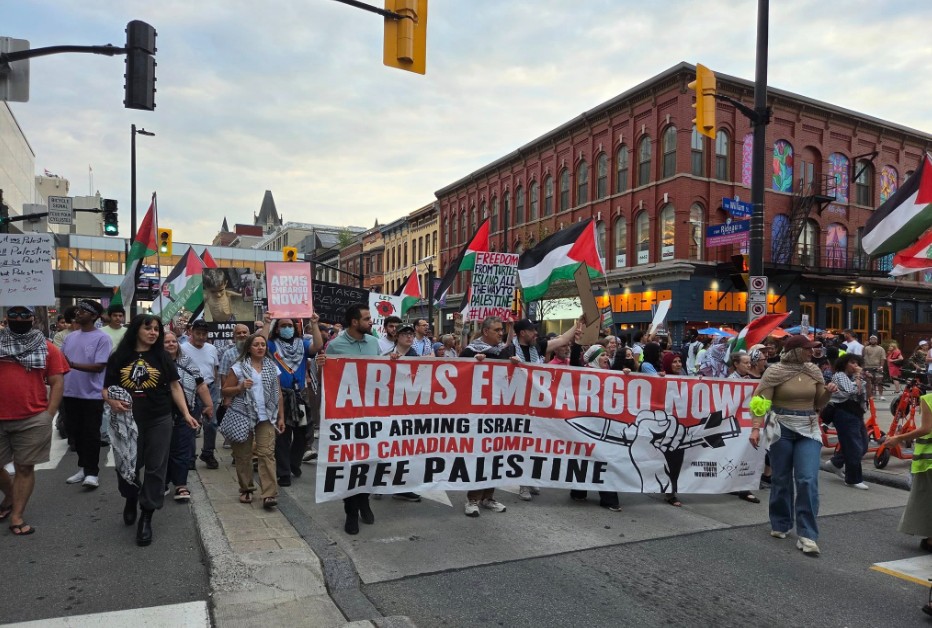
The ICLMG also denounces the smear campaigns, surveillance, harassment, fining and criminalizing of people, in Canada and abroad, for expressing support for the rights of Palestinians, and their opposition to Israeli occupation and the ongoing genocide. In particular, we condemn the conflation of Charter-protected expression and dissent with “support for terrorism,” the violent arrests of peaceful protestors, and the adoption or consideration of “bubble zone” laws in multiple cities across Canada, which ban or limit protests across vast areas of cities, violating freedom of assembly.
Thankfully, many of the fines and charges against anti-genocide protesters have been dropped or their cases have been resolved without convictions, including against Ottawa protesters for using megaphones and the Toronto Indigo 11. Their lives were severely disrupted, though, most likely leading others to think twice before exercising their right to peaceful dissent. More than 133 pro-Palestine protesters have been charged since 2023. Many charges are still pending; the rest have ended in withdrawals or discharges.
Instead of addressing the over-policing of protests, though, the federal government recently introduced Bill C-9, the Combatting Hate Act, which will give police discretionary powers to determine what symbols are hateful and to discern protestors’ intentions. Passing this legislation would criminalize dissent, violate freedom of assembly and chill free expression. This bill is one more attempt to criminalize pro-Palestine and anti-genocide protesters, and must be withdrawn.
One year later, we are dismayed that we must reiterate our 2024 calls to action:
- Canada must enact a two-way embargo on arms transfer and stop all military support to Israel (including support via the US).
- Canada must stop considering all Palestinians as potential security threats, welcome the Gazan families of Palestinian Canadians accepted through the “emergency” program, and reopen the program to process more applications to save more lives before it’s too late.
- Canada must meet its obligation under international law to do everything in its power to stop the genocide.
The ICLMG remains steadfast in its mandate and commitment to protect civil liberties in the context of the so-called war on terror and its legacy, which includes the genocide in Gaza and the repression of people taking action and calling for an end to the ongoing violence and human rights violations. Source
These Horrific Numbers Show the Scale of Israel's Genocide in Gaza Two Years On
CJPME: With a ceasefire, Canada must ensure Israel does not resume genocide
Tony Blair Should Be on Trial for War Crimes, Not Running Gaza
When speaking up for Palestine gets you put on a list
ACTION Not in my Name: Demand that Canada stop arming Israel and stand for peace and justice
5 Days in Israel’s Desert Prison: Jewish Flotilla Activist David Adler on Harrowing Detention Ordeal
ACTION Protect the Global Sumud Flotilla Participants and Sanction Israel
ACTION Parliamentary petition to close existing loopholes in Canada’s arms export laws
| | This family applied to leave Gaza on 1st day of Canada's visa program. 21 months later, they're still waiting | |
CBC News 06/10/2025 - Mona Alatbash gathers her children and husband, each of them either carrying a chair or a flashlight, and treks to a nearby building — her phone signal there is stronger than the tent in the Khan Younis displacement camp where the family shelters.
On this recent night in southern Gaza, they find a dark corner and place the plastic chairs side by side. The phone rings. The video call from her sister Eman in Cobourg, Ont., lights Mona's face.
In a low voice, she asks her sister for updates. The family had applied to be admitted to Canada through the country's special measures program for extended family of Palestinian Canadians. But nearly two years later, there is no news about their request.
In January 2024, Immigration, Refugees and Citizenship Canada (IRCC) launched the program for extended families of Canadians and permanent residents in Gaza. Some families have resorted to bribes to get their loved ones to neighbouring countries — while dealing with stalled applications for their Canadian visas.
Eman has lived in Canada for 10 years and is a single mother of two. She applied through the program on Jan. 9, 2024, the first day it opened. "They thought it's going to take a few weeks to one month or two months maximum," Eman told CBC News regarding her family's visa applications.
When they received an email in April 2024 that they were at the biometrics screening phase, Eman paid $5,000 per person in bribes to smuggle her father, brother, another sister and nieces and nephews out of Gaza. She did not have enough money to cover the cost of smuggling out Mona and her family. Canada was not able to evacuate anyone from the enclave, citing the closed borders and airspace.
Eman's mom was able to come to Canada with a visitor visa before the war began. Since then, the family has been split between Cobourg, Cairo and Gaza as their applications are stuck in the security screening phase. She is desperate to get them all here. Eman has already lost one of her brothers to the war, in an Israeli sniper attack, she said. She said her brother Ahmed was surrounded by tanks and drones and shot in the head.
In a statement to CBC News, IRCC said that as of July 29, "880 people have arrived in Canada through the special measures for extended family." But two federal sources with knowledge of the situation told CBC News the temporary program was met with institutional resistance from the very start — facing a lack of resources to quickly bring Palestinians like Eman's family to Canada.
They spoke on condition they not be named, since they were not authorized to publicly comment on the situation. The sources said there weren't enough funds made available to process the thousands of files. The program's 5,000 spots are filled and it is closed to new applicants. "Funding came second. We had to push it out and just announce it without anyone approving [funding]," said one source.
The second source said the government also lacked enough Arabic speakers. "Screening for Gaza needs to be done by people familiar with the Arabic language," they said, adding it is not easy to find, for example, 100 more Arabic speakers to work for the Canada Border Services Agency. The source said there were security concerns within the government about a lack of information on the applicants.
Pantea Jafari, an immigration lawyer in Toronto, says security screening delays of over a year are not normal for similar programs. She pointed to court decisions that say delayed security screenings "because of actions of third parties that you have no control over" shouldn't stop the process. "In some situations, the duration would have been too long and they would be required to move forward," Jafari said.
Eman said the stress over trying to reunite her family safely in Canada has started taking a toll on her health. She continues to hope for a miracle. "I have been affected by everything going on in Gaza and with my family," she said. "I can't sleep normally thinking that I might lose someone else."
After the video calls are done, Eman takes her daughter to a nearby park to play. She said her children ask about their cousins, aunts, uncles and grandfather all the time. "My child Zahed is four years old," she said. "And every time he sees a flight in the sky, he prays, 'I hope the next flight will have my grandpa and my uncle and cousins.'" Source
This N.S. woman has been waiting almost 2 years to bring 23 family members fleeing Gaza
NDP calls on Ottawa to do more to get approved refugees out of Gaza
| | Canada’s increasingly militarized border pushes migrants into taking riskier routes to claim asylum | |
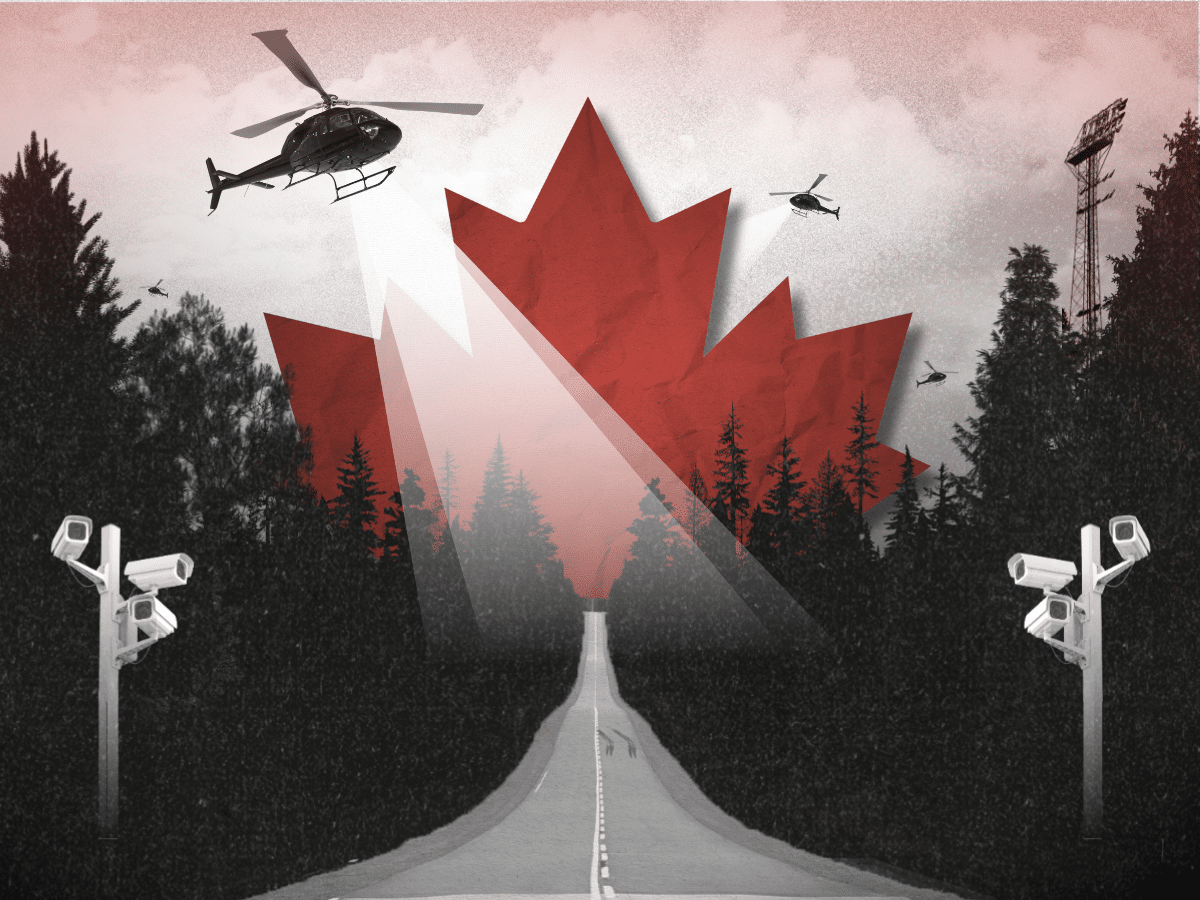
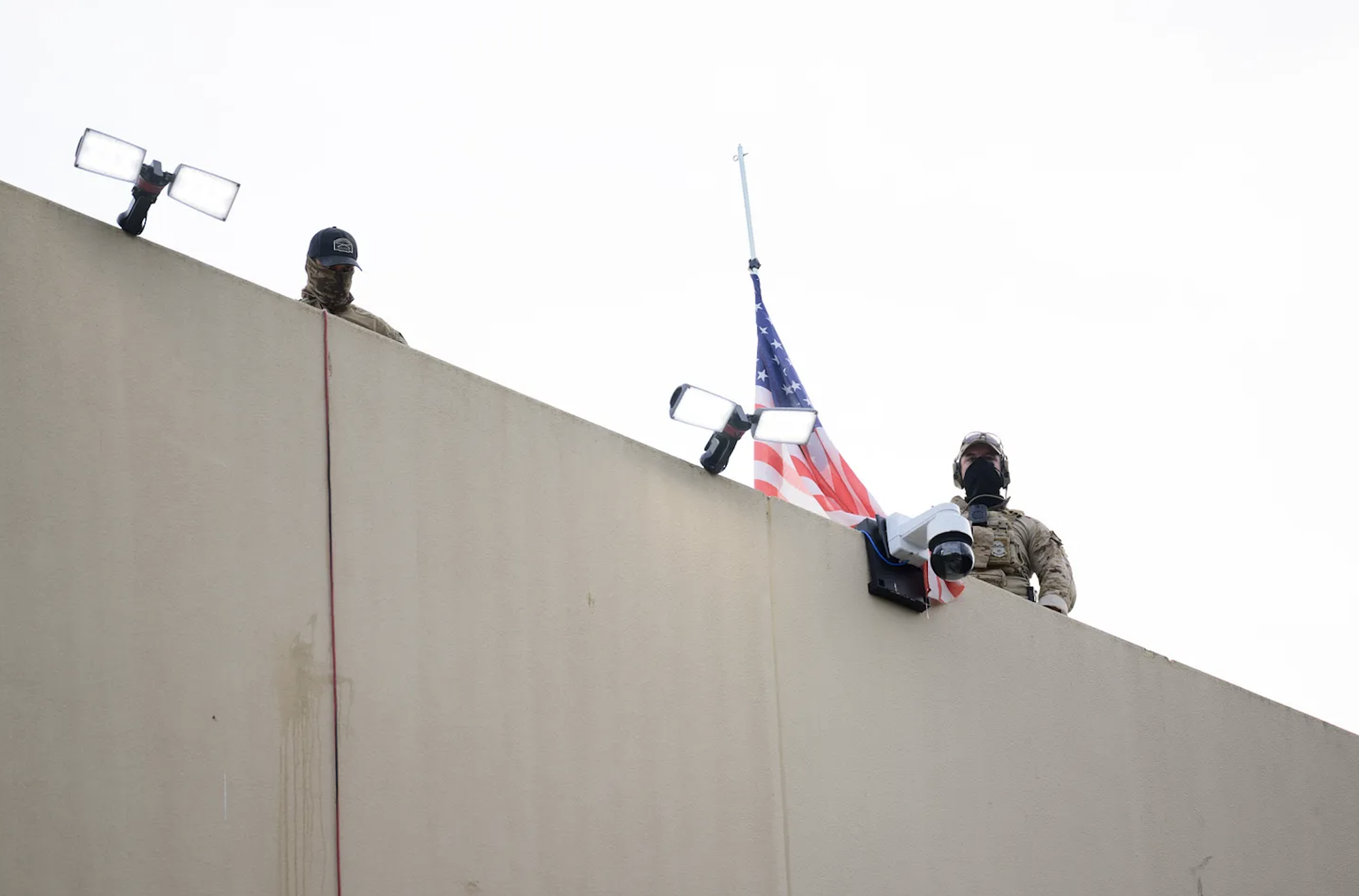
Ricochet 24/09/2025 - Since December 2024, the federal government has invested more than a billion dollars along the border in an effort to appease U.S. president Donald Trump. But, when you’re on the ground, walking the woods and driving along the roads along the border, from Quebec to Manitoba and through northwestern Ontario, you find far more than cameras, drones, and helicopters.
There is the disparity between intensive controls in Quebec, which have led to ‘neighbourly denunciations,’ and the futility of monitoring thousands of kilometers of Canada’s border with the U.S. across the rest of the country. And, more importantly, there are those who feel compelled to take increasing risks to assert their right to asylum, as a result of the increasingly militarized border — which numerous migration specialists have warned about since the implementation of the new safe third-country agreement.
In the early morning hours [of July 13, 2025], near the municipality of Hemmingford in Montérégie, a reckless driver operating a vehicle registered in New York State collided with an SUV on Route 202 near Jackson Hill. According to police reports at the time, an SUV transporting about 10 migrants was struck by a reckless driver. Four of them were transported to hospital while the remaining individuals fled the scene, leaving the overturned vehicle on the side of the road.
What this account does not mention is that another vehicle filled with migrants was following the first SUV. Among them was Astride, a Haitian woman in her sixties. She believed, at this point, that entering Canada would result in her death.
“I was totally shocked when I saw the overturned vehicle. We all became deeply afraid of losing our lives as our driver began screaming and driving increasingly faster, fearing the arrival of the police at the scene of the crash,” said the woman over the phone, whose name has been changed by Ricochet to protect her identity. The situation is all the more tragic given that Astride knows the people in the crashed vehicle, having recently crossed the border covertly with them.
After being dropped off by smugglers at the edge of a forest near the border on the American side, the group of about 15 migrants used their phone GPS to follow an imagined straight line to Canada. Upon reaching a perpendicular road, Astride said they were informed that other vehicles would come to get them.
It took the group nearly four hours to cross the forest, relying solely on the light from their mobile phones. “It was very difficult. Sometimes we had to run through the night with our luggage. Some people fell, others stayed hidden. Not all of us were able to keep up,” admits Astride.
All of these people chose to come to Canada to escape the United States Immigration and Customs Enforcement (ICE), which has intensified raids against immigrants, particularly in the New York City area where the passengers of the two SUVs come from. They are all concerned that they may lose their Temporary Protected Status in the U.S. and have decided to take action before it is too late.
When she went to church, Astrid frequently heard stories of ICE raids on New York’s Haitian community, who face deportation and limited legal avenues to seek asylum in Canada from the U.S. That’s why Astride did not hesitate for a moment to enter the country through the “back door.” “In our situation in the United States, we had no other choice. To find a better life, we had to come here,” she said.
She hoped that her case would be heard after the fourteen-day period stipulated in the new Safe Third Country Agreement of March 2023, after which a person arriving from the U.S. is entitled to apply for asylum, even if they have entered Canada irregularly.
This agreement establishes that, with some exceptions, it is not possible to seek asylum here for people arriving from the U.S., since that country is officially considered ‘safe’ by the Canadian government – a claim that many humanitarian organizations dispute. In March 2023, the agreement was expanded to apply regardless of where people cross the land border, thereby blocking alternative routes such as Roxham Road.
It is also important to note that the federal government’s new Bill C-2 [and now Bill C-12], designed to “secure the border,” with the aim, among other objectives, to abolish the 14-day rule and restrict access to asylum by granting discretionary authority to the government over migrant control.
While seated in their SUV just before dawn on July 13, Astride and the other migrants are especially worried about their driver. He is shouting and frantically attempting to return to the scene of the accident.
In front of another wooded area in the same sector, the driver stops and forces everyone out of the vehicle. He then returns to retrieve the others from the site of the accident. “We had to stay hidden for a good two hours, lying on the ground in silence, before someone came back to get us,” she describes.
Between January and June 2025, Immigration, Refugees and Citizenship Canada recorded 701 interceptions conducted by the RCMP at the Canadian border, with 441 of these occurring in Quebec. In the previous year, there were 648 interceptions in Quebec, contributing to a total of 1,302 nationwide.
Meanwhile, Astride is now in Montreal. After hiding for 14 days, she applied for asylum. But, she is still scared, living in an apartment she knows she will eventually have to leave due to financial constraints, since she is not yet legally allowed to work while awaiting her asylum application. Speaking only French, Astride hopes she won’t have to go back to the U.S.
More control, more risk
Since the amendment to the Safe Third Country Agreement in March 2023, and the federal government’s $1.3 billion investment in December 2024 to enhance border security amid pressure from Trump, migration experts have become increasingly vocal in the media.
Across the country, migration experts consistently reiterate that additional border control does not prevent migrants from fleeing wars, crises, or complex economic situations. Instead, more control often compels people to undertake greater risks in pursuit of a better life.
Quebec saw further evidence of this in early August, when 44 migrants were found packed into a cube truck as they attempted to cross the border clandestinely at the Stanstead crossing in Estrie. Unfortunately, this story is just one of many examples of the risks migrants take in their efforts to reach Canada.
In Quebec, even locals have reported being followed to their homes by RCMP vehicles or drones following the federal government’s investment. Several individuals have expressed their concerns, including publicly, regarding the methods employed by various police forces, notably the noise generated by the frequent passage of military helicopters currently used for border monitoring.
A few hundred meters from Roxham Road and the site of the July 13, 2025 incident, Denis Bouchard, a retired professor from the University of Quebec in Montreal, who has spent the last few months restoring his primary residence in Hemmingford and is increasingly concerned with the level of police presence in his municipality.
“You can sense that, suddenly, [after Roxham closed] the overall atmosphere along the border has changed significantly. It has truly become a monitored zone. I’m really uncomfortable with that, and I know I’m not the only one,” says Bouchard, who has lived in Hemmingford his entire life.
Bouchard has expressed specific concern regarding the new RCMP signs installed along the roadside since spring, as well as the distribution of pamphlets derived from these posters within the neighborhood, which urge residents to “collaborate in safeguarding our borders” by “reporting any suspicious persons or activities” by calling the number shown on the sign.
From his perspective, the heightened police presence has contributed to an increased risk of abuse, affecting both residents and migrants. “So I don’t want more police officers, as they appear to be the ones responsible for creating the problem. They pushed people to go elsewhere, to more dangerous places, and to employ smuggling services,” says Denis Bouchard, sitting in his Hemmingford home. “It used to be fine,” he said. “Migrants would arrive on their own by taxi at Roxham Road.”
Sergeant Dubois, who recalls the times when migrants arrived directly at Roxham Road and were automatically detained by police prior to initiating the asylum process, does not believe that the situation was “simpler before,” particularly in terms of logistics. However, in terms of safety, the circumstances are indeed significantly different.
“We now encounter situations where the people we come across may be armed. As a result, the alert level remains high,” said Dubois, referring to criminal groups involved in border crossings. “Given the choice, I would prefer that people enter safely. I have no interest in seeing people, whether officers or migrants, get hurt in the woods.” [...]
Data from Immigration, Refugees and Citizenship Canada reveals a significant increase in the number of asylum claims processed at land ports of entry by Canada Border Services Agency (CBSA) offices during the first half of 2025, compared to the same period in 2024. [...]
Between January and June alone of this year, there were 7,900 asylum claims at land ports of entry in Quebec, compared to a total of 8,405 claims in all of 2024. [...]
It is extremely difficult to enter Canada, even through designated ports of entry. For example, boarding a plane often requires a visa. As a result, many still resort to perilous journeys across the Americas to reach land border crossings into Canada.
Under the Safe Third Country Agreement, migrants who do not meet one of the few exceptions. or fail to prove their exemption at the border, will be automatically returned to the U.S. The two primary exceptions to the agreement are being an unaccompanied minor under the age of 18 or having a family member with the appropriate immigration status in Canada.
However, providing sufficient proof of these exceptions can sometimes be challenging, prompting some migrants to set off and try their luck through the “back door.” This is the case for Junior, whose name has been changed by Ricochet. Junior left Haiti in 2021, traveling through Chile and walking all the way to Canada.
After two years of migration efforts, he ultimately reached a land border checkpoint to seek asylum, as a close family member resides in the country. However, he was turned back to the U.S. because the name of his family member living in the country was not listed exactly the same way on his application as it appears on that person’s official documents in Canada. To reunite with his family, Junior spent nearly two additional years in the U.S. before finally attempting to cross the border illegally in the spring of 2025. [...]
One border, two solitudes
Therein lies another irony of border controls on Quebec soil. Media coverage of interceptions and regular demonstrations of the technology used to monitor the border in southern Quebec, the effects of which Ricochet has witnessed, have not stopped people from crossing. It has simply pushed migrants elsewhere along the nearly 9,000-kilometre border between Canada and the United States. [...]
“Securing such an extensive border seems impossible to me,” said Jennifer Dagsvik, director of the Newcomer Legal Clinic in Thunder Bay and professor at Lakehead University’s Faculty of Law. “It appears more like an act. People will find a way to be safe if they need to.” The immigration expert also thinks that spending over a billion dollars on the border is “troubling” and that asylum seekers should not be seen as a “threat” to Canada. Especially since remote cities like Thunder Bay are always looking for new people to keep their communities alive.
Former Rainy River First Nation Chief Jim Leonard agrees, especially since migration has never really been an issue in Northwestern Ontario, although that does not mean no one is passing through there today. [...]
“The investment of more than a billion dollars at the border is just to please Donald Trump. In my mind, it’s a waste of public money. We don’t need all that,” he adds, sitting in his garden overlooking the Rainy River.
Near Emerson, in the southern part of the province, the Patel family was found dead at the border after a snowstorm in January 2022. Today, however, there is no real surveillance along the border, except for a few cameras along one of the many dirt roads that serve as the border line. [...]
Thus, when Clara, an Ecuadorian mother, crossed the border [near Gretna] last year with four of her five children, she did not encounter a single person on the Canadian side. She proceeded following a straight line across a snow-covered field to escape the police on the American side. “We ran because we were scared. The children were crying as they tried to drag their luggage. We were fortunate, nothing serious happened,” she recounts. Clara was shocked to learn that in Quebec, neighbours have started spying on each other to find out who is helping migrants like her. After all, it was thanks to a local farmer that she was able to get to Winnipeg. [...]
Back in Montreal with a notebook filled with stories, it was ultimately Astride’s closing remarks during the interview that most accurately reflected the sentiments of those we met from Manitoba to Quebec. “It’s terrible to think that we must go through such a traumatic experience, risking our lives, in the hope of a better life.”
However, it remains challenging to ascertain the exact number of migrants attempting to cross the border, as well as how many successfully made it, and how many were never seen again. Read more
Version française : Les nouvelles réalités de la militarisation frontalière
| | Nova Scotia passes law that may allow police to remove Mi’kmaw land protectors | |
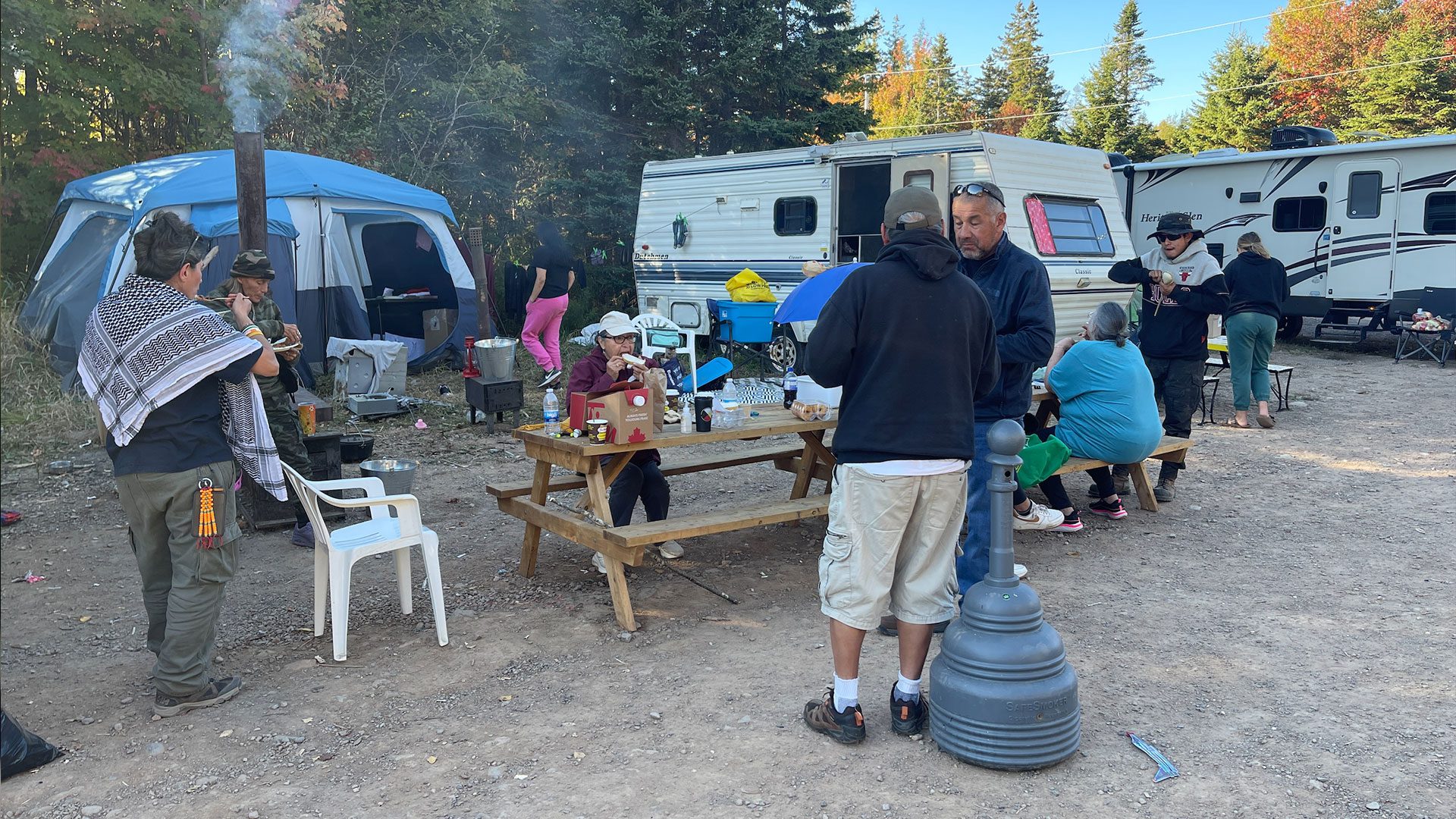
APTN News 03/10/2025 - The RCMP now has a tool that will allow them to remove Mi’kmaw land protectors from a checkpoint set up at the base of Hunters Mountain in Unama’ki, Mi’kmaq for Cape Breton.
On Friday, the provincial government in Nova Scotia, led by Premier Tim Houston, passed the Protecting Nova Scotians Act, an omnibus law that covers everything from funeral services to liquor licenses. For Mi’kmaw land protectors on Hunters Mountain, the law prohibits the blocking of any roads on Crown Land.
The province claims that the omnibus bill is being imposed in order to protect Nova Scotians utilizing wood resources and not because of the checkpoint. But Mi’kmaw said they will be criminalized for practicing their rights, including Treaty Rights Day that was celebrated on Oct. 1. The Mi’kmaq created the checkpoint four weeks ago at Hunters Mountain to prevent logging trucks from clear-cutting and destroying their forests. Mi’kmaw said that locals are welcome to visit the checkpoint.
Michelle Paul, a Mi’kmaw land and water protector, said the law impedes Mi’kmaq inherent rights. “The people will stay here like the stars are stuck in the sky; they are not going to move as they shouldn’t, because our treaties say so. We should be unhindered, we should be unmolested and free to roam in our territories and our homelands,” said Paul.
Concerns about the decline in moose population, impacts to the environment, sacred sites and medicines led to the Mi’kmaq taking back their right to steward the land. The bill amends the Crown Lands Act, which would make it illegal to block access on Crown land roads. Law enforcement now has the power to remove any encampments and obstructions on the roadway.
Land protectors who refuse to leave the mountain could face up to a $50,000 fine and or six months in jail.
APTN News is inside the checkpoint. The road to the forest is not blocked. Off to the side of the road are encampments for protectors to live in. Despite threats of being arrested or removed by law enforcement, Mi’kmaw land protector, Kukuwes Wowkis, said they will remain where they are on the mountain.
“They can try to cross our cedar lines, we are not going anywhere. This bill passing through legislation and stuff like that does not mean nothing to me anyway. I’m staying here,” said Wowkis. Sipekne’katik First Nation is calling on the minister responsible for L’nu Affairs to resign. “Minister [Leah] Martin does not speak for Sipekne’katik, and she most certainly does not speak for the Mi’kmaq Nation,” said Chief Michelle Glasgow.
“Minister Leah Martin’s support for this legislation demonstrates a fundamental disregard for Mi’kmaq rights and a failure to uphold the Province’s legal and moral obligations.” Martin is the first Indigenous MLA to sit in the province’s legislature, according to the government’s website. The Assembly of Nova Scotia Mi’kmaw Chiefs is demanding a meeting with Houston over the passage of the law.
“Premier Houston and his government need to know that they are not the only ones calling the shots here in Mi’kma’ki. We not only hold Treaty Rights, but also Aboriginal Rights, Jurisdictions and Title, as we never ceded or surrendered our lands, waters and resources,” said Chief Terrance Paul in a statement on Friday. “Making decisions without us is unconstitutional and wrong”.
Previously, law enforcement would have had to provide a 60-day notice before removing any obstruction or blockade to the road. With the new bill being introduced, that notice would no longer be mandatory and law enforcement could take legal action on the mountain at any time. Read more - Lire plus
| | Collateral Damage Podcast: Trump’s War on Drugs | Journalist Radley Balko examines how Trump’s war on immigrants merges and expands the lethal policies of the wars on drugs and terror. | |
The Intercept 08/10/2025 - From Afghanistan to Iraq, the United States has long used drone strikes to take out people it alleges are terrorists or insurgents. It’s a legacy that started under President George W. Bush and greatly expanded under President Barack Obama. President Donald Trump has taken this tactic to new extremes, boasting about lethal strikes against alleged drug boats in the Caribbean and declaring the U.S. is in a “non-international armed conflict” with narcotics traffickers.
Trump appears to be merging the war on terror with the war on drugs. This comes as he’s simultaneously ramping up the use of troops to police inside American cities. It’s a chilling escalation. But it’s not the first time we’ve seen a president stoke public fear and deploy overwhelming force in the name of law and order.
In the modern war on drugs — which dates back more than 50 years to President Richard Nixon’s administration — the United States has produced laws and policies ensuring that collateral damage isn’t just tolerated, it’s inevitable. This is the prelude. Read more - Lire plus
| | Trump Administration Conjures Up New “Terrorist” Designation to Justify Killing Civilians | |
The Intercept 01/10/2025 - Since beginning its lethal attacks on boats in the Caribbean last month, the Trump administration has faced a difficult question: How can the U.S. justify drone strikes against non-combatants?
In a briefing on Capitol Hill last week, the U.S. military offered up new explanations, relying on Article 2 of the Constitution and hinging on the claim the suspected drug traffickers are affiliated with “designated terrorist organizations,” or DTOs, according to three sources familiar with the meeting.
The vague phrase — which has previously appeared in government publications but lacks a clear definition — was used in President Donald Trump’s two-page War Powers letter to Congress following the first boat strike on September 2 and one of Trump’s Truth Social posts. A defense official, who did not attend the briefing and spoke to The Intercept on the condition of anonymity, called the label “meaningless.”
Unlike at a previous briefing that excluded senior staff from House leadership and relevant committees, the military sent judge advocates general to last week’s briefing, ostensibly to explain the legal underpinnings of the attacks. The sources familiar with the meeting said that congressional staffers left the Thursday gathering without answers. Military briefers repeatedly referenced a secret directive that the staffers involved have never seen, according to the government officials. The directive, reportedly signed by Trump in July, ordered the Pentagon to use military force against some Latin American drug cartels he has labeled terrorist organizations.
Experts told The Intercept that the sweeping authority asserted by the White House opens the door to even greater authoritarian overreach at home — and the possibility that Trump could order lethal strikes on supposed enemies inside the United States.
“The U.S. boat strikes in the Caribbean were unlawful killings, no matter what the Trump administration’s lawyers say after the fact. There is no recognized armed conflict that magically converts alleged criminals into combatants,” said Sarah Yager, a former senior adviser on human rights to the chair of the Joint Chiefs of Staff. “Inventing new labels like ‘narco-terrorists’ or ‘designated terrorist organizations’ does not create legal authority where none exists. International human rights law is what governs this situation. It clearly says that lethal force is a last resort to avert an imminent threat to life, and the burden is on the government to show necessity and immediacy. The Trump administration hasn’t. Dressing this up as self-defense is wordplay, not law.” Read more - Lire plus
Trump Declares He Can Wage Secret Wars Against Anyone He Calls an Enemy
Fetterman Joins GOP to Kill War Powers Resolution Against Trump’s Extrajudicial Venezuela Bombings
| | Trump’s NSPM-7 Labels Common Beliefs As Terrorism “Indicators” | |
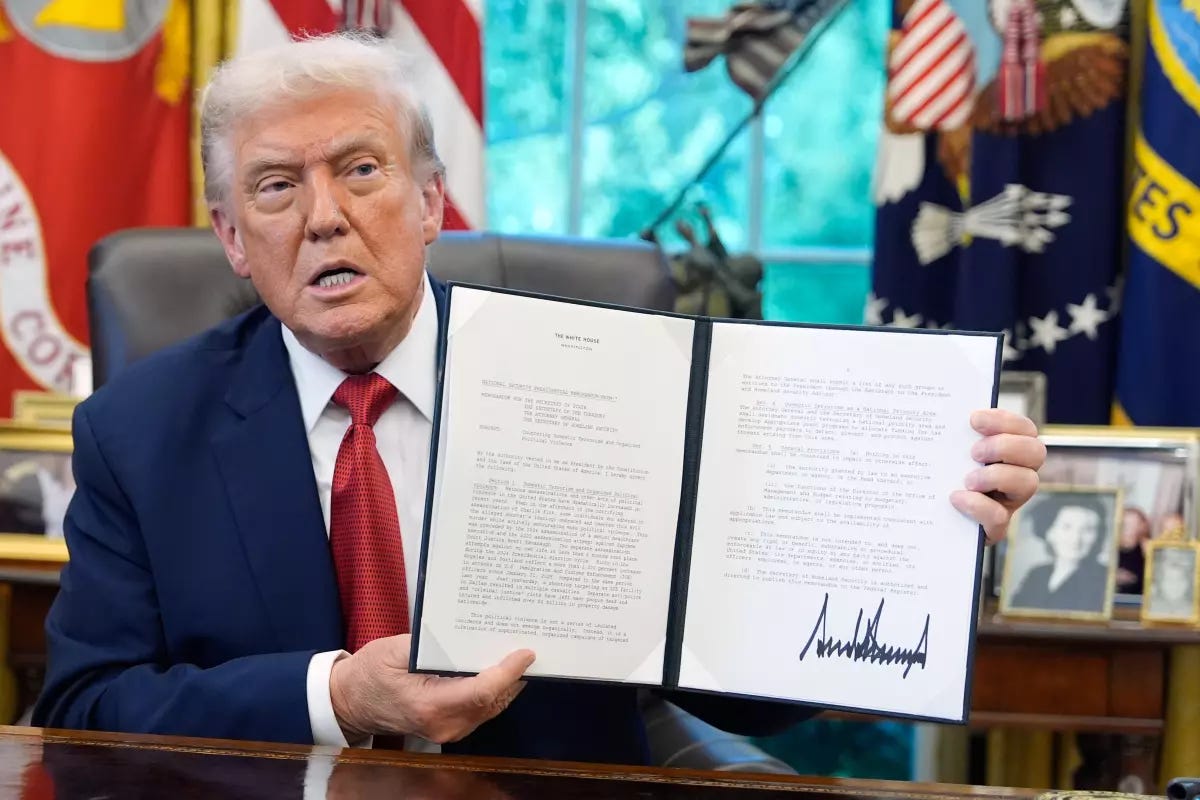
Ken Klippenstein 27/09/2025 - It’s hard to overstate how much different NSPM-7 is from the over 200 executive orders Trump has frantically signed since coming back into office.
An executive order publicly lays out the course of day-to-day federal government operations; whereas a national security directive is a sweeping policy decree for the defense, foreign policy, intelligence, and law enforcement apparatus. National security directives are often secret, but in this case the Trump administration chose to publish NSPM-7 — only the seventh since he’s come into office.)
Previous national security directives have been controversial, even politically earthshaking. In 1980, for example, President Jimmy Carter signed the Top Secret Presidential Directive 59 (“PD-59”) directing new nuclear warfighting policies that persisted until the end of the Cold War. When revealed, PD-59 caused a public furor.
Similarly, President George W. Bush signed a series of classified national security directives after 9/11, the most famous of which authorized NSA’s unlawful domestic intercepts, a directive that wasn’t publicly revealed until four years later.
In NSPM-7, “Countering Domestic Terrorism and Organized Political Violence,” President Trump directs the Justice Department, the FBI, and other national security agencies and departments to fight his version of political violence in America, retooling a network of Joint Terrorism Task Forces to focus on “leftist” political violence in America. This vast counterterrorism army, made up of federal, state, and local agents would, as Trump aide Stephen Miller said, form “the central hub of that effort.”
NSPM-7 directs a new national strategy to “disrupt” any individual or groups “that foment political violence,” including “before they result in violent political acts.”
In other words, they’re targeting pre-crime, to reference Minority Report.
The Trump administration isn’t only targeting organizations or groups but even individuals and “entities” whom NSPM-7 says can be identified by any of the following “indicia” (indicators) of violence:
- anti-Americanism,
- anti-capitalism,
- anti-Christianity,
- support for the overthrow of the United States Government,
- extremism on migration,
- extremism on race,
- extremism on gender
- hostility towards those who hold traditional American views on family,
- hostility towards those who hold traditional American views on religion, and
- hostility towards those who hold traditional American views on morality.
“The United States requires a national strategy to investigate and disrupt networks, entities, and organizations that foment political violence so that law enforcement can intervene in criminal conspiracies before they result in violent political acts,” the directive states (emphasis mine).
A “pre-crime” endeavor, preventing attacks before they happen, is core to the post-9/11 concept of counterterrorism itself. No longer satisfied to investigate acts of terrorism after the fact to bring terrorists to justice, the Bush administration adopted preemption. Overseas, that led to aerial assassination by drones and “special operations” kill missions. Domestically, it led to a counter-terrorism campaign whose hallmark was excessive and illegal government surveillance and the use of undercover agents and “confidential human sources” to trap (and entrap) would-be terrorists.
Now, with Donald Trump’s directive retooling the counter-terror apparatus to go after Americans at home, this means monitoring political activity, or speech, as an investigative method to discover “radicalism.” (Contrary to other national security documents all during the post-Watergate era, NSPM-7 doesn’t even mention the First Amendment or the fundamental right of Americans to organize and protest.)
The focus on speech is evident throughout NSPM-7. The directive says that political violence is the result of “organized campaigns” that often begin (with the left) dehumanizing targets in “anonymous chat foras, in-person meetings, social media, and even educational institutions.” Read more - Lire plus
Over 3,700 nonprofit orgs issue statement condemning NSPM-7
Secretive Watchlisting Center Executing NSPM-7: “We’re expanding the watchlist,” FBI director says amid 300% increase in domestic terror investigations.
Texas AG Ken Paxton Announces Undercover Operations Into "Antifa," Citing "Transgenderism"
| | Trump’s Blueprint to Crush the Left Draws from Decades of Counterterrorism Policy | |
Drop Site News 03/10/2025 - On the evening of September 22, Trump signed an executive order designating “Antifa” as a “domestic terrorist organization.” [...] If there was any question as to whether his Executive Order was merely bluster, Trump clarified the matter three days later when he issued National Security Presidential Memorandum 7 (NSPM-7). Bearing Trump’s signature, NSPM-7 was clearly drafted with a deep understanding of the U.S. counterterrorism bureaucracy. It seeks to “disrupt” not just those allegedly carrying out left-wing violence, but those who fund it and those who “radicalize” and recruit individuals to partake in it. It declares domestic terrorism to be a top priority and defines domestic terrorism priorities to include “civil unrest” and “doxing.”
The memo lays out a range of responsibilities for government agencies. It tasks the Secretary of Treasury to apply powers traditionally used against money laundering and international terrorism to ferreting out the funders of so-called domestic terrorism. It instructs the IRS to make sure no “tax-exempt entities are directly or indirectly financing political violence or domestic terrorism,” and refer those that are to the Department of Justice for prosecution. It instructs the Attorney General to come up with a list of “recurrent motives” and indicators of groups that engage in supposed domestic terrorism so that resources can be directed at similar groups to “prevent potential violent activity.”
At the heart of the strategy lies the FBI’s Joint Terrorism Task Force (JTTF). The first JTTF was created in 1980 to bring the FBI and the New York Police Department together in response to politically motivated robberies by radical groups. Since that time, the model has spread across the country. Currently, there are 200 FBI JTTFs around the country. By comparison, the FBI has 55 field offices. While the JTTFs are FBI entities, carrying out FBI investigations, their staff are drawn from other federal and local law enforcement agencies. According to the FBI, as of October 2024 the JTTFs consisted of “4,000 members—including FBI personnel and task force officers (or TFOs) from more than 500 state and local agencies and 50 federal agencies.” Deputizing local police to carry out FBI terrorism investigations dramatically increased the FBI’s manpower, making sprawling investigations such as a nationwide pursuit of a nebulous idea, possible. It also creates a pool of agents and officers ordered to go out and find terrorists, facing pressure to open investigations in line with the FBI’s political priorities.
Whether it be regular FBI agents or Task Force Officers, those carrying out the FBI counterterrorism mission are instructed to be proactive in finding terrorists before they strike. After the attacks on September 11, 2001, Attorney General John Ashcroft and FBI Director Robert Mueller retooled the FBI’s focus away from a law enforcement agency that prosecuted terrorists after they acted to an intelligence agency dedicated to preventing and disrupting terrorists before they can strike. To do this, Ashcroft and his successor Michael Mukasey dramatically rewrote the guidelines under which the FBI operated. These guidelines were originally put in place after revelations of the abuses of the J. Edgar Hoover years, when the FBI spied on antiwar and civil rights protesters. Ashcroft and others pushed a false narrative that such restrictions left the FBI helpless to prevent terrorism while regearing the Bureau toward the preventative approach.
The preventative approach to terrorism is rooted in the long history of FBI political spying. For many of the Hoover years, the FBI used a questionable interpretation of Presidential Directives to claim it had the right to investigate subversive activities. In the early 1970s, following Hoover’s death and growing criticism of the FBI, the Bureau concocted a new legal theory: The FBI’s intelligence gathering on political groups was justified by the need to prevent violations of a handful of federal statutes. Barry Goldwater and others then turned the same logic toward terrorism. Through a dissenting opinion on the Church Committee, white papers from right-wing think tanks, and a Reagan-era Senate subcommittee on terrorism, the narrative was crafted that restricting FBI investigations to those with actual suspicion of a crime meant the FBI could not prevent terrorism.
Today, the FBI still operates under Mukasey’s guidelines. These guidelines tell FBI agents not to “wait for leads to come in through the actions of others, but rather must be vigilant in detecting terrorist activities to the full extent permitted by law, with an eye towards early intervention and prevention of acts of terrorism before they occur.” The guidelines dramatically lowered the bar to open a case by creating a new category of investigation called an “assessment.” FBI officers can start an “assessment” without a factual predication, i.e. evidence, to believe the subject may violate federal law or threaten national security, allowing the FBI to engage in incredibly intrusive techniques like tasking an informant to clandestinely spy on someone or rifle through their trash.
On paper, the FBI is not allowed to open an investigation solely on First Amendment-protected speech. But in practice, the loose guidelines and preventative framework open the door to exactly that. For example, an FBI agent or local police officer acting as a Task Force Officer is told to find potential terrorists and disrupt them before they strike. They are warned that the priority is “anarchist extremists.” And they are told that anarchists extremists are those who oppose “capitalism, corporate globalization” or “perceived economic, social, or racial hierarchies.” How else does an agent interpret that mandate, other than to locate and surveil those who express those opinions?
Even before the creation of assessments, FBI documents released under FOIA show, agents often merely regurgitated the beliefs that make up supposed extremist groups as the predicate for their investigation. When justifying opening an terrorist enterprise investigation into a nonviolent Palestine solidarity group, for example, FBI agents referenced their “predisposition to anti-capitalist and anti-global philosophy.” The language comes directly from the FBI’s definition of anarchist extremism. And now NSPM-7 has added a whole new list of suspect ideologies as being behind violence, including vague categories like “anti-Americanism” or “extremism on gender.” During Trump’s first term, similar high-level hysteria about Antifa led to the FBI and its JTTFs to question George Floyd protesters about Antifa.
The open invitation to target political speech is made even worse by the fact that the FBI treats “civil unrest” or violations of federal riot statutes as terrorism. In theory, any protest could transform into a riot. In the past, the FBI has distributed intelligence bulletins to local law enforcement alerting them to common tactics used during protest. A Bush-era Office of Legal Counsel opinion found nothing unconstitutional with the FBI preemptively monitoring protests if the stated goal was looking for terrorism. NSPM-7 makes clear it is doubling down on the FBI’s preventative framework, as well as the treatment of civil unrest as terrorism.
NSPM-7 features two other notable changes. For one, it calls for the use of the Foreign Agent Registration Act against “non-governmental organizations and American citizens residing abroad or with close ties to foreign governments, agents, citizens, foundations, or influence networks.” This might appear strange in a memorandum on combatting domestic terrorism. But it closely mirrors calls from Congressional Republicans for similar actions to be taken against Americans based on conspiracy theories about China being behind domestic protests for immigrants’ or Palestinian rights.
It also creates a pipeline of intelligence from the FBI’s Joint Terrorism Task Force to Trump that passes through the Assistant to the President and the Homeland Security Advisor–Stephen Miller. Miller is responsible for some of the most inflammatory language about crushing the domestic left. He has also been using his role on the Homeland Security Council to consolidate his own power. Miller played a central role in the Trump administration’s politically motivated deportations of pro-Palestinian students, and he has been guiding Trump’s extrajudicial executions of alleged Venezuelan drug traffickers in international waters. And now Miller will be the intermediary between the White House and the FBI and Attorney General as they carry out Trump’s crackdown on the political left.
While this consolidation of power into the Homeland Security Council, and into the hands of Miller, is a troubling reorganization of the national security leviathan, nearly all of what Trump is doing is firmly rooted in existing powers. To carry out the renewed war on left-wing protest, Trump has not needed to pass new laws nor create new agencies. For decades, the FBI and other executive branch agencies have amassed powers to investigate Americans on the premise of combating terrorism. No matter who was in office, the FBI has abused these powers to spy on dissent. Read more - Lire plus
An FBI Counterterrorism Vet Explains How To Use Trump's New Orders Against The Left
| | The Sinister Reason Trump Is Itching to Invoke the Insurrection Act | |
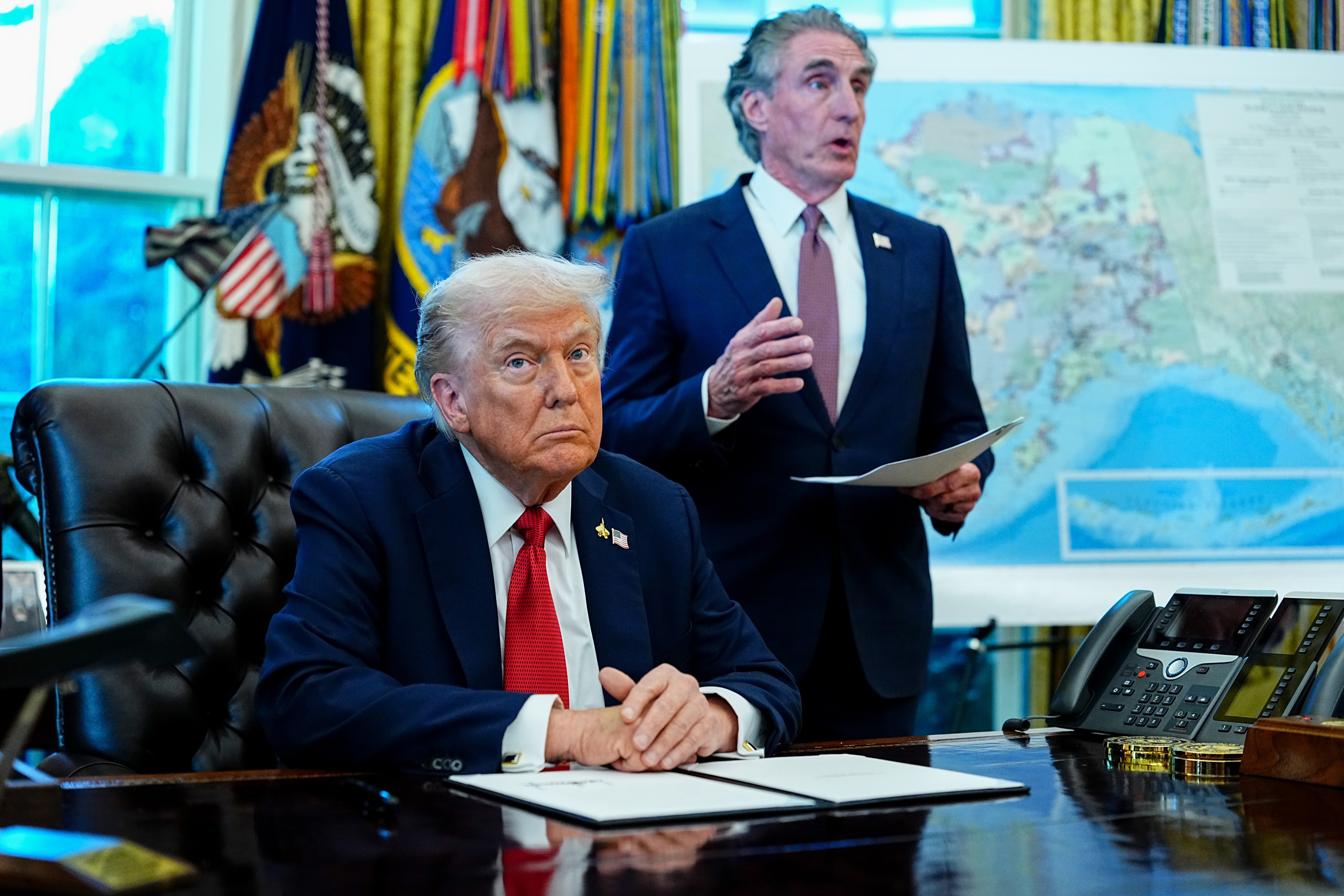
The Intercept 07/10/2025 - President Donald Trump teased a dangerous escalation on Monday afternoon, threatening to invoke the Insurrection Act to send military forces to U.S. cities, should pesky judges and state leaders continue to thwart his ambitions to assault and occupy blue states.
“We have an Insurrection Act for a reason,” Trump told reporters in the Oval Office. “If I had to enact it, I’d do it, if people were being killed and courts were holding us up, or governors or mayors were holding us up.”
Trump noted that he did not see an immediate need to invoke the federal law. His comments, though, make clear the shape of his authoritarian plans to dispatch the military to liberal American cities after a federal judge blocked him from sending troops to Portland, Oregon. Like so many of the Trump regime’s power grabs, the threat is both shocking and predictable.
He Badly Wants to Use It
Trump’s interest in the Insurrection Act is hardly new. He toyed with invoking the law in his first term.
He was itching to use it to send in the military to crush the 2020 George Floyd uprisings but faced opposition at the time from then-Defense Secretary Mark Esper. No such problem for the president with loyalist goon Pete Hegseth in the so-called secretary of war position. And Trump allies called on the president to invoke the law to illegally hold onto power after the 2020 election. During his 2024 presidential campaign, Trump vowed to use the Insurrection Act to suppress unrest and dissent.
In his second term, Trump’s aides and advisers have been clearly setting up a justification for invoking the law — softening up MAGA adherents to accept yet another shockingly dictatorial move from the president.
It’s no accident, after all, that members of Trump’s Cabinet have repeatedly used the term “insurrection” and “insurrectionists” to describe the protesters standing up to U.S. Immigration and Custom Enforcement’s Gestapo-style operations. And Stephen Miller, the ghoulish architect of Trump’s deportation machine, described the Oregon judge’s ruling as “legal insurrection.”
Like an incantation, they call the notion of insurrection into being to justify the Insurrection Act’s invocation when no such justification exists in material reality. “The Trump administration is following a playbook: cause chaos, create fear and confusion, make it seem like peaceful protesters are a mob by firing gas pellets and tear gas canisters at them,” JB Pritzker, the Democratic governor of Illinois, where Trump’s storm troopers already wreaking havoc in Chicago, said on Monday. “Why? To create the pretext for invoking the Insurrection Act so that he can send the military to our city.”
Ripe for Abuse
Then there is the law itself, which could not be better tailored for abuse by exactly the kind of brazen authoritarian like Trump. Legal experts have long warned that the two-century-old statute is dangerously broad and in desperate need of updating for the exact reasons it’s such an appealing tool for Trump.
First, the law gives extraordinary discretion to the president alone to declare a domestic “insurrection” is underway and deploy U.S. military forces against the American people. And it’s one of the few key exceptions to the Posse Comitatus Act barring federal military forces from engaging in civilian law enforcement operations.
If there is “a reason” we have an Insurrection Act, as Trump said on Monday, then it is a historic one, with little bearing on current conditions. With its roots in the 1792 Militia Act and first enacted in 1807, the Insurrection Act “has not been meaningfully updated in over 150 years, is dangerously overbroad and ripe for abuse,” wrote Joseph Nunn of the Brennan Center for Justice.
The language of the law is vague — a gift to a president with dictatorial aims. It grants the federal executive power to deploy troops to suppress “any insurrection, domestic violence, unlawful combination, or conspiracy” in a state that “opposes or obstructs the execution of the laws of the United States or impedes the course of justice under those laws.”
“Nothing in the text of the Insurrection Act defines ‘insurrection,’ ‘rebellion,’ ‘domestic violence,’ or any of the other key terms used in setting forth the prerequisites for deployment,” noted Nunn. “Absent statutory guidance, the Supreme Court decided early on that this question is for the president alone to decide.”
“Create the Pretext”
Concern that Trump will invoke the Insurrection Act to take control of Democratic-led cities is by no means far-fetched. Our cities are already occupied by a federal army of thugs — ICE — directed to kidnap and cage our neighbors atop regular police violence. And Trump has already federalized and deployed National Guard troops in Los Angeles and Washington, overreaches that are already facing their own legal challenges.
Things can, of course, get much worse. Invoking the Insurrection Act would not, however, be a flip switch moving us from a functional democracy into fascism; rather, it would be an expansion of already existent fascist action, and another tool that the president can use to continue to crackdown on dissent.
In the face of such a threat, it is tempting to urge protesters to be placid, to avoid giving the Trump administration pretext for further escalation. That would be a grave mistake. Even Pritzker’s statement recognized that it is the president’s regime that will “create the pretext,” regardless of how peaceful the protesters are.
In the Trumpist imagination — committed to the lie and/or delusion of a well-funded network of criminal leftists — no real pretext is required for a further collapsing of the police and military state. By ruling that the administration’s notion of a grave threat to federal agents was unmoored from reality, Immergut, the federal judge, was saying that Trump cannot ignore facts on the ground. Trump’s flirtations with the Insurrection Act on Monday, though, made clear that he wholly intends to do so. Source
Court battles over National Guard troops deliver win for Chicago as Portland awaits ruling
ICE Agents Dragged Naked Children Out of Homes in Chicago Raid: Neighbors
Chicago Activist on Organizing Community ICE Patrols as Trump Escalates Immigration Crackdown
Video: Where ICE Has Taken The Most People - ICE has arrested 100,000+ in 2025, double compared to last year
ICE to Buy Tool that Tracks Locations of Hundreds of Millions of Phones Every Day
The United Police State of America Has Arrived
A “Green Light” for War Crimes? What Trump & Hegseth’s Lecture to Generals Really Means
| | US Supreme Court lets Trump strip temporary status from 300,000 Venezuelan migrants | |
Reuters 03/10/2025 - The U.S. Supreme Court again cleared the way on Friday for Donald Trump's administration to revoke a temporary legal protection for hundreds of thousands of Venezuelan migrants in the United States, backing a key priority of the Republican president as he pursues a policy of mass deportations.
The justices granted the administration's request to put on hold a judge's ruling that Homeland Security Secretary Kristi Noem lacked the authority to end the Temporary Protected Status, or TPS, granted to the migrants under Trump's Democratic predecessor Joe Biden while litigation proceeds. The Supreme Court has a 6-3 conservative majority. Its three liberal justices dissented.
The court's ruling came at a time of simmering tensions between the United States and Venezuela.
The TPS program is a humanitarian designation under U.S. law for countries stricken by war, natural disaster or other catastrophes, giving recipients living in the United States deportation protection and access to work permits.
The Supreme Court previously sided with the administration in May to lift a temporary order that San Francisco-based U.S. District Judge Edward Chen had issued at an earlier stage of the case that halted the TPS termination while a legal challenge by TPS holders and an advocacy group played out.
Chen issued a final ruling on September 5, finding that Noem's actions to terminate the program violated a federal law that governs the actions of federal agencies. The judge's ruling meant that more than 300,000 Venezuelan TPS holders would be able to remain in the country for now, even though Noem had determined that to be "contrary to the national interest," according to the administration.
The Supreme Court said in an unsigned order on Friday that although the litigation had advanced to a later stage, "the parties' legal arguments and relative harms generally have not. The same result that we reached in May is appropriate here." "I view today's decision as yet another grave misuse of our emergency docket," liberal Justice Ketanji Brown Jackson wrote in a sole dissenting opinion.
The court, Jackson wrote, is "privileging the bald assertion of unconstrained executive power" over judgments made by lower courts that these 300,000 people should not be "left vulnerable to job loss, family separation and deportation" to Venezuela until the legality of the administration's actions is fully resolved. Jackson noted that the U.S. government in January concluded that Venezuela was experiencing a humanitarian crisis.
"We once again use our equitable power (but not our opinion-writing capacity) to allow this administration to disrupt as many lives as possible, as quickly as possible," Jackson added. Trump's administration has repeatedly turned to the Supreme Court's emergency docket to ask the justices this year to allow implementation of his policies that have been impeded by lower courts.
In contrast to the court's regular work, these decisions are made quickly, without the benefit of oral arguments and extensive written briefing. The Supreme Court has sided with the administration in almost every case it has been called upon to review since Trump returned to the presidency in January.
'CLASSIC FORM OF RACISM'
Chen faulted Noem's "discriminatory statements" concerning the Venezuelans, noting that her generalization of the alleged crimes of a few migrants "to the entire population of Venezuelan TPS holders, who have lower rates of criminality and higher rates of college education and workforce participation than the general population, is a classic form of racism."
Lawyers for the plaintiffs decried the Supreme Court's decision.
"The court is throwing aside its standards to green light the Trump administration's lawless actions. The damage to the rule of law as well as directly affected American families is profound," said Cecillia Wang, national legal director of the American Civil Liberties Union, which helped represent the plaintiffs.
The decision also extends the Supreme Court's emergency power "to the final judgments of lower courts, beyond mere interim rulings," added Ahilan Arulanantham, co-director of a UCLA immigration law center and another lawyer for the plaintiffs.
"This is perhaps the most extreme sign that the Supreme Court has abandoned law for politics," Arulanantham said.
Trump has made cracking down on immigration - legal and illegal - a central plank of his second term as president, and has moved to strip certain migrants of temporary legal protections, expanding the pool of possible deportees.
The U.S. government under Biden designated Venezuelans as eligible for TPS in 2021 and 2023. Just days before Trump returned to office in January, Biden's administration announced an extension of the program to October 2026.
Noem, a Trump appointee, rescinded that extension and moved to end the TPS designation for a subset of Venezuelans who had benefited from the 2023 designation. Read more - Lire plus
US Threatens to Deport 33,000 Colombians, Including to Guantanamo Prison
ICE Transfers 18 Migrants From Guantánamo, Emptying Detention Site
| | Myanmar junta says it targeted rebels in deadly attack on protest | |
AFP 09/10/2025 - The Southeast Asian country has been engulfed in a civil war since the military seized power in a 2021 coup, prompting pro-democracy "People's Defence Forces" (PDF) to ally with ethnic minority armed groups against the junta.
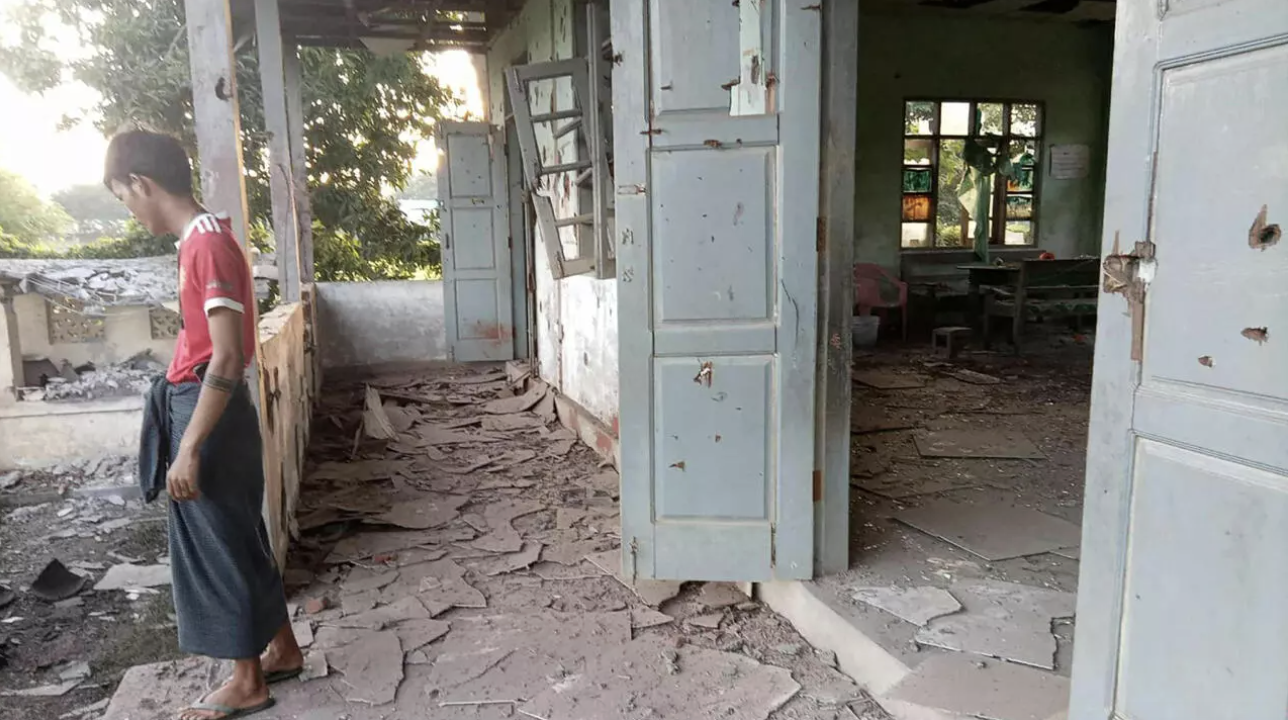
A military strike on a festival and anti-junta protest in central Myanmar on Monday evening killed at least 25 people, and possibly as many as 43, including children, a local committee member told AFP on Thursday.
The woman, who requested anonymity for security reasons, said the bombing on a crowd of hundreds gathered in Chaung U township for the Thadingyut full moon festival left some bodies unidentifiable.
The military accused "so-called PDF terrorist groups" of forcing people to join an anti-government protest and using them as "human shields" in Chaung U.
"According to a detailed report by a responsible citizen who was among those forced to do so, the security forces chose to attack as a counter-terrorism operation to minimise harm to innocent civilians," it said in a statement.
It said four "PDF terrorists" were killed in the attack, releasing photos of four men who several anti-coup campaign groups identified as their members.
A resident of Chaung U who attended the protest told AFP that people attempted to run when they noticed a motor-powered paraglider flying overhead.
The man, who also spoke on condition of anonymity, said the paraglider dropped two bombs and around 40 people were killed, some in front of him.
The "National Unity Government", a self-proclaimed administration in exile, said in a statement that at least three children were among those killed, including a two-year-old.
The Armed Conflict Location & Data monitoring group has tallied more than 85,000 fatalities reported by the media on all sides of the civil war.
Of those, nearly 3,400 were civilians killed by state forces in targeted air or drone strikes. There is no official death toll for the war and estimates vary widely. Source
| | Security frameworks and terror accusations weaponised to punish cooperation with UN in 62% of reprisals cases across the MENA | New analysis reveals systematic abuse of security and counter-terrorism frameworks to intimidate activists and organisations engaging with UN human rights mechanisms. | |
MENA Rights Group 25/09/2025 - A comprehensive 15-year analysis of UN-documented reprisals cases reveals that more than 60% of all intimidation and retaliation against individuals and organisations cooperating with UN human rights mechanisms in the Middle East and North Africa (MENA) region involve the abuse of security and counter-terrorism frameworks.
The report, submitted to UN Secretary-General (UNSG), examines 296 cases from 2010 to 2024 documented in the UNSG’s annual reports on reprisals, across 22 Arab League states and Israel. The findings expose a troubling pattern of states weaponising security and counter-terrorism laws and measures to silence human rights defenders, journalists, and civil society organisations who engage with UN mechanisms.
“Our findings confirm what we have long documented on the ground – accusations of “terrorism” or “threats to security” have become repressive governments’ tool of choice to punish those who dare speak to the UN about human rights violations,” said Tanya Boulakovski, author of the report. “Every act of reprisal has a chilling effect: it not only harms those targeted but perpetuates a climate of fear and self-censorship, weakening the entire UN human rights system.”
The report categorises the 183 security-related reprisals cases into two types: direct and indirect links. Direct links (over 70% of cases) mean the reprisal itself was carried out using security measures – for example, the person was charged with terrorism offenses, prosecuted before an exceptional court, or detained by state security forces specifically because they cooperated with the UN. Indirect links refer to cases where individuals or organisations experienced both reprisals for UN cooperation and security-related targeting, but the reprisal was not directly carried out through those security measures.
The MENA countries where the most cases of reprisals were reported are Bahrain (52), Egypt (38), Israel (33),* Mauritania (24) and Sudan (19). Most alarming is the complete correlation between reprisals and security measures in Saudi Arabia, the United Arab Emirates, Kuwait, Oman, Somalia, Lebanon, and Tunisia: in the seven countries, 100% of documented reprisals cases involved counter-terrorism or security elements.
Egypt accounts for 30 counter-terrorism-related reprisals cases – the highest number in the region. Of these, 28 cases showed a direct link between the reprisal act itself and counter-terrorism measures, demonstrating the systematic deployment of security legislation to punish those cooperating with the UN.
The analysis also reveals that organisations face disproportionate targeting, including dissolution, asset freezes, security-related classifications and terrorism designations for engaging with UN mechanisms. Israel stands out for having targeted the highest number of organisations – 15 in total – all linked to abusive security or terrorism-related accusations.
The findings come as the UNSG 2025 annual report on reprisals was presented yesterday before the UN Human Rights Council (HRC). MENA Rights Group calls on the HRC to establish a dedicated mechanism to monitor and respond to the abuse of security and counter-terrorism frameworks in reprisals cases, and urges governments in the MENA to immediately cease all acts of reprisals and intimidation against those engaging with the UN.
* All reported cases of reprisals committed by Israeli authorities involved Palestinian individuals or organisations, or reprisals linked to human rights work related to Palestine. Read more - Lire plus
| | UK: 'New' police powers to tackle protest yet another attempt to clamp down on human rights | |
Amnesty International UK 05/10/2025 - Responding to news that the Home Secretary is to hand police broader powers to tackle repeat protests, Tom Southerden, Amnesty International UK’s Law and Human Rights Director, said:
“The ‘new’ powers announced by the Home Secretary today are not new at all – they are a reheat of powers that the last Government tried to push through under regulations that the courts found to be unlawful.
“They bear no relation to yesterday’s Defend Our Juries protest, which was at a new location and was targeted at the Government over its draconian misuse of anti-terror laws.
“Is the Government seriously suggesting that people protesting its decisions should only be able to do that a limited number of times? If it is, it is a ludicrous proposal, and if not, this announcement is just a cynical attempt at looking tough.
“Amnesty hopes that the Home Secretary’s threatened ‘review’ of the state of protest law in this country will take into account that there have been three anti-protest bills in as many years and that the Government is putting the fourth through Parliament as we speak.
“However, it seems that when clamping down on peaceful protest, this Government will always find yet another way to restrict this basic human right.” Read more - Lire plus
Nearly 500 arrested at Palestine Action protest in London
UK: Police footage of protests can be held for decades
Former UK MP George Galloway and wife detained 'for hours' by counter terror police at Gatwick airport
| | OTHER NEWS - AUTRES NOUVELLES | | ICLMG ACTIONS DE LA CSILC | | |
UPDATE: The government has now introduced Bill C-12, the Strengthening Canada’s Immigration System and Borders Act. This new bill simply copies over C-2's anti-migrant and anti-refugee provisions. At the same time, Bill C-2 - with its privacy-violating measures absent in C-12 - will continue through Parliament.
Please send a quick email to your MP, the Public Safety Minister, the Justice Minister, the Immigration Minister and the Prime Minister urging them to withdraw these dangerous bills. Thank you!
| |
Canada: Abolish rights-violating terrorist entities list!
| | |
On October 15, 2024, the Canadian government placed the Samidoun Palestinian Prisoner Solidarity Network on Canada’s terrorist entities list. While ostensibly a tool to protect the safety and security of people in Canada and internationally, the list is an arbitrary political tool that undermines freedom of association, of expression and due process in the courts. Its effectiveness as a national security tool has never been demonstrated in a manner that justifies its use.
Due to these deep flaws, and more, the ICLMG has consistently called for the list to be abolished since the Canadian coalition’s founding in 2002. Please join us in urging the Canadian government to abolish the rights-violating terrorist entities list once and for all. Thank you!
| | CSIS isn't above the law! | | |
In recent years, at least three court decisions revealed the Canadian Security and Intelligence Service (CSIS) engaged in potentially illegal activities and lied to the courts. This is utterly unacceptable, especially given that this is not the first time these serious problems have been raised. CSIS cannot be allowed to act as though they are above the law.
Send a message to the Public Safety Minister demanding that he take immediate action to put an end to this abuse of power and hold those CSIS officers involved accountable. Your message will also be sent to your MP and to the Minister of Justice.
| | Canada must protect Hassan Diab! | | Canada must repatriate all Canadians detained in NE Syria now! | Every day the government fails to bring these Canadians home, it places their lives at risk from disease, malnutrition, violence, and ongoing military conflicts. United Nations officials have even found that the conditions faced by Canadians in prison are akin to torture. Please click below to urge the federal government to repatriate all Canadians illegally and arbitrarily detained in northeast Syria without delay. | | 22 years of fighting deportation to torture: Justice for Mohamed Harkat Now! | | Reform Canada's extradition law now! | |
Canada’s extradition system is broken. One leading legal expert calls it “the least fair law in Canada.” It has led to grave harms and rights violations, as we’ve seen in the case of Canadian citizen Dr Hassan Diab. It needs to be reformed now.
Click below to send a message to urge the Prime Minister, the Minister of Justice and your MP to reform the extradition system before it makes more victims. Thank you!
Version française: Le Canada doit réformer la loi sur l'extradition!
| | Canada must protect encryption! | |
Canada, with other G7 nations, continues to push to weaken our access to strong, reliable encryption, after decades of being supportive of strong encryption. We need encryption to safeguard our data, our online transactions, our communications, and to protect the lives of journalists and human rights activists.
Please send a message to the Prime Minister of Canada, the Minister of Public Safety, as well as your Member of Parliament, to urge them to reverse course and once again commit to protecting encryption.
Regardez la vidéo avec les sous-titres en français + Agir
| | Protect our rights from facial recognition! | Facial recognition surveillance is invasive and inaccurate. This unregulated tech poses a threat to the fundamental rights of people across Canada. Federal intelligence agencies refuse to disclose whether they use facial recognition technology. The RCMP has admitted (after lying about it) to using facial recognition for 18 years without regulation, let alone a public debate regarding whether it should have been allowed in the first place. Send a message to the Prime Minister and the Public Safety Minister calling for a ban now. | | What we’ve been up to from January to May 2025 and our plan for the rest of the year | |
ICLMG 30/05/2025 - Thanks to the support of our members and donors, here is what we were able to work on so far in 2025 :
- Open letter to the new Prime Minister and government
- 2025 federal election and National Security Info Card
- C-20: First independent watchdog for the CBSA
- C-27: Digital Charter Implementation Act, 2022
- Online Harms
- Foreign Interference
- Combatting Racism & Islamophobia
- Canada’s terrorist entities list
- Palestine and the right to dissent
- Impacts of Counter terrorism financing
- Hassan Diab & Extradition
- Civil Society Coalition on Human Rights and Counter-terrorism
- And more!
What we have planned for the rest of 2025!
We have our work cut out for us! In response to threats of tariffs and annexation from the Trump administration, the Canadian government has problematically committed to the rapid expansion of border security, surveillance and information sharing with the US, and expanded the use of rights violating anti-terrorism tools. We also cannot ignore the US crackdown on protesters and migrants under the guise of fighting terrorism and protecting national security. We need to ensure that Canada disentangles itself from the US national security regime, resists US pressure to expand surveillance and counter-terror powers and tools at the expense of our civil liberties, and increases protections for privacy, dissent, migrants and asylum seekers.
We will continue our work on these issues and much more:
- Protecting our privacy from government surveillance, including facial recognition, and from attempts to weaken encryption, along with advocating for good privacy law reform
- Addressing the lack of regulation on the use of AI in national security
- Advocating for restrictions on Canadian information sharing with the US, including the application of the US No Fly List in Canada
- Campaigning for the repeal of secretive and rights violating national security lists, such as the Terrorist Entities List and the Canadian No Fly List
- Halting the rapid expansion of new security measures at the border and continuing to push back against the false narrative depicting migrants and refugees as security risks, and advocating for rights protection and accountability for border agencies, including by monitoring the creation of a new CBSA and RCMP watchdog agency
- Advocating with lawmakers and officials to protect civil liberties from the overall negative impact of national security
- Countering the escalating repression of free expression, dissent and protest in the name of “countering terrorism,” including the crackdown on protests in support of Palestinian human rights and against the genocide in Gaza. This includes countering new “bubble zone” laws at the municipal and federal levels
- Fighting for Justice for Mohamed Harkat, an end to security certificates, and addressing problems in security inadmissibility
- Fighting for Justice for Hassan Diab and reforming Canada's extradition law
- Addressing the impacts of measures to counter terrorism financing on civil society groups, including the CRA’s targeting of Muslim-led charities and restrictions and criminalization of the provision of international assistance and humanitarian aid
- Calling for the return of Canadian citizens and the non-Canadian mothers of Canadian children, who remain indefinitely detained in Syrian camps
- Pushing for restrictions on the implementation of new foreign interference laws
- Keeping you and our member organizations informed via the News Digest
- And much more! Read more - Lire plus
Share on Facebook + Instagram + Bluesky + Twitter
| | Les opinions exprimées ne reflètent pas nécessairement les positions de la CSILC - The views expressed do not necessarily reflect the positions of ICLMG. | | |
THANK YOU
to our amazing supporters!
We would like to thank all our member organizations, and the hundreds of people who have supported us over the years, including on Patreon! As a reward, we are listing below our patrons who give $10 or more per month (and wanted to be listed) directly in the News Digest. Without all of you, our work wouldn't be possible!
James Deutsch
Bill Ewanick
Kevin Malseed
Brian Murphy
Colin Stuart
Bob Thomson
James Turk
John & Rosemary Williams
Jo Wood
The late Bob Stevenson
Nous tenons à remercier nos organisations membres ainsi que les centaines de personnes qui ont soutenu notre travail à travers les années, y compris sur Patreon! En récompense, nous nommons ci-dessus nos mécènes qui donnent 10$ ou plus par mois et voulaient être mentionné.es directement dans la Revue de l'actualité. Sans vous tous et toutes, notre travail ne serait pas possible!
Merci!
| | | | |