|
International Civil Liberties Monitoring Group
Coalition pour la surveillance internationale des libertés civiles
February 17, 2024 - 17 février 2024
| |
Civil Society Coalition Urges Canada To Stop Arms Transfers To Israel | |
|
Oxfam 05/02/2024 - We, the undersigned 45 civil society organizations, express profound concerns about the legal and humanitarian implications of Canada’s transfer of weapon systems to the government of Israel. These concerns have been further amplified following the January 26th provisional ruling by the International Court of Justice (ICJ).
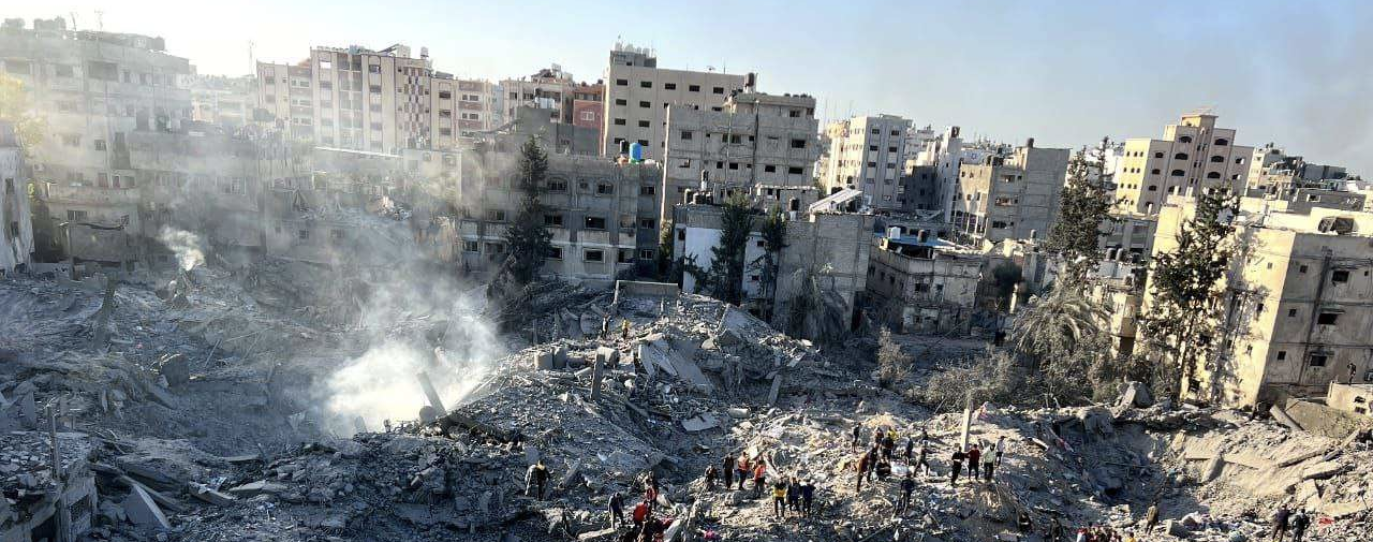
Since the onset of Israel’s response to the Hamas-led October 7 attacks, over 26,000 Palestinians, the majority civilians, including more than 10,000 children, have been killed in Gaza. Large parts of the Gaza Strip have experienced widespread devastation, including the destruction of homes, schools, hospitals, refugee camps, and critical civilian infrastructure. Experts have labeled Israel’s bombing campaign as one of the “deadliest and most destructive in recent history.”
According to annual datasets published by Global Affairs Canada, over the last decade, Canada has exported more than $140 million (constant CAD) in military goods to Israel, including military aerospace components, bombs, missiles, explosives, and associated parts. There is substantial concern that some of these weapons could be enabling Israel’s operation in Gaza. In addition to direct exports, Canadian-produced technology has been supplied to Israel by first being integrated into US-produced systems, including components incorporated into the F-35 Joint Strike Fighter, which Israel has used in its bombing campaign across Gaza.
Credible human rights monitors, including UN officials, have routinely alleged that Israel has violated international humanitarian and human rights law throughout its operation. UN Secretary-General António Guterres has likened the ongoing humanitarian crisis in Gaza to the “collective punishment of the Palestinian people.” Given Israel’s conduct during its ongoing military operation in Gaza, there is clear and substantial risk that Canadian arms transfers may be used to commit serious violations of international humanitarian law or international human rights law in the conflict.
As per Canada’s obligations under the Export and Import Permits Act and the Arms Trade Treaty, Canadian officials are therefore required to halt arms transfers and deny further arms export and brokering authorizations to Israel.
The January 26th provisional ruling by the ICJ deemed that at least some of South Africa’s allegations of violations of rights of Palestinians under the Genocide Convention are “plausible.” This is a further reason for Canada to halt arms transfers to Israel. All parties to the Genocide Convention, including Canada, have duties to ensure the prevention and non-complicity in one of the most serious internationally wrongful acts. Countries that transfer arms to another country that are likely to be used in the commission of war crimes, crimes against humanity, or genocide risk being complicit in those crimes.
In December, the government of Canada joined an overwhelming majority of UN member states in calling for a ceasefire. Civil society welcomed such a call. Now, towards this effort of ending the grave abuses taking place on the ground, Canada must meet its domestic and international obligations by halting the supply of weapon systems to Israel.
In recent years, Canadian officials have taken the proactive step to presumptively deny the issuance of arms export and brokering permits to certain countries when there was a substantial risk those weapons would be misused, including at times to Türkiye, Belarus, and Russia. Dozens more individual arms export permits have been denied since Canada’s accession to the ATT due to the risks posed by their proposed export. Given the wholesale destruction in Gaza and the deaths of thousands of Palestinian civilians, there is no reason a similar policy cannot or should not be implemented in regards to Israel.
This call echoes that of leading Canadian and global humanitarian organizations urging for a cessation of arms transfers to Israel and Palestinian armed groups in order to protect civilians and allow Gaza’s only remaining lifeline, an internationally funded humanitarian aid response, to reach the 2.3 million in need.
Minister, we welcome Canada’s announced strong support for the “critical role” of the ICJ and commitment to abide by its rulings in the genocide case brought by South Africa against Israel. However, the government of Canada cannot at the same time signal support for the ICJ, and adherence to its rulings, while continuing to arm those whom the ICJ has ruled are plausibly accused of genocide. We therefore urge immediate action on the part of your government by halting further arms exports, alongside export and brokering authorizations, to Israel. Read more - Lire plus
Which countries have stopped supplying arms to Israel?
Amnesty international: New evidence of unlawful Israeli attacks in Gaza causing mass civilian casualties amid real risk of genocide
Doctors say Israel is wiping out a generation of kids in Gaza
Amnesty International: Shocking Spike in Use of Unlawful Lethal Force by Israeli Forces Against Palestinians in the Occupied West Bank
Israel’s War on Journalists: More Reporters Killed in Gaza in 3 Months Than Any Country Over Entire Year
Canada, Australia, New Zealand call for immediate ceasefire in Gaza ahead of Rafah assault
Trudeau Government Authorized $28.5 Million Of New Military Exports To Israel
ACTION: Last chance to sign Parliamentary petition against arms transfers to Israel
ACTION: Take action now to demand Canada impose an immediate arms embargo on Israel
NEW ACTION: Tell Canada: Support the ICJ decision, end the genocide in Gaza!
We Support South Africa's Genocide Convention Case Against Israel
NEW ACTION: End Canadian Assistance to Military Committing Genocide
Six Canadian unions representing more than 2 million workers demand reinstatement of UNRWA funding to support humanitarian aid in Gaza
Amnesty International: States must reverse cruel decision to withdraw UNRWA funding
Report Finds “No Evidence” in Key Dossier to Support Israel’s UNRWA Allegations
UNRWA staff accused by Israel sacked without evidence, chief admits
Israel releases names and details of alleged involvement of UNRWA employees in October 7 attacks but provides no evidence to support its allegations
NEW ACTION: Tell Minister Hussen: Reverse the UNRWA cuts, don’t punish Gaza!
Ruling by UN’s top court means Canada and the U.S. could be complicit in Gaza genocide
Key Liberal MP rips his government's policy on Gaza war in private call with constituent
ICLMG ACTION: Canada Must Oppose Genocide in Gaza and Defend Free Expression at Home! + Share on Facebook + Twitter + Instagram
| |
Matthew Behrens: Canada's temporary residence program for Palestinians from Gaza has serious flaws | |
Matthew Behrens coordinates the Rural Refugee Rights Network, which works closely with Palestinians navigating this program and in 2021 worked to reunite 14 long-separated Gaza families in Canada. | |
|
Ottawa Citizen 24/01/2024 - A widely circulated October photo from Gaza shows a Palestinian mother in shock as she cradles her baby, both with blood stains on their heads. The faces of other family members exhibit fear and anxiety following a narrow brush with death. They had miraculously survived the bombing of the house next door in what they’d been told was a safe location in Rafah.
That mother recently contacted me seeking help. Her father, Mohammed Alsouci, has been in Canada since August, 2022, working full-time in Cornwall as he awaits the disposition of his refugee claim. On Jan. 9, Mr. Alsouci anxiously logged in to the new temporary residency program designed for for Palestinians in Gaza with loved ones — “anchor relatives” — in Canada.
But Alsouci was immediately locked out. Despite his intention to live here permanently and his ability to support his family, he was ineligible to apply because he is not yet a permanent resident or Canadian citizen. While the Immigration and Refugee Board has declared his file worthy of consideration under “less complex claims” — meaning the case is solid and could be decided without a hearing — it’s not enough to meet his family’s urgent needs. Permanent residency applications take years to process, which would leave his wife and children exposed to the constant threat of death from bombardment and the ravages of disease and starvation in the flimsy, non-winterized open air tent that is now their “home.”
The failure to include refugees and refugee claimants from Gaza as anchor relatives is one of many serious problems with the government’s new program. It has generated endless stress for Palestinian families in Canada forced to race against one another to upload applications and get in under the 1,000-person cap. Many report a desperate effort to gather documents from family members in a war zone where lack of consistent internet poses significant communication challenges.
Of particular concern is the securitizing framework that appears to have informed the program’s architecture. Immigration Minister Marc Miller’s public pronouncements have undermined its potentially welcoming effects by repeatedly painting Palestinians with the unfair brush of suspicion (in one recent CBC Ottawa Morning interview, he mentioned “terrorism” and “security” 11 times, and “humanitarian” only once). Yet rarely mentioned is that anyone applying for this program would be subject to the same thorough vetting as everyone else who seeks to come to Canada. That suspicion is also built into application forms that ask unprecedented questions about the origin of every scar, while seeking employment histories dating to the age of 16, complete with supervisor names and notes on any workplace disciplinary incidents.
The Canada-Ukraine authorization for emergency travel program (CUAET) provides a sharp contrast. Following the Russian invasion, Canada offered unlimited access (more than 1.1 million permits approved, though only 20 per cent have actually come here); Ukrainian nationals and family members could apply from anywhere in the world and did not require anchor relatives in Canada; almost all application and biometric fees were waived; applications were to be processed within 14 days; and families received direct deposits of $3,000 per adult and $1,500 per child.
CUAET was not perfect, but it showed Canadian immigration officials can execute a program that meets the moment. Yet for Palestinians, Canada has not shown such compassion. Under the Gaza program, all fees remain in place; anyone caught outside of Gaza after Oct. 7 cannot apply; the 1,000-person cap remains with no clarity about whether it will be lifted; and there is no financial assistance to cover flights out of Egypt for families who have nothing but the often blood-stained clothes on their backs.
Meanwhile, those struggling with the application process report numerous instances of false government replies informing them they did not submit documents or their applications are incomplete. Some report receiving responses about other families, a violation of privacy and worrying sign about the program’s integrity.
Minister Miller says he’s willing to be flexible. That flexibility should include meeting with family members and community organizations working with Palestinians who can explain the system’s flaws, work together to fix them, and hopefully provide the temporary refuge so desperately needed. Source
Canadian Council for Refugees' letter on the temporary immigration measures in response to humanitarian crisis in Gaza
NEW ACTION: Save This Gaza Family: Palestinian Refugees Must be Allowed to Bring Loved Ones to Canada
NEW ACTION: Demand Immediate Release of Mansour Shouman from Israel Government and IDF
ACTION: Canada Must Issue Permits to Leave Gaza for 4 Grandchildren of Canadian Family
ACTION: Please support the Alhalees and other Canadian families with loved ones in Gaza
Palestinians face red tape, delays in applications to come to Canada, families here say
Why is Canada asking Palestinians to list scars on Gaza visa applications?
| |
Canadian police muzzle advocates for peace | |
|
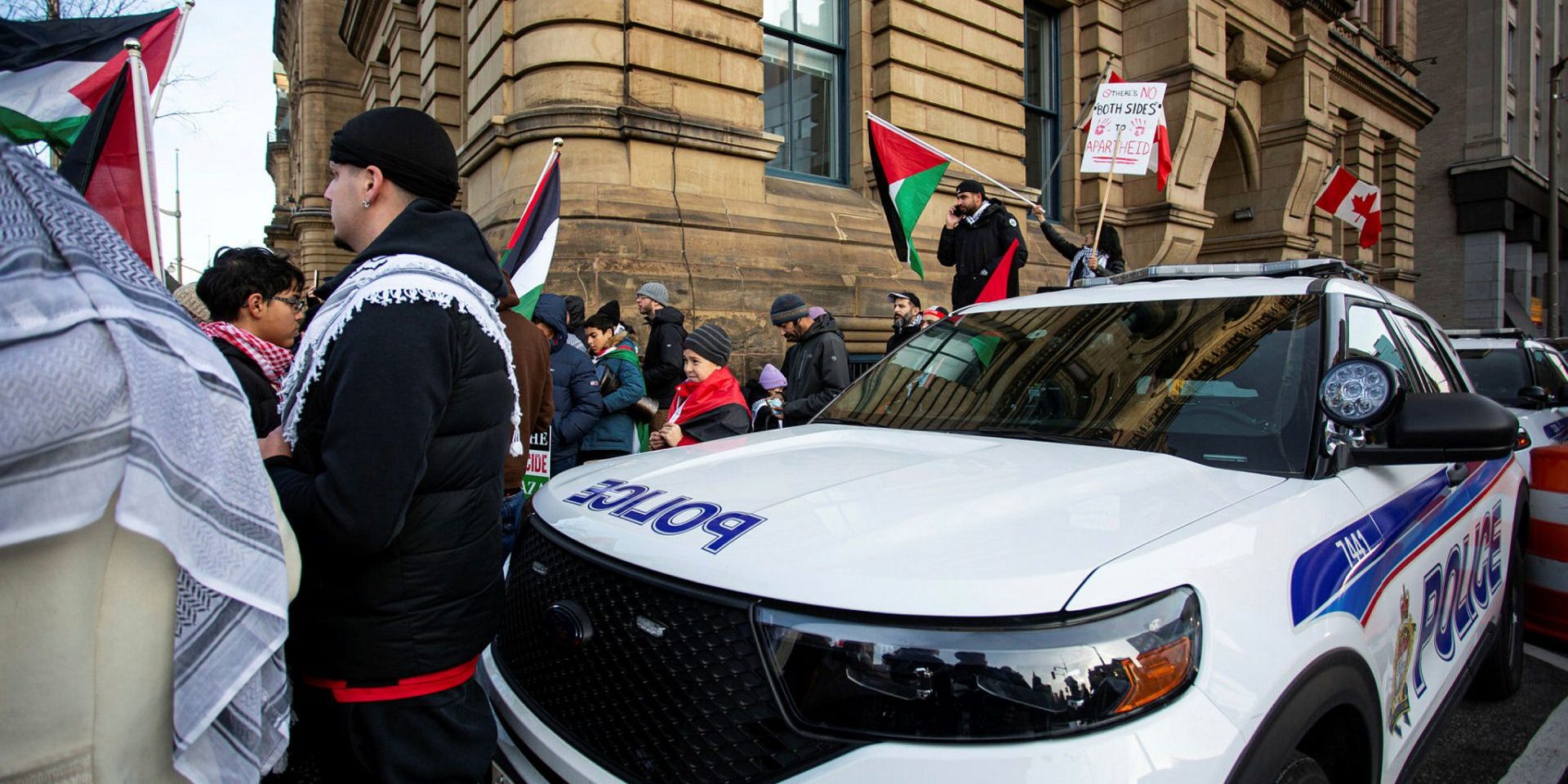
The Hill Times 12/02/2024 - The right to peaceful protest is a constitutional guarantee enshrined in the Canadian Charter of Rights and Freedoms. But from our vantage point as criminal defence lawyers, an unstated “Palestine exception” to the Charter seems to have taken hold.
The timing couldn’t be worse. As of the end of January, the International Court of Justice (ICJ) is no longer the only court to have found Israel’s current military campaign in Gaza “plausibly” genocidal: a United States federal court reached the same conclusion.
Judge Jeffrey White (a George W. Bush appointee) found: “the undisputed evidence before this Court comports with the finding of the ICJ and indicates that the current treatment of the Palestinians in the Gaza Strip by the Israeli military may plausibly constitute a genocide in violation of international law.”
“It is every individual’s obligation to confront the current siege in Gaza,” he added. Despite our moral obligation to speak out against a potential genocide, police forces from across the country have been at work to silence us.
For example, in Calgary, police charged a protester with a hate-motivated offence for chanting “From the river to the sea, Palestine will be free”—a spurious charge that was later stayed. (Even when charges do not stick, the criminal process is traumatizing, stigmatizing, and expensive, and can be expected to have a chilling effect on expression.)
In Toronto, police issued an edict banning all protests at the Avenue Road overpass, a site of pro-Palestinian expression, eliciting criticism from the Canadian Civil Liberties Association. They also laid an “unprecedented” public incitement of hatred charge on someone for allegedly carrying the flag of the Popular Front for the Liberation of Palestine—a charge one legal expert has described as “an uphill battle” to prosecute.
In Ottawa, people raising their voice for a ceasefire were issued $1,500 in fines for using loudspeakers and megaphones on public streets. This kind of equipment is commonly used at any protest without hassle.
In British Columbia, RCMP deployed its Community-Industry Response Group (a unit notorious for its use of snipers against Wet’suwet’en land defenders) at pro-Palestine rallies as though peaceful protesters are a significant public safety risk.
In our view, this wave of police crackdown stems from a deliberate conflation of criticizing Israel with antisemitism. The Ontario government, for example, has funded at least one police service to receive training on antisemitism from Friends of Simon Wiesenthal Center. This organization takes the stance that, “If you’re not pro Israel, then you’re antisemitic,” according to employees who spoke to CBC News.
Since 2019, the Government of Canada has adopted the International Holocaust Remembrance Alliance definition of antisemitism. According to dozens of human rights organizations, this definition is so overly broad that it “has often been used to wrongly label criticism of Israel as antisemitic, and thus chill and sometimes suppress, non-violent protest, activism and speech critical of Israel and/or Zionism.”
Another well-known factor is discriminatory policing and bias. According to Toronto Police’s own numbers from 2020, people of colour, including Middle Easterners, are more likely to be subject to use of force. Anti-Palestinian racism has only risen since. The British Columbia Civil Liberties Association has sounded the alarm about “escalating levels of Islamophobia, harassment, racial profiling, and surveillance akin to that seen post-9/11.”
On the other hand, police forces in Ontario have an “excellent” relationship with Israeli police, which has included a 2005 visit by the province’s chiefs of police to Israel—funded in part by the Israeli government. The chief of York Regional Police at the time called Israel “one of the world’s most sophisticated democratic states.”
It is true that freedom of expression in Canada is not absolute. It is subject to “reasonable limits” that can be justified in a free and democratic society. But it’s fatally dangerous for both freedom and democracy to put the police in charge of dictating the bounds of acceptable political discourse—no less during a potential genocide. Source
ACTION: Drop the Charges against the ‘Peace 11’ Indigo Protestors!
ACTION: Ottawa: Drop the Fines: Don't Silence Palestinian Voices!
Concerns raised after Ottawa Police follow community members to underground parking lot after Gaza ceasefire protest
Ottawa Police Using ‘Intimidation Tactics’ Against Striking Workers, Canada’s Biggest Federal Public Sector Union Says
Is There Anywhere Left To Protest For Gaza In Canada?
Paltry are the forms of protest we have today and they are under threat
Anti-hate: the new face of political policing
The Political Weaponization of Antisemitism Highlights Challenges for Upcoming Online Harms Legislation
CCLA speaks on the rights of protestors following Avenue Rd bridge arrests
Know Your Rights: CCLA's Citizen’s Guide To Rights When Dealing With Police
The RCMP Sent Its Pipeline Protest Unit to Pro-Palestinian Rallies
Supreme Court staff polices Black voices and shows anti-Palestinian bias
CMPAC Calls for Carleton University to Uphold Freedom of Expression After Its Cancellation of a Palestine Advocacy Event
What happened outside Mount Sinai Hospital as a pro-Palestine rally passed by?
Palestinians In Canada Say Their Voices And History Are Being Erased
| |
Maha Hilal: Israel, the United States, and the Rhetoric of the War on Terror
| |
|
TimDispatch 25/01/2024 - Just as the 9/11 attacks “did not speak for themselves,” neither did Hamas’s attacks on Israel on October 7, 2023. In remarks at a bilateral meeting with President Biden 11 days later, however, Prime Minister Netanyahu strategically compared the Hamas attacks to the 9/11 ones, using resonant terms for Americans that also allowed Israel to claim its own total innocence, as the U.S. had done 22 years earlier. In that vein, Netanyahu stated, “On October 7th, Hamas murdered 1,400 Israelis, maybe more. This is in a country of fewer than 10 million people. This would be equivalent to over 50,000 Americans murdered in a single day. That’s 20 9/11s. That is why October 7th is another day that will live in infamy.”
But 9/11 doesn’t live in infamy because it actually caused damage of any long-lasting or ultimate sort to the United States or because it far exceeded the scale of other acts of global mass violence, but because it involved “Americans as the victims of terror, not as the perpetrators” and because of the way those leading the country portrayed it as uniquely and exceptionally victimized. As Professor Jackson put it, 9/11 “was immediately iconicized as the foremost symbol of American suffering.” The ability to reproduce that narrative endlessly, while transforming 9/11 into a date that transcended time itself, served as a powerful lesson to Israel in how to communicate suffering and an omnipresent existential threat that could be weaponized to legitimize future violent interventions. By framing the Hamas attacks on October 7th similarly as a symbol of ultimate suffering and existential threat, Israel could do the same.
Giving Israel further license for unfettered state violence under the guise of a war on terror, in remarks in Tel Aviv President Biden stated that “since this terrorist attack… took place, we have seen it described as Israel’s 9/11. But for a nation the size of Israel, it was like 15 9/11s. The scale may be different, but I’m sure those horrors have tapped into… some kind of primal feeling in Israel, just like it did and felt in the United States.”
It bears noting that while Israel quickly deployed the rhetoric of the War on Terror on and after October 7th, weaponizing the language of terror was not in and of itself novel in that country. For example, in 1986, Benjamin Netanyahu edited and contributed to a collection of essays called Terrorism: How the West Can Win that spoke to themes similar to those woven into the U.S. war on terror narrative. However, in responding to Hamas’s attacks, Israel’s discursive strategy was both to capitalize on and tether itself to the meanings the U.S. had popularized and made pervasive about the 9/11 attacks.
“Surprise” Attacks
The power of that “primal feeling” was intensified by the way both the United States and Israel feigned “surprise” about their countries being targeted, despite evidence of impending threats both were privy to. That evidence included a President’s Daily Brief that Bush received on August 6, 2001, entitled “Bin Laden Determined to Strike in US,” and the possession by Israeli officials of a Hamas battle plan document detailing the potential attack a year in advance.
Just as Bush referred to the 9/11 attacks as a surprise, despite several years of conflict with al-Qaeda and Osama bin Laden (who clearly stated that U.S. violence in Muslim-majority countries was the motivation for the attacks), Netanyahu claimed the same after the Hamas attacks, ignoring Israel’s longtime chokehold on Gaza (and Palestinian areas of the West Bank). Addressing Israeli citizens on the day of the attack, Netanyahu asserted that “we are at war, not in an operation or in rounds, but at war. This morning, Hamas launched a murderous surprise attack against the State of Israel and its citizens.”
By portraying terrorism as a grave, unparalleled, and unpredictable danger, both the United States and Israel framed their brutal wars and over-responses as necessary actions. Even more problematically, both tried to evade accountability for future acts by characterizing themselves as coerced into the wars they then launched. Netanyahu typically asserted on October 30th that, “since October 7th, Israel has been at war. Israel did not start this war. Israel did not want this war. But Israel will win this war.”
All of these tactics are meant to create and perpetuate “an extremely narrow set of ‘political truths’” (or untruths, if you prefer). Whether ingrained in the public consciousness by the United States or Israel, such “truths” were meant to dictate just who the “terrorists” were (never us, of course), their irrational, barbaric, uncivilized nature, and so, why intervention — full-scale war, in fact — was necessary. An additional rhetorical goal was to position the dominant narrative, whether American or Israeli, as a “natural interpretation” of reality, not a constructed one.
Israel has relied on such a framework to consistently peddle a depoliticized narrative of Hamas, which roots any violence committed in a fundamental and irrational opposition to the state of Israel and inherent hatred of the Jewish people as opposed to the longstanding regime of occupation, apartheid, and now genocide of Palestinians. Hamas and other non-state actors are, of course, always portrayed as “driven by fanaticism,” as Scott Poynting and David Whyte note, while state violence, in contrast, is “presented as defensive, responsible, rational, and unavoidable — and not motivated by a particular ideological bias or political choice.”
The Threat of Terrorism and Moral Equivalencies
Terrorist violence in these years has regularly been weaponized in the service of state violence by conceiving of its threat as almost unimaginably dangerous. Both the United States and Israel have represented terrorism as “catastrophic to democracy, freedom, civilization and the American [or Israeli] way of life,” and “a threat commensurate with Nazism and Communism.” As with Bush’s argument that the 9/11 attackers were the “heirs of all the murderous ideologies of the twentieth century” and that “they follow in the path of fascism, and Nazism, and totalitarianism,” Netanyahu urged a mobilization of countries across the world to eliminate Hamas on a similar basis. To this end, he asserted that “just as the civilized world united to defeat the Nazis and united to defeat ISIS, the civilized world must unite to defeat Hamas.”
American officials regularly frame U.S. violence as a function of the country’s inherent goodness and superiority. For example, in September 2006, responding to criticisms of the moral basis for the War on Terror, Bush said at a press conference: “If there’s any comparison between the compassion and decency of the American people and the terrorist tactics of extremists, it’s flawed logic… I simply can’t accept that. It’s unacceptable to think that there’s any kind of comparison between the behavior of the United States of America and the action of Islamic extremists who kill innocent women and children to achieve an objective.”
By the time Bush made those remarks, the invasions of and wars in both Afghanistan and Iraq, as well as other “counterterrorism” operations across the globe, had been underway for years. Given the staggering number of civilians already killed, drawing a demarcation line between the United States and “Islamic extremists” based on the slaughter of innocent women and children should hardly have been possible (though when it came to those killed by Americans, the term of the time was the all-too-dehumanizing “collateral damage”).
No stranger to weaponizing the language of moral equivalencies, Netanyahu has repeatedly highlighted the victims of Hamas’s attacks in order to distinguish them from Israel’s. For example, he described Hamas as “an enemy that murders children and mothers in their homes, in their beds. An enemy that kidnaps the elderly, kids, youths. Murderers who massacre and slaughter our citizens, our kids, who just wanted to have fun on the holiday.” But like the United States, Israel has killed women and children on a strikingly greater scale than the non-state actors they were comparing their violence to. In fact, in the last 100 days of Israel’s war, it is believed to have killed more than 10,000 children (and those figures will only rise if you include children who are now likely to die from starvation and disease in a devastated Gaza). [...]
If Israel’s U.S.-backed genocide of the Palestinians has revealed anything about the power of discourse, it’s that the war on terror narrative has proven to be remarkably enduring. This has enabled both states to make use of specific schemas that were constructed and deployed in Washington to explain the 9/11 attacks — and now to justify a genocidal war in a world where “terror” is seen as an eternal threat to “liberal democracies.”
In his book Narrative and the Making of US National Security, Donald Krebs argues that, when it comes to politics, language “neither competes with nor complements power politics: it is power politics.” In this vein, it remains critical to subvert such destructive and pervasive narratives so that countries like the United States and Israel can no longer maintain “necropolitical” rule domestically or globally — that is, in the words of Cameroon historian and political theorist Achille Mmembe, “the power and the capacity to dictate who may live and who must die.” Read more - Lire plus
Webinar: From Turtle Island to Kashmir to Palestine: Settler Colonialism is a Crime
Azeezah Kanji: The Genocidal “Civilized” vs the Erased Colonized: Gaza at the International Court of Justice
Spencer Ackerman: The Eighteenth Brumaire of The War on Terror
“Obscene”: Biden Pushes House to Approve Bill with $14B in Military Aid to Israel, Cuts UNRWA Funding
“A War Against Palestinian Americans”: Jailed, Attacked, Killed in West Bank and U.S.
Israeli police repressing anti-war protests with ‘iron fist,’ say activists
New Report Reveals State led Censorship and Suppression of Palestine Solidarity Across Europe
UK: Kids referred to counter-terror police amid crackdown on Palestine support
A coalition of international organizations demands that Meta refrain from censoring criticism of Zionism on its platforms
| |
National Day of Remembrance of the Québec City Mosque Attack and Action Against Islamophobia | |
|
ICLMG 29/01/2024 - Today marks the 7th anniversary of the Quebec Mosque shooting. We remember the victims of that Islamophobic attack: Azzeddine Soufiane, Khaled Belkacemi, Aboubaker Thabti, Abdelkrim Hassane, Mamadou Tanou Barry and Ibrahima Barry.
It is also the National Day for Action Against Islamophobia. As we see increasing levels of Islamophobia and anti-Palestinian racism in Canada, we commit to continuing our fight against the targeting of Muslims and racial and religious profiling in Canada's anti-terrorism and national security activities, including:
- Countering government officials', politicians' and the media's continued false portrayal of Muslims, including refugees and migrants, as a "security threat";
- Protecting the civil liberties of those who protest human rights abuses, including in support of Palestinian human rights;
- Ending the CRA's unfounded and prejudiced targeting of Muslim charities;
- Rescinding national security programs that reinforce systemic Islamophobia, including the No Fly List and other border measures; the Terrorist Entities List; security certificates; and others;
- Advocating for justice for Canadian Muslims who have and continue to face the disproportionate brunt of anti-terrorism policies and the "War on Terror," including Mohamed Harkat and his fight against deportation to torture in Algeria; Hassan Diab's quest for justice and no new extradition to France; and the repatriation of Canadian men, women and children in indefinite detention in northeastern Syria;
- Ending Canada's role in international military operations that carry on the legacy of the "War on Terror" and its abuses, including opposing the military's purchase of armed drones.
Each and everyday, we will work with our coalition members and community partners to fight Islamophobia, racism, hate and human rights and civil liberties abuses in Canada and abroad. Source
Amira Elghawaby: On anniversary of Quebec mosque attack let's work collectively to combat Islamophobia
EVENT: [Feb 29 & Mar 1, 2024] In Dialogue: Canada Revenue Agency & Muslim-led Charity Sector
Loi 21: La Ligue des droits et libertés dénonce le renouvellement de la clause dérogatoire
| |
Reasonable Cause to Suspect: Book Launch and Discussion on a Hidden Human Rights Case | |
|
Octopus Books - Join us for the launch of Reasonable Cause to Suspect with author Sally Lane, featuring a panel discussion on the obstacles preventing the repatriation from Northeast Syria of over two dozen arbitrarily detained Canadian Muslim men, women, and children. Presented by Justice and Equality Action Group and Stop Canadian Involvement in Torture, with the support of Octopus Books, who will be selling books on-site.
Wednesday, February 21, 7pm-9pm
Fellowship Hall, First Unitarian Congregation of Ottawa
30 Cleary Ave., Ottawa
Panel participants:
- Sally Lane, whose son Jack Letts has been wrongfully defamed by an inflammatory UK media and illegally held almost 7 years under conditions the UN calls “akin to torture”.
- Monia Mazigh, the author of Hope and Despair: My Struggle to Free My Husband Maher Arar, and most recently Gendered Islamophobia.
- Alex Neve, Senior Fellow at University of Ottawa’s Graduate School of Public and International Affairs and member of NE Syria August 2023 Delegation.
- Matthew Behrens of Stop Canadian Involvement in Torture, who has worked closely with the targets of Canadian and U.S. “national security” repression for over 25 years.
Guantanamo in the Desert – where 50,000 Muslims are off-shored in NE Syria, beyond reach of law & rights, respect & dignity. Over two dozen Muslim Canadians – men, women & kids – are illegally detained there under conditions the UN calls akin to torture because Ottawa either refuses to repatriate them or has offered to repatriate children only if they are forcibly separated from their mothers. There is no clean water, nutritious food or proper medical care. The men’s prison cells are packed with bone-thin prisoners, many with amputated limbs. In January, 2023, a Federal Court judge called on Ottawa to repatriate them, noting: “Canadians are dying or at risk of dying every day this matter is adjourned.” Over one year later, Canada still refuses, going all the way to the Supreme Court to block their return, thereby participating in the illegal practice of forced exile.
About Reasonable Cause to Suspect: A Mother’s Ordeal to Free Her Son from a Kurdish Prison
In the fall of 2014, Sally Lane’s son called to tell her he was in Syria. Eighteen years old at the time, Jack Letts was a recent convert to Islam and, according to Lane, idealistic and misguided. After he was accused of being a member of the Islamic State group (ISIS) and given the name “Jihadi Jack” by some media outlets, Lane’s loss of her son to a region in conflict became ever more complex – and far more public. Reasonable Cause to Suspect details the years of fear, uncertainty, and confounding legal complexity that followed as Jack’s family attempted to get him out of ISIS territory, and then a Kurdish prison camp, where Jack has been detained since attempting to leave Syria in 2017. Source + Share on Facebook
ACTION: Canada must repatriate all Canadians detained in NE Syria now!
Alex Neve testifying at House of Commons Foreign Affairs Committee as part of their study of Canada's diplomatic capacity for the immediate repatriation of Canadians detained in NE Syria
Phone messages reveal detained British mothers fear death in Syrian camp
| |
Canada Must Put an End to This 15-Year Miscarriage of Justice | |
 | |
Hassan Diab Support Committee 14/01/2024 - Six years ago, on 14 January 2018, Hassan Diab returned to Canada. He had spent thirty- eight months in the French maximum security prison of Fleury-Mérogis just outside Paris. For most of that time, Dr. Diab was held in solitary confinement for up to twenty-two hours a day. He was never formally charged nor tried in court.
On Friday, 12 January 2018, Jean-Marc Herbaut and Richard Foltzer, the two senior anti- terrorist investigation judges responsible for Dr. Diab’s case, signed their 72-page ‘Order of Dismissal’ decision (Ordonnance de non-lieu). They had determined that there was no evidence to justify bringing Dr. Diab to trial and ordered his immediate, unconditional release. This concluded thirty-eight years of investigation into the 1980 rue Copernic bombing.
Dr. Diab’s French lawyers, William Bourdon, Apolline Cagnat, and Amélie Lefebvre, stated that “this decision is exceptional […] in French judicial history. It is based on clear evidence that there is no possibility of attributing to Hassan Diab any responsibility in the attack.”
With the active support of Global Affairs Canada (Foreign Minister Chrystia Freeland) and Canadian Embassy officials in Paris, Dr. Diab was able to fly back to Ottawa on 14 January 2018. He was welcomed at the airport in the early hours of the morning by his wife and children, together with many of his local supporters.
The sense of relief and the hope that justice was finally being done, were to be short-lived. The French Prosecutor appealed against Dr. Diab’s release. Pressure from victims’ advocacy groups, aligned with ultra-conservative political opinion, and the compulsion to identify the individual(s) responsible for the 1980 explosion, all combined in the scapegoating of Dr. Diab. The French Court of Appeal, after multiple delays, rendered its opinion on 27 January 2021, effectively dismissing the Ordonnance de non-lieu and ordering that Dr. Diab stand trial.
Dr. Diab’s Canadian lawyer, Donald Bayne, carried out a detailed analysis of the Court of Appeal decision. Donald Bayne concludes: “The serious multiple errors of fact, reliance on evidence so unreliable it should be disregarded, misstatement of its own mandated handwriting report, resort to sheer speculation in an effort to explain away “essential elements” of exculpatory fingerprint and consistent alibi evidence, willful ignorance of the actual evidence and imposition on Hassan Diab of an impossible onus to prove absolute innocence “indisputably” demonstrate that the decision of the French Court of Appeal to set aside the Investigation Judges’ Order of Dismissal and order that Hassan Diab be put on trial in France is an unjust decision and one that perpetuates over a decade-long miscarriage of justice.”
Dr. Diab was tried in absentia in April 2023. Although the Investigation Judges (Jean-Marc Herbaut and Richard Foltzer) testified that there was no valid basis for a conviction, the Special Assize Court in Paris sentenced Dr. Diab to life imprisonment and ordered his arrest. “The unjust French conviction was based on secret, unsourced, uncircumstanced and unreliable ‘intelligence’ – inadmissible in our system of justice. Canada should not be party to this injustice.” (Donald Bayne)
Dr. Diab and his family live a stressful life in limbo, not knowing when or if a further unjust process might be commenced against him. Prime Minister Trudeau must honour his words in June 2018, when he acknowledged that “this is something that obviously was an extremely difficult situation to go through for himself, for his family” and promised to “make sure that this never happens again”. Source
“Hassan Diab: Justice Denied” – Webinar held on Sunday January 28, 2024
ACTION: New petition from the Canadian Civil Liberties Association
ACTION: English emailing campaign + Campagne d'envoi de courriels en français
| |
Amend or Reject: 100+ groups call for crucial changes to UN cybercrime treaty | |
|
ICLMG 23/01/2024 - The ICLMG has joined more than 100 other organizations globally setting out red-lines on the protection of civil liberties in the proposed UN Cybercrime Treaty. We are urging the Canadian government and all other member states to either incorporate crucial changes to the agreement, or to vote against it all together.
Joint Statement on the Proposed Cybercrime Treaty Ahead of the Concluding Session
We, the undersigned organizations and individual experts call on the state delegations participating in the concluding session of the United Nations (UN) Ad Hoc Committee to ensure that the proposed Cybercrime Convention (the Convention) is narrowly focused on tackling cybercrime, and not used as a tool to undermine human rights. Absent meaningful changes to address these shortcomings, the Convention should be rejected. [...]
The Convention should only move forward if it pursues a specific goal of combating cybercrime without endangering the human rights and fundamental freedoms of those it seeks to protect nor undermining efforts to improve cybersecurity for an open internet. The present draft text falls far short of this goal and these basic minimum requirements, and must be comprehensively revised, amended, or rejected.
Therefore, we call on all state delegations to:
- Narrow the scope of the whole Convention to cyber-dependent crimes specifically defined and included in its text;
- Make certain the Convention includes provisions to ensure that security researchers, whistleblowers, journalists, and human rights defenders are not prosecuted for their legitimate activities and that other public interest activities are protected;
- Guarantee that explicit data protection and human rights standards – including the principles of non-discrimination, legality, legitimate purpose, necessity and proportionality – are applicable to the whole Convention. Specific, explicit safeguards, such as the principle of prior judicial authorization, must be put in place for accessing or sharing data, as well as for conducting cross-border investigations and cooperation in accordance with the rule of law;
- Mainstream gender across the Convention as a whole and throughout each article in efforts to prevent and combat cybercrime;
- Limit the scope of application of procedural measures and international cooperation to the cyber-dependent crimes established in the criminalization chapter of the Convention;
- Avoid endorsing any surveillance provision that can be abused to undermine cybersecurity and encryption.
As the UN Ad Hoc Committee convenes its concluding session, we call on state delegations to redouble their efforts to address these critical gaps in the current draft. The final outcome of the treaty negotiation process should only be deemed acceptable if it effectively incorporates strong and meaningful safeguards to protect human rights, ensures legal clarity for fairness and due process, and fosters international cooperation under the rule of law. The proposed Convention must not serve as a validation of intrusion and surveillance practices harmful to human rights.
Absent these minimum requirements, we call on state delegations to reject the draft treaty and not advance it to the UN General Assembly for adoption. Read more - Lire plus
| |
ICLMG on new Privacy Commissioner's report on RCMP's "open source" internet surveillance under Project Wide Awake
| |
|
ICLMG 15/02/2024 - The Office of the Privacy Commissioner of Canada just dropped a new report on the RCMP's "open source" internet surveillance under Project Wide Awake."
Result: Mounties are breaking the law, using 3rd parties to scoop up your private information.
Details: The outright obfuscation & underhandedness of the RCMP to both mislead the Office of the Privacy Commissioner and the public, and to evade protections guaranteed under privacy laws, is stunning and infuriating (if not surprising, given the RCMP's previous use of Clearview AI)
For example, this is what the RCMP told the OPC in 2021 regarding use of third-party surveillance tools:
"The RCMP disagreed with our finding in that matter that it had contravened the Privacy Act by collecting personal information from Clearview AI. Notwithstanding this disagreement, in response to our investigation, the RCMP committed, in May 2021, that as part of its new National Technology Onboarding Program (“NTOP”) framework: “…the RCMP will undertake fulsome privacy assessments of third party data collection practices, in collaboration with our Access to Information and Privacy Branch and Legal Services Unit to ensure any personal information is collected and used by the RCMP in accordance with Canadian privacy legislation."
But in reality, the RCMP thought it was being clever in its wording, and say it never agreed to ensure third party systems the police force use adhere to privacy laws. Outrageous.
In response to a preliminary version of this report, the RCMP asserted that this statement was only intended to be a commitment to assessing the “RCMP’s own compliance with Section 4 of the Privacy Act” not compliance of third parties with privacy laws those third parties are subject to. This was contrary to both the OPC’s understanding and the clear context of the RCMP’s commitment. The use of an unverified and third-party service provider acting unlawfully (ie. Clearview AI), was the central matter in that investigation.
Later on, the OPC documents the gymnastics that the RCMP uses to deny it "collects" information from third party surveillance system Babel X. The RCMP also asserted that: “With respect to the application of PIPEDA to Babel X, the RCMP’s position is that it is not relevant, since it does not collect any personal information from the Babel X platform – it collects personal information directly from the online source where it originally appeared.” Specifically, it explained that RCMP policy and the Babel Street contractual agreement do not allow capturing information directly from Babel X.
The RCMP argued that practitioners therefore do not copy information that they view in Babel X or use hyperlinks provided within Babel X to gain access to a post. Instead, they open a separate window, go to the applicable program or application where the information was originally posted, and then search for and copy information (if still available) from within that program or application. In other words, while Babel X and its data providers do disclose information to the RCMP, and the RCMP does use the information (to inform their subsequent information gathering), the RCMP asserts that it does not collect information from Babel X or its data providers because it does not record the information directly from the Babel X platform. We disagree.
The RCMP accesses personal information on the Babel X platform. The RCMP then ultimately collects at least some of the same information, albeit from a different, but clearly related source. Given that the underlying information will almost always be inextricably linked if not identical to what the RCMP initially retrieved from Babel X, we find that such information can be said to have been collected from Babel X, (as well as from the other source).
The contempt for privacy laws here is palpable. Again not surprising, given this is coming from the RCMP. But in the aftermath of Clearview AI where the RCMP said "we'll bring in changes," to still be doing the same thing... Its the definition of operating with impunity. There's lots more in the report that I haven't even gotten to yet. But kudos to the Office of the Privacy Commissioner of Canada, to The Tyee & Brian Carney whose reporting broke the Babel X story in 2021, and NDP MP Charlie Angus for filing the complaint that led to this investigation. Source: Facebook + Twitter
Report: Investigation of the RCMP’s collection of open-source information under Project Wide Awake
| |
Shiri Pasternak: Why is the RCMP taking civil-liberties advice from pipeline company lawyers? | |
|
Ricochet 06/02/2024 - The testimony of Royal Canadian Mounted Police heard in a small British Columbia courthouse last month revealed evidence that the Community-Industry Response Group (C-IRG) unit is interpreting injunctions in ways that bend to the will of industry in startling new ways.
The case heard in a Smithers, B.C. court is the first part of an application to determine whether abuses of process by the RCMP will impact a verdict that found three people guilty of violating an injunction on Wet’suwet’en territory.
Sleydo Molly Wickham (Wet’suwet’en), Shay Lynn Sampson (Gitxsan), and Corey “Jayohcee” Jocko (Haudenosaunee) made an application to the court alleging that the RCMP used excessive force in their arrests and subjected them to unfair treatment while in custody following their arrests during a 2021, raid on camps blocking or contesting the Coastal GasLink (CGL) pipeline. The defendants are asking Justice Michael Tammen to stay the charges of contempt or reduce their sentences.
These abuses of process are alleged to constitute violations of the Charter of Rights and Freedoms and common law abuse of process. This court hearing, which continues in June, also highlighted in alarming ways how injunctions issued with overbroad enforcement clauses lead to unlawful and violent infringements of Indigenous rights and civil liberties. The “private-public partnerships” facilitated by injunctions allow resource companies to direct enforcement, blurring the lines between public institutions and private capital.
During the hearing, disturbing audio evidence was presented by the defence, including recordings of C-IRG unit members using racist and misogynist language during their violent arrests of land defenders. RCMP referred to Indigenous women as “orcs” and “ogres” for painting red hands on their faces as a symbol of Missing and Murdered Indigenous Women and Girls. They also mocked an Indigenous man for expressing pain during a beating they inflicted.
But the relationship and communications between the police and Fasken, TC Energy’s law firm, also raised other instances of troubling police conduct into the operation that saw 19 people arrested during two days of raids in the mountains of northwestern British Columbia. TC Energy owns the Coastal GasLink pipeline. As standard practice for a civil contempt case, Fasken directed bail conditions for those arrested, but they also steered police away from obtaining a warrant to break into structures on Wet’suwet’en territory. [...]
On November 17, Fasken allegedly greenlit the RCMP’s interpretation of the injunction. According to Badlinger, he called Fasken to confirm his reading that the RCMP were authorized to remove people from the cabins without a Feeney warrant. Baldinger believed the enforcement clause in the injunction gave the RCMP authority to arrest people in the tiny homes that day.
But why would Baldinger, under the supervision of Silver Commander John Elliot, call the industry lawyer and not the RCMP’s own legal counsel for guidance and direction? Baldinger also said that he relayed his interpretation of the injunction to Silver Commander Elliot, who decided that they did not need to seek a Feeney Warrant. The Defense asked, “Is there anywhere in this injunction that permits police to arrest people inside structures or dwelling houses without a warrant?” Baldinger replied, “I don't believe it says it in those words.”
This testimony raises significant questions about the role of the energy industry’s law firm in shaping the interpretation of the injunction. Why is the C-IRG unit of the RCMP seeking and taking instruction about how to act from Bay Street industry lawyers? And who is paying their bill? Why is RCMP taking advice from industry on legal matters related to civil liberties, such as whether a warrant is needed? Why didn't they call their own legal counsel? The hearing underscores significant concerns about the role of private industry in public enforcement operations. When the case continues in June, hope springs eternal that justice will be done. Read more - Lire plus
Amnesty International condemns court decision regarding Wet’suwet’en, other Indigenous land defenders
| |
Exclusive: Information commissioner finds feds withheld details of relationship with private spy agency | |
|
Ricochet 14/02/2024 - Last Friday, we published a story on a secretive private intelligence firm that was monitoring journalist Brandi Morin and her ongoing court case. Welund, which has an active contract with the Alberta government to provide intelligence reports, and has previously contracted with at least three branches of the federal government, responded to our inquiries by deleting tweets mentioning Morin, and taking their public website offline.
Since we published that story, things have only gotten stranger. Today, Ricochet is able to report for the first time on a scathing, soon-to-be-released report by Information Commissioner Caroline Maynard, dated October 16 of last year, which found that Natural Resources Canada improperly withheld documents related to their business relationship with Welund from an access to information request, failed to respond to the commissioner’s recommendations as required by law, and although they released a second package of information, the commissioner notes that it did not include all of the files she had found should be released.
Ricochet has also obtained affidavits filed in federal court by the Canada Energy Regulator that show the then-National Energy Board systematically deleted all communication with Welund across all departments and reported holding zero records related to the company — despite paying tens of thousands of dollars to receive intelligence reports. Neither of the federal departments have current contracts with Welund. The Alberta Government does have an active contract with Welund according to public disclosures, but has not responded to Ricochet’s requests for comment. We asked Natural Resources Canada a series of questions about the report, which has not yet been released publicly, and is being reported on here for the first time.
Ricochet sent these questions nine days ago, on February 5. Since then we have exchanged over a dozen emails with two staff members. They promised in each email they are working on answers, but refused to provide a timeline. Yesterday, the issue was escalated to deputy Natural Resources minister Michael Vandergrift and associate deputy minister Jeff Labonté. Within the hour, Labonté responded with a promise that they would provide answers by 4 p.m. At 10 minutes past four, we received an email from the media relations team promising that we would receive their answers “shortly.” As of publication almost 24 hours later, and despite the direct intervention of the associate deputy minister, we have still not received any comment from the department.
The Edmonton Police declined to answer questions about any contracts they may have with Welund, instructing us to file an access to information request. When pressed, they explained that it is their standard practice to direct all questions about records or contracts to FOIP, a process that takes months at best. The city of Edmonton confirmed they do not have an active contract with Welund, but did not respond to questions about whether any of their employees were ever provided access to Welund intelligence reports via the provincial government or the Provincial Intelligence and Security Office, a secretive provincial intelligence agency that works with law enforcement and other levels of government and was identified as a recipient of Welund’s services in public disclosures. Read more - Lire plus
Canada: RSF warns of dangerous precedent in charges against journalist Brandi Morin
By detaining journalists doing their job, police in Canada threaten the public interest
| |
ICLMG on the Emergencies Act federal court ruling | |
|
ICLMG 23/01/2024 - As we noted at the time of the Emergencies Act's invocation, “extraordinary laws” should not be used or introduced when other laws suffice because of the dangerous precedent it could set, including around the policing of protests and the use of emergency measures more generally.
The court's decision makes it clear that government's must be extremely cautious in using emergency powers and ensure the protection of fundamental rights. At the same time, the ruling does not vindicate the harassment, violence and threats used by participants of the occupation.
The ruling also reminds us that for more than twenty years, we have seen the extraordinary powers granted to fight terrorism become commonplace and accepted, despite the ongoing violations of civil liberties that they entail.
We hope today's ruling sends a clear message going forward that ANY powers invoked by the government that violate charter rights must be limited, proportionate, necessary and temporary, and that such a lens be applied to anti-terror and national security laws as well. Source
| |
Drone strikes in Burkina Faso killed scores of civilians | |
The Intercept 25/01/2024 - Three drone strikes last year by the government of Burkina Faso killed scores of civilians, according to a report released Thursday by Human Rights Watch. The attacks, targeting Islamist militants in crowded marketplaces and at a funeral, left at least 60 civilians dead and dozens more injured.
The drone strikes in Burkina Faso and Mali are just the latest in a yearslong string of atrocities carried out as part of Burkina Faso’s counterterrorism campaign against the Al Qaeda-linked Jama’at Nasr al-Islam wal Muslimin, or JNIM, and other Islamist militant groups that operate in the West African Sahel.
“The Burkina Faso military used one of the most accurate weapons in its arsenal to attack large groups of people, causing the loss of numerous civilian lives in violation of the laws of war,” said Ilaria Allegrozzi, senior Sahel researcher at Human Rights Watch, or HRW. “The Burkinabè government should urgently and impartially investigate these apparent war crimes, hold those responsible to account, and provide adequate support for the victims and their families.” Read more - Lire plus
| |
Türkiye’s Strikes Wreak Havoc on Northeast Syria | |
|
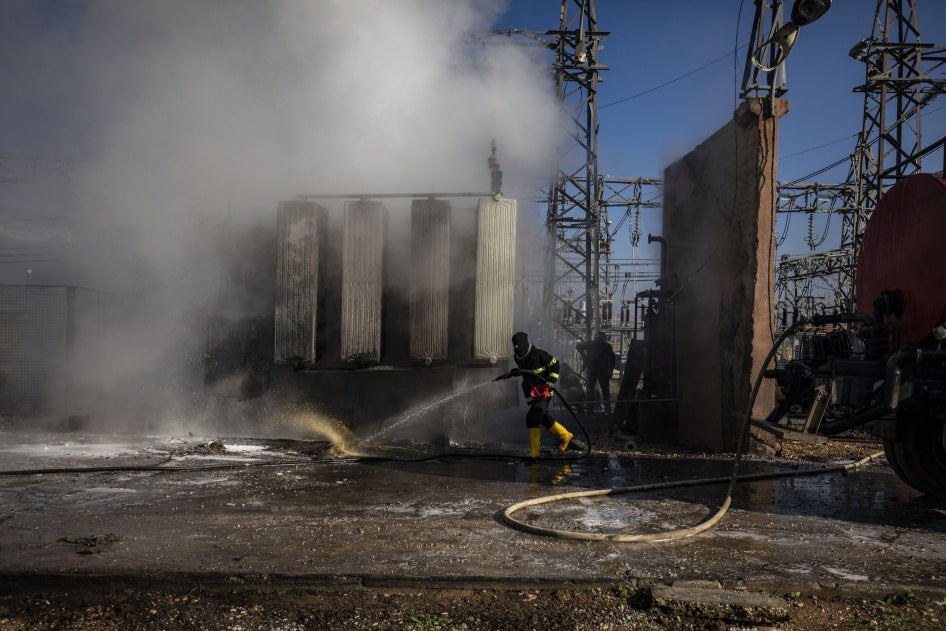
Human Rights Watch 09/02/2024 - As the world's attention remains fixed on the devastating conflict unfolding in Gaza, another crisis is intensifying under the radar in northeast Syria. There, Türkiye’s airstrikes and drone attacks on critical civilian infrastructure are putting livelihoods at risk and severing communities from electricity, medical care, and other essential services.
In late October 2023, Human Rights Watch reported that Turkish strikes on Kurdish-held areas of northeast Syria had resulted in water and electricity disruptions for millions of people. Back then, Turkish forces struck water and electrical power stations, oil installations, and the only operational gas plant for domestic use in all of northeast Syria.
In December and January, Türkiye intensified its strikes to include medical facilities and crucial access roads used by humanitarian responders, according to the Northeast Syria (NES) NGO Forum, a coalition of international organizations operating in the area. Attacks which cause disproportionate damage to civilians and civilian objects are prohibited under international humanitarian law, and deliberate targeting of civilian infrastructure is a war crime. The repeated strikes on civilian infrastructure have left many essential facilities in ruins, rendering hospitals, bakeries, and water facilities inoperable. Fuel, needed for cooking, heating, and farming, is running out.
On January 29, the NES NGO forum said that 1 million people in cities and villages had been cut off from electricity, and over 2 million people had limited access to safe water. Damage to medical facilities targeted in December has disrupted the oxygen supply to more than a dozen private and public hospitals, and strikes on 28 health facilities have disrupted their services, increasing the risk of water-borne diseases. The forum warned that the “scale of damage far supersedes the humanitarian community’s capacity to sustain emergency life-saving service provision.”
Türkiye has, for years, carried out military operations and airstrikes in northern Syria with the stated aim of targeting the Syrian Kurdish armed group, the People’s Protections Unit (YPG). Türkiye views the YPG as an extension of the Kurdistan Workers' Party (PKK), an armed group based in Türkiye and Iraq, which it considers a terrorist organization.
As the crisis in Northeast Syria escalates, action is needed to mitigate the humanitarian impacts on the civilian population. Türkiye should immediately stop targeting critical civilian infrastructure, respect international humanitarian law and hold to account those responsible for serious violations. All countries need to address the plight of the region's populace even if other conflicts are dominating the headlines. Source
Turkey: IBAHRI and TALI release report documenting mass imprisonment of lawyers
| |
Innocent Until Proven Muslim: Author Q&A with Dr. Maha Hilal | |
|
Political Research Associates 14/02/2024 - To fight a War on Terror, the state needs terrorists. Indeed, it creates them. As author, researcher, and organizer Dr. Maha Hilal observes, “If you followed the logic of the U.S. government when it comes to post-9/11 detentions, the prevailing wisdom seems to be that if you treat a person like a terrorist, they become one.”
In her book, Innocent Until Proven Muslim: Islamophobia, the War on Terror, and the Muslim Experience Since 9/11, Hilal analyzes the narrative and political mechanisms that enable the War on Terror; its institutionalized Islamophobia as entrenched in the state’s laws and policies; and how Muslims internalize, reproduce, challenge, and live with these injustices.
Alongside its domestic impact, Hilal examines the global scope of the War on Terror’s systemic imperial violence and torture in state memos, reports, case studies, and detainees’ stories. The latter includes the stories of men like Omar Khadr, detained at Guantánamo Bay at the age of 15, and Abu Zubaydah, Guantánamo’s “forever prisoner,” who the U.S. has held without charges since 2006.
Their continued detention relies on dehumanizing state narratives that portray Muslims and Arabs as violent, vengeful terrorists—beasts lacking humanity that require subhuman violence to tame, and in some cases, eradicate. In reaffirming its right to surveil, contain, and brutalize Muslims suspected of being terrorists anywhere in the world, the United States upholds systems of prison imperialism—producing CIA black sites, and more renditions, torture, prisons, and terrorists—at home and abroad.
The decades-long War on Terror and its violence toward Muslims is a bipartisan priority despite its conservative origins. While George W. Bush signed the Authorization for Use of Military Force (AUMF) bill, his successors—two Democratic presidents and one Republican—upheld the AUMF. This, Hilal writes, “has allowed the War on Terror’s global military footprint to expand exponentially—rippling out from the initial conflicts in Afghanistan and Iraq to touch nearly 40 percent of the entire world.” The Bush Doctrine thus remains core to U.S. war making and policies for managing populations at home and across the globe.
PRA spoke with Hilal in early December about the pervasiveness of War on Terror narratives, her visit to Guantánamo, and Muslim humanity. Read more - Lire plus
| |
Sunsetting the War on Terror — Or Not: The Stubborn Legacy of America’s Response to 9/11 | |
|
Juan Cole 10/01/2024 - In the days, weeks, and even years following the attacks of September 11th, the U.S. government took action to create new powers in the name of keeping the nation safe. Two of them, more than two decades after those attacks, are now rife with calls for change. Congress created the first just a week after 9/11 (with but a single no vote). It authorized unchecked and unending presidentially driven war powers that could be used without specified geographical limits — and, strangely enough, that power still remains in place, despite recent congressional efforts to curtail its authority. The second, the expansive use of secret surveillance powers on Americans, is currently under heated debate.
War Powers
The very first new authority created in the name of the war on terror was the Authorization for the Use of Military Force, or AUMF, passed by Congress one week after the 9/11 attacks. It gave the president the power “to use all necessary and appropriate force against those nations, organizations, or persons he determines planned, authorized, committed, or aided the terrorist attacks that occurred on September 11, 2001, or harbored such organizations or persons, in order to prevent any future acts of international terrorism against the United States by such nations, organizations, or persons.”
Unlike past declarations of war or authorizations for war in American history, it was staggeringly vague. It named no actual enemy or geographical locations. It made no reference to what conditions would end the hostilities and the power of that authorization. It was in essence “a blank check” for presidential war powers, as Congresswoman Barbara Lee (D-CA), the single member of Congress to vote no on its passage, warned at the time and has reiterated over the years.
It was also a game-changing authorization. Not only did it lack specifics, but it stripped Congress of its constitutionally authorized power to declare war. In the war on terror, Congress would defer to the president who could decide on his own when and where to launch attacks. Over the course of the last two-plus decades, that 2001 AUMF has been used repeatedly to do exactly what Barbara Lee feared — namely, broaden the president’s power to commit acts of war against not just the terrorist groups who conspired in the 9/11 attacks, but groups in countries far and wide. According to the Costs of War Project at Brown University’s Watson Institute, as of 2021, it had been used in at least 22 countries, including Afghanistan, Djibouti, Eritrea, Ethiopia, Georgia, Iraq, Kenya, Niger, Pakistan, the Philippines, Somalia, and Yemen.
Twenty-two-and-a-half years later, in April 2023, Congressman Gregory Meeks, (D-NY), ranking member of the House Foreign Affairs Committee, acknowledged that the 2001 AUMF had indeed become, in the words of fellow Democrat Annie Kuster (D-NH), “a blank check for presidents from both parties to wage war around the world.” There have been calls for the repeal of that AUMF over the years, including from — you undoubtedly won’t be surprised to learn — Representative Lee (repeatedly). This past fall, several such bills were introduced in both the House and Senate, including a bipartisan version by Senator Rand Paul (R-KY).
In the spring of 2023, Representative Meeks submitted his bill to replace the 2001 AUMF with a new one. [...] In many ways, the new version of the AUMF would rein in the aberration of those war powers that came into being in the aftermath of 9/11. And yet the time to redesign the authority of presidential war powers, as created more than 22 years ago by the war on terror, has still not arrived. Meeks’s bill, like Rand Paul’s, gained remarkably little traction. Likewise, a bill from those relatively few congressional representatives calling for a full repeal of that AUMF rather than a replacement of it failed to make it to a vote.
Surveillance
In addition to indefinite detention at Guantánamo and the authorization of endless, expansive war-making, ever more expansive intelligence collection, at home as well as abroad, has been a foundational pillar of the war on terror — and, like the AUMF, bringing it under some control has been mired in debate and controversy in recent months. In 2023, some members of Congress tried to put limits on part of a controversial law, Section 702 of the Foreign Intelligence Surveillance Amendments Act, passed in the summer of 2008 in the waning months of George W. Bush’s presidency. It authorized the collection and sharing of foreign intelligence for the purpose of deterring national security threats. [...]
The act allows foreigners abroad to be surveilled without a warrant. But since its inception, it’s also been used for warrantless investigations of Americans whose communications have been caught up in sweeping searches of the communications of foreigners — investigations that have become known as “back-door searches.” [...] In addition, experts note that, over time, the broad authority to collect the communications of Americans has been abused in alarming ways by the authorities. Gotein points out that 702-based warrantless searches have scrutinized the “communications of Black Lives Matter protesters, members of Congress, a local political party, a state court judge, journalists, and in one case, more than 19,000 contributors to a congressional campaign.” [...]
So fraught was the congressional loggerhead over Section 702 that the deadline for a decision proved unworkable. Instead, Congress inserted an extension to mid-April 2024 in this year’s defense spending bill, signed into law by President Biden three days before Christmas. It’s likely that, as with the 2001 AUMF, the attempt to change Section 702 will fail. Powers once given, it seems, only prove ever harder to relinquish and, all too sadly, the overreach engendered by the war on terror has by now become an accepted part of the American (and congressional) way of life. Read more - Lire plus
| |
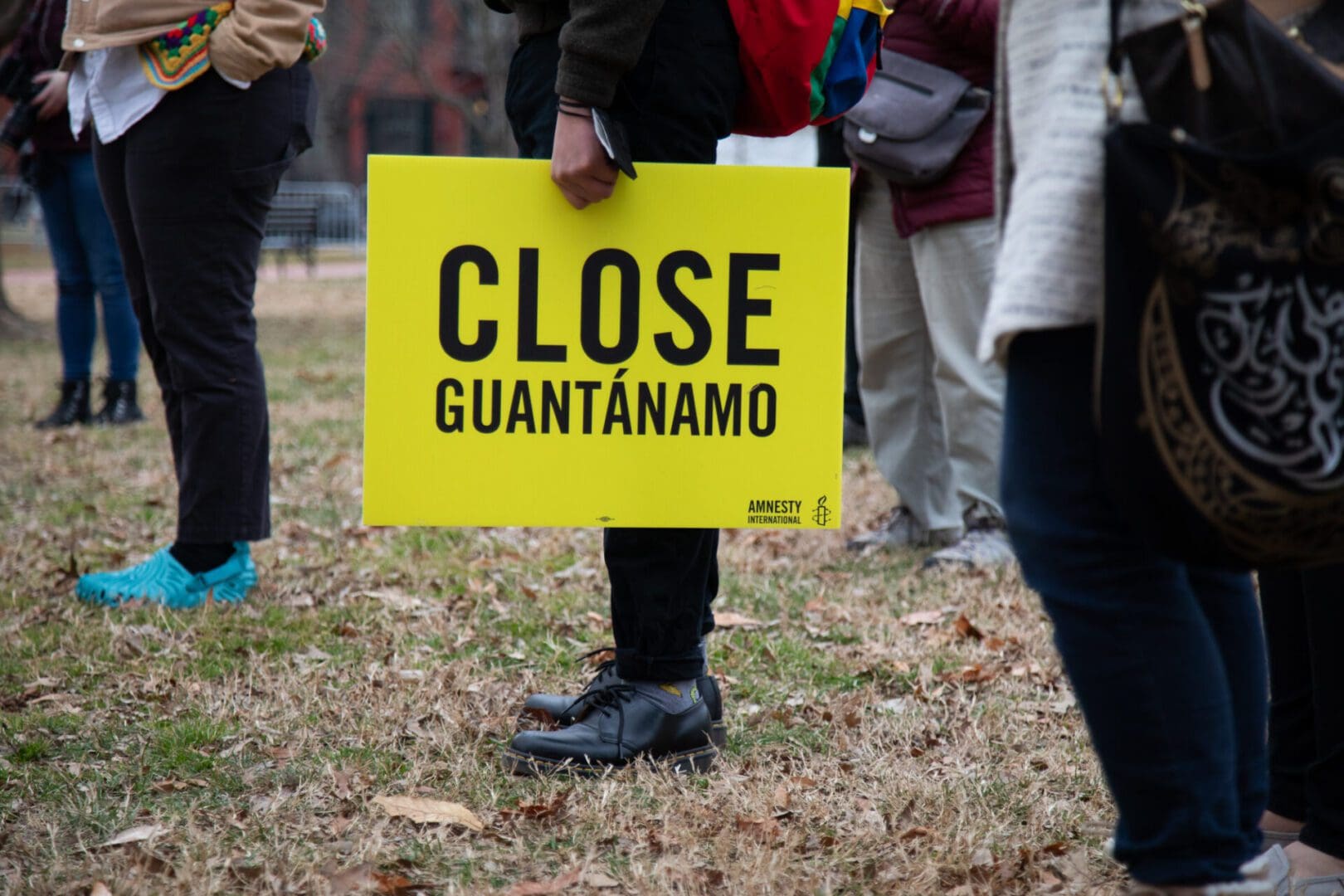
After 22 Years of Human Rights Abuses, the U.S. Government Must Close the Military Detention Camp at Guantanamo Bay | |
|
Amnesty International 11/01/2024 - January 11, 2024, marks the 22nd anniversary of the opening of the U.S. military detention camp at Guantanamo Bay. Thirty men remain detained indefinitely without trial; most have never even been charged with a crime.
In urging the U.S. Government to close the detention camp Guantanamo Bay, Daphne Eviatar, director of the Security with Human Rights program at Amnesty International USA, made the following statement:
“It is outrageous that 22 years after the U.S. government opened the Guantanamo detention camp to detain Muslim men beyond the reach of U.S. law, that this abuse of human rights continues today.
“Even after the U.S. withdrew its troops from Afghanistan, the government continues to claim that indefinite detention without charge or trial is justified as part of its problematic ‘global war on terror.’
“Sixteen of the men imprisoned at Guantanamo without charge have been cleared by U.S. security agencies for transfer out of Guantanamo, some for more than a decade. Yet they unjustly remain there today.
“Meanwhile, the men accused of orchestrating the 9/11 attacks still have not had a trial. This has not only deprived them of their rights but has also deprived the victims of the 9/11 attacks and their survivors their right to justice. The military commissions created to try those crimes have proven wholly ineffectual and unfair, and do not meet international standards of due process.
“The Biden administration should transfer all remaining detainees who have not been charged with crimes to countries where they will be safe, and their human rights will be respected. In those cases where there is sufficient admissible evidence under international law to prosecute internationally recognizable criminal offences, this must be done through fair judicial resolution, without recourse to the death penalty.
“President Biden must finally right this wrong and end this unconscionable practice that both he and President Obama pledged to do years ago. After 22 years, the U.S. government must finally live up to its promises and close the Guantanamo prison for good.” Amnesty International USA has joined a letter calling on President Biden to Close Guantánamo Permanently. Source
ACTION: Close Guantanamo
'I felt like it was Eid for me': Two ex-Guantanamo prisoners return to Afghanistan after 20 years
On First Anniversary of Guantánamo Prisoner Resettlement Lawyers Call for U.S. State Department Action
Military Judge to Rule on C.I.A. Torture Program in Sept. 11 Case
Saudi 9/11 suspect treated inhumanly at secret CIA base in Europe, court says
Long-Serving Prosecutor Quits Sept. 11 Case at Guantánamo Bay
| |
National Security Carve-Outs Undermine AI Regulations | |
|
Brennan Center 23/12/2023 - Earlier this month, the U.S. Senate wrapped up its “AI Insight Forums” with a 21-person panel focusing on national security. The vast majority of tech executives and former government officials at the forum—in which we were both pleased to participate—called for national security agencies to rapidly incorporate AI into their operations. But it is crucial that agencies safeguard people from the risks of these technologies, which President Joe Biden’s recent executive order rightly recognizes “can lead to and deepen discrimination, bias, and other abuses” if used irresponsibly. Unfortunately the executive order itself, as well as the administration’s recent draft policy on AI, have a major flaw: while they seek to ensure that the government’s use of AI systems is fair, effective, and transparent, they essentially exempt the national security apparatus, including significant parts of the FBI and the Department of Homeland Security (DHS).
This two-tiered approach is a mistake. It allows for the development of a separate—and likely less protective—set of rules for AI systems such as facial recognition, social media monitoring, and algorithmic risk scoring of travelers, which directly affect people in the United States. It excuses national security agencies from following sensible, baseline rules to assess the impact of AI: ensure that it is independently evaluated and tested in the real world, take steps to mitigate harms such as discrimination, train staff, consult with stakeholders, and offer recourse for harms.
These agencies are already rapidly integrating AI into a host of consequential operations and are accelerating their development of these technologies. The full scope of these activities, including what safeguards (if any) are in place to prevent discrimination and protect privacy and other rights, is hard to gauge because little public information is available. What we do know demonstrates the acute risks of carving out national security systems from basic AI rules.
Already, the Department of Homeland Security’s Automated Targeting System relies on secret algorithms to predict “threats” and to identify travelers for heightened scrutiny. DHS also entered into a $3.4 million contract with researchers to develop algorithms to undertake a “risk assessment” of social media accounts for purported “pro-terrorist” sympathies for use by immigration authorities.
Through its domestic intelligence arm, DHS runs several programs that comb through Americans’ social media posts in search of “derogatory information” and dangerous “narratives and grievances,” scooping up information about individuals’ personal and political views. During the racial justice protests of 2020, for example, DHS used social media monitoring tools to assemble dossiers on protestors and journalists to share with law enforcement. Each year, DHS sends thousands of unverified summaries of what it finds on social media to police departments around the country, providing justification for surveillance and, in some cases, prosecution.
None of these programs is supported by empirical evidence demonstrating the validity of its approach. In 2017, the department’s inspector general called out five of DHS’s pilot social media monitoring programs for failing to even measure efficacy. Other internal reviews have repeatedly shown that these types of programs are of questionable or “no value.” Nor have these systems—as far as we know—ever been tested to see if they entrench bias or reproduce stereotypes. The policy framework for regulating these programs is weak, with loopholesriddling the department’s general policies on racial profiling and First Amendment-protected activities.
The FBI has deployed AI-powered facial recognition tools to identify suspects for investigation and arrest, and has worked with the Defense Department to develop tools that could identify people in video footage from street cameras and flying drones. It has pursued such efforts without adequate testing, training, or safeguards for civil rights and civil liberties. The FBI has even contracted with Clearview AI, a notorious company that scrapes photos from the internet to create faceprints without consent, claiming access to 30 billion facial photos. It has embraced these systems despite evidence that facial recognition technology disproportionately misidentifies and misclassifies people of color, trans people, women, and members of other marginalized groups. Already, the use of facial recognition by police has resulted in six reported cases of false arrest and wrongful incarceration of Black people.
These types of clear and present risks will only grow as agencies incorporate more AI into their systems and explore other unreliable technologies, such as “sentiment analysis” and gait recognition. National security, intelligence, and law enforcement agencies must be subject to the same baseline standards that apply throughout the federal government, with only narrow—and transparent—modifications where strictly justified by specific national security needs. Congress should strengthen independent oversight by creating a body like the Privacy and Civil Liberties Oversight Board, which was established after 9/11 to review counterterrorism programs.
The time to act is now, before irresponsible and damaging AI systems become entrenched under the banner of “national security.” Source
ACTION: Canada: Remove the national security exemptions from Bill C-27!
The AI Act — a breach of EU fundamental rights charter?
The Internet Enabled Mass Surveillance. A.I. Will Enable Mass Spying.
Advances in AI Increase Risks of Government Social Media Monitoring
OpenAI quietly deletes ban on using ChatGPT for "military and warfare"
Predictive policing in France: Against opacity and discrimination, the need for a ban
Bodycam Maker Axon Is on a Mission to Surveil America with AI
| |
U.S. terrorist watchlist grows to 2 million people — nearly doubling in 6 years | |
|
CBS 12/12/2023 - The U.S. government's terrorist watchlist has nearly doubled in size in just six years, a CBS Reports investigation has found.
An extensive review of court records, government documents and interviews with more than a dozen current and former intelligence community leaders revealed that the consolidated database of individuals has not only been quietly expanding in number but also in who it targets.
The numbers speak for themselves. When it first launched on Dec. 1, 2003, the consolidated watchlist — now known as the Terrorist Screening Dataset — included approximately 120,000 people. By 2017, the last publicly confirmed numbers, it included nearly 10 times as many: 1,160,000 individuals. Now, at the end of 2023, the Terrorist Screening Dataset contains the names of approximately 2 million people the government considers known or suspected terrorists, including thousands of Americans, according to a CBS Reports investigation.
"It doesn't mean they're a terrorist," cautioned Russ Travers, a veteran of the U.S. intelligence community for four decades who helped create the watchlist. "It means there's something that has led a department or agency to say, 'This person needs a closer look.'"
Government policy says agents must have "reasonable suspicion" to put a person on the watchlist. But it does not disclose what those suspicions are based on, and the government will neither confirm nor deny whether an individual is on the list.
National security officials acknowledge that there are people listed in the consolidated terrorist database whose names should probably be removed, but that there isn't enough staff to audit every person's file regularly. "I'm sure that there are a lot of people that are in the database that are dead, that we don't even know it," said Travers.
The interagency group that oversees the watchlist also administers a second list targeting primarily American gangs with international ties. That other watchlist, known as the Transnational Organized Crime Actor Detection Program, contains another 40,000 individuals, according to a recent audit obtained by CBS News.
Being on a watchlist can have significant consequences on people's lives. In countless civil lawsuits over the past 20 years, people have described how they believe the watchlist caused them to be stopped from flying home after a vacation, to fail a background check to get jobs, or to have their phones and computers searched. Others said it triggered law enforcement to handcuff them at gunpoint, or that they were detained and interrogated by foreign intelligence services.
Over the years, tens of thousands of innocent people have complained to the government about being incorrectly treated like terrorist suspects. According to the Department of Homeland Security, 98% of those who've reported complaints were subjected to "false positives," meaning that they were flagged because their names were similar to others in the database.
The TSA redress department director stated in late 2006 that over the preceding year alone, the names of approximately 30,000 airline passengers were mistakenly matched with those appearing on federal watchlists.
Someone who believes they've been wrongfully impacted by the watchlist can file a complaint with the Department of Homeland Security requesting redress. However, this is unlikely to help those who are on the watchlist, whether they're innocent or not. In one case, it took a Stanford PhD student fighting a nine-year court battle to prove that she was wrongfully listed; the FBI finally admitted she was watchlisted by mistake because an agent had accidentally checked a wrong box.
The FBI told CBS News that it recently revised its criteria to require more identifying information about individuals for them to be added to the database. If enough information is not provided for any individual, that person won't be listed, and people already on the list will be removed if their files are deemed too thin under the new standard. Officials said they were also prioritizing the collection of biometrics, particularly faces and fingerprints, to reduce cases of mistaken identity.
According to U.S. national security assessments for 2023 and 2024, the threats of both foreign and domestic terrorism are on the rise. According to intelligence community insiders, the government considers it imperative to rely on the watchlist as part of its "early warning system."
But civil liberties advocates as well as former counterterrorism insiders who've worked directly on watchlisting expressed concern over the system's expansion, calling attention to government abuses, errors and a lack of willingness to admit mistakes over the two decades since it launched.
"People might think that the watchlisting system is a remnant of 9/11. It is not," said Hina Shamsi, National Security Project director at the American Civil Liberties Union. "This is a system that has only expanded."
A series of federal lawsuits allege that FBI agents have violated policy, for example, by putting innocent people in the database to coerce them into becoming informants. Critics said efforts at accountability have also been stymied by a culture of secrecy and lack of disclosure — issues the Biden administration acknowledges. Read more - Lire plus
| |
UN expert condemns UK crackdown on environmental protest | |
|
The Guardian 23/01/2024 - A severe crackdown on environmental protest in Britain with “draconian” new laws, excessive restrictions on courtroom evidence and the use of civil injunctions is having a chilling impact on fundamental freedoms, the United Nations special rapporteur has said.
As the world faces a triple planetary crisis of climate change, biodiversity loss and pollution, environmental protesters were acting for the “benefit of us all” and must be protected, Michel Forst, the UN special rapporteur on environmental defenders, said on Tuesday. Forst said that during a two-day visit to the UK earlier this month he uncovered worrying information on the treatment of peaceful protesters.
Rules imposed on defendants in one London court have prevented them from explaining their motivations to the jury. At Inner London crown court, peaceful protesters have been forbidden by court order from mentioning the climate crisis, fuel poverty or even the US civil rights movement in their statements to the jury. “It is very difficult to understand what could justify denying the jury the opportunity to hear the reason for the defendant’s action, and how a jury could reach a properly informed decision without hearing it, in particular at the time of environmental defenders’ peaceful but ever more urgent calls for the government to take pressing action for the climate,” Forst said.
He said the prosecution of peaceful protesters under “regressive” new public nuisance laws in the Police, Crime, Sentencing and Courts Act 2022, which carried a 10-year sentence, and the use of the Public Order Act 2023 was criminalising peaceful demonstrations. Forst highlighted the case of a peaceful protester jailed in December for six months for walking slowly down a road for 30 minutes during a climate protest under the new public order law. “It is important to highlight that, prior to these legislative developments, it had been almost unheard of since the 1930s for members of the public to be imprisoned for peaceful protest in the UK,” said Forst, in a statement issued on Tuesday morning. “I am therefore seriously concerned by these regressive new laws.”
Forst also picked out the harsh bail conditions imposed on climate activists for peaceful protests. These include being forced to wear tags while awaiting trial, restrictions on movement, and bans on speaking to other environmental activists. “Some environmental defenders have also been required to wear electronic ankle tags, some including a 10pm-7am curfew, and others, GPS tracking,” said Forst. “Under the current timeframes of the criminal justice system, environmental defenders may be on bail for up to two years from the date of arrest to their eventual criminal trial.
“Such severe bail conditions have significant impacts on the environmental defenders’ personal lives and mental health, and I seriously question the necessity and proportionality of such conditions for persons engaging in peaceful protest.” He condemned the widespread use of civil injunctions to stop peaceful protest and the “toxic” discourse in the media and among politicians about climate protesters. “The toxic discourse may also be used by the state as justification for adopting increasingly severe and draconian measures against environmental defenders,” he said. “In the course of my visit, I witnessed first-hand that this is precisely what is taking place in the UK right now. This has a significant chilling effect on civil society and the exercise of fundamental freedoms.”
Forst said he was speaking out because of the gravity of his concerns about the widespread restrictions on peaceful protest. His investigations are ongoing as he considers formal complaints about treatment that have been submitted to him. He called for a constructive dialogue with the Conservative government to ensure that members of the public seeking to protect the environment were not subject to persecution, penalisation or harassment for doing so. The UN special rapporteur is appointed under the Aarhus convention to which the Uk is a signatory.
Tim Crosland of Plan B said the convention was legally binding on the UK and the implication of the special rapporteur’s report was that the Government was acting unlawfully. “ If the events related by the UN rapporteur were taking place in Russia or China we’d be appalled,” he said. “The British Government aims to crush political opposition to its environmental destruction through a violent programme of repression - imprisoning peaceful demonstrators and undermining the right to a fair trial. In doing they vandalise not only our environment and Britain’s international reputation, but also our democracy.”
Sacha Deshmukh, Amnesty International UK’s chief executive, said: “The UN special rapporteur offers a damning indictment of the repressive crackdown climate activists in the UK face for exercising their right to peacefully protest. “The UK Government seems more intent on creating a climate of fear than tackling the climate crisis.“ Source
Judge throws out case against Greta Thunberg and other London protesters
Solicitor general urged to drop prosecutions of jury rights activists
Masked protesters could soon face arrest, says Home Office
| |
UAE Confirms Trial Against 84 Detainees; Ahmed Mansoor Suspected Among Them | |
|
EFF 10/01/2024 - The UAE confirmed this week that it has placed 84 detainees on trial, on charges of “establishing another secret organization for the purpose of committing acts of violence and terrorism on state territory.” Suspected to be among those facing trial is award-winning human rights defender Ahmed Mansoor, also known as the “the million dollar dissident,” as he was once the target of exploits that exposed major security flaws in Apple’s iOS operating system—the kind of “zero-day” vulnerabilities that fetch seven figures on the exploit market. Mansoor drew the ire of UAE authorities for criticizing the country’s internet censorship and surveillance apparatus and for calling for a free press and democratic freedoms in the country.
Having previously been arrested in 2011 and sentenced to three years' imprisonment for “insulting officials,'' Ahmed Mansoor was released after eight months due to a presidential pardon influenced by international pressure. Later, Mansoor faced new speech-related charges for using social media to “publish false information that harms national unity.” During this period, authorities held him in an unknown location for over a year, deprived of legal representation, before convicting him again in May 2018 to ten years in prison under the UAE’s draconian cybercrime law. We have long advocated for his release, and are joined in doing so by hundreds of digital and human rights organizations around the world.
At the recent COP28 climate talks, Human Rights Watch and Amnesty International and other activists conducted a protest inside the UN-protected “blue zone” to raise awareness of Mansoor’s plight, as well the cases of both UAE detainee Mohamed El-Siddiq and Egyptian-British activist Alaa Abd El Fattah. At the same time, it was reported by a dissident group that the UAE was proceeding with the trial against 84 of its detainees.
We reiterate our call for Ahmed Mansoor’s freedom, and take this opportunity to raise further awareness of the oppressive nature of the legislation that was used to imprison him. The UAE’s use of its criminal law to silence those who speak truth to power is another example of how counter-terrorism laws restrict free expression and justify disproportionate state surveillance. This concern is not hypothetical; a 2023 study by the Special Rapporteur on counter-terrorism found widespread and systematic abuse of civil society and civic space through the use of similar laws supposedly designed to counter terrorism.
Moreover, and problematically, references 'related to terrorism’ in the treaty preamble are still included in the latest version of a proposed United Nations Cybercrime Treaty, currently being negotiated with more than 190 member states, even though there is no agreed-upon definition of terrorism in international law. If approved as currently written, the UN Cybercrime Treaty has the potential to substantively reshape international criminal law and bolster cross-border police surveillance powers to access and share users’ data, implicating the human rights of billions of people worldwide, and could enable States to justify repressive measures that overly restrict free expression and peaceful dissent. Source
| |
The Tragedy Of India’s Authoritarian Descent: The Case of Prabir Purukayastha | |
|
The Transnational Institute 13/01/2024 - Despite all the talk about India being the world’s largest democracy the existing reality is very different indeed. For persistent dissidents and opponents of the current Hindu nationalist regime headed by Prime Minister Narendra Modi, the general political environment is effectively an undeclared emergency. In many respects it is worse than the declared Emergency of 1975-77 with its suspension of fundamental civic and political rights. That lasted a little less than two years. The current process of systematic degradation of the basic institutions of Indian democracy under the Modi government has been going on since 2014 when it first came to power.
Matters have been getting progressively worse and will be more difficult to reverse institutionally and practically even if the ruling BJP does not get a third term of office which it is most likely to achieve in the coming general elections in May this year. One of the most dangerous aspects of what has been happening is that behind the electoral mask, a host of laws have been amended in a very repressive direction. This has been done with the support of a compliant judiciary at even the highest level ensuring that the government can and does get away with criminal behaviour at a large, sometimes mass scale as well as in respect of targeting individuals like journalists, academics, social activists of various kinds, recalcitrant NGOs and ordinary citizens seeking to defend their minority religious communities from discriminatory policies and onslaughts.
An entity called the Enforcement Directorate (ED) is used by the government to raid civil society organisations and investigate their economic resources and activities despite knowing they are operating legally. Here, as elsewhere, the process is itself the punishment, with their work seriously or completely disrupted. The targeted seek legal recourse through the courts at different levels, which results in great delays before final judgements are passed. This too suits the purposes of the government agencies which have initiated the process and sends the desired warning to the organisations concerned to behave as the ruling powers want. But when it comes to actions against individuals deemed by the government to be their critics and opponents, i.e., ‘anti-national’, punishment by process is of a much more severe character. Here is where the most draconian of laws in the government’s armoury---the Unlawful Activities Prevention Act or UAPA ---comes into play. Preventive detention laws were first laid down by British colonial rule but were carried over into independent India and some of them through amendments over time were made even more stringent and cruel.
This happened with the UAPA which was first formulated not by the BJP but by the Congress government in 1967. A series of amendments took place. By 2013 it became the supreme legislated law for application to organisations that are deemed to be guilty of terrorist behaviour even as there is no universally accepted definition of terrorist action. So every government is free to have its own, good or bad, legal definition. Here is how the UAPA defines the terrorist act: “Whoever does any act with intent to threaten or likely to threaten the unity, integrity, security or sovereignty of India or with intent to strike terror or likely to strike terror in people or any section of the people in India or in any foreign country.”
This was initially applicable only to groups. But in 2019, the Modi government made it applicable for the first time to individuals. It is so vaguely worded and so broad in its areas of possible application that the state can (and does) arrest anyone on mere ‘suspicion’ before any actual commission. Moreover, bail can be denied for as long as the courts accept that the police or a central agency has ‘reasonable grounds’ to continue its investigation for as long as it thinks necessary which all too often extends into many years without the case coming to trial. Between 2014 and 2020, 10,552 people have been arrested under UAPA and only 2.3% of them have been convicted. Some 6,952 have been arrested since 2020.
By way of illustration of how and why the government resorts to this law to curb lawful dissent, I will only take up one very recent case---that of Prabir Purukayastha---whom I have personally known and worked with in one way or the other on various issues/campaigns. These include the anti-nuclear weapons peace front after India’s 1998 test explosions; in anti-communal efforts; and in support of Palestine. Purukayastha has an engineering background and therefore has technical expertise. He has been involved in a host of political campaigns and has also shed light on the growing surveillance nature and capacities of the Indian state which has certainly not been to the government’s liking. Among other things Purukayastha is the founder of Newsclick, a news and analysis portal that has constantly given space in word and image to critics of this government’s policies and behaviour. Regularly presented are the concerns of Dalits, tribals, women, workers, farmers, oppressed religious minorities as well as progressive single-issue or sectoral movements about health, education and civil liberties.
He and other senior employees of Newsclick and even select outside contributors were raided and electronic devices seized ostensibly to reveal alleged economic and political ‘infractions’ and ‘illegalities’. Despite the over two years’ passage of time, no crime has been detected. But the investigation continues. Purukayastha was unfairly imprisoned for several months during Mrs. Gandhi’s emergency period (1975-77). Both as part of and beyond, the Communist Party of India-Marxist (CPM) of which he is a senior member, he has engaged in various struggles ranging from defending secularism and democracy to helping set up after 1998 the Movement in India for Nuclear Disarmament (MIND). He is one of the founders of the Delhi Science Forum and has been the President of the Free Software Movement of India. Among the books he has authored and co-authored are Enron Blowout: Corporate Capital and Theft of the Global Commons; Uncle Sam’s Nuclear Cabin; Political Journeys in Health; Knowledge as Commons: Towards Inclusive Science and Technology.
On October 3, 2023, he was arrested and put in police custody under UAPA as a possible terrorist threat to ‘national integrity’. This action came about two months after a New York Times article of early August on philanthropist Neville Roy Singham, an American citizen of Sri Lankan origin who currently resides in China. He has through various legal channels contributed funds to a host of left-wing organisations in the Global South---in Africa, Latin America, India’s Newsclick as well as in the North to such groups as Code Pink. Given India’s hostility to China, this was seized as an opportunity by the Modi government agencies to take a different tack for continuing the harassment of Purukayastha, another employee, Amit Chakrabarty, and Newsclick more generally. On China, there may well be some shared positions of support but the crucial points are that Singham has no editorial connection to the organisation and that the funding process is above board. Furthermore, coverage of China’s affairs is very sparse compared to their overall coverage of domestic and international issues and it is its criticisms of the government that has set the latter’s back up and hence the over two years of harassment.
Purukayastha is in jail since November 2, 2023. There is an interesting parallel between the case of Russian dissident Boris Kagarlitsky and that of Prabir Purukayastha. Both have suffered previous incarcerations. Both have been steady and courageous critics of their respective governments regardless of which party has been in central power. Both situate themselves on the Marxist-influenced left. Both have used their latest period of incarceration to write a book. That by Kagarlitsky will be brought out very soon by Pluto Press. Leftword publishers have very recently brought out Purukayastha’s Keeping Up The Good fight: From the Emergency to the Present Day.
Boris, fortunately, has finally been released and in this respect international publicity on the internet certainly played its part. It is hoped that here too, publicity not just of Prabir’s plight but that this highlighting of the iniquity of UAPA (and the general compliance of the judiciary) under which so many others have been unfairly imprisoned can help release, at least on bail, Prabir Purkasyastha and so many others. We need to get more people the world over to recognise that an India that will very soon become the globe’s most populated country is also rapidly transiting into, if not already having become, the world’s largest highly authoritarian electoral autocracy! Source
Amnesty International: Russia: Anti-terrorism legislation misused to punish activist Boris Kagarlitsky
| |
Canada Must Oppose Genocide in Gaza and Defend Free Expression at Home | |
The UN Genocide Convention – which Canada has ratified – stipulates that “states that have the capacity to influence others have a duty to employ all means reasonably available to them to prevent genocide.” Canada therefore has the obligation to not only call for a permanent and immediate ceasefire, but to immediately halt any arm sales, transfers and military aid to Israel.
| |
Canada: Remove the national security exemptions from Bill C-27! | |
Bill C-27, the Digital Charter Implementation Act, has been introduced by the federal government with the promise that it would enhance privacy protections, adequately regulate artificial intelligence (AI) and protect human rights. The bill, however, is not up to the task. Please join us in denouncing the dangerous national security related exemptions in the bill. | |
Canada: Do not purchase armed drones | |
The ICLMG is a member of the No Armed Drones campaign | |
In the government's proposal seeking bids for its drone program it laid out disturbing scenarios for Canadian military drone use: One scenario described drones being used to surveil activists protesting a (theoretical) G20 Summit in Quebec, helping the security team intercept and identify the occupants of a vehicle, who are “anti-capitalist radicals” intending to “hang a banner concerning global warming.” Another scenario modeled after US drone strike programs features a drone bombing “Fighting Age Males” in the Middle East after spotting one of them “holding a small radio or cell phone." The initial cost estimate is $5 billion with billions more to operate the drones over their 25-year lifespan. | |
CSIS isn't above the law! | |
|
In recent years, at least three court decisions revealed the Canadian Security and Intelligence Service (CSIS) engaged in potentially illegal activities and lied to the courts. This is utterly unacceptable, especially given that this is not the first time these serious problems have been raised. CSIS cannot be allowed to act as though they are above the law.
Send a message to Public Safety Minister Marco Mendicino demanding that he take immediate action to put an end to this abuse of power and hold those CSIS officers involved accountable, and for parliament to support Bill C-331, An Act to amend the Canadian Security Intelligence Service Act (duty of candour). Your message will also be sent to your MP and to Minister of Justice David Lametti.
| |
Canada must protect Hassan Diab! | |
Canada must repatriate all Canadians detained in NE Syria now! | |
On January 20, 2023, Federal Court Justice Henry Brown ruled that Canada must repatriate Canadians illegally and arbitrarily detained in northeast Syria. On February 6, 2023, the Canadian government filed an appeal and asked that the Brown ruling be set aside and placed on hold while the appeal plays out. This is unacceptable.
Every day the government fails to bring these Canadians home, it places their lives at risk from disease, malnutrition, violence, and ongoing military conflicts, including bombing by Turkey’s military. United Nations officials have even found that the conditions faced by Canadians in prison are akin to torture. Please click below to urge the federal government to repatriate all Canadians illegally & arbitrarily detained in northeast Syria without delay.
| |
20 years of fighting deportation to torture: Justice for Mohamed Harkat Now! | |
Canada must protect encryption! | |
Canada’s extradition system is broken. One leading legal expert calls it “the least fair law in Canada.” It has led to grave harms and rights violations, as we’ve seen in the case of Canadian citizen Dr Hassan Diab. It needs to be reformed now.
Click below to send a message to urge Prime Minister Trudeau, the Minister of Justice and your Member of Parliament to reform the extradition system before it makes more victims. And share on Facebook + Twitter + Instagram. Thank you!
Regardez la vidéo avec les sous-titres en français + Agir
| |
Protect our rights from facial recognition! | Facial recognition surveillance is invasive and inaccurate. This unregulated tech poses a threat to the fundamental rights of people across Canada. Federal intelligence agencies refuse to disclose whether they use facial recognition technology. The RCMP has admitted (after lying about it) to using facial recognition for 18 years without regulation, let alone a public debate regarding whether it should have been allowed in the first place. Send a message to Prime Minister Trudeau and Public Safety Minister Bill Blair calling for a ban now. | |
OTHER NEWS - AUTRES NOUVELLES | |
July to December 2023 - Juillet à décembre 2023 | |
|
Thanks to your support, in the second half of 2023, we were able to work on the following issues or with the following entities:
- Bill C-20, Public Complaints and Review Commission Act
- Bill C-26, An Act respecting cybersecurity and amending the Telecommunications Act
- Bill C-27, Digital Charter Implementation Act, 2022
- Bill C-41: International assistance and anti-terrorism laws
- Canadians detained in Northeastern Syria
- Justice for Dr Hassan Diab & reform of the Extradition Act
- Security certificates & inadmissibility
- Combatting Islamophobia
- National Security and Intelligence Review Agency (NSIRA)
- Prejudiced audits of Muslim charities
- Federal anti-terrorist financing consultation
- Office of the Privacy Commissioner of Canada
- Canada’s 4th Universal Periodic Review
- Civil Society Coalition on Human Rights and Counter-terrorism
- UN Counter-terrorism Executive Directorate (CTED) Canada assessment
- UN Special Rapporteur on counter-terrorism and human rights global study on counter-terrorism and civic space
For more details on each item and to see all the media articles we were mentioned in or were interviewed for, click here.
What we have planned for 2024!
Your support, will allow us to continue our work on these issues and much more in the next year:
- Ensuring that the Canadian government’s proposals on “online harms” do not violate fundamental freedoms, or exacerbate the silencing of racialized and marginalized voices
- Protecting our privacy from government surveillance, including facial recognition, and from attempts to weaken encryption, along with advocating for good privacy law reform
- Addressing the lack of regulation on the use of AI in national security, including proposed exemptions for national security agencies
- Fighting for Justice for Mohamed Harkat, an end to security certificates, and addressing problems in security inadmissibility
- Ensuring Justice for Hassan Diab and reforming Canada’s extradition law
- The return of the rest of the Canadian citizens and the non-Canadian mothers of Canadian children indefinitely detained in Syrian camps
- The end to the CRA’s prejudiced audits of Muslim-led charities
- Greater accountability and transparency for the Canada Border Services Agency
- Greater accountability and transparency for the Canadian Security Intelligence Service
- Advocating for the repeal of the Canadian No Fly List, and for putting a stop to the use of the US No Fly List by air carriers in Canada
- Pressuring lawmakers to protect our civil liberties from the negative impact of national security and the “war on terror”, as well as keeping you and our member organizations informed via the News Digest
- Publishing a collection of essays written by amazing partners on the work of the ICLMG for our 20th anniversary
- And much more!
| |
Les opinions exprimées ne reflètent pas nécessairement les positions de la CSILC - The views expressed do not necessarily reflect the positions of ICLMG. | |
|
THANK YOU
to our amazing supporters!
We would like to thank all our member organizations, and the hundreds of people who have supported us over the years, including on Patreon! As a reward, we are listing below our patrons who give $10 or more per month (and wanted to be listed) directly in the News Digest. Without all of you, our work wouldn't be possible!
James Deutsch
Bill Ewanick
Kevin Malseed
Brian Murphy
Colin Stuart
Bob Thomson
James Turk
John & Rosemary Williams
Jo Wood
The late Bob Stevenson
Nous tenons à remercier nos organisations membres ainsi que les centaines de personnes qui ont soutenu notre travail à travers les années, y compris sur Patreon! En récompense, nous nommons ci-dessus nos mécènes qui donnent 10$ ou plus par mois et voulaient être mentionné.es directement dans la Revue de l'actualité. Sans vous tous et toutes, notre travail ne serait pas possible!
Merci!
| | | | |