|
International Civil Liberties Monitoring Group
Coalition pour la surveillance internationale des libertés civiles
May 10, 2025 - 10 mai 2025
| | Canadian Government Files Motion to Strike (Dismiss) Our Case | |
LCFP 05/05/2025 - The Canadian government has filed a motion attempting to limit the Court’s authority by arguing that it cannot intervene in matters of policy and foreign affairs. This is a deeply misleading characterization of our case.
Our legal challenge is not about foreign policy—it’s about the rule of law. At its core, the case raises two urgent legal questions:
- Has Canada violated its international legal obligations to prevent genocide?
- Has Canada, in doing so, also violated the Charter rights of its citizens?
In suggesting that the Court cannot weigh in on a matter as serious as genocide, especially when it involves the Charter rights of Canadian citizens, Canada undermines the critical function of judicial oversight. This function is key to the system of checks and balances that make a healthy democracy.
Also notable in the motion to strike is the tone of the government. Reflecting its sense of Western moral supremacy, the government claims that stating facts about Israel’s genocide in Gaza or suggesting that Canada may have supported those actions, is “scandalous, offensive, and inflammatory.” The implication is that states like Israel or Canada are, by default, above scrutiny under international law.
Further, the government has asserted that Israel’s history of ethnic cleansing in Palestine is “irrelevant to the claims.” This erasure of context attempts to depoliticize and dehistoricize a case rooted in lived realities, international obligations, and the ongoing harm experienced by Palestinian Canadians.
We will have the chance to argue against the government’s motion in a hearing this November, with a decision by the Court expected late this year or early next year. We are confident that our claim will stand, and intend to do all we can to ensure that this case has its day in court. Source
Double Standards: Canada’s Response to Previous Genocides and War Crimes
NEW Call it what it is. Genocide. Tell Canada’s new government to stop arming Israel
NEW Car rally for Gaza: Sat May 10, 12 PM, Ottawa
NEW Ottawa rally: 77 years of ongoing Nakba, May 17, 2 PM
| | Stop Repressive Protest Bans! | |
CJPME 07/05/2025 - Many municipalities across Canada are moving to restrict pro-Palestine protests. Cities like Vaughan have already passed repressive protest bans, and others—including Toronto—are considering following suit. These repressive “bubble bylaws” would make it illegal to protest events promoting the sale of properties in Israel’s illegal settlements in the occupied West Bank — if those events are held in synagogues.
This is not a hypothetical.
Synagogues in Canada have already been used to host real estate events marketing properties in occupied Palestinian territory — including one at Beth Avraham Yoseph of Toronto in March 2024, which drew large protests and was reported on by CBC News. The event was part of a broader tour offering settlement properties in violation of international law. The website for the event markets it as: "Your chance to own a piece of the Holy Land!"
Despite the explicitly political nature of these events, the “bubble zones” render them off-limits for protest simply because of the venue. Under the guise of protecting “vulnerable social infrastructure,” these bylaws would also make it illegal to protest events hosting IDF soldiers or high-ranking Israeli officials complicit in ongoing atrocities in Gaza.
Worse, the federal government may soon make these local “bubble zones” a national reality. As part of his crime platform, Prime Minister Mark Carney pledged to introduce federal legislation to implement these protest restrictions nationwide.
People of conscience must have the right to lawfully protest events that promote violations of international law — including genocide, apartheid, and illegal settlement activity — regardless of the venue in which those events take place. We need to protect the right to lawfully protest all violations of human rights and international law.
More information
How these bylaws target Palestine solidarity protests:
- In Vaughan, a 2024 bylaw banned protests within 100 meters of “vulnerable social infrastructure,” after a peaceful demonstration was held outside a synagogue where illegal West Bank settlement sales were being promoted. Instead of addressing the violation of international law, the city criminalized those speaking out.
- In Toronto, Mayor Olivia Chow supported a similar proposal in December 2024 after months of lobbying from pro-Israel organizations. The motion includes vague language that could be weaponized against non-violent pro-Palestinian protests.
- In Ottawa, a “Vulnerable Social Infrastructure” Bylaw was introduced in October 2024 to study potential restrictions on protests near certain institutions, citing “public safety” concerns—but mainly targeting protests outside institutions linked to Israeli military fundraising.
- In Montreal, a court issued an injunction banning protests within 50 meters of several Jewish institutions. The ruling was secured by pro-Israel groups after a protest at a synagogue that hosted Israeli real estate developers selling properties in illegal settlements.
Meanwhile, other municipalities—including Brampton, Mississauga, and Oakville—are also studying or considering similar motions. It remains to be seen whether these will be implemented, but civil liberties groups have raised concerns about their impact on freedom of expression and the right to protest.
The Canadian Civil Liberties Association (CCLA) has strongly opposed these measures, warning that they are:
- Overly broad and likely unconstitutional, violating Charter rights to free expression and peaceful assembly.
- Politically motivated, selectively used to silence Palestine solidarity protests while allowing other demonstrations.
- A dangerous precedent, paving the way for further restrictions on civic engagement and political activism.
Click here to read the CCLA’s full letter to Brampton City Council.
Please tell your elected officials to protect our fundamental freedoms now. Thank you! ACTION
‘The process is the punishment’: Assault charge against U of T encampment protester withdrawn — a year later
| | Toronto police move to upgrade facial recognition technology, raising concerns | |
Ricochet 21/03/2025 - As Toronto police look to supercharge their facial recognition capabilities, documents obtained by Ricochet Media reveal a slew of controversial biometrics companies have formed a queue, each offering to provide them with the necessary technology.
Last December, the Toronto Police Service (TPS) published a request for proposal (RFP) seeking to upgrade the facial recognition system it currently employs. Documents obtained by Ricochet in a freedom of information request reveal that companies like Idemia responded to a similar request for information (RFI) two years prior, offering their facial recognition system as a suitable upgrade. Idemia currently provides its technology to neighboring Peel and York police and has been accused of racial bias.
“Torontonians should see this as a real threat,” says Beverly Bain of No Pride in Policing, an advocacy group focused on defunding Canadian police forces. “These machines are designed to target those who protest, including pro-Palestinian protesters. The idea is to weed those people out, to arrest them, and to punish them for protesting against genocide.” [...]
Ricochet has obtained a copy of the full RFI, including amendments, as well as some of the documents submitted by vendors in response, in a freedom of information request. The documents offer insight as to what specific upgrades Toronto police are looking for in its new system.
In an amendment to the original RFI, TPS said it was looking for systems capable of intaking and processing between 8,000 to 10,000 images yearly. “When no investigative lead is provided, the software should have an unsolved database that would continuously compare probe images against new known images/videos ingested into the TPS booking database,” also reads Toronto police’s initial RFI. [...]
Kristen Thomasen, an associate law professor at the University of Windsor who specializes in automated technologies and issues of surveillance, says however the technology Toronto police currently uses is already concerning.
“Being booked doesn’t necessarily mean someone has committed any crimes, it just means you’ve come into contact with the police,” says Thomasen. “It’s concerning, even if there is an [AI] policy in place, if this is now running constantly, spitting out results. It could lead to state scrutiny on people who hadn’t done anything wrong but were just picked up and had a photograph taken.” [...]
In total, Ricochet has learned that 11 “involved vendors” expressed an interest in providing Toronto police with new technology: TCG Digital, Cumberland Strategies, Facia AI Ltd., Genvis, Idemia, IMDS, NEC Corporation of America, Rank One Computing, Securaglobe Solutions, Shufti Pro, and Tech5 USA. [...]
However it is Idemia’s facial recognition technology — currently employed by neighboring Peel and York police — that has elicited the most media attention. In 2019, investigators in Woodbridge, New Jersey misidentified Nijeer Parks using Idemia’s facial recognition technology. Parks, a Black man, was arrested for theft and assault on a police officer and spent 10 days in jail for a crime he didn’t commit. “There’s clear evidence that it doesn’t work,” Nijeer Parks told CBC.
Idemia is not the only company to face such accusations: in 2018, researchers at MIT and Stanford University found that three leading AI facial-analysis programs exhibited significant bias, performing worse for darker-skinned individuals and women.
Idemia already supplies Toronto police with its Automated Fingerprint Identification System (AFIS), a computerized fingerprint search and storage system, as well as technology used in the collection of mugshots. [...]
Mission creep
What is most concerning to Thomasen about police use of facial recognition technologies is their potential for mission creep — the slow expansion of a police force’s mission beyond its original scope once a new technology is adopted.
“Once you have the technology, it becomes very likely that new ways of using it are integrated into practice over time, especially when they know the public isn’t maybe as strongly informed about the use of that technology,” said Thomasen.
She cites the growing trend of U.S. police forces relying solely on unproven facial recognition results to make arrests — ignoring their own policies that demand supplementary evidence — resulting in false arrests. [...]
Included in the service’s request is an evaluation key, which Toronto police will use to score proposals. The key gives high weight to solutions that can accurately match individuals wearing masks, hats, and hoods — objects often worn by demonstrators at protests to conceal their identity. McNicoll says the use of facial recognition technologies by police to monitor protests remains a perpetual concern.
“Using this kind of technology could potentially reveal the political leanings of individuals or allow police to profile different individuals,” says McNicoll. “This could have a chilling effect on people’s ability or decision to gather, to express their opinions and engage in behavior that is absolutely necessary and vital for a healthy democracy.” Read more - Lire plus
| | ICE shows Canadians the frightening path the RCMP is on | |
Ricochet 01/05/2025 - Immigration and Customs Enforcement, known as ICE, is quickly emerging as the Trump administration’s authoritarian secret police force, aggressively sowing terror and suppressing political speech, not just at the country’s borders but throughout the country. But ICE wasn’t founded by President Donald Trump: it was a product of President George W. Bush’s so-called War on Terror and has played a fascistic role in the U.S. under both Democratic and Republican administrations ever since.
There were warning signs about the role ICE would play in the event of an authoritarian turn. B.C. and Canada must learn from the American experience by heeding these warning signs in advance, curbing our most fascistic police forces — particularly, the RCMP’s CRU, formerly known as the C-IRG (Community-Industry Response Unit) — before it’s too late. [...]
This is the fundamental problem with ICE: it is an unaccountable police force originally created after 9/11 to facilitate multi-agency coordination in an unconstitutional Islamophobic witch hunt. It’s always been fascistic in nature, with the ability to transform at any moment into the group of jackbooted stormtroopers kidnapping students off the street that we see today.
The only way to ensure that a would-be authoritarian leader doesn’t have access to this armed militia is to stop the creep of police militarization and surveillance before they have the chance to take control. It is here that we in Canada can draw our warnings. In BC, we need to abolish the RCMP’s CRU unit before its rampant disregard for Charter rights and freedoms can be used by right-wing leaders to upend democracy as we know it.
CRU — née C-IRG — was formed specifically to defend the federal government’s Trans Mountain Expansion Project. The RCMP justified its creation based on the difficulties that Indigenous-led protests at Standing Rock, North Dakota, created for the Dakota Access Pipeline in 2016. According to documents obtained by the CBC, the unit was intended to be temporary and limited in scope to the Trans Mountain project. But just last year, the BC government announced permanent funding for the unit and expanded its official scope to responding to “critical incident[s].”
CRU has become internationally infamous for videos showing officers pulling down masks and pepper spraying protestors in the face and eyes at Fairy Creek; for referring to Indigenous land defenders as “orcs” on Wet’suwet’en yintah; and for enforcing illegal “exclusion zones” and arresting journalists. They’ve wrongfully arrested hundreds, if not thousands, of people, inevitably dropping charges, a tactic that they use to undermine protest movements in the moment and defend corporate interests. And they have lied extensively about all these incidents. Rank-and-file CRU members have regularly obscured their badge numbers and refused to identify themselves during police actions, all while wearing “thin blue line” patches, imagery associated with far-right and white supremacist movements.
A 2022 APTN investigation found “evidence of vast spying — including casual surveillance of law-abiding groups engaged in the democratic process — collusion with private security, collaboration with industry lawyers and wilful violations of RCMP policy.” The list goes on and on.
For all of this, C-IRG/CRU has faced little to no consequences. A review by the Civilian Review and Complaints Commission for the RCMP (CRCC) confirmed that the unit had acted “unreasonably” in numerous instances at Fairy Creek but levied no consequences. Despite this, along with numerous other investigations and lawsuits, the province has doubled down on this unit.
They’ve also expanded its mandate, deploying it — secretively — to police Palestine solidarity organizing in urban centres, which the RCMP refer to as “pro-Hamas demonstrations.” At protests in Vancouver, I have witnessed CRU and their colleagues in the Vancouver Police Department deploying surveillance drones, cameras, and other devices that are capable of monitoring all cell phones operating within their range.
I have also heard reports that activists in Vancouver have had unexpected visits from the police asking probing questions, including bringing up their social media posts, but making no charges, tactics clearly designed to intimidate and suppress political speech.
CRU and other elements of the RCMP involved in widespread surveillance and criminalization of protest are not ICE. But they bear many of its most dangerous hallmarks. They are violent. They act as though they are above the law. They protect themselves and their corporate allies by suppressing journalism and political speech. And they have no problem doing the bidding of those corporate allies, or of politicians interested in shutting down public debate, whether that debate is over extraction on Indigenous lands or Canada’s ongoing support for Israel’s rampant violations of international law in occupied Palestine.
CRU is an unaccountable force with already-existing fascistic tendencies that, under the wrong circumstances, could relatively easily transition from its current state of rampant rights violations and overreach to full-fledged secret police. The only way we can protect ourselves from that is by reigning in these out-of-control police forces while we still can. As the Union of BC Indian Chiefs and countless other organizations have called for, in BC, we should start by abolishing CRU. Read more - Lire plus
| | Airlines Are Collecting Your Data And Selling It To ICE | |
Lever News 08/05/2025 - A massive aviation industry clearinghouse that processes data for 12 billion passenger flights per year is selling that information to the Trump administration amid the White House’s new immigration crackdown, according to documents reviewed by The Lever.
The data — including “full flight itineraries, passenger name records, and financial details, which are otherwise difficult or impossible to obtain” for past and future flights — is fed into a secretive government intelligence operation called the Travel Intelligence Program and provided to Immigration and Customs Enforcement (ICE) and other federal agencies, records reveal. Details of this program were outlined in procurement documents released Wednesday by ICE, which is a division of the Department of Homeland Security.
Privacy and travel industry experts interviewed by The Lever said that law enforcement’s access to such a vast database — with little information on what privacy or other restrictions are in place — raises serious civil liberties concerns. “This is probably the single most significant aggregated repository of data about American air travelers,” said Edward Hasbrouck, an expert in travel data privacy. “That the government has gotten access to it is a very big deal.”
When a passenger buys a flight through a travel agency — including via common online booking sites like Booking.com or Expedia — the transaction is fed through the Airlines Reporting Corporation, which acts as an intermediary between travel agencies and airlines.
So, although most airline passengers have never heard of the Airlines Reporting Corporation, there’s a good chance that their data has, at some point, passed through the company. Its dataset includes information on 54 percent of all flights taken globally, according to the company’s website.
In a statement to The Lever, a spokesperson for the company said that the Travel Intelligence Program “was established after the Sept. 11 terrorist attacks to provide certain data to law enforcement… for the purpose of national security matters” and criminal investigations. The spokesperson declined to answer questions about whether clients outside the U.S. government have access to the data.
The company is jointly owned by nine major airlines, most of which are U.S.-based: Delta, Southwest, United, American Airlines, Alaska Airlines, JetBlue, Air Canada, Lufthansa, and Air France. But more than 200 airlines settle tickets through the Airlines Reporting Corporation, giving the company unparalleled, comprehensive access to passenger data. The company claims to manage the database in partnership with the International Air Transport Association, the primary lobbying group for airlines.
Consumer advocates have already been concerned about the monopoly that the Airlines Reporting Corporation (ARC) has established over airline passenger data. Because no other comparable financial clearinghouse exists in aviation, there’s no alternative for travel agencies or consumers to use instead.
“[The company] has long had a virtual monopoly on processing airline bookings,” explained Bill McGee, a senior fellow for aviation and travel at the American Economic Liberties Project, a consumer protection watchdog organization. Through this, McGee explained, the Airlines Reporting Corporation “collects massive amounts of personal data on consumers, including information on finances, travel itineraries, shopping patterns.”
“To hear that ARC is now selling such personal information to the government is rather chilling,” McGee said.
The Lever contacted each of the nine airlines that are shareholders of the Airlines Reporting Corporation for this story. United Airlines declined to comment, referring questions instead to the Department of Homeland Security; the others did not reply.
Federal law enforcement has other ways to access flight data. Already, U.S. Customs and Border Protection demands that airlines hand over passenger records for every flight that passes through the United States, and there have been reports in the past of federal law enforcement, including the Federal Bureau of Investigation, accessing passenger data through travel agencies’ reservation systems and other intermediaries.
But the new documents indicate that the Airlines Reporting Corporation provides data that federal law enforcement cannot obtain elsewhere.
In the documents — published to provide notice that ICE is entering into a no-bid contract with the company — officials write that the Airlines Reporting Corporation database “is the only company in the U.S. that provides this level of real-time travel data access to law enforcement.”
The Airlines Reporting Corporation provides this data to ICE and Department of Homeland Security analysts through the Travel Intelligence Program, which is described in the documents as proprietary software.
“The [Travel Intelligence Program] database holds over one billion records, spanning 39 months of past and future travel data — an unparalleled intelligence resource,” the documents say. In this database, “analysts gain unrestricted access to all sold ticket databases, enabling targeted searches by name or credit card number,” the documents continue. [...]
Hasbrouck said that law enforcement’s access to such data comes with “a lot of potential for abuse.” This may be particularly true amid the Trump administration’s ongoing immigration crackdown, as Immigration and Customs Enforcement targets green card holders over their political views and sends immigrants to El Salvador without a hearing.
“How will this information be used?” said McGee. “What safeguards on privacy and personal rights will be in place? There are far too many unanswered questions.” Read more - Lire plus
| | |
Yves Engler's blog 05/05/2025 - Mark Carney’s claims about ending the “old relationship” with the US are highly misleading. His deception highlights the absurdity of the prime minister suggesting the world needs more Canada.
In his victory speech Monday Carney reiterated his claim of breaking from the US. “Our old relationship with the United States, a relationship based on steadily increasing integration, is over,” he stated.
Carney knows the public wants him to get tough with the US. Leger recently found only 16 per cent of Canadians said the country has a good relationship with the US (compared to 15% for Russia and 36% for China).
But Carney isn’t really breaking from the US. On Thursday the Ottawa Citizen reported that the Canadian military favored US manufacturers over European firms for an as yet completed $100-million purchase of night-vision equipment. “The move is raising questions about Prime Minister Mark Carney’s promises to decrease reliance on U.S. suppliers and to boost defence alliances with European nations”, the paper explained.
Canada is currently participating in a major US-Philippines military exercise targeting China and has naval vessels sailing with US counterparts in many places. A small number of Canadian soldiers are also part of Operation Prosperity Guardian assisting the US bombing of Yemen. They are also deployed as part of Operation PROTEUS, which the Department of National Defence describes as the “CAF [Canadian Armed Forces] role in the Office of the U.S. Security Coordinator to build security capacity in the Palestinian Authority” to oversee Israel’s occupation of the West Bank. There is also Operation FOUNDATION, which is the “CAF role in United States Central Command Headquarters, United States Air Forces Central Headquarters, and Combined Maritime Forces Headquarters.”
Canada has hundreds of bilateral military accords with the US. It also remains part of the US led Five Eyes intelligence sharing arrangement, Group of 7 of wealthy countries and NATO military alliance. A look at Canadian policy from Haiti to Lebanon demonstrates that Ottawa is actively assisting the US empire.
And yet, alongside his get tough on Washington claims, Carney is suggesting the world needs more Canada. “I spokewith UN Secretary-General Antonio Guterres today”, the PM posted Friday. “In this time of rising conflict, Canada is ready to lead. We will build coalitions, defend democracy, and stand up for our values on the world stage. As others step back from global leadership, Canada is stepping up.”
It is absurd to suggest the world needs more Canada when Ottawa continues to actively participate in the US empire’s global power projection. There’s also little historical basis for Carney’s claims. As Owen Schalk and I document in Canada’s Long Fight against Democracy, Ottawa has contributed to the ouster of over 20 elected governments from Mohammad Mossadegh in Iran to Patrice Lumumba in Congo, Salvador Allende in Chile and Jean Bertrand Aristide in Haiti. Since the early 1990s Canadian forces’ have attacked Iraq, Yugoslavia, Afghanistan and Libya. At the turn of the last century — before it was oriented to assist its US counterparts — Canadian forces participated in British imperial wars in Sudan, South Africa and Europe.
While vocally but superficially breaking from US empire, Carney is turning to Canada’s British imperial roots to solidify Canadian nationalism. On Friday Carney boasted that King Charles will deliver the speech from the throne, laying out the government’s priorities, at the end of the month. In announcing the first such speech in a half century, Governor General Mary Simon declared, “now more than ever, we need to come together to ensure a future that builds on our shared global values of democracy, equality and peace.” How does a British King represent “democracy” and “peace”?
Internationalist, anti-imperialist, critics of Canadian foreign policy face some interesting political dynamics because of Donald Trump. On one hand, the surge of anti-US nationalism offers an important opportunity to push Ottawa to lessen its support for the US empire.
At the same time, nationalism that ignores this country’s British colonial roots or “independent” Canadian imperialism is also regressive. To take but the most egregious example, Canadian mining companies are in disputes with local communities and governments all around the world. Pick almost any country in the Global South — from Papua New Guinea to Ghana, Ecuador to the Philippines — and you will find a Canadian-run mine that has caused environmental devastation or been the scene of violent confrontations.
The world needs less Canada. Both the support Washington and capitalist types. Source
Press conference: Amnesty International Canada on Rise of Authoritarian Practices Globally
| | Podcast: Maher Arar - The Syrian Revolution and Interrogation & Torture in Syrian Prison | |
In Bed With the Elephant 17/04/2025 - In November 2024 the Syrian government of Bashar Al Assad was toppled in a revolution. The Assad family dynasty ruled over Syria with iron fists for over 50 years. Maher Arar knew the Assad regime all too well.
In late September 2002 just a year after the Al-Qaeda led September 11th attacks on the United States and in the midst of the so called War on Terror that followed 9/11, Maher Arar, a Syrian-born-McGill University educated engineer, was on his way home to Canada following a family trip to Tunisia. While on a stopover at New York’s JFK Airport, Arar was detained by US authorities and held for 12 days. He was then sent secretly on a private plane to Syria through Jordan. Maher Arar would spend a harrowing 10 months and ten days in some of Syria’s most notorious prisons where he was interrogated and tortured. Following a nationwide campaign led by his wife Monia Mazigh, Arar was released from Syrian detention and returned home to Ottawa in October 2003.
A few months later the Canadian government established a “Commission of Inquiry that examined his case.” Finally in January 2007 the Canadian government officially apologized to Maher Arar and paid him over $10 million dollars in compensation for its complicity in his detention.
Adrian Harewood spoke to Maher Arar in mid-December 2024 just weeks after the revolution that swept Syria. They discussed the political earthquake occurring in Syria, his memories of growing up during the Assad dictatorship, his time in the Syrian gulag and his hopes for the people of Syria. Listen - Écouter
| | Two months of cruel and inhumane siege are further evidence of Israel’s genocidal intent in Gaza | |
Amnesty International 02/05/2025 - Israel must immediately end its devastating siege on the occupied Gaza Strip which constitutes a genocidal act, a blatant form of unlawful collective punishment, and the war crime of using starvation of civilians as a method of warfare, said Amnesty International, marking two months since Israel reimposed a ban on the entry of aid and commercial goods into the Strip on 2 March 2025.
By blocking the entry of supplies critical for the survival of the population, Israel continues its policy of deliberately imposing conditions of life on Palestinians in Gaza calculated to bring about their physical destruction; this constitutes an act of genocide.
Harrowing new testimonies gathered by Amnesty International throughout April reveal the catastrophic human cost of Israel’s two-month long total siege, where starvation and denial of life-saving essentials are being used as weapons of war in flagrant violation of international law.
“The extent of human suffering in Gaza for the past 19 months has been unimaginable, and it is a direct consequence of Israel’s ongoing genocide. Apart from a brief respite during the temporary truce, Israel has relentlessly and mercilessly turned Gaza into an inferno of death and destruction,” Erika Guevara Rosas, Senior Director for Research, Advocacy, Policy, and Campaigns at Amnesty International.
“For the past two months, Israel has completely cut off the supply of humanitarian aid and other items indispensable to the survival of civilians in a clear and calculated effort to collectively punish over two million civilians and to make Gaza unlivable. This is genocide in action.
“The international community must not continue to stand by as Israel perpetrates these atrocities with impunity. States, especially Israel’s allies, must act now and take concrete measures to pressure Israel into immediately lifting its total siege and allowing the unhindered entry of humanitarian aid and its safe distribution across all of Gaza. A sustained ceasefire is essential to ensure that can happen.”
This week in the Hague, the International Court of Justice (ICJ) is holding public hearings to examine Israel’s obligations in relation to the presence and activities of the United Nations (UN) and other international organizations in the Occupied Palestinian Territory (OPT), including the provision of humanitarian assistance. Amnesty International reiterates the critical urgency of allowing UNRWA, other UN agencies and humanitarian organizations, to carry out their life-saving work across the OPT without obstructions.
Israel’s refusal to allow aid into Gaza also flouts repeated ICJ orders to ensure Palestinians have access to sufficient humanitarian assistance and basic services.
‘I don’t want my child to die hungry’
Amnesty International conducted interviews with 35 internally displaced individuals seeking shelter in Gaza City and six residents of Beit Lahia, which paint a grim picture of a population teetering on the brink of survival.
In addition to blocking entry of all aid, Israel’s decision to cut power to Gaza’s main desalination plant on 9 March has further crippled access to clean water. The plant was the only facility in Gaza reconnected to Israel’s electricity grid in November 2024, after a full electricity blackout had been imposed since 11 October 2023.
The collapse of the truce with Israel’s resumption of attacks on 18 March, which have killed at least 2,325 people, including 820 children, shattered any semblance of hope for Palestinians in Gaza. “We thought we would finally have a chance to mourn our dead in peace, to bury those we couldn’t bury and to start life,” one resident told Amnesty International. “Conditions were very tough, but at least we could start planning for something other than death.”
Expansive “evacuation” orders and no-go zones now engulf nearly 70% of the Gaza Strip, forcing people to abandon what is left of the scarce sources of sustenance and access to livelihoods for farmers and fishermen.
The consequences are irreversible damage to the Palestinian population. Basic food items -including fish and meat- have become prohibitively expensive, pushing countless families into hunger. One fisherman described the deadly gamble he is forced to take due to the risk of being shot at by the Israeli military while at sea: “When I go fishing, I know that the danger of not returning home to my family is great… but we have no other option. My family’s survival depends on the money we can get out of selling the fish in the market – and it may cost you your life.”
The severe food scarcity is being exploited and exacerbated by individuals hoarding or looting supplies, selling them at extortionate prices. Amidst a severe cash liquidity crisis, commissions to withdraw money may reach 30%. Most Palestinians in Gaza now can only rely on overcrowded community kitchens, where displaced people endure hours-long waits for minimal sustenance, often just a single meal per day.
“We don’t ask if food is nutritious or not, if it’s fresh or good; that’s a luxury, we just want to fill the stomachs of our children. I don’t want my child to die hungry,” one displaced parent said. Read more - Lire plus
Israel military razed Gaza perimeter land to create ‘kill zone’, soldiers say
Netanyahu says Gaza population to be moved in intensive Israeli operation
Rafah no longer exists. This is part of Israel’s plan to permanently occupy Gaza.
Gaza Aid Ship Bombed, Echoing 2010 Flotilla Attack
Call for Action to Protect ‘The Conscience’: Al-Haq Reminds Malta and Third States of Genocide Convention Obligations, to Ensure Passage of Humanitarian Aid to Gaza
| | Pentagon May Have Drawn on Anonymous Social Media Accounts in Planning Deadly Yemen Attack | |
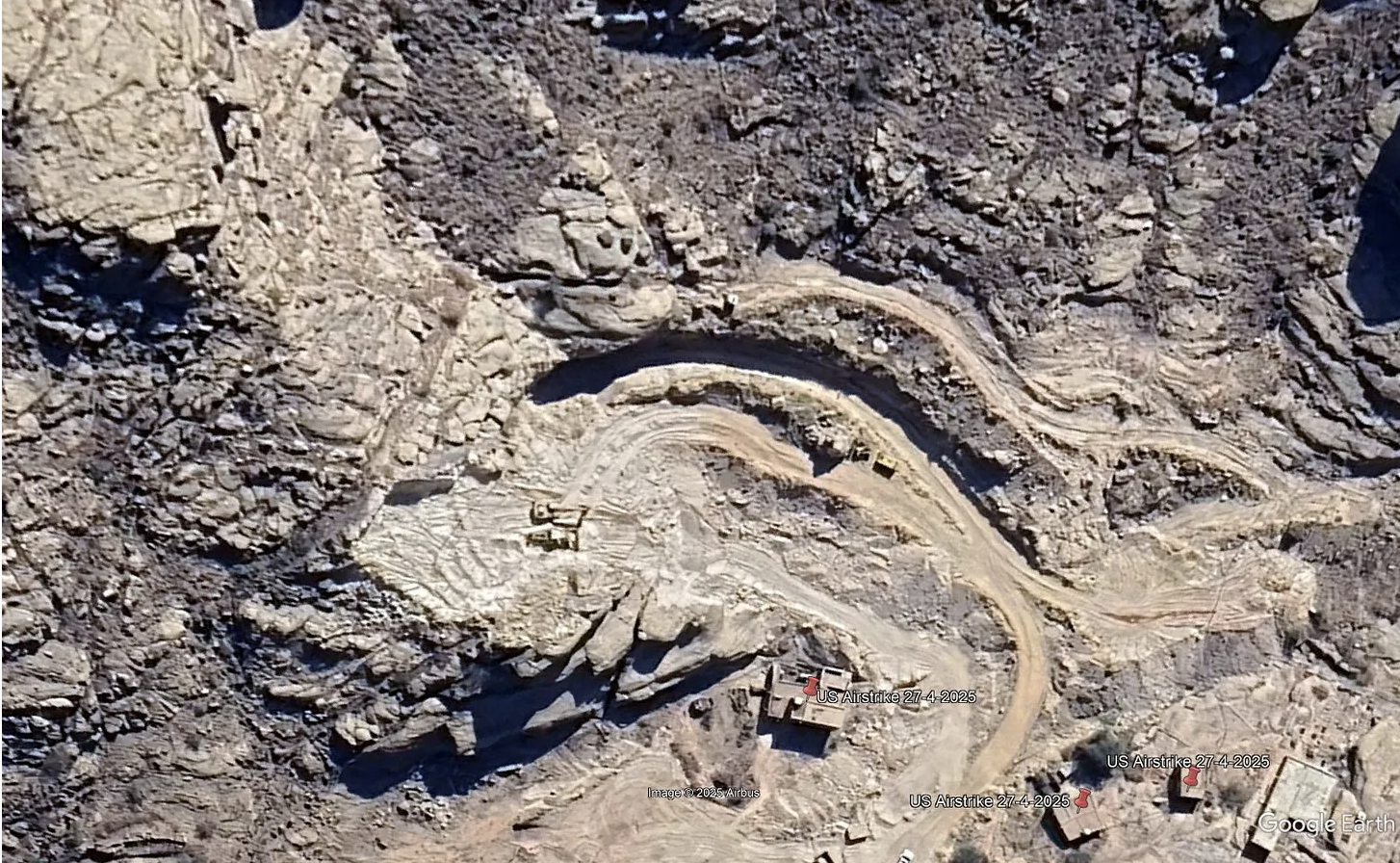
Drop Site News 01/05/2025 - For the past several months, the U.S. military has been carrying out a bombing campaign in Yemen ostensibly aimed at forcing the militant group Ansar Allah, also known as the Houthis, to stop their military intervention on behalf of Palestinians under Israeli assault in Gaza. This campaign has conducted strikes against more than 800 targets, as well as verified claims of civilian harm, including, most recently, a strike against a detention facility housing African migrants that killed dozens of people. (Shuaib Almosawa in Sana’a and Amanda Sperber have more on that below.)
It would be comforting to think that the decision makers in the U.S. military are carrying out these strikes with great care—and with the highest quality of intelligence—given the power of life and death that its operations hold for innocent people. Yet, serious allegations have emerged that the U.S. military has been relying, in part, on anonymous X accounts who post coordinates that they dubiously claim contain military assets.
This week, U.S. warplanes bombed a location alleged by two such amateur open-source intelligence accounts to be a Houthi stronghold, killing innocent bystanders in the process.
A Twitter account—operated by an individual whose bio says they are based in the Netherlands, using the handle @VleckieHond—apologized this week after the U.S. struck coordinates she erroneously suggested, in early April, were the location of an underground Houthi military position; it was not a military site. “Allright, time for me to go through the mud,” Vleckie posted. “Based on satellite imagery I'd marked this quarry as an underground base, and tweeted is out as such. I'm fairly certain Centcom doesn't take their targeting data from Twitter, but this still is a very severe mistake.” Vleckie had highlighted the coordinates in a thread that claimed to have uncovered a Houthi base, and they had relied, in part, on a secondary account, @Galal_Alsalahi, whose bio suggests they are based in Houston. That account, which is hostile to the Houthis, claimed to have discovered a Houthi missile launcher at the coordinates.
The strike that took place on April 28 reportedly killed eight civilians in their homes on the outskirts of the capital of Sana’a. Vleckie’s reading of satellite imagery, the account later said, was incomplete—they said they had privately marked the target as only “possible”—and they would strive to do better in the future, while posting a screenshot of a 500 Euro donation to charity that she had made as penance. “I should never have posted it,” they added. (A message seeking comment from the account went unanswered.)
Reports from local Yemeni news outlets highlighted the devastating impact of the attack. Among the dead and wounded were children, some of whom were later evacuated to local hospitals.
The U.S. military and CENTCOM have ultimate responsibility for verifying the information used to conduct airstrikes. The Pentagon has spent hundreds of millions of dollars on advanced data analytics programs from companies, like Palantir, that include open-source data scraped from social media as part of their information-gathering process to help the military with targeting and intelligence. Data analysts live by the credo “garbage in, garbage out,” which sophisticated intelligence collection is intended to overcome.
To be sure, it may be a mere coincidence that the amateur sleuths identified the location before CENTCOM struck it, but the account used for the Sana’a strike is known to officials in the military, increasing the potential likelihood that it was relied on—at least, in part—for the tragic targeting. @VleckieHond has been publicly cited by reputable military-linked publications, including the influential Combating Terrorism Center at West Point Sentinel, which referred to the “ever-resourceful analyst @Vleckiehond,” in an April 2024 report citing her analysis on U.S. air operations against the Houthis. The report noted she had compiled her analysis based on her purchases of commercially available satellite imagery. Read more - Lire plus
Yemeni People in State of “Terror” After 1,000+ U.S. Airstrikes Kill Hundreds: Helen Lackner
U.S. and Houthis reach truce—How it came together
The Trump Administration Is Hiding American Casualties of War
Why Trump 2.0 is unlikely to end the “Forever War” on terrorism
| | “A Dangerous Escalation”: India Bombs Pakistan in Intensification of “Forever War” over Kashmir | |
DemocracyNow! 07/05/2025 - Dozens of people have been killed in the worst fighting between India and Pakistan in more than two decades.
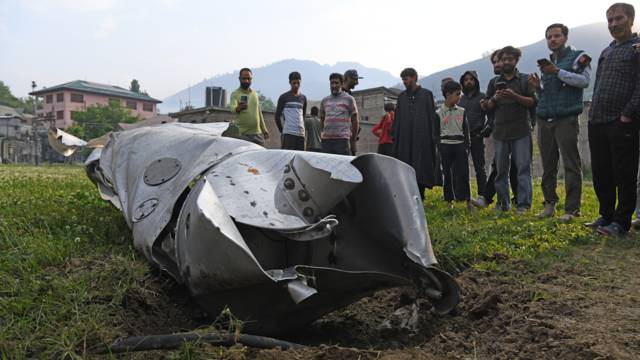
India attacked nine locations in Pakistan and Pakistani-controlled Kashmir early Wednesday, killing at least 26 people, including a child. Pakistan described the attacks as an act of war and responded by shelling areas controlled by India.
Tensions have been soaring between the two nuclear-armed states since gunmen massacred 26 tourists in Indian-administered Kashmir in a rampage that India blamed on Pakistan.
Mirza Waheed, a Kashmiri journalist and award-winning novelist, says that as the countries fight, the people of Kashmir get left behind. “When elephants fight, it’s the grass that gets trampled upon,” said Waheed. Read more - Lire plus
Pahalgam terror attack updates: Military solution is no solution, says UN Chief António Guterres
UN experts urge Pakistan to address human rights violations in Balochistan
| |
‘Killer Robots’ Threaten Human Rights During War, Peace:
Urgent Need for Treaty on Autonomous Weapon Systems
| |
Human Rights Watch 28/04/2025 - Autonomous weapons systems pose grave risks to human rights during both war and peacetime, Human Rights Watch said in a report released today. Governments should tackle the concerns raised by such weapons systems, known as “killer robots,” by negotiating a multinational treaty to address the dangers.
The 61-page report, “A Hazard to Human Rights: Autonomous Weapons Systems and Digital Decision-Making,” finds that autonomous weapons, which select and apply force to targets based on sensor rather human inputs, would contravene the rights to life, peaceful assembly, privacy, and remedy as well as the principles of human dignity and non-discrimination. Technological advances and military investments are now spurring the rapid development of autonomous weapons systems that would operate without meaningful human control.
“The use of autonomous weapons systems will not be limited to war, but will extend to law enforcement operations, border control, and other circumstances, raising serious concerns under international human rights law,” said Bonnie Docherty, senior arms adviser at Human Rights Watch, lecturer on law at Harvard Law School’s International Human Rights Clinic, and lead author of the report. “To avoid a future of automated killing, governments should seize every opportunity to work toward the goal of adopting a global treaty on autonomous weapons systems.”
The report, co-published with Harvard Law School’s International Human Rights Clinic, was issued ahead of the first United Nations General Assembly meeting on autonomous weapons systems in New York on May 12 to 13, 2025.
Weapons systems with varying degrees of autonomy have existed for years, but the types of targets, duration of operation, geographical scope, and environment in which they operate have been limited. They include missile defense systems, armed drones, and loitering munitions.
Autonomous weapons systems operating without meaningful human control would, once activated, rely on software, often using algorithms, input from sensors like cameras, radar signatures, and heat shapes, and other data, to identify a target. After finding a target, they would fire or release their payload without the need for approval or review by a human operator. That means a machine rather than a human would determine where, when, and against what force is applied.
Autonomous weapons systems would lack the ability to interpret complex situations and to accurately approximate human judgment and emotion, elements that are essential to lawfully using force under the rights to life and peaceful assembly.
Contrary to fundamental human rights principles, the weapons systems would be incapable of valuing human life in a way that is required to respect an individual’s dignity. In addition, systems relying on artificial intelligence would most likely be discriminatory due to developers’ biases and the inherent lack of transparency of machine learning.
Autonomous weapons systems would also violate human rights throughout their life cycle, not just at the time of use. The mass surveillance necessary for their development and training would undermine the right to privacy. The accountability gap of these black-box systems would infringe upon the right to a remedy for harm after an attack.
“Human beings, whether soldiers or police officers, often egregiously violate human rights, but it would be worse to replace them with machines,” Docherty said. “While people have the ability to uphold human rights, machines do not have the capacity to comply or to understand the consequences of their actions.”
Christof Heyns, the late UN special rapporteur on extrajudicial executions, was the first UN official to raise the alarm about autonomous weapons systems in his 2013 report to the UN Human Rights Council. “A Hazard to Human Rights” charts how the UN secretary-general and numerous UN bodies and experts have stressed that the use of autonomous weapons systems would pose threats to international human rights law, and some have argued they should be prohibited.
More than 120 countries are now on record calling for the adoption of a new international treaty on autonomous weapons systems. UN Secretary-General António Guterres and Mirjana Spoljaric Egger, president of the International Committee of the Red Cross, have urged states to “act now to preserve human control over the use of force” by negotiating by 2026 a legally binding instrument with prohibitions and regulations for autonomous weapons systems.
Most treaty proponents have called for prohibitions on autonomous weapons systems that by their nature operate without meaningful human control or systems that target people, as well as for regulations that ensure all other autonomous weapons systems cannot be used without meaningful human control.
The upcoming UN meeting was mandated by a UN General Assembly resolution on lethal autonomous weapons systems that was adopted on December 2, 2024, by a vote of 166 in favor, 3 opposed (Belarus, North Korea, and Russia), and 15 abstentions.
Countries have discussed lethal autonomous weapons systems at the Convention on Conventional Weapons (CCW) meetings in Geneva since May 2014, but with no substantive outcome. The main reason for the lack of progress under the CCW is that its member countries rely on a consensus approach to decision-making, which means a single country can reject a proposal, even if every other country agrees to it. A handful of major military powers investing in autonomous weapons systems have exploited this process to repeatedly block proposals to negotiate a legally binding instrument.
“Negotiations for a treaty on autonomous weapons systems should take place in a forum characterized by a common purpose, voting-based decision-making, clear and ambitious deadlines, and a commitment to inclusivity,” Docherty said.
Human Rights Watch is a cofounder of Stop Killer Robots, which calls for a new international treaty to prohibit and regulate autonomous weapons systems. The coalition of more than 270 nongovernmental organizations in 70 countries supports the development of legal and other norms that ensure meaningful human control over the use of force, counter digital dehumanization, and reduce automated harm. Source
| | Entrenching Authoritarianism: Expanding the Terrorism Framework and the Infrastructure of Surveillance to Repress Expression and Stifle Dissent | Joint Submission to the United Nations Human Rights Council Reviewing the U.S. National Report under the Universal Periodic Review 50th Session of the Universal Periodic Review - Fourth Cycle (November 3-14, 2025). | |
CCR 07/04/2025 - I. Introduction
The accelerated disintegration of democracy and the evaporation of fundamental rights in the United States (hereinafter U.S.) witnessed since the second inauguration of President Donald Trump is the culmination of decades of bi-partisan suspension of international human rights obligations. Increasing concentration of unchecked power in the executive branch, failure to address past harms, and noncompliance with international recommendations created the context currently being exploited and weaponized by a right-wing authoritarian regime. Motivated by racial and ethnic animus, operating without regard for the rule of law, and equipped with advanced technological tools, the new administration is positioned to supercharge the dissolution of human rights protections.
Since the U.S.’s last Universal Periodic Review, state actors across all levels of government have committed violations to stifle dissent and debate, criminalize protest, and threaten human rights defenders. A central feature of the repression is a metastasizing “terrorism” framework that escalated in the aftermath of September 11th. The methods deployed in the name of “counterterrorism” and “national security” evolved from emergency measures to common practices, ensnaring new populations and cannibalizing a broader range of issues. Today, University students and professors that challenge support for Israel’s genocide of Palestinians are being targeted. Environmental activists that oppose the plan to build a police training facility in a clearcut forest outside of Atlanta, Georgia have been prosecuted as “domestic terrorists.” And key to the administration advancing its anti-democratic and anti-rights agenda is the expansion of a vast surveillance infrastructure of law enforcement agencies with the aid of unaccountable tech magnates.
Chillingly, the government’s repeated and rising attacks on civil society as well as lawyers seek to erode the infrastructure of support for the most marginalized communities and to neutralize the very mechanisms by which government power can be checked and constrained. These patterns are familiar to any reader of history or observer of comparative case studies in authoritarianism. The current submission documents evidence of human rights violations committed by the U.S. government in the areas of freedom of expression, due process, and privacy rights. Given the rapid deterioration of the human rights situation and the pronounced consolidation of power underway, the submission requests that member states of the Human Rights Council not only urgently consider raising these issues during the 2025 Universal Periodic Review of the U.S., but to use all available means to hold the present administration accountable to its obligations under international human rights law.
II. The Metastasizing “Terrorism” Framework: Guantánamo and the Alien Enemies Act
Recommendations:
The U.S.’ severely bloated counterterrorism and national security infrastructure, laws, policies and practices are used to criminalize racialized and marginalized communities and are being weaponized against human rights defenders and to suppress social movements. Member states should demand that the U.S.:
1. End military detention at Guantánamo Bay by safely transferring the remaining six uncharged men, including those who have been cleared for release, and allowing for the resolution of the cases of charged men through mutually acceptable plea deals; and cease using the Migrant Operations Center to detain individuals deported by the U.S.
2. Immediately engage in a whole-of-government review of War on Terror infrastructure, laws, policies and practices, specifically taking immediate steps toward ending the criminalization of communities by eliminating laws and policies that are ripe for abuse against activists as well as Black, Muslim, Arab, and South Asian, Indigenous, Latinx, and LGBTQIA+ communities.
3. Cease the weaponization of the terrorism framework and immediately repeal 18 U.S.C. §2339B of the material support statute, and oppose any new domestic terrorism crime legislation, the creation of a list of designated domestic terrorist organizations, or any other expansion of existing terrorism-related authorities.
4. Immediately revoke the ongoing invocation of the Alien Enemies Act and repeal its status as valid law, and define and commit to a plan to prevent future occurrences of the human rights violations inherent in the invocation of this law. [...]
IV. Freedom of Expression and Thought
Recommendations:
As yet, Member States have not sufficiently addressed the U.S.’ continued defiance of its obligations under the ICCPR, and in the escalating environment of repression and the targeting of political dissidents, should recommend that the U.S.:
1. Cease its policy and practice of arresting and detaining individuals, including noncitizens, who have exercised freedom of expression and engaged in First Amendment-protected activity in support of Palestinian rights;
2. Cease its policy and practice of targeting political dissenters, including noncitizens, on the basis of their support for Palestinian rights; and 3. Make efforts to repeal laws at state and local levels that criminalize or otherwise unduly restrict lawful assembly and advocacy for Palestine, such as domestic terrorism. [...]
V. Repression of Privacy: Dragnet Surveillance by U.S. Agencies
1. Case Studies
#1: The Foreign Intelligence Surveillance Act allows for intelligence agencies’ widespread violations of the right to privacy and freedom of expression of people in the U.S.
#2: The Department of Homeland Security and its components’ dragnet surveillance violates the right to privacy, the freedom of expression, peaceful assembly, and association of people in the U.S.
#3: Data brokers, AI and tech-enabled surveillance
Recommendations:
The U.S. government should: (1) repeal any law, e.g., Section (1)(1)(A) of the DNA Fingerprint Act, that is incompatible with Article 17 of ICCPR and Article 12 of UDHR, (2) investigate all data practices that violate ICCPR such as dragnet surveillance, (3) disclose all the details relating to DHS’s contract with Paragon Solutions (US) Inc., (4) cease the collection of DNA profiles from individuals detained by DHS, (5) stop and prevent privacy washing through privacy enhancing technologies (PETs), (6) and establish federal-level privacy protection laws which satisfy the requirements of Article 17 of the ICCPR and Article 12 of UDHR. We suggest United Nations Member States ask the U.S. government:
1. What mechanism, if any, does the United States have for ensuring that law enforcement operations by DHS or other federal, state, local agencies generally, and in particular with respect to data surveillance, comply with ICCPR?
2. How and when will the United States investigate law enforcement data practices, hold the relevant actors accountable, provide meaningful remedies to people affected, and ensure non-repetition? Read more - Lire plus
Police Shot Them in the Head With Rubber Bullets. Now UCLA Gaza Protesters Are Suing.
Students Are Winning in Court Against Trump’s Deportation Regime
Video: Trump’s demonstrably false claim about a photoshopped tattoo on the knuckles of Kilmar Abrego Garcia
Another judge skewers Trump’s use of Alien Enemies Act for deportations to El Salvador
Venezuelan detainees at Texas center spell out SOS with their bodies
Swiftly deporting migrants to Libya would violate court order, US judge rules
U.S. Companies Honed Their Surveillance Tech in Israel. Now It’s Coming Home.
| | Migrant Torture at Guantanamo Authorized by Trump Administration Memo | |
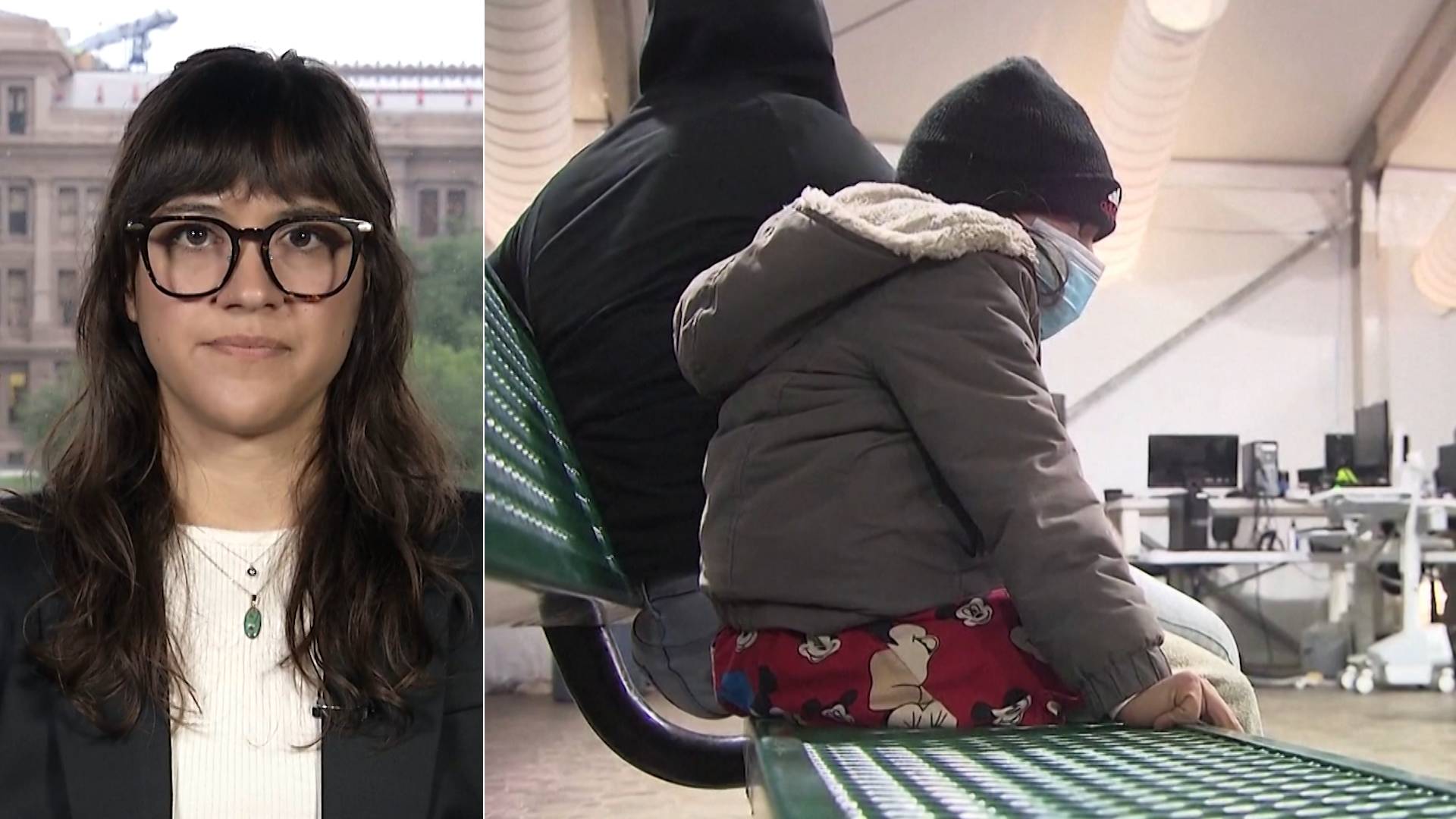
Forever Wars 28/04/2025 - WHILE I WAS AWAY, CBS News acquired and reported on a memorandum of understanding between the Departments of Defense and Homeland Security on shared responsibilities over the expanded migrant-detention camps at Guantanamo Bay.
Appropriately, CBS' Camilo Montoya-Galvez led with and focused on how the March 7 memo gave the lie to the Trump administration's assertions that only the "worst of the worst" migrants with criminal backgrounds would be caged at Guantanamo. The Pentagon and DHS memo defines a "nexus to a transnational criminal organization" broadly enough to ensnare anyone who paid such an entity to be smuggled into the United States. Such organizations often exploit those migrants, and accordingly, the Guantanamo arrangement outlined in the memo collapses the difference between predator and prey. Mass deportation obviously becomes easier when the government can portray millions of people as Tied To A Transnational Criminal Organization.
And it's worth recognizing that Montoya-Galvez and others have very admirably inserted a greater and earlier skepticism about the government's pronouncements than did the 9/11 generation of journalists (i.e., mine). It took several years before mainstream news outlets began doubting that most of those caged at Guantanamo were actually the dangerous men that the Bush administration falsely portrayed. This piece appeared within the Second Trump Administration's first hundred days.
But another aspect of this memo deserves some additional attention. It appears relatively innocuous at first glance. But if you've been to Guantanamo Bay, you know immediately how it authorizes treatment that in practice amounts to torture.
I'm talking about this line, found at section 4.2.2. It says that the Defense Department, via U.S. Southern Command, the military command that oversees Guantanamo,
Will provide DHS/ICE with soft structures (tents) to hold other NSGB IAs. [In context, that means other than "high threat" IAs, i.e., low-threat "illegal aliens." NSGB means Naval Station Guantanamo Bay.] These tents do not have power, lighting, heating/air conditioning.
I've been to Guantanamo Bay three times. At this time of year—and two of those visits occurred at this time of year—Guantanamo is baking hot. I mean it's hotter than I have experienced during this time of year in Baghdad. You feel like you're in a furnace, and the summers are even worse. You need to hydrate frequently, if not constantly.
And what you really need is air conditioning.
On two occasions when I was at Guantanamo, press were housed in a "soft structure" tent not unlike what this memo outlines. (The first time was before those tents were set up.) The tents weren't exactly comfortable, but they were mercifully kept cold—powerfully cold. Those reading this who've worked in restaurants: it's like stepping into the walk-in on the hottest day of the year. If the tents didn't have air conditioning, they would have been unbearable. I don't mean "uncomfortable," the kind of discomfort that, were someone so inclined, they could rationalize as par for the course for a detention camp. I mean unbearable.
Now, according to Carol Rosenberg, dean of the Guantanamo press corps, writing about two weeks before CBS, 195 tents that the Pentagon constructed at Guantanamo in the expanded camp have yet to be used, and right now, the migrants held at Guantanamo are held in the extant migrant and wartime-detainee buildings. So it would appear this policy memo hasn't yet been put into place, much like the announced construction of the expanded tent camps has stalled. But as a matter of policy to manifest going forward, these tents are intended to be absolutely stifling. They will also not have lighting. So not only will they be unbearably hot, migrants will have to endure the heat in total darkness.
I can tell you that the tents I stayed in at Guantanamo Bay were also quite dark once you switched off the installed fluorescent lights. I am at the moment writing a book about someone who had to endure a very long period of time in a CIA black site known as the Dark Prison, which was swelteringly hot and pitch dark. It was impossible not to think of that experience when reading this provision in the March memo.
The memo doesn't authorize waterboarding, stress positions, or similar "enhanced interrogation techniques" that all but War-on-Terror dead-enders recognize as torture. But make no mistake. "Environmental manipulation"—extreme temperatures—and "sensory manipulation"—enforced darkness, for instance—were both torture techniques used by the Defense Department (and the CIA) earlier in the War on Terror, at Guantanamo and beyond.
Now, in bland and bureaucratic terms, they are set to be put into effect again, this time for people whose crime was to seek a better life in America, much as the ancestors of the architects of this memo did. Even while attention is appropriately focused on the dire situation for migrants rendered to El Salvador's CECOT prison, CBS quoted a Pentagon spokesperson saying that 42 migrants are presently caged at Guantanamo.
Someone whom I guarantee you knows exactly what it means to pen people in Guantanamo with no air conditioning? Former Gitmo guard and current Secretary of Defense Pete Hegseth.
Two other aspects of the memo are worth flagging on similar grounds. First, at section 4.1.15, it grants DHS and ICE responsibility for "any involuntary medical treatment, including in response to hunger strikes, or similar measures." That means enteral feeding, the forced insertion of tubes through the nose and down the throat, through which liquified food will pass. That is also torture, as anyone who has experienced it will tell you. Perhaps you watched the episode of the FX adaptation of Patrick Radden Keefe's excellent book Say Nothing where Dolours and Marion Price are forcibly tube-fed, including by medical staff who don't disguise taking pleasure from it. If not, it's a good time to check that one out.
Second, and for this part I admit the context raises more questions for me than answers, at 4.1.4, there is a vague reference to "mandatory work for detained aliens." I don't know what that means, since ICE's style of prison labor is unknown at Guantantamo, but it's ominous, and I'm going to try to get answers for a future edition. Source
Lawsuit says migrants endure isolation and intimidation at US’ Guantanamo detention center
US judge limits Trump’s push to rapidly deport migrants in Guantanamo Bay
U.S. Forces Are Taking Down Tents In Guantanamo
Tech Weirdos Want to Transform Guantánamo Into a ‘Freedom City’
Trial in Bombing of U.S. Warship Is Postponed Until June 2026
| | Haiti: How US terrorist designations could deepen criminal rule and humanitarian tragedy | |
Global Initiative against Transnational Organized Crime 08/05/2025 - In the first quarter of 2025, at least 1 617 people were killed in Haiti. As the gangs have tightened their grip over the country, the need for aid is intensifying – more than a million people have been displaced and more than half of the population needs humanitarian assistance, a 9 per cent increase against 2024. Criminal groups have recently launched new offensives, particularly in the Central Plateau and Artibonite regions. The population of these areas risk joining the millions in the capital, Port-au-Prince, who already live under the de facto authority of gangs.
In this constantly deteriorating situation, on 2 May 2025 the United States designated the Viv Ansanm gang coalition and the Gran Grif gang as foreign terrorist organizations and specially designated global terrorists. The measures bar members of the designated gangs from accessing financial institutions with a US link, and from being issued visas. They also provide for potential legal action and secondary sanctions against individuals or organizations providing various forms of support to the gangs.
The action is the latest use of counterterrorism measures as a tool to combat organized crime, building on a previous tranche of US designations targeting Latin American gangs and cartels. However, the US designations may inadvertently worsen the situation on the ground by impeding humanitarian assistance, strengthening gang governance and empowering broader criminal networks. This may drive further entrenchment of designees in the illicit political economy. But in the short term, the most pressing concern is whether the US designations will prevent Haitian and international NGOs from continuing to deliver aid to communities in gang-controlled areas that lack public services.
For NGOs working in areas under gang control in Haiti, as in other locations, negotiating access with criminal leaders is often a necessary condition for reaching affected populations. In such contexts, it is these non-state actors (and not official authorities) who dictate the terms of engagement, effectively exercising control over communities and restricting humanitarian access. Under prevailing sanctions regimes, these dynamics expose humanitarian organizations to legal and reputational risks, including potential liability for engaging – even indirectly – with sanctioned or criminal entities. There is therefore growing concern within the aid community that organizations could lose funding or face legal risks – including prosecution. Under the terrorist designation, the assistance they provide could now be classified as ‘material support’ to terrorist groups.
The inability to provide assistance could also indirectly deepen gang governance. If people find themselves even more isolated than they are today, living under the thumb of criminal leaders, the bargaining power of those bosses will be strengthened. Gangs are also likely to increase the pressure they exert through widespread extortion and territorial expansion to secure their sources of income. [...]
Fuelling the underworld?
From a more structural perspective, the ability of humanitarian actors to carry out their operations is directly linked to their ability to access international financial services, which could be cut off or hampered in the context of sanctions. The perceived legal and operational risks associated with sanctions compliance may lead financial institutions and money transfer companies to scale back or even withdraw from Haiti. For example, companies such as Western Union may reduce or cease operations in the country due to potential exposure under US law, even if their activities are technically authorized.
The broader concern is that a strict or inconsistent interpretation of sanctions might lead to widespread de-risking, whereby financial institutions disengage entirely from high-risk regions. Unable to use formal banking channels, NGOs are often forced to rely on informal systems, increasing operational risks and reducing oversight.
This constrained operating environment also creates space for criminal networks and illicit actors to exploit the aid vacuum, which in the medium and long term could expand rather than constrain the power and scope of the gangs and associated illicit economies in Haiti.
Regulated financial channels are heavily used by the diaspora to send remittances and by Haitian businesses to move funds. With those potentially blocked, unregulated intermediaries – including some fintech companies and money services businesses – could step in to facilitate transactions, potentially without adequate scrutiny. This not only hampers humanitarian access, but also risks increasing informality, further weakening local institutions and strengthening criminal financing structures. [...]
Moreover, the experience of Somalia provides a relevant comparative example. In response to the terrorist designation of al-Shabaab by the US, the UN and others in the international community, major banks cut ties with Somali money services businesses and clients, leading to a significant reduction in formal financial access. This, in turn, affected remittances from the diaspora and increased reliance on informal financial networks, which are more vulnerable to exploitation by criminal actors and can facilitate money laundering and other illicit activities. [...]
A 180-degree turn is urgently needed
Without appropriate safeguards, the terrorist designations risk further destabilizing Haiti and inadvertently empowering gang structures, which previous GI-TOC research suggests are likely to remain largely unaffected by sanctions alone. And, without coordination with a clear security and judicial strategy, particularly to dismantle political-criminal networks, the designations risk becoming yet another policy tool that is poorly used or not used at all.
It is troubling that these designations have not been accompanied by robust engagement, strategic coordination or technical support from the United States, the Haitian authorities and the international community. Immediate action is needed to provide clarity, facilitate the work of NGOs and ensure the continued delivery of life-saving assistance to a population whose latest misfortune is to have been left vulnerable to the rule of armed criminal groups. Read more - Lire plus
| | Judge: Trump’s national security reasoning for anti-union EO was 'pretext for retaliation' | |
GovExec 29/04/2025 - A federal judge on Monday wrote that President Trump’s controversial invocation of a provision of the 1978 Civil Service Reform Act to strip two-thirds of federal employees of their collective bargaining rights on national security grounds was “mere pretext” for retaliating against unions resistant to his workforce policies.
U.S. District Judge Paul Friedman issued the finding Monday in a 46-page opinion explaining his decision last week to enjoin the administration from implementing the March executive order, following a lawsuit from the National Treasury Employees Union.
“The scope of the executive order when compared with the intent of Congress in passing the [Civil Service Reform Act], coupled with the surrounding statements in the [White House] fact sheet and [Office of Personnel Management] guidance—which strongly suggest that President Trump’s invocation of [the statute’s national security exemption] was mere pretext for retaliation and for accomplishing unrelated policy objectives—are persuasive reasons to believe NTEU will likely be successful on the merits of its claim,” Friedman wrote.
In federal courts, judges generally are expected to assume that government officials properly discharged their duties, a concept called the “presumption of regularity.” But Friedman found that the White House and OPM’s public explanations for the executive order, as well as the exemption of some law and immigration enforcement unions from the edict, override that presumption.
“In sum, the OPM guidance says little about national security, notwithstanding the national security valence of [the statute]," he wrote. “On examination, the OPM guidance and the executive order appear to be more about accomplishing the administration’s goal of substantially changing the nature of the federal workforce. The OPM guidance lists numerous examples of earlier policy directives by the president and OPM, identifies the difficulties collective bargaining agreements posed to accomplishing those directives, and states that those obstacles are now gone as a result of the executive order ... Indeed, it is strong evidence that the president’s invocation of [the national security exemption] was to remove barriers created by the [labor statute] to his unrelated policy objectives.” Read more - Lire plus
“They Actually Had a List”: ICE Arrests Workers Involved in Landmark Labor Rights Case
| | Why I wrote an expert report against the UK classing Hamas as a terror group | |
Jonathan Cook's blog 01/05/2025 - This is the first time I have had to begin an opinion column with both a journalistic disclosure and a legal disclaimer. But hey ho, these are dystopian times we live in.
The disclosure: I was one of 20 people who contributed expert reports for a recent legal submission to the British home secretary, Yvette Cooper, calling on her to end the proscription of Hamas as a terrorist organisation.
You can read my submission – on the significant damage done to journalism by Hamas’ proscription – here.
If, as widely expected, Cooper does not approve the application, prepared by the London-based Riverway Law firm on behalf of Hamas, within the 90-day time limit, her decision will be referred to an appeal tribunal for judicial review.
The disclaimer: Nothing that follows is intended in any way to encourage you to take a more favourable view of Hamas. It is not intended in any way to encourage you to support Hamas. It does not endorse opinions or beliefs that are supportive of Hamas, as set out in the submissions calling for the de-proscription of Hamas.
The danger is this: under Section 12 of Britain’s draconian Terrorism Act of 2000, if anything I write, however inadvertently, encourages you to think more favourably of a proscribed organisation like Hamas, I face up to 14 years in jail.
The purpose of this article is to show how the law and the establishment operate together to stifle legitimate criticism of the Israeli occupation.
The law is so loosely worded that the British government, supported by a counter-terrorism police seemingly only too eager to please, can potentially arrest anyone praising the work of Gaza’s public hospitals in saving lives because Hamas is in charge of the enclave's government, or prosecute anyone, including media outlets, giving a platform to Hamas politicians trying to advance a ceasefire.
If all this sounds crazy, given both that stating facts should not be illegal and that I cannot possibly know how anyone might receive and feel about any information regarding Hamas, then you are starting to understand why the application to the home secretary is so urgent and important. [...]
Bullied into silence
Concerns about Hamas being proscribed in its entirety – not just its armed wing – are far from hypothetical, given the expansive wording of the UK’s Terrorism Act since 2019, when it was amended.
In particular, a revision to Section 12 means that anyone who “expresses an opinion or belief that is supportive of a proscribed organisation”, and one that might “encourage support” for that organisation, is liable to arrest by terrorism police, prosecution, and up to 14 years in jail.
For expressing an opinion.
The wording is so vague that, for example, simply criticising Israel for committing greater and more numerous atrocities than Hamas could theoretically have the counter-terrorism police banging on your door.
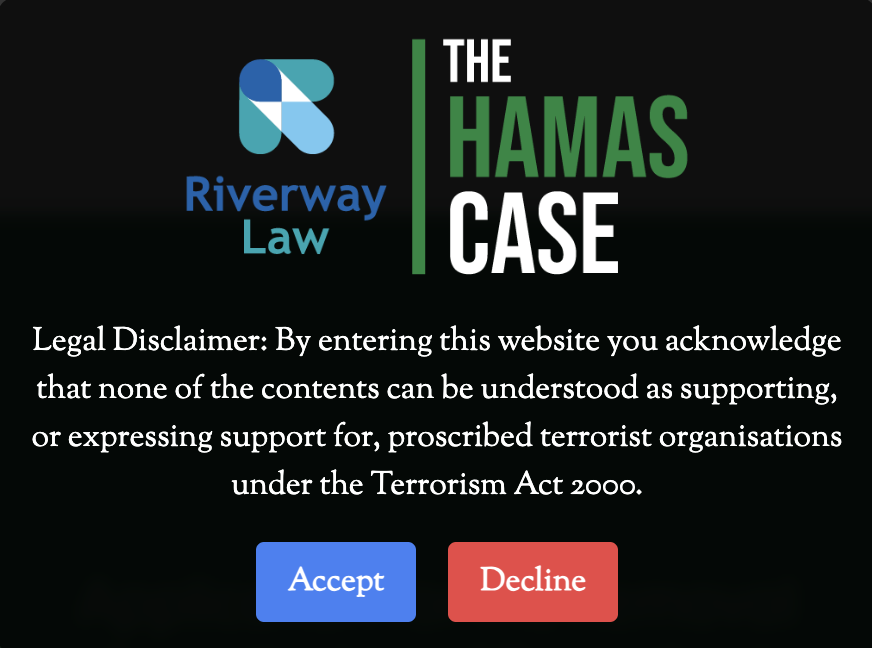
To avoid prosecution, Riverway Law’s website dedicated to its application to the home secretary carries a legal disclaimer: “By entering this website you acknowledge that none of the contents can be understood as supporting, or expressing support for, proscribed terrorist organisations under the Terrorism Act 2000.” (see image)
Several independent British journalists and commentators – those whose careers are not dictated, and protected, by billionaires or the UK state broadcaster – have had their homes raided at dawn by counter-terrorism police or been arrested at the border as they return home.
One political commentator, Tony Greenstein – who also happens to be Jewish and a trained lawyer – is currently being prosecuted under Section 12 of the Terrorism Act. Others are under prolonged investigation. They have the threat of prosecution hanging over their heads like a sword.
The rest of us are meant to take note, feeling the chilling effect. Do we want the police breaking down the door of our homes at dawn? Do we want to be arrested on return from holiday, our partners and children looking on in horror?
The National Union of Journalists has called the police actions against journalists “abuse and mis-use of counter-terror legislation” and warned that they risk “threatening the safety of journalists”, as well as their sources. [...]
The British government is not a neutral party in the levelling of Gaza, the decimation of its people by bombs, the ethnic cleansing of swaths of the enclave, or the starvation of the population. It is actively assisting Israel in its genocidal campaign.
The UK establishment is also, through its proscription of Hamas and the wording of the Terrorism Act, bullying journalists, academics, politicians, lawyers – in fact, anyone – into silence about the context of its complicity, into an unwillingness to scrutinise its rationalisations for collusion in genocide.
'No civilians'
There are two main objectives behind Riverway Law’s submission to the home secretary against Hamas’ proscription as a violation of the European Convention on Human Rights.
The first concerns the proscription of the entire organisation by the British government. This is the part of the legal submission that has attracted most attention – and which has been used to vilify the lawyers involved
As barrister Franck Magennis has explained, Riverway’s hands were tied because Patel – now the shadow foreign secretary – added Hamas to the list as a single entity in 2021, making no distinction between its different wings. That meant the lawyers had no choice but to petition for the entire group to be deproscribed.
The government set the terms of the legal debate, not Hamas or its legal representatives.
Hamas’ lawyers accept that its military wing meets the definition of a terrorist organisation under the terms of the UK’s Terrorism Act. They argue this law casts the net so wide that any organisation using violence to achieve political ends is covered, including the Israeli, Ukrainian and British militaries.
The establishment media have tried to smear Riverway and its barristers as Hamas "stooges" and supporters of terrorism – amply illustrating why the case is so necessary.
An openly hostile interviewer for LBC appeared to think he had caught out Magennis in some kind of ethical or professional lapse because he chose to represent Hamas without payment – as he must do under UK law because Hamas is a proscribed organisation.
The implication was that Magennis was so enthusiastically supportive of terrorism that he was willing to take on time-consuming and career-damaging work for free – rather than that he is doing so because there are vitally important legal and ethical principles at stake.
Not least, the proscription of Hamas’ political wing, including its governmental and administrative institutions, treats them as extensions of the armed struggle.
It breathes life into Israel’s patently ridiculous claims that all of Gaza’s 36 hospitals are really “Hamas command and control centres”, that Gaza’s doctors can be killed or arrested and taken to torture camps because they are "Hamas operatives" in disguise, and that Gaza’s paramedics can be executed because their rescue missions supposedly aid Hamas.
And worse, ultimately proscription supports Israeli leaders’ genocidal statements that there are “no civilians in Gaza”, a place where half the population are children. [...]
Attack on lawyers
Robert Jenrick, Britain’s shadow justice secretary, has called for Riverway Law and its barristers to be investigated and struck off for representing Hamas – apparently forgetting the foundational principle in law that everyone, even serial killers, have a right to legal representation if the law is not to become a hollow charade.
The Terrorism Act includes provision for an appeal by proscribed organisations against their inclusion on the list. How are they to go through the legal procedure to appeal their listing apart from through lawyers?
Disgracefully, Starmer’s officials have once again kept their silence as Hamas’ legal representatives in the UK have been turned into targets for establishment abuse. The government is as complicit in the assault at home on basic democratic rights, such as free speech and the rule of law, as it has been complicit abroad in Israel’s genocide in Gaza. Read more - Lire plus
Royaume-Uni : un rapport d’expert conteste la classification du Hamas comme mouvement terroriste
Revealed: Britain’s Labour Government Sent 8,000 “Munitions of War” to Israel After Saying It Had Stopped
| | UK’s Border Security Bill: When Solidarity Becomes a Crime | |
The Decolonial Centre 16/04/2025 - Welcome to the second episode of Decolonial Dispatch, where we examine global affairs through an anti-colonial lens.
In this episode, we’re taking a look at the UK’s new Border Security Bill — a law that goes way beyond borders. It expands surveillance, treats people fleeing violence like criminals, and even targets those who try to help.
We’ll talk about what’s really driving this legislation, how it connects to a long history of colonial control, and why it should concern all of us — not just migrants.
Joined by Fizza Qureshi from Migrants Rights Network, we unpack what’s happening and what we can do about it.
⸻
The UK government has a problem: how do you stop people seeking asylum without admitting that’s what you’re doing? Their solution: make it impossible to seek asylum legally, then criminalise those who try anyway. The Border Security Bill represents the completion of this strategy — expanding powers to criminalise not just those crossing the Channel, but anyone who assists them, even indirectly.
This isn’t about security — it’s about manufacturing criminality to placate the far right. Source
| |
EU’s secretive “security AI” plans need critical, democratic scrutiny, says new report | |
Statewatch 29/04/2025 - The EU is secretively paving the way for police, border and criminal justice agencies to develop and use experimental “artificial intelligence” (AI) technologies, posing risks for human rights, civil liberties, transparency and accountability, says a report published today by Statewatch.
The report, Automating Authority: Artificial intelligence in European police and border regimes, warns that the growing use of AI technologies by the EU and its member states will reinforce the existing discrimination, violence and harm caused by policing, border and criminal justice policies.
Hundreds of pages of documents obtained from EU institutions, agencies and working groups detail attempts by politicians and officials to put into use what the report refers to as “security AI” – artificial intelligence tools and technologies for police, immigration, border and criminal justice agencies.
Legal loopholes
The EU’s Artificial Intelligence Act, a landmark piece of legislation adopted in 2024, is designed to ensure “a high level of protection of health, safety, fundamental rights… including democracy, the rule of law and environmental protection.”
However, the Act contains a multitude of exemptions, exceptions and loopholes for security AI.
This includes a total exemption from the Act, until at least 2031, for high-risk AI systems used by EU and national authorities.
The Act does not apply to individuals located outside the EU. This means that it will provide no protection to the millions of people obliged to apply for visas and travel authorisations, which will be processed using AI techniques.
Despite supposed bans on practices such as individual profiling, biometric categorization, and mass biometric surveillance (such as public facial recognition systems), exemptions grant law enforcement and migration authorities many options for using them.
State secrecy
The report argues that the law draws a “silicon curtain of secrecy” over the use of AI by law enforcement agencies.
Police forces have claimed credit for having many of these exemptions included in the law. A secretive body called the European Clearing Board, made up of EU member state police officials, worked extensively to weaken safeguards in the Act.
Ultimately, the Act “will make meaningful supervision of and control over the use of AI systems for policing and migration authorities extremely difficult,” says the report. [...]
Technical infrastructure
The report also details two initiatives to set up the technical infrastructure needed to develop and use security AI.
The first is a “Security Data Space for Innovation” (SDSI) that will interconnect datasets held by different agencies and institutions across the EU. The data will be used to train AI systems for law enforcement, which topics of interest including automated image recognition and video analysis.
A €1m EU-funded project is currently mapping the types of data that could be shared through the SDSI, including photos, videos, voice samples, and text scraped from the web.
EU police agency Europol is working on a separate, but similar, plan. Amongst the agency’s priority technologies are voice print analysis, age and gender detection from audio recordings of voices, and the use of augmented and virtual reality for data analytics.
To help develop these technologies, it is building a “sandbox” – an isolated technical environment in which software can be developed and tested with no external effects.
Europol documents describe the sandbox as an “infrastructural foundation” for “numerous depending initiatives” that has “paramount strategic significance.”
One aim is to use the vast quantities of data held by Europol to train new AI tools. However, this runs the risk of reinforcing the bias and discrimination inherent in police data, the report warns.
Quotes
Chris Jones, Statewatch director and co-author of the report, said:
While the EU claims the AI Act will protect peoples’ rights, our analysis suggests completely the opposite when it comes to law enforcement and immigration agencies. It is riddled with loopholes, exceptions and exemptions that will severely limit people’s ability to know when AI is being used against them, and to challenge the use of these experimental technologies.
The creeping introduction of AI tools and techniques into EU policing, border and criminal justice agencies gives further cause for concern. This should be high on the public and political agenda at any time, let alone a time of growing far-right influence and power over EU governments and institutions. Instead, we see secretive working groups set up and plans being introduced with zero public or democratic debate. This has to change.
Romain Lanneau, Statewatch researcher and co-author of the report, said:
European law enforcement agencies and private companies have convinced European legislators to include wide exceptions in the Artificial Intelligence Act. Police forces will self-assess the legality of their experiments with highly intrusive technologies on migrants and people they deem to be a risk. Our report shows that this secretive deployment is a major threat to the rule of law, in particular for free speech, non-discrimination and the right to asylum. The next decade will show if and how litigation and journalistic investigations against the worst impacts of AI in law enforcement can bring back fundamental rights protection for all. Source
| | OTHER NEWS - AUTRES NOUVELLES | | ICLMG ACTIONS DE LA CSILC | |
Canada: Abolish rights-violating terrorist entities list!
| | |
On October 15, 2024, the Canadian government placed the Samidoun Palestinian Prisoner Solidarity Network on Canada’s terrorist entities list. While ostensibly a tool to protect the safety and security of people in Canada and internationally, the list is an arbitrary political tool that undermines freedom of association, of expression and due process in the courts. Its effectiveness as a national security tool has never been demonstrated in a manner that justifies its use.
Due to these deep flaws, and more, the ICLMG has consistently called for the list to be abolished since the Canadian coalition’s founding in 2002. Please join us in urging the Canadian government to abolish the rights-violating terrorist entities list once and for all. Thank you!
| | CSIS isn't above the law! | | |
In recent years, at least three court decisions revealed the Canadian Security and Intelligence Service (CSIS) engaged in potentially illegal activities and lied to the courts. This is utterly unacceptable, especially given that this is not the first time these serious problems have been raised. CSIS cannot be allowed to act as though they are above the law.
Send a message to Public Safety Minister Marco Mendicino demanding that he take immediate action to put an end to this abuse of power and hold those CSIS officers involved accountable, and for parliament to support Bill C-331, An Act to amend the Canadian Security Intelligence Service Act (duty of candour). Your message will also be sent to your MP and to Minister of Justice David Lametti.
| | Canada must protect Hassan Diab! | | Canada must repatriate all Canadians detained in NE Syria now! | |
On January 20, 2023, Federal Court Justice Henry Brown ruled that Canada must repatriate Canadians illegally and arbitrarily detained in northeast Syria. On February 6, 2023, the Canadian government filed an appeal and asked that the Brown ruling be set aside and placed on hold while the appeal plays out. This is unacceptable.
Every day the government fails to bring these Canadians home, it places their lives at risk from disease, malnutrition, violence, and ongoing military conflicts, including bombing by Turkey’s military. United Nations officials have even found that the conditions faced by Canadians in prison are akin to torture. Please click below to urge the federal government to repatriate all Canadians illegally & arbitrarily detained in northeast Syria without delay.
| | 21 years of fighting deportation to torture: Justice for Mohamed Harkat Now! | | Canada must protect encryption! | |
Canada’s extradition system is broken. One leading legal expert calls it “the least fair law in Canada.” It has led to grave harms and rights violations, as we’ve seen in the case of Canadian citizen Dr Hassan Diab. It needs to be reformed now.
Click below to send a message to urge Prime Minister Trudeau, the Minister of Justice and your Member of Parliament to reform the extradition system before it makes more victims. And share on Facebook + Twitter + Instagram. Thank you!
Regardez la vidéo avec les sous-titres en français + Agir
| | Protect our rights from facial recognition! | Facial recognition surveillance is invasive and inaccurate. This unregulated tech poses a threat to the fundamental rights of people across Canada. Federal intelligence agencies refuse to disclose whether they use facial recognition technology. The RCMP has admitted (after lying about it) to using facial recognition for 18 years without regulation, let alone a public debate regarding whether it should have been allowed in the first place. Send a message to Prime Minister Trudeau and Public Safety Minister Bill Blair calling for a ban now. | | |
Thanks to the support of our members and donors in the second half of 2024 we have been able to work on the following:
- Bill C-20, the Public Complaints and Review Commission Act - which has been adopted and will finally create an independent watchdog for CBSA
- Bill C-27, Digital Charter Implementation Act, 2022 and the very problematic Artificial Intelligence and Data Act
- Bill C-63: The concerning Online Harms Act
- Bill C-70: The new and highly controversial Foreign Interference law
- Bill C-353: The Foreign Hostage Takers Accountability Act
- Palestine and the right to dissent
- Canada’s terrorist entities list
-
Monitoring the implementation and review of the authorization regime for international assistance to vulnerable populations in areas controlled by “terrorist” groups
- Combatting Racism & Islamophobia
- Repatriation of all Canadians detained in Northeastern Syria
- Justice for Dr Hassan Diab
- Mohamed Harkat & Security certificates
- Work with the international Civil Society Coalition on Human Rights and Counter-terrorism
- The UN Counter-terrorism Executive Directorate (CTED) Canada assessment
- The UN Cybersecurity Treaty & the EU AI Convention
What we have planned for 2025!
The coming year will present many challenges, old and new. Much of our successes from this past year will continue to need follow-up, as we track the establishment of the new CBSA review body, and push back against new foreign interference laws and attempts to silence protest. There are also the challenges we will face with the incoming US government, which is already playing out its promises to increase the securitization of the US-Canada border with more police, drones and facial recognition surveillance. This will place the rights of all travellers, but especially asylum seekers searching for protection and better living conditions, at risk.
We’ll also have our own election in Canada this year, and ICLMG will be working to both make sure the public is aware of the parties’ track records on civil liberties and national security, as well as to secure commitments to protect our rights from candidates and the new government once it is in office.
We will continue our work on these issues and much more in the next year:
- Pressuring lawmakers and officials to protect our civil liberties from the negative impact of national security as well as opposing the discourse of “countering terrorism” to repress dissent, such as protests in support of Palestinian rights and lives
- Co-creating a mechanism to monitor how the new Countering Foreign Interference law is used, as well as continue pushing back against xenophobic fear-mongering
-
Protecting our privacy from government surveillance, including facial recognition, and from attempts to weaken encryption, along with advocating for good privacy law reform
- Addressing the lack of regulation on the use of AI in national security, including proposed exemptions for national security agencies
-
Fighting for Justice for Mohamed Harkat, an end to security certificates, and addressing problems in security inadmissibility
-
Fighting for Justice for Hassan Diab and reforming Canada’s extradition law
-
Monitoring the implementation of the authorization regime for organizations that provide international assistance to vulnerable populations in areas controlled by “terrorist” groups
-
Pushing back on the false narrative depicting migrants and refugees as security risks, and advocating for rights protection and accountability for border agencies, including by monitoring the creation of a new CBSA and RCMP watchdog and complaint body
-
The return of the rest of the Canadian citizens and the non-Canadian mothers of Canadian children indefinitely detained in Syrian camps
-
The end to the CRA’s prejudiced audits of Muslim-led charities
- Greater accountability and transparency for the Canadian Security Intelligence Service
- Advocating for the repeal of the terrorist entities list, the Canadian No Fly List, and for putting a stop to the use of the US No Fly List by air carriers in Canada
- Keeping you and our member organizations informed via the News Digest
-
And much more! Read more - Lire plus
| | Les opinions exprimées ne reflètent pas nécessairement les positions de la CSILC - The views expressed do not necessarily reflect the positions of ICLMG. | | |
THANK YOU
to our amazing supporters!
We would like to thank all our member organizations, and the hundreds of people who have supported us over the years, including on Patreon! As a reward, we are listing below our patrons who give $10 or more per month (and wanted to be listed) directly in the News Digest. Without all of you, our work wouldn't be possible!
James Deutsch
Bill Ewanick
Kevin Malseed
Brian Murphy
Colin Stuart
Bob Thomson
James Turk
John & Rosemary Williams
Jo Wood
The late Bob Stevenson
Nous tenons à remercier nos organisations membres ainsi que les centaines de personnes qui ont soutenu notre travail à travers les années, y compris sur Patreon! En récompense, nous nommons ci-dessus nos mécènes qui donnent 10$ ou plus par mois et voulaient être mentionné.es directement dans la Revue de l'actualité. Sans vous tous et toutes, notre travail ne serait pas possible!
Merci!
| | | | |