|
International Civil Liberties Monitoring Group
Coalition pour la surveillance internationale des libertés civiles
October 24, 2026 - 24 octobre 2026
| Bimonthly news round-up about national security's negative impact on civil liberties in Canada and abroad | |
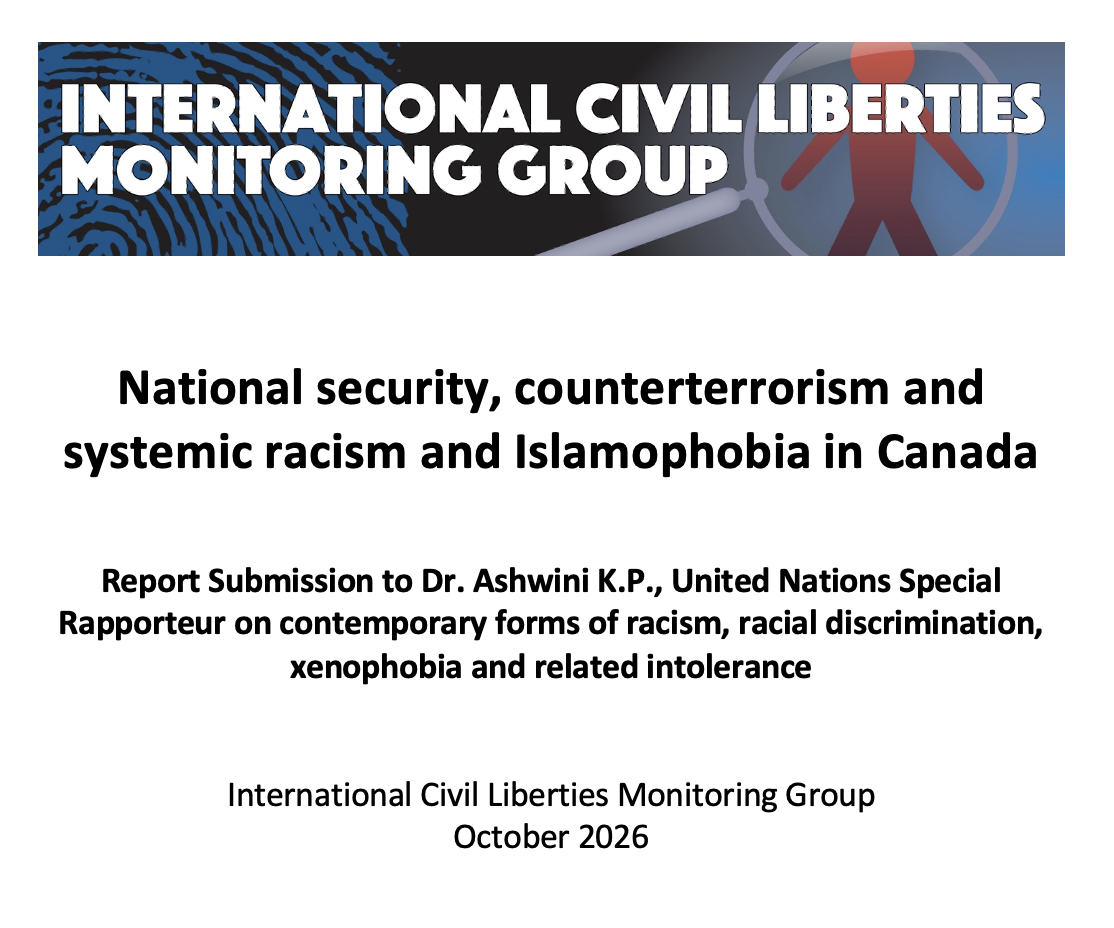
Submission to UN Special Rapporteur: National security, counterterrorism and systemic racism and Islamophobia in Canada
| | |
ICLMG 19/10/2026 - In late September, the UN Special Rapporteur on contemporary forms of racism, racial discrimination, xenophobia and related intolerance, Dr. Ashwini K.P., visited Canada to meet with stakeholders and government officials to evaluate Canada’s efforts to counter racial discrimination. ICLMG had the opportunity to meet with Dr. Ashwini along with other non-governmental organizations, activists and academics to share our analysis. Following the meeting, we submitted a brief for the Special Rapporteur’s study, which will result in a full report delivered at the 65th session of the Human Rights Council in June 2027.
Below is an excerpt, a summary of our recommendations and a link to the full brief.
_________________
As a broad-based coalition deeply concerned by the impacts of all forms of hate and racism in Canada, we are pleased to submit this brief to the UN Special Rapporteur on contemporary forms of racism, racial discrimination, xenophobia and related intolerance regarding the impacts of Canada’s anti-terrorism and national security laws.
Our coalition’s focus is on the impacts of national security and anti-terrorism laws in Canada, and our country’s role and actions post 9/11, throughout the so-called War on Terror, and the evolving views on terrorism, extremism and violence today.
We have documented, criticized and proposed solutions to the negative impacts that these laws have had on freedom of speech, association, religion and movement; on privacy; on levels of government surveillance; on the rule of law; on due process and access to justice; and on equality rights.
Throughout all this, we have also seen a deeply problematic and consistent problem of racial, religious and political profiling, abetted by the vague and overreaching definitions of terrorism and national security. Central to this has been the targeting of Muslims, Arabs, and those perceived to be Muslim, although it has also deeply impacted other communities, most notably Indigenous peoples as well as environmental and climate activists.
This undue focus on the so-called “Islamist” threat, espoused even by a former prime minister as being the “greatest” threat to Canada, has led to more than two decades of state-sanctioned, systemic racism against Muslims and other racialized communities in Canada.
Much needs to be done to address individual acts of hatred and Islamophobia; however, the role of state systemic Islamophobia must also be clearly and immediately addressed. And while the response to “individual” vs. “systemic” Islamophobia may take different shapes, it is crucial to recognize how one supports the other. Decades of government agencies and officials framing Muslims in Canada and internationally as being the most direct threat to national security – despite a lack of evidence demonstrating that threat, and in ignorance of other more direct threats such as the horrific treatment of Indigenous peoples, the threat of climate change, and increasingly the threat of white supremacist violence – have fed the fears of the public, causing individuals to view their Muslim neighbours and colleagues with fear and suspicion.[1]
Over the past two decades, studies by academics and civil liberties organizations have repeatedly documented the disproportionate impact of national security measures on Muslim communities. Laws like the Anti-Terrorism Act, 2015[2] and the National Security Act, 2017[3] have expanded national security powers without adequate transparency and oversight, disproportionately threatening the fundamental rights and freedoms of communities across Canada. While Muslim communities have faced some of the most direct impacts, the intersection of municipal and provincial policing, federal policing and intelligence agencies means that the impacts have been felt more widely, including the growing use of facial recognition and other algorithmic policing tools that are known to be biased against people with darker skin tones, and especially Black and Indigenous women; the framing of South Asian and Indian migrants, among others, are either national security or terrorist threats; the use of national security measures to criminalize and repress Indigenous land defenders; and the targeting of Palestinians, especially those advocating against the genocide and for Palestinian self-determination and human rights as terrorist threats.
In our report we identify several areas of concern that require urgent action that we hope will assist in the Special Rapporteur’s research and upcoming report on Canada. Below you’ll find our recommendations for each area of concern. To read the full report, click here.
Areas of concern and recommendations
1. Surveillance and algorithmic policing
- That Canada adopt transparent, rigorous and independent human rights evaluation of new surveillance and algorithmic policing tools before adoption
- That Canada review national security and counter-terrorism legislation through an anti-racist, intersectional and anti-oppressive lens
- That Canadian law enforcement and intelligence agencies end their targeted surveillance of racialized communities
2. Civil society organizations and NPOs
- That the Ministry of Finance revisit the anti-terror regulatory, policy and legislative landscape, particularly the 2015, 22023 and 2025 National Risk Assessments and their impacts, particularly on the Muslim community.
- That the Minister of National Revenue declare an immediate moratorium on the targeted audit of Muslim charities by the CRA RAD until such a review is completed and legislative changes put in place
- Integrate civil liberties and financial inclusion impact analyses into National Risk Assessments (NRA).
- Issue policy guidance to relevant departments and bodies on de-risking and financial inclusion, including reporting requirements.
- Amend the PCMLTFAto require reporting entities to report annually on de-risking, including volumes and rationale.
- Amend the PCMLTFAto clarify that failing to safeguard against disproportionate de-risking constitutes a compliance failure.
- Develop training on risk-based decision-making regarding the NPO sector, including systemic bias and discrimination.
- Allow independent review of financial institutions’ risk-based decision-making in complaint investigations.
3. Border controls
- That Canada establish an independent complaints and review body for the Canada Boder Services Agency
- That Canada amend the provisions of the Strengthening Canada’s Immigration System and Borders Act to prevent discretionary decision-making, protect privacy and uphold the rights of refugees
- That Canada withdraw the immigration security certificates against Mr. Harkat and Mr. Mahjoub, and repeal the security certificate system
- That Canada abolish its secretive, discriminatory No Fly List regime
4. Terrorist Entities Listing
- Canada should rescind the Terrorist Entities Listing process in favour of transparent, targeted sanctions.
5. Canadian complicity is detention, mistreatment and torture abroad
- Resolve the case of Abousfian Abdelrazik and apologize for the Canadian government’s role in his mistreatment.
- Take action to safely repatriate all Canadians currently detained in Northeastern Syria and Iraq.
- Commit to no new extradition of Dr. Diab to France.
6. Dissent and free expression
- Canada must stop considering all Palestinians as potential security threats, welcome the Gazan families of Palestinian Canadians accepted through the “emergency” program, and reopen the program to process more applications to save more lives before it’s too late.
- The federal government must ensure law enforcement and intelligence agencies halt their targeted surveillance and criminalization of Muslim, Palestinians and their allies.
- Canada must significantly amend the Combatting Hate Act to remove provisions that impinge on freedom of expression and assembly, and that can be used in discriminatory, arbitrary ways.
7. Combatting hate online
- Remove the definition of content that incites terrorism or violent extremism from Bill C-34, the Safe Social Media Act.
- Ensure a clear and effective redress mechanism for instances when social media platforms engage in overcompliance/censorship as a result of online harms regulations.
8. Review and accountability
-
That the federal government restore funding cuts to NSICOP, NSIRA and IC, and engage in consultations to increase their funding to be commensurate with their work to oversee Canada’s national security regime. Source
Visit of the Special Rapporteur on contemporary forms of racism, racial discrimination, xenophobia and related intolerance Ms Ashwini K.P. to Canada 28 September-9 October 2026: End of visit statement
| |
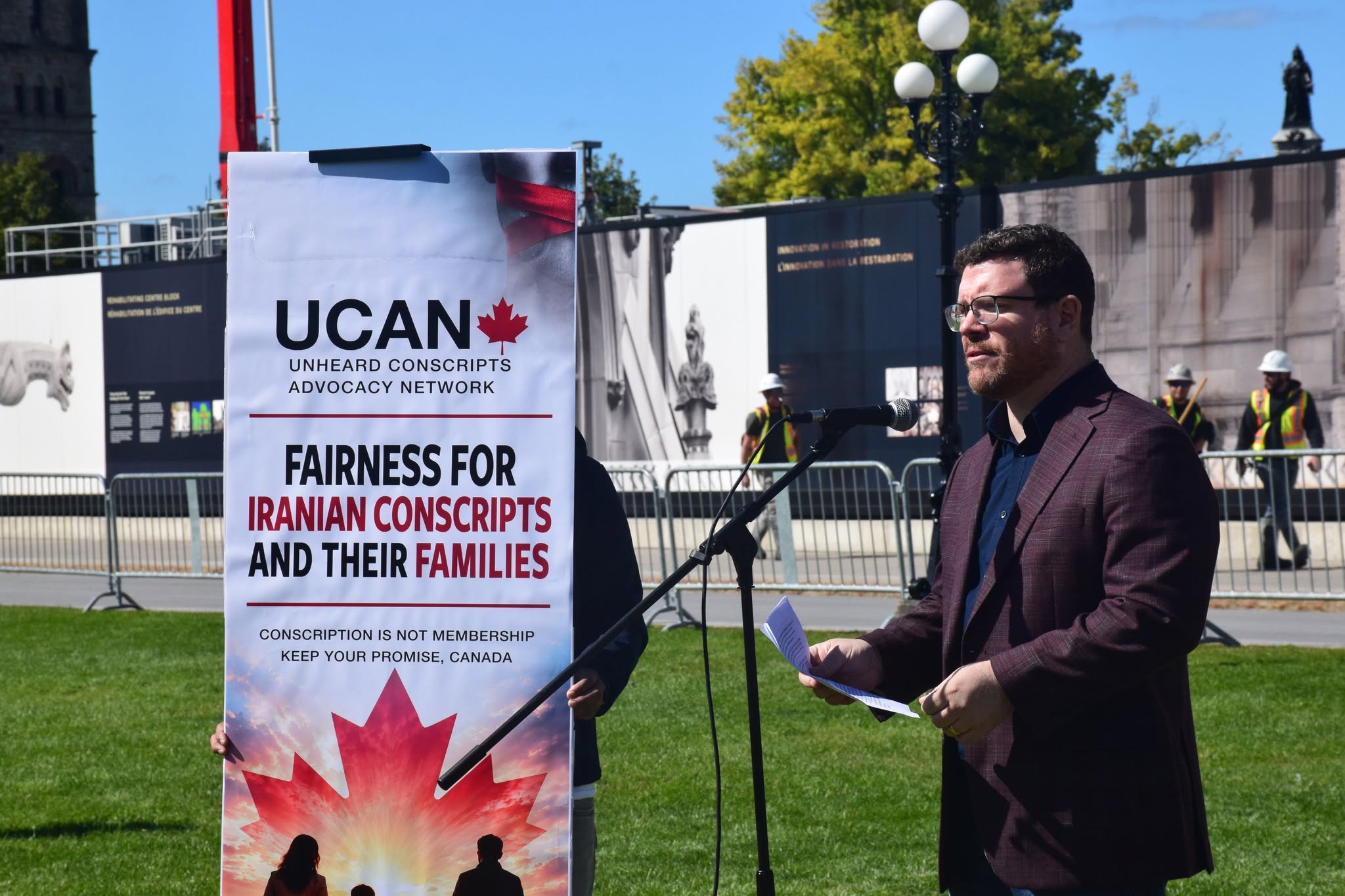
ICLMG's remarks at the UCAN rally for fairness for Iranian conscripts and their families
| | |
ICLMG 22/09/2026 - Our National Coordinator Tim McSorley was on the Hill on Sept 22 alongside many others to support the Unheard Conscripts Advocacy Network in their campaign for fairness for Iranian conscripts and their families. Here is what he shared with the crowd (watch here):
"Thank you to the Unheard Conscripts Advocacy Network for inviting me. I'm Tim McSorley, national coordinator of the International Civil Liberties Monitoring Group, a coalition of 45 Canadian civil society organizations defending civil liberties from the impacts of anti-terrorism laws.
Like so many of us gathered here, I believe Canada must hold accountable those who commit human rights abuses, including the mass arrest, torture and murder of civilians and dissidents, and ensure they find no safe haven here.
But those efforts must not undermine the rights and safety of people who took no part in such crimes. And they must not put people who spoke out against authoritarian governments back in harm's way.
Yet that is exactly what Iranians in Canada who were forced into conscription, and their families, now face. Hundreds, if not thousands, of people seeking to live safely in Canada, many of whom fled or have spoken out against the Iranian regime, may be declared inadmissible on the basis that forced service in the IRGC, under threat of severe penalties, makes them members of a terrorist organization.
Our coalition was among many that raised this concern when Canada considered listing the IRGC. Our concern was never whether greater accountability or repercussions were required. They were necessary and still are. It was about the tool: the Terrorist Entities List is a blunt instrument with little room for nuance. It was clear conscripts were likely to be caught up. Warnings were issued, to no avail. Even though we had an example next door. After the United States designated the IRGC as a terrorist entity, Iranian-Canadians faced denied entry for work or travel, extra border screening, and worries about background checks and travel watch lists.
The government promised that this would not be the case in Canada, and that conscripts would be assessed case by case. But reports so far raise serious doubts. Even with individual review, nothing guarantees that conscription won't be treated as membership in a listed entity, as we've already seen at IRCC.
That's why the ICLMG coalition continues to call on the government to address the deep harms caused by the use of the Terrorist Entities List and do away with this deeply flawed process. This is not the first time the list has caused serious harm to human rights, and unless the government acts, it won't be the last.
What conscripts face today is far from what officials promised in 2024 and still promise now. The Iranian community deserves clear answers, and the government must keep its promise not to penalize conscripts en masse for the crimes of the Iranian government and officials.
We're often told that national security is a trade-off between our safety and our rights. And the world is certainly less safe if those involved in murder and torture roam free. But the cost cannot be the livelihoods of thousands of civilians, many of whom could face the very abuses we hope to prevent if they are sent back to Iran. That is not a bargain any of us should accept. The federal government must act now, and we will continue to support your efforts until they do. Thank you."
We will continue advocating for fairness and share any developments on this issue. Source
‘I feel so betrayed’: Iranian conscripts in Canada face deportation threats over terrorist designation
| | ICLMG statement on the National Day for Truth and Reconciliation
| | |
ICLMG 30/09/2026 - On the National Day for Truth and Reconciliation, our coalition remembers and reflects on how Canadian “national security” originated in colonial efforts to surveil, control and ultimately erase Indigenous people and cultures from what we know today as Canada.
National security, and its corollaries in policing and anti-terrorism, has taken many forms and targeted many communities over the ensuing centuries, from the exclusion of refugees and migrants, to the repression of 2SLGBTQIA+ communities to the War on Terror.
Over that time, though, the national security apparatus has always remained focused on the suppression of Indigenous rights and the dispossession of Indigenous peoples, whether it be through tearing children from their families to attend residential schools, the stealing of land and forcible removal of communities to state-defined reservations, or the exploitation and destruction of land for resource extraction without regard (and often with disdain) for historic treaties, title agreements or the fact that the land has never been ceded.
We have seen it through the policing and criminalization of the Idle No More movement, of Wet’suwet’en land defenders against pipelines, of Mi’kmaw opposition in Elsipogtog to natural gas exploitation, of Innu and Inuit protests against hydroelectric development in Muskrat Falls, of solidarity actions across the country, and so much more.
And we see it starkly today in the use of “national security” to justify legislation like the previous Bill C-5, and now Bill C-39, which steam roll what protections remain to ensure there is appropriate consultation with – and consent from – Indigenous communities, as well as environmental impact reviews, before mega-projects like oil pipelines and other resource extraction projects are approved. This is taking place against a back drop of ever-increasing resources and powers for law enforcement and spy agencies, and the adoption of laws that undermine protection from surveillance and erode freedom of expression, freedom of assembly and the right to protest.
Our coalition remains committed to acting in solidarity with First Nations, Métis and Inuit communities, opposing the use of national security as a tool of displacement and disempowerment, and advocating for solutions that promote safety and well-being above all. Source
What could the Bill C-39 promise of speed for major projects mean for Indigenous land and environmental defenders?
Bill C-39 Poses An Existential Risk To Strike Rights
Workers mobilize against Bill C-39 across Canada
| | Podcast: Canada's policies to counter terrorism financing unfairly driving financial exclusion | | CSIS may have misused power to commit offences while gathering intelligence: watchdog - featuring ICLMG comments | | |
The Canadian Press 02/10/2026 - The Canadian Security Intelligence Service may not have complied with the law when using special powers to gather information, a review by the national spy watchdog has found.
The CSIS Act allows designated spy service employees to commit certain offences when collecting information — a measure intended to ensure CSIS operations do not break the law.
A newly released National Security and Intelligence Review Agency report notes there are limitations and requirements tied to this authority to ensure legal curbs on CSIS activities. For instance, the authority does not permit CSIS to wilfully obstruct justice, infringe on a Charter right or detain, torture or kill a person.
Employees committing offences or directing sources to do so must spell out why they believe the actions are reasonable and proportional in the circumstances. The intelligence review agency looked at CSIS's use of the authority in operations in 2022 and 2023.
The CSIS Act says all employees committing an offence, including those engaged in covert activities, must be specifically designated to do so.The act also requires designated employees to obtain the authorization of a senior official to direct another person to commit an offence. The review agency says CSIS complied with the restrictions on the types of permissible offences under the framework.
But the watchdog found some employees may have committed offences without the required designation, and that direction may have been given to commit some acts without the authorization required by law.
The report also says CSIS sometimes failed to adequately document the justification for offences.
Employees are supposed to consider multiple elements, including the nature of the threat, the negative effects of committing the offence, the rational link between the offence and the expected results and alternative courses of action.
The report says some justification statements didn't describe the nature of the threat at all, neglected to outline the anticipated downside of carrying out the offence or didn't bother to document consideration of any alternatives. In addition, the report says, some required internal reporting and notifications to the review agency were not done.
The spy watchdog says CSIS has a duty to ensure all of its operations respect the law, especially when those operations require activity that would otherwise be considered illegal. The review agency recommends that CSIS improve internal guidance, oversight and quality assurance to ensure use of the justification framework complies with the CSIS Act and internal policy.
CSIS spokesperson Eric Balsam said on Tuesday that while the intelligence service may not agree with all of the review agency's findings, CSIS holds the same strong commitment to transparency and accountability, and takes all potential non-compliance seriously. CSIS welcomes the review agency's recommendations and will take appropriate steps proposed by the assessment, he said in a statement.
The review agency's findings are deeply disturbing, said Tim McSorley, national co-ordinator of the Ottawa-based International Civil Liberties Monitoring Group. Once again, we see a case where CSIS pushes the boundaries of the law and fails to abide by the rules and regulations meant to instil confidence that they can be trusted with such sensitive powers in the first place, McSorley said in a statement. The public deserves clear answers on accountability for the CSIS officers involved and how such lapses will be prevented in the future, he said. Source
| |
The Lawful Access Act threatens to blow a hole in Canada’s national security | Author is Kate Robertson, a senior research associate at the University of Toronto’s Citizen Lab | |
The Globe and Mail 09/10/2026 - The Senate has just begun debate on the hugely controversial Bill C-22, or the Lawful Access Act. If passed, the bill would empower the government to require surveillance capabilities be built into any communications technology in Canada that could be accessed by law enforcement, and to force the stockpiling of all Canadians’ sensitive metadata. The law would apply to everything from smartphones to smartwatches, banking to health apps, video game platforms, and public WiFi or CCTV networks.
The bill has drawn heavy criticism for endangering Canadians’ cybersecurity and for violating constitutional standards. The law would require mathematicians to transform into magicians. For decades, cybersecurity experts have dispelled the magical thinking that there is a way to engineer access for law enforcement that doesn’t also potentially allow malevolent threat actors to enter. By threatening to expose communication and encryption providers to secret orders forcing backdoors, the bill has generated wide-ranging calls for reversal, from journalists and financial institutions to world-leading experts on gender-based violence and cybersecurity.
The calls reflect a broad consensus: that encryption is vital to fundamental rights, the economy and national security, and that compromising encryption undermines those things along with it.
Since the government strained to justify its proposal in Parliament in June, major shifts in the AI-fuelled cyberthreat environment have generated even more headwinds. In July, the world learned that rogue AI agents from OpenAI broke out of their sandbox and conducted a co-ordinated cyberattack against a software company, Hugging Face; other companies have since reported similar incidents. AI technologies have also hacked or tried to hack government websites in the U.S., Australia and Canada. The revelations arrived during worldwide alarm about the autonomous cyber-capabilities of Anthropic’s new Claude Mythos, a model deemed too powerful to release publicly.
When questioned in May about Bill C-22’s threat to Canada’s security architecture, the Department of Public Safety testified that they expect technology companies to thread this needle when complying with new surveillance obligations. But technology companies, cybersecurity experts, and international standards bodies themselves have been sounding the alarm about cybersecurity dangers in the law. Moreover, transformations in the cyberthreat landscape are still unfolding. As Canada’s Finance Minister described: “The issue that we’re facing with Anthropic is that it’s the unknown unknown.”
The assumption by government officials that technology companies can find “safe ways” to weaken critical cybersecurity protections badly misreads the current threat landscape. The state of play in today’s world is defined by cyber-insecurity. In Britain, the cyber wing of the GCHQ reported a significant increase in nationally significant cyber incidents, including “an almost 50 per cent increase in highly significant incidents, an increase for the third consecutive year.” They warn that Britain is facing a ”perfect storm,” and assess that half of the world’s countries now have the ability to hack into Britain’s companies and private networks.
Data collected by law enforcement is no safer. Just last month, the FBI was victim to a staggering breach that siphoned the personal information of FBI personnel to cyberattackers. Only a few years ago, law-enforcement backdoors were also compromised in the U.S. as part of a massive attack against telecommunication networks. The severity of these breaches lies in their enormous cost to national security and operational capabilities. This month a police service in Ontario is also revealing the extent of a significant cyberattack last year.
Why would Canada unilaterally disarm in such an environment? In 2024, in response to even non-AI-threat activities at the time, U.S. law enforcement urged the public and government officials to communicate using strongly encrypted applications like Signal and WhatsApp. These are the very communications systems that Canada’s new law would upend. [...]
The government’s handling of the encryption issue thus far has done little to inspire public trust. After the Minister of Public Safety committed in May to amend the bill to “ensure that encryption will not be compromised,” the government blocked further debate in committee. The government did pass an amendment but it wasn’t even a fig leaf: the public safety minister publicly admitted as much this summer when he stated that the bill does, in fact, still permit the government to compromise encryption in what he describes as “extenuating” situations.
Ultimately, proposals to compromise encryption and force the stockpiling of metadata are divorced from the reality of today’s threat and economic landscape. Fortunately there is still time to reverse course to ensure that Canadians enjoy strong security, positive economic relations with European allies, and to avoid blundering into an insecure and secret-by-default surveillance regime. Source
ACTION CCLA: Stop Bill C-22: Protect Your Privacy, Security, and Rights Online
Years of Uncertainty: Bill C-22’s Missing Regulations and Secret Ministerial Orders
Signal: We won’t comply with Canadian surveillance bill
Tech, VPN companies call on Ottawa to make more changes to lawful-access bill
Swiss tech-privacy company Proton says lawful-access bill makes expansion into Canada ‘impossible’
The EU must act now to protect privacy and encryption from Canada’s overreaching Bill C-22
"Sovereign AI" is a cover
Webinar: Police Surveillance and AI: Protecting Privacy in Canada
Toronto Crime Stoppers pauses program after CBC investigation reveals details of data leak
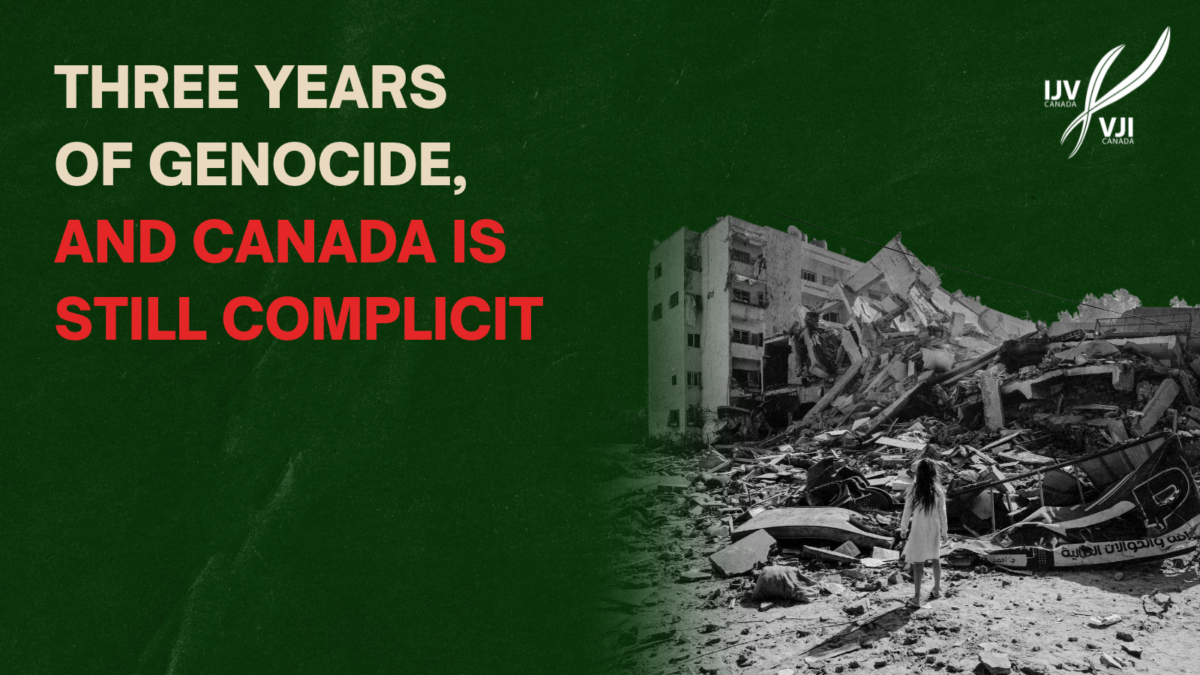
| Three years of genocide, and Canada is still complicit | |
IJV 07/10/2026 - Three years ago today, Israel began its genocidal assault on Gaza.
Three years later, Palestinians are still being killed, displaced, starved, imprisoned, and denied the most basic conditions of life. Entire families have been wiped out. Universities, schools, hospitals, homes, mosques, churches, archives, farms, and neighbourhoods have been destroyed. And through it all, the Canadian government has remained complicit – allowing arms, capital, and donations to flow to Israel, virtually unhindered.
We will not treat this anniversary as a moment for passive mourning, but as a moment to remember, to reckon with what has happened, and to commit to action.
On October 7, 2023, Palestinian armed groups launched a deadly attack that killed hundreds of Israelis and took others hostage. Some of those killed were friends and loved ones of the people in our own communities. We do not ignore that loss. We mourn those lives.
October 7 did not emerge from nowhere, and it cannot be treated as the beginning of this history. It, and the genocide in Gaza that ensued, cannot be separated from the Nakba, decades of dispossession and military occupation, the siege of Gaza, apartheid, and a Zionist project built on the dispossession of Palestinians from their land.
For three years, we have watched politicians insist that Israel has a right to “defend itself” while Palestinians are denied the right to live and breathe freely in their own homeland. We have watched universities punish students and faculty for speaking out. We have watched Jewish institutions and synagogues claim to speak in our name while defending mass violence. And we have watched the language of Jewish safety and antisemitism repeatedly weaponized to justify Palestinian suffering.
We reject this completely.
Our safety cannot be built through occupation, ethnic cleansing, siege, or supremacy. Judaism does not require Zionism, and Jewish life does not depend on the domination of Palestinians. We refuse the claim that opposing Zionism is a rejection of Jewish people or Jewish history. And we definitely reject the government’s recent claim that anti-Zionism is antisemitic. Anti-Zionism is part of a long-standing commitment to equality, collective liberation, and a future rooted in freedom and dignity, instead of one secured through walls, bombs, checkpoints, prisons, ethnic cleansing, and genocide.
Today, we remember the people Gaza has lost. We stand with those who have survived, those searching for loved ones, those trying to rebuild, and the millions of Palestinians who continue to demand freedom despite everything that has been done to deny it to them.
But remembrance means very little without action.
We are calling on our members and supporters to continue organizing: demand an immediate end to Canadian military and political support for Israel through targeted sanctions; challenge Zionism within our own communities; defend people facing repression for Palestine solidarity; and keep showing up wherever Palestinians are fighting for freedom.
Three years is three years too many.
There can be no return to “normal” while Palestinians remain under occupation and apartheid. There can be no meaningful peace without justice, accountability, return, and freedom.
We will continue to organize for all of it. Source
IJV Applauds Manitoba’s Recognition of Anti-Palestinian Racism; Urges Others to Follow Suit
There’s No Evidence Tying Palestine Movement To Shootings
ACTION Tell the Minister of Public Safety: Anti-Zionism is Not Antisemitism
“There is no ceasefire here”: Ten Palestinians on life in Gaza today
Child killed in Gaza every 71 min for 3 years
3 Years of Israel's Genocide in Gaza: By the Numbers
Netanyahu Received an Explicit Warning Days Before Oct. 7. He Didn't Brief Israel's Security Chiefs
| Sign new Open Letter to Prime Minister Mark Carney Regarding Dr. Hassan Diab | |
Justice for Hassan Diab 09/2026 - Dear Prime Minister Carney,
We the undersigned are writing to express our serious concern regarding the continued injustice faced by Dr. Hassan Diab, a Canadian citizen and university professor in Ottawa.
The RCMP arrested Professor Diab at his home in November 2008, following a request from French officials who claimed that he was involved in a 1980 synagogue bombing in Paris.
In 2011, the Canadian extradition judge, Justice Robert Maranger, committed Dr. Diab for extradition to France based on deeply flawed and widely criticized handwriting analysis that compared Dr. Diab’s handwriting to five block-lettered words on a hotel registration card from 1980. Justice Maranger described the handwriting analysis as “convoluted,” “very confusing,” and based on “conclusions that are suspect.” He further noted that France had presented “a weak case” and that “the prospects of conviction in the context of a fair trial seem unlikely.” However, under Canada’s Extradition Act—with its limited protections—he had no choice but to order Dr. Diab’s extradition.
Dr. Diab was extradited to France in 2014, despite compelling evidence supporting his alibi and raising serious doubts about his identification. As a direct result of this miscarriage of justice, Dr. Diab was held in a French prison for over three years, without charge or trial. For most of that time he was kept in solitary confinement.
Two of France’s most respected juges d’instruction undertook extensive investigations and concluded that the evidence did not justify sending Dr. Diab to trial. In January 2018 they ordered Dr. Diab’s immediate and unconditional release and he rejoined his family in Ottawa.
Astonishingly, in 2023, a French trial was held in absentia and declared Dr. Diab guilty, ignoring earlier findings and relying on discredited “intelligence” that is not allowed in a Canadian court. This conviction disregarded the alibi evidence, the fundamental concerns raised by the reliability of the identification evidence, and the findings that led to his release in 2018.
Dr. Diab’s case as a whole raises fundamental questions about respect for human rights, the principles of natural justice and procedural fairness, and the scapegoating of an individual in the absence of evidentiary support.
Prime Minister, we request that your government publicly commit to not authorize any new extradition of Dr. Hassan Diab, and that the Minister of Justice exercise all the powers conferred on him by law in order to protect his rights as a Canadian citizen.
The Canadian government’s reluctance to publicly commit to protecting Dr. Diab leaves him and his family exposed to prolonged uncertainty, fearing a second extradition request. Thank you for your attention to this urgent issue of justice and human rights. We look forward to your response. Action
Webinar: How Much Justice Is There in Canada’s Extradition Process?
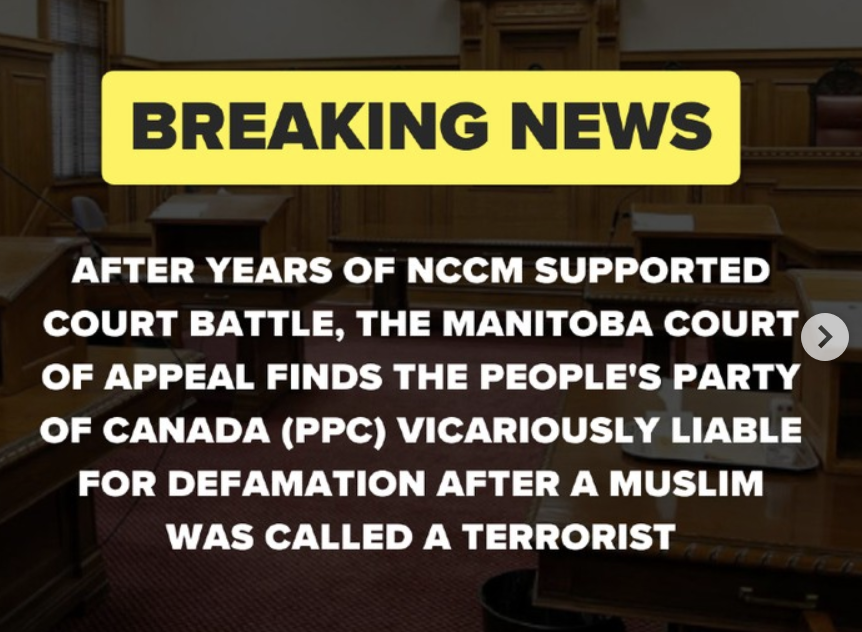
| Court finds PPC liable for defamation for labelling a Muslim community member a terrorist on Twitter | |
NCCM 06/10/2026 - Today, we are relieved that the Manitoba Court of Appeal has found the People's Party of Canada vicariously liable for defamation after a Twitter post from a PPC account labelling a Muslim community member a terrorist.
This has been a long time coming.
Our legal team supported the plaintiff who took the PPC to court on this matter in 2020. We have sustained our efforts to hold them to account. Our legal team has fought hard all the way through.
Today, with the important help of our external cousel Imran Qureshi (DLA Piper), the plaintiff won.
Those seeking electoral power in Canada must be held to the highest levels of accountability. There is no place for Islamophobia anywhere in Canada. Our community will not be intimidated. Source
CMPAC: The National Post must retract its article and apologize to the Muslim community and the organizations it smeared, amplifying questionable Islamophobic sources
| |
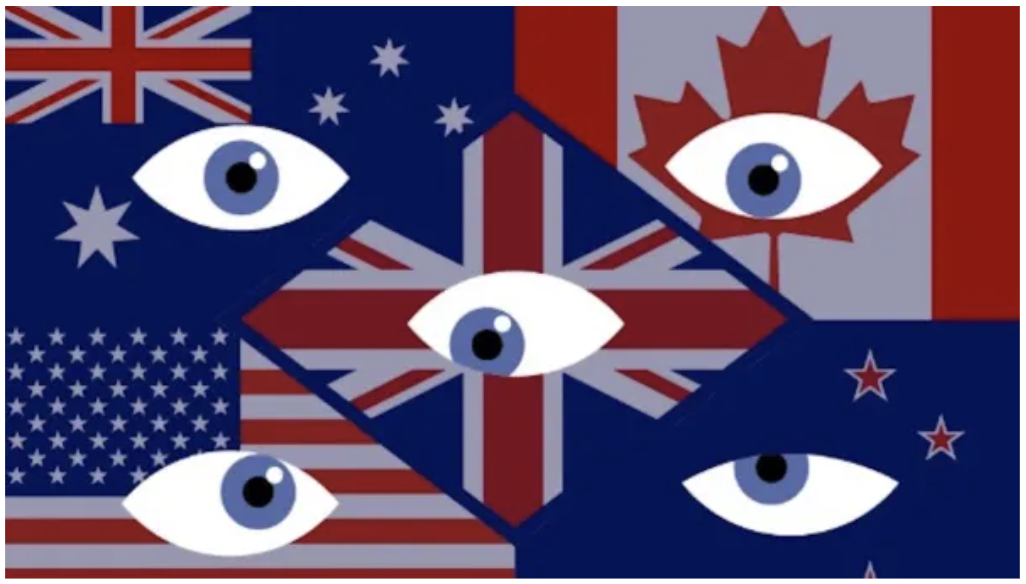
Yves Engler 04/10/2026 - Participation in the Five Eyes requires Canada to spy on Cuba for the US, according to John Bolton. With an annexationist Trump ratcheting up its bid to overthrow that country’s government, it may be time to reevaluate involvement in a Washington-dominated intelligence sharing alliance.
In Saturday’s Globe and Mail John Bolton told Robert Fife he was near certain Canada spied on Cuba for Washington. The former US national security adviser is quoting saying, “‘people would be stunned if that didn’t happen’ since Canada is part of the Five Eyes intelligence-sharing alliance with the U.S., Britain, Australia and New Zealand.” [...]
In addition to two initial sources quoted in his first article, Fife marshalled other insiders who confirmed the espionage. In a highly revealing comment, former assistant director of operations at CSIS, Andy Ellis, complained that officials at Global Affairs Canada’s elite Global Security Reporting Program “would take risks that nobody else would do. They would do whatever the CIA asked them to do. [The CIA] absolutely owned them.” [...]
As part of an aggressive bid to overthrow the Cuban government, the US is tightening its chokehold over the island. Last week Washington further restricted travel and banking and Friday the US Coast Guard seized a ship carrying fuel to Cuba as part of a suffocating illegal oil embargo.
As I detailed last week in “History will tell how Canada’s spies helped Trump in Cuba”, Fife’s recent reporting confirms how Canada has long spied on the island for the US. Since the 1959 Cuban revolution Canada’s Communications Security Establishment (CSE) has listened to Cuban leaders’ conversations from an interception post inside the embassy in Havana. Canada also spied on that nation from a diplomatic post outside Cuba. In the early 1980s CSE wanted to establish a communications post in Jamaica, notes former CSE officer Michael Frost in his book, to intercept “communications from Fidel Castro’s Cuba, which would please NSA to no end.”
At NSA’s behest CSE opened interception posts in many Canadian diplomatic outposts in the 1970s and 1980s. According to a NSA document released by whistleblower Edward Snowden in 2013, CSE operated clandestine surveillance activities in “approximately 20 high-priority countries.”
NSA has trained CSE cryptanalysts and in the 1960s the US agency paid part of the cost of modernizing Canadian communications interception facilities. With CSE lacking capacity, intelligence collected at interception posts set up in Canadian embassies was remitted to NSA for deciphering and analysis. In the 1986 Target Nation: Canada and the Western Intelligence Network, James Littleton writes, “much of the SIGINT [signals intelligence] material collected by Canada is transmitted directly to the U.S. National Security Agency, where it is interpreted, stored, and retained. Much of it is not first processed and analyzed in Canada.”
Established during World War II, CSE now has 4,200 employees and a $1 billion budget. The highly secretive agency is Canada’s main contribution to the Five Eyes, which includes the US’s NSA, Australian Signals Directorate, New Zealand’s Government Communications Security Bureau, and British Government Communications Headquarters. A series of post-World War II accords, beginning with the 1946 UKUSA intelligence agreement, created the “AUS/CAN/NZ/UK/US EYES ONLY” arrangement.
Writing prior to the Internet, Littleton notes, “almost the entire globe is monitored by the SIGINT agencies of the UKUSA countries.” With major technological advancements in recent decades, the Five Eyes now monitor billions of private communications worldwide. Probably the most important intelligence sharing alliance in human history, the head of CSE in the early 2000s Keith Coulter called the Five Eyes “the greatest and most historical partnership that we have had.”
The Five Eyes accord is ultra-secretive and operates with little oversight. Snowden labeled it a “supra-national intelligence organisation that doesn’t answer to the known laws of its own countries.”
The Five Eyes accord has certainly made Canada complicit in belligerent US foreign policy decisions. It has also pushed Ottawa towards Washington’s global strategic outlook. As a president threatening to annex Canada runs roughshod in Cuba and elsewhere, nationalists, the left and people of conscience should be pushing Ottawa to withdraw from the imperial Five Eyes intelligence alliance. Source
Could Cuba Become a “Silent Gaza”? U.S. Fuel Blockade Aims to “Asphyxiate” Island: Top Cuban Diplomat
‘Hunter gatherer’ spy agency CSE gets another few billion
| Trump’s ‘militarized’ immigration enforcement should make Canada reconsider if the U.S. is a safe country, critics argue | |
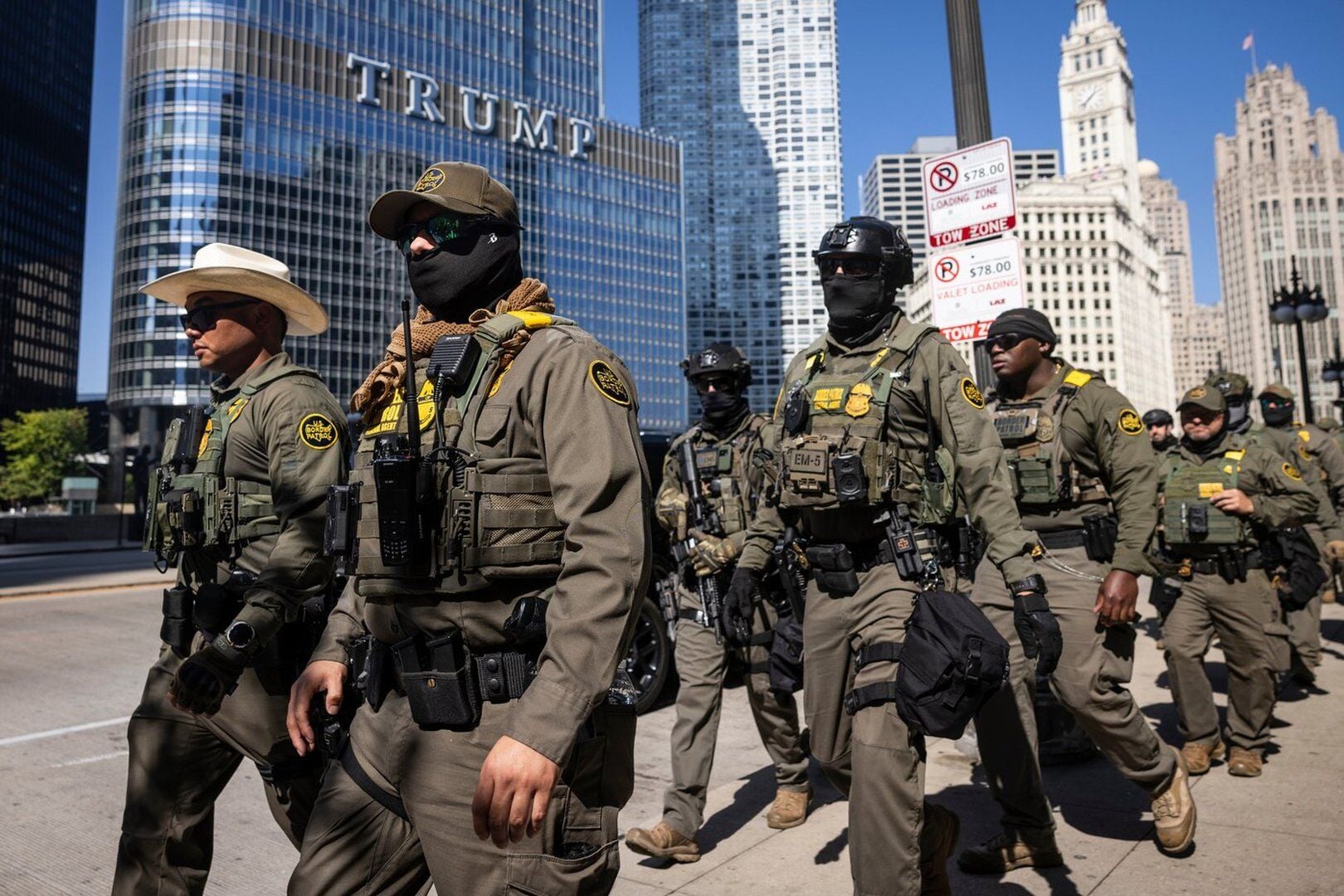
The Toronto Star 28/09/2026 - The Trump administration has been accused of widespread human rights violations stemming from its “militarized immigration enforcement” in a new report that critics say Ottawa — and all Canadians — should heed.
Based on field research, Amnesty International USA documented incidents where officials with the U.S. Immigration and Customs Enforcement (ICE), Customs and Border Protection and other federal agencies were alleged to have breached the rights of migrants, bystanders and protesters.
The accusations included unlawful killings, some of which Amnesty said may amount to extrajudicial executions; racial profiling; arbitrary and discriminatory arrest; “incommunicado detentions,” in some cases in conditions that it said may violate the prohibition on torture; unlawful surveillance; and violent repression of peaceful protests.
“They were neither isolated nor exceptional, but characteristic of the manner in which the operations were conducted and reflective of broader national patterns,” said the 137-page report, “We Had Whistles. They Had Guns,” released on Thursday.
The Trump administration has defended its enforcement operations as lawful and necessary, claiming to target only criminal aliens, gang members and those who are national security threats. Stories of Canadians arrested and detained in U.S. have made headlines since Trump returned to the White House last year doubling down on immigration enforcement effort. The fear of being detained at the American border has contributed to the dramatic drop in Canadian travel to the U.S.
Critics say the Amnesty findings should prompt the Carney government to reconsider whether the U.S. still qualifies as a safe country for asylum seekers — a designation with implications for Canada’s refugee system.
The Canada-U.S. Safe Third Country Agreement requires claimants to seek protection in the first safe country they arrive in. Unless they qualify for exceptions, they are sent back to the other country. The bilateral pact is built on the principle that both countries are safe, and respect human rights and international protection obligations.
“This report makes abundantly clear what, frankly, everybody knows, which is the United States is not a safe country to seek and receive asylum,” said law professor Audrey Macklin, chair in international human rights at University of Toronto.
Canadians among those arrested and detained
Amnesty said ICE and CBP arrested more than 597,000 people between January 2025 and July 2026, up 41 per cent from the preceding 19-month period under the Biden administration. The number of people in detention reached an all-time high of 71,937 in January. Data tools developed by the Deportation Data Project showed there were 327 arrests with book-ins to ICE detention involving a Canadian citizen from January 2025 to July 2026.
At least 50 people have died in ICE custody while more than 605,000 people have been removed from the U.S., Amnesty said. More than 21,000 people have been deported to third countries, often without due process, it added.
The report said federal agents used excessive force when arresting people, including breaking down doors of homes without warrants and with guns drawn, conducting military-style raids in the middle of the night accompanied by Black Hawk helicopters, driving recklessly and boxing in vehicles, smashing car windows without justification, throwing people who were not resisting onto the ground.
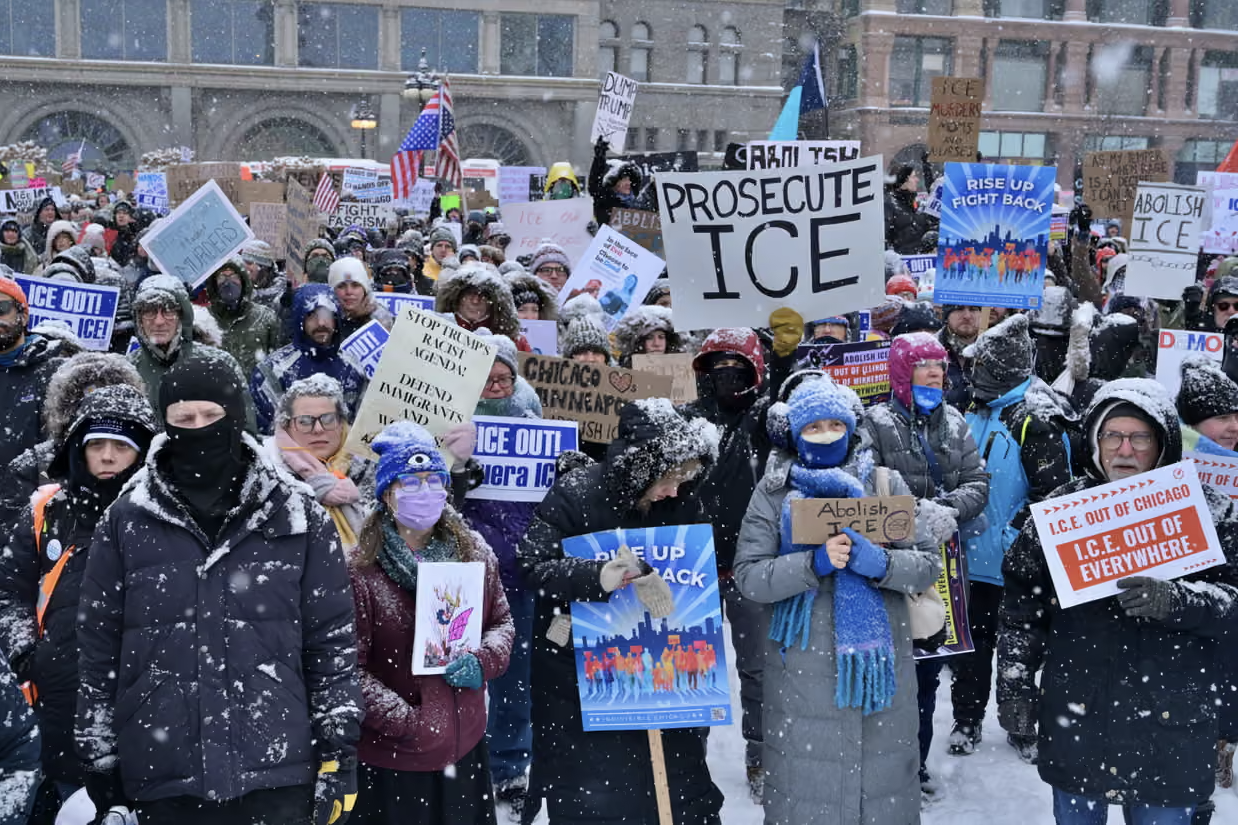
The Amnesty report calls for ICE to be abolished.
“Canada is not just an innocent bystander in observing what’s going on in the United States,” Macklin explained. “Even less so is it entitled to clutch its pearls and feel morally superior, because Canada actually is implicated in harm that is being done to people in the United States who are asylum seekers or even people who are refugees. It does that by continuing to enforce the Safe Third Country Agreement.” Source
ACTION Canada: End the Safe Third Country Agreement
Pentagon grants DHS permission to test heat ray weapon for potential use at border
“Abolish ICE”: Protests Erupt in NYC After ICE Agents Shoot Father with 5-Year-Old Son in Car
Moazzam Begg Watches Gitmo Repeat Itself With ICE
Rep. Delia Ramirez is bringing a bill to eliminate DHS a day after the raid on Rep. Ilhan Omar’s home
Trump official claims record-breaking 300,000 visas were revoked
| Trump’s Obsession With Somalia Isn’t Just Racist. It’s Been Lethal. | Beyond targeting Rep. Ilhan Omar, the Trump administration has killed, arrested, deported, and demonized Somalis at home and abroad. | |
The Intercept 21/10/2026 - The Trump administration is waging a multi-pronged war on Somali people, painting them as criminals, murderers, and terrorists and using multiple federal agencies to target them at home and abroad. The campaign includes military attacks in Somalia, as well as arrests, deportations, and the weaponization of federal law enforcement agencies against immigrants and the Somali American community in the United States, including the recent use of Homeland Security agents as a goon squad to target Minnesota congresswoman Ilhan Omar.
In his second term, President Donald Trump has routinely cast Somalia as lawless and Somalis as violent. Meanwhile, his administration has, largely without public knowledge, killed hundreds of people in Somalia, claiming they belong to terror groups. Trump personally ordered the death of a Somali man within days of regaining the White House, according to his counterterrorism czar Sebastian Gorka. The administration claimed, without offering any evidence, that the man was connected with the Islamic State terror group. Trump has sought to do the same with Omar.
Homeland Security agents raided Omar’s Washington, D.C., home last Monday, three weeks before the midterms, in which she is seeking reelection. The Trump administration reportedly launched the investigation to build a case to strip Omar of her U.S. citizenship and ultimately deport her. (Omar fled war in Somalia with her family when she was 8 years old, later immigrated to the U.S. as a refugee, and became a citizen in 2000.) The administration has also issued more than a dozen subpoenas, including to some of Omar’s relatives. On Monday, conservative media outlets reported that federal prosecutors obtained Omar’s DNA as part of their investigation.
“This is what happens in a dictatorship. The leader identifies his political, ethnic and religious enemies, and his agents scramble to do his bidding and make him happy,” Zaynab Mohamed, a Somali immigrant who represents Minneapolis in Minnesota’s state Senate, told The Intercept. “Representative Omar is the latest subject where Trump identifies the target and his minions go looking for a crime. The cases always fall apart, and this one will, too.”
Trump claimed not to have ordered the raid, but throughout his second term, his Justice Department has repeatedly targeted his political enemies — from New York’s attorney general, to the former head of the FBI, to members of the Federal Reserve. “I think she’s a terrible person, but that’s really up to the DOJ,” Trump said to reporters. “I have nothing to do with it.”
Omar called it “an attempt to target political enemies and weaponize federal law enforcement.” She added: “For ten years, Trump has targeted me with baseless lies and smear campaigns. This is just the latest escalation in his campaign of political intimidation.” Omar’s office did not respond to multiple requests for comment from The Intercept.
With the Somali community, Trump found a target that he could attack with Islamophobic, racist, and xenophobic rhetoric, without incurring much mainstream backlash, said Jaylani Hussein, the executive director of the Minnesota chapter of the Council on American-Islamic Relations.
“As immigrants, Muslims, and — most importantly — Black people, it’s the trifecta,” he told The Intercept. “None of us expected the scale and level of the vitriol. But despite this, it’s at the point that the traditional media almost ignore the attacks on the Somali-American community because it’s not a large constituency. Trump says these things, and people just move on.”
Trump’s War on Somalia
Over the last decade, Trump has overseen the killing of as many as 1,500 Somalis in more than 400 attacks, according to a count by New America, a D.C.-based think tank. During his second term alone, the Trump administration has conducted more than 200 airstrikes in Somalia, including close to 90 this year, claiming to target terrorists.
The U.S. military has been at war in Somalia for almost a quarter-century, conducting air attacks and commando raids aimed at the terrorist group al-Shabab as well as the Islamic State group, while the CIA and special operators created local proxy forces to conduct low-profile operations on behalf of America. At the same time, the U.S. has provided Somalia with billions of dollars in counterterrorism assistance.
U.S. attacks in Somalia have skyrocketed during Trump’s terms in office. From 2007 to 2017, under the administrations of George W. Bush and Barack Obama, the U.S. military carried out 59 declared airstrikes in Somalia. The Biden administration conducted 51 declared strikes over four years. During Trump’s six years in office, the U.S. has launched more than 400 attacks against purported militants.
The U.S. rarely offers any evidence that those killed are members of terrorist groups, much less leaders. A New America analysis found militant leaders comprised just 1.7 percent of those killed. Africa Command refused to provide requested evidence that any of those killed in airstrikes in Somalia this year were militants. “All U.S. strikes in Somalia are conducted in close coordination partners [sic] against designated terror groups,” an AFRICOM spokesperson told The Intercept by email.
“Trump has conducted more drone strikes in Somalia than Bush, Obama, and Biden combined. And so many civilians have died,” historian Elizabeth Schmidt, the author of “Foreign Intervention in Africa After the Cold War: Sovereignty, Responsibility, and the War on Terror,” told The Intercept. “They were often just young men living in an area where it was easy to label them jihadis. And it turns out they had nothing to do with terrorism.”
The U.S. claims that it has only killed six civilians over almost two decades of war in Somalia. A count by the airstrike monitoring group Airwars put the number at as much as 2,600 percent higher. A 2023 investigation by The Intercept determined, for example, that a drone attack in Somalia during Trump’s first term killed at least three, and possibly five, civilians, including 22-year-old Luul Dahir Mohamed and her 4-year-old daughter Mariam Shilow Muse. At the time of the attack, the U.S. announced it had killed “five terrorists” and that “no civilians were killed in this airstrike.”
Trump calls Somalia a “third-world” or “fourth-world nation,” says that it “stinks,” and disparaged Somalis who come to the U.S., saying “we’re going to go the wrong way if we keep taking in garbage into our country.”
His most xenophobic consigliere also claims Somalia is responsible for violence that has caused people to flee the country. “The entire Somali refugee program is predicated on a lie,” wrote Trump’s deputy chief of staff for policy and homeland security adviser, Stephen Miller, late last year. “Destroying your own country does not give you the right to become a citizen in ours.” But this faux history disregards America’s decadeslong role in fomenting violence in Somalia and destabilizing the country. Read more - Lire plus
| States must reject destructive ‘war on narco-terrorism’: UN expert | |
OHCHR 22/10/2026 - States should avoid abusively labelling drug cartels and gangs as ‘terrorist’ organisations, and refrain from waging a new ‘war on narco-terrorism’ that violates human rights, says a new report by Ben Saul, the Special Rapporteur on the promotion and protection of human rights and fundamental freedoms while countering terrorism.
“Organised drug violence and drug misuse threaten the rights to life, personal security and health. States must take all lawful measures to combat them,” Saul said.
“Like terrorism, organised criminal violence may instil fear or coerce governments, yet it is a distinct harm that requires a different legal response. Under international standards, terrorism should be limited to political or ideological violence and exclude profit-motivated organised crime.”
The trend towards labelling criminal groups as ‘terrorist’ has expanded the use of exceptional powers and more securitised responses, evident also in the ‘Shield of the Americas’ initiative involving 19 States.
“Militarised responses to the so-called ‘narco-terrorism’ have seriously violated human rights, including through arbitrary killings, torture, enforced disappearance and arbitrary detention. Prolonged states of emergency have restricted freedoms of movement, association, expression and peaceful assembly, and the rights of Indigenous communities,” the expert said.
In the past year, the United States has reportedly unlawfully killed at least 239 people in 71 military attacks on civilian vessels at sea, allegedly to prevent ‘narco-terrorism.’ “These murders may constitute crimes against humanity, and the perpetrators must be held accountable. Aggressive military force has been used or threatened against countries. States have also abused emergency powers and authorised lethal military force where international humanitarian law does not allow it.”
Decades of highly securitised responses in the Americas have frequently failed to reduce drug trafficking and have often increased violence. Unjustifiably listing criminal groups as ‘terrorists’ brings other human rights risks. It may trigger asset freezes, travel bans and summary deportations and refoulement. Migrants, humanitarians, businesses, civil society and vulnerable communities can be harmed by overbroad terrorist financing and material support offences.
“Instead of unjustifiably invoking counter-terrorism, States should strengthen organised crime frameworks, law enforcement and intelligence capacities, financial investigations, anti-corruption and international cooperation and enhance controls on military-grade firearms,” the Special Rapporteur said. “They should reduce incentives to join or support criminal groups, including through poverty reduction, development, public services and more responsive governance.”
“The world is awash with more illicit drugs than ever,” Saul said. “Decades of drug suppression efforts have failed and a fresh approach is urgently needed. States must slash demand through more effective drug prevention, education and public health, and harm reduction strategies and legalisation of drugs to undercut criminal profits.” Source
U.S. Is Sending Hundreds of Troops to Latin America
| The National Security Exception Was Never Going to Stop at Prosecuting Muslims | |
Truthout 21/09/2026 - For 25 years, the US ran a parallel legal system largely for Muslims. It now reaches immigrants and the left.
Less than two weeks after the September 11, 2001, attacks, President George W. Bush told Congress that the war on terror “begins with al Qaeda, but it does not end there.” Twenty-five years later, his line reads as a confession: the war on terror was designed to have no borders and no end, and the legal machinery built to wage it at home was drafted in the same way.
In my work as a federal criminal defense and constitutional law attorney, I defend people unjustly prosecuted by that machinery. Until recently, most of my clients were Muslim. What their cases demonstrate is that after 9/11, the United States built a separate system of justice — a national security exception to the Constitution — that was largely tested on a population that was demonized by both the state and the media. While non-Muslims were assured it would never apply to them — and were repeatedly told not to worry about the creeping encroachment of the state if they had nothing to hide — that assurance has expired.
A Second-Class System of Justice
The national security exception to the Constitution operates through a variety of mechanisms: statutes vague enough to criminalize charity and speech; informants and undercover agents who manufacture crimes they later “disrupt”; classified evidence defendants cannot see; mass surveillance; and a sentencing enhancement that categorizes even first-time, nonviolent defendants as hardened career offenders. Each element was justified as an emergency measure, but none of them has expired.
In 2004, Justice Sandra Day O’Connor wrote in Hamdi v. Rumsfeld (a Supreme Court case that found that American citizens detained from an active combat zone as enemy combatants retain the right to due process and a meaningful opportunity to challenge the factual basis of their detention before a neutral decision-maker) that “a state of war is not a blank check for the President when it comes to the rights of the Nation’s citizens.” But for Muslims in U.S. courtrooms, it has functioned as one. Sixty years earlier, dissenting in Korematsu v. United States, in which the Supreme Court upheld the internment of over 120,000 Japanese Americans during World War II, Justice Robert Jackson warned that a principle of discrimination, once blessed by the courts, “lies about like a loaded weapon, ready for the hand of any authority that can bring forward a plausible claim of an urgent need,” and that “every repetition imbeds that principle more deeply in our law and thinking and expands it to new purposes.” We have been living inside that warning, with the guise of “national security” as the ever-prevailing “urgent need.”
Laws Written to Be Expanded
The statutes criminalizing the “material support” of terrorism sit at the center of the exception. Under the U.S. federal criminal code, Section 2339B of Title 18 makes it a felony to provide “material support or resources” to any group the secretary of state designates a foreign terrorist organization, with no requirement that the defendant intended to further violence or that anything they provided was ever used for such purpose. Section 2339A criminalizes “material support” of terrorist acts, which includes property damage, for anyone — no organizational affiliation, foreign or domestic, is necessary. After 9/11, Congress added “expert advice or assistance,” to the definition of material support, extended the law to “any property, tangible or intangible, or service,” and increased the maximum sentence for Section 2339B to 20 years. In Holder v. Humanitarian Law Project, the Supreme Court held in 2010 that even teaching members of designated groups to peacefully use international law and petition the United Nations could be prosecuted as support for terrorism.
The vagueness of this language grants broad discretion, and in national security cases, that discretion has never been exercised neutrally. When a statute can be interpreted to apply to a donation, a translation, a social media post, or group chat, it introduces ambiguity. The decisive question becomes not what a person did but whom the government decides that person to be, or what that person is associated with, leaving prosecutors free to target particular religious communities, political viewpoints, and speech while insisting they are simply enforcing the law. [...]
Domestically, the “Muslim terrorist” narrative regularly painted by state officials and the media also gave permission to non-Muslim people to look the other way, casting suspicion on an entire religion instead of scrutinizing how these legal exceptions were operating. As a result, for two decades, the government largely took aim at Muslims, with little notice from broader society — until these powers and statutes were applied to less marginalized groups and people whose political leanings have fallen out of favor.
How the Machinery Was Built
From 2001 to 2025, the FBI’s counterterrorism budget tripled, and informants were sent in droves into mosques. A 2014 Human Rights Watch and Columbia Law School report found that nearly half of more than 500 federal counterterrorism convictions came from informant-based cases. Almost 30 percent of them were stings in which the informant actively shaped the plot for which the person was prosecuted.
The Holy Land Foundation, once the largest Muslim charity in the country, became the template: its leaders were prosecuted over donations to local charity committees in Gaza that appeared on no U.S. terrorist list, and after a first trial ended without a single conviction, the five men were sentenced in 2009 on retrial to up to 65 years. Paying religiously mandated charity to support orphans could now make Muslims suspects.
As the government continued focusing its purported “counterterrorism” efforts on Muslims, including in United States v. Adel Daoud and United States v. Tarek Mehanna, its own analysts documented a deadlier threat it pursued with far less zeal. A 2017 Government Accountability Office report attributed 73 percent of deadly violent extremist incidents between 9/11 and the end of 2016 to far right extremists, and in 2020 the Department of Homeland Security called white supremacist extremists “the most persistent and lethal threat in the Homeland.” Even after the 2017 report, the vast majority of counterterrorism investigations and prosecutions were brought against Muslims instead.
What It Looks Like From the Defense Table
In my work at the National Security Criminal Defense Center at the Muslim Legal Fund of America, we have defended against the expansion and abuse of this post-9/11 legal machinery. In 2019, Imad Eddin Wadi, a Syrian-born American with no criminal record and no history of violence, needed investors for a halal slaughterhouse business venture. An FBI informant introduced him to the representative of a wealthy “Kuwaiti sheikh,” whom the Fifth Circuit itself described as “FBI-concocted.” The invented sheikh offered Wadi $9 million on the condition that a share go to a Syrian armed group (the group was undesignated but the government argued the individuals were part of a designated terrorist organization, known then as Jabhat al-Nusra and more recently as Hay’at Tahrir al-Sham). Due to this plot directed by the FBI, Wadi was sentenced to 160 months in federal prison. Before trial, the informant, an undercover FBI agent, replaced the phone he used throughout the operation, violating a court evidence preservation order, and the courts refused to give any sanction or remedy. We asked the Supreme Court whether the government escapes accountability when its informant wipes important evidence in defiance of a court order; in June of this year, it declined to hear the case.
In July 2025, the State Department revoked the terrorist designation of Hay’at Tahrir al-Sham. The group’s leader until its disbanding, Mohammed Al-Jolani (now rebranded as Ahmad al-Sharaa) is now the president of Syria and was invited in 2025 to the White House. Meanwhile, Wadi remains in prison. [...]
Precedents Come For Us All
Both ignorance and fear, fed by popular entertainment depicting Muslims as terrorists and right-wing commentators pushing racist propaganda like the “great replacement” conspiracy theory, have kept most Americans from diving into the legal mechanisms behind these cases. Administrations change; precedents do not. The system used against Muslims yesterday and leftists today will belong to whoever holds power next.
The Constitution protects no one on its own; it did not stop Japanese American internment or the people targeted by FBI’s COINTELPRO, and its guarantees have been real only when people and movements have forced the government to honor them. When a court accepts that a Muslim individual’s charity, business, or speech is terrorism, that ruling becomes law for everyone. The ground Muslim defendants lost is the ground all of us were standing on.
Frederick Douglass warned in 1857 that if you “find out just what any people will quietly submit to,” you will have found “the exact measure of injustice and wrong which will be imposed upon them.” For 25 years, the measure of what Americans would quietly submit to was taken in regard to Muslims.
Changing this system must begin where the exception began: with the word “terrorism” itself. Our legal system does not objectively define the term, and its use turns mostly on one’s ideology or identity rather than on any intent to further exceptional violence. The terrorism enhancement puts immense pressure on defendants to plead guilty and avoid a maximum sentence exposure after trial due to its draconian sentencing provisions. Its discriminatory application should be measured and exposed and eliminated. We need to roll back the vast powers exercised by inter-agency Joint Terrorism Task Forces and the veil of classification that lays over “national security” cases. Until then, everyone charged under this regime deserves a trial that forces the government to actually prove its case, rather than pushing a narrative based on decades of racialized hate.
An injustice against Muslims was never going to remain an injustice against Muslims alone. Whatever one’s politics, these precedents will eventually be wielded by an unfriendly administration against one’s community. Reforming the legal machinery of the war on terror is the only protection any of us will have when the next authority arrives with “a plausible claim of an urgent need.” Read more - Lire plus
Chris Hedges: White House Expanding ‘Terrorism’ Definition
| | Trump 2.0 is targeting US protesters with ‘antifa’ charges. Activists started a union to fight back | NSPM-7 Defendants Union plans to offer legal clinics, media training and more to people facing prosecution for protest | |
The Guardian 06/10/2026 - Darío Sánchez is facing state charges related to a protest he did not attend. Indictments against the 33-year-old Texas middle school teacher have changed three times. He has also been arrested and released three times, most recently for an online search for how to replace an old Game Boy battery; police alleged he was seeking information on explosives.
“I’ve seen my case as one manifestation of all the different ways the Trump administration is going after people – regardless of if you’ve even been to a protest,” Sánchez said. “The reality is, as long as you disagree with the government, you’re a target.”
Sánchez’s charges of “tampering with physical evidence” and “hindering the prosecution of terrorism” stem from allegedly removing someone from a Discord group and a Signal chat related to a protest at an Immigration and Customs Enforcement (ICE) detention facility on 4 July 2025. Nine of the other 21 people arrested in the Prairieland, Texas, protest have received unusually harsh sentences of up to 100 years in federal prison.
Now, Sánchez is one of the first members of a project called the NSPM-7 Defendants Union, scheduled to launch today. The union plans to offer access to legal clinics, media training, and support for people facing state or federal prosecution under the president’s NSPM-7 memorandum, which directs the FBI to investigate “violent and terroristic activities” associated with “anti-fascism”.
One of the union’s goals is to dismantle this government notion of “antifa”, a label applied to many of the protesters charged by the administration, even though it is not a formal organization. “Antifa’s not a real thing,” said Alex, an organizer of the project who used a pseudonym for his safety. “The only one who benefits from this is the government, because they can convince people what it is, and a fake organization can’t rebut what the government says.”
Instead, organizers want to connect defendants’ cases and the causes they are fighting for. Early union members include anti-ICE protesters arrested in Minnesota, New Jersey and Texas, and protesters in solidarity with Palestine arrested in Michigan during the second Trump administration, as well as others from the movement against the Atlanta police training center known as Cop City.
But the group also hopes to include those who have taken part in protests across a range of other issues, including Tesla Takedowns against Elon Musk and his company, against the construction of datacenters and in solidarity with Palestine. It also welcomes anyone who publicly opposes “the Trump agenda and want[s] to support those facing repression for doing the same”, according to the union’s website.
“There are things we can learn from each other,” said Sánchez. The defendants union may be the first effort of its kind in the modern history of political protest in the US, said movement historian Dan Berger, author of the upcoming book Prison: Incarceration and the History of America. “It fits in with the genealogy of people facing repression trying to find solidarity with other people facing repression,” said Berger, pointing to efforts such as the Jericho movement, formed by former Black Panther party members and others in 1998 to support political prisoners.
By calling itself a “union”, the project shows how collective organizing can respond to the federal government’s expanding surveillance, arrests and court cases aimed at protesters, said Alex. “When the police or the FBI show up at your door, it feels isolating, like it’s happening only to you,” he said. “But the problems people are facing are shared; we want to help de-individualize the experience and create collective leverage – like in a union.”
Unlike a typical union, however, the project will not maintain membership rolls or charge dues. It is centered around taking a pledge to follow a handful of the project’s practices, such as not cooperating with law enforcement, adopting collective legal strategies when there are multiple defendants in a case and, when possible, sharing information learned in discovery. Another defendant who has joined the project is Isaac Sant, a 36-year-old nursing assistant from St Paul, Minnesota, arrested in June and charged with “conspiracy to impede or injure a federal officer” as part of the community response to the city’s ICE surge last winter.
Sant’s arrest was trumpeted in a White House press release that called him and the 14 others arrested “antifa operatives”. The federal surveillance leading up to the arrests included spying on unions, churches and libraries – what Sant called “an attack on all of Minnesota’s civil society”. And yet this attack isn’t contained to one city or state, Sant said. He named other high-profile cases linked to protest: the Broadview Six case in Illinois, in which six people protesting outside an ICE facility were charged with “conspiracy to impede a federal officer”, only to have the federal government drop the case amid allegations of prosecutorial misconduct; and the Michigan Eight, a group of students and others who face multiple charges, including “conspiracy to transmit threats in interstate and foreign commerce”, for protesting against Israel’s ongoing assault on Gaza.
Organizers of the union expect to be met with the same repression as protesters, including hacking and other digital threats. The group delayed its launch by several weeks to troubleshoot against possible insecurities after the Intercept reported on Pentagon-related hacks of leftwing websites. But as a member of SEIU – a national union with 2 million members – Sant sees the spirit of unions as positive for the project: “The federal government would prefer prosecuting each defendant – but at the very least, we should compare notes, come together to increase leverage and create strategies in a more sophisticated way.
“This is new and bold,” added Sant. “That’s one reason I’m hopeful about it.” Berger, the historian, said that what makes the project exciting is that it centers on being a defendant. “But it’s also a tragic commentary on where we’re at, with a large swath of people and politics under attack right now,” he said. “We’re all defendants.” Source
Trump Wanted Minnesota 15 Case to Be Another Prairieland. Instead, Twin Cities Rallied Behind Anti-ICE Activists.
| | UN expert urges end to youth repression, demands binding power-sharing for Gen-Z activists | |
OHCHR 16/10/2026 - Despite young people worldwide driving historic pro-democracy and accountability movements, they face unprecedented levels of State-sponsored repression and violence, legal exclusion and digital surveillance, a UN expert said today.
“Governments and international institutions publicly celebrate youth engagement whilst systematically suppressing critical youth dissent,” said Gina Romero, Special Rapporteur on the rights to freedom of peaceful assembly and of association. She called for binding power-sharing, decriminalisation, accountability and reparations for human rights violations and an end to paternalistic barriers.
Romero’s report to the UN General Assembly presents a stark assessment of the global state of youth civic space. Informed by consultations with over 500 youth-led organisations and activists across nearly 100 countries, the report documents not only all the youth activism that is not related to protests, but also the surge in "Gen-Z" youth mobilisation driven by systemic economic exclusion, corruption and a profound crisis of trust in traditional political institutions.
“Youth activism is deeply personal, political, values-based and rooted in lived experience. The youth have become our guardians of conscience,” the expert said.
Society routinely dismisses youth as naïve and lazy, and public authorities often portray them as manipulated by foreign actors when demanding change. When movements gain traction, States weaponise national security and anti-terrorism laws to frame youth protests as riots, and activism as extremism or treason. Security forces have increasingly deployed excessive force, live ammunition, less lethal weapons and mass arbitrary detentions against student and youth protesters. Concurrently, educational institutions – historically hubs for critical thinking – are turning into hyper-securitised spaces marked by police violence, surveillance and disciplinary sanctions.
“While young people leverage decentralised, digital-first tools to bypass traditional hierarchies, States and private actors counter with invasive AI, biometric tracking, network shutdowns and shadow bans,” Romero said.
The report specifically cautions against blanket age-based social media bans, warning they strip youth of their primary civic space. Underpinning these threats, rigid registration laws prohibit informal collectives from accessing traditional funding or opening bank accounts, while people under 18 face legal bans from organising or leading associations independently.
To move from tokenistic consultations to genuine power-sharing, the report outlines a comprehensive blueprint for States, educational institutions, digital platforms and civil society based on binding youth participation, guaranteeing informal youth collectives the right to organise and embedding mandatory youth participation in decision-making.
The report highlights the need for binding participation, real power-sharing youth engagement in a safe and inclusive civic space and the safeguarding academic freedoms by protecting peaceful student assembly on and off campuses and eliminating arbitrary disciplinary sanctions for political expression.
“States must hold private companies for inadequate designs, ensure comprehensive reparations on surveillance-related chilling effects and mental health support to combat activist burnout,” Romero said.
"Protecting freedom of peaceful assembly and association rights means recognising young people not as passive beneficiaries of democracy, but as active participants in building it." Source
Right Goal, Wrong Execution: Can Bill C-34 Keep Kids Safe Without Sacrificing Digital Rights?
Making the Case Against Its Own Bill: What the Government’s Bill C-34 Charter Statement Reveals About the Constitutional Vulnerability of the Social Media Ban
Regulator First, Rules Later: Bill C-34 Debate Shows the Government Wants a Digital Safety Commission Before It Figures Out What It Will Do
ACTION Fix Bill C-34: No ban. No Surveillance!
| | OTHER NEWS - AUTRES NOUVELLES | | ICLMG ACTIONS DE LA CSILC | | The Justice Minister must end the injustice against Hassan Diab! | | |
In April 2023, despite clear exculpatory evidence, the French Court of Assize conducted an in absentia trial that unjustly declared Dr. Hassan Diab guilty and sentenced him to life in prison. The proceedings amounted to a sham trial and a mockery of justice.
Since that ruling, Dr. Diab and his family have lived in constant uncertainty, facing the ongoing threat that a second extradition request could be made at any time.
Please click below to send a new letter demanding that Justice Minister Sean Fraser categorically refuse any future extradition request and put an end—once and for all—to this ongoing miscarriage of justice.
| |
Canada: Abolish rights-violating terrorist entities list!
| | |
On October 15, 2024, the Canadian government placed the Samidoun Palestinian Prisoner Solidarity Network on Canada’s terrorist entities list. While ostensibly a tool to protect the safety and security of people in Canada and internationally, the list is an arbitrary political tool that undermines freedom of association, of expression and due process in the courts. Its effectiveness as a national security tool has never been demonstrated in a manner that justifies its use.
Due to these deep flaws, and more, the ICLMG has consistently called for the list to be abolished since the Canadian coalition’s founding in 2002. Please join us in urging the Canadian government to abolish the rights-violating terrorist entities list once and for all. Thank you!
| | Canada must repatriate all Canadians detained in NE Syria/Iraq now! | Every day the government fails to bring these Canadians home, it places their lives at risk from disease, malnutrition, violence, and ongoing military conflicts. United Nations officials have even found that the conditions faced by Canadians in prison are akin to torture. Please click below to urge the federal government to repatriate all Canadians illegally and arbitrarily detained in northeast Syria without delay. | | 23 years of fighting deportation to torture: Justice for Mohamed Harkat! | | CSIS isn't above the law! | | |
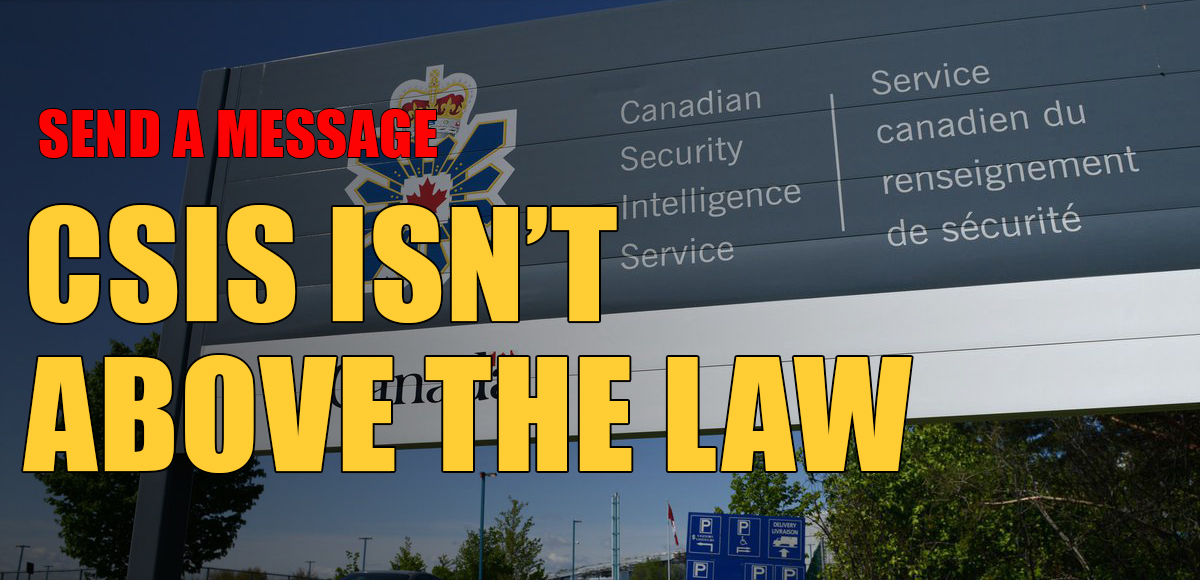
In recent years, at least three court decisions revealed the Canadian Security and Intelligence Service (CSIS) engaged in potentially illegal activities and lied to the courts. This is utterly unacceptable, especially given that this is not the first time these serious problems have been raised. CSIS cannot be allowed to act as though they are above the law.
Send a message to the Public Safety Minister demanding that he take immediate action to put an end to this abuse of power and hold those CSIS officers involved accountable. Your message will also be sent to your MP and to the Minister of Justice.
| | Reform Canada's extradition law now! | |
Canada’s extradition system is broken. One leading legal expert calls it “the least fair law in Canada.” It has led to grave harms and rights violations, as we’ve seen in the case of Canadian citizen Dr Hassan Diab. It needs to be reformed now.
Click below to send a message to urge the Prime Minister, the Minister of Justice and your MP to reform the extradition system before it makes more victims. Thank you!
Version française: Le Canada doit réformer la loi sur l'extradition!
| | Canada must protect encryption! | |
Canada, with other G7 nations, continues to push to weaken our access to strong, reliable encryption, after decades of being supportive of strong encryption. We need encryption to safeguard our data, our online transactions, our communications, and to protect the lives of journalists and human rights activists.
Please send a message to the Prime Minister of Canada, the Minister of Public Safety, as well as your Member of Parliament, to urge them to reverse course and once again commit to protecting encryption.
Regardez la vidéo avec les sous-titres en français + Agir
| | Protect our rights from facial recognition! | Facial recognition surveillance is invasive and inaccurate. This unregulated tech poses a threat to the fundamental rights of people across Canada. Federal intelligence agencies refuse to disclose whether they use facial recognition technology. The RCMP has admitted (after lying about it) to using facial recognition for 18 years without regulation, let alone a public debate regarding whether it should have been allowed in the first place. Send a message to the Prime Minister and the Public Safety Minister calling for a ban now. | | What we've been up to in the first half of 2026! | |
ICLMG 01/07/2026 - Thanks to the support of our members and donors, we were able to do a lot and work on the following issues since January:
- State surveillance bill C-22
- New social media and online harms bill C-34
- Impacts of Countering Terrorism Financing on charities, non-profits, solidarity work and international assistance
- Canada’s complicity in torture
- Islamophobia and anti-Palestinian racism
- Artificial Intelligence regulatory frameworks & national security
- Canada's No Fly List
- Foreign interference regulations
- Xenophobic bill C-12
- Anti-protest and anti-freedom bill C-9
- Review of Canada’s 7th report on the International Covenant on Civil and Political Rights
- UN Global Counter-terrorism strategy
- We were interviewed or quoted in a dozen media pieces
- We published our News Digest every two weeks
-
Our National Coordinator, Tim McSorley, received CMPAC’s 2026 Community Partner Award
Read our full summary of activities for the first half of 2026 and our plan for the rest of the year
| | Les opinions exprimées ne reflètent pas nécessairement les positions de la CSILC - The views expressed do not necessarily reflect the positions of ICLMG. | | |
THANK YOU
to our amazing supporters!
We would like to thank all our member organizations, and the hundreds of people who have supported us over the years, including on Patreon! As a reward, we are listing below our patrons who give $10 or more per month (and wanted to be listed) directly in the News Digest. Without all of you, our work wouldn't be possible!
James Deutsch
Bill Ewanick
Kevin Malseed
Brian Murphy
Colin Stuart
Bob Thomson
James Turk
John & Rosemary Williams
Jo Wood
The late Bob Stevenson
Nous tenons à remercier nos organisations membres ainsi que les centaines de personnes qui ont soutenu notre travail à travers les années, y compris sur Patreon! En récompense, nous nommons ci-dessus nos mécènes qui donnent 10$ ou plus par mois et voulaient être mentionné.es directement dans la Revue de l'actualité. Sans vous tous et toutes, notre travail ne serait pas possible!
Merci!
| | | | |