|
International Civil Liberties Monitoring Group
Coalition pour la surveillance internationale des libertés civiles
November 22, 2025 - 22 novembre 2025
| | ICLMG speaks at the Palestine Tribunal on Canadian Responsibility | |
ICLMG - On November 14 and 15, 2025, the Palestine Tribunal on Canadian Responsibility took place in Ottawa and online. It featured testimonies by many amazing panelists and elders, including Palestinians who lived through the genocide, Canadian and international human rights activists, legal and international law experts, and humanitarian and aid organizations.
ICLMG’s National Coordinator Tim McSorley joined to speak about our work on how Canada’s counter terrorist financing regime is used to target, surveil, undermine and shut down Muslim-led charities and the impact that this has on support for and solidarity with Palestinians. Watch his presentation from Day 2 of the tribunal above. If the timestamped link falters, go to 4:06:00. Watch Day 1 of the Tribunal here.
The event almost did not happen. It was originally going to take place at the University of Ottawa but university administration canceled the room reservation at the last minute without proper justification. Luckily, Senator Yuen Pau Woo was able to secure a room in the Senate to host the event.
In addition to this, Richard Falk, a prominent international legal scholar and former United Nations Special Rapporteur on the situation of human rights in the Palestinian territories who had been invited to speak at the Tribunal, was detained, with his wife and fellow scholar Hilal Elver, by the CBSA for more than four hours upon their arrival from the US at the Toronto Pearson Airport. Falk and Elver were told by a CBSA agent that they were detained because they “pose a national security threat to Canada.”
While detained, Falk was asked questions such as: “What exactly will you be saying about Israel in Ottawa?”; “Why did your UN reports criticize Israeli military actions?”; “What is your position on the war in Gaza?” In his decades-long career, Falk — who turned 95 on the day of his detention — said this was a first.
Finally, another tribunal speaker traveling from Europe had their Electronic Travel Authorization (ETA) revoked for unknown, and we suspect, illegitimate and problematic reasons. It fits a pattern, though, of Canada refusing or revoking entrance for travellers coming to speak at conferences, including those who are critical of Canadian foreign policy.
Tribunal organizers and supporters are looking into all these issues to figure out exactly what happened.
These attempts to silence the Palestine Tribunal and critics of Canada, Israel and their allies are outrageous and unacceptable. Government and university officials must explain how these events were allowed to happen and what they will do to prevent this from happening in the future. We will share updates on any developments as we learn about them. Source
New report: Exposing the US Loophole: How Canadian F-35 Parts and Explosives Reach Israel
NEW ACTION Demand your MP vote yes on No More Loopholes Bill & cut off flow of weapons to Israel
How Canada’s Purchases Of Israeli Weapons Fuel Genocide
RALLY Ottawa: All out for the International Day of Solidarity with the Palestinian People - Sat Nov 29, 2 PM
NEW ACTION Canadian soldiers went to Israel last week: Canada must sever all military ties with Israel!
NEW ACTION Canada Must Act Now to Ensure Canadian Weapons Do Not Fuel Atrocities in Sudan & Gaza
ACTION Reunite Palestinian Families Now
New book: Razing Palestine: Punishing Solidarity and Dissent in Canada
| | ICLMG submits brief on border and immigration bill C-12 to the Immigration committee | |
ICLMG 10/11/2025 - ICLMG submitted a short brief on the problematic Bill C-12, the Strengthening Canada’s Immigration System and Borders Act, to the Standing Committee on Citizenship and Immigration.
ICLMG has observed with deep concern the growing securitization of the Canadian border based on the framing of migrants and refugees as a national security threat even when evidence does not support such claims, as well as pressure from the United States for Canada to further align and integrate its border security with their own, to the detriment of civil liberties protections in Canada.
In June 2025, the ICLMG joined more than 300 other civil society organizations in speaking out over the dangers of Bill C-2, the Strong Borders Act, including the severe harms to fundamental rights if many of the provisions in Bill C-2 were adopted. The introduction of Bill C-12 failed to alleviate these concerns, particularly by replicating changes to Canada’s immigration and refugee regime included in Bill C-2.
We continue to join others in calling for both C-2 and C-12 to be withdrawn in favor of consultations and, if warranted, the introduction of targeted legislation that upholds and protects fundamental rights. Below we outline specific areas of concern with Bill C-12.
1. Part 5: Information Sharing — Immigration, Refugees and Citizenship
Part 5 of Bill C-12 would expand the ability of Immigration, Refugees and Citizenship Canada to share private information across federal, provincial and territorial governments, as well as with foreign entities. These changes would have a significant impact on privacy rights for all people in Canada, regardless of status. For migrants and refugees, the powers could inhibit their ability to access critical services without fear or harm, as well as pose serious risks for those seeking protection from persecution by foreign states. Permanent residents and Canadian citizens could also see their information impacted, including details collected in residency or passport applications.
Categories of information covered are very broad, including relating to identity, status, and the contents of any document issued to an individual, including information regarding the issuance, renewal, refusal, termination, revocation or suspension of a document.
This could include information relating to finances, health, biometrics, employment or family and friends, changes in status or gender identity, or prejudicial information relating to decisions to refuse or cancel documents.
This information could be shared with a wide range of service providers including housing and health authorities, with police and security agencies, or with foreign entities for uses far beyond the original reasons the information was collected, exposing individuals to possible discrimination or harm.
Moreover, once information is shared outside of Canada, it is impossible to control. Protections to avoid foreign abuse would be limited to avoiding substantial risk of “mistreatment,” defined in legislation as “torture or other cruel, inhuman or degrading treatment or punishment”; it would fail to apply to other equally dangerous forms of persecution that do not meet that high bar.
Nor do these new powers include provisions for reporting, record keeping, or to ensure accuracy of information shared.
2. Part 7: Immigration and Refugee Protection Act (Certain Measures in Respect of Applications and Documents)
Part 7 would grant the Governor in Council extraordinary powers to issue orders, based on “Public Interest,” to not accept, suspend or terminate applications for various forms of visas, and to cancel, vary or suspend immigration documents, including temporary visas and permanent residency cards.
We oppose the creation of such broad powers due to the strong possibility of misuse in general. This is compounded by the lack of a definition for “public interest,” a term so vague and malleable that it could easily be used in prejudicial ways. For example, previous governments have sought to block specific nationalities from immigrating to Canada. By deciding that it is against the “public interest,” future governments would be able to do the same. The ability to cancel documents of individuals already in the country would also open up the possibility of mass deportations, again based solely on “public interest.” Nor would such actions be restricted to instances of a national emergency; future governments would have a carte blanche to determine when the “public interest” merited the use of these powers.
3. Part 8: Immigration and Refugee Protection Act (Ineligibility)
Changes in Part 8 of Bill C-12 would result in refugee claims made after a year had passed since a claimant first arrived in Canada (post-June 2020) being directed to a Pre-Removal Risk Assessment (PRRA), as opposed to adjudication by decision makers at the Refugee Protection Division (RPD), where they would have the right to an oral hearing and appeal to the Refugee Appeal Division.
PRRAs are much less robust: They lack independence since they are assessed by employees of Immigration, Refugees and Citizenship Canada (who do not have the same expertise or receive the same training). Nor are PRRAs more efficient, given that they are more likely to lead to error and heavy reliance on them is likely to overwhelm our federal courts.
The impacts of these changes would be severe. For example:
- An infant visiting Canada with her parents in 2022 would be ineligible to seek protection if she returns 20 years later due to persecution in her country.
- Three years into an international students stay in Canada, they come out as homosexual, and are unable to return to their home country for fear of persecution
These types of cases merit a fulsome refugee claim, and not be relegated to the PRRA system. While proponents have suggested this is a need to address abuse or inefficiencies in the refugee claim process, a universal bar is a blunt instrument that will have significant impacts on those seeking protection, with questionable benefits to the asylum system. These changes would also go against Canada’s international legal obligations under the 1951 Refugee Convention and related UN guidance. Source
ACTION Stop Bill C-2, Bill C-12 and protect our rights!
REMINDER Mapping the Threat: How Recent Federal Bills Would Erode Our Rights and Freedoms - webinar featuring ICLMG on Nov 25 at 7 PM ET
WEBINAR Confronting Fear-Based Politics – Drug Policy, Borders and Migration: Nov 26 at 1:30 PM ET
Résolution de la Fédération internationale pour les droits humains : le Canada doit retirer C-2 et C-12, deux projets de loi menaçant le droit d’asile
CCR, Amnesty International, CUPE & Partners Launch the We're Better Together Campaign
| | ICLMG submits brief on Bill C-9, the Combatting Hate Act, to the Justice committee | On November 14, 2025, ICLMG submitted a brief on the problematic Bill C-9, the “Combatting Hate” Act, to the Standing Committee on Justice and Human Rights. | |
ICLMG - We believe strongly that Canada must do more as a society to address polarization, marginalization and hate, and that there is a role for both government and the public to play in doing so.
Despite this, the ICLMG is alarmed by the approach of Bill C-9, the Combatting Hate Act, to addressing concerns about rising incidents of hate. The government’s approach of adopting new Criminal Code offenses, expanding existing offenses and removing legal safeguards will undermine protections guaranteed under the Canadian Charter of Rights and Freedoms, particularly freedom of expression, freedom of association and freedom of peaceful assembly.
These concerns are reflected in a joint letter the ICLMG signed alongside 36 other civil society organizations from across various sectors, including the Canadian Civil Liberties Association, the Black Legal Action Centre, the Canadian Labour Congress, the Canadian Muslim Lawyers’ Association, the Jewish Faculty Network, the Canadian Muslim Public Affairs Council and the Ligue des droits et libertés, raising substantial concerns with Bill C-9 and calling for it to be withdrawn.
In our brief, we touch on three specific concerns with Bill C-9:
- The proposed new Criminal Code offense of “wilfully promoting hatred against any identifiable group by displaying [a symbol] in any public place.”
- The proposed new Criminal Code offences of intimidation and obstruction outside certain buildings and structures
- The removal of the requirement for Attorney General consent for hate propaganda charges
1. New Criminal Code offense of “wilfully promoting hatred against any identifiable group by displaying [a symbol] in any public place.”
The wording of the new offence leaves open the very real likelihood that the simple public display of one of the symbols included in s. 319(2.2) would in and of itself be considered a wilful incitement to hatred. While the government may state this is not their intention, it does not change the fact that the wording of the text could easily – and is likely to be – understood this way. [...]
This expands the possible application of the law much more broadly that what has been proposed by the Minister of Justice and government officials. It is not simply the recognition that the use of a “tool” in the commission of an offence can make an offence even more serious, as the Minister stated at committee. Rather, it could mean that any public display of such a symbol could be considered an act of wilful incitement of hatred. This would walk a very fine line of pushing the burden of proving that displaying a proscribed symbol does not incite hatred onto the individual, rather than necessitating that the state prove that the display of such a symbol was a wilful incitement to hatred.
The discretion granted to police to interpret what images are “associated with” or “used by” a listed terrorist entity, as well as whether any symbol resembles a “terrorist entity symbol,” is already so broad that it will likely lead to either abuse, misuse or mistakes that will have serious impacts on Charter protected rights.
These concerns are also compounded by the reliance of s.319(2.2) on the rights-violating, political terrorist entities listing process. The terrorist entities list was established – ostensibly – to be able to list entities engaged in terrorist activities. While some of those entities may be viewed as being driven by hate, the list and listing process have nothing to do with addressing hatred or incitement to hatred. This bill is equating apples and oranges. At the same time, we are seeing the words "hate" and "terrorism" being used to malign perfectly legitimate positions and actions.
All of this combined with the fact that the simple display of a symbol could be considered incitement to hatred will almost certainly result in individuals being at a minimum arrested, and likely charged, with a hate offence for exercising their right to free expression.
There is a reason why, up to this point, the law has included clearly framed offences, protections such as Attorney General approval for charges, and ensuring that the burden to prove intent to incite hatred falls with the state: to protect free speech – including speech that is critical of government policies, its actions, or actions by its allies – from state overreach and censorship. [...]
Over the past several months, we have seen heated arguments and accusations that certain symbols associated with protests in support of Palestinian human rights and against the genocide in Gaza are either hateful, are associated with a terrorist entity, or both. Peaceful and lawful protests have been accused of fomenting hate based on the signs and slogans that they carry. Some have gone so far as to accuse individuals wearing the keffiyeh of promoting hatred and that it is associated with terrorist activities. Others have said that the slogan, “From the River to the Sea” is a call for violence and hatred, and associated it with Hamas, despite its widespread use, and the legitimate understanding that it is a call for liberation of Palestinians living under apartheid, and not a de facto call for violence or the incitement of hatred. […]
This is made even more complicated if police are empowered to make the decision that a symbol so nearly resembles the symbol associated with a terrorist entity. For example, would a protester with a of a green flag or scarf – a color that has distinct significance in Islam – be determined to resemble the Hamas flag, which is also green? Or since some terrorist organizations have featured Arabic writing, including the “shahada,” the Islamic declaration of faith, on their flags, could a police officer believe that any such display on a sign, a shirt or a banner closely resemble a terrorist entity to merit arrest? […]
Given the severe potential for overreach, along with the stigma of being accused of committing a hate crime, we believe that this law will create a significant chill on free expression and dissent.
Finally, basing this new offence on the Terrorist Entities List, is in and of itself problematic.
The ICLMG, along with many others, have raised serious concerns with the terrorist entity listing process, including: the list is based on unaccountable executive listing decisions; decisions to list are based on secret evidence that cannot be shared publicly or with the listed entity itself; and the absence of adequate avenues for challenging listings and obtaining redress.
Decisions to list or not list can also be political in nature. As eminent national security scholars Kent Roach and Craig Forcese noted in their 2018 article, “Yesterday’s Law: Terrorist Group Listing in Canada”:
“Listing decisions may implicate domestic politics, as Canadian politicians calculate the implications of listing among diaspora communities in Canada. Sometimes also at issue are foreign policy considerations, and especially Canada’s stature as a proverbial ‘honest broker’ in international peace negotiations. These considerations seem particularly acute where the entity has a political wing and exercises a governance role in a foreign jurisdiction.” […]
Given all this, we are opposed to any new Criminal Code provisions that would rely on the Terrorist Entities Listing process, and reiterate our coalition’s longstanding call for the regime to instead be abolished. Read more - Lire plus
NEW ACTION CMPAC phone call campaign to reject C-9
ACTION Withdraw Bill C-9, the Combatting Hate Act: a threat to our rights and freedoms!
ACTION Canada: Abolish rights-violating terrorist entities list!
Egale: Bill C-9, the Combatting Hate Act: Assessing the Bill’s Impact on 2SLGBTQI Communities in Canada
| |
NEW ACTION Justice Minister Sean Fraser must act now to end the injustice against Dr. Hassan Diab!
| | |
Hassan Diab Support Committee & ICLMG 12/11/2025 - In April 2023, despite clear exculpatory evidence, the French Court of Assize conducted an in absentia trial that unjustly declared Dr. Hassan Diab guilty and sentenced him to life in prison. The proceedings amounted to a sham trial and a mockery of justice. The court’s verdict was based on hearsay testimony, unsourced “intelligence,” and unfounded speculation rather than credible evidence.
Since that ruling, Dr. Diab and his family have lived in constant uncertainty, facing the ongoing threat that a second extradition request could be made at any time.
We urge you to please send the letter below demanding that Justice Minister Sean Fraser categorically refuse any future extradition request and put an end—once and for all—to this ongoing miscarriage of justice.
Your letter will also be sent to Prime Minister Mark Carney, Minister of Foreign Affairs Anita Anand, Hassan Diab’s MP Anita Vandenbeld, and your MP. Thank you! Take action - Passez à l'action
Share on Bluesky + Instagram + Facebook + Twitter
Nov 14 event in support of Hassan Diab was a success!
ACTION Hassan Diab is innocent. Join the postcard campaign to urge Prime Minister Carney to right an historical wrong. To get copies for you and your friends, contact diabsupport@gmail.com
| | Defending civil liberties, defending democracy - Interview with ICLMG's National Coordinator Tim McSorley | |
Inter Pares 05/11/2025 - The International Civil Liberties Monitoring Group (ICLMG) is a coalition of Canadian civil society organizations, including Inter Pares, working to protect civil liberties and human rights from the negative impacts of national security and anti-terrorism measures. Tim McSorley, ICLMG’s coordinator, spoke with us about how defending civil liberties is essential to protecting democracy. Interview edited for length and clarity.
- Why was ICLMG founded and how was Inter Pares involved?
ICLMG was founded in 2002 in the wake of the attacks in the U.S. on September 11th, 2001, and Canada’s response. There was incredible growth in the use of surveillance tools, police powers and national security measures, a sharp increase in xenophobia, Islamophobia and hate-based violence, and mounting criminalization of the aid sector. The sector was worried by the significant negative impacts of new anti-terrorism laws on limiting humanitarian aid and international cooperation. Inter Pares was one of the key organizations and leading forces that initiated the first meetings and helped form the coalition.
- How does protecting civil liberties support democracy?
Protest and free expression are fundamental to democracy. We see our work as supporting democracy and people’s ability to be involved in democratic decision-making—not just voting, but engaging with MPs, protesting and exercising free expression. That includes speech people might find disagreeable or offensive.
- Are you seeing parallels between the post-9/11 context and today?
Definitely. In both contexts, people are protesting for peace, against war, to save people's lives. The rhetoric we’re seeing now—labeling people protesting the genocide in Gaza as extremists or supporters of terrorism—is very similar to what we saw after 9/11.
Once put in place, new national security laws (like the Anti-terrorism acts in 2001 and 2015 and 2017’s National Security Act) justified in the wake of 9/11 or similar crises, tend to stick around and get repurposed. We’ve seen them used against Indigenous land defenders, and now again in the context of Gaza protests. The context changes, but the patterns are the same.
- What happens to democracy when civil liberties are eroded?
When civil liberties are eroded, there’s a chilling effect—people don’t know if their rights will be protected or if they’ll be investigated or charged just for speaking out. That fear stops people from participating in democracy. We’ve seen people charged with serious crimes for things like postering or graffiti. Even if charges are dropped, the damage is done. It makes people think twice about speaking out.
- What are you watching for in the coming months?
We’re watching proposed anti-protest laws at the federal level and municipal bylaws that restrict protests near schools and religious institutions. We believe incidents of hate, violence and intimidation need to be addressed, but that the powers and laws to do so already exist. What’s being proposed by the federal government is overreach.
We’re also concerned about the Strong Borders Act, which would expand surveillance and limit the rights of asylum seekers. These laws risk dissuading people from participating in protests or engaging in political debate.
- What can people do to protect their civil liberties?
Reach out to your elected officials—call, email, talk to them at events. ICLMG has tools on our website to help with that. Join local groups, show up to protests. These actions matter.
- ICLMG has been around for more than 20 years. What’s kept the work going?
Honestly, we wish we didn’t have to keep doing this work. But the issues haven’t gone away. What’s kept us going is the strength of our membership—organizations from across sectors who are committed to pushing back against the impacts of national security laws. That collective effort is what makes this work possible. Source
NEW Inter Pares action: War crimes in Sudan: Canada must act NOW
Inter Pares event Sudan, a crisis ignored. Online on Nov 26th at 12PM ET
| |
NEW ACTION Reject Drone Warfare Testing in Downtown Ottawa: No Canadian City should Host War "Games"
| |
Matthew Behrens 10/11/2025 - Ottawa and other Canadian towns and cities should never be used for drone warfare testing. Yet from November 24 to 28 the Canadian military, RCMP, and American officials are planning to use downtown Ottawa to test the kinds of killer drones wreaking terror now in Gaza, Ukraine, Somalia, Lebanon and elsewhere.
We demand that these drone warfare tests be stopped and not rescheduled. We call on the Government of Canada and Ottawa City Council to end this planning for war and devote public resources to peaceful means of conflict resolution. [...]
Billions for Drones, not Homes
Canada plans to purchase billions of dollars worth of drones from companies complicit in the genocide in Gaza, including American and Israeli firms. Drone warfare sites will be at 14 Wing Greenwood, N.S., 19 Wing Comox, B.C. and Uplands, Ottawa (which will house a new $65. Million 6,000 square metres drone warfare facility).
Drone warfare violates international law on multiple levels and we have for decades now seen the brutal results of such violations.
Most recently, we have seen how drones adapted by the Israeli apartheid regime have been used to kill Palestinian civilians in the Gaza Strip. The drones are operated manually by soldiers on the ground to bomb civilians – including children – to force them out of their homes or prevent them from returning to areas where Palestinians have been expelled.
They have used quadcopter drones as tools of psychological intimidation, surveillance, and direct killing, particularly in areas where civilians have sought refuge after being forcibly displaced from northern Gaza. This systematic pattern appears aimed at stripping away any sense of safety and turning displacement zones into death traps. [...]
Say NO to Drone Warfare Testing
Just as the answer to nuclear weapons is not to build more nuclear weapons, the metastasizing pandemic of drone warfare must be stopped, not increased in a deadly arms race. The City of Ottawa must reject drone warfare testing in its jurisdiction, and other Canadian cities should refuse to allow such war testing as well. Take action - Passez à l'action
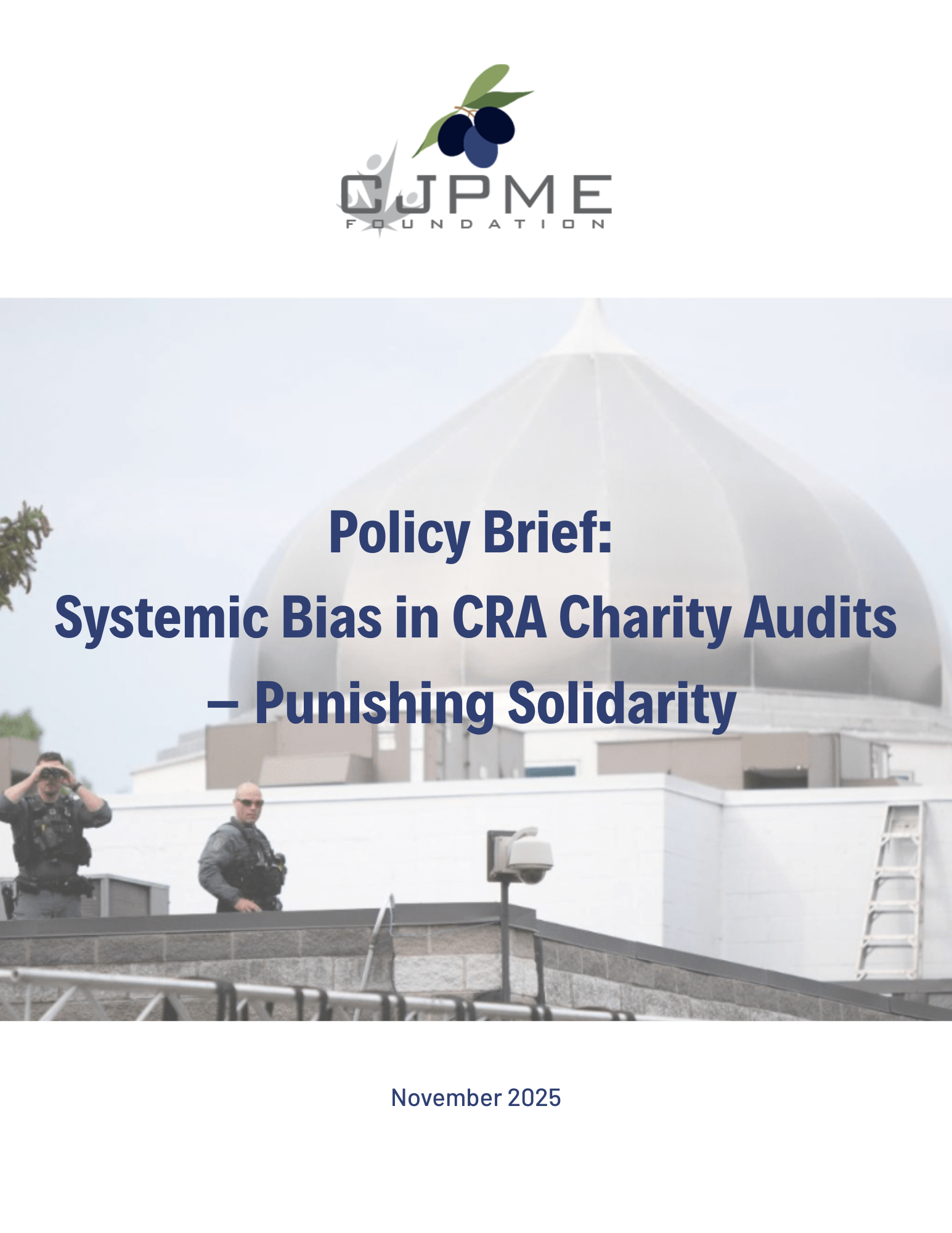
| | Policy Brief: Systemic Bias in CRA Charity Audits – Punishing Solidarity | |
CJPME Foundation 11/11/2025 - Executive Summary: In October 2025, the National Security and Intelligence Review Agency (NSIRA) released a landmark review that officially confirmed the Canada Revenue Agency’s (CRA) approach to terrorism-related charity audits is “deeply flawed,” lacks rigour, and introduces significant risks of bias and discrimination, potentially breaching the Charter of Rights and Freedoms.[i] This report validated decades of advocacy by Muslim, Arab, and Sikh communities, whose charitable organizations have faced disproportionate scrutiny based on weak or unsubstantiated leads. Click here to download the full report as a PDF
The NSIRA report explicitly identified patterns of religious discrimination in how the CRA’s Review and Analysis Division (RAD) selected charities for terrorism-related audits. It found that 67% of the charities selected for audit during the review period were identified as “Muslim-led,” a targeting pattern NSIRA stated “raises concerns about bias” and suggested a discriminatory outcome even in the absence of direct proof of discriminatory intent. Moreover, the report criticized the CRA for relying on unsubstantiated and vague intelligence sources that disproportionately flagged Islamic charities, and warned that this selection practice “may infringe” Charter rights, including equality and religious freedom. It emphasized that such audits lacked proper documentation or justification and risked violating fundamental rights when focused predominantly on religious groups without transparent, evidence-based triggers.
While the NSIRA review was a necessary step toward accountability, its structural and methodological limitations prevent a full reckoning of the discriminatory nature of the CRA’s auditing regime. Civil society groups have rightly highlighted several persistent gaps that severely undermine the review's comprehensiveness and utility.[iii] Fundamentally, the CRA’s deliberate refusal to collect demographic data on the faith or ethnicity of the charities created a statistical vacuum,[iv] making it impossible for NSIRA to conclusively prove systemic discrimination with quantitative evidence, despite the overwhelming and consistent anecdotal and case-based testimony from affected communities.[v]
Compounding this opacity, the public version of the NSIRA report was heavily redacted, with critical details such as charity names, specific allegations, and the list of "high-risk countries" removed. [vi] This level of censorship prevents independent experts, journalists, and the affected communities themselves from scrutinizing the very evidence and rationale upon which the audits were based, shielding the process from the public accountability and transparency it desperately requires. Furthermore, the review’s findings on procedural failures remain damning even in their public report, confirming that the Review and Analysis Division (RAD) repeatedly launched audits based on weak or unsubstantiated claims, relied on outdated intelligence and overly broad criteria that could capture virtually all Islamic charities, and frequently initiated intensive investigations without a documented rationale.
Finally, and most critically for the victims of this system, the NSIRA review offered no pathway toward justice or reparations. It provided no mechanism for formal apologies, financial compensation for millions in legal fees, or reputational rehabilitation for charities that suffered profound and lasting damage because of the illegitimate reviews. As the International Civil Liberties Monitoring Group (ICLMG) notes, this absence of a remedy mechanism means that organizations that were wrongfully targeted and dismantled are left without recourse, cementing the injustice they endured.[vii]
Our analysis demonstrates that the NSIRA review critically overlooked a fundamental driver of this bias: the CRA audits function not merely as an instrument of religious profiling, but as a state mechanism to suppress political solidarity with oppressed groups abroad. This pattern reflects a deeper failure of Canadian policy: the outsourcing of domestic threat assessments to foreign allies. By adopting the security frameworks of nations like India and Israel, which frame political dissent as terrorism, Canadian agencies import foreign political conflicts onto domestic soil. This process effectively "others" Canadian citizens, treating them not as rights-bearing individuals but as extensions of foreign populations to be managed in the interests of allied governments. The audit regime, therefore, is a key tool in this practice, criminalizing transnational humanitarian and advocacy work that challenges Canada's geopolitical interests at the expense of civil liberties. Read more - Lire plus
| | |
JURIST 14/11/2025 - A Canadian Human Rights Tribunal member ruled last week that the government cannot invoke national security laws to indefinitely delay discrimination complaints. The Tribunal decision comes as a victory for a former refugee who says the Canadian Security Intelligence Service (CSIS) exploited and discriminated against him for more than two decades.
Kagusthan Ariaratnam—a Tamil former refugee from Sri Lanka who was forced to join a militant group as a child soldier—alleges that CSIS coerced him to work for nine years as an unpaid informant. He also contends that the agency shared his private mental health records with prospective employers, sabotaging his efforts to secure work elsewhere.
Ariaratnam says CSIS refused to hire him despite his qualifications and experience, even as the agency continued to benefit from intelligence tips he provided about Tamil militant organizations. He also asserts that the agency discriminated against him based on his race, ethnicity, religious identity as a Muslim, and mental health conditions—including depression, and what he describes as false diagnoses of bipolar disorder and schizophrenia, which he argues resulted from CSIS inaccurately telling police and doctors that he was delusional when he was, in fact, following their instructions.
After filing a complaint in January 2018, Ariaratnam says it took more than six years for the complaint to reach the tribunal, and he was unable to submit detailed allegations until February 2025. At that time, CSIS asked the Canadian government to invoke the national security doctrine, which would transfer the case to a different oversight body: the National Security and Intelligence Review Agency (NSIRA).
Both CSIS and the Canadian Human Rights Commission argued that this move would pause the tribunal proceedings indefinitely, allowing NSIRA to complete its review, after which the commission would decide whether to return the case to the tribunal—a process with no clear timeline.
Tribunal Member Ashley Bressette-Martinez rejected the argument advanced by CSIS and the Human Rights Commission, finding the law is silent on whether tribunal proceedings should be paused when agencies invoke national security laws. Reasoning that such power conflicts with the tribunal’s independence from the commission, she determined that once a case reaches the tribunal, it belongs to the complainant—not the government agencies involved.
“The power to withdraw a complaint before the Tribunal belongs to a complainant and no other party has that power,” Bressette-Martinez wrote.
Ariaratnam’s lawyer, Nicholas Pope, told JURIST in an exclusive interview that Bressette-Martinez’s decision blocks a delay tactic commonly used by agencies. “It’s quite common for federal agencies to invoke national security in human rights cases involving CSIS or immigration matters with individuals from areas of the world that the government stereotypes as being affiliated with terrorism,” Pope explained. “This decision limits the use of NSIRA as a tool to delay human rights proceedings.”
Ariaratnam told JURIST his seven-year legal battle has devastated him financially and emotionally. “I have spent tens of thousands of dollars on legal fees. There were moments I felt completely alone and defeated, especially when the process dragged on for years without progress,” he said. “But I kept going because I knew what happened to me was wrong.”
The allegations at issue date back to events that began in 2000. At that time, Ariaratnam says a CSIS agent threatened to report him to immigration authorities if he refused to become an informant. The agent allegedly promised to hire him once he became a permanent resident in 2002. Despite this promise, CSIS never hired him, even after he repeatedly applied for about 22 years, according to his complaint.
In 2016, Ariaratnam had applied for a security guard position on Parliament Hill. He explained that CSIS shared his confidential mental health information with House of Commons officials, who then cancelled his security clearance application. A 2020 NSIRA report confirms that CSIS representatives met with House officials and shared with them Ariaratnam’s mental health records.
“My medical history had nothing to do with my ability to perform the job,” Ariaratnam stated. “It was shared without my consent and used to deny me a security clearance—effectively branding me as ‘unfit’ because of my mental health status.”
In his complaint, Ariaratnam seeks $3.8 million in damages. Pope says the complaint’s central claim is straightforward: “His CSIS handler promised him that he would be hired once he obtained his permanent residency, and she said he had the suitable skills. Then he was not hired despite applying multiple times.”
The tribunal noted that pausing the proceedings could be illogical if it ultimately resolved the pending dispute over which allegations should be included in the case—an outcome that could eliminate the national security concerns entirely. The case will now proceed, with the tribunal retaining authority to manage how any national security issues are addressed. Source
ACTION Stop Silencing Survivors: Ban National Security Secrecy in Violence Against Women Cases
| | The day pipeline security followed me — and what I learned later about Canada’s spy agency | | |
The Narwhal 12/11/2025 - The truck slowly pulled alongside as I idled at the side of a remote dirt road in northern B.C. No cell service, the nearest town half an hour away. I’d pulled off to let industrial traffic heading the other direction pass. It was 2022 and I was on my way to meet with Indigenous land defenders embroiled in a years-long fight against a major pipeline being built through Wet’suwet’en lands and waters without the permission of Hereditary Chiefs. The driver of the truck rolled down his window. “Need any help?” he said.
I knew from markings on the truck that he worked for Forsythe, a private security company contracted by Calgary-based pipeline giant TC Energy. Security companies were hired to protect the construction of Coastal GasLink, a 670-kilometre natural gas pipeline. For years, Coastal GasLink had been a focal point for conflict, including dozens of arrests and extensive surveillance operations by private security and RCMP. What I didn’t know at the time was information about me, collected on behalf of the pipeline company, could have been shared with Canada’s national spy agency.
The Narwhal and the Investigative Journalism Foundation recently reported TC Energy apparently leveraged a close relationship with former Canadian Security Intelligence Service (CSIS) director David Vigneault to expand information-sharing between CSIS and major Canadian companies. In 2024 emails to Vigneault, TC Energy said the proposed arrangement was necessary due to “security threats facing Canadian industry” which the company said included “acute risks from foreign adversaries,” according to documents obtained through freedom of information legislation. Vigneault left CSIS in 2024 and now works for an American intelligence company.
This year, Canada passed legislation delivering many of TC Energy’s requests. Critics warn the flow of information could be going both ways — that companies like TC Energy could be feeding information to CSIS. They worry this could influence how and when the spy agency and federal law enforcement conduct surveillance of individuals and groups. It also means third-party security services like Forsythe, which employs ex-paramilitary soldiers and former RCMP officers, could be passing on information to CSIS and police about Indigenous and non-Indigenous land defenders and activists.
Tia Dafnos, an associate professor of sociology at the University of New Brunswick, said the level of access gives industry an opportunity to shape a criminal justice narrative aligned with its interests. “One of the key concerns here is the lack of transparency and therefore accountability, when you have these discussions happening in spaces that are outside of public access,” she said.
As the federal government pushes resource extraction in response to a barrage of economic sanctions from the current Trump administration, several major industrial developments — including an expansion of Coastal GasLink — could become new sources of conflict. Now, companies being scrutinized by environmental advocates and Indigenous land defenders have direct and secretive channels of communication to Canada’s spy agency.
“When you have something deemed to be in the national interest, a threat to that national interest would move it into the realm of a national security issue,” Dafnos said. Protecting critical infrastructure can then become a justification to monitor and criminalize project opponents, she explained. [...]
Formal and informal relationships between industry executives and senior CSIS officials offer the private sector an avenue for “framing a threat or influencing the perception of threat,” Dafnos said. The secretive nature of those relationships also risks criminalizing or intimidating journalists.
Back in 2022, I told the security guard I didn’t need his help and rolled up my window. After the heavy trucks rumbled past, I drove on. He followed. For more than 20 kilometres, winding through deep forest beside the Wedzin Kwa (Morice River), the truck stayed close behind, a spectre in my rear view mirror. At my destination, I parked and got out, shouldering my camera and grabbing my notebook. I could see him in his truck watching my movements from a distance. I turned and went inside the land defenders’ compound.
What goes on in ‘private, high-level’ discussions between TC Energy and CSIS? No one knows
The documents obtained by The Narwhal and the Investigative Journalism Foundation this fall detail email communications between TC Energy executives, the Business Council of Canada, which represents the country’s wealthiest companies, and Vigneault, who signalled his support for the industry-led initiative. It was a paper trail that confirmed what was discussed in internal company calls leaked to the media in mid-2024.
On those calls, detailed by The Narwhal in a series of investigative reports, former staffers from the first Trump administration — including foreign service operatives and ex-military hackers — talked about the extensive intelligence-gathering operations they conducted on behalf of the pipeline company. They also said TC Energy executives were attempting to persuade CSIS to share information with corporations more freely. Those efforts were ultimately successful.
Keith Stewart, a senior energy strategist with Greenpeace Canada, warned the powers given to CSIS are “ripe for further abuse.” “This intelligence sharing blurs the line between public security and corporate interests and risks putting Indigenous land defenders and climate activists under increasingly invasive surveillance for peacefully opposing fossil fuel expansion,” he said in a statement.
Secrecy is intrinsically part of CSIS operations, which means much of what goes on in its meetings with corporations like TC Energy remains unknown. Unlike lobbying activities, which give the public a glimpse into how and when fossil fuel companies and other private sector entities interact with government officials, the “private, high-level discussions” requested by TC Energy remain a black box.
As Dafnos put it, an absence of any details about what kind of information is being shared means the public doesn’t know whether or not it should be concerned. “It’s kind of a conundrum,” she said, adding it’s also likely information is being shared in less formal ways.
As The Narwhal and the Investigative Journalism Foundation reported, Business Council of Canada president Goldy Hyder called Vigneault a “dear friend” and said he texts him regularly. “Are they sharing information about threats, like political opposition or grassroots opposition to energy projects?” Dafnos asked. “How do we get access to the phone calls that people are making to each other?”
‘Our democratic right’
Nikki Skuce has first-hand experience with her environmental activism attracting the attention of the federal spy agency. While working for environmental advocacy group ForestEthics in the early 2010s, she found herself unexpectedly entangled with CSIS. At the time, she was involved in organizing opposition to the Northern Gateway pipeline, an Enbridge proposal to transport bitumen from the Alberta oilsands to marine shipping routes on the northwest coast.
Skuce said opposition to Northern Gateway drew the ire of former minister of natural resources Joe Oliver. In 2012, Oliver accused those who opposed projects like the pipeline of having a “radical ideological agenda.” He alleged they were trying to “exploit any loophole they can find, stacking public hearings with bodies to ensure that delays kill good projects.” Others took it a step further, labelling Skuce and her peers as “eco-terrorists” or “extremists” after then-prime minister Stephen Harper and his cabinet lumped environmental advocates in with white supremacists and anti-capitalists in a controversial anti-terrorism [strategy paper].
“It was frightening, frankly,” she said. She told The Narwhal she first became aware she was being spied on after a small community meeting on Nadleh Whut’en territory, about 150 kilometres west of Prince George, B.C. “It wasn’t a meeting that stood out or anything,” she said, explaining the point was for attendees to come together in solidarity and strategize opportunities for outreach.
After the surveillance operation came to light, when records were unearthed in 2013, land defenders and environmental organizations in B.C. feared they were under constant surveillance and some felt they could no longer safely voice dissent over Northern Gateway. “It was rattling and just a feeling in the pit of your stomach, like, what has become of this country, what’s become of Canada, that they’re spying on activists?” Skuce said.
Skuce and others targeted in the surveillance operation later testified as part of a case brought forward by the BC Civil Liberties Association, which alleged CSIS had illegally spied on citizens, groups and First Nations, and was sharing that information with fossil fuel companies. At the time, they were subject to a “gag order” prohibiting witnesses from talking about their testimonies, even to each other, Skuce said. Eventually, after lawyers with the civil liberties group fought in the courts for five years, the so-called “protest papers” were released, though heavily redacted, and the gag order was lifted. In 2024, the federal courts denied an application to release all the documents unredacted. The civil liberties association appealed that decision.
“It was just shocking and kind of hard to believe,” Skuce said. “Since then, I think it’s gotten worse, seeing how things played out here in Wet’suwet’en territory with Coastal GasLink and the level of oppression and the weaponizing and use of injunctions.”
She said it feels like an erosion of democracy, where dissent is directly targeted and dissuaded, if not criminalized. “It’s just depressing, really.” “Legitimate protest and activism is our democratic right here in Canada and I think everyone should be concerned if we’re having our police force and spy agencies sharing that information with corporations,” she said. Source
How investigating Indigenous activists became a CSIS priority for at least a decade: Previously secret papers detail agency’s ‘Native extremism’ surveillance program between 1988-99
| Opinion: Canada once spoke out against unlawful American military action. Why it’s time to do so again now | |
The Toronto Star 18/11/2025 - At the tail end of last week’s G7 summit in Niagara, France’s foreign minister condemned U.S. boat strikes in the Caribbean as unlawful. The United Kingdom also appears to have determined that intelligence-sharing in these operations could render it complicit in extrajudicial killings, and it has reportedly paused such co-operation.
Yet Canada’s foreign minister has taken the position that it is for “U.S. authorities,” not international counterparts, to determine the lawfulness of U.S. strikes. One wonders if she would take the same position if the strikes were killing Canadians.
Canadians are rightly concerned about the United States’ authoritarian turn, marked by Donald Trump’s seemingly unconstrained expansionist rhetoric and tariff roulette. The collapse of legal oversight within key parts of the U.S. Executive Branch has been precipitous, harming individuals and businesses within and outside the United States. Yet other countries need not and should not forsake or withhold their independent judgment to appease the U.S. president, especially on matters involving the use of military force.
For many countries, the United States has gone from a trusted ally to a fickle friend, if not yet a foe. This is a terrifying development for Canada, which shares the world’s longest undefended land border with the United States.
Yet remaining silent about U.S. violations does not erase them. To the contrary, the more the United States feels it can get away with, the farther it will push the limits. The feeble legal justification belatedly proffered for the boat strikes — namely that the United States in involved in a non-International armed conflict with groups including the Venezuelan gang Tren de Aruga — are modelled on legal arguments made to justify killing members of al-Qaeda and associated forces in the wake of September 11. Yet that justification, which was itself highly controversial, only applies in the context of an actual armed conflict. Saying there is an “armed conflict” does not make it so (and nor would an actual armed conflict with the government of Venezuela). Trump has long been described as untethered by the facts; those who have advanced this legal argument appear to be similarly indifferent to reality.
To be sure, there might be practical reasons not to antagonize the United States. [...] But it’s precisely because U.S. policy is so unpredictable that predicating Canadian behaviour on the hope of avoiding erratic U.S. reactions is likely futile. In this context, American policy itself might also be unlawful. Foreign minister Anita Anand said that the United States is “using its own intelligence” for the strikes, which have killed at least 75 people. But it is not necessarily reasonable to rely on U.S. assurances given the current US administration’s willingness to disregard both the facts and the law.
Concerns about complicity can restrict policy options in ways that decision-makers find inconvenient, and that can implicate other core interests. That said, unlawful policies are often also unwise and counterproductive. For example, in the wake of the United Kingdom’s participation in the invasion of Iraq in 2003, Sir John Chilcot led an extensive inquiry that focused on issues including the process by which the U.K. Attorney General ultimately signed off on U.K. involvement. More than 20 years later, the Iraq invasion is widely viewed not only as unlawful, but also as a policy failure with disastrous humanitarian consequences, as well as significant repercussions for the invading countries.
Canada should stand strong for legal principles and insist on decision-making based on facts. Legal constraints can frustrate short-term policy objectives, but they also offer critical protections. At the moment, Venezuelans and nationals of other Latin and South American countries are in the crosshairs. States create and enforce international law through their actions and their words. The best way to ensure that Canadians aren’t next isn’t to remain silent in the face of U.S. transgressions — it’s to insist that law applies to every country’s conduct, no matter how powerful the country or how impetuous its president. Source
Joint Letter: Call for action by Canada to avoid complicity in unlawful US airstrikes in Latin America and the Caribbean
US has extrajudicially killed 83 people in boat strikes as of November 17
War in Venezuela, Brought to You By the Same People Who Lied Us Into Iraq
A new Trump administration memo argues that those carrying out the boat attacks can’t be prosecuted. Why? Because the administration says so!
| | The Toll of Intent: Looking at the Genocidal Impact of Israel's Assault on Gaza | |
CJPME 11/2025 - This report synthesizes existing data to project that between 14% and 20% of Gaza's pre-October 7, 2023, population (approximately 341,000–480,800 Palestinians) could ultimately be killed as a result of Israel's operations and the subsequent conditions by 2030 without urgent intervention from Canada and its allies. The report uses existing estimates and modelling to define various projections of Palestinian deaths for the different possible outcomes of Israel’s military campaign in Gaza. The report concludes that the case that Israel has committed genocide is strong and supported by a growing body of scholarly and grey literature from the UN and NGOs. Access the full report here.
Executive Summary
Beginning to understand the human cost of Israel’s current occupation of Gaza is necessary for proposing policy towards Israel and Palestine. The situation on the ground in Palestine should guide our strategy for supporting Palestinians in rebuilding their lives and communities. It also helps us hold Israel accountable for the impact of its crimes in Gaza.
This report compiles the growing evidence of the scale of horror experienced by Palestinians in Gaza, along with the human lives lost due to Israel’s crimes. It synthesizes existing literature on the death toll in Gaza, within the context of the emerging consensus that Israel’s attacks on Gaza constitute genocide.[i]
To do this, we conducted a review of grey literature produced by the United Nations, thinktanks, and prominent non-governmental organizations (NGOs). Throughout, we update previous calculations to the current date and conflict context. We also provided a range of potential indirect death totals based on the different death ratio scenarios outlined in the literature on violent civil conflict.
Key findings
- As of Oct 19, 2025, direct deaths in Gaza are estimated between 64,600-96,100 based on differing analysis of the Gaza Ministry of Health’s (GMoH) official count of 68,500. The case is extremely strong for the GMoH number to be understood as the floor.
- With certainty we can project that Israel’s attacks will kill at least 193,800 or 8% of the 2.4 million Palestinians in Gaza before October 7, 2023; with over 120,100 or 5% already having been killed based on conservative estimates.
-
Projections that posit that Israel’s actions will kill roughly 480,800 or 20% of the pre-October 7th, 2023 population of Gaza are highly plausible and should be utilized in policymaking and planning.
- Higher ratio scenarios suggest the possibility of over 682,000 – 961,600, or 28-40%, of Palestinians in Gaza eventually being killed as a result of Israel’s operations. These scenarios should be planned for.
-
The most extreme “worst-case” scenario of Israel’s attacks projects an eventual loss of life equal to roughly 67% of Gaza’s pre-Oct 7th, 2023 population. Confidence is much lower for projections like these and they should be approached with the utmost caution and forbearance.
- In all projections, the vast majority of deaths have occurred because of Israel’s attacks on the social determinants of health in Gaza. These so-called “indirect deaths” will continue for years, with approximately 38% of total deaths occurring within a five-year timespan after fighting stops. Some of these deaths are preventable and should serve the basis for policy and planning.
- The case that Israel has committed genocide is strong and supported by a growing body of grey and scholarly literature from the UN and NGOs. The case is especially strong within the historical context of Israel’s settler colonial pursuit of annexation of all of historic Palestine, with the full intention of removing the vast majority of Palestinians from that land through ethnic cleansing or genocide.
Summary of Recommendations
Given its legal obligations, we recommend that the Government of Canada:
- Officially recognize that Israel has perpetrated genocide in Gaza.
- Support South Africa’s genocide case against Israel at the ICJ.
- Accept Palestinians evacuating from Gaza into Canada through all migration streams.
- Publicly defend the multilateral institutions from attacks by Israel and the US.
- Conduct independent war crimes investigations in conduct of Canadians in Gaza.
- Stop the remaining flow of Canadian-made weapons to Israel.
- Impose escalating economic sanctions on Israel until it ends the illegal occupation of the State of Palestine.
- Provide leadership in rebuilding Gaza’s public health and population health systems.
Given Canada’s legal obligations, we recommend that all Parliamentarians:
- Recognize Israel’s actions in Gaza as a genocide by passing motions in Parliament.
- Publicly declare that Israel has committed genocide and call for immediate escalating sanctions.
-
Vote in favour of Bill C-233, the No More Loopholes Act. Source
After the Genocide, the Genocide
Israeli airstrike on Palestinian refugee camp in Lebanon kills 13
Israel Kills Over 30 Palestinians in Gaza in One of Bloodiest Assaults of "Ceasefire"
Position Paper: Palestinian Civil Society Condemns UNSC Resolution 2803 Establishing Joint US-Israel Illegal Occupation of Gaza
Israeli Knesset advances bill allowing execution of Palestinian prisoners
PCHR Documents Testimonies of Systematic Rape and Sexual Torture in Israeli Detention against Released Palestinian Detainees
| | Counterterrorism review calls for Shamima Begum and other British-linked people in Syria to be repatriated | |
Sky News 11/11/2025 - Shamima Begum, the former east London schoolgirl who joined Islamic State, and other British-linked people who are detained in camps in Syria should be repatriated, a major review of UK counterterrorism policy has said.
The report, by an independent commission, said the current policy of leaving such women, men and children in limbo was "unsustainable" and risked turning the detention camps in northeastern Syria into "Britain's Guantanamo".
This is a reference to the notorious American detention facility in Guantanamo Bay, Cuba, that was used to imprison al Qaeda suspects indefinitely. The Independent Commission on UK Counterterrorism warned that conditions at the Syrian camps, including Al Hol and Al Roj, "constitute inhuman and degrading treatment".
It said forcing British-linked people to live in such facilities instead of allowing them to return home was "inconsistent" with the UK's international human rights obligations. The exact number of British citizens, as well as individuals like Begum, who had her citizenship revoked because she joined Islamic State (IS), stranded in the camps is not clear.
But estimates put the total figure at between 50 and 70, the majority of them women, and between 12 to 30 children, half of whom are under the age of 10. There is a particular obligation of the British state to protect children from harm.
"The government should facilitate the voluntary repatriation for British nationals, including those deprived of British nationality," the commission said. "It should appoint a special envoy to oversee repatriation and inform returnees of the likelihood of prosecution."[...]
"As escapes from camps are likely to lead to some returns to the UK, an organised programme of return, rehabilitation and integration is the best long-term option for managing risk," the commission said. Read more - Lire plus
If the UK can cordially host an ex-Al-Qaeda commander it can repatriate Shamima Begum
ACTION Canada must repatriate all Canadians detained in NE Syria now!
ACTION “Canadians are dying": Free Jack Letts & 19 Canadian Kids, Women & Men in Syria
| | Dramatic Chicago ICE raid touted as anti-terror win results in no criminal charges | |
PBS News 14/11/2025 - A new investigation by ProPublica found that immigration raids hailed by the Trump administration as a major strike against terrorism did not live up to those claims. Dozens of Venezuelan migrants were detained in a September raid, with officials alleging they are members of the dangerous Tren de Aragua gang. Ali Rogin discussed more with Melissa Sanchez of ProPublica.
Transcript
Amna Nawaz:
Well, there were more arrests in the Chicago area today, as protesters clashed with police in a demonstration outside an ICE facility. Four officers were injured and 21 people were arrested after a fight broke out. Protesters are demanding an end to ICE's methods and raids that have been a constant in Chicago since the administration launched what it called Operation Midway Blitz in September. The allegations around a number of those raids are being sharply questioned. The latest comes from a new investigation by ProPublica that finds a recent raid hailed by the Trump administration as a major strike against terrorism did not live up to those claims. Ali Rogin tells us more.
Ali Rogin:
Amna, the raid on September 30 is etched into the minds of some residents after they watched hundreds of federal agents rappel from Black Hawk helicopters, use drones and flashbang grenades to storm an apartment building in the city's South Shore neighborhood. Dozens of Venezuelan migrants who were found to be undocumented were detained, with officials alleging they are members of a dangerous gang called Tren de Aragua, which has been designated as a terrorist group.
But the investigation by ProPublica paints a different picture. It found that many of those arrested had no criminal records and the government has provided no evidence tying them to terrorism. I'm joined by Melissa Sanchez, who co-authored this article after a monthslong investigation. Melissa, thank you so much for joining us. First of all, what have government officials been saying in order to justify this raid and what did your reporting find out?
Melissa Sanchez, ProPublica:
Well, the government has claimed that the Venezuelan gang — the Venezuelan gang Tren de Aragua had taken over this building on the South Side of Chicago and that there were guns and explosives and drugs inside the building. But our reporting has found, like, little evidence to back up this claim. The government has provided little — no proof at all that this is true. They haven't even revealed the names of any of the immigrants that they detained. We were able to identify 21 of the 37 immigrants. And we were — and I spoke with 12 of them. And we looked up all their criminal records. Very few of them had any. And the records that we did find showed zero mentions of gang membership.
Ali Rogin:
And of those 37 individuals who were arrested, there were no criminal charges filed against them. Why is that? What did you find out about that?
Melissa Sanchez:
So, we spoke with federal — former federal prosecutors. And what they have told us is that if the government had a good case, we would have seen charges filed in federal court, and we haven't seen any yet. So that suggests that maybe no charges are coming. And kind of to add to that, we have gone to a lot of these men's immigration court hearings. We have gone to eight of them so far. And in not one of those hearings as a government lawyer made any reference to criminal cases or to gang membership. So all of that makes it really difficult to believe that — believe what the government is saying about gang membership.
Ali Rogin:
There is tremendous video evidence showing this dramatic entrance into this complex. Did agents have warrants to forcibly enter the apartments that they did that night?
Melissa Sanchez:
That's a great question. I wish I could tell you that we knew the answer. The government won't tell us. We have found no evidence of warrants filed in federal court, although they could be under sealed. But we have asked the government, and they haven't answered. They said they have done everything according to the law.
Ali Rogin:
I want to ask you about what the administration has said in response to your story. A Homeland Security spokesperson said agents arrested two — quote — "confirmed members" of Tren de Aragua and that children were taken into custody for safety, but that they were not handcuffed. How does that jibe with your reporting?
Melissa Sanchez:
Well, the part about the kids being handcuffed, I do want to make clear to your audience that none of the 12 Venezuelans who we spoke to said that they saw kids being zip-tied, so that — just to be clear. But we have seen no evidence about these two gang members. We were able to identify one of the two people that the government says is a gang member. We were able to run his name against these lists from Interpol and from Venezuelan police of gang members, and he doesn't appear on that list. Read more - Lire plus
ICE Caged This Man For His Instagram Posts And Likes
Trump's order to send National Guard troops to Portland, Ore., was illegal, U.S. judge rules
ICE, National Guard Deployments Just the Beginning: Upcoming National Security Strategy makes “homeland” top priority
The president’s new national-security draft document rants against migration and cultural “erasure” – and endorses far-right political parties abroad, sources tell Zeteo
| | CAIR sues Texas officials over terror group designation | |
Politico 20/11/2025 - The Council on American-Islamic Relations sued Texas Gov. Greg Abbott and Attorney General Ken Paxton on Thursday for designating the group a foreign terrorist and transnational criminal organization.
The lawsuit, filed in west Texas U.S. District Court by the group alongside the Muslim Legal Fund of America, comes after CAIR threatened legal action against Abbott on Tuesday if he attempted “to turn this publicity stunt into actual policy.” CAIR says that proclamation, which bars its members from buying land in Texas, violates its members’ constitutional property and free speech rights.
Abbott’s proclamation authorized “heightened penalties” against CAIR and the Muslim Brotherhood and prohibited the organizations from purchasing land in Texas, alleging that CAIR had “repeatedly employed, affiliated with, and supported individuals promoting terrorism-related activities.”
The proclamation refers to CAIR as a “successor organization” to the Muslim Brotherhood — a decades-old Islamist organization — a claim that CAIR rejects. It also alleges CAIR’s executive director “publicly praised and supported Hamas’s October 7, 2023, attack against Israel,” but CAIR says in its lawsuit that it has condemned the attack and others perpetrated by Hamas.
CAIR Litigation Director and General Counsel Lena Masri in a statement called the lawsuit “our first step towards defeating Governor Abbott again so that our nation protects free speech and due process for all Americans.”
“No civil rights organizations are safe if a governor can baselessly and unilaterally declare any of them terrorist groups, ban them from buying land, and threaten them with closure,” Masri said. “We have beaten Greg Abbott’s attacks on the First Amendment before, and God willing, we will do it again now.”
Republican officials have repeatedly called for the group to be investigated, with Sen. Tom Cotton (R-Ark.) and Rep. Elise Stefanik (R-N.Y.) asking the Treasury Department to probe the organization’s funding sources last month. The Muslim advocacy group has sued Abbott on several occasions, winning three previous cases challenging the governor’s moves to crack down on anti-Israel speech. Source
| | How the 2015 Paris attacks increased police powers and eroded civil liberties | |
France24 10/11/2025 - In a matter of hours after the November 13 Paris attacks, the government declared a state of national emergency in France. This had only happened a handful of times before – during France’s conflict with Algeria in the 1950s and '60s, in New Caledonia in 1984 and in 2005 when three weeks of violent riots swept the nation’s suburbs.
Such was the scale of the deadly attacks in Paris and the northern suburb of Saint-Denis that it pushed then president François Hollande to introduce an exceptional legal framework – giving the authorities more power to pursue terrorists and starting a rollback on civil liberties that is still under way today. The sweeping new laws enacted in the wake of the attacks were far-reaching and supposed to be temporary.
Police were given the power to place anyone under house arrest, without trial, if there were “serious grounds” to believe they posed a threat to public safety or order. The authorities could order a search on any location used by someone thought to pose the same threat – with a few exemptions for spaces used by politicians, legal professionals and journalists. Administrative authorities gained the right to seize legally owned weapons and ammunition from owners.
And the government was allowed to block any websites thought to be promoting or inciting terrorism and to dissolve charitable organisations that it judged undermined public order. “In the name of terrorism, which justified everything, extensive powers were given to the executive branch,” says Nathalie Tehio, president of French rights organisation la Ligue des droits de l’Homme (Human Rights League). The new expansive powers enabled the French authorities to get quick results when tracking down the perpetrators of the Paris attacks in the weeks following the incident – but they were soon used for other purposes.
“There were an enormous amount of police searches that were not necessarily linked to terrorism but that the police used for other investigations, for legal purposes, but without approval from a judge,” adds Tehio.
The legal framework provided by the state of emergency gave the French government the power to ban protests and deter other forms of activism, even if they had no connection to the attacks. As France prepared to host the COP21 environmental summit in December 2015, several dozen climate activists found that they had been placed under house arrest for the duration of the conference.
‘Exceptional measures’
The state of emergency was initially supposed to last for three months, but was soon extended to May 2016. After more terrorist attacks in Nice on July 14, 2016, it was extended three more times before finally being lifted on November 1, 2017, almost two years after it was first introduced. “The problem is that the longer the delay in ending the state of emergency, the harder it is to decide to stop,” says Tehio.
During the two years the legal framework was in place, “the public became accustomed to the idea that these exceptional measures were possible and they went from something that should be exceptional to something that is used to manage the public”, she added. Shortly before France ended its state of emergency, the government decided to hang on to some of the powers it enabled. An October 2017 anti-terrorism law known as Silt (la loi Sécurité intérieure et Lutte contre le terrorisme) “integrated measures introduced during the state of emergency into every day law”, says Tehio.
House arrest orders were renamed control and surveillance measures, or Micas (mesures individuelles de contrôle administratif et de surveillance), and administrative searches became known as home visits (visites domiciliaires). Under the law, local authorities were granted the additional rights to control access by establishing security perimeters around locations they considered prime targets for terrorist acts.
The Micas, in particular, demonstrate how the law has eroded the rights of people in France. “The safeguards that are supposed to exist on paper are very relative in practice,” says specialist Nicolas Klausser, le Centre de recherches sociologiques sur le droit et les institutions pénales (Cesdip), a legal research organisation. “Ninety percent of Micas are approved by administrative judges, who almost never question intelligence reports sent to them by the interior ministry. Before 2015, the interior ministry could only impose asset freezes or travel bans on French nationals, but now it has a considerably wider range of measures at its disposal," he adds.
Today, having any kind of connection to individuals convicted of terrorism-related offenses could be enough to prompt a Micas or a home visit, as security figures from the 2024 Paris Olympic games indicate. A parliamentary security report on the games reported 626 home visits and 547 Micas were implemented during the Olympic period, equivalent to “a level four to five times higher than the annual average observed since 2017”.
The figure is evidence of “the extended scope” of the amount of police interventions the type of person the law is able to target, the researcher says, with serious consequences for those involved who may find themselves unable to work and at risk of losing their income.
‘Neutralising internal enemies’
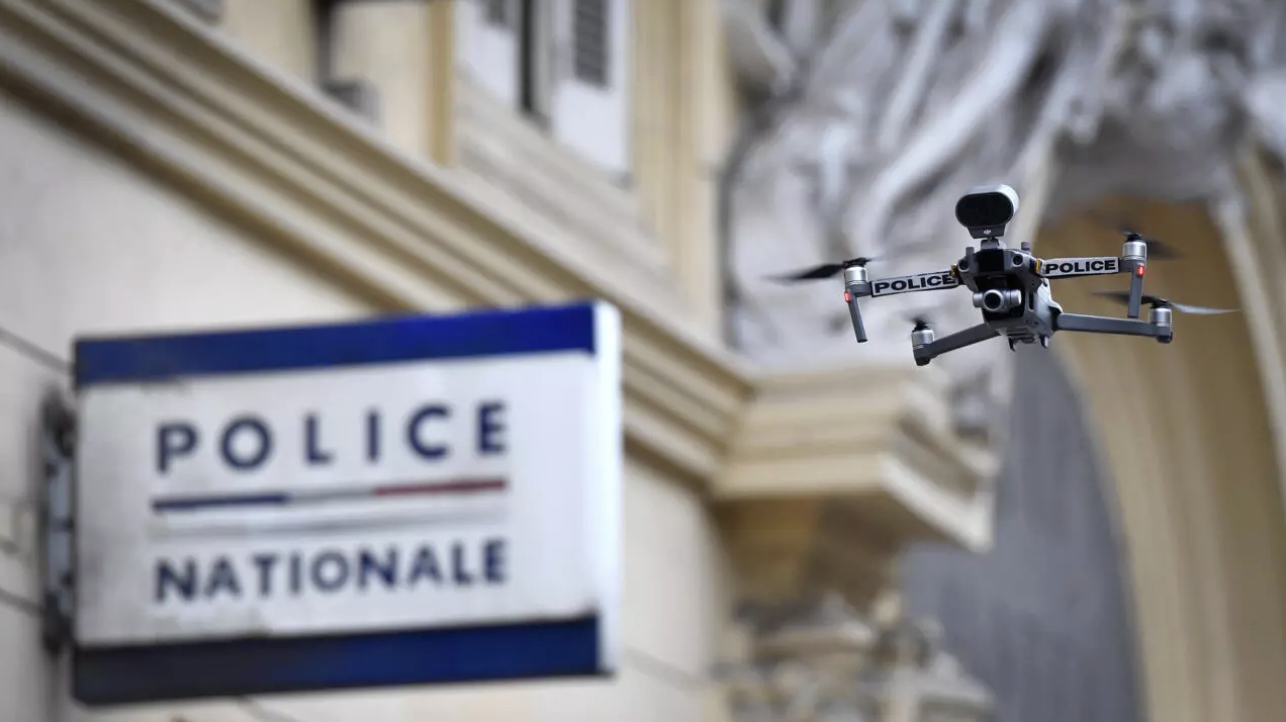
A steady influx of new laws since 2017 have reinforced France’s legal arsenal to fight against terrorism and expanded the reach of the intelligence services and the military. In this timeframe, major events, such as the Olympics and the Covid pandemic, have provided unique contexts that have accelerated an overall restriction on individual freedoms. In the past three years, a 2021 law obliged charities receiving public subsidies to sign a “commitment contract”, reinforcing compliance with the principles of the Republic; a 2022 law authorised the use of surveillance drones on internal security grounds; and a 2023 law, brought in for use during the Olympics, allowed the use of algorithmic video surveillance on an experimental basis until March 2025.
“First they say it’s experimental, then it becomes normal,” says Tehio. “It’s a maddening engine of repression that never has enough. First it's drones, then AI, then facial recognition. For a long time we pointed the finger at China and said it was a dictatorship [for using such surveillance methods], but now France finds itself doing the same thing.” The government insists that such measures are necessary to counter terrorism, which is still a high-level threat in France, according to the intelligence services.
The director of France’s anti-terror unit, la Direction générale de la sécurité intérieure, said in February 2025 that 79 planned attacks had been prevented in France since 2015. “It’s a standard bit of rhetoric from the interior ministry. These measures were initially intended to ‘remove doubts' and in practice they are often not directly linked to imminent threats,” says Klausser. “The existence of these measures clouds the classic boundary between administrative and criminal law. The State is drawing on the same mechanisms used in former colonies or immigration law to neutralise its internal enemies,” he adds.
The researcher notes the potential danger of a future far-right government being tempted to expand the scope of individuals targeted by such tools. But the far-reaching power of the judiciary is increasingly woven into life in France, even for law-abiding citizens. An Amnesty International report found that of around 11,000 people arrested during France’s Yellow Vest protests in 2018-19, just 3,000 led to convictions.
When President Emmanuel Macron was travelling the country in spring 2023 amid contested pension reforms, protesters who wanted to show opposition by banging pots and pans were blocked from approaching areas where the president might have been. "The risk is that we become accustomed to the loss of freedom, surveillance and an increasingly authoritarian state,” says Tehio. “It’s a dangerous trend that is currently under way, leading towards the dismantling of all dissent. Many people are now giving up on protesting, including advocacy organisations. We are in the process of diminishing our democracy.” Read more - Lire plus
| | OTHER NEWS - AUTRES NOUVELLES | | ICLMG ACTIONS DE LA CSILC | |
NEW The Justice Minister must end the injustice against Hassan Diab!
| | |
In April 2023, despite clear exculpatory evidence, the French Court of Assize conducted an in absentia trial that unjustly declared Dr. Hassan Diab guilty and sentenced him to life in prison. The proceedings amounted to a sham trial and a mockery of justice.
Since that ruling, Dr. Diab and his family have lived in constant uncertainty, facing the ongoing threat that a second extradition request could be made at any time.
Please click below to send a new letter demanding that Justice Minister Sean Fraser categorically refuse any future extradition request and put an end—once and for all—to this ongoing miscarriage of justice.
| | |
UPDATED: The government has now introduced Bill C-12, the Strengthening Canada’s Immigration System and Borders Act. This new bill simply copies over C-2's anti-migrant and anti-refugee provisions. At the same time, Bill C-2 - with its privacy-violating measures absent in C-12 - will continue through Parliament.
Please send a quick email to your MP, the Public Safety Minister, the Justice Minister, the Immigration Minister and the Prime Minister urging them to withdraw these dangerous bills. Thank you!
| |
Canada: Abolish rights-violating terrorist entities list!
| | |
On October 15, 2024, the Canadian government placed the Samidoun Palestinian Prisoner Solidarity Network on Canada’s terrorist entities list. While ostensibly a tool to protect the safety and security of people in Canada and internationally, the list is an arbitrary political tool that undermines freedom of association, of expression and due process in the courts. Its effectiveness as a national security tool has never been demonstrated in a manner that justifies its use.
Due to these deep flaws, and more, the ICLMG has consistently called for the list to be abolished since the Canadian coalition’s founding in 2002. Please join us in urging the Canadian government to abolish the rights-violating terrorist entities list once and for all. Thank you!
| | Canada must repatriate all Canadians detained in NE Syria now! | Every day the government fails to bring these Canadians home, it places their lives at risk from disease, malnutrition, violence, and ongoing military conflicts. United Nations officials have even found that the conditions faced by Canadians in prison are akin to torture. Please click below to urge the federal government to repatriate all Canadians illegally and arbitrarily detained in northeast Syria without delay. | | 22 years of fighting deportation to torture: Justice for Mohamed Harkat Now! | | CSIS isn't above the law! | | |
In recent years, at least three court decisions revealed the Canadian Security and Intelligence Service (CSIS) engaged in potentially illegal activities and lied to the courts. This is utterly unacceptable, especially given that this is not the first time these serious problems have been raised. CSIS cannot be allowed to act as though they are above the law.
Send a message to the Public Safety Minister demanding that he take immediate action to put an end to this abuse of power and hold those CSIS officers involved accountable. Your message will also be sent to your MP and to the Minister of Justice.
| | Reform Canada's extradition law now! | |
Canada’s extradition system is broken. One leading legal expert calls it “the least fair law in Canada.” It has led to grave harms and rights violations, as we’ve seen in the case of Canadian citizen Dr Hassan Diab. It needs to be reformed now.
Click below to send a message to urge the Prime Minister, the Minister of Justice and your MP to reform the extradition system before it makes more victims. Thank you!
Version française: Le Canada doit réformer la loi sur l'extradition!
| | Canada must protect encryption! | |
Canada, with other G7 nations, continues to push to weaken our access to strong, reliable encryption, after decades of being supportive of strong encryption. We need encryption to safeguard our data, our online transactions, our communications, and to protect the lives of journalists and human rights activists.
Please send a message to the Prime Minister of Canada, the Minister of Public Safety, as well as your Member of Parliament, to urge them to reverse course and once again commit to protecting encryption.
Regardez la vidéo avec les sous-titres en français + Agir
| | Protect our rights from facial recognition! | Facial recognition surveillance is invasive and inaccurate. This unregulated tech poses a threat to the fundamental rights of people across Canada. Federal intelligence agencies refuse to disclose whether they use facial recognition technology. The RCMP has admitted (after lying about it) to using facial recognition for 18 years without regulation, let alone a public debate regarding whether it should have been allowed in the first place. Send a message to the Prime Minister and the Public Safety Minister calling for a ban now. | | What we’ve been up to from January to May 2025 and our plan for the rest of the year | |
ICLMG 30/05/2025 - Thanks to the support of our members and donors, here is what we were able to work on so far in 2025 :
- Open letter to the new Prime Minister and government
- 2025 federal election and National Security Info Card
- C-20: First independent watchdog for the CBSA
- C-27: Digital Charter Implementation Act, 2022
- Online Harms
- Foreign Interference
- Combatting Racism & Islamophobia
- Canada’s terrorist entities list
- Palestine and the right to dissent
- Impacts of Counter terrorism financing
- Hassan Diab & Extradition
- Civil Society Coalition on Human Rights and Counter-terrorism
- And more!
What we have planned for the rest of 2025!
We have our work cut out for us! In response to threats of tariffs and annexation from the Trump administration, the Canadian government has problematically committed to the rapid expansion of border security, surveillance and information sharing with the US, and expanded the use of rights violating anti-terrorism tools. We also cannot ignore the US crackdown on protesters and migrants under the guise of fighting terrorism and protecting national security. We need to ensure that Canada disentangles itself from the US national security regime, resists US pressure to expand surveillance and counter-terror powers and tools at the expense of our civil liberties, and increases protections for privacy, dissent, migrants and asylum seekers.
We will continue our work on these issues and much more:
- Protecting our privacy from government surveillance, including facial recognition, and from attempts to weaken encryption, along with advocating for good privacy law reform
- Addressing the lack of regulation on the use of AI in national security
- Advocating for restrictions on Canadian information sharing with the US, including the application of the US No Fly List in Canada
- Campaigning for the repeal of secretive and rights violating national security lists, such as the Terrorist Entities List and the Canadian No Fly List
- Halting the rapid expansion of new security measures at the border and continuing to push back against the false narrative depicting migrants and refugees as security risks, and advocating for rights protection and accountability for border agencies, including by monitoring the creation of a new CBSA and RCMP watchdog agency
- Advocating with lawmakers and officials to protect civil liberties from the overall negative impact of national security
- Countering the escalating repression of free expression, dissent and protest in the name of “countering terrorism,” including the crackdown on protests in support of Palestinian human rights and against the genocide in Gaza. This includes countering new “bubble zone” laws at the municipal and federal levels
- Fighting for Justice for Mohamed Harkat, an end to security certificates, and addressing problems in security inadmissibility
- Fighting for Justice for Hassan Diab and reforming Canada's extradition law
- Addressing the impacts of measures to counter terrorism financing on civil society groups, including the CRA’s targeting of Muslim-led charities and restrictions and criminalization of the provision of international assistance and humanitarian aid
- Calling for the return of Canadian citizens and the non-Canadian mothers of Canadian children, who remain indefinitely detained in Syrian camps
- Pushing for restrictions on the implementation of new foreign interference laws
- Keeping you and our member organizations informed via the News Digest
- And much more! Read more - Lire plus
Share on Facebook + Instagram + Bluesky + Twitter
| | Les opinions exprimées ne reflètent pas nécessairement les positions de la CSILC - The views expressed do not necessarily reflect the positions of ICLMG. | | |
THANK YOU
to our amazing supporters!
We would like to thank all our member organizations, and the hundreds of people who have supported us over the years, including on Patreon! As a reward, we are listing below our patrons who give $10 or more per month (and wanted to be listed) directly in the News Digest. Without all of you, our work wouldn't be possible!
James Deutsch
Bill Ewanick
Kevin Malseed
Brian Murphy
Colin Stuart
Bob Thomson
James Turk
John & Rosemary Williams
Jo Wood
The late Bob Stevenson
Nous tenons à remercier nos organisations membres ainsi que les centaines de personnes qui ont soutenu notre travail à travers les années, y compris sur Patreon! En récompense, nous nommons ci-dessus nos mécènes qui donnent 10$ ou plus par mois et voulaient être mentionné.es directement dans la Revue de l'actualité. Sans vous tous et toutes, notre travail ne serait pas possible!
Merci!
| | | | |