|
International Civil Liberties Monitoring Group
Coalition pour la surveillance internationale des libertés civiles
November 23, 2024 - 23 novembre 2024
| |
Pamela Palmater: Canada’s National Security Practices Part of Genocide Against First Nations
| We launched our 20th anniversary publication "Defending Civil Liberties in an Age of Counter-terrorism and National Security" on Sept 11, 2024. You can read the full PDF or get a physical copy here. Over the next few months, we will be sharing two texts from the publication per News Digest to make sure they all get the attention they deserve. |
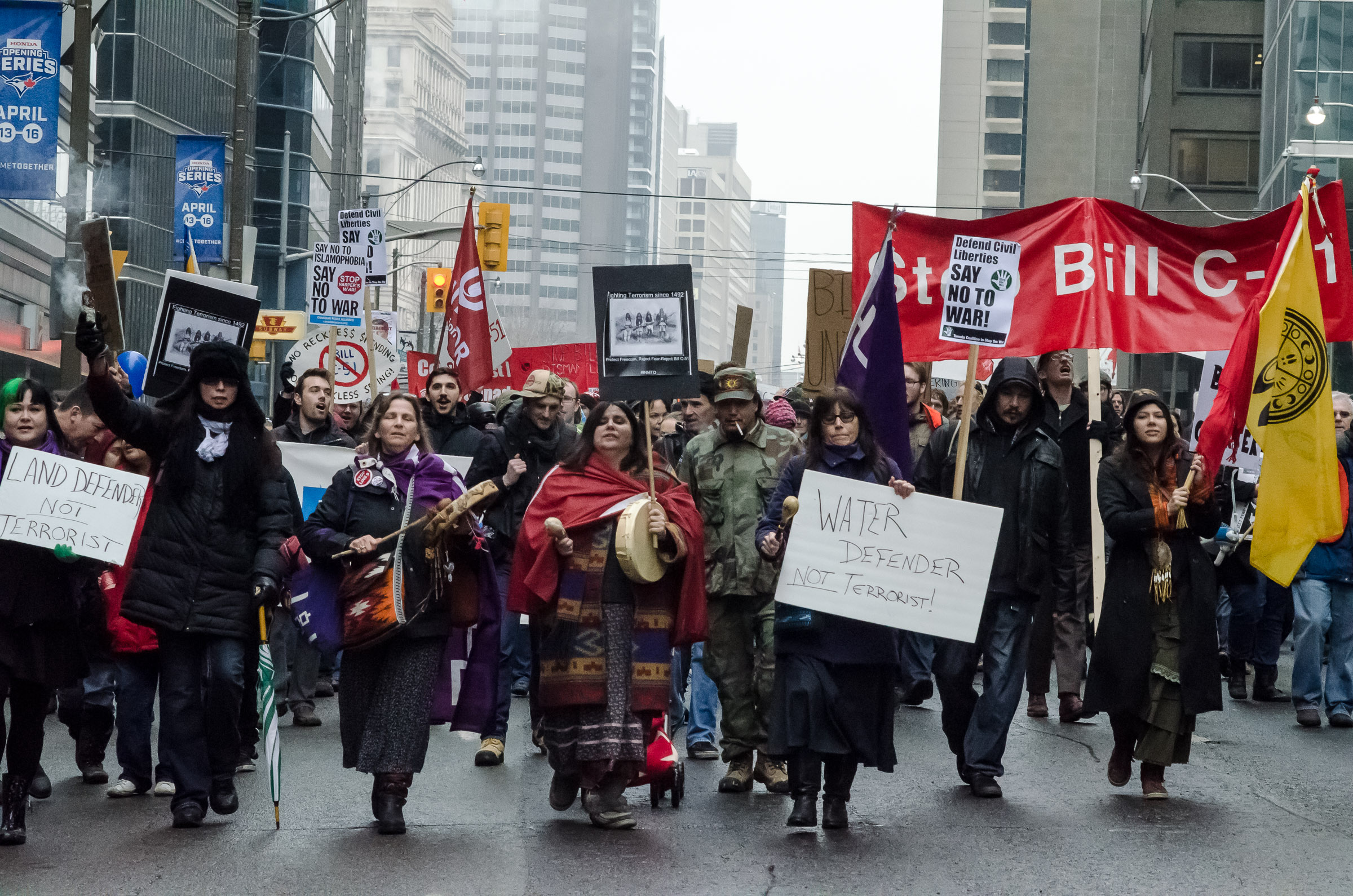
| |  | ICLMG 2024 - Throughout Canada’s relatively short history as a state, governments of all political stripes, together with the military, and various law enforcement and intelligence agencies, have treated First Nations as enemies – as threats to national security. From early colonial depictions of “Indians” as dangerous savages to modern-day intelligence assessments of First Nations as extremists, Canada’s national security policies have changed little in either purpose or impact. Far from protecting the safety and security of Canadians, national security laws have been designed to “secure” the state’s assertion of sovereignty and control over First Nation lands, resources and peoples. In other words, national security laws and policies are about protecting Canada’s economic interests in First Nations’ lands by any means, including sustained violent acts of genocide. Canada’s national security policy can only truly be understood in the context of its ongoing genocide against First Nations and the related economic interests.
While historical acts of genocide included deaths from scalping bounties, starvation policies, forced sterilizations, and Indian residential schools, the genocide continues today under different names: ongoing forced and coerced sterilizations and abortions; discriminatory underfunding of food, water and housing; the foster care system; overincarceration; forced assimilation under the Indian Act, deaths caused by racism in healthcare and police killings of First Nations people. These acts were, and are, all part of a comprehensive strategy to weaken First Nations, which includes laws and policies designed to destroy them socially, culturally, politically and legally, in order to “secure permanent access to Indigenous lands and resources for the settler population.” To this end, Canada has engaged in a “slow-moving” genocide which “has taken place insidiously and over centuries,” facilitated by a sustained “low-intensity warfare” against First Nations that continues into the present. National security laws, policies and practices over the years helped to keep track of both individuals and potential “hot spots” of collective resistance which might threaten Canada’s war efforts against First Nations.
The finding by the National Inquiry into Missing and Murdered Indigenous Women and Girls (National Inquiry) of ongoing genocide was met with both shock and outright denial by some commentators. They simply could not reconcile the political rhetoric with the lived realities of First Nations. Since genocide requires intent, it sounds incredulous when contrasted with Canada’s promises of reconciliation with First Nations, based on a nation-to-nation relationship that respects their inherent, Aboriginal and treaty rights. On the surface, it also seems to be in conflict with Canada’s vast array of human rights protections at the provincial, national and international levels. However, it is precisely this chasm between stated political objectives and actual state law, policy and practice that betray Canada’s ulterior motives. The National Inquiry found that:
Canada has displayed a continuous policy, with shifting expressed motives but an ultimately steady intention, to destroy Indigenous peoples physically, biologically, and as social units, thereby fulfilling the required specific intent element.
The actions of the state’s national security apparatus must be understood in light of this policy. Knowing that the state’s objective is to secure its economic interests and political power over First Nation lands helps us to understand how and why First Nations have been constructed as a threat. We can also better understand how other laws targeting, controlling, removing and criminalizing First Nations people, work hand in hand with national security laws. The Indian Act has a registration formula which guarantees the legislative extinction of ‘Indians’ (First Nations) over time – effectively removing them from their lands. Hunting, fishing, and timber laws and regulations severely limit First Nations rights to sustain themselves on their lands. We have literally had to “skulk around the forest like criminals” in order to survive. From scalping bounties on our heads to outlawing our cultural practices, the only way to survive centuries of genocide was to be “criminally Indigenous.”
The Criminal Code directly criminalizes various First Nation economic practices, including the tobacco trade and gaming on reserve as contraband, illicit and illegal. If you add to this the anti-First Nation racism built into law enforcement, especially the RCMP, then it should be no surprise that First Nations people are disproportionately targeted, brutalized, sexually assaulted, arrested, convicted and incarcerated by police forces at crisis levels. Despite Supreme Court of Canada cases, commissions, inquiries and reports calling out the crisis of racism against First Nations at every level of the justice system, it has been allowed to continue, and even to get worse. This is how the First Nation terror threat is manufactured and sustained by the state and its enforcement agencies: by criminalizing what it means to be a First Nations person, whether or not the individual actually poses any safety threat to society. The more arrests, charges, and convictions racked up by the state against First Nations people, the more they become “justified” targets of even more invasive state surveillance, monitoring, and control. Shooting First Nation suspects, incarcerating them, labelling them as dangerous offenders and/or placing them on permanent probation – all of these policies work hand in hand with national security laws.
There is no sign of this ending any time soon. Governments, law enforcement, military, intelligence organizations, and now, even private corporations involved in the extractive industry work together to surveil, control and suppress the rights of First Nations peoples to their lands and resources. There are countless examples of this. The Trans Mountain Corporation hired retired RCMP officers and security operatives while also working directly with the RCMP’s Community-Industry Response Group. The RCMP spied on First Nations opposed to Enbridge’s Northern Gateway pipeline using unnamed “industry reports”. Sharing intelligence on First Nations is a common practice between the RCMP and energy companies.
There is a similar problematic relationship between Coastal GasLink officials and the RCMP working together against First Nations. The RCMP effectively acts like publicly funded, private security for pipeline companies – even authorizing the use of “lethal overwatch” to shoot peaceful, Indigenous land defenders. Despite pleas from the United Nations Committee for the Elimination of Racial Discrimination to remove the RCMP and their weapons from First Nation territories, and halt all major projects until First Nations consent, all the projects continue. National security methods now include collusion with private corporations extracting the wealth from First Nation lands.
In case anyone is still asking why, the fact that the RCMP pension is invested in TC Energy – the parent company of Coastal GasLink – should help answer that question. In fact, Canada’s largest public pension plans are heavily invested in the extractive industry and specifically in fossil fuels. The Canadian state and indeed its law enforcement and spy agencies have a vested interest in the ongoing suppression of First Nations peoples, control of their lands and extraction of their resources – all under the guise of national security. If ever there is to be an end to genocide in Canada, it will require a massive overhaul of national security policy, starting with challenging the vested economic and political interests of the policymakers themselves.
_________________
Dr. Pamela Palmater is a Mi’kmaw lawyer, professor, and human rights expert from Eel River Bar First Nation. Source
Version française : Les pratiques du Canada en matière de sécurité nationale et leur contribution au génocide des Premières Nations
| |
Jen Moore: Canada and Criminalization in the War Over Land and Nature
| Le 11 septembre 2024, nous avons lancé notre publication 20e anniversaire « Défendre les libertés civiles à l’ère de la sécurité nationale et de la guerre au terrorisme ». Vous pouvez lire le PDF complet ou obtenir une copie papier ici. Au cours des prochains mois, nous partagerons deux textes de la publication dans chaque Revue de l'actualité pour nous assurer qu'ils reçoivent tous l'attention qu'ils méritent. | |
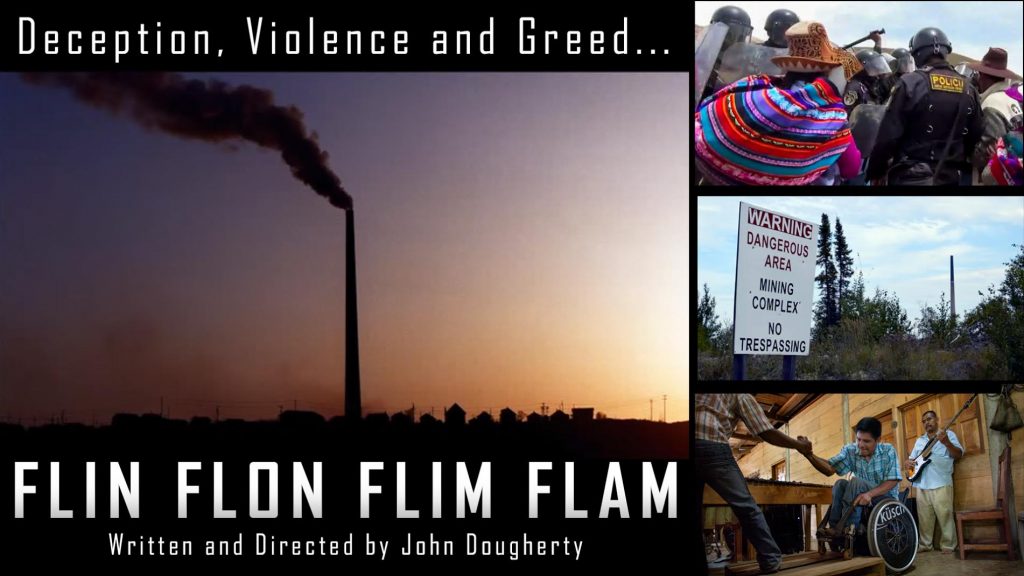
ICLMG 2024 - Almost five years ago, while working as Latin America Program Coordinator for MiningWatch Canada, I was declared a threat to public order and security in Peru and barred indefinitely from the country. My crime, and that of similarly-accused U.S. documentary filmmaker John Dougherty, was working with Peruvian organizations to show a film critical of Canadian mining company Hudbay to communities affected by its open-pit copper Constancia mine. The film, Flin Flon Flim Flam, presents critical testimony on this company’s operations from Manitoba to southern Peru.
Our case needs to be understood in the context of social control, repression and criminalization1 that communities and organizations living and working around the Constancia mine face regularly. Hudbay’s mine has given rise to numerous protests over unfulfilled agreements with communities, as well as environmental and social impacts. Community demonstrators have faced police repression and legal persecution at the hands of the Peruvian National Police, who had a security services contract with Hudbay at the time of these events. Such contracts have been common in Peru and are hotly criticized2 for putting police at the service of private interests, contributing to the high incidence of violent repression of legitimate protest, causing injuries and deaths.
Our case is part of a “concerted attack” throughout the Americas on environment and land defenders, “aimed at disciplining and quashing individuals and groups in diverse countries in the hemisphere where considerable gains have been made to stop or slow the accelerated expansion of this industry and the serious social and environmental impacts which it entails,” as MiningWatch and ICLMG wrote in the 2015 report In the National Interest?.3 This report examines how the law has been progressively turned against defenders to impose a destructive and often unwanted model of mineral extraction on communities and even on whole
countries. Using examples from Peru, Mexico, Guatemala, Ecuador and Canada, the report also illustrates how the Canadian government has played a strategic role through aid, diplomacy and trade policy to facilitate the massive expansion of Canadian mining interests in the region. Canada is exporting abroad the same extractive industry dependence that the Canadian settler colonial state was founded on and continues to perpetuate.
Even before we arrived in Peru in April 2017, we were defamed in the press as trying to “sabotage” Hudbay’s operations. During community screenings, police and Hudbay representatives questioned local community members about our presence, while police surveilled our movements. Following a screening in the city of Cusco, we were detained for four hours by more than 15 migration officers and plain clothes police who claimed they needed to verify our travel documents, but who sought to interrogate us instead.
The next day, Saturday, the Ministry of Interior issued a public communiqué declaring us to be a threat to public order, accusing us of inciting communities to violent protest against Hudbay’s mine, and stating that the company’s permits were in order. On advice from our lawyers that we were in danger of the authorities cooking up false charges and that we could continue the legal process from afar, we left Peru. On Sunday, Migration Services banned us from the country indefinitely. We never had the opportunity to defend ourselves and only became aware of this decision months later.
Peruvian courts have since found that these actions constituted grave violations of my rights, and that the decision to ban my re-entry to Peru is illegal and arbitrary. A 2019 decision further found that police and the Ministry of the Interior acted with bias as a result of the security contract between Hudbay and national police.
Despite this, and despite being a Canadian citizen and human rights defender working at the time for an organization that enjoys generous support of prominent human rights and legal organizations in both countries, Canadian officials utterly failed to provide meaningful support, going as far as to make false and misleading statements to UN bodies.
Canadian cooperation in the cover up for Hudbay
A new report from the Justice and Corporate Accountability Project (JCAP)4 analyzes hundreds of pages of government records obtained through access to information requests about Canada’s response before, during and after our detention. The report weighs up the response of Canadian officials to their own guidelines for supporting human rights defenders, Voices at Risk, and finds that the government failed miserably.
While MiningWatch’s appeals to Canadian officials – with support from many other organizations – received no reply, Canadian officials were obliged to reply to correspondence signed by four United Nations and three regional human rights bodies.
The UN letter expressed concern for my safety and sought information about Hudbay’s potential involvement in our criminalization. After a three-month delay, Canadian officials responded, avoiding the UN’s question about how it had implemented, or not, the Voices at Risk policy. Regarding the company’s role, they stated they were “not aware of any evidence that Hudbay Minerals was involved in the actions of Peruvian authorities in detaining and questioning Ms. Moore.” But this was both misleading and false.
In all of my communications with Canadian officials, including detailed letters endorsed by many other organizations, I provided information on how Hudbay personnel had questioned community members prior to our detention and on the company’s contract with police, which we believed – and which Peruvian courts have found since – led to biased police actions against John and I. Embassy officials also reviewed social media posts by Peruvian organizations making similar claims. On this basis and according to its own policies, Canadian officials should have exercised due diligence, but there is no evidence that they did. In addition, Duane McMullen, then Director General of Trade Operations and Trade Strategy for GAC, received an email from a Hudbay employee three days after our detention. This person expressed support for our criminalization by Peru, and this should have raised a red flag, but Canadian officials reported none of this in their response to the UN. JCAP concludes, “By protecting Hudbay and withholding the information referred to here, Canada not only failed to cooperate with the Special Rapporteur, it also undermined the Rapporteur’s ability to fulfill its mandate and take steps to protect a Canadian [human rights defender].”
Overall, the failures were numerous and systemic. They provide further evidence of how Canada’s clientelistic relationship with the mining industry corrupts its ability not only to fulfill its human rights obligations, but to hear the calls of environment and land defenders to abandon the extractivist economic model that causes so much harm and puts them in ever greater danger.
_______________
Jen Moore is now based in Mexico and an Associate Fellow with the Mining and Trade project at the Institute for Policy Studies. Source
Version française : Le Canada et la criminalisation dans la guerre pour la terre et la nature
| |
Senator Kim Pate, Alex Neve, Hadayt Nazami: Human rights matter for us all
| The recent death of a Canadian woman in a Turkish prison further underscores that all citizens who remain locked up in northeastern Syria must be repatriated immediately. | |
The Hill Times 11/11/2024 - When we met FJ and her six young children—all seven, Canadian citizens—in a detention camp in northeastern Syria in August 2023, it was immediately clear that their bonds were close. Not surprising, given that they were trapped in a lawless dystopia, abandoned by their government, and had no one else to turn to for survival.
Fourteen months later, FJ has mysteriously died in troubling circumstances in a prison in neighbouring Turkey, and the children have been in foster care in Canada for the past four months. There are many unanswered questions about how FJ died, what led up to her death, how this tightly connected family was forced apart, and Canada’s refusal to protect her and her children’s rights. That refusal likely led to the desperate course of action that ended in FJ’s death in a Turkish prison.
The federal government must immediately launch an independent investigation into the circumstances surrounding FJ’s death. Above all, FJ’s children have the right to know what happened to their mother. Canadians need to know why the citizenship of seven Canadians was callously disregarded. And Canadian officials need to understand what role government policies played in this tragedy. What happened to FJ further underscores that all Canadians who remain locked up in northeastern Syria must be repatriated immediately. That includes seven other Canadian children whose non-Canadian mothers we interviewed. The government says the children can come home, but their mothers have to stay behind. Once again, the prospect of families being torn apart.
This is part of a wider human rights travesty that has dragged on for years. After Syrian Kurdish forces—backed by the United States and other allies—ended the ISIS reign of terror in northeastern Syria, they were faced with more than 50,000 foreign nationals who remained in the region. Lacking capacity to review cases individually, everyone was rounded up. For years, women and children have been held in two detention camps, while men and teenage boys are locked up in jails. Charges have not been brought. Trials have not been held. And there is no legal process for challenging the detentions. Inflammatory headlines quickly and inaccurately labelled all prisoners as ISIS fighters and supporters, blaring that they deserve no one’s sympathy. It isn’t about sympathy, though; it is about upholding universal human rights. And the broad-sweeping accusations are simply wrong.
Yes, there most certainly are individuals responsible for heinous crimes among the prisoners. So why is nothing being done to ensure they face justice? More than half of the prisoners are children. No one is suggesting they were involved in terrorism. Women who were trafficked into northeastern Syria are among the prisoners, as are Yazidi refugees who fled from the horrors of ISIS genocide in Iraq. ISIS dissenters and opponents are also among the prisoners. This is where FJ and her children were locked up. This is where Jack Letts and at least eight other Canadian men are locked up. This is where the seven other Canadian children—between five and 12 years of age—remain locked up.
FJ, too, was told that her children could come home, but she could not. She was told that her views were too radical to allow her to return. She was effectively banished from her country, for which there is no basis in Canadian law. It became too much to bear. FJ escaped from the camp, intent on reaching a Canadian embassy where she could obtain a passport and travel home. She made the impossible choice to leave her children, hopeful that they would be repatriated, which they were. But it went terribly wrong. FJ was arrested in Turkey and charged with being a member of a terrorist group. Canadian consular officials visited her twice. Her Turkish lawyer says that the RCMP also met with her in prison, after which she was psychologically distressed. (The RCMP says it did not have any engagement with FJ in Turkey, and none since June 2023.)
There was hope again when a Turkish court acquitted FJ on Oct. 15. Two days later, she died in the middle of the night, while being held in an immigration holding centre. The human rights of FJ and her children were ignored at every turn. That neglect and abandonment continues for the Canadians still illegally held in cruel conditions. It cannot go on. FJ’s death must be independently investigated. Canadians must be brought home from northeastern Syria. Any allegations of terrorism or other criminality should be dealt with in our legal system. Human rights do not matter only when it is convenient or when we feel sympathetic. They matter always, and they matter for us all.
Independent Senator Kim Pate (Ontario); Alex Neve, senior fellow with the Graduate School of Public and International Affairs at the University of Ottawa; and immigration and human rights lawyer Hadayt Nazami were part of a humanitarian delegation to northeastern Syria in August 2023. Source
UPDATED Canada must repatriate all Canadians detained in NE Syria + Initiate an independent investigation into the death of Canadian citizen FJ now!
ACTION “Canadians are dying": Free Jack Letts & 19 Canadian Kids, Women & Men in Syria
| |
Canada must protect Hassan Diab from renewed smear campaign and death threats | |
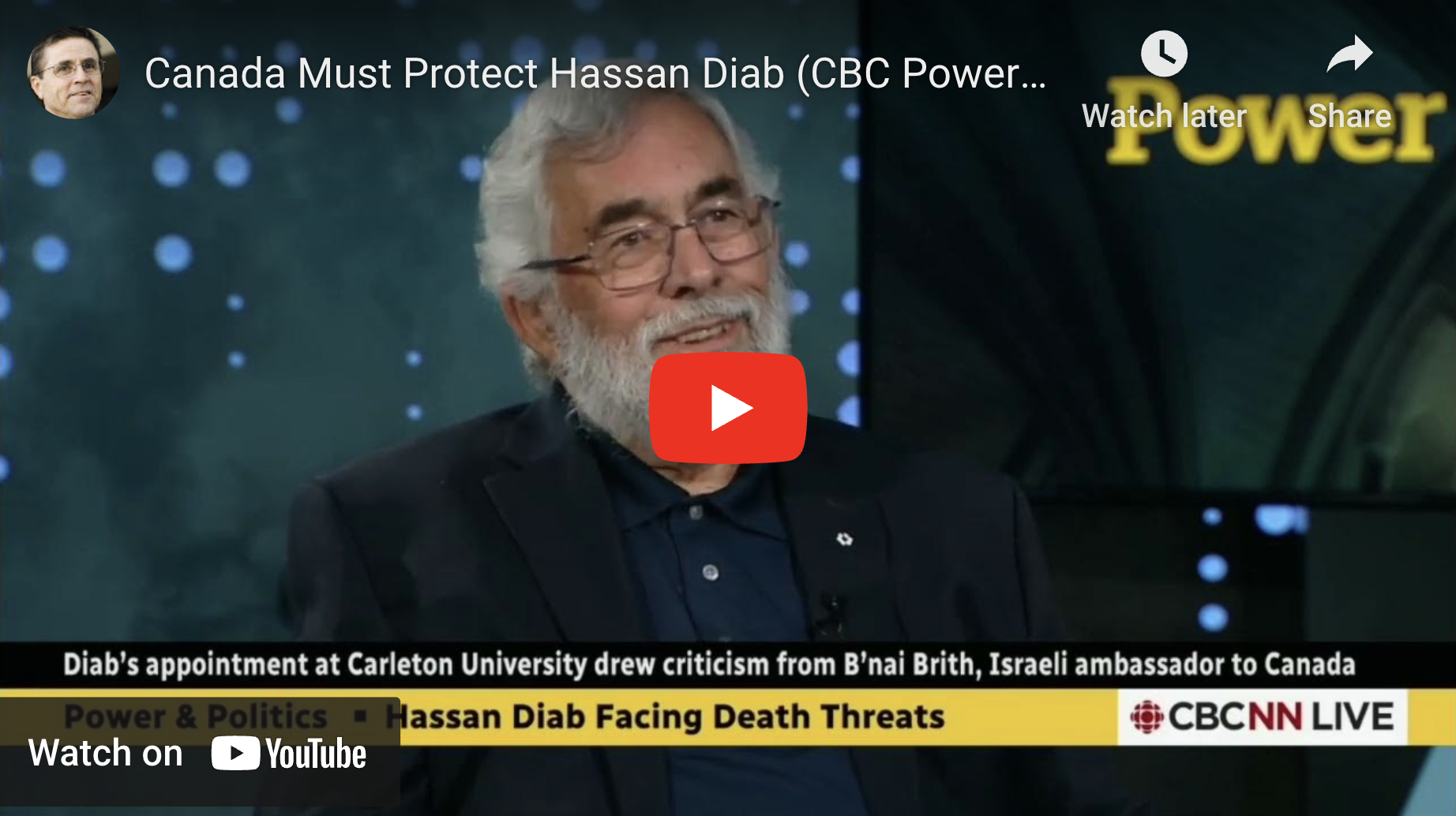
CBC Power & Politics 22/11/2014 - Hassan Diab’s lawyer, Don Bayne, and member of his support committee, Roger Clark, urge the Canadian government to protect Hassan Diab from death threats and a renewed organized smear campaign that misunderstand or misrepresents his case. The French court – desperate to pin the 1980 attack on someone – wrongly convicted Hassan Diab in April 2023, following a very short and unfair “trial.” It relied on disproven and debunked “evidence” and ignored all disculpatory evidence – including proof he was in Lebanon at the moment the crime he was convicted of was happening in Paris – which had led to an order from a French investigative judge for his release and return to Canada in 2018.
Please watch the interview for more details, take action below and share widely! Watch - Visionner
ACTION Canada must take immediate action to end the injustice against Dr. Hassan Diab
| |
CSIS did not want Abdelrazik to return to Canada, former diplomat tells court | |
CBC News 18/11/2024 - The Canadian Security Intelligence Service's objective was to keep Abousfian Abdelrazik detained in Sudan, a former diplomat who worked on the case testified Monday in a hearing on the Montreal man's lawsuit against the federal government.
Scott Heatherington served as director of foreign intelligence at Foreign Affairs and has since retired. He continued his testimony Monday as part of Abdelrazik's multi-million dollar civil suit claiming the federal government arranged for his arbitrary imprisonment, encouraged his detention by Sudanese authorities and actively obstructed his repatriation to Canada for several years.
The federal government argues Canada did not urge Sudan to keep Abdelrazik in detention and is not responsible for his mistreatment. The now 62-year-old Abdelrazik was arrested in Sudan during a 2003 trip to visit his mother. He was interrogated while in custody by Sudanese officials and CSIS agents about suspected extremist links. He has denied any involvement in terrorist activity.
On Monday, Heatherington was shown emails spanning two decades that he exchanged with other diplomats working on the case, and with CSIS officials. In one exchange, a CSIS official — whose name was redacted from the documents shown in court — wrote to Heatherington to "make it crystal clear" that the service felt Abdelrazik was a terrorist.
"What threats would ensue if Abdelrazik is released? The same high level of threat he posed prior to his incarceration. What threat does he pose to Canadian interests while he is detained? None," reads the emails. During cross examination, Paul Champ, Abdelrazik's lawyer, suggested to Heatherington that the exchange shows "CSIS's top objective" was to see Abdelrazik remain in detention. "It's pretty clear the message," said Heatherington. "That was the message you understood from them," asked Champ. "I did," Heatherington responded.
Champ later took Heatherington through a memo he signed in the summer of 2004 about the ongoing case. "CSIS regards him as a dangerous terrorist and would prefer that he not return to Canada," the memo said. Questioned by Champ, Heatherington agreed that was CSIS's consistent position at the time.
Detention in Sudan was 'messy:' retired official
Heatherington was also questioned about Canada's communications with the Sudanese at the time. According to the agreed statement of facts in the case, Canada's head of mission in Khartoum, David Hutchings, was advised by Sudanese officials sometime around Dec. 18, 2003 that Abdelrazik likely was going to be released the following week.
The court has also heard how CSIS was planning another visit to Khartoum later that month. According to a memo written by Heatherington at the time and shown to the court on Monday, Foreign Affairs officials told the Sudanese that the CSIS visit "may be relevant to their decision whether or not to release him."
Heatherington testified that neither he nor Hutchings told Sudanese officials not to release Abdelrazik. "What's being communicated is they may take this as relevant to their decision whether or not to release him," he said. Champ suggested to Heatherington that Foreign Affairs was slow-walking efforts to secure Abdelrazik's release so that CSIS could continue to question him in Sudan.
Heatherington repeatedly told the court that Foreign Affairs's position called for Sudan to either charge Abdelrazik or release him. "That goes to the duality of Hutchings representing all of Canada. And we're mindful of protecting Canadians and protecting Abdelrazik," said Heatherington. "Both things are happening at the same time. And it's messy."
Abdelrazik was released to a halfway house in July of 2004 and detained for a second time by Sudanese officials in 2006. In April 2008, Abdelrazik sought refuge at the Canadian Embassy in Khartoum. He returned to Canada in 2009 after a judge ruled Ottawa had breached his constitutional rights by refusing to give him an emergency travel document. CSIS has denied claims it asked Sudan to detain Abdelrazik or intervened to keep him in custody. Abdelrazik was never charged with terrorism offences. In 2007, the RCMP cleared Abdelrazik, confirming publicly that it had no "substantive information" indicating Abdelrazik was involved in criminal activity. Source
Former CSIS official denies claim that spy agency tried to 'scare' diplomats working to free Abdelrazik
Lawyer Paul Champ: Other CSIS agent wrote in an email after Abousfian's release from arbitrary detention in Sudan: "so much for jail forever"
Feds want to censor transcripts of Abdelrazik trial over national security concerns
| |
CCLA on the Federal Cybersecurity Bill: Cybersecurity Should Not Undermine Civil Liberties | |
CCLA 15/11/2024 - Cybersecurity is an essential part of national security. The digital ecosystem in which we increasingly live our lives needs to be safe, reliable, and secure from threats.
However, cybersecurity should not undermine civil liberties.
The work accomplished by the Standing Committee on Public Safety and National Security on Bill C-26, An Act respecting cyber security, amending the Telecommunications Act and making consequential amendments to other Acts, did address some of the civil liberties concerns associated with this bill.
Several issues still need to be tackled. In its submission filed on November 13, 2024, CCLA urged the Standing Senate Committee on National Security, Defence and Veterans Affairs currently considering Bill C-26 to address key outstanding concerns.
These issues are detailed in a joint civil society submission endorsed by CCLA. Several civil society organizations and experts are calling on the Senate Committee to amend Bill C-26 to:
(1) prohibit the government from undermining encryption and communications security;
(2) ensure that government orders cannot remain secret indefinitely;
(3) address significant privacy shortcomings in the bill; and
(4) ensure that all government departments and agencies use information obtained under Bill C-26 exclusively for the cybersecurity and information assurance activities for which the information is collected.
The recommended remedies address pressing concerns likely to undermine public trust while still enabling the legislation to fulfill its stated goals: bolstering cybersecurity across the financial, telecommunications, energy, and transportation sectors, and helping organizations better prepare, prevent, and respond to cyber incidents.
CCLA’s submission and the joint civil society submission on Bill C-26 can be found here. Source
| |
Joint letter: Urgent changes needed to Canada’s Temporary Residence Visa Program for Gazans | |
|
Amnesty International Canada 19/11/2024 - More than 40 civil-society organizations have signed on to a powerful open letter to the Canadian government calling for urgent changes to the Temporary Residence Visa for Gazans with extended family in Canada.
The full text of the letter is below, followed by the list of current signatories. The list will be updated as more organizations sign on to the letter.
To: Prime Minister Trudeau, Minister Miller, Minister Joly, Deputy Minister Kochhar, and Deputy Minister Morrison:
We, the undersigned organizations, movements, and collectives across Canada, demand that our government exercise its moral duty and act on its public commitments to support Palestinians fleeing Israel’s relentless military campaign in the occupied Gaza Strip.
In December 2023, almost 3 months after the start of Israel’s assault and siege on over 2 million Palestinians in Gaza, Immigration, Refugee, and Citizenship Canada (IRCC) announced the launch of a Temporary Residence Visa Program for Gazans with Canadian Family Ties, “Crisis in Gaza: Special measures for extended family”; 10 months later, it is unclear whether the program has facilitated the exit of any Palestinians from Gaza.
The Canadian government has the capacity and ability to expedite approvals and immediate exits of Palestinians from Gaza. We know this because, in 2022, the Government of Canada launched the Canadian-Ukraine Authorization for Emergency Travel (CUAET) to help Ukranians fleeing the Russian invasion find safety in Canada. Over two years, more than 900,000 applications were approved through this program, approximately 80% of the 1.1 million received; in all, nearly 300,000 people arrived in Canada thanks to the CUAET program.
The Government appears to be choosing to abandon Palestinians in Gaza, including Canadians who have Palestinian families. The Special Measures program requires applicants to have a passport to apply, something difficult to obtain given the wanton destruction and near eradication of the civil infrastructure in Gaza, including civil registries. The program also requires applicants to travel to Egypt to receive biometrics, despite the fact that both travel within Gaza and exit opportunities are incredibly dangerous and prohibitively expensive. Palestinians who have spent every cent they have to survive, who have crowdfunded tens of thousands of dollars to flee to Egypt, are now further expected to cover the significant cost of obtaining biometrics and travel documents.
Anti-Arab, and specifically anti-Palestinian racism, saturates every aspect of the Special Measures program: Palestinians are denied access to financial or other forms of government support. They are required to submit to invasive and retraumatizing questions as part of intense security checks. After all that, Egyptian and/or Israeli approval is needed before they can travel to Canada. While Canada does not directly control whether someone can exit Gaza, it can help to facilitate such exits through diplomatic pressure and it has chosen not to do so.
The Special Measures program has been designed to fail. As of September 13th, Canada has received nearly 9,000 applications through the program, yet only submitted a list of 500 names from those applications to the Coordinator of Government Activities in the Territories (COGAT).
The situation is desperate. In July 2024, a study in The Lancet estimated that 186,000 Palestinians had been killed in Gaza alone since October 7th, either from direct military action or from starvation, malnutrition, disease, exposure, and lack of access to medical facilities or supplies. Those who successfully fled to Egypt, struggle to access essential services such as healthcare and education; their Palestinian documents make them ineligible for most jobs, to open bank accounts, or to travel.
National and international support is minimal, and while community aid is striving to fill the gap, many live hand-to-mouth with no idea what their future will hold. Based on the number of applications to the Special Measures program, nearly 9000 people are trapped in limbo, awaiting a decision; given their difficulty in accessing shelter, jobs, housing, and healthcare, we can only imagine how many lives have been lost due to Canada’s institutional anti-Arab, anti-Muslim, and anti-Palestinian racism.
Canada’s Immigration Levels Plan for 2024-2026 seeks to support family reunification and respond to humanitarian crises. In furtherance of these laudable goals, Canada has created humanitarian pathways for civilians fleeing conflict, including Gazans. Now, we’re asking that Canada act without delay to ensure that Gazans can actually arrive safely in Canada.
As Canadian organizations and initiatives, and as concerned citizens, we call on the government to take the following urgent steps:
1. The Minister of Immigration, Refugees and Citizenship Canada must immediately reform the following systemic barriers in Canada’s Special Measures program as identified by the Canadian families of Palestinians trying to flee Gaza:
- Provide an option to waive biometric requirements or increase support options for applicants seeking biometrics;
- Be prepared to issue single-entry documents to those who meet all requirements but lack travel documents due to the destruction of civil infrastructure;
- Offer exemption from a medical exam until 90 days after arriving in Canada;
- Lift the cap on accepted entrants completely;
- Through increased diplomatic pressure on Israel and Egypt, help to facilitate the exit of Palestinians from the respective countries;
- Reduce the disproportionate burden of the Special Measures program security vetting process, specifically the sharing of social media and contact information.
2. The Minister of Foreign Affairs and Global Affairs Canada must explore alternative exit opportunities and immediate evacuation support options for the Palestinians currently on the Special Measures program list.
3. The Minister of Immigration must offer an immediate Permanent Resident pathway for Palestinians with family in Canada.
4. The IRCC must provide immediate settlement services, including facilitation for housing, employment, and integration, as well as eligibility for comprehensive provincial/territorial health coverage during their stay in Canada. While welcome, the financial assistance measures announced on October 16 are inadequate.
It is our responsibility as a nation to uphold our moral obligations to Palestinians fleeing conflict in the occupied Gaza Strip. On September 17, 2024, Minister Miller said in a statement regarding Canada’s migration pathways that “we remain committed to our long-standing humanitarian tradition of helping the world’s most vulnerable people.” If that sentiment remains true, it is time for the Canadian government to demonstrate it through effective and equitable measures. Source
UN Special Committee finds Israel’s warfare methods in Gaza consistent with genocide, including use of starvation as weapon of war
Prime Minister Trudeau stated Canada would recognize the ICC arrest warrants. That means, in theory, that Netanyahu and Gallant could be arrested if they stepped foot in Canada.
Ligue des droits et libertés: Génocide colonial en Palestine : le Canada doit respecter ses obligations
Human Rights Watch: “Hopeless, Starving, and Besieged” Israel’s Forced Displacement of Palestinians in Gaza
CJPME welcomes Canada’s UN votes on Israeli settlements and Palestinian refugees
| |
Four pro-Palestinian protesters arrested for allegedly blocking road | |
|
Ottawa Citizen 19/11/2024 - Ottawa police have arrested four pro-Palestinian protesters for allegedly blocking a downtown street during a demonstration on Monday evening.
Police said Tuesday demonstrators gathered on Elgin Street at approximately 5 p.m. the night before “and were advised by the Police Liaison Team members multiple times that they would need to limit their demonstration to the sidewalk and not obstruct traffic.”
Demonstrators did not comply, police said. Pro-Palestinian protests and marches have become a mainstay on the streets of downtown Ottawa for more than a year, since the Oct. 7, 2023 Hamas attack on Israel, and Israel’s subsequent retaliation, escalated the ongoing war in the region. Hundreds of Pro-Palestinian demonstrators have routinely gathered at the human rights monument on Elgin Street and marched through the streets of downtown Ottawa and the ByWard Market, flanked by police.
Sarah Abdul-Karim, an organizer with the Palestinian Youth Movement, said typically, the protesters’ police liaison tells police where the group plans to march shortly before the demonstration starts.
“We didn’t do anything different from what we do in the usual protest. But the response from police was different,” she said.
“From the second we showed up at the human rights monument there were massive amounts of police. They refused to let us take the streets to march, although we were too many people to fit on the sidewalk.” Abdul-Karim says police told the protesters they needed to give police advanced warning of their plans, something they’ve never required previously. Police also told organizers their numbers were too low to take the streets, though in the past, protesters have marched with even smaller groups, she said.
This newspaper asked OPS why protesters weren’t allowed to march on the street, and a police spokesperson said police make decisions “based on public safety and traffic impacts to the community.”
Abdul-Karim says the group had planned to march by office buildings of companies that have business dealings with Israel’s military, and opted to protest on the sidewalk, per police’s instructions. But as they marched, some of the large group split at a crosswalk and spilled out onto the road.
“If someone stepped slightly outside they would push us, shoving bikes into people,” she said. “They lifted up their bikes, pushed the wheels into people. Some people put their hands up to protect themselves from the bikes, and they arrested those folks.” Videos posted to social media show OPS officers pushing their bike tires and handlebars into the crowd, and at least one person being arrested.
The police press release says protesters began marching but “quickly turned north on Metcalfe Street and took over the street,” and “despite repeated orders from police and dialogue with PLT (police liaison team) members at that location, the demonstrators remained and interactions between police and demonstrators began.”
Josh Lalonde, Ali Nasser-El-Dinne, Ayman Fadil and Hassan Hamed appeared in court Tuesday afternoon. They each face charges of mischief, obstructing a peace officer, and participating in an unlawful assembly. Crown attorney Moiz Karimjee alleged their actions the following evening “exceeded the bounds of lawful protest.”
All four were released on bail, and are banned from communicating with each other. They’re also forbidden from attending, organizing or participating in protests relating to the conflict in the Middle East, and aren’t allowed to wear masks in public, unless medically required. Additionally, Nasser-El-Dinne was given a weapons prohibition. After the four were arrested, the protesters gathered at the OPS headquarters on Elgin Street. There, protestors received a $490 noise infraction bylaw for using a sound system.
In an email statement to this newspaper, Roger Chapman, the city’s director of bylaw and regulatory services, said bylaw officers were called to police headquarters for a noise complaint, and protesters were “unlawfully using speaker systems, whistles and horns.” Officers initially provided a verbal warning to organizers and then conducted multiple noise readings, showing sound levels of more than 95 decibels, he said.
The city’s bylaw officers have “educated the organizers of the protests numerous times in the past about the regulations prohibiting the use of speakers on City property,” he said. “Continued failure to follow officers’ instructions will result in further enforcement action.” In the past, the city has levied noise bylaw tickets against pro-Palestinian protesters, but haven’t been giving out tickets in recent months.
Earlier this year, a coalition of more than 50 community groups called for city hall to protect protesters from being fined for noise violations while using megaphones and speakers at protests. It came after the city handed out more than $23,000 worth of tickets to protesters at pro-Palestinian demonstrations, rallies for transgender youth, picket lines for striking workers and climate change protests. Abdul-Karim said she took the $490 bylaw ticket and the group intended to continue to use their sound system, as they have done at prior protests, was threatened with arrests and charges of mischief.
“The messages we’re getting are mixed, and all very aggressive,” she said. “It was really really messed up, the way they treated us.” As the group protested at the police headquarters, there were also online calls for people to flood police phone lines. Police say its communication centre received “some frivolous calls on 911 and other, non-urgent phone lines.” Police said on social media that further charges may be laid as the investigations continue, and police are also investigating “those who engaged in public mischief by flooding police phone lines with calls.” Source
Video: Ottawa police ram into protesters and slam us to the ground
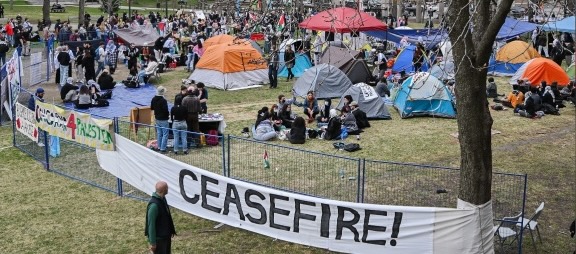
NEW Ottawa Protest for Palestine and Lebanon: We will NOT be silenced! Sat Nov 23 at 2pm
Ottawa city council passes motion to study 'bubble' bylaw, despite skepticism from councillors
IJV event Student Encampments Spring 2024 -Lessons for the Future
UPDATED Tell Canada: Stop building the F-35s that Israel is using to commit genocide
Global coalition of NGOs call for immediate ceasefire in Lebanon
CJPME: Speaker Greg Fergus' decision to ban watermelon pin from the House of Commons is deeply wrong and should be reversed
Canada’s Double Standard: The Politicized Terror Designation of Samidoun
| |
The Most Dangerous Domestic Antiterrorism Bill Since The PATRIOT Act | |
|
Forever Wars 15/11/2024 - A proposed amendment to the tax code empowering the government to effectively defund non-profits by labeling them “terrorist supporting organizations” quietly slithered through the House of Representatives unchecked until arriving on the floor this Tuesday.
Proponents of the anti-charities bill, H.R. 9495, exploited the aftermath of Donald Trump’s reelection to fast-track the legislation using a procedure that required a two-thirds majority. Fortunately, a broad coalition of nonprofits sounded the alarm and enough Democrats woke up to defeat the bill—although, shamefully, 52 of them still voted to give the second Trump administration an authoritarian’s ideal housewarming gift. House Republicans appear to be gearing up for another vote as early as next week, one that would require only a simple majority to send the bill on to the Senate. [It has now passed in the House and is heading to the Senate.]
As law, the anti-charities bill would be the most dangerous piece of domestic antiterrorism legislation since the PATRIOT Act. Even if it doesn't survive this lame-duck congressional session, the bill is certain to be reintroduced once the GOP trifecta is in place next year. The next bullet we'll have to dodge is already in the chamber.
A Backdoor Domestic Terrorism List
There have been two major lines of attack on the bill. First, it is quite clearly a civil liberties disaster, permitting designation of charities as terrorist supporters without due process and on the basis of secret evidence. The Secretary of the Treasury would have unilateral power to designate a "terrorist supporting organization" and would not have to either explain or provide evidence for such a designation. Because no detailed explanation is required, any judicial review is reduced to a legal spell-checking exercise. Second, thanks to several decades of Global War on Terror authoritarianism, the government already has ample power to criminally prosecute charities on terrorism grounds. It can even seize charities’ assets without due process using sanctions laws. The bill is, on this view, redundant.
But being both draconian and redundant does not make the anti-charities bill pointless. On the contrary, it promises to solve a longstanding problem for the national security state. Despite decades of antiterrorism as a central organizing logic of government, there has never been a terrorism blacklist of domestic organizations in the United States, thanks to broad opposition—both right-wingers sympathetic to white supremacists and progressive civil libertarians object to the idea. But this bill would introduce precisely such a list, one designed to target anyone seen as supporting Palestinians, Muslims, Arabs while insulating white supremacist and other right-wing groups.
As FOREVER WARS readers may know, federal agencies maintain many lists of hundreds (if not thousands) of alleged terrorist organizations designated through processes that have long been criticized as opaque, unreviewable, and discriminatory. Because these mechanisms have been applied almost exclusively to foreign groups, courts have largely upheld them on the theory that the executive branch enjoys a comparatively free hand in dealing with international threats – but should pay heed to some constitutional safeguards domestically.
If resurrected, the anti-charities bill would essentially smuggle a domestic terrorism blacklist through the already-existing foreign ones. It would do that by creating a new tier to its terror-blacklisting system for nonprofits accused of providing "material support" to the groups already on most major international terrorism bans. The requirement of a tie-in to international terrorism—again, largely already coded as Muslim—is crucial for any bipartisan appeal. Liberal Zionists can support the bill to brandish their national security bona fides. Right wingers who rail against the "Deep State" can jump on the bandwagon knowing that white supremacist groups will be unaffected.
The other striking feature of the anti-charities bill is how it achieves most of its devastating effects indirectly – and for that very reason is more likely to survive any judicial scrutiny.
As mentioned above, the government already claims the ability to freeze the assets of U.S.-based groups without due process under the International Emergency Economic Powers Act. This power was used a handful of times in the early 2000s, most notoriously to shut down the Holy Land Foundation (HLF), the largest Muslim charity in the U.S. at the time. Yet targeting U.S. groups raises significant concerns under the Fifth Amendment’s prohibition against seizing property without due process, an area where some right-wing judges are particularly concerned about government overreach. I suspect this is why the few charities targeted in this way were either presented as U.S. branches of foreign organizations or, in the case of HLF, subsequently targeted in criminal investigations leading to asset forfeiture. (In other words, the feds seized the funds first and sprinkled some due process on the case years later.)
By contrast, the anti-charities bill does not seize anything. It merely revokes a group’s tax exemption, theoretically leaving it free to continue operating and even to raise funds. In reality, however, the stigma of being labeled terrorist supporters by the government will almost inevitably lead to ostracization by banks and other financial services providers, with the same end result, to say nothing of everyday donors.
The Revolution Will Not be Defunded?
The anti-charities bill is of course part of a longer story of the anti-Palestinian foundations of U.S. terrorism law, including the legacy of the HLF affair. For years now, Zionist groups have waged lawfare against American Muslims for Palestine (AMP), accusing it of being a continuation of the long-shuttered HLF and a front for Hamas. In the meantime, the U.S. government has conscripted nongovernmental organizations and municipalities in Palestine itself into implementing terrorism screening policies as a condition for receiving foreign aid, as detailed in geographer Lisa Bhungalia’s new book, Elastic Empire: Refashioning War through Aid in Palestine.
The sponsors of the anti-charities bill have made no secret of their desire to crack down on the ecosystem of U.S. nonprofits that over the past decade have tentatively mainstreamed Palestine alongside other social justice issues. The bill’s most important innovation—labeling domestic groups terrorists by connecting them to international ones—is an idea that has become increasingly prominent anti-Palestinian policy entrepreneurship in recent years. The right-wing Zachor Legal Institute coined the acronym “Domestic Terrorist Affiliate (DTA)” while calling for federal investigations into Black Lives Matter movement groups in 2020. The Heritage Foundation’s recently unveiled policy blueprint for crushing Palestine advocacy, Project Esther—a sort of anti-Palestinian Project 2025—refers to U.S. civil society groups and campus activists as a “Hamas Support Network (HSN).” It’s easy to dismiss these corny acronyms as crude propaganda, but they help to shape and saturate conversations about public policy in ways that lay the groundwork for more decisive action in moments of crisis.
The October 7 attacks, of course, provided the opportunity to put these long-percolating ideas into action. In November 2023, House Republicans invited testimony from the neoconservative Foundation for Defense of Democracies to support H.R. 9495. Although the hearing was ostensibly about campus anti-semitism, FDD’s testimony was notably a rehash of old allegations that AMP acts as a Hamas front, with only a single footnote attempting to link it to student activists.
While a civil suit against AMP has dragged on for years, and the Virginia attorney general has also opened an investigation into the group, the anti-charities bill threatens to effectively finish AMP off. And it won't just be them. Last month, the U.S. government, acting in concert with Canadian authorities, added Samidoun, a Vancouver-based organization dedicated to solidarity with Palestinian political prisoners, to a Treasury Department terrorism list, claiming that it operates as a front for the Popular Front for the Liberation of Palestine (PFLP). Should the anti-charities bill pass, any non-profit that might have worked with Samidoun in the past would also likely be in its cross-hairs.
After years of repression targeting first the leftist and then the Islamist currents within Palestinian politics, the anti-charity bill now directly threatens liberal U.S. organizations as well. Two Republican House committee chairs earlier this year sent a letter to Treasury Secretary Janet Yellen demanding information on 20 groups, from Students for Justice in Palestine (which isn’t even a registered non-profit) to liberal behemoths like the Open Society Foundations and the Bill and Melinda Gates Foundation. Here, the right is using the bipartisan appeal of anti-Palestinian racism and the tools of the War on Terror to pursue its broader assault on liberal institutions in its quest for cultural hegemony.
The attack on HLF in the early years of the Global War on Terror had dramatic chilling effects on Palestinian communities in the United States. It severely hampered political organizing in Palestine and throughout the diaspora. While the non-profit industrial complex has never been a revolutionary force, the anti-charities bill raises the stakes further and could dramatically shift the risk calculus of the foundation world when it comes to all things Palestine, with ripple effects for every other interlinked social justice cause.
As in so many other cases, hostility to Palestinian liberation is the tip of a spear aimed at liberal and left causes alike. For that reason, we should expect the right wing to continue pushing the anti-charities bill, and to find opportunities to replicate its logic in other ones. The only question is whether enough liberals will wake up to the threat in time. Source
US House passes bill targeting charities and pro-Palestine groups
From Campus to the Courts, the “Palestine Exception” Rules University Crackdowns
UK: 'My daughter was branded a terrorist'
UK crackdown on Palestine Action continues amid fresh arrests
| |
Homeland insecurity: the rise and rise of global anti-terrorism law | |
LSE 02/11/2024 – How did the ‘‘war on terror’’ bed down so easily? Why have seemingly endless anti-terrorism laws been tolerated by our supposedly liberal and democratic society? Professor Conor Gearty explores the answers from his latest book, Homeland Insecurity. He locates anti-terrorism laws in their historical, international and political contexts – starting with colonialism, taking off with the Cold War, and coming of age with Israel’s successful presentation of Palestine as a crisis of global terror. Conor Gearty is Professor of Human Rights Law at LSE Law School. Watch - Visionner
Read “Homeland Insecurity: The Rise and Rise of Global Anti-Terrorism Law” (Polity Press, 2024)
| |
|
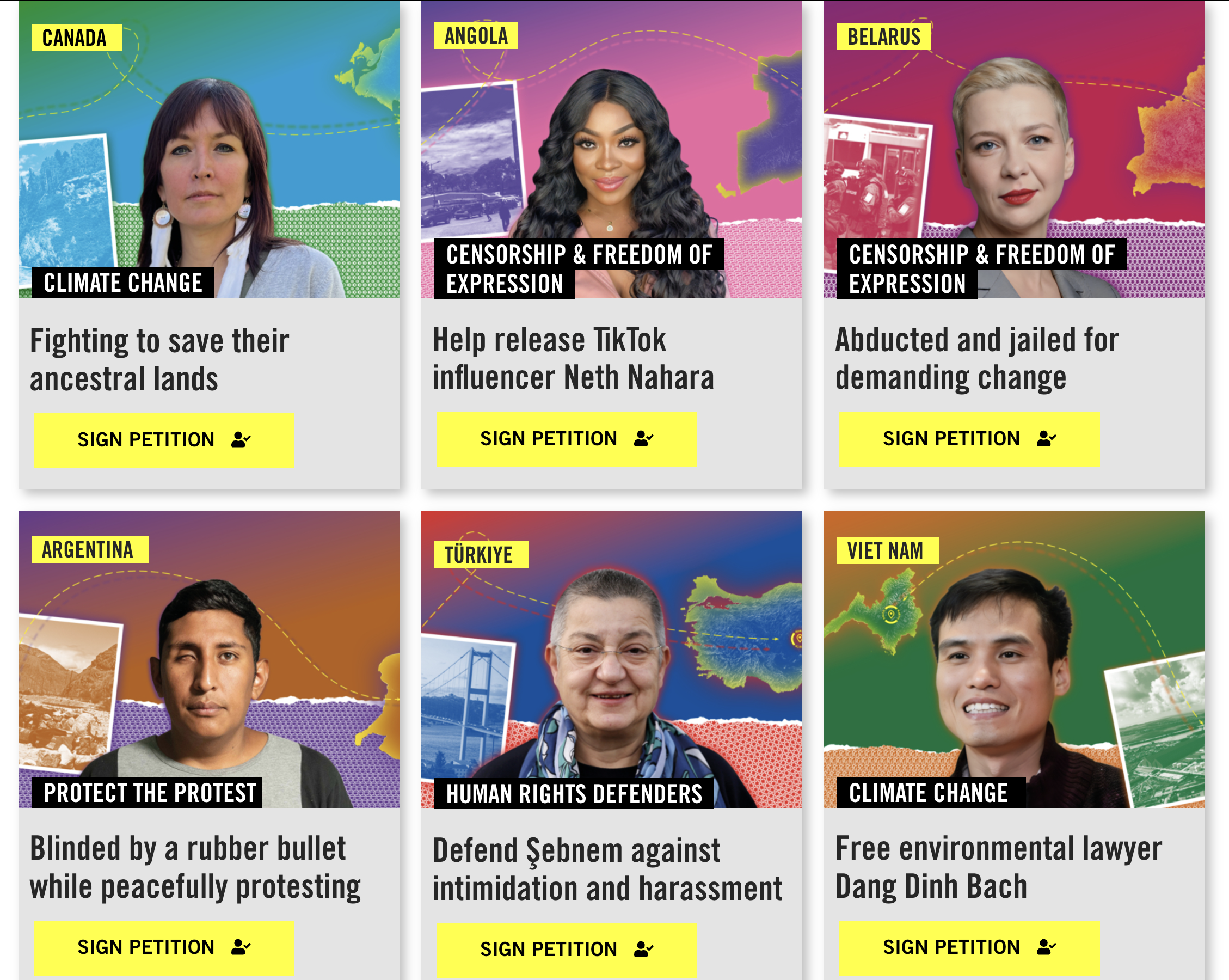
Amnesty Fall 2024 - For over 20 years, Amnesty International’s annual Write for Rights campaign has transformed the lives of people whose rights have been wronged.
Using the power of their words, hundreds of thousands of Write for Rights supporters in more than 200 countries have united behind a common purpose: together, we can change lives for the better.
Several of the people in this campaign have been harmed by police, detained, charged and/or imprisoned in the name of anti-terrorism or security simply for protesting or criticizing the authorities. Take action - Passez à l'action
| |
Special Rapporteur urges Security Council to renew humanitarian exemption to counter-terrorism sanctions | |
|
OCHCR 19/11/2024 - Renewing the humanitarian exemption to the Security Council’s counter-terrorism sanctions is essential to ensuring the live-saving flow of humanitarian relief to civilians in need, an independent human rights expert said today. Ben Saul, the Special Rapporteur on the promotion and protection of human rights and fundamental freedoms while countering terrorism, issued the following statement in advance of Security Council discussions in early December:
“I urge Security Council members next month to indefinitely renew the humanitarian exemption to the Council’s counter-terrorism sanctions.
In a widely welcomed move, in 2022 the Security Council adopted resolution 2664, which created an exemption to the assets freezes in all Council sanctions to allow funding, goods and services for humanitarian assistance or other basic human needs. The exemption was limited to two years for the Council’s counter-terrorism sanctions against Al Qaeda, the Islamic State in the Levant and their associates, under resolution 1267 (1999) and other resolutions. That exemption is shortly due to expire and will be reconsidered by the Security Council in early December 2024.
In the past two years, the exemption has vitally enhanced the flow of humanitarian relief to the 110 million civilians living in areas affected by counter-terrorism sanctions. These include conflicts in Afghanistan, Democratic Republic of the Congo, Iraq, Libya, Sahel, Syria and Yemen. The exemption has given legal and operational certainty, predictability and confidence to humanitarian actors, donors and the financial sector that humanitarian activities are lawful. Humanitarians have found it easier to make payments. Donors have been more willing to give funds. Bank ‘de-risking’ and over-compliance are less prevalent.
There is no evidence that the exemption has led to more diversion of humanitarian assistance to terrorist groups. Humanitarian organisations already have strong and effective measures in place to prevent aid diversion and are subject to stringent regulatory controls. The Security Council exemption only applies to highly professional, reputable organisations. Humanitarians share the interest of states in ensuring aid only reaches those in need.
In armed conflicts, international humanitarian law requires all states to facilitate the rapid and unimpeded delivery of humanitarian assistance. Counter-terrorism measures can never justify denying humanitarian relief to civilians. An indefinite renewal of the exemption is essential to permanently remove barriers to humanitarian action and to provide continuity, certainty and simplicity to all involved. An indefinite renewal would also enhance the legitimacy and credibility of the Security Council’s counter-terrorism efforts and reassert the Council’s commitment to international law, including human rights, humanitarian law and protection of civilians.” Source
| |
Spencer Ackerman: Biden's AI Spying Rules Are A Last Gift of Power To Trump | |
|
Forever Wars 18/11/2024 - [...] I thought of that when I saw that President Biden's team cobbled together rules for "national security" usage of artificial-intelligence tools shortly before leaving office. That guidance, released in late October, had an annex for the intelligence agencies and the military about what to do when using Americans' data for training these AI tools. Charlie Savage of the New York Times, an excellent reporter and a friend of mine, got that annex and presented it to readers last week, leavened by an interview with Josh Geltzer, the legal adviser to the National Security Council.
I want to mention here that I've known Josh for years and consider him a responsible, forward-thinking person, whatever our disagreements. But when I read lines in Charlie's piece like "The Biden legal team, Mr. Geltzer said, worried that applying [existing surveillance] privacy rules at the point when A.I. systems are acquired would severely inhibit agencies’ ability to experiment with the new technology," I think: Here we go again.
No matter how often the FBI and the NSA violate the rules, intelligence officials—and especially intelligence attorneys—frequently assert that those rules, and the broader process they uphold, are the difference between responsible surveillance and freedom-threatening spying. Yet whenever technological developments create new opportunities for surveillance, the surveillance-relevant agencies bemoan the unreasonable inhibitions that existing privacy laws or rules present. NSA Director Michael Hayden, when crafting the constellation of bulk surveillance programs known as STELLAR WIND and which live on as the Foreign Intelligence Surveillance Act’s (FISA) notorious Section 702, reasoned after 9/11 that rules for surveilling the internet shouldn't depend on laws written with telephonic communication in mind. The result is an institutionalized threat to your freedoms of association and from illegal search and seizure.
As you'll see from Charlie's story and the Biden guidance itself, the gist is that the intelligence agencies don't always have to consider themselves bound by rules about domestic intelligence collection when they acquire bleeding-edge ("frontier") AI tools that were trained using domestic data—the stuff that you and I generate when we engage in most of our economic and social activity, thanks to surveillance capitalism. Remember that without lots of collected data, an AI system can't "train" itself to function as advertised. The point of the order is to say that the intelligence agencies can experiment with frontier AI models purchased from AI companies, and then place a belt of procedure around it to call this usage lawful, even when it launders massive amounts of Americans' data collected without a warrant, because the AI vendors didn't need a warrant to acquire it. [Whether or not it’s even legal for private companies to collect the data necessary to train these tools in the first place is far from a settled question—Sam.]
In reading over this annex, when the intelligence agencies seek "to modify or augment" a frontier-AI model—that is, to train the model on privacy-protected data—they are to seek "guidance from the relevant General Counsel's office, Chief AI Officer, and senior privacy and civil liberties officials." Ask someone from a different office is what counts for checks and balances in intelligence work. And that's what the Biden annex recommends even for highly sensitive and potentially life-changing information harvested through FISA, including FISA Section 702. Intelligence agencies "should not modify or augment a FM using FISA-obtained or FISA-derived information without coordination with the Department of Justice and Office of the Director of National Intelligence," they intone. Read more - Lire plus
ACTION Canada: Remove the national security exemptions from Bill C-27!
The WIRED Guide to Protecting Yourself From Government Surveillance
Ken Rubin: Public Safety Canada’s dealing with natural and communication infrastructure disasters
Video: Deepfakes, AI and the Battle for Democracy
| |
America’s Shadow War in Yemen Has Its Own Racist Military Swag | |
|
The Intercept 12/11/2024 - While president-elect Donald Trump accuses the U.S. military of being too “woke,” a morale patch showcased on a Defense Department website suggests some troops are as bigoted as ever. While the military has covered up evidence of the patch, removing photographs of it amid press outcry, the Pentagon has not disavowed it.
In late October, the website of the Defense Visual Information Distribution Service — the Pentagon’s official photo repository — posted a photograph highlighting the shoulder patch of Lt. Kyle Festa, a pilot assigned to the Navy’s Helicopter Maritime Strike Squadron 74. Festa’s patch features crosshairs over likenesses of the Tusken Raiders, the fictional “sand people” who attacked Luke Skywalker in the 1977 movie “Star Wars.” The patch reads: “Houthi Hunting Club. Red Sea 2023-2024.”
The insignia commemorated his deployment aboard the USS Dwight D. Eisenhower in the Red Sea, according to the photo’s caption. Since January, U.S. warships in the Red Sea have repeatedly struck the Houthis, a nationalist movement that controls much of Yemen and has been attacking ships — including U.S. warships — there and in the Gulf of Aden in retaliation for the U.S.-backed Israeli war on Gaza. U.S. military personnel wear all manner of patches — official and unofficial — on their uniforms. Some so-called morale patches are rooted in heraldry and history; others reference pop culture or dark humor.
“The patches reduce the Houthis to the status of a not-quite-human, semi-alien Other. So the enemy is given quasi-racialized and subhuman status, which makes it easier to kill them,” observes Janet McIntosh, a professor of anthropology at Brandeis University and an expert in the U.S. military’s long history of dehumanizing its enemies. “It also lumps all Houthis into the same category, which will also make non-combatants or civilians easier to kill.”
For years, the United States backed an atrocity-filled air campaign led by Saudi Arabia against the Houthis. Just after entering office, President Joe Biden formally delisted Houthis as terrorist group. But after the Houthis started targeting ships, Biden reclassified them as a terrorists and began launching attacks on Houthi missile and radar sites. Read more - Lire plus
| |
Abu Ghraib Verdict: Iraqi Torture Survivors Win Landmark Case as Jury Holds Private Contractor CACI Liable | |
First of its kind to make it to trial, lawsuit delivers rare accountability for U.S post-9/11 torture | |
|
CCR 12/11/2024 - Today, in a landmark verdict, a jury in a federal court found a Virginia-based government contractor liable for its role in the torture of Iraqi men at Abu Ghraib prison in 2003-2004 and ordered it to pay each of the three plaintiffs $3 million in compensatory damages and $11 million in punitive damages, for a total of $42 million. The ruling stems from a lawsuit filed in 2008 against CACI Premier Technology, Inc., on behalf of three men who endured the sorts of torture and abuse made infamous by leaked images that horrified the world twenty years ago. The jury in an earlier trial last April was unable to reach a unanimous decision; today’s verdict comes from a retrial with a new jury.
The jury found CACI liable for conspiring to torture and cruel, inhuman, and degrading treatment of Suhail Al Shimari, a middle school principal, Asa’ad Zuba’e, a fruit vendor, and Salah Al-Ejaili, a journalist. The men were all held at the “hard site,” the part of the prison where the most severe abuses occurred. Along with hundreds of other Iraqis tortured at Abu Ghraib, they have suffered long-standing physical and emotional effects.
“Today is a big day for me and for justice,” said Mr. Al-Ejaili. “I’ve waited a long time for this day. This victory isn’t only for the three plaintiffs in this case against a corporation. This victory is a shinning light for everyone who has been oppressed and a strong warning to any company or contractor practicing different forms of torture and abuse. Those companies should no longer feel exempt from accountability moving forward. I offer my thanks to my legal team and everyone who helped us during the long journey to this moment.”
The first case of its kind to make it to trial, Al Shimari, et al. v. CACI delivers a rare measure of justice to survivors of the U.S. government’s post-9/11 torture regime, which extended from Guantanamo to Iraq and Afghanistan to secret prisons around the world. It also brings a new degree of accountability to the shadowy realm of security contractors at a time when employees of private companies, integral to the U.S. “war on terror,” have often been implicated in human rights abuses across the globe.
The plaintiffs brought their case under the Alien Tort Statute, a 1789 federal law that allows foreign nationals to seek redress in U.S. courts for certain violations of international law. This historic outcome follows 16 years of litigation, more than 20 attempts by CACI to have the case dismissed, and a previous trial in which the jury was unable to reach a verdict. Never before this case had survivors of U.S post-9/11 torture testified in a U.S. courtroom. It also featured testimony from U.S. generals, CACI employees, and former MPs involved in the torture.
Baher Azmy, legal director of the Center for Constitutional Rights, said, “Our clients have fought bravely for 16 years in search of justice for the horrors they endured at Abu Ghraib, against all of the challenges this massive private military contractor threw in their way over the years to avoid basic accountability for its role in this shameful episode in American history. We are awed by our clients’ courage and by the power of their testimony in court, and we are grateful that this jury knew enough to credit their story over the deflections of CACI. We thank the jury for affording our clients the measure of justice they came to a United States court to seek.”
After it invaded Iraq in 2003, the U.S. government hired CACI to provide interrogation services at Abu Ghraib. In April 2004, news outlets broke the story of the torture of Iraqi prisoners there, releasing photographs and video showing naked, hooded detainees posed in human pyramids, prisoners on leashes, and widespread sexual assault. In U.S. military reports, investigators concluded that CACI employees had conspired with U.S. soldiers to “soften up” imprisoned Iraqis, and low-level military personnel who worked under CACI employees’ instructions were court-martialed for their role in the torture.
“With today’s verdict, private military and security contractors are put on notice that they can and will be held accountable when they breach the most fundamental international law protections – like the prohibition against torture – and fail to comply with their contractual and regulatory obligations to ensure their employees follow the law,” said Katherine Gallagher, a Senior Staff Attorney at the Center for Constitutional Rights. “For 20 years, CACI has refused to take responsibility for its role in torture at Abu Ghraib. The jury’s verdict makes clear CACI’s role in this shameful part of our history.”
Plaintiffs’ pro bono co-counsel, Muhammad Faridi, a partner at the law firm of Patterson Belknap Webb and Tyler LLP, said, “We feel immense pride in representing these plaintiffs and have been proud to partner with the Center for Constitutional Rights in their mission to fight for human rights and equal justice. The jury’s verdict vindicates the rights of our clients and will provide some measure of justice for the horrific treatment they endured.” Source
| |
Five killed in Turkish drone strikes on PKK members in northern Iraq | |
|
Reuters 10/11/2024 - Turkish drone strikes killed five members of the Kurdistan Workers Party (PKK) in northern Iraq, Iraqi Kurdistan's counter-terrorism service and security sources said on Sunday.
The first Turkish strike targeted a vehicle in a mountain area near Iraq's northern province Dohuk late on Saturday, killing three, including one person identified by the Iraqi Kurdistan's counter-terrorism service statement as a "senior PKK official", the statement added.
Another drone strike on Sunday targeted a vehicle, killing two fighters from the Sinjar Resistance Units (YBS), a militia affiliated with the Kurdistan Workers Party (PKK), two security sources and a local official in the district of Sinjar told Reuters.
Turkey regularly carries out airstrikes on PKK militants in northern Iraq and has dozens of outposts in the Iraqi territory. The PKK launched an insurgency against Ankara in 1984 with the initial aim of creating an independent Kurdish state. It subsequently moderated its goals to seeking greater Kurdish rights and limited autonomy in southeast Turkey. Source
| |
45 activists sentenced in Hong Kong national security case. The longest term is 10 years | |
|
CTV News 18/11/2024 - Dozens of prominent activists were sentenced to up to 10 years in prison on Tuesday in Hong Kong’s biggest national security case under a sweeping law imposed by Beijing that crushed a once-thriving pro-democracy movement.
The defendants were prosecuted in 2021 for their roles in an unofficial primary election under the 2020 national security law. They were accused of attempting to paralyze Hong Kong’s government and force the city’s leader to resign by aiming to win a legislative majority and using it to block government budgets indiscriminately.
The 45 convicted received prison terms ranging from four years and two months to 10 years. Legal scholar Benny Tai was given the longest sentence. They either pleaded guilty to or were found guilty of conspiracy to commit subversion by three government-approved judges. The judges said in the verdict that the activists’ plans to effect change through the election would have undermined the government’s authority and created a constitutional crisis. Two of the 47 original defendants were acquitted.
Observers said the case illustrated how authorities suppressed dissent following huge anti-government protests in 2019, alongside media crackdowns and reduced public choice in elections. The drastic changes reflect how Beijing’s promise to retain the former British colony’s civil liberties for 50 years when it returned to China in 1997 is increasingly threadbare, they said.
Beijing and Hong Kong governments insist the law is necessary for the city's stability. The subversion case involves pro-democracy activists across the spectrum. They include Tai, former student leader Joshua Wong and former lawmakers. Most of them have already been detained for more than three and a half years before the sentencing. The separations pained them and their families.
As they pleaded for lesser sentences, some activists were remorseful and apologized while others remained defiant. Lawyers for Tai and several other defendants argued their clients genuinely believed their actions were lawful at the time.
More than 200 people stood in line in moderate rain and winds Tuesday morning for a seat in the court, including one of the acquitted defendants Lee Yue-shun. Lee said he hoped members of the public would show they care about the development of the court case. “The public's interpretation and understanding has a far-reaching impact on our society's future development,” he said. Read more - Lire plus
Video: National Security Law under scrutiny as Jimmy Lai takes the stand
| |
Imran’s close aide and former Pakistan foreign minister, 20 others indicted by court | |
|
The Indian Express 19/11/2024 - Shah Mahmood Qureshi, Pakistan’s former foreign minister and vice-president of jailed former prime minister Imran Khan’s party, and 20 other leaders were indicted by a court here on multiple charges related to the May 9, 2023 riots, a court official said on Tuesday.
Qureshi described the charges, framed during a hearing held at Kot Lakhpat Jail here on Monday, as baseless and politically motivated and said the cases were designed to suppress Pakistan Tehreek-e-Insaf’s (PTI) leadership.
Among the senior party leaders indicted by the Anti-Terrorism Court (ATC) were PTI’s Punjab president Dr Yasmin Rashid, Senator Ejaz Chaudhry, former Punjab governor Omar Sarfraz Cheema, former provincial minister Mian Mahmoodur Rasheed, ex-lawmakers Aliya Hamza and Rubina Jamil, and social media activist Sanam Javed.
A special prosecutor presented the charge sheets, which included accusations of attacking a police station, torching public property, and assaulting law enforcement personnel. According to the court official, all accused individuals denied the allegations, pleaded not guilty, and expressed their intent to contest the charges, asserting that the prosecution lacked evidence to substantiate its claims.
The court directed the prosecution to present its witnesses during the next hearing, scheduled for November 25. On May 9, 2023, Khan’s party workers vandalised a dozen military installations, including the Jinnah House (Lahore Corps Commander House), Mianwali Airbase and the ISI building in Faisalabad. The Pakistan Army headquarters (GHQ) in Rawalpindi was also attacked by the mob for the first time.
Speaking to reporters outside the jail, Qureshi reaffirmed his allegiance to Khan, who remains incarcerated since Aug 2023 in over 200 cases. Qureshi described the cases as baseless and politically motivated, designed to suppress PTI’s leadership and unlawfully keep them behind bars. Source
16 Jinnah House accused declared innocent
Anti-Terrorism Court acquits ex Pak PM Imran Khan in May 9 riots case
Pak anti-terrorism court grants five-day physical remand of Imran Khan in vandalism case
‘Internet services must not be disturbed on pretext of security’
| |
Action: Saudi Arabia must release Mohammad bin Nasser al-Ghamdi immediately and unconditionally
| |
|
Amnesty International 14/11/2024 - On September 24, 2024, Saudi Arabia’s Specialized Criminal Court (SCC) reduced Mohammad bin Nasser al-Ghamdi’s death sentence to 30 years in prison. The 55-year-old retired teacher faced this severe penalty for expressing his views online. Originally sentenced on July 9, 2023, al-Ghamdi was charged with terrorism simply for sharing peaceful criticism on X (formerly Twitter) and YouTube. His posts included critiques of the Saudi King and Crown Prince, comments on foreign policy, calls to release detained religious clerics, and concerns over rising prices. Amnesty International urges Saudi authorities to release Mohammad bin Nasser al-Ghamdi immediately and unconditionally, recognizing his right to free expression.
Write to the Saudi Minister of Justice urging the authorities to:
-
Release Mohammad bin Nasser al-Ghamdi immediately and unconditionally, as he was convicted solely for exercising his right to free expression. Action
| |
Cara and Celeste, charged with eco-terrorism, accused of freeing mink from fur farm, are out of jail | |
|
Unoffensive Animal 11/11/2024 - Cara and Celeste, “the Northumberland 2”, were arrested after a mink raid at a fur farm. They were held on multiple charges, including felony eco-terrorism.
On the 9th of November, their bail review changed as the judge accepted 10% bail (from 150k each to 15k each) and they are both out of jail after 3 weeks locked up.
Despite the reduction of bail conditions, they are still facing multiple charges including felonies, which will ensure a lot of court dates ahead.
They are going to need a lot of support, even now when they are out of jail. Read more - Lire plus
| |
OTHER NEWS - AUTRES NOUVELLES | |
ICLMG ACTIONS DE LA CSILC | |
Canada: Abolish rights-violating terrorist entities list!
| |
|
On October 15, 2024, the Canadian government placed the Samidoun Palestinian Prisoner Solidarity Network on Canada’s terrorist entities list. While ostensibly a tool to protect the safety and security of people in Canada and internationally, the list is an arbitrary political tool that undermines freedom of association, of expression and due process in the courts. Its effectiveness as a national security tool has never been demonstrated in a manner that justifies its use.
Due to these deep flaws, and more, the ICLMG has consistently called for the list to be abolished since the Canadian coalition’s founding in 2002. Please join us in urging the Canadian government to abolish the rights-violating terrorist entities list once and for all. Thank you!
| |
Uphold rights and liberties at protests and encampments across Canada! | |
|
Please join us in calling for the following:
- Officials must stop equating Charter-protected expression and dissent with “support for terrorism,” and refrain from calling for law enforcement to forcibly end or prevent protest activities.
- Law enforcement agencies must refrain from acting against protesters exercising their Charter-protected rights, including at encampments.
- The Ontario legislature must immediately reverse the keffiyeh ban.
- Canada must call for a permanent ceasefire and to halt all arms sales, transfers and military aid to Israel.
| |
Canada: Remove the national security exemptions from Bill C-27! | |
Bill C-27, the Digital Charter Implementation Act, has been introduced by the federal government with the promise that it would enhance privacy protections, adequately regulate artificial intelligence (AI) and protect human rights. The bill, however, is not up to the task. Please join us in denouncing the dangerous national security related exemptions in the bill. | |
Canada: Do not purchase armed drones | |
The ICLMG is a member of the No Armed Drones campaign | |
In the government's proposal seeking bids for its drone program it laid out disturbing scenarios for Canadian military drone use: One scenario described drones being used to surveil activists protesting a (theoretical) G20 Summit in Quebec, helping the security team intercept and identify the occupants of a vehicle, who are “anti-capitalist radicals” intending to “hang a banner concerning global warming.” Another scenario modeled after US drone strike programs features a drone bombing “Fighting Age Males” in the Middle East after spotting one of them “holding a small radio or cell phone." The initial cost estimate is $5 billion with billions more to operate the drones over their 25-year lifespan. | |
CSIS isn't above the law! | |
|
In recent years, at least three court decisions revealed the Canadian Security and Intelligence Service (CSIS) engaged in potentially illegal activities and lied to the courts. This is utterly unacceptable, especially given that this is not the first time these serious problems have been raised. CSIS cannot be allowed to act as though they are above the law.
Send a message to Public Safety Minister Marco Mendicino demanding that he take immediate action to put an end to this abuse of power and hold those CSIS officers involved accountable, and for parliament to support Bill C-331, An Act to amend the Canadian Security Intelligence Service Act (duty of candour). Your message will also be sent to your MP and to Minister of Justice David Lametti.
| |
Canada must protect Hassan Diab! | |
Canada must repatriate all Canadians detained in NE Syria now! | |
On January 20, 2023, Federal Court Justice Henry Brown ruled that Canada must repatriate Canadians illegally and arbitrarily detained in northeast Syria. On February 6, 2023, the Canadian government filed an appeal and asked that the Brown ruling be set aside and placed on hold while the appeal plays out. This is unacceptable.
Every day the government fails to bring these Canadians home, it places their lives at risk from disease, malnutrition, violence, and ongoing military conflicts, including bombing by Turkey’s military. United Nations officials have even found that the conditions faced by Canadians in prison are akin to torture. Please click below to urge the federal government to repatriate all Canadians illegally & arbitrarily detained in northeast Syria without delay.
| |
21 years of fighting deportation to torture: Justice for Mohamed Harkat Now! | |
Canada must protect encryption! | |
Canada’s extradition system is broken. One leading legal expert calls it “the least fair law in Canada.” It has led to grave harms and rights violations, as we’ve seen in the case of Canadian citizen Dr Hassan Diab. It needs to be reformed now.
Click below to send a message to urge Prime Minister Trudeau, the Minister of Justice and your Member of Parliament to reform the extradition system before it makes more victims. And share on Facebook + Twitter + Instagram. Thank you!
Regardez la vidéo avec les sous-titres en français + Agir
| |
Protect our rights from facial recognition! | Facial recognition surveillance is invasive and inaccurate. This unregulated tech poses a threat to the fundamental rights of people across Canada. Federal intelligence agencies refuse to disclose whether they use facial recognition technology. The RCMP has admitted (after lying about it) to using facial recognition for 18 years without regulation, let alone a public debate regarding whether it should have been allowed in the first place. Send a message to Prime Minister Trudeau and Public Safety Minister Bill Blair calling for a ban now. | |
December to June 2024 - Décembre à juin 2024 | |
|
Thanks to the support of our members and donors, so far in 2024 we have been able to work on the following:
- Bill C-20, Public Complaints and Review Commission Act - which would FINALLY create an independent watchdog for CBSA
- Bill C-27, Digital Charter Implementation Act, 2022 - which includes the very problematic Artificial Intelligence and Data Act
- Advocating for the protection of international assistance from anti-terrorism laws after the adoption of Bill C-41
- Bill C-63: The very concerning Online Harms Act
- Bill C-70: The new and highly controversial Foreign Interference legislation
- Parliamentary study on Transparency of the Department of National Defence
- Biometrics guidance & other privacy issues with the Office of the Privacy Commissioner of Canada
- Palestine and the right to dissent
- Combatting Racism & Islamophobia
- Repatriation of all Canadians detained in Northeastern Syria
- Justice for Dr Hassan Diab
- Mohamed Harkat & Security certificates
- Canada’s 4th Universal Periodic Review
- Work with the international Civil Society Coalition on Human Rights and Counter-terrorism
- The UN Counter-terrorism Executive Directorate (CTED) Canada assessment
- The UN Cybersecurity Treaty & the EU AI Convention
What we have planned for the rest of 2024!
- Pressuring lawmakers and officials to protect our civil liberties from the negative impact of national security as well as opposing the discourse of “countering terrorism” to repress dissent, such as protests and encampments in support of Palestinian rights and lives.
- Opposing the weaponization of concerns around foreign interference to unnecessarily increase national security powers, which will greatly affect rights and liberties of Canadians, and will most likely lead to more harassment and xenophobia
- Ensuring that the Canadian government’s proposals on “online harms” do not violate fundamental freedoms, or exacerbate the silencing of racialized and marginalized voices
-
Protecting our privacy from government surveillance, including facial recognition, and from attempts to weaken encryption, along with advocating for good privacy law reform
- Addressing the lack of regulation on the use of AI in national security, including proposed exemptions for national security agencies
-
Fighting for Justice for Mohamed Harkat, an end to security certificates, and addressing problems in security inadmissibility
-
Ensuring Justice for Hassan Diab and reforming Canada’s extradition law
-
The return of the rest of the Canadian citizens and the non-Canadian mothers of Canadian children indefinitely detained in Syrian camps
-
The end to the CRA’s prejudiced audits of Muslim-led charities
- Greater accountability and transparency for the Canada Border Services Agency
- Greater accountability and transparency for the Canadian Security Intelligence Service
- Advocating for the repeal of the Canadian No Fly List, and for putting a stop to the use of the US No Fly List by air carriers in Canada
- Keeping you and our member organizations informed via the News Digest
- Publishing a collection of essays written by amazing partners on the work of the ICLMG for our 20th anniversary
-
And much more! Read more - Lire plus
| |
Les opinions exprimées ne reflètent pas nécessairement les positions de la CSILC - The views expressed do not necessarily reflect the positions of ICLMG. | |
|
THANK YOU
to our amazing supporters!
We would like to thank all our member organizations, and the hundreds of people who have supported us over the years, including on Patreon! As a reward, we are listing below our patrons who give $10 or more per month (and wanted to be listed) directly in the News Digest. Without all of you, our work wouldn't be possible!
James Deutsch
Bill Ewanick
Kevin Malseed
Brian Murphy
Colin Stuart
Bob Thomson
James Turk
John & Rosemary Williams
Jo Wood
The late Bob Stevenson
Nous tenons à remercier nos organisations membres ainsi que les centaines de personnes qui ont soutenu notre travail à travers les années, y compris sur Patreon! En récompense, nous nommons ci-dessus nos mécènes qui donnent 10$ ou plus par mois et voulaient être mentionné.es directement dans la Revue de l'actualité. Sans vous tous et toutes, notre travail ne serait pas possible!
Merci!
| | | | |