|
International Civil Liberties Monitoring Group
Coalition pour la surveillance internationale des libertés civiles
May 9, 2026 - 9 mai 2026
| Bimonthly news round-up about national security's negative impact on civil liberties in Canada and abroad | | Webinaire | Projet de loi C-22, Loi sur l'accès légal : une surveillance sans précédent, avec la CSILC | | |
La Ligue des droits et libertés 06/05/2026 - Le projet de loi fédéral C-22, Loi sur l'accès légal, présentement à l’étude à la Chambre des communes à vitesse grand V.
C-22 est l’une des plus grandes menaces à la vie privée des deux dernières décennies. Avec C-22, le gouvernement pourra transformer chaque service numérique en outil de surveillance par l’État.
Co-organisé par la Ligue des droits et libertés (LDL) et la Coalition pour la surveillance internationale des libertés civiles (CSILC).
Panélistes
🗣 Tim McSorley, coordonnateur de la CSILC
🗣 Carmen Perlain, militante au comité Surveillance des populations, IA et droits humains de la LDL
Animation
🗣 Lynda Khelil, responsable de dossiers politiques à la LDL
🔎 C-22 : la mise en place d'une architecture de surveillance au Canada
En mars 2026, le gouvernement fédéral a déposé le projet de loi C-22, Loi concernant l’accès légal : une architecture de surveillance sans précédent qui pourrait affecter chaque outil numérique que nous utilisons au quotidien!
C-22 contient de vastes nouveaux pouvoirs qui pourraient obliger tout fournisseur de services numériques à conserver pour une période d'un an les métadonnées de chaque personne au Canada, portant ainsi atteinte à la vie privée de millions de personnes.
La portée absolument excessive de C-22 constitue une menace grave pour les libertés civiles au Canada, tout en créant des risques pour la cybersécurité si nos données devaient faire l'objet de fuite, de vol, ou de tout autre usage imprévu, grâce notamment à des portes dérobées installées chez les fournisseurs de services numériques à la demande des autorités canadiennes.
Que des pays partenaires du Canada aient adopté de telles dispositions ne justifie en rien la mise sur pied d'un État de surveillance et l'abandon de nos principes démocratiques et de nos droits constitutionnels. Bien au contraire, les dérives et abus qui accompagnent de telles dispositions appellent plutôt au rejet sans équivoque du projet C-22. Visionnez - Watch + Powerpoint
ACTION MISE À JOUR Envoyez un courriel pour arrêter C-22!
ACTION MISE À JOUR Appelez pour arrêter C-22!
Alexandre Popovic : Premières Nations, premières victimes de l’espionnage politique
| | White hat hackers warn lawful access bill could make it easier for criminals to penetrate Canadian systems | | |
The Globe and Mail 06/05/2026 - A major professional hacking company is among cybersecurity experts warning that the government’s lawful access bill could create vulnerabilities ripe for exploitation by criminals.
Packetlabs, an ethical hacking company that simulates real-world cyberattacks against organizations to find security weaknesses, is also cautioning that Bill C-22 could weaken encryption.
The white hat hacking company has tested the cybersecurity of clients including fighter jet manufacturers, the federal government, and 911 systems. It is among the tech experts warning that, especially with AI boosting the capabilities of hackers, Bill C-22 has the potential for making malevolent penetration of Canadian systems easier.
Minister faces calls from MPs to amend lawful access bill to prevent compromising encryption
Bill C-22, which is being scrutinised by the Commons public safety committee, would require telecoms, internet companies and other digital service providers to make changes to their systems to give surveillance and monitoring capabilities to police services and the Canadian Security Intelligence Service.
The government has argued that Canada is dragging behind other G7 countries in not having a lawful-access regime. It brought in Bill C-22 following calls from law enforcement and CSIS for more powers, including with identifying suspects’ locations and their activity in the digital space.
But cyber security experts and businesses, including Apple – whose products include iPhones, iPads and smart watches – have warned that the proposed changes risk creating a weakness that malevolent actors, could exploit.
Richard Rogerson, CEO, founder of Packetlabs and co-chair of the Canadian Chamber of Commerce’s Cyber Security Council, said in a statement that from a cybersecurity standpoint, the idea of a ‘secure backdoor’ is a contradiction. He added that the bill “would require engineers to enable access to encrypted systems for law enforcement without degrading their integrity, something that isn’t technically feasible.
“Any such mechanism would create vulnerabilities that threat actors could also exploit. Criminals are increasingly sophisticated and we should not miss the mark on this important legislation,” Mr. Rogerson added.
A widespread cyberattack in the U.S. in 2024 resulted from changes made under its lawful access regime. The Salt Typhoon hackers, alleged to have been working on behalf of the Chinese state, exploited a lawful intercept infrastructure that U.S. telecoms were required by law to build. [...]
The bill requires “core providers” – to be later defined through regulations – to retain metadata for up to a year, which tech experts have warned could prove a new and valuable target for hackers.
Kim Chandler McDonald, global vice president of the non-profit Cybersecurity Advisors Network, warned the bill could “increase systemic vulnerability across communications platforms, cloud services, and encrypted business systems.”
Matt Hatfield, director of OpenMedia, a non-profit that advocates for widespread and inexpensive internet access, said: “Canada asking our most sensitive services to develop new security vulnerabilities at the exact same time that frontier AI models are becoming extremely capable security vulnerability exploitation systems would be extraordinarily reckless.
“All electronic service providers can be ordered to accept surveillance devices being added to their systems if the government wants them to do so” under the provisions in Bill C-22, he added.
Tamir Israel, director, privacy, surveillance and technology program, at the Canadian Civil Liberties Association, warned that the bill could enable surveillance using everyday electronic devices, including phones, software in cars and cameras on people’s doorsteps.
He added that in most instances the government would need court orders to do that. But he warned that the new capability could be exploited by “malicious cybercrime syndicates or foreign spy agencies.” Source
UPDATED ACTION Send an email to stop C-22!
UPDATED ACTION Call to stop C-22!
NEW Internet Society action: Keep Canadians protected: Reject C-22
Liberals refuse to disclose report on police search powers consultation as bill heads to committee
U.S. Congressional Leaders Warn Canadian Lawful Access Plans Harm U.S. National Security and Economic Interests
Apple argues Liberals' lawful access bill could put users’ personal data at risk
Meta warns lawful access bill would make tech companies a surveillance arm of government
Lawful-access bill could threaten encryption, deter investment, Chamber of Commerce warns
Minister faces calls from MPs to amend lawful access bill to prevent compromising encryption
Federal intelligence commissioner issued record number of decisions last year: Approving CSIS & CSE's activities in 13.5 out of 14 cases
Ken Rubin: Will Carney’s majority government usher in a costly era of privacy invasion?
| | CMPAC: Canada must ascertain its position against Israel’s continued military aggression in Lebanon | | |
CMPAC 01/05/2026 - Israel’s military aggression in Lebanon, despite the existence of a declared ceasefire, reflects a sustained pattern of conduct that raises serious concerns under international humanitarian law.
Since March 2, Israeli aggression in Lebanon has killed 2,618 and injured 8,094, with further deaths and injuries recorded in the past 24 hours. Furthermore, more than one million civilians have been displaced in Lebanon, underscoring the scale of harm inflicted on the civilian population. Israel’s ongoing use of airstrikes and the demolition of civilian homes during a ceasefire period points to repeated violations of a rogue state that erode the integrity of ceasefire frameworks and the protections it was intended to afford.
The Canadian government must respond in a manner consistent with its legal and moral obligations along with its stated commitment to the protection of civilians.
Canada should employ its diplomatic, legal, and economic pressures including diplomatic actions and targeted economic sanctions to contribute to an immediate end to Israel’s ongoing aggression, ensuring that ceasefire obligations are upheld and that further harm to civilians is prevented.
Canada must also advocate for an independent and transparent investigation into violations of international humanitarian law, and pursue accountability through concrete measures to ensure that such conduct does not proceed with impunity. Source
NEW End Israel's Aggression on Lebanon
Canada must rule out militarized role for Israeli drone from Elbit Systems
ACTION Shut Elbit Down: Tell Procurement Canada to end all contracts with and procurement from Elbit Systems
Ottawa Says It’s Not Involved in the Iran War. It Might Be Lying
| | Canadian sues U.S. Homeland Security, which allegedly sought his Google data after critical social media posts | | |
CBC News 06/05/2026 - A Canadian is fighting back in U.S. federal court over what he says is an attempt by the Department of Homeland Security, through Google, to seek "vast swaths of information" about his personal life following social media posts critical of Donald Trump's administration.
The Canadian John Doe plaintiff on Monday sued Markwayne Mullin, the current DHS secretary, in a lawsuit that contends DHS is engaged in "a transparent gambit to chill speech the government doesn't like." The suit was brought by American Civil Liberties Union (ACLU) offices in D.C., where DHS is located, and in northern California, the jurisdiction where Google has its headquarters. [...]
According to the complaint, the Canadian posts under a pseudonym about political topics on X and other platforms, routinely posting "content critical of President Trump and his administration." In his social media posts, he frequently tags the user names and accounts of U.S. government officials.
The Gmail account linked to his X account was evidently found by officials in DHS and on Feb. 9, he was informed by Google that they had "received an administrative subpoena issued by the Department of Homeland Security compelling the release of information related to your Google account" for the period between Sept. 1, 2025 and Feb. 4, 2026.
In February, the New York Times reported that Google, Reddit, Discord and Meta "have received hundreds of administrative subpoenas" for information on their users from DHS. The newspaper cited four individuals privy to those requests who spoke on the condition of anonymity, as they weren't authorized to speak publicly on the matter.
Summons soon after Minnesota blitz
This specific summons arose after a period in which the Canadian made a series of posts critical of Trump's immigration policies after two U.S.-born activists were killed protesting a deportation blitz in Minnesota. Renee Good was fatally shot by an Immigrations and Customs (ICE) officer on Jan. 7, and more than two weeks later, Alex Pretti died after being struck multiple times as two Customs and Border Patrol officers fired their weapons.
Trump administration officials had blistering criticisms of Good and Pretti just hours after their deaths. Vice-President JD Vance called Good a "deranged leftist," while Mullin's predecessor, Kristi Noem, said Good's actions in her vehicle in the moments prior to her killing constituted an act of "domestic terrorism." Stephen Miller, the White House deputy chief of staff, branded Pretti a "domestic terrorist" and "assassin."
Minnesota has sued DHS, alleging that federal officials are denying state investigators access to information required to conduct their own probes into the Good and Pretti killings, as well as a non-fatal shooting involving a federal immigration agent.
On Jan. 30, the Canadian X user disparaged ICE in a post that received nearly 96,000 views, according to this week's complaint. "Not satisfied with trying to suppress speech at home, the Trump administration is now targeting dissenters abroad," Michael Perloff, senior staff attorney at the ACLU of the District of Columbia, said in a statement after the lawsuit was filed.
Google did not comment on the Canadian case but said it has objected to government requests for user data that are overly broad or don't follow the correct process. The company has said it supports legislative reform for government data demands that would provide clarity and transparency while protecting the civil liberties of its users.
"When we receive a subpoena, our review process is designed to protect user privacy while meeting our legal obligations," a Google spokesperson told CBC News. "We inform users when their accounts have been subpoenaed, unless under legal order not to, or in an exceptional circumstance. We review every legal demand and push back against those that are overbroad or improper, including objecting to some entirely."
In making the request to Google, Homeland Security officials cited Section 1509 of the Tariff Act of 1930, a statute that concerns the government’s ability to enforce customs law by examining "records, statements and declarations."
John Doe's lawyers argue it's an improper use of the statute and that "even if the summons were issued for a proper purpose, the scope of the records sought would still far exceed 1509's limits on what officials can use it to acquire." [...]
In the first Trump administration, CBP issued a summons to Twitter in 2017 requesting information regarding the account of a user on Twitter, which the company objected to. The summons was withdrawn, and the inspector general for DHS subsequently issued a report containing criticism and recommendations regarding the "proper use of Section 1509."
The ACLU is asking for the summons for the Canadian to be withdrawn, as has happened with similar cases involving three Americans it has advocated for. In one of those other cases, an Instagram user's information was reportedly sought after they posted a border agent's purported name and wrote that they should be "welcomed to the wall of shame." In another, a person received a summons through Google after directly emailing a U.S. government official to apply "common sense and decency" in the case of an asylum seeker whose case drew national attention. Read more - Lire plus
| | Supreme Court rules that national security committee legislation stands | | |
CBA National 01/05/2026 - The Supreme Court of Canada has ruled that the legislation creating a federal committee to oversee national security and intelligence matters is valid.
At issue was whether it was constitutional for Parliament to legislate limits to fundamental parliamentary privileges, specifically the free speech of the MPs and senators on the National Security and Intelligence Committee of Parliamentarians (NSICOP), which was created in 2017.
Not a parliamentary committee; it was constituted as an executive body composed of parliamentarians with security clearances. Section 12 of the National Security and Intelligence Committee of Parliamentarians Act limits the parliamentary privilege of those members. That means they could face criminal prosecution for disclosing secret information, even if it’s done within the confines of Parliament, where their privilege would normally protect them.
Ryan Alford, an associate professor of Law at Lakehead University, launched a constitutional challenge to the section. He argued that MPs and senators on the NSICOP couldn’t be stripped of immunity that shields them from lawsuits and prosecutions for what they say during parliamentary proceedings about the secret matters they examine as part of their work. Rather, they must be free to act as whistleblowers who can reveal state secrets if the agencies they oversee abuse their powers.
The Ontario Superior Court agreed with his concerns that this infringement of privilege, as laid out in Section 18 of the Constitution Act of 1867, was beyond the scope of ordinary legislation and would require a constitutional amendment. The Ontario Court of Appeal disagreed, finding that this kind of privilege limitation was acceptable under ordinary legislation.
In an 8-1 decision, the Supreme Court of Canada dismissed the appeal, finding that this is a permissible use of legislation to limit that privilege. “In my view, it cannot be said that s. 12 of the NSICOP Act constitutes an ‘abrogation’ or ‘elimination’ of freedom of speech in Parliament, as the appellant contends,” Justice Malcolm Rowe wrote for the majority, emphasis his.
“It has a circumscribed effect: it applies only to the disclosure of specific national security information that was obtained by members of the Committee through their participation on the Committee.” Rowe added that the limit on privilege is narrow because parliamentarians choose to sit on the committee, and it doesn’t limit the privilege of other parliamentarians, nor does it affect free speech broadly.
While he may not have won the appeal, Alford says the majority's decision is better than he could have hoped. “There is a clear recognition that there is a constitutional limitation to what you can do with Section 18. This is not only the first time the Supreme Court has said that—it’s the first time that any court has said that.”
He says the problem with the Court of Appeal’s decision was that it said section 18 could have been used for anything, including the complete elimination of parliamentary privilege by ordinary legislation. The Supreme Court, including the dissent, says it is subject to the same limits as section 44 of the Constitution Act of 1982 regarding amendments.
“The particular provisions survive, but there is a clear recognition that there is a constitutional standard against which it has to be judged,” Alford says. University of Waterloo political science professor Emmett Macfarlane says that the majority’s decision is clarifying and right.
“It helps preserve parliamentary privilege and a sensible understanding of the relationship parliamentary privilege has with the rest of the constitution, including the amending formula. Justice Rowe’s reasons were wonderfully cogent and very clear and precise.”
Macfarlane says he addressed not only Parliament’s ability to limit its own privileges under section 18, but also highlighted the underlying issues. A weaker decision might have avoided some of the bigger questions. One that went in the other direction would have raised profound questions about the Constitution's coherence as a whole and the meaning of parliamentary privilege.
Anaïs Bussières McNicholl, director of the fundamental freedoms program of the Canadian Civil Liberties Association, which intervened in the case, says they were disappointed that the Court didn’t strike down section 12 of the Act, as they believe it’s too broad. [...]
The majority and the dissent diverge on where they see the principles applied in this case. In her dissent, Justice Suzanne Côté sees the breadth of the protections for the information contained in the legislation, while the majority reads it more narrowly. Goldenberg says that allows the majority to avoid the spectre of executive overreach, which was the real thrust of Alford’s submissions.
Justice Côté says the problem with the NSICOP Act is that it can cover not just information that’s classified or related to national security, but any information that the government finds embarrassing.
“The executive can prosecute you for talking about this information, and it’s not information that you received by virtue of being on the committee—it’s information you received while you were on the committee,” Alford says. “She has a particularly clear description of this problem in the legislation, and there’s no response to that in the majority.”
Macfarlane isn’t convinced by Côté’s characterization of the legislation. “At one point, she suggested it allows the executive to decide what parliamentarians can and can’t say,” he says. “That’s not exactly true. Parliamentarians who want to serve on this committee know what they are going to be signing up for under the law.”
Being on that committee provides additional parliamentary oversight of the executive in the realm of parliamentary security, and it’s hard to see that it has a detrimental impact on parliament when they will be privy to information that has traditionally never been shared with parliamentarians, Macfarlane adds.
The majority’s narrow reading will become important if there’s ever an attempt to prosecute an MP for breaching their secrecy oaths taken to be part of NSICOP. Goldenberg says the Court has articulated an interpretation of the information protections that would presumably be binding on any court that was faced with a prosecution.
Alford says if you take Justice Rowe’s position, it may be a lot narrower than what the executive would want it to be. While if you look at the Court of Appeal, there are ways it could be circumvented.
“Given the idea that there is real vagueness, it would seem like it would be a good way to deal with this by saying we don’t need this [committee] and we’ve never needed this. Justice Côté pointed out that there were in-camera sessions of Parliament in the First and Second World Wars.”
He hopes that moving forward, Parliament can transition NSICOP to a parliamentary committee and that there is momentum for this kind of reform. Read more - Lire plus
| | Carney’s Attack on Refugees and Migrants | | Bill C-12 and cutting refugees’ access to healthcare pave a dangerous path forward | | |
The Leveller 21/04/2026 - n March 26, Bill C-12, the Strengthening Canada’s Immigration System and Borders Act, received royal assent and became law. It marks one of the most significant shifts in Canada’s refugee and immigration system in the past decade, with new ineligibility provisions for refugee claimants and new powers for the government to mass cancel immigration documents.
The first iteration of the legislation was introduced in June 2025 as Bill C-2, the Strong Borders Act. However, due to privacy and surveillance concerns, as well as lack of support by the Conservatives, the bill was shelved. Instead, the Liberal government introduced Bill C-12 in October 2025, with the refugee and immigration provisions from Bill C-2 intact.
The Senate committee tasked with studying the bill recommended deleting or making significant amendments to the sections that would make changes to the refugee and immigration system. However, the concerns outlined by activists and civil society organizations were largely dismissed, and the legislation was passed with minimal amendments.
The omnibus legislation forces individuals to make a refugee claim before the Immigration and Refugee Board—an independent and quasi-judicial administrative tribunal—within a year of first arriving in Canada. Critics argue that this arbitrary timeline is unfair, as people need time to disclose their stories and gather evidence to make a refugee claim, or because conditions in a country of origin can change at any moment.
For example, Asya Medea, a trans woman who first came to Canada on a student visa in 2018, made a refugee claim over a year after arriving due to growing dangers for LGBTQ+ people in Turkey. While her refugee claim was approved in 2020 and she now has permanent residency, a person in a similar situation would not be able to make a refugee claim under the new law.
Canada’s new eligibility rule replicates a similar requirement in the United States, where individuals are forced to make a refugee claim within a year of their most recent arrival in the country. However, in Canada, the new eligibility provision applies retroactively to claims made after June 3, 2025 (when Bill C-2 was first introduced) and to individuals who first entered Canada after June 24, 2020, nearly six years before the law came into effect.
“I think this is an injustice because you have not given this person an opportunity to explain why they are running away from their country, where there is a fear for loss of life or being arrested,” said Tonny Muzira, a former refugee claimant and a representative of the Uganda Community Centre Canada.
Bill C-12 also introduces new powers to cancel, suspend or change immigration documents and applications, such as work and study permits. These discretionary powers are limited to address matters of “public interest,” such as fraud, public health or safety risks, administrative errors, or national security, according to Immigration, Refugees and Citizenship Canada.
Yet these provisions—which have been widely criticized by migrant rights organizations and activists—create a culture of precarity, fear and instability for individuals with temporary status. “There are immediate impacts on people who are already in the queue for permanent residence or have been planning to apply, for example, international students who have been working and studying here with the expectation of trying to find a path forward to stay in Canada,” said a representative of the Ottawa chapter of the International Migrants Alliance (IMA) Canada.
Bill C-12 also enables the government to share personal information about migrants, such as their identity and status, across federal, provincial and territorial governments. As the International Civil Liberties Monitoring Group highlights, this information could be shared with housing providers, health and welfare authorities, and police and security agencies, exacerbating risks of discrimination and precarity for migrants.
In this case, someone who loses their status may be unable to receive social assistance if provincial authorities receive this information under the new law. Information could also be shared with foreign entities with departmental permission, creating risks if someone were to return, including forcefully, back to their country of origin. [...]
While public services, particularly those for migrants and refugees, are being cut dramatically, defence spending is being bolstered at unprecedented levels. As the Canadian Centre for Policy Alternatives found, the $56.7 billion in cuts across the federal government is balanced by an almost identical $58.8 billion boost in the Department of National Defence’s budget.
Looking ahead, Carney has pledged to spend a staggering $470 billion over the next decade under the Defence Industrial Strategy. The government is prioritizing the military-industrial complex, which, according to IMA Canada, is not only detrimental to both people and the planet but will also increase forced displacement around the world.
The IMA Canada representative underlined the need to address Canada’s contributions to the “root causes” of global displacement. For example, Canada is playing an active role in global conflicts that force people to become refugees, such as by sending weapons to fuel the genocide in Palestine and Sudan. Read more - Lire plus
Parliamentary petition: Cancel the Safe Third Country Agreement
| | Five Ways The War on Terror Empowered The ICE Assault | | We got an advance look at a new analysis from the Costs of War Project about the heritage of the 9/11 era on current ICE operations | | |
Forever Wars 05/05/2026 - OVER THE WEEKEND, Jose Oliveres revealed in The Guardian that ICE has contracted with a security firm called MVM to hunt for undocumented people who entered the United States as unaccompanied children. "ICE says it wants to confirm the children’s location, school enrollment and overall wellness, including checking for signs of abuse or trafficking, according to the contracting document," Oliveres reported.
If you're thinking to yourself that MVM sounds familiar, perhaps you're remembering its earlier incarnation from the War on Terror. Back then, it provided force protection for CIA and NSA officers in Iraq. In 2018, I reported on an earlier ICE contract with MVM, this one to ferry unaccompanied migrant children across the ICE network of warehoused-sized cages. They did so "using unmarked vehicles, commercial airlines, and makeshift detention centers," according to a recent lawsuit Jose reports on. That lawsuit, which is ongoing, was brought by two Guatemalan fathers who allege MVM complicity in "torture, enforced disappearance and cruel, inhuman, and degrading treatment."
If only there had been warning signs about the company's willingness to do the dirty work of empire.
The MVM contract is one example among many—seriously, someone should write a book—of the heritage of the War on Terror manifesting within the operations of ICE, an institution that war literally created. Such examples are the subject of an excellent and insightful analysis published this morning by the Costs of War Project at Brown University. Written by Widener University Delaware Law School Professor Elizabeth Beavers, it provides a vivid, concise framework along five critical and listicle-ready areas for understanding that heritage.
"In its wide-ranging abuse of the law to support its anti-immigration agenda, the Trump administration is in part utilizing rhetoric and legal precedent borrowed from the 'War on Terror,'" Beavers writes. She concludes: "Indisputably, administration officials are weaponizing the law in new and particularly indefensible ways to effectuate a widespread harassment and mass deportation campaign that is more akin to ethnic cleansing than routine immigration enforcement."
I would put it slightly differently. "Routine immigration enforcement" always possessed the ethnic-cleansing gene in its DNA, though it hasn't always been the dominant one. A hard-and-fast distinction between, say, ICE in 2026 and ICE in 2006—or between ICE and its predecessor, Immigration and Naturalization Services—risks whitewashing pre-9/11 immigration enforcement. Dan Denvir wrote an excellent book about the violence that enforcement entailed. I don't think Beavers would disagree. And certainly, the War on Terror was the crucible for ICE's emergence as a domestic secret police. I just want to retain some skepticism about what a phrase like "routine immigration enforcement" conceals.
Beavers' report is out this morning. I don't mind saying I find it validating, and not only because of all the kind things it says about my work in citation. Given how perfect its overlap is with the central preoccupations of this newsletter, the Costs of War Project gave FOREVER WARS an early look. You should read Beavers' report on its own terms, but I'll quickly run through her five areas of focus.
CONFLATION OF IMMIGRATION ENFORCEMENT AND COUNTERTERRORISM
Beyond simply the creation of ICE, Beavers identifies a foundation for what ICE eventually became in the FBI's wide-ranging investigation of the 9/11 attacks, known as PENTTBOM. PENTTBOM was the umbrella and the justification for an immigration detention dragnet that resulted in the detention of at least 1200 people and likely many more. You'll read in my forthcoming book about Majid Khan about how the FBI "investigated" the attack overseas, in places like Pakistan. Beavers insightfully notes that often the bureau didn't rely on powers granted post-9/11, but rather on existing immigration law, which was eminently weaponizable.
"In the end," Beavers writes, "the program did not result in the conviction of anyone actually involved in 9/11 or any other act of terrorism but instead resulted in hundreds of arrests and closed-door trials for minor, technical immigration law violations such as taking too few academic credits under a student visa."
EXPANDED AND POLITICIZED 'TERRORIST' DESIGNATION LISTS
Beavers notes how poorly defined "terrorism" is as a concept within U.S. law, making it a useful authoritarian tool. To designate a group as a Foreign Terrorist Organization (FTO), an administration "must find that the group engages in 'terrorist activity,' with a definition that is wide-ranging enough to be regarded by at least one scholar as allowing 'almost any group to be designated.'" Beavers focuses on the past 18 months' steady expansion of Venezuelan gangs and the Venezuelan military itself as FTOs. The purpose has been to accustom U.S. audiences for dozens of murders of fishermen in the southern Caribbean, and then a regime-change operation. I'd only add that we should also understand this point in reference to Trump's National Security Presidential Memo-7. A hunt for foreign connections to domestic left wing groups will unlock a whole lot of surveillance authorities, especially Section 702 of the Foreign Intelligence Surveillance Act, and they don't have to be plausible connections.
Speaking of: I'll be part of an online panel on Monday, May 11 at 7 p.m. talking about NSPM-7 that Defending Rights and Dissent is holding.
I also have to note that just yesterday, Treasury Secretary Scott Bessent actually said that China's purchases of Iranian oil represent material support for terrorism.
DEPORTING PEOPLE AS TERRORISTS WITHOUT PROVING ACTUAL VIOLENT CONDUCT
This is the maturation phase of what's called "material support for terrorism," a dragnet category designed to grow like a spider's web, expanding through threads of association. Before the 1990s, prosecuting someone for a connection to an act of terrorism required a defendant to affirmatively participate in or knowingly contribute to a specific act of violence. That's ancient history. Only now, Beavers notes, the logic of the post-9/11 expansion of the material-support-for-terrorism now applies to deportations. Beavers highlights ICE accusing someone of links to MS-13 because they once gave up money to MS-13 gang members threatening them. She rightfully points to the ICE detentions of people who engaged in pro-Palestine speech, particularly that of Yaa'kub Ira Vijandre, who has spent nearly seven months in prison for his Instagram activity.
INDEFINITE DETENTION, TORTURE AND RENDITION OF NONCITIZENS
I'm grateful to Beavers for invoking post-9/11 renditions as a template for ICE deportations to countries, like South Sudan, far from migrants' homes. To her, the entire unpunished legacy of CIA and military torture not only normalized such treatment but ensured it would expand to new cohorts. As you can read from yesterday's devastating Washington Post report on 1,460 incidents of ICE force inside its cages—documents with the chilling name "Daily Detainee Assault Reports" and leaked by a whistleblower—or in my own reporting going back years, this is a proper context in which to understand the brutality of ICE.
Naturally, Beavers also traces the twin uses of Guantanamo for both counterterrorism and countermigration operations. As she notes, Camp 6 of the wartime prison has now been repurposed for "high-risk" migrants—a term that needs more journalistic attention. "As of the time of this writing, more than 700 migrants have been sent to and from Guantánamo in President Trump’s second term, detained there by ICE with support from the military," she writes. That number is eye-opening. There have been 779 men detained as terrorists at Guantanamo in total; and now almost as many migrants.
Also, speaking of that Post report, it says without elaboration that ICE uses "restraint chairs." That really needs urgent additional investigation. You will read in my forthcoming book about CIA black site/Guantanamo survivor Majid Khan about such a chair. The term itself is reminiscent of an infamous torture technique Israelis used on Palestinians that the Israeli Supreme Court banned in 1999.
ANTIDEMOCRATIC CONCENTRATION OF EXECUTIVE NATIONAL SECURITY POWERS
This one is bound to get the lawyers animated. It's also one of the most underappreciated aspects of Constitutional collapse. Throughout the War on Terror, the courts, nine times out of ten, simply allow the executive branch to do as it likes, using the language and culture of judicial restraint to stop themselves from redressing abuses of power and usurpations of authority. Now the Trump administration can push even further—certainly after Trump v. United States—"without fear they will be meaningfully held accountable in court," Beavers writes.
I wrote in REIGN OF TERROR that we should not let ourselves think we have seen the War on Terror's final form. The use of the War on Terror for "a widespread harassment and mass deportation campaign… akin to ethnic cleansing" is a reminder that nothing short of its total abolition is a tolerable redress. Source
‘They Are Choking Me’: Witness Describes ICE Camp Homicide That Team Trump Tried to Cover Up
What is the "Mamdani Act"? GOP bill would ban socialists, Marxists from US
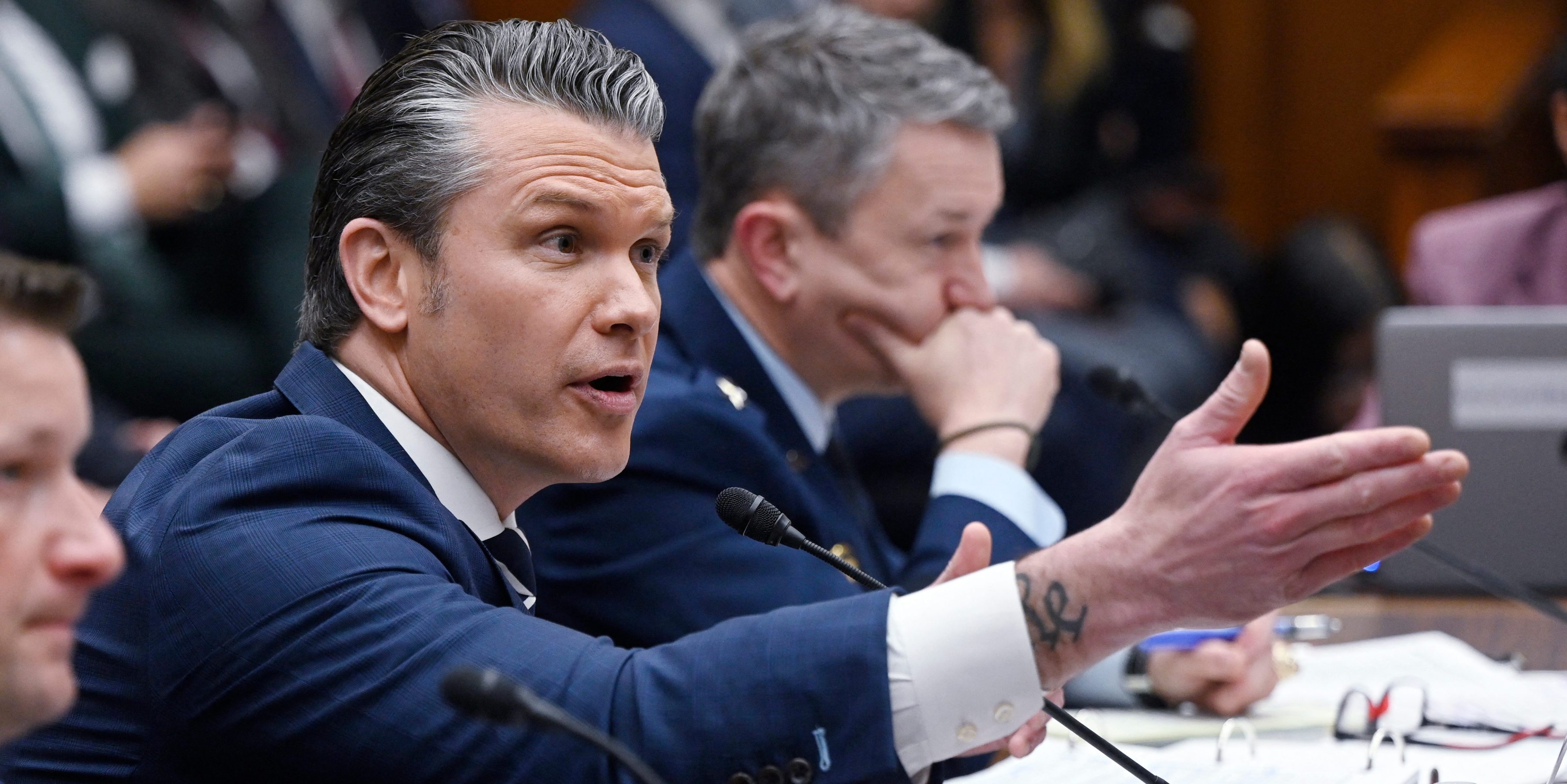
| | Hegseth Brags of a Deadlier War Machine as U.S. Unleashes “Devastating Civilian Harm Globally” | While testifying to Congress on Wednesday, War Secretary Pete Hegseth lobbed threats and brushed off queries about civilian harm. | |
The Intercept 29/04/2026 - President Donald Trump has imperiled civilians across the globe in an unprecedented fashion, outpacing his record of civilian harm during his first term in just the first 15 months of his second, according to experts. The spike in civilian casualties comes as Trump wages wars across the world from Africa to South America and as Secretary of War Pete Hegseth repeatedly brushed off questions by members of Congress on Wednesday about civilian casualties, the U.S. military’s adherence to the laws of war, and the Pentagon’s coordinated campaign to erode civilian harm mitigation efforts.
Trump has embroiled the U.S. in more than 20 military interventions, armed conflicts, and wars during his five-plus years in the White House, including a furious blitz during his second term. In March, for example, the United States made war on three continents over three days, conducting attacks in Africa, Asia, and South America. During that span, the U.S. also struck a civilian boat in the Pacific Ocean.
On Wednesday, Hegseth repeatedly dismissed congressional concerns about civilian harm and respect for the laws of war in testimony before the House Armed Services Committee. “The Department of War fights to win,” Hegseth replied when asked if he stood by his statement that the U.S. would afford enemies “no quarter” — a war crime.
“Secretary Hegseth has presided over an expansion in U.S. military operations that has caused devastating civilian harm globally, from Yemen, Iran, and Somalia to extrajudicial killings in the Caribbean and Pacific,” said Annie Shiel, U.S. director at the Center for Civilians in Conflict. “This is against the backdrop of a serious reduction in the United States’ capacity and will to prevent civilian harm, including statements from administration officials threatening civilian infrastructure and decrying ‘stupid rules of engagement,’ and the slashing of U.S. military offices and staff tasked with preventing civilian harm.”
The U.S. has killed more than 2,000 civilians across the world during Trump’s second term from Latin America to Africa to the Middle East. “This is unprecedented in terms of the sheer number of theaters where harm to civilians has been reported within such a short space of time,” Megan Karlshoej-Pedersen, a policy specialist with Airwars, a U.K.-based organization that tracks civilian harm across the world, told The Intercept, referencing attacks in the Caribbean Sea, the Pacific Ocean, Iran, Nigeria, Somalia, Syria, Venezuela, and Yemen.
Adding in the 1,700 civilians killed in Iran, according to the Human Rights Activists News Agency, pushes the death toll — and the overall threat to civilians — to a historic level. Other counts of civilian casualties in Iran push the death toll even higher. “U.S.–Israeli airstrikes have killed at least 2,362 civilians, including 383 children, and injured over 32,314 civilians, according to official figures,” Raha Bahreini, a regional researcher with Amnesty International’s Iran Team told The Intercept and other journalists during a press briefing. This includes an attack on the Shajarah Tayyebeh elementary school that killed at least 175 people, most of them children.
The preliminary findings of a U.S. military investigation revealed by The Intercept and other outlets determined that the United States conducted the attack on the elementary school in Minab, contradicting assertions by Trump that Iran struck the school.
“The girls’ school that got hit in the first days of this war, there is absolutely no question at this point what happened. We made a mistake,” said Rep. Adam Smith, D-Wash., the top Democrat on the House Armed Services Committee, on Wednesday. “We identified this target based on earlier charts. And yet, two months after it happened, we refused to say anything about it, giving the world the impression that we just don’t care.” [...]
Earlier this month, President Donald Trump threatened to commit genocide in Iran, ahead of warnings of a wave of attacks on civilian infrastructure. After backing off, Trump lobbed new threats on Truth Social on Wednesday. “Iran can’t get their act together,” Trump wrote, above an AI-generated image of himself, donning sunglasses and carrying an automatic rifle, with explosions going off in the background. The caption of the image reads, “No more Mr. Nice Guy!”
During his testimony on Wednesday, Hegseth lobbed his own bellicose threats. “The days in which these narco-terrorists — Designated Terrorist Organizations — operated freely in our hemisphere are over,” he said. “We are tracking them. We are killing them.” Under Operation Southern Spear, the U.S. military has conducted 55 attacks on so-called drug boats in the Caribbean and Eastern Pacific Ocean, destroying 56 vessels and killing more than 185 civilians since last September. The latest strike, on April 26 in the Pacific, killed three people. The Trump administration claims its victims are members of at least one of 24 or more cartels and criminal gangs with whom it claims to be at war but refuses to name. Read more - Lire plus
Designating Cartels as Terrorists Has Sweeping Legal Consequences
| | Insane Pre-Crime Strategy Unveiled for Leftist “Extremists" | New national counterterrorism strategy vows to “cripple them before" crimes are committed | |
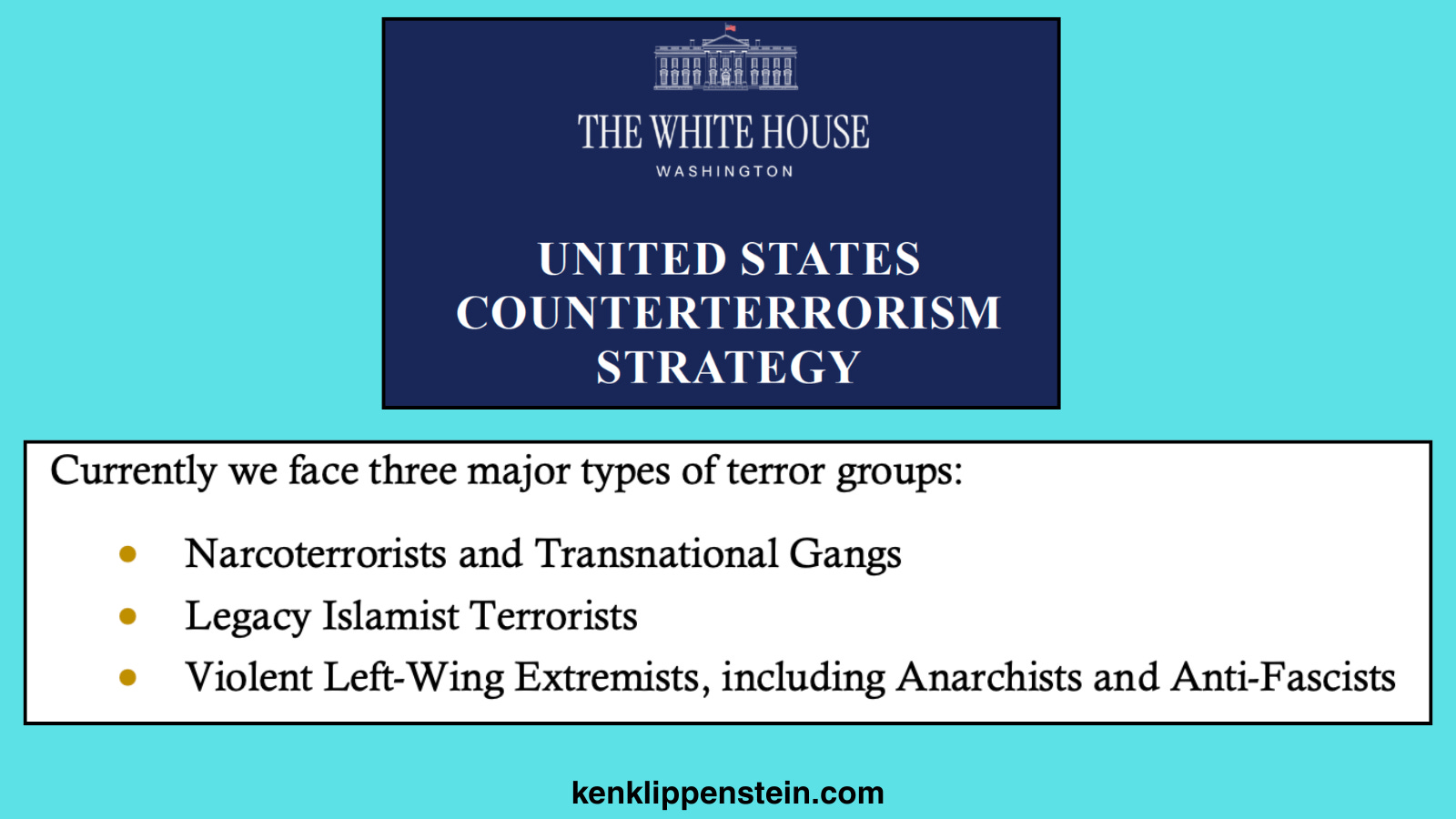
Ken Klippenstein 06/05/2026 - The White House declared war on the American people today, labeling its political opponents as terrorists, including “Left-wing extremists.” The new label also claims that there are “deepening alliances” between “the far-left and Islamists” — or pro-Palestinian protesters.
The language is contained in the White House’s newly released National Counterterrorism Strategy. It is the first National Strategy to be unveiled since 2021, when the Biden administration issued its document. The Strategy identifies the “left-wing,” “anti-Fascists,” “Anarchists” and “radically pro-transgender” ideologies as threats equivalent to jihadi groups like al Qaeda and ISIS, or narco-traffickers.
The Strategy is the brainchild of White House counterterrorism czar Sebastian Gorka, an eccentric figure I have reported on, who last year hinted at terrorism charges being levied for political opponents of the administration. The document makes clear he got his wish. Gorka called the Strategy “my life’s work,” and apparently waxed so poetic in previous drafts that his superiors told him (by his own account): “Cut it down, Gorka!”
“Currently we face three major types of terror groups,” the Strategy says, listing “Narcoterrorists and Transnational Gangs,” “Legacy Islamist Terrorists,” and “Violent Left-Wing Extremists, including Anarchists and Anti-Fascists.”
"Counterterrorism" itself is a propaganda term, sanitizing the actual practice: pre-crime, which aims to build cases against people for what they might do, most ominously based on speech or beliefs. (I've written about the Bureau’s pre-crime push at length.) The Strategy doesn't bother hiding it. It promises to "Identify terror actors and plots before they happen" and to use "law enforcement tools to cripple them operationally before they can maim or kill the innocent."
The Strategy also hints at a crackdown on pro-Palestinian groups. In a section laying out “five functional aspects of the current CT environment” beyond the previously named three categories, it warns of “New and deepening alliances between the far-left and Islamists, i.e., the ‘Red-Green’ alliance” — a phrase borrowed from conservative discourse to suggest a conspiratorial alignment between the American left and radical Islam.
The “Red-Green alliance” term has been pushed by Israeli think tanks like the Reut Group — which defines the term as “the nexus between radical progressive groups to Islamists organizations” — and picked up by right-wing U.S. news outlets. The framing is designed to recast pro-Palestinian activism as a front for jihadism.
The Strategy proposes employing the same tactics used to map out jihadi networks like al Qaeda against Americans here at home, promising “rapid identification and neutralization” of the supposed threat. This is exactly the technique that Gorka and other top Trump officials like Kash Patel cut their teeth on during the post-9/11 global war on terror — experience that I previously warned they would lean heavily on.
National Security Presidential Memorandum 7 (NSPM-7) defines the threat as those espousing “anti-American,” “anti-Christian” and “anti-Capitalism” viewpoints. The new National Strategy uniquely identifies “radically pro-transgender ideologies” as terrorists, adding yet another threat group to the federal government’s targeting.
As I reported last year, the FBI in response to Charlie Kirk’s murder was preparing a war on what it considers transgender “extremism,” based on my sources. That report was subject to endless fact-checks asking how I knew this — something I can’t answer without burning my sources — and whether I was spreading panic in the transgender community. The counterterrorism strategy affirms my reporting, explicitly pointing to “the assassination of Charlie Kirk by a radical who espoused extreme transgender ideologies” as part of its justification for the new targeting.
The Strategy is, in important respects, Charlie Kirk’s strategy. Within hours of his September 10, 2025 murder at Utah Valley University, White House, Justice, and Homeland Security officials scrambled to draft a sweeping domestic crackdown, as I previously reported. Treasury Secretary Scott Bessent called the killing “a domestic 9/11,” vowing his department would now do to American political networks what it once did to al Qaeda’s in going after their finances. [...]
The new Strategy also leans heavily on grievances about the “weaponization” of counterterrorism powers under prior administrations to justify a sweeping expansion of those same powers. It cites past FBI controversies — surveillance of “conservative Catholics attending traditional mass in Virginia,” “parents standing up for their children at school board meetings,” and investigations of “Members of Congress, or President Trump and his associates” — as the rationale for what it calls a previous “radical shift” in U.S. counterterrorism.
In other words: abuses of counterterrorism authorities against the right have now become the grounds for unleashing those same authorities against the left. The Strategy anticipates this reversal and tries to inoculate against it. “Our counterterrorism powers will not be used to target our fellow Americans who simply disagree with us,” it insists, before going on to describe a regime that does precisely that — provided the disagreement is categorized as “extremism.”
Except that’s exactly what it does! The strategy includes a foreword by President Trump that emphasizes its unparalleled focus on the homeland: “my Administration has put an unprecedented focus on dismantling threats to the American homeland in our Hemisphere.” The global war on terror has come home. Read more - Lire plus
US says migration has made Europe an ‘incubator’ for terrorism in new counter-terrorism strategy
NPR podcast: As the definition of “terrorist” expands, so does state violence
| | Palestine Action: Deproscription Theatre Cannot Justify Terrorism Laws | |
CI 28/04/2026 - Today, the Court of Appeal hears the government's challenge to the High Court's February ruling that the proscription of Palestine Action was unlawful. It will be seen whether the judiciary will continue the catalogue of capitulations we’ve documented over two decades.
When Palestine Action was proscribed in July 2025, it was a clear example of how the architecture of anti-terrorism legislation primed for over two decades of exploiting fears and prejudices against Muslims was weaponised to enable the state to clamp down on those who refused to be complicit in a genocide.
Under intense public pressure, the High Court struck down the proscription. In February, it found that the proscription was both unlawful under the Home Secretary's own policy and a disproportionate breach of fundamental rights to freedom of expression and association. Nearly 3,000 people have been arrested in the interim as terrorists for expressing support for Palestine Action.
We are now in the extraordinary position of watching a government spend public money contesting a court's finding that it acted unlawfully, while Palestine Action supporters continue to face arrest and prosecution under a ban that has already been deemed unjust. The proscription order remains in force pending today's proceedings. Every day it does, the injustice continues.
This appeal must be seen in that wider context. In recent weeks, we have witnessed the trial of Majid Freeman in Birmingham - an activist and humanitarian prosecuted for expressing solidarity with Palestine. The infrastructure of terror legislation was built to do exactly this: to narrow the space for dissent, and to protect the interests of states and corporations over the conscience of ordinary people.
We hope the Court of Appeal upholds the decision that the ban is unlawful. But whether it does or not, we must demand the wholesale abolition of proscription powers and the counter-terrorism legislation that enables them.
Anas Mustapha, Head of Public Advocacy at CAGE International, said:
"The government has chosen to drag this case back to court rather than accept that it acted unlawfully. It has already spent hundreds of thousands of pounds defending a decision that the High Court found to be both contrary to its own policy and a breach of fundamental rights. That should be a source of profound shame. These laws were not perverted to reach this outcome, rather they worked exactly as intended. The public sees that. The attempt to criminalise resistance to genocide has not and will not succeed." Source
UK convicts four Palestine Action activists over break-in at Israeli firm
| | OTHER NEWS - AUTRES NOUVELLES | | ICLMG ACTIONS DE LA CSILC | | The Justice Minister must end the injustice against Hassan Diab! | | |
In April 2023, despite clear exculpatory evidence, the French Court of Assize conducted an in absentia trial that unjustly declared Dr. Hassan Diab guilty and sentenced him to life in prison. The proceedings amounted to a sham trial and a mockery of justice.
Since that ruling, Dr. Diab and his family have lived in constant uncertainty, facing the ongoing threat that a second extradition request could be made at any time.
Please click below to send a new letter demanding that Justice Minister Sean Fraser categorically refuse any future extradition request and put an end—once and for all—to this ongoing miscarriage of justice.
| |
Canada: Abolish rights-violating terrorist entities list!
| | |
On October 15, 2024, the Canadian government placed the Samidoun Palestinian Prisoner Solidarity Network on Canada’s terrorist entities list. While ostensibly a tool to protect the safety and security of people in Canada and internationally, the list is an arbitrary political tool that undermines freedom of association, of expression and due process in the courts. Its effectiveness as a national security tool has never been demonstrated in a manner that justifies its use.
Due to these deep flaws, and more, the ICLMG has consistently called for the list to be abolished since the Canadian coalition’s founding in 2002. Please join us in urging the Canadian government to abolish the rights-violating terrorist entities list once and for all. Thank you!
| | Canada must repatriate all Canadians detained in NE Syria/Iraq now! | Every day the government fails to bring these Canadians home, it places their lives at risk from disease, malnutrition, violence, and ongoing military conflicts. United Nations officials have even found that the conditions faced by Canadians in prison are akin to torture. Please click below to urge the federal government to repatriate all Canadians illegally and arbitrarily detained in northeast Syria without delay. | | 23 years of fighting deportation to torture: Justice for Mohamed Harkat! | | CSIS isn't above the law! | | |
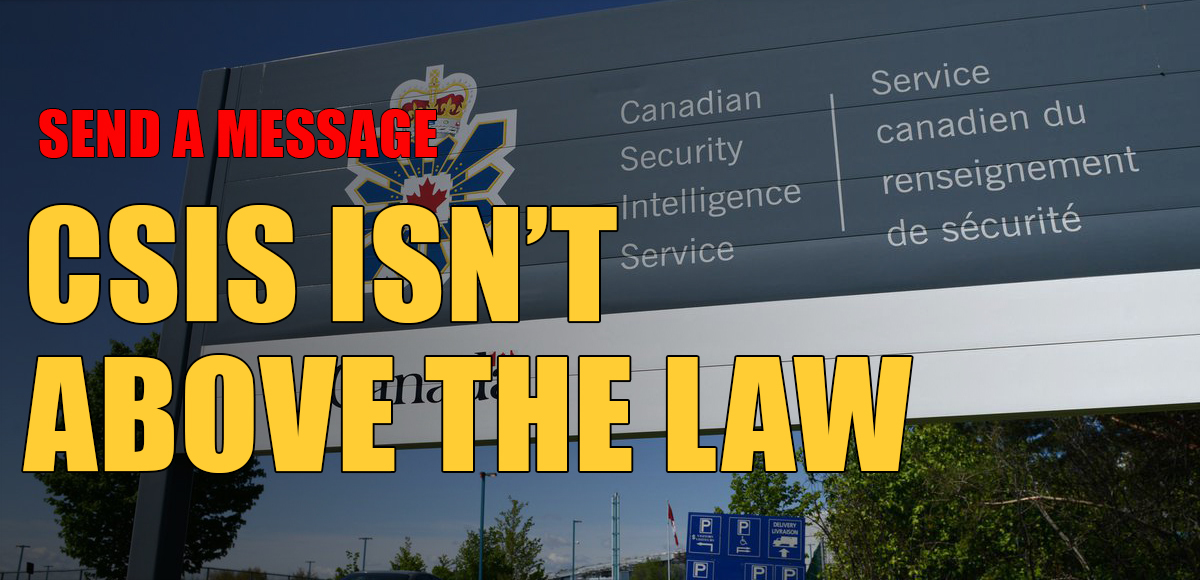
In recent years, at least three court decisions revealed the Canadian Security and Intelligence Service (CSIS) engaged in potentially illegal activities and lied to the courts. This is utterly unacceptable, especially given that this is not the first time these serious problems have been raised. CSIS cannot be allowed to act as though they are above the law.
Send a message to the Public Safety Minister demanding that he take immediate action to put an end to this abuse of power and hold those CSIS officers involved accountable. Your message will also be sent to your MP and to the Minister of Justice.
| | Reform Canada's extradition law now! | |
Canada’s extradition system is broken. One leading legal expert calls it “the least fair law in Canada.” It has led to grave harms and rights violations, as we’ve seen in the case of Canadian citizen Dr Hassan Diab. It needs to be reformed now.
Click below to send a message to urge the Prime Minister, the Minister of Justice and your MP to reform the extradition system before it makes more victims. Thank you!
Version française: Le Canada doit réformer la loi sur l'extradition!
| | Canada must protect encryption! | |
Canada, with other G7 nations, continues to push to weaken our access to strong, reliable encryption, after decades of being supportive of strong encryption. We need encryption to safeguard our data, our online transactions, our communications, and to protect the lives of journalists and human rights activists.
Please send a message to the Prime Minister of Canada, the Minister of Public Safety, as well as your Member of Parliament, to urge them to reverse course and once again commit to protecting encryption.
Regardez la vidéo avec les sous-titres en français + Agir
| | Protect our rights from facial recognition! | Facial recognition surveillance is invasive and inaccurate. This unregulated tech poses a threat to the fundamental rights of people across Canada. Federal intelligence agencies refuse to disclose whether they use facial recognition technology. The RCMP has admitted (after lying about it) to using facial recognition for 18 years without regulation, let alone a public debate regarding whether it should have been allowed in the first place. Send a message to the Prime Minister and the Public Safety Minister calling for a ban now. | | What we've been up to in 2025, and our plans for 2026! | |
ICLMG 03/12/2025 - Thanks to the support of our members and donors, we’ve been able to do a lot and work on the following since June:
- Anti-privacy and xenophobic bills C-2 & C-12
- Anti-protest and anti-freedom bill C-9
- Impacts of Countering Terrorism Financing on charities, non-profits, solidarity work and international assistance.
- Canada’s complicity in torture
- Justice for Hassan Diab
- Artificial Intelligence regulatory frameworks & national security
- The gaps in oversight and review of national security agencies
- Consultations on the UN Global Counter-terrorism strategy & definitions of “terrorism” and “violent extremism"
- We were interviewed or quoted in dozens of media pieces
- And much more!
For all details on our activities, and our plans for 2026, click here.
| | Les opinions exprimées ne reflètent pas nécessairement les positions de la CSILC - The views expressed do not necessarily reflect the positions of ICLMG. | | |
THANK YOU
to our amazing supporters!
We would like to thank all our member organizations, and the hundreds of people who have supported us over the years, including on Patreon! As a reward, we are listing below our patrons who give $10 or more per month (and wanted to be listed) directly in the News Digest. Without all of you, our work wouldn't be possible!
James Deutsch
Bill Ewanick
Kevin Malseed
Brian Murphy
Colin Stuart
Bob Thomson
James Turk
John & Rosemary Williams
Jo Wood
The late Bob Stevenson
Nous tenons à remercier nos organisations membres ainsi que les centaines de personnes qui ont soutenu notre travail à travers les années, y compris sur Patreon! En récompense, nous nommons ci-dessus nos mécènes qui donnent 10$ ou plus par mois et voulaient être mentionné.es directement dans la Revue de l'actualité. Sans vous tous et toutes, notre travail ne serait pas possible!
Merci!
| | | | |











.png)