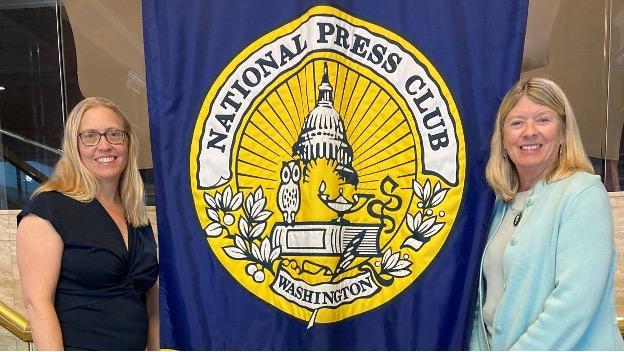
Photo: Laura Wagner (left) and Susan Chapman (right) at the National Press Club on October 11. See details below! | |
|
Congratulations to our team here at the UCSF HWRC and our partners at University of Michigan on receiving funding for the new National Dementia Workforce Study. The study will survey those who work in homes, hospitals, clinics, assisted living facilities, and nursing homes, yielding data to improve care and inform policy.
This study will go a long way to support better dementia care in the US. I’m especially excited to be joined in this effort by the study’s co-leader, Donovan Maust at the University of Michigan; UCSF HWRC collaborators Susan Chapman, Laura Wagner, Alissa Bernstein Sideman, Soo-Jeong Lee, and Ulrike Muench; and other scholars and leaders at UCSF, University of North Carolina at Chapel Hill, Brown University, University of Pennsylvania, Mathematica, and the Alzheimer’s Association.
Direct care workers who come to patients’ homes, and those who work on the front lines of long-term care, are often overlooked. But the high turnover in these low-wage jobs, which often don’t require advanced training, is a major factor in the current crisis in dementia care.
Read more about the grant in the story below.
Joanne Spetz, PhD, FAAN
Director
This newsletter highlights new HWRC publications, as well as workforce-related research conducted by our team at the Institute for Health Policy Studies and Healthforce Center at UCSF, and other research partners.
| |
New $81M NIH Grant Will Help US Answer Urgent Need for Better Dementia Care | |
|
The UCSF Health Workforce Research Center on Long-Term Care has won a five-year, $81-million grant from the prestigious National Institute on Aging (NIA) in partnership with University of Michigan under the leadership of Donovan Maust.
The team will work to improve understanding of the health workforce that cares for people with dementia through surveys and other methods that will produce data for clinicians, researchers, policymakers, and others. The new National Dementia Workforce Study will survey those who are paid to care for people with dementia in all settings, from homes, assisted living facilities, and nursing home memory care units to hospitals and clinics.
Every year starting in 2024, NDWS aims to survey thousands of people who work as home health and personal care aides, nursing assistants, nurses of all licensing and practice levels, physicians, nurse practitioners, physician assistants, and clinical staff of facilities where people with dementia live. Reaching such a large and diverse array of workers will make it possible to gather a truly representative picture of what dementia care is like today.
Read more about the survey.
| |
A Confusing Patchwork of Laws Govern Nurses’ Ability to Practice: States’ Scope of Practice Laws Need to Be Standardized | |
Variation in scope-of-practice laws for nurses have created a maze of policies and practice restrictions that are difficult to navigate. And while standardizing the language of scope of practice laws would solve the issue, that seems politically difficult.
This yawning gap in the regulatory landscape makes it almost impossible for research to inform policy — and for policy to inform research. In a recent blog post, HWRC researchers Molly Candon, Joanne Spetz, and Amber Rose describe a few ways to approach this problem and identify assets already in place that could be leveraged.
Studies show that more restrictive scope-of-practice laws for nurse practitioners, physician assistants, and certified nurse midwives do not improve the quality of care, while the removal of these restrictions can increase access to care, the capacity of care, and the cost of care. More clarity surrounding what nurses can do and say, and how it affects patients, is a critical and overlooked part of enhancing value-based care.
Read the complete blog for details.
| |
Nursing Care Facility Workers More Severely Impacted During COVID‐19 Pandemic Than Other Occupations | |
UCSF-HWRC researcher Soo-Jeong Lee and colleagues examined California Workers Compensation claims during 2019-2021 to understand the physical and psychological effects of the COVID‐19 pandemic on nursing care facility workers. They did not find evidence of an increased risk of occupational injuries during the pandemic, except for increased claims for stress or mental disorders.
Annual claims increased by 64.6% from 2019 to 2020 and then decreased in 2021, returning to levels similar to pre‐COVID. In contrast, non‐healthcare settings had decreases in claims during the pandemic. COVID‐related claims accounted for 50.5% of claims in nursing facilities in 2020–2021; this proportion was much higher compared with other healthcare (35.7%) or nonhealthcare settings (14.3%). Non‐COVID claims decreased during the pandemic but mental disorder or stress claims increased in nursing facilities, particularly in 2020 (+42.5%).
See the complete article.
| |
Scope of Practice Laws for Nurse Delegation Are Associated with Turnover in Home Health | |
Nursing staff turnover can compromise the quality and continuity of home health care. An important driver of job satisfaction among nurses is autonomy, defined as a nurse’s ability to make decisions that are informed by their education and experience. Scope of practice laws, which determine the tasks nurses are allowed to perform and delegate, are a key element of autonomy and vary considerably across states.
Molly Candon, with Amber Rose and Joanne Spetz of UCSF-HWRC and other colleagues, found that more task delegation correlated with lower turnover rates for licensed practical nurses, which may be driven by a different workload for licensed practical nurses when registered nurses can delegate more tasks to unlicensed aides. These results point to a potential and unexplored benefit of expanding scope of practice for nurses.
See the complete article.
| |
Recent Publications from UCSF HWRC-LTC Investigators | |
|
Candon, M, Bergman, A, Rose, A, Song, H, David, G, Spetz, J. The Relationship Between Scope of Practice Laws for Task Delegation and Nursing Turnover in Home Health. JAMDA, online August 24, 2023. https://www.sciencedirect.com/science/article/pii/S1525861023006679
Khavjou, O, Suarez, G, Tyler, D, Squillace, M, Dey, J, & Oliveira, I. Wages of Direct Care Workers Lower Than Other Entry-Level Jobs in Most States (Issue Brief). Washington, DC: Office of the Assistant Secretary for Planning and Evaluation, U.S. Department of Health and Human Services. August 2, 2023. (Also see HHS press release and RTI press release on minimum staff standards.)
Kwon SY, Lee SJ. Underreporting of work-related low back pain among registered nurses: A mixed method study. Am J Ind Med. 2023 Aug 27. DOI: 10.1002/ajim.23530
Lee, S-J, Yun, Y, Hwang, J, Jong, S. Impact of COVID-19 on occupational injuries and illnesses among nursing care facility workers: Analysis of California workers' compensation data, 2019–2021. Am J Ind Med. 2023; 66: 965-976. doi:10.1002/ajim.23531
Lyndon, A, Simpson, KR, Spetz, J, Zhong, J, Gay, CL, Fletcher J, Landstrom GL. Nurse-reported staffing guidelines and exclusive breast milk feeding. Nursing Research, 2022, 71 (6): 432-440 (online September 5, 2022). doi: 10.1097/NNR.0000000000000620. PMCID: PMC9640285
Poghosyan, L, Stein, J, Liu, J, Spetz, J, Osakwe, Z, Martsolf, G. State-level Scope of Practice Regulations for Nurse Practitioners Impact Work Environments: Six State Investigation. Research in Nursing and Health, 2022, 45 (5): 516–524. July 19, 2022. https://doi.org/10.1002/nur.22253. PMCID: PMC9534177
Sideman AB, Ma M, Hernandez de Jesus A, et al. Primary Care Practitioner Perspectives on the Role of Primary Care in Dementia Diagnosis and Care. JAMA Netw Open. 2023;6(9):e2336030. doi:10.1001/jamanetworkopen.2023.36030
Simpson, KR, Spetz, J, Gay, CL, Fletcher, J, Landstrom, GL, Lyndon, A. Hospital Characteristics Associated with Nurse Staffing during Labor and Birth: Inequities for the Most Vulnerable Maternity Patients. Nursing Outlook, 2023, 71 (3): (online March 31, 2023).
Zhong, J, Simpson, KR, Spetz, J, Fletcher, J, Gay, CL, Landstrom, GL, Lyndon, A. Linking Patient Safety Climate with Missed Nursing Care in Labor and Delivery Units: Findings from the LaborRNs Survey. Journal of Patient Safety, 2023, 19 (3): 166-172 (online January 18, 2023). PMID: 36728161
| |
Recent Presentations from UCSF HWRC-LTC Investigators | |
|
2023 Health Workforce Research Symposium
Susan Chapman and Laura Wagner joined colleagues from all nine of the US Health Workforce Research Centers at the 2023 symposium, “Addressing Health Workforce Shortages Now and in the Future,” on October 11 in Washington, DC.
Over 150 attendees participated in the online and in-person symposium at the National Press Club. Wagner served as the moderator for the session “Reducing Health Workforce Turnover in a Complex Health Care Environment.” Chapman highlighted two HWRC projects that explored reducing turnover in rural areas and home health.
See the complete agenda.
| |
|
The UCSF Health Workforce Research Center on Long-Term Care (UCSF HWRC) is a dynamic hub of policy-oriented research and investigation, established through support from the National Center for Health Workforce Analysis in the US Bureau of Health Workforce. UCSF HWRC closely examines the health care workforce and helps shape policies to meet expanding LTC needs. Our research includes the workforce in nursing homes, home health care, adult day care, community-based settings, and home settings, and includes all LTC occupations.
Director: Joanne Spetz, PhD, FAAN
Deputy Director: Susan Chapman, PhD, RN, FAAN
Associate Director for Research: Laura Wagner, PhD, RN, FAAN
Visit: https://healthworkforce.ucsf.edu/about
Follow on Twitter: @ucsfhwrc
| | | | |