|
Sidney Cotton was born in 1894 at a cattle station in Queensland, Australia. He was twenty years old at the start of the World War in Europe and wanted to enlist, but his parents objected. But the sinking of the RMS Lusitania ocean liner by a German U-boat in April 1915 galvanized him into action, and he booked passage to England, traveling among a group of other young Australian men who were eager to do their bit.
By November, he had enlisted in the Royal Naval Air Service and had learned to fly. In what seems beyond belief by today’s standards, he was cleared for combat flying after only five hours of solo flight. He was originally assigned to fly Channel patrols, but later in the war, he flew a number of night bombing missions.
After the War, he became a successful businessman, with one of his major interests being developing and marketing a color film process. His business interests allowed him to continue to fly, and he became well-known across Europe.
In the spring of 1939, he was approached by MI6, the British foreign intelligence service, and was asked to undertake a series of photographic spy flights. For this task, he purchased a three-year-old twin-engine Lockheed Model 12A Electra Junior in the United States and had it disassembled and shipped to the UK.
While it was being reassembled and fitted with hidden cameras, his attention was drawn to a pale green civilian aircraft that had just taken off, and he was surprised to note that it quickly became difficult to see in the air. So, he elected to apply a slightly lighter version of the color to his Lockheed as something of a camouflage measure. He also registered the color as ‘camotint’, and it was used by the RAF on the undersurfaces of fighter planes in the early months of WWII. His Lockheed had been assigned the civilian registration letters G-AFTL, which were duly applied in dark blue on the wings and fuselage, along with some additional decorative striping along the fuselage and on the engine cowlings.
G-AFTL began flying spy missions in June 1939 and flew more than twenty such missions before the outbreak of the Second World War, with Cotton and his co-pilot R.H. Niven making flights over Malta, Sicily, Italian Somaliland, Cairo, Berlin, Frankfurt, and Mannheim. Cotton employed a number of plausible cover stories during these flights, variously explaining them as being necessary for his business dealings, scouting for potential future locations for possible use in cinema, or simply sightseeing. On 24 August, G-AFTL became the last British civilian aircraft to leave Germany before the start of the war in Europe.
One month after the start of the war, Cotton was appointed as the acting commanding officer of the RAF’s No. 1 Photographic Development Unit based at Heston. His Lockheed was also assigned to the unit but still carried its civilian registration. Over the course of the next year, Cotton or Niven flew G-AFTL on another fifteen covert flights over Belgium and France, flying as far as Sardinia. But the bulk of the other spy flights were now being made with two similarly painted Spitfire fighter planes that Cotton had managed to acquire.
G-AFTL came to grief in September 1940 when a German parachute mine landed on its hangar at Heston. Badly damaged, the aircraft was later returned to Lockheed for repair and resale, and its previous history was largely forgotten. It served for most of 1943 and 1944 as VP-TAI with British West Indian Airlines before returning to private ownership stateside. It was sold several times over the next two decades before being damaged in a landing accident in September 1965.
Records indicate that it was approved for carrying skydivers in 1969 before being purchased by the well-known aerobatic pilot ‘Art’ Scholl in 1974. He had bought the aircraft at the behest of the Warner Brothers film studio, where it was used in the movie ‘Doc Savage: Man of Bronze’. The aircraft also appeared in an NBC film about Amelia Earhart and was seen in the CBS television series ‘Spencer’s Pilots’. Scholl later learned of its previous history as a spy plane while reading about Sidney Cotton.
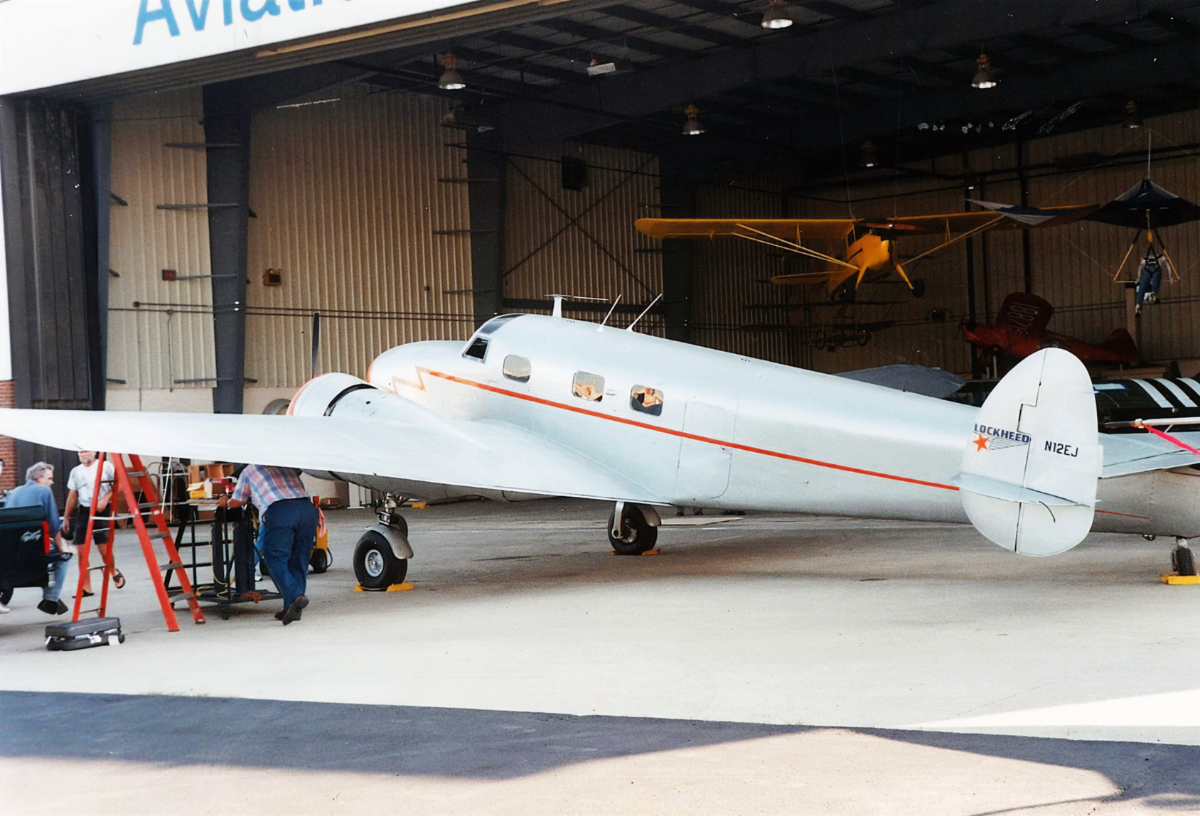
In 1990, it was purchased by Steve Oliver of Lexington, Kentucky, and his wife, Suzanne Asbury-Oliver. By this time it had been repainted in an attractive overall silver paint scheme with orange trim and wore the registration N12EJ. They generously allowed the aircraft to be displayed here at the Aviation Museum of Kentucky for several years before reluctantly selling it in late 2003.
It was sold again in 2019 and was later sent to Ultimate Warbird Flights at the Sywell Aerodrome at Northampton, UK. After restoration, it was repainted in Cotton’s colors, and it regained its original G-AFTL registration. It’s now owned by Fighter Aviation Engineering, Dunmow, UK and makes public appearances at fly-ins and airshows.
-- Dennis Sparks
|