|
|
News from AWSNA January 2017
The official e-news of the Association of independent Waldorf schools
|
|
On March 7 at 8:00 EST AWSNA will co-host our fourth webinar with the Anthroposophical Society. This webinar, titled "Building a Space for Rest: Helping children release from the anxieties of the world to find restful sleep," will be presented by Adam Blanning, MD and is geared toward parents, caregivers, and grandparents of young children.
We are living in an unpredictable world which is constantly competing for our attention, so much so that we need to consciously create spaces for rest. One of the best ways we can help children learn to work with anxiety is to help them find healthy pathways into sleep. In this webinar we will look at how the four lower senses (the touch sense, balance sense, movement sense, and "life" sense) create the foundation for journey and how they help children find greater peace and resiliency.
Sincerely,
Beverly Amico
for the AWSNA Executive Team
bamico@awsna.org
|
|
K-8 Comeback: Clear Merits over Middle School Model: Middle school has a particular reputation, and it's not necessarily a good one. Children often approach these years of schooling (6-8 or 7-8) anxiously - concerned about cliques, closed-off cafeteria tables and bullies roaming the halls. Parents send children into these schools with trepidation as well. But, for some, it may come as a surprise to learn that educators are also regarding middle school environments with increasing criticism.
Teach Children to Seek Significance over Success: "Our job is to help [children] know and appreciate themselves deeply, to be resilient in the face of adversity, to approach the world with zest, to find work that is satisfying, friends and spouses who are loving and loyal, and to hold a deep belief that they have something meaningful to contribute to the world."
You can read these articles and more
in
Essentials In Education,
AWSNA's blog that explores topics that matter to educators, researchers, policy experts, and thought leaders - from a Waldorf Education perspective.
Previous topics include:
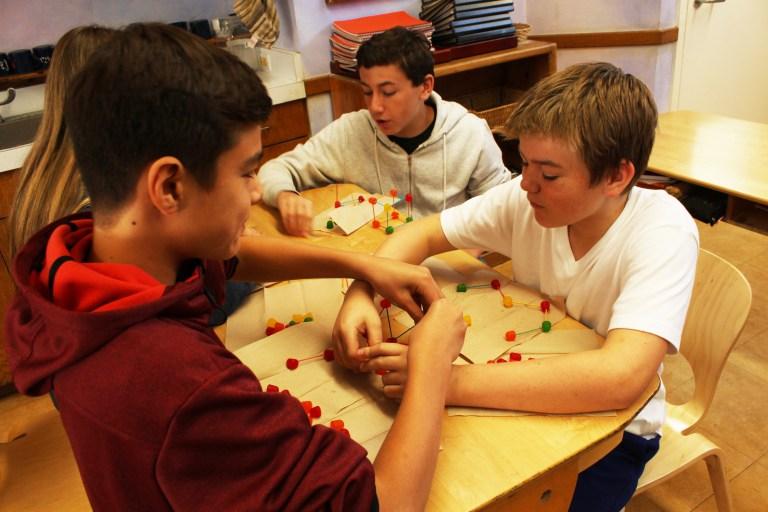
Photo: San Francisco Waldorf School
|
Recess is Making a Comeback
"Many of us can remember elementary school recesses where we worked through weighty issues with our classmates such as: Was that ball in or out? Some can recall the alliances formed on the dodge ball court that ultimately led to victory or defeat. Little did we know that we were learning about conflict resolution, leadership and friendship."
Photo: Orchard Valley Waldorf School
|
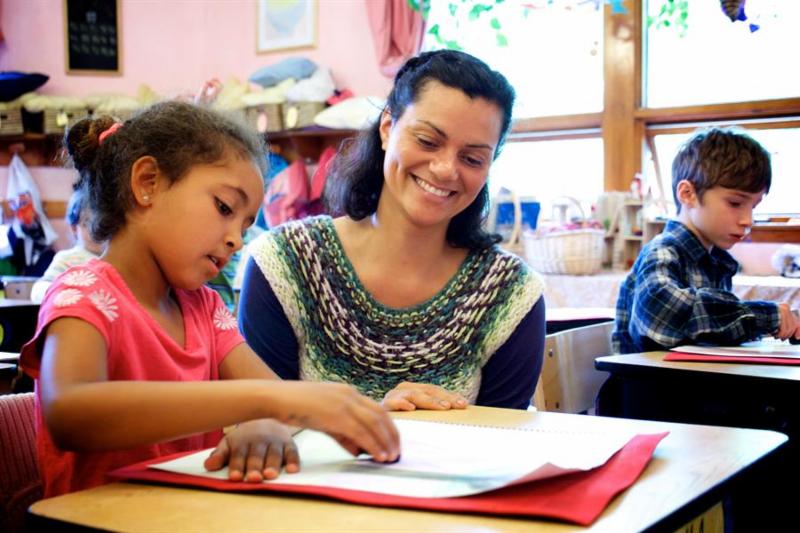
"Teachers are the main source of strength in Waldorf schools. With a heavy focus on the importance of hands-on experience for their students, rather than standardized testing, Waldorf teachers help their students to explore curricula through diverse activities, with plenty of room to customize lesson plans. The fluidity of this approach provides extensive engagement that leads to lifelong connections with the material taught, the teachers involved and the bigger questions at the heart of each subject.
Photo: Green Meadow Waldorf School
|
From an article in the Atlantic: "Stopping students from using their fingers when they count could, according to the new brain research, be akin to halting their mathematical development. Fingers are probably one of our most useful visual aids, and the finger area of our brain is used well into adulthood. The need for and importance of finger perception could even be the reason that pianists, and other musicians, often display higher mathematical understanding than people who don't learn a musical instrument."
|
"In some respects, Form Drawing is the most important subject that the children will study in first grade, for it provides a good foundation for the letter recognition that is so central to reading, as well as numerical and spatial relationships that are so essential in arithmetic. The drawings themselves could not be any simpler. All year we work with only two elements of drawing - straight lines and curves."
Photo: Waldorf School of Cape Cod
|
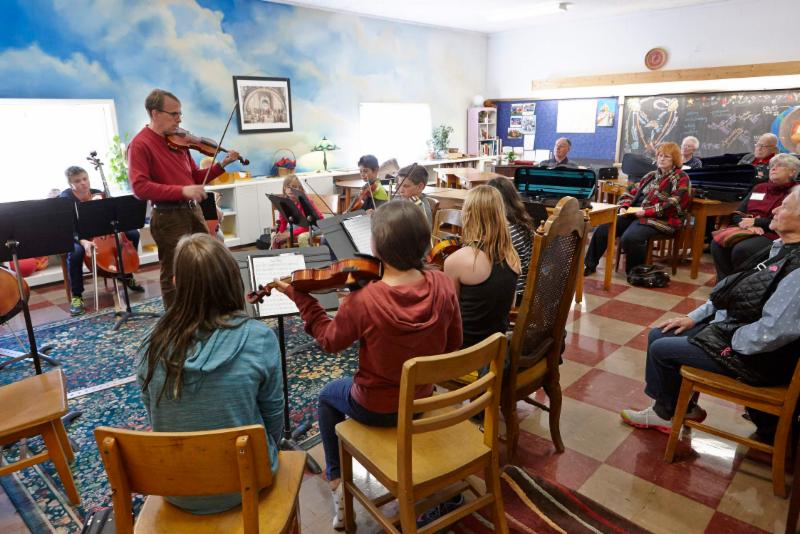
A two-year study by researchers at the Brain and Creativity Institute (BCI) at the University of Southern California shows that exposure to music and music instruction accelerates the brain development of young children in the areas responsible for language development, sound, reading skill and speech perception.
Photo:
Pleasant Ridge Waldorf School
|
From an article in the
Washington Post: "
The very movements we are restricting children from doing to keep them "safe" are the exact exercises I've used as a pediatric occupational therapist to help treat the increasingly "unsafe" behaviors seen by veteran teachers in the United States."
|
"T
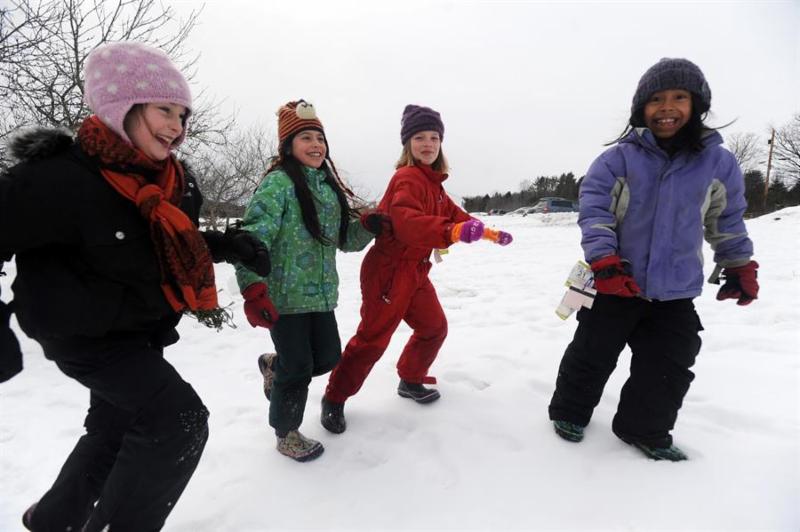
he cognitive benefits of outdoor play are tremendous, though they may not be obvious at first glance. In outdoor play, children practice planning and executing ideas. They experience making a guess about something and then trying it out - if I drop this pebble into that puddle, how high will it splash? Will I get wet? With enough of this kind of experience, children acquire an intuitive understanding of scientific method. Later, when it is taught formally inside the classroom, children who have had the experiences have a great head start in understanding what the teacher is talking about."
Photo: Washington Waldorf School
|
Research is telling us that outdoor play offers children far more learning opportunities than indoor environments. Here's an excellent overview of some of the key attributes children gain from outdoor play.
|
AWSNA's 2017 Summer Conference will be hosted by Cedarwood Waldorf School, in Portland, OR from June 26 - 29, 2017. The theme is You And I Are We...Now What? Exploring Collaboration and Leadership in Waldorf Schools. Keynote speakers are Elan Leibner, Chair of the Pedagogical Section Council, Jessica Heffernan Ziegler, Executive Director of Sunbridge Institute, Valerie Colis, Trustee at the Chicago Waldorf School, and Kay Hoffman, Pedagogical Director at the Santa Fe Waldorf School. Online registration will be coming soon
Check out the complete listing of events on
our website
.
|
 We'd like to extend a special thank you to We'd like to extend a special thank you to
and
for supporting AWSNA
as members of our Partners Circle.
Their supporting funds help our Association
to drive strategic initiatives and services
to our member schools and ins
titutes.
Thank you.

|
|
|
| |
|
| |

|
AWSNA provides leadership to schools by facilitating resources, networks and research as they strive towards excellence and build healthy school communities. The Association performs functions that its member schools and institutes could not do alone, including:
· Outreach and advocacy
· Accreditation and school support services
· Professional development activities
· Research and publications
Please contact us if you have any questions about AWSNA or this or any other newsletter.
|
|
Questions please contact webeditor@awsna.org or an AWSNA executive director:
Executive Director, Finance & Operations: Stephanie Rynas
srynas@awsna.org
515 Kimbark, Suite 106, Longmont, CO 80501
612-870-8310 x104 Fax 720-633-9543
Executive Director, Advancement: Beverly Amico
515 Kimbark, Suite
106,
Longmont, CO 80501
612-870-8310 x106 Fax 720-633-9543
Executive Director, Membership: Melanie Reiser
515 Kimbark, Suite
106,
Longmont, CO 80501
612-870-8310 x105 Fax 720-633-9531
|
|
|
|