|
A-B-C-D
Albany, Boston, Chicago & Denver in the News
Intercity Bus E-News, June 2026
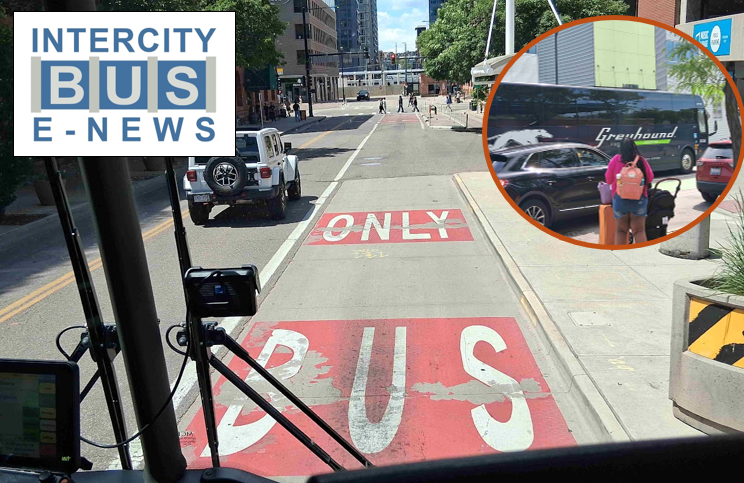
June 17, 2026 | Above: A view from Bustang on a Denver bus lane. Inset: Chicago station. Full caption below
| |
Editor’s Perspective
This edition features an A-B-C-D news update from Albany (NY), Boston, Chicago, and Denver. The big news is the "C"-- the Chicago City Council's vote only an hour ago approving the purchase of the city's Intercity Bus ("Greyhound") Station. By a 38-10 margin, it moved ahead. I've been following Chicago's rough-and-tumble politics for decades, but this is a particularly gratifying "win."
| If you haven't followed the Windy City drama, here's a synopsis. The architecturally attractive but aging facility, built in 1989, is managed by Flix-Greyhound under a month-to-month lease with Alden Capital, a real estate holding company. These lines and two others, Barons Bus and Jefferson Lines, use the facility, which sees 90+ bus movements (arrivals and departures combined) on busy summer days. However, it was at risk of being sold by Alden for non-transportation use, creating a situation akin to that in Philadelphia, where major lines moved to curbside locations, before the municipal government intervened and reopened the station in May. | |
Give credit to the Chicago-area coalition led by the Environmental Law & Policy Center and Better Streets Chicago, with support from the High Speed Rail Alliance and many other organizations, that sprang into action, raising awareness, testifying at hearings, and meeting with elected officials. The City of Chicago also stepped up by bringing municipal departments together in consultation with Alderman William Conway of the 34th Ward, which includes the station. Conway has become an articulate spokesman for what needs to be done to make the station a positive contributor to this part of downtown's vitality.
The City plans to use roughly $19 million in tax increment financing district funds to acquire the terminal, likely in August. Another $10 million or more is likely to be spent on badly needed upgrades, such as HVAC and electrical work. It seems likely the City will lease the station to Flix-Greyhound for a year to allow for an orderly transition to a lease with a property management firm. If several bus lines that use curbside pickup are moved to the station, daily movements would exceed 120, improving the system's vitality.
| Our Chicago Bears seem poised to exit the city (and state) for Hammond, Indiana, but our Intercity Bus Station appears to be here to stay and is on the cusp of getting important upgrades. We will continue to follow the process, as stumbling blocks may emerge. See below for the news from Albany, Boston, and Denver, which is (mostly) favorable for bus travelers. | |
Joseph Schwieterman, PhD
Intercity Bus E-News Editor | Professor and Director, Chaddick Institute at DePaul University
| Saddling up on Bustang: Denver Report | Denver’s intercity bus system has been riding high lately, so when I had a chance to check it out, I saddled up for a couple of rides. Adding a day to a business trip, I took three brief rides, allowing me to sample all but one of the four largest brands in the Colorado Bustang system. I rode Bustang, Outrider, and Pegasus, missing only the resort-focused Snowstang. | |
My rides came on the heels of several favorable developments for Denver:
-
The state government is pursuing a new revenue source—tolls from express lanes on major highways—to avert the Bustang system’s fiscal cliff, which made headlines a few months ago. If approved, this will put the country’s largest state-operated branded bus system again on firm financial footing.
-
FlixBus entered the Centennial State—the most populous state missing from its continental network—through a new Denver–Dallas service via Amarillo that started in May.
-
Greyhound added a Denver–Seattle service via Salt Lake City and Spokane earlier this year.
| |
These moves, together with last year’s launch of Denver–Sparks (Reno), Nevada, via Salt Lake City service by Greyhound, supported by the state of Nevada, restore Denver as an important hub with well-timed connections. The new FlixBus service connects efficiently with Greyhound’s Seattle service in both directions. Although few passengers are likely to ride from Texas to the Emerald City, this creates myriad transfer opportunities.
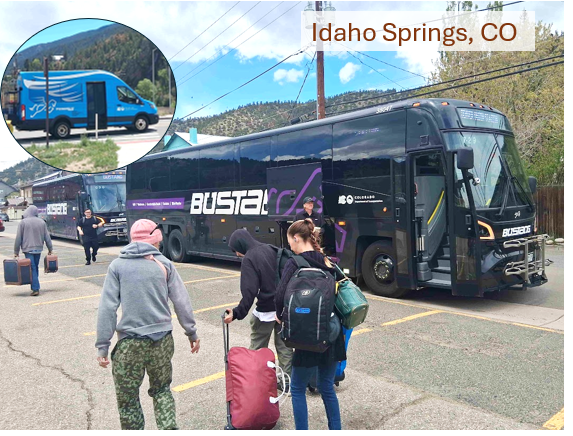
The goal of my trip was to see how Bustang differentiates its brands by vehicle size and route type. The Pegasus brand consists of just one route, Denver–Avon (near Vail), and is served by 11-seat vans. Its route overlaps with Bustang’s West Line along Interstate 70 to Glenwood Springs and Grand Junction, with one extra stop while boosting frequency. The entire system is operated by Ace Express Coaches under contract with the state.
| |
Riding a Mile High
I boarded the Pegasus van (see inset above) at Denver's Federal Center and alighted at the Idaho Springs stop, which, while only a shelter next to a parking lot, is just a minute’s walk from its bustling downtown, lined with restaurants and Western-themed retailers. My return West Line coach, a few hours later, had about 30 passengers on board. A semitruck rollover was wreaking havoc on Interstate 70 that day, a distressingly familiar scenario to locals, but we arrived in Denver on time.
| |
Later that day, I had a brief ride on one of the state’s six Outrider routes, most of which use 38-seat buses. I rode only a fraction of its roughly 135-mile route to Sterling in northeastern Colorado. The minibus had a more Spartan interior than my other two vehicles, but there was ample legroom, good Wi-Fi, and space for two wheelchairs. Three passengers boarded at Denver International Airport with heavy luggage at a stop just a 30-second walk from the terminal entrance and A Line rail-transit stop.
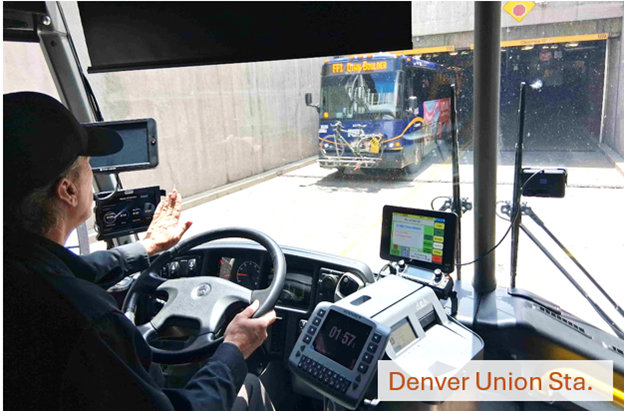
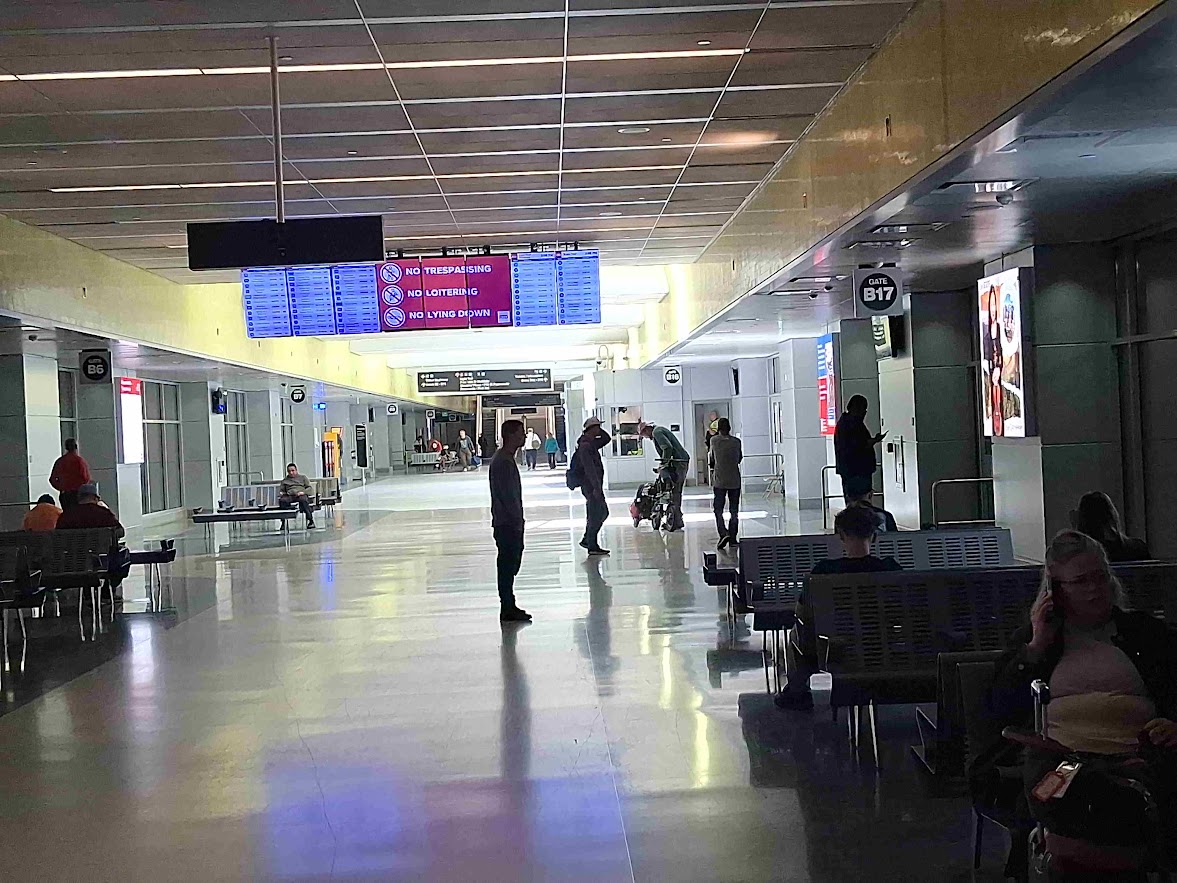
My chief takeaways? Even with so much press coverage about its growth, Bustang’s size still impresses. The South Line to Colorado Springs, the North Line to Fort Collins, and the West Line have twelve to fifteen weekday trips in each direction. When including Pegasus’s six trips, twenty-one buses travel each way from Denver to Avon. On Interstate 70, drivers seemed to be constantly waving to passing Bustang colleagues. Denver Union Station’s bus concourse is busy and pleasant (see photo below), despite being windowless and below ground. Fares are set to promote high ridership rather than maximize farebox recovery. The extensive dedicated bus lanes in downtown Denver (see masthead photo) that Bustang uses were a pleasant surprise.
| A challenge: Ticketing for Bustang’s different brands is handled through separate apps, but they are connected through links and are easy to use. Travelers can change their schedules at no cost within a specified period. It will be exciting to see whether this year’s ridership surpasses the record 351,000 reported last summer on the 10th anniversary of Bustang's launch. | ABA Sues over New York “Bounty Hunter” Anti-Emission Policy | Bus lines are facing heavy, seemingly unreasonable penalties under a New York anti-idling law that imposes fines of up to $2,000 for coaches that idle for more than three minutes. The American Bus Association (ABA) has filed a federal lawsuit against the City of New York over the Citizens Air Complaint Program, which it says has a “bounty hunter” design. Citizens who video private buses idling for more than the three-minute maximum can keep 25 percent of the fines levied. | |
Fees collected by individuals range from $350 to $600, and some have reportedly received more than $50,000. Publicly owned buses are exempt. ABA argues that the program disproportionately targets private operators and is unconstitutional because it burdens interstate commerce and conflicts with federal safety regulations requiring buses to idle to maintain air brakes and other critical safety systems.
More than 4,000 idling summonses have been issued to ABA member operators since 2020, resulting in fines totaling hundreds of thousands of dollars and extensive legal costs. In addition, the New York City Council has introduced a bill that would increase the idling fine by up to 200 percent, to $7,500, potentially putting small operators out of business.
| |
ABA's press release points out that its lawsuit "does not challenge clean air objectives or environmental progress," adding that "Instead, it seeks equal enforcement, regulatory consistency, and policies that recognize the role motorcoaches already play in reducing congestion and transportation-related emissions." ABA notes that many motorcoaches are equipped with Clean Idle technology that reduces idle nitrogen oxide emissions by nearly 50% below the regulatory limit during normal loading and rest stops.
In the opinion of the Intercity Bus E-News editor, the program is at odds with the realities of operating in an environment as complex as New York. It prevents the common-sense trade-offs that bus lines must make, such as when dealing with extreme weather or traffic gridlock. It pits citizens against bus lines in ways that violate societal norms.
| Landline's New "Remote Airport Terminal” in Framingham, Massachusetts, linked to Boston Logan | |
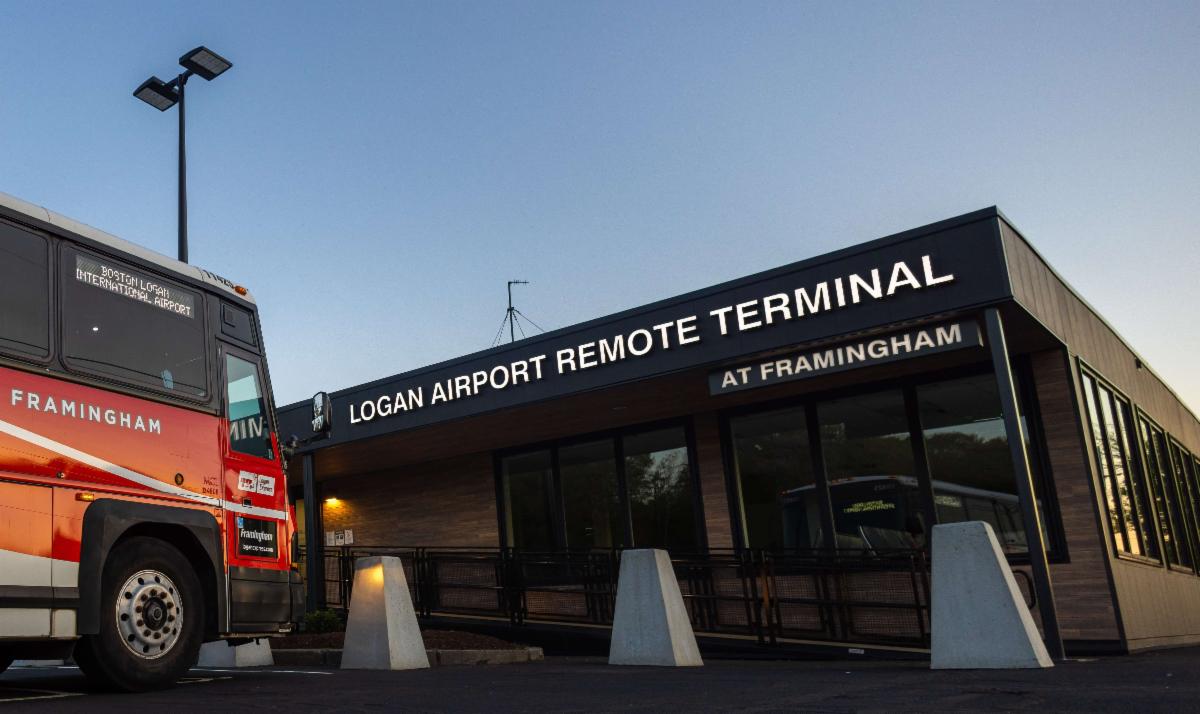
The mobility company Landline and the public agency Massport have opened the Logan Airport Remote Terminal in Framingham, Massachusetts, in the western suburbs of Boston. Travelers on Delta and JetBlue can park at the terminal, check in, drop off bags, and clear TSA screening before making the 45- to 60-minute trip to Logan, where they are brought directly to Logan’s Terminals A and C. Coaches run hourly, and the service is branded as part of the state’s expansive Logan Express program.
| |
This is Landline’s first offering in which a public agency is the primary partner rather than an airline. The terminal is also its first suburban facility in the same metro region as the hub airport. This sets it apart from Landline’s ground services for American Airlines in Chicago and Philadelphia, Sun Country Airlines at Minneapolis–Saint Paul, and Air Canada in Toronto, where coaches primarily replace short-hop flights. The target audience is people who would otherwise drive to Logan, which is only about 20 miles away, but involves stressful and unpredictable traffic and expensive parking.
| This terminal augments Landline’s positioning as “the leading provider of remote security checkpoints for commercial aviation,” with services that “integrate booking, secure ground transport, and baggage check-in into a frictionless platform.” The news suggests that much more is to come regarding bus-plane integration around the country. (Photo credit: www.landline.com) | |
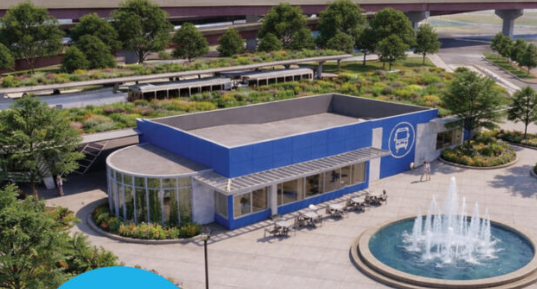
Albany, NY, is working to create a new "gateway" intercity bus terminal in the South End neighborhood at South Pearl Street and Madison Avenue. The architecturally impressive project, involving the transformation of a shuttered McDonald’s restaurant, is being led by the Advance Albany County Alliance, a local development corporation, and is expected to cost $5 - $7 million. However, the Albany County Legislature recently tabled a vote to provide $1.5 million due to pushback from residents living in the area. Albany has a pressing need for a high-quality bus terminal. Greyhound and FlixBus operate from an aging and oversized station at 34 Hamilton Street, while Trailways uses a temporary modular facility nearby. Although downtown Albany has long lacked a high-quality station, FlixBus and Trailways have stops at SUNY-Albany that are heavily used. (Photo credit: AACA)
| |
The National Rural Transit Assistance Program is hosting a free webinar on June 26, 2026, 1:00 – 2:30 pm Central (CT) entitled “Intercity Bus Industry and State Updates: Where Things Are Now." It features a panel of experts: Lisa Ballard, Alta Planning + Design; Fred Fravel, KFH Group; Carrie Kissel, National Association of Development Organizations; and Kai Monast, North Carolina State University. Moderated by Kari Banta, RTAP Manager, Texas DOT, the session will discuss the need for state inclusion of regional needs in plans. Registration link.
| |
Peter Pan Bus Lines rolled out a reserved-seating option on high-demand routes in the Northeast in June. “Reserved Seating gives our customers one more way to travel comfortably, confidently, and together,” remarked Peter Picknelly, the company’s chairman and CEO in a press release. Reserved seating is an optional purchase.
| |
Trailways was featured in a CBS Evening News story in May about the favorable impact of high fuel prices on bus travel demand. Alex Berardi, president of Trailways.com, noted that demand for alternatives to personal vehicle travel has been rising. “Trailways has experienced a notable increase in ridership from passengers seeking both value and convenience,” the company noted in a press release about the trends underway.
| |
Flixbus. FlixBus launched a new route linking Boston and Worcester, MA, to Amherst, MA, and Albany, NY, in April. Running five days a week, the service caters to student populations in the Hub City, the University of Massachusetts Amherst, and the State University of New York at Albany. “College campuses are some of the busiest travel hubs in the Northeast, with students frequently traveling between school, home, and nearby cities,” said Karina Frayter, head of communications at Flix North America, in a press release.
| |
Greyhound, the Flix North America brand, has rolled out its "America 250 Fleet," a collection of four commemorative buses "honoring the nation's 250th anniversary and celebrating the people, places, and journeys that keep America connected." The press announcement, which has a photo of one of the buses, indicates that they "will operate in a different part of the country, connecting major cities, small towns, and rural communities through intercity travel".
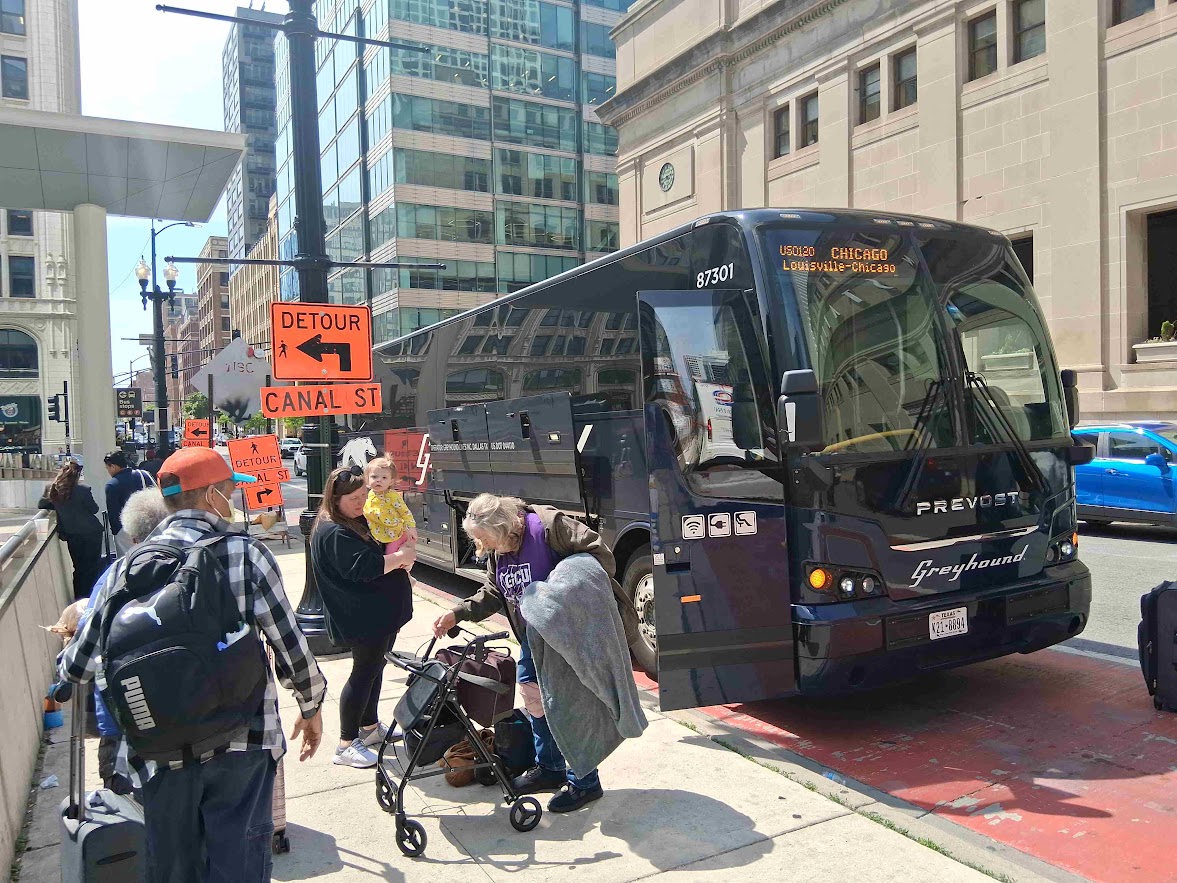
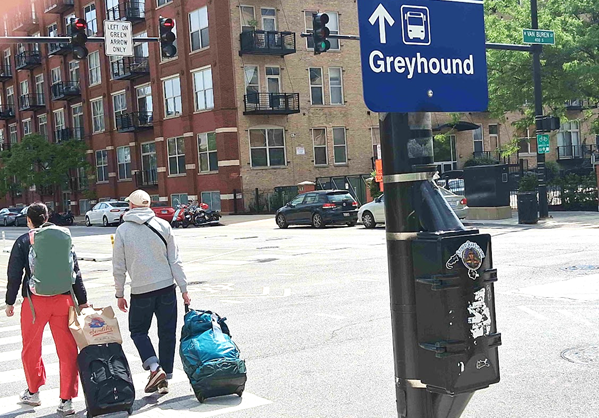
| News Photos from Around the US | A Greyhound coach from Louisville operating as part of the Amtrak Thruway network is on the "red lane" at Chicago Union Station in May 2026. The afternoon arrival allows for transfers to trains bound for Midwestern points and the East Coast, filling a void in the rail network. The coach's next and final stop will be the Chicago Intercity Bus ("Greyhound") station a few blocks away. | Denver Union Station Bus Concourse | Passengers wait for a Bustang South Line departure in the Denver Union Station bus concourse in May 2026. This view faces northwest, away from the lavishly restored DUS terminal building and faces toward the station's busy light-rail stop. Bustang departs from both the southwest side (left, which is also used by Flix/Greyhound) and northeast side (right) of the concourse. | Travelers tote their luggage down Clinton Street just a block from Chicago Union Station toward the Chicago Intercity Bus Station and CTA Blue Line rapid-transit stop. A sign points the way to Greyhound. The juxtaposition of these three transportation nodes heightens local interest in saving the bus station. | Masthead (top) photo caption: A Bustang West Line coach travels along a well-marked bus line on 18th Street as it approaches Denver Union Station, a compelling example of the benefits of allowing intercity buses to use dedicated bus lanes through downtown districts. An RTD train at one of DUS's platforms is in the distance. Inset: A passenger waits outside the Chicago intercity Bus Station. We thank Robert Rynerson for keeping us apprised of news from Colorado. | | |
Invite others to join Intercity Bus Listserv
For a link to this newsletter, our past newsletters, and reports, click here
Invite your colleagues to join our Intercity Bus Listserv. To become part of our Intercity Bus Listserv and receive 8 – 10 emails per year, email Zaria by replying to this email. No spam. Free. Also, check out our recent studies, briefs, and podcasts below. The Intercity Bus E-News team is Zaria Bonds, Samantha Rouzan, and Joe Schwieterman.
-
For a link to our May Intercity Bus E-News, click here
This independently produced e-newsletter brief has been shared with our Intercity Bus (IB) and Transportation listservs. The Chaddick Institute does not receive funds from transportation companies or related industries.
| | | | |