|
Sacramento County overrides oak protections
California's goals for protecting biological diversity and cultural resources are often overridden by the development of renewable energy sources. The November 2025 approval of a solar project in Sacramento County underscores the willingness of decision makers to degrade natural and cultural resources in the name of "clean" energy.
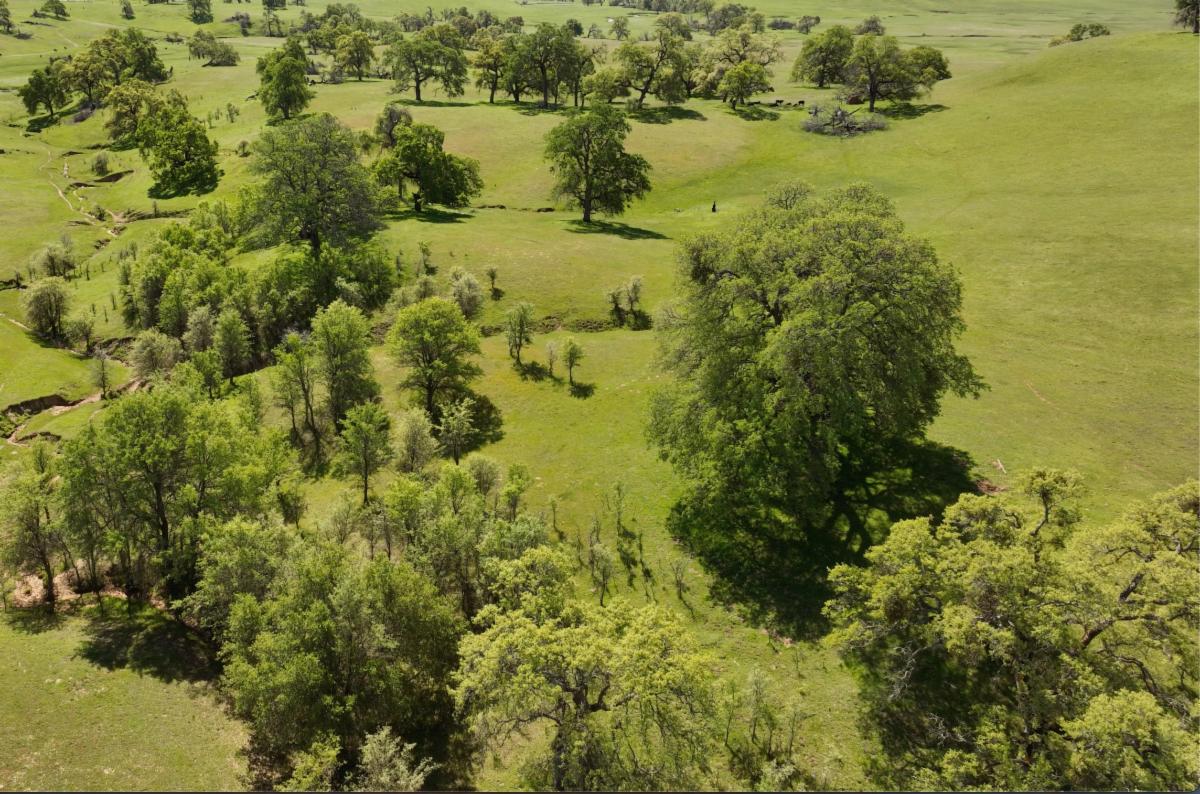
The Coyote Creek Agrovoltaic Project will develop 1,554 acres of blue oak woodland, blue oak savanna, and grassland on a 2,704 acre property in southern Sacramento County. The location's oak trees are Tribal cultural resources and the land is likely home to Tribal burial sites, remnants of settlements, and artifacts.
California Wildlife Foundation/California Oaks' review of the project's environmental documentation found it to be inconsistent with Sacramento County's General Plan. The plan's Public Facilities Element calls for solar electric facilities to be located away from sensitive habitats, sited instead where impacts will be minimized. The Conservation Element is unambiguous in stating the need to ensure no net loss of the county's wetlands, riparian woodlands, and oak woodlands. Instead 3,493 trees will be destroyed, many of which are mature native oaks. The fragmentation of the remaining acres will degrade their habitat value, with remaining connectivity corridors below thresholds recommended by California Department of Fish and Wildlife.
The Board of Supervisors' unanimous approval of the project also violated the General Plan's mitigation requirements, with mitigation ratios dramatically below those articulated in the General Plan. Even if the replanting requirements were stronger, an oak takes many years to produce acorns and provide other ecosystem services destroyed by the removal of a mature tree.
A segment of the project is within the South Sacramento Habitat Conservation Plan area. (A section of the plan is quoted above.) Eleven of the vertebrate species covered by this plan are identified by California Department of Fish and Wildlife’s California Wildlife Habitat Relationship information system as oak-associated, including the following, which are believed to occur at the project site (with Latin names provided for those with state or federal endangered species act designations): American badger, Northern Harrier, Swainson’s Hawk (Buteo swainsoni, state threatened), Western Burrowing Owl (Athene cunicularia hypugaea, state candidate), western pond turtle (Actinemys marmorata, federal candidate), western spadefoot, and White-tailed Kite (Elanus leucurus, California fully protected). Another oak-associated vertebrate that utilizes the site is the Bald Eagle (Haliaeetus leucocephalus, state threatened and fully protected).
Additionally, a number of the habitat conservation plan’s covered invertebrates and plants are considered to be oak-associated species, based on cross-references of California Natural Diversity Database occurrence records with the oak woodland dataset in California Department of Fish and Wildlife’s Areas of Conservation System: Crotch's bumble bee (Bombus crotchii, state candidate), Boggs Lake hedge-hyssop (Gratiola heterosepalam, state endangered), dwarf downingia, legenere, pincushion navarretia, Ricksecker's water scavenger beetle, Sanford's arrowhead, slender Orcutt grass (Orcuttia tenuis, federally threatened and state endangered), and valley elderberry longhorn beetle (Desmocerus californicus dimorphus, federally threatened). Another oak associated invertebrate that utilizes the site's habitat is the vernal pool fairy shrimp (Branchinecta lynchi, federally threatened).
The project also runs counter to Sacramento County's Climate Action Plan, which recognizes the importance of oaks growing in the South Sacramento Habitat Conservation Plan area in sequestering carbon and providing habitat connectivity. The county's 2017 carbon assessment also calls out the importance of oak trees in carbon sequestration.
The environmental analysis also did not use best available science. For example, impacts on groundwater dependent species were improperly assessed. A threshold depth of 30-feet was used for valley oak, a groundwater dependent species that will be impacted by the project. The Nature Conservancy's Groundwater Resource Hub lists valley oak rooting depth at 80-feet.
California Wildlife Foundation/California Oaks appreciates the need for California to adhere to climate goals, but a better path to reaching climate goals is to keep native oaks standing. An extractive project such as Coyote Creek is an ill-conceived approach. Sacramento County chose to disregard the natural and cultural values of the landscape that support local communities, ignoring strong opposition to this project. California must enforce protections for oaks. We can all hold decision makers responsible by participating in elections, reviewing development projects, and by advocating for oak protections.
Next Steps: California Native Plant Society, a member of California Oaks Coalition, and partners hosted a community meeting on December 9, 2025, to explore next steps.
To learn more: The Environmental Council of Sacramento (ECOS) has a webpage about the project or reach out to Brendan Wilce Conservation Program Coordinator of California Native Plant Society.
|