Congratulations to the Class of 2019 and the Human Rights Certificate Graduates!
|
|
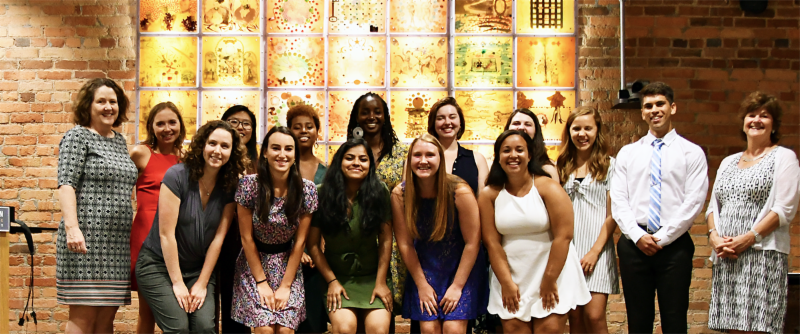
Last Saturday the Duke Human Rights Center@FHI celebrated 15 seniors who received the Human Rights Certificate. This year's graduates include: Mumbi Kanyogo, Rebecca Hall, Isabella Arbelaez, Likhitha Butchireddygari, Trey Walk, Hannah Collins, Isabel Gutenplan, Jair Oballe, Elina Rodriguez, Kristina Smith, Elle Winfield, Cara Leigh Downey, Grace Cai, Mary Aline Fertin, and Christine Kinyua. To learn more about some of the graduates and why they chose to study human rights, visit the
DHRC@FHI website
.
|
|
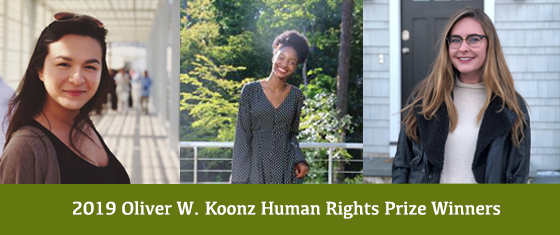
2019 Oliver W. Koonz Human Rights Prize Winners
|
|
The Oliver W. Koonz Human Rights Prize recognizes innovative work done by students in human rights. The recipients of this year's awards are Anna Chulak, for her paper, “How and to what Extent did the Nature of Civil Rights Activism Perpetuate Gender Oppression and Hinder the Work of Black Female Activists?”; Christiana Oshotse for her paper, “The Medical Brain Drain: Impact on Sub-Saharan African Countries”; and Erin Williams for her film,
Silent No More.
Read more about this year's winners and their projects
here
.
|
|
Sowers and Reapers: Gardening in an Era of Change
|
|
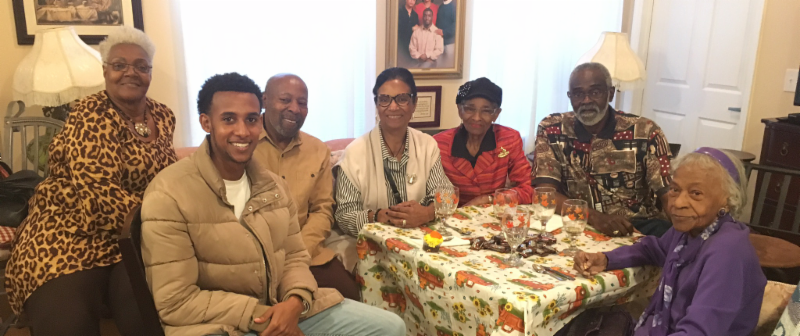
This Bass Connections project brought humanities tools to the issue of environmental justice and migration. The project team documented how Durham residents in two garden clubs and one community garden engage with issues around climate change, environmental justice and gentrification through their gardens. This work drew on human rights approaches, oral history, gardening history, documentary photography, digital mapping and exhibit curation.
Sowers and Reapers: A Durham-based project
By Jordan Dozier ('19)
From backyard gardens to community gardens with an emphasis on faith and connections, the act of tilling the earth is about more than plants or food. As a member of the research team for Sowers and Reapers, a Bass Connections project, I’ve learned that what’s most important about growing things in Durham is the humans who make meaning out of the soil [...]
Read Jordan's full blog post
.
|
|
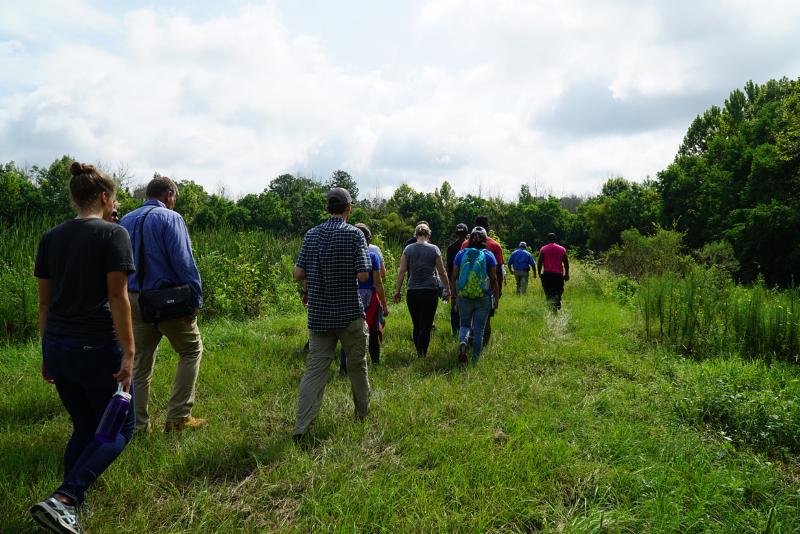
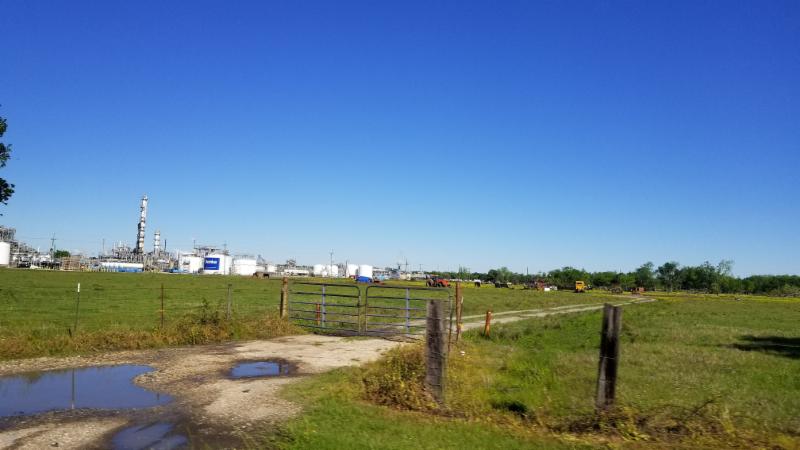
Since 2014, Duke’s Human Rights Center at the Franklin Humanities Institute and the Alabama Center for Rural Enterprise (ACRE) have partnered to address the inadequacy of wastewater treatment infrastructure, which is an economic, racial and environmental injustice entrenched in many communities in rural, black America. This year through a Bass Connections project, students worked with ACRE’s director, Catherine Coleman Flowers, to examine the reasons for the lack of proper sanitation in Lowndes County, and research how to improve sanitation access in the county and explore racial, economic and climate justice in rural America.
|
|
Resilience and Community: Learning About Environmental Disasters and Injustices in Louisiana
By Elizabeth Allen ('20), and Laura Landes, Masters of Environmental Management ('19)
As part of our community partnership with the Alabama Center for Rural Enterprise (ACRE), students traveled with ACRE’s director Catherine Coleman Flowers to the Climate Reality Training in Atlanta, Georgia in March. It was there that we first heard Lieutenant General Russel Honoré speak about environmental justice in Louisiana. Only days later he invited Ms. Flowers and our group to visit him to learn about his work in person. [...]
Read more from Elizabeth and Laura.
|
|
No More Forgetting: Learning from a Global Human Rights Perspective on Sanitation Issues Nationwide
By Laura Landes, Master of Environmental Management ('19)
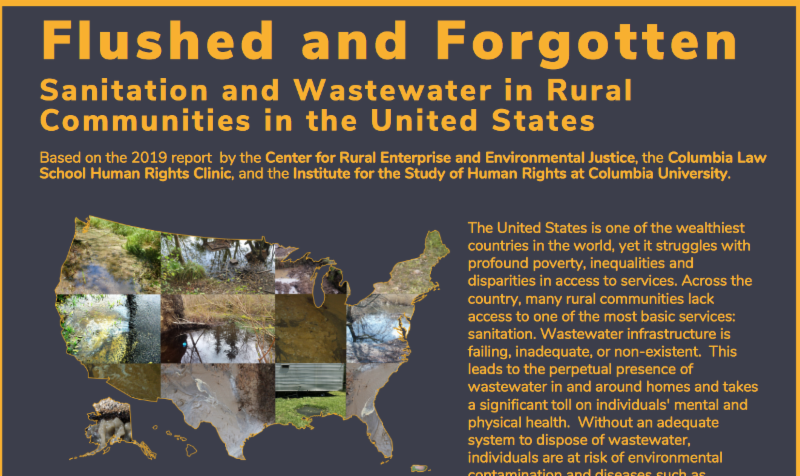
The report recently published by the Alabama Center for Rural Enterprise (ACRE), in partnership with the Columbia Law School Human Rights Clinic and the Institute for the Study of Human Rights at Columbia University, “
Flushed and Forgotten: Sanitation and Wastewater in Rural Communities in the United States
,” is unlikely to be soon forgotten by anyone who reads it. An eye-opening and in-depth study of the issues of access to adequate sanitation services in rural America, placed in the framework of global human rights, it serves as a call to action to the United States. [...]
Read more from Laura
|
|
A Timeline of the Environmental Justice Movement from 1960s-present
By Elizabeth Allen, McKenzie Cook, Gino Nuzzolillo, Ana Ramirez and Madelyn Winchester
As part of the Bass Connections project, students built an online, interactive environmental justice timeline that describes the history and the development of environmental justice in the U.S. The project aims to create a detailed history of important events in the Environmental Justice Movement, and includes interviews with activists and scholars
.
View the Environmental Justice timeline and interviews
.
|
|
2019 Human Rights Summer Research Grant Recipients
|
|
Each year, the
Duke Human Rights Center at the Franklin Humanities Institute award
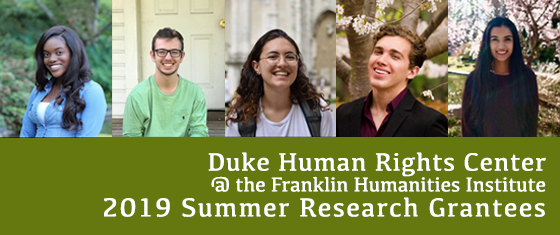
s students interested in developing, implementing and working in human rights with funding for summer research. This year’s recipients include five undergraduate students with projects ranging from an exploration of community organizing after Hurricane Maria to understanding Hepatitis C rates in the North Carolina prison population. These students work will aim to address disparities in human rights through observational social science, archival sources, and medicinal data.
This year's winners are Esther Kwarteng ('20), Gino Nuzzolillo ('20), Selin Ocal ('20), Ivan Robles ('20) and Anisha Watwe ('21). Read more about their summer research projects
here
.
|
|
Why the Human Rights Certificate? Interview with Incoming Young Trustee Trey Walk
|
|
This interview was conducted over email with Trey Walk, a senior undergraduate student enrolled in the Human Rights Certificate Program, completing a major in History, by Miranda Gershoni, a first-year undergraduate student working for the Duke Human Rights Center at the Franklin Humanities Institute.
Miranda Gershoni (MG):
Why did you decide to pursue the human rights certificate?
Trey Walk (TW):
I took the introductory course and realized that this certificate would be a great opportunity for me to use my coursework to learn more about social justice issues I cared about like poverty and inequality [...]
Read the rest of the interview with Trey
here
.
|
|
Featured Video:
Global Ideas, Local Impact
|
|
This year's
Global Ideas and Local Impact
event featured a panel of Duke alums and a research slam of current students presenting their research in human rights. The panel included Damjan Denoble, Executive Director at Mi Maletin (a firm working to integrate digital technologies into the legal immigration process); James Tager, Deputy Director of Free Expression Research at PEN America; and Karen Stauss, Senior Policy Counsel in the Human Trafficking Division in the Department of Justice.
|
|
|
Report from the Field: "Clean" Streets at What Cost?
|
|
This post was written by a recent Duke alumna working in Rwanda. She was involved with the Duke Human Rights Center throughout her time at Duke. The blog post is published anonymously at the alumna's request.
When I first arrived in Rwanda, I immediately noticed how clean the streets are in Kigali, the country’s capital. Rwanda is notoriously pristine and orderly, often deemed the “Switzerland of Africa.” Kigali is praised as one of the cleanest and greenest cities in the world (1). Single-use plastics are banned. Street cleaners sweep for hours every day. And hardly any street vendors, homeless people, beggars, or sex workers can be seen.
Read the full blog here.
|
|
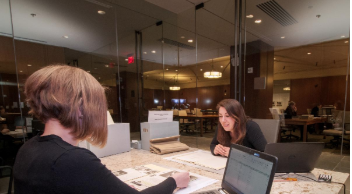
Graduate Student Opportunity: Rubenstein Library Seeks Archival Expeditions Fellows.
Archival Expeditions introduces Duke graduate students to teaching with digital and physical primary sources. Each student partners with a Duke faculty sponsor to design an undergraduate course module that incorporates primary source material tailored to a specific class taught by that faculty member. Students have the option of drawing on the physical special collections of the Rubenstein Library or primary source databases and digital collections available at Duke or elsewhere. Visit the
Archival Expeditions website
for details and application instructions.
|
|
CFP: The Columbia Journal of Politics and Society Seeks Undergraduate Submissions.
The Journal of Politics & Society, with its particular focus on undergraduates and interdisciplinary coverage, is the only scholarly publication of its kind. Now in its twenty-eighth year, the Journal only considers academic papers submitted by undergraduates. In a process comparable to the peer review and editing procedures of professional academic journals, selected papers are rigorously edited by the Editorial Board, itself composed exclusively of undergraduates.
Visit their website
for information about paper and research submissions.
|
|
The Duke Human Rights Center @ the Franklin Humanities Institute brings together an interdisciplinary group of scholars, staff and students to promote new understandings about global human rights issues.
|
|
|
|
|
|
|