Interviews with this Week's Guest Speakers
|
|
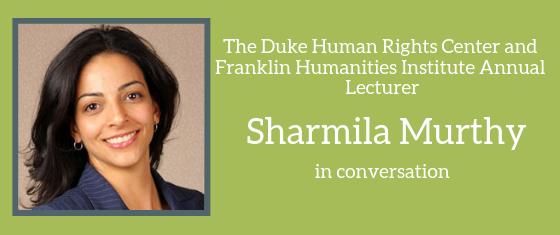
This interview with Sharmila L. Murthy was conducted over e-mail with Miranda Gershoni.
Miranda Gershoni
: How did you get involved in the work you do?
Sharmila Murthy
: As an undergraduate, I studied natural resources with a focus on international development and studied disparities in access to key resources such as water. After college, I contributed to several public health and development projects in India. The experience opened my eyes to what life was like without easy access to water. Following law school, I began my legal career as a poverty lawyer in the U.S. and then in 2010, I started a program on the Human Rights to Water and Sanitation at the Carr Center for Human Rights Policy at Harvard Kennedy School. It was an exciting time to work on these issues; in 2010, the United Nations General Assembly recognized the human right to safe drinking water and sanitation.
See the full interview
here
.
|
|
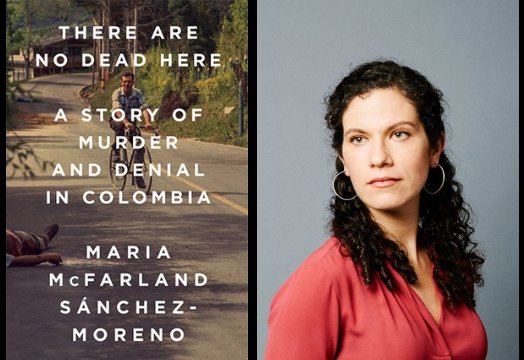
On February 26, María McFarland Sánchez Moreno, the winner of the 2018 Juan E. Méndez Human Rights Book award, was on campus to receive her award and discuss her book,
There Are No Dead Here: A Story of Murder and Denial in Colombia
.
This interview with Maria McFarland Sánchez-Moreno was conducted over e-mail with Miranda Gershoni.
Miranda Gershoni:
What inspired you to write
There Are No Dead Here
?
Maria McFarland Sánchez-Moreno:
In my five-plus years of work on Colombia, I got to know so many extraordinary Colombians, who had risked their lives to stand up for truth, justice, and basic human dignity, but whose stories were unknown more broadly. Most of the stories you hear about Colombia—especially outside the country—have to do with violence, drugs, or corruption, and while that is all certainly a part of the country’s reality, it fails to capture what I found to be most striking about my experience there. The book is an attempt to paint a more nuanced portrait of Colombian society and uncover parts of its recent history that aren’t well known, but also to honor the many brave Colombians who in largely anonymous ways are fighting to make a difference.
Read the full interview
here
.
|
|
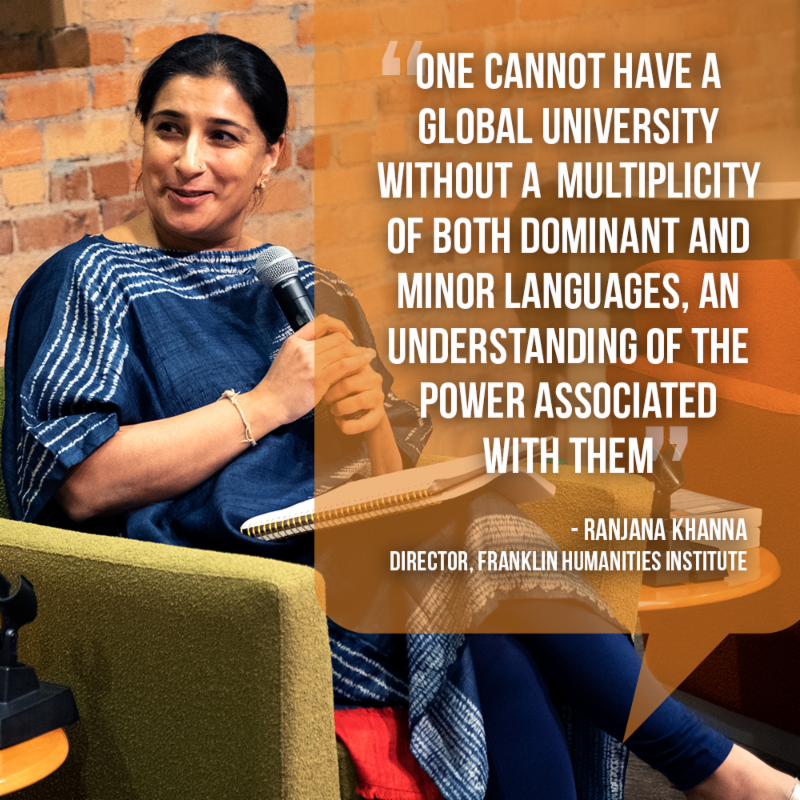
DHRC and FHI Statements on Linguistic Diversity
|
|
A Look at the El Pueblo Inc. Records:
Serving the Growing Latinx Population of North Carolina
News from the Human Rights Archive
|
|
Post contributed by David Dulceany, Marshall T. Meyer Human Rights Intern and PhD candidate in Romance Studies.
El Pueblo Inc. is a Triangle area Latinx organization based in Raleigh, NC. They strive for the local Latinx community “to achieve positive social change by building consciousness, capacity, and community action.” El Pueblo Inc. has been involved in policy change by lobbying state and national politicians and pushing for legislation that benefits the Latinx community, raising health awareness, and especially, spearheading public safety campaigns. For example, in past campaigns, they have focused on reducing drunk driving and encouraging the proper use of child car seats. The organization also specifically focuses on youth issues and youth leadership. They have a separate Youth Program division tasked with running programs for Latino youth that are youth-led. One example is Pueblo Power, a social justice and community-organizing program
.
|
|
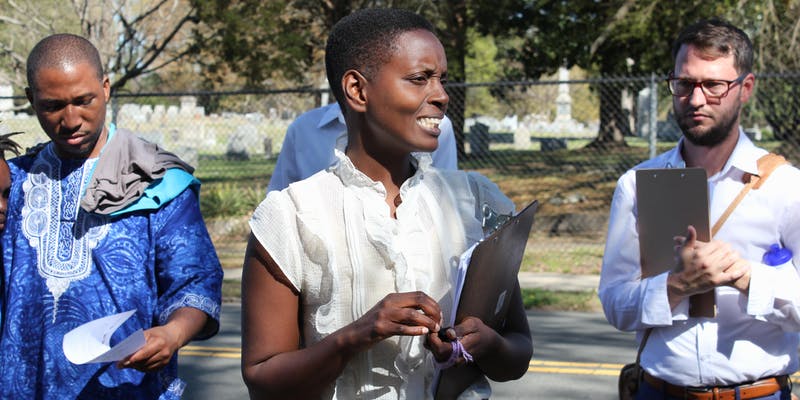
The Pauli Murray Project's Walking Tours
|
|
by Emerson Goldstein,
Programming and Communications Associate
, The Pauli Murray Project
The Pauli Murray Project’s walking tours are back for 2019!
Please join the Pauli Murray Project and Whistle Stop Tours for these historic tours of Pauli Murray’s Durham home on March 23, April 27, May 26, June 2, September 14, October 12, or November 19.
Aya Shabu and friends will share stories about the significance of Black Civil War soldiers, the Freedman Schools movement, Durham’s origin story, and unsung hero Pauli Murray - her multiracial ancestry and heritage, spirit of relentless activism, and roots in Durham. You can purchase tickets for the Spring dates (March-June)
here
, or purchase tickets for Fall dates (September-November)
here
.
Please email Emerson Goldstein
(
emerson.goldstein@duke.edu
)
for more info.
|
|
Meet Human Rights Certificate Students
Isabel Gutenplan and Mumbi Kanyogo
|
|
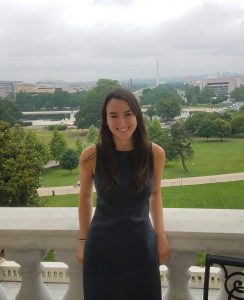
This interview was conducted over email with Isabel Gutenplan, a senior undergraduate student enrolled in the Human Rights Certificate Program, completing a major in Political Science, by Miranda Gershoni.
Miranda Gershoni
: Why did you decide to pursue the human rights certificate?
Isabel Gutenplan
: I decided to pursue the human rights certificate because I took the introduction class my freshman year and I found all the topics we touched on so interesting — I found each week I just wanted to learn more about each topic, all of which could have been their own class. I found that even in that brief introduction into many different topics the way I saw and read the world was changing, and I really liked that.
Read the full interview with Isabel
here
.
|
|
This interview was conducted over email with Mumbi Kanyogo, a senior undergraduate student enrolled in the Human Rights Certificate Program, completing majors in Gender, Sexuality and Feminist Studies and Public Policy, by Miranda Gershoni.
Miranda Gershoni
: Why did you decide to pursue the human rights certificate?
Mumbi Kanyogo
: I decided to pursue a human rights certificate because I’m interested in how gender issues are thought about and acted upon in liberal discourse, and gaining an understanding of the values and contradictions of human rights discourse, as well as a better understanding of how human rights agenda contributes to neoliberalism in contemporary politics.
Read the full interview with Mumbi
here
.
|
|
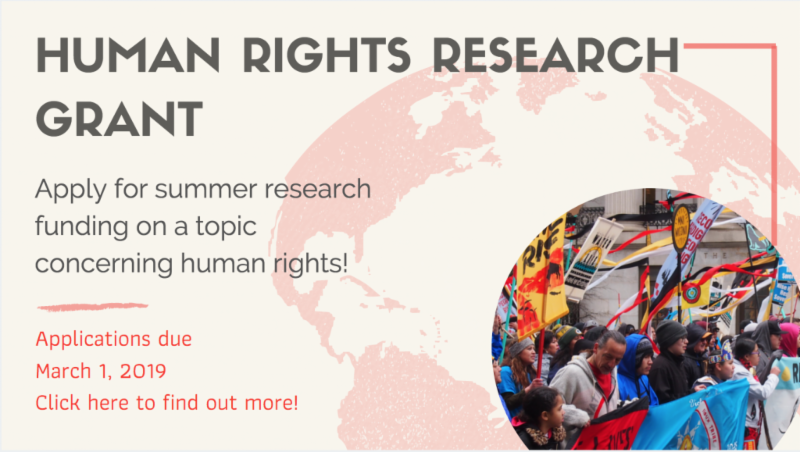
What can you do with a Human Rights
Research Grant? Apply Now! Deadline is March 1.
|
|
Tyler Goldberger
is a senior studying History, Spanish, and Jewish Studies and
a 2018 recipient of a Human Rights Summer Research Grant.
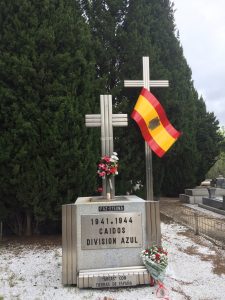
During his time in Madrid, Spain Tyler visited numerous archives and worked directly as a research analyst with the social movement
Asociación para la Recuperación de la Memoria Histórica
. Asociación’s mission is to uncover Spain’s (in)ability to adequately recognize three major human rights atrocities in history. Click
here
to read more about Tyler's research.
|
|
Nora Nunn
is a doctoral candidate in Duke University’s department of English and
a recipient of a 2018 Human Rights Summer Research Grant.
She
specializes in transnational 20th-century American literature and visual cultures, with a focus on genocide and human rights
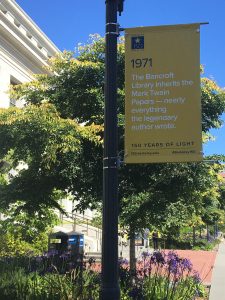
. During her time in the
Mark Twain Papers
archive, Nora analyzed and carefully studied Mark Twain's little known 1905 satirical piece King Leopold's Soliloquy dedicated to
King Leopold’s bloody reign over the Belgian Congo. Click
here
to read more about Nora's summer research.
|
|
Interested in knowing more about what you can do with a Human Research Summer Research Grant?
Please see
here
. The goals of the grant are to strengthen global research opportunities for students interested in developing, implementing and working in human rights. Special consideration is given to students whose research contributes to a senior thesis or project, or towards the research component for the Capstone for the
Human Rights Certificate
. Grants are available of up to $2,000.
The deadline for applying for a 2019 Human Rights Summer Research Grant is March 1st.
|
|
Now in its 20th anniversary year,
Democracy Summer is a paid summer internship for North Carolina college and community college students
interested in organizing experience valuable to a career in social change. Interns work for nine weeks during the summer as organizers in communities across the state. They are looking for interns who can spend the summer in Western NC, Eastern NC, the Triad, and Charlotte area regions to reach local volunteers, advocate policies that improve democracy, and help our state navigate this important year for building political power and engaging in local elections. Interns earn a $3,000 stipend, while building relationships and receiving training that will help them kickstart an exciting career in social and economic justice, advocacy, research, politics, law, nonprofits, or public service.
The deadline to apply is
Friday, March 15, 2019
. For more information email
info@democracync.org
and use the subject line: "Democracy Summer Application.
Click
here
for more details about Democracy Summer and to begin completing the 2019 application.
|
|
Rights & Identities in the Americas: Human Rights, Indigenous People and Contemporary Challenges, Duke Immerse, Fall 2019.
Rights & Identities in the Americas takes an interdisciplinary, integrated look at the history of human rights in the Americas, indigenous rights through the lens of language and culture, and connections between the state, family, gender and immigration. Applications are currently being accepted for Fall 2019!
Download the application
and submit the completed application to Robin Kirk (
rights@duke.edu
). Students are accepted on a rolling basis until 5pm on
Thursday, March 21st
, or until the Fall 2019 cohort is full. Contact Robin Kirk (
rights@duke.edu
) for more information.
|
|
'Race', Science & Power: Contextualizing Durham's Hidden Histories, Duke Immerse, Fall 2019.
Researching 'race' through the intersection of biology, anthropology, education, and history. The cluster investigates ‘race’ as both a lived experience and an institutionalized system of oppression, and considers how racial categories have been used to empower, create, and negotiate alliances within structures of power. Acceptance is on a rolling basis until
Thursday, March 21st
or until the Fall 2019 cohort is full. (Registration is complete with the professors' confirmation.)
Download the application
and submit the completed form to Professor Márcia Rego,
marcia.rego@duke.edu
.
|
|
Annual Oliver W. Koonz Human Rights Prize competition.
The Duke Human Rights Center awards one $500 prize in each category of best essay and best alternative project on a human rights theme. Essays must be no longer than 25 double-spaced pages. They may take the form of analytic or critical essays, empirical research papers, term papers or personal essays on any human rights issue. Projects can be photo or video-based, theater pieces or scripts or web pages. Please send submissions with an introductory paragraph describing the connection with human rights and specify if the paper or project is related to a course. Please send submissions to
Emily.Stewart@duke.edu
by
April 1, 2019
. Awards will be announced in May 2019. Click
here
for more info.
|
|
Indigenous Rights, Environmental Justice, and the Atlantic Coast Pipeline
Wednesday March 6, 5:30 PM - 7:00 PM
Smith Warehouse, Bay 4, Ahmadieh Family Lecture Hall (C105)
.
Food and drinks provided
Please join us on March 6 at 5:30 PM for a talk by
Ryan Emanuel
entitled, “Indigenous Rights, Environmental Justice, and the Atlantic Coast Pipeline.”
Federal agencies in the United States use environmental justice analyses to help identify and address disproportionate, adverse impacts of environmental permitting and decision-making on vulnerable communities. Among those most affected by such actions are indigenous peoples, whose living ties to specific places can extend from time immemorial to the present. In spite of policies designed to promote justice and engagement, indigenous communities and their place-based knowledge systems are often omitted from environmental reviews and excluded from environmental decision-making. More info
here
.
|
|
Global Ideas, Local Impact
Wednesday March 27, 4:30 PM - 6:00 PM
Holsti-Anderson Family Assembly Room (Rubinstein Library 153)
Global Ideas, Local Impact
is the Duke Human Rights Center’s annual celebration of human rights opportunities at Duke and in the world. The event, hosted by the
Student Advisory Board
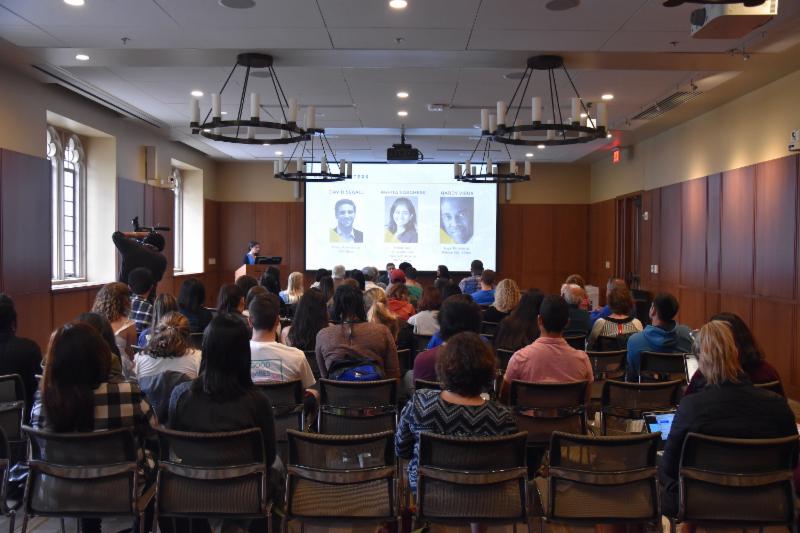
, includes a research slam, where students present their human rights research conducted throughout the school year, and an alumni panel, where alumni working in different fields related to human rights share their experiences and advice about human rights work. Food will be provided. More info
here
.
|
|
The Duke Human Rights Center @ the Franklin Humanities Institute brings together an interdisciplinary group of scholars, staff and students to promote new understandings about global human rights issues.
|
|
|
|
|
|
|