Méndez Award winner: Carolyn Forché’s
What You Have Heard Is True
|
|
Carolyn Forché’s timely book, “
What You Have Heard is True: A Memoir of Witness and Resistance
” (Penguin Press, 2019), is the winner of the 2019 Juan E. Méndez Book Award for Human Rights in Latin America. Forché will accept the Méndez award at a March 2 reading at Duke University.
“
What You Have Heard is True
” is an account of a poet’s engagement with a country going through violent change, in part funded and propelled by U.S. foreign policy. When notified of the award, Forché wrote, “I’m deeply honored by the news of this award, especially one named for an ardent and heroic champion of human rights, Juan E. Méndez, whom I once had the honor of meeting briefly, through my former student, Marjory Wentworth, with whom he wrote ‘
Taking a Stand: The Evolution of Human Rights.
’ Read more
here
.
|
|
The Right to Speak: Examining Language in the Framework of Human Rights
|
|
By Tyler Kopp, '20
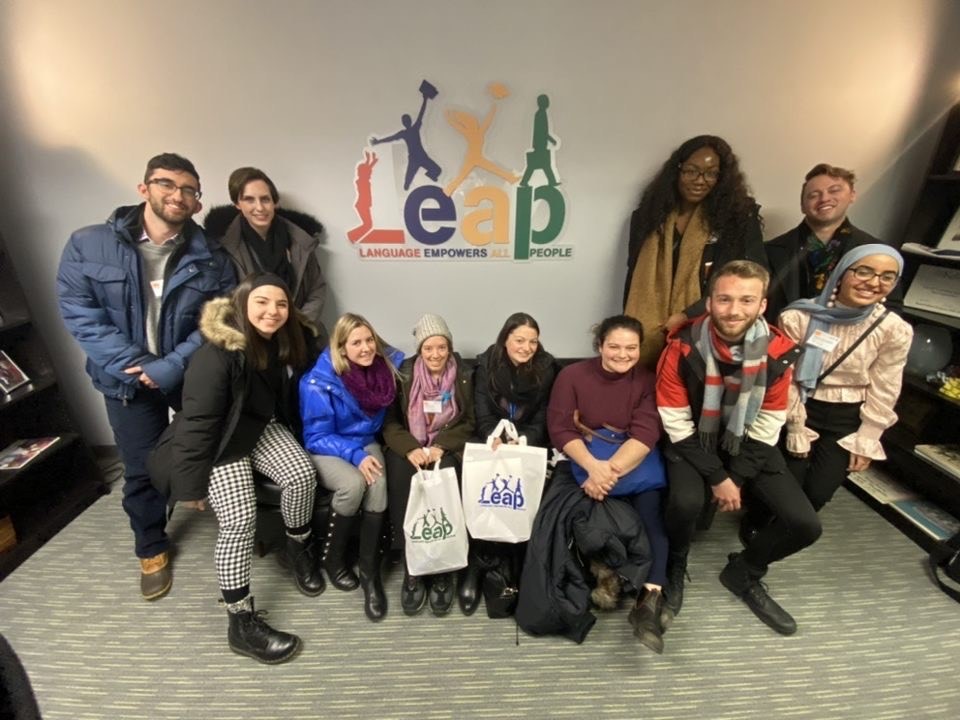
This January, I had the privilege of attending the 19th annual Northwestern University Conference on Human Rights, “The Right to Speak: Examining Language in the Framework of Human Rights.” Through two keynote speakers, a series of panels, and a day trip to a linguistic justice-focused organization, the conference opened diverse rights discussions around topics of systemic linguicism, language revitalization, the language of human rights, and how human rights relate with linguistic justice.
The conference began with a keynote address from two staff members at Wikitongues, a non-profit that aims to revitalize languages and preserve oral tradition by documenting all languages in the world online. The speakers discussed how histories of forced assimilation have threatened linguistic and cultural diversity for centuries and explained their work as a way of joining global efforts to promote language access. Wikitongues’s model relies on the exchange through the Internet, which brings up questions of access. Read more
here
.
|
|
By Miranda Gershoni, '22
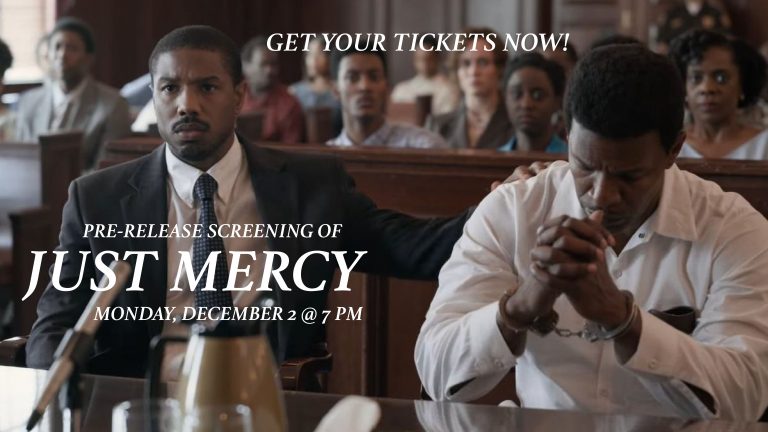
The Duke Human Rights Center at the Franklin Humanities Institute was able to host a special early screening of
Just Mercy
(directed by Destin Daniel Cretton) thanks to the generosity of recent Duke alum Bryce Cracknell (Class of 2018) who now works on Social Impact for Participant Media.
Just Mercy
tells the true story of Bryan Stevenson, a recent Harvard Law School graduate, who decides to move to Alabama to represent incarcerated people without the resources for adequate representation, including those who were wrongfully accused. The film takes us through the journey of Stevenson’s determination to prove his clients’ innocence, which proves to be close to impossible against a system held up by institutional racism. Read more about the event
here
.
|
|
‘
Waging Peace in Vietnam: U.S. Soldiers and Veterans Who Opposed the War
’ Exhibit
|
|
By Zac Johnson, ‘22
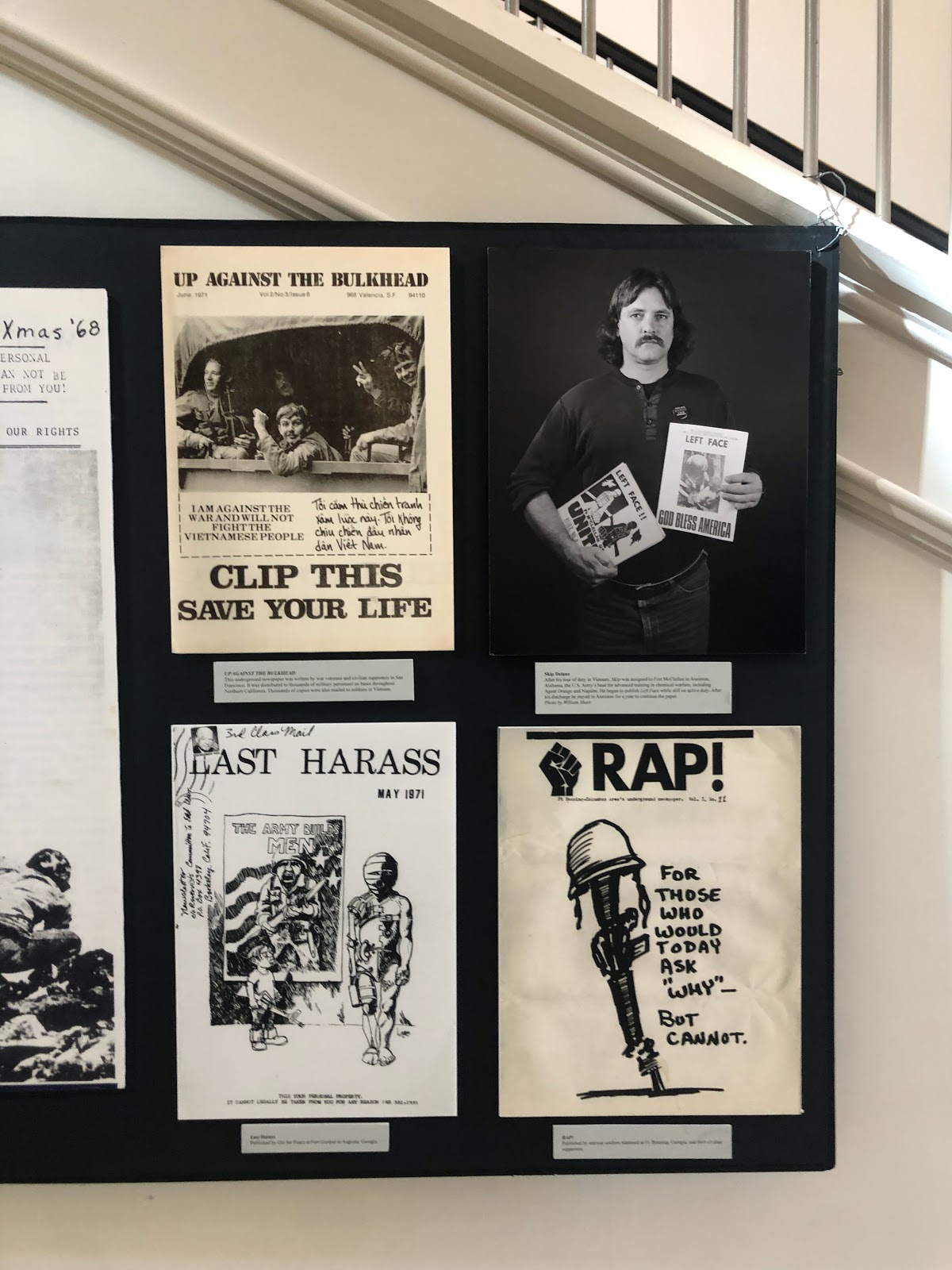
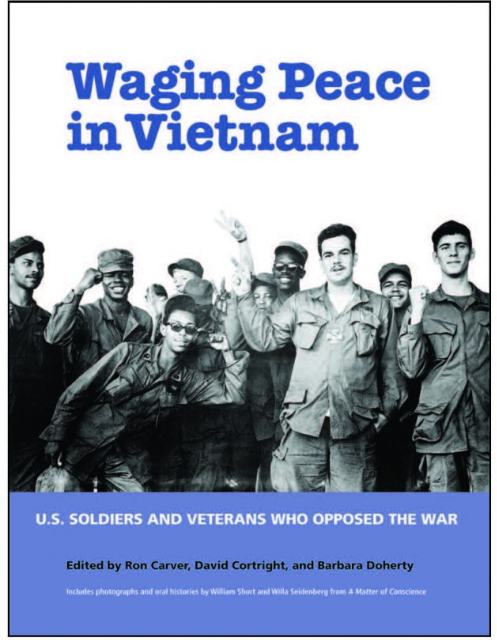
The Duke Divinity School is one of many stops along an international tour for the ‘Waging Peace in Vietnam: U.S. Soldiers and Veterans Who Opposed the War’ exhibit. So far it’s made stops from D.C. to Ho Chi Minh City, with plans to visit Seattle and San Francisco this Spring. The exhibit has been on the 00 level floor of the Westbrook Building since January 15th and it will remain there for the span of a month. Despite some questionable weather earlier in the week, my arrival at the exhibit was blessed with an entrance washed in sunlight. To the left of a tall stone staircase with rustic looking chandeliers dangling above, the exhibit flows down one hallway and into another.
Pieces of blackboard hold together several bits of information, newspaper articles, pictures, and artefacts. The first board contains the most narrative text, explaining the history of the anti-war movement during the Vietnam War, apparently “the largest peace movement in American history.” Read more
here
.
|
|
Why the Human Rights Certificate? Interviews with
Alicia Porile and Madeleine Cochrane
|
|
These interviews were conducted over email with Alicia Porile and
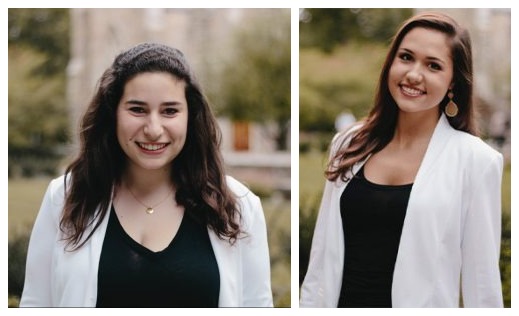
Madeleine Cochrane, by Miranda Gershoni, a second-year undergraduate student working for the Duke Human Rights Center at the Franklin Humanities Institute.
Miranda Gershoni (MG):
Why did you decide to pursue the human rights certificate?
Alicia Porile (AP)
: I wanted to pursue this certificate to ensure that human rights were a critical part of my learning at Duke. While there are many fields of study, human rights have implications in nearly all of them. Having a nuanced understanding of human rights across different contexts is extremely important to me moving forward as a young professional. Read more
here
.
Madeleine Cochrane (MC):
After getting involved with financial advocacy work at the Community Empowerment Fund of Durham in the fall of 2016, I became inspired to seek out curricular opportunities to learn more about the institutions that impact the well-being of human rights across minority and marginalized groups. Additionally, I hoped that my classroom interaction with local, state, national, and international law would allow me to draw conclusions and think critically about solutions for ongoing human rights abuses entrenched in our systems while drawing from relevant experience and historical context. A fire was lit within me and I had to seek out more information to build the tools I needed to (try to) make a real difference! Read more
here
.
|
|
Reflections on
Prosecuting Evil: The Extraordinary World of Ben Ferencz
|
|
By Srishti Saha, Master in Interdisciplinary Data Science, ’21
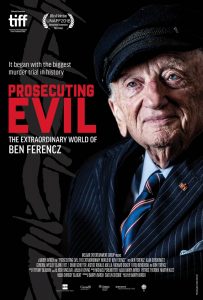
The DHRC@FHI hosted a screening of “
Prosecuting Evil: The Extraordinary World of Ben Ferencz
” (directed by Barry Avrich) on January 22. It was a successful show with around 35 people gathering for the screening followed by a panel discussion with Profs. Eric L. Muller from UNC Law and James Chappel from Duke University’s History Department.
The movie offered insightful information. It was extremely inspiring. Ben Ferencz dedicated a large part of his life to international criminal law.
The movie takes its viewers through a journey of Ben’s life, as seen through his eyes and from the perspective of the people who have known him and have worked with him. Read more
here
.
|
|
Looking for Summer Research Opportunities? Apply now!
|
|
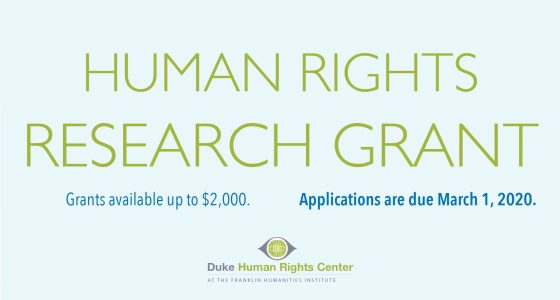
Currently enrolled Duke undergraduate and graduate students are invited to apply for summer research funding from the Duke Human Rights Center@FHI. The goals of the grants are to strengthen research opportunities for students interested in developing, implementing and working in human rights. Special consideration is given to students whose research projects contribute to a senior thesis or project. Grants are available of up to $2,000.
Eligibility and Criteria:
Students from all backgrounds and academic disciplines are encouraged to apply. Graduating seniors or graduate students in their final year at Duke are not eligible.
Students must be directed by a member of the Duke University faculty and conducted over a period no less than 2 weeks during the summer. Students are expected to be in frequent contact with their advisors and the DHRC@FHI throughout the duration of the project. Read more
here
.
|
|
2020 Oliver W. Koonz Human Rights Prize
|
|
Current undergraduates are invited to enter essays or projects related to human rights in our annual Oliver W. Koonz Human Rights Prize competition. The Duke Human Rights Center@FHI awards one $500 prize to the winners in each category. The Oliver W. Koonz Human Rights Prize honors Oliver W. Koonz (1910-2009), who was the father of Claudia Koonz, the Peabody Family Professor Emeritus in the History Department and a founding member of the Duke Human Rights Center@FHI.
The recipient of many awards, Professor Koonz is a passionate advocate of undergraduate education. She has taught and mentored hundreds of Duke students during her career at the university. Her areas of specialty include genocide, 20th century European history and fascism. From her father, she inherited a passion for the outdoors and learning. This prize honors his memory.
Please send submissions to
Emily Stewart
by April 1, 2020
. Awards will be announced in May 2020.
For more details read
here
. For a glimpse into the stories of the recipients of the 2019 Oliver W. Koonz Prize, read more
here
.
|
|
Call for Applications: Technology and Human Rights Fellowship Program.
The Technology and Human Rights Fellowship is part of the Carr Center for Human Rights Policy’s project to examine how technological advances over the next several decades will affect the future of human life, as well as the protections provided by the human rights framework. The project invites applications from individuals to affiliate with the Center for one academic year to conduct research on the ethical and rights implications of technological advancements in general, and artificial intelligence in particular. Applications are due on February 28. Interested students should apply
here
. To learn more about the opportunity, click
here
.
|
|
Paid Summer Research Experience with Story+.
Story+ is a 6-week paid summer research experience for Duke students—undergraduates and graduates—interested in exploring humanities research approaches (archival research, oral histories, narrative analysis, visual analysis, and more). The program combines research with an emphasis on storytelling for different public audiences. In Story+, students are organized into small project teams and have the opportunity to participate in a flexible mini “curriculum” on research methods and storytelling strategies. Team projects may be led by Duke faculty, Duke librarians, or non-profit organizations, and will be supervised on a day-to-day basis by graduate student mentors. Story+ takes place during Summer Session 1.
|
|
'
Waging Peace in Vietnam: US Soldiers and Veterans Who Opposed the War
’ Exhibit
|
|
Please join us for an ongoing exhibit at the Duke Divinity School.
During America’s War in Vietnam, tens of thousands of GIs and veterans created a robust movement in opposition to the war. Yet its history is largely unknown.
The Waging Peace in Vietnam exhibit and its companion book show how the GI movement unfolded, from the numerous anti-war coffeehouses springing up outside military bases, to the hundreds of GI newspapers giving an independent voice to active soldiers, to the stockade revolts and the strikes and near-mutinies on naval vessels and in the air force. It’s time to set the record straight. Read more about the event
here
.
|
|
“What is a resource curse: energy, infrastructure, and climate change in Native North America”
|
|
Andrew Curley is a member of the Navajo Nation and an Assistant Professor in the Department of Geography at the University of North Carolina at Chapel Hill. He studies coal and development in the Navajo Nation. His latest publications highlight the consequence of colonial water laws on indigenous nations and the political economy of green transition within reservation economies. His current work is on extraction, energy, and notions of resource curse among tribal governments.
|
|
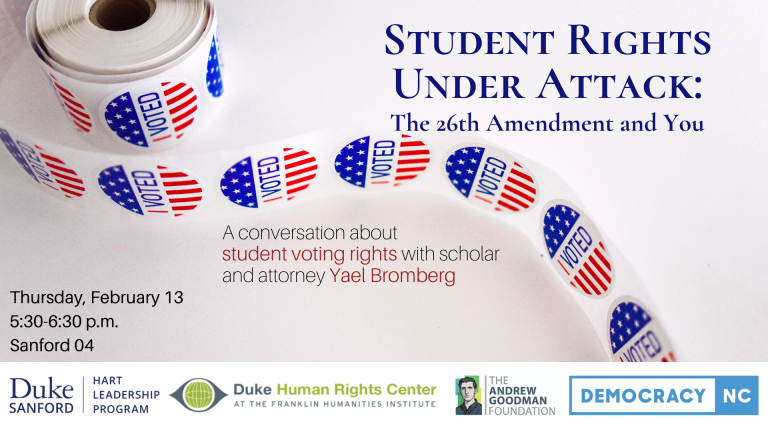
Student Rights Under Attack: The 26th Amendment and You.
|
|
Please join us for a conversation in about student rights.
The 26th Amendment guarantees voting rights to Americans over the age of 18. However, even as young people still face many barriers to voting, the last decade has seen a profusion of attempts to keep students from exercising that right, from new strict voter identification laws, to confusion about the right to vote at campus addresses, to gerrymandering of campus precincts, to efforts to close down campus polling places. Why is this happening? Who doesn’t want students to vote—and why? What can we do to protect our voices and use our power, particularly when the youth vote is on the rise? Read more
here
.
|
|
The Duke Human Rights Center @ the Franklin Humanities Institute brings together an interdisciplinary group of scholars, staff and students to promote new understandings about global human rights issues.
|
|
|
|
|
|
|