| |
|
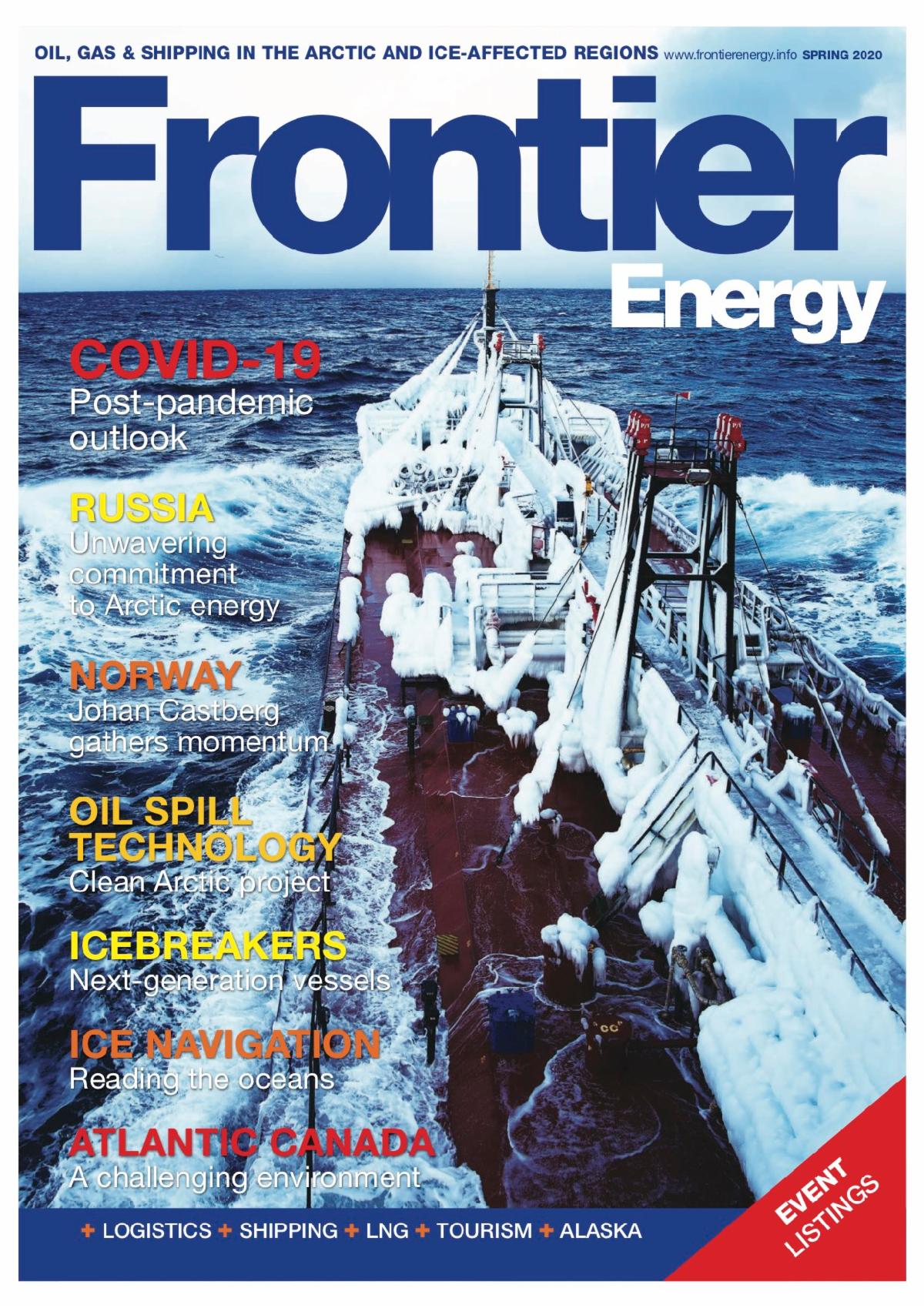
NEW ISSUE TODAY - Spring 2020
Unique news and features including ...
*
COVID 19 -
Post pandemic outlook
* RUSSIA - Unwavering commitment to Arctic
* ICEBREAKERS -
Next generation vessels
* NORWAY -
Johan Castberg gathers pace
* ICE NAVIGATION -
Reading the oceans
* ATLANTIC CANADA -
A challenging
environment
Click
HERE
to read the latest issue
of Frontier Energy magazine!
In the light of the Covid-19 pandemic, our industry is facing unprecedented challenges. We will continue to report on events and wish that you, your families and work colleagues stay well and healthy during these difficult times.
|
Fresh exploration opportunities offshore eastern Canada
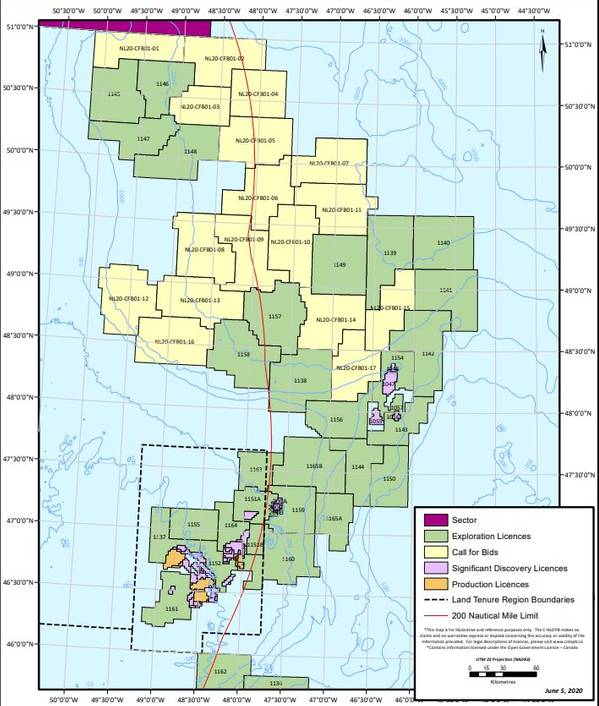 Canada-Newfoundland and Labrador Offshore Petroleum Board (C-NLOPB) has issued a Call for Bids for Exploration Licences in the Eastern Newfoundland Region.
Interested parties will have until 12:00 p.m. NST on November 4, 2020 to submit sealed bids for the parcels offered in this Call for Bids. Notification of any changes to the Call for Bids will be posted on the C-NLOPB's website.
The sole criterion for selecting a winning bid will be the total amount of money the bidder commits to spend on exploration of the parcel during Period I (the first period of a nine-year licence). The minimum bid for the parcels offered is $10million in work commitments.
Planning, monitoring and assessment of offshore petroleum activities will ensure they occur in an environmentally responsible way. Required regional and/or site-specific mitigation measures will be undertaken before any petroleum-related operations can begin within a licence area, as conditions of
C-NLOPB approvals and authorisations. The timing, spatial extent, and nature of proposed oil and gas activities, in addition to mitigations already prescribed by legislation or regulation, will determine the level of restriction or mitigation that may be required.
|
 |
Sakhalin-2 LNG plant starts maintenance work
Russia's Sakhalin-2 liquefied natural gas (LNG) plant has started maintenance work set to last for just over a month at one of the plant's two lines, the company said., reports Reuters.
Sakhalin Energy had originally planned for work to be done on both lines at the same time, but logistical difficulties caused by the coronavirus outbreak forced it to postpone some of the maintenance to 2021.
Works at the Lunskoye-A offshore platform, the Onshore Processing Facility (OPF), Booster Station No.2 and the LNG plant would involve around 1,500 people, all of whom have undergone a 14-day period of self-isolation to guard against the spread of the novel coronavirus, the company said.
"Due to current economic downturn and the pandemic challenge, we had to modify the initial turnaround scope," Ole Myklestad, Sakhalin Energy's production director, said in a statement.
|
 |
|
Gangway contract awarded for new shallow draft icebreaker
 |
|
|
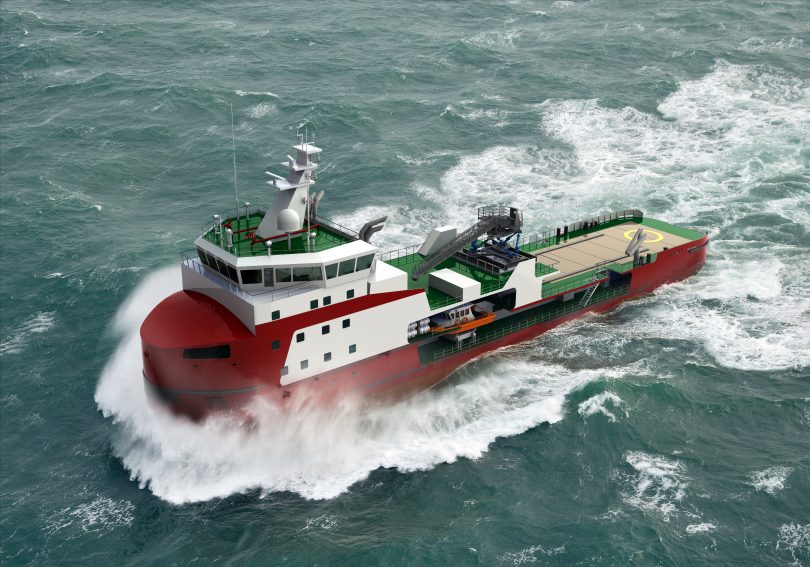
The new shallow draft ice breaker featuring the walk to work gangway
|
Ampelmann, Royal Niestern Sander and Royal Wagenborg signed an agreement for the supply of an ice-strengthened walk-to-work gangway. This system will be installed on the newbuild shallow draught icebreaking walk-to-work vessel that will be delivered to its new owners in December 2021. Together with the vessel, the motion compensated gangway of Ampelmann will perform crew transfer services for up to 40 persons from the shallow Nabil Port to offshore platforms near the east coast of Sakhalin.
The vessel will be operated by Mercury Sakhalin. This agreement is the third time Ampelmann, Niestern Sander and Wagenborg have cooperated. Starting back in 2015 with the Ampelmann A-type installed on the Kroonborg, the second Ampelmann A-type followed on the Kasteelborg in 2018.
The design and construction of this vessel strengthen the position of Niestern Sander in building specialised offshore vessels, including icebreakers and walk-to-work vessels.
|
 |
US starts planning for polar icebreaking fleet
US President Donald Trump has ordered his administration to develop a program to build a polar icebreaking fleet for the Arctic and Antarctic.
"The United States will develop and execute a polar security icebreaking fleet acquisition program that supports our national interests in the Arctic and Antarctic regions," the White House memorandum reads.
The document also states that the United States requires an available fleet of polar security icebreakers that is operationally tested by fiscal year 2029 (due to begin in October 2028).
In addition, Donald Trump has ordered the secretary of homeland security, in coordination with the commandant of the Coast Guard, the secretary of defense, and the secretary of energy, to conduct a study of the comparative operational and fiscal benefits and risks of a polar security icebreaking fleet mix "that consists of at least three heavy polar-class security cutters (PSC)."
The United States currently has just one heavy icebreaker, the
USCGC Polar Star, and one medium icebreaker, the
USCGC Healy.
|
Maersk explores Arctic shipping route with Russia
Shipping group A.P. Moller-Maersk said on Friday it is in talks with Russia's state-owned icebreaker operator to send more goods via the Arctic, which is becoming more accessible as climate change reduces the sea ice, reports Reuters.
Russia has made developing the so-called northern sea route (NSR) - which requires new ports and heavy icebreakers to move goods - a priority, with supporters dubbing the route the northern Suez Canal.
Last summer, Maersk carried out what it said was a one-off trial, becoming the first to send a container ship - loaded with Russian fish and South Korean electronics - on the route.
At the time it denied that the route could be commercially viable, partly because it is on
ly accessible for around three months of the year due to ice.
Russian officials have said there is strong interest in the sea route from Asian countries and that new icebreakers will allow for year-round navigation in the 2020s, reports Reuters.
Beijing laid out ambitions in January 2018 to form a "Polar Silk Road" by developing shipping lanes opened up by global warming and encouraging enterprises to build infrastructure in the Arctic.
|
|
Arctic Council reports on year of Icelandic leadership
Chair of the Senior Arctic Officials Einar Gunnarsson's report on the first year of Iceland's Chairmanship of the Arctic Council has been published.
Sustainable development has been at the heart of the Arctic Council's mandate since the Ottawa Declaration was signed in 1996. We chose sustainable development as the Icelandic Chairmanship program theme because in a rapidly changing world, we see the value in remembering our starting point. While no one could have predicted a year ago that the world would be facing a global health crisis today, it is ever more important that sustainable development lights our way, environmentally, socially and economically, as we gradually resume our daily lives after the confinement period has passed. I am proud of the Council's resilience and efforts towards our common goal of a sustainable Arctic.
Click
here to read the report.
|
|
News in Brief ...
*
Russian prosecutors have ordered checks at "particularly dangerous installations" built on permafrost after a huge oil spill in the Arctic.
An emergency was declared after 20,000 tonnes of diesel leaked into a river when a tank at a power plant near the city of Norilsk collapsed last Friday. I
nitial Russian inquiries suggest ground subsidence as the cause.
The plant is owned by a subsidiary of Norilsk Nickel, which is the world's leading nickel and palladium producer.
*
Russia's largest producer of liquefied natural gas Novatek said progress on its Arctic LNG 2 project. Currently, the overall progress for the project is estimated at 19%, with concrete casting of the first GBS platform estimated to be completed by 37%, despite the COVID-19 outbreak.
An online meeting held this week was attended by Leonid Mikhelson (NOVATEK), Patrick Pouyanne (TOTAL), Dai Houliang (CNPC), Wang Dongjin (CNOOC), Tatsuo Yasunaga (Mitsui) and Tetsuhiro Hosono (JOGMEC). The partners expressed confidence that the project will commence on time based on the current progress.
*
After nine months in orbit China's first micro satellite BNU 1 (Jingshi 1) started its Arctic observation mission. The main objective of the remote sensing equipment is to track ice drifts and iceberg thaw rates, according to Xinhua agency.
"BNU 1 is expected to achieve full coverage of the Arctic in seven days," said the operations team leader, Chen Zhuoqi, who is also an associate professor at the School of Geospatial Engineering and Science at Sun Yat-Sen University.
|
|
REACH YOUR TARGET MARKET VIA THIS eNEWSLETTER
|
Advertise on this unique eNewsletter and reach thousands of senior, decision-making oil, gas and shipping executives; government officials and energy policy makers!
CONTACT our team at
publisher@frontierenergy.info for further information, and other unique sponsorship opportunities.
|
|
Frontier Energy magazine is distributed to an international readership of key decision makers, senior oil company E&P and shipping company executives; contractors and suppliers; technologists; government policy makers and NGO officials; classification societies and consultants. It brings you focussed news, features, comment and key industry trends in a unique one-stop place for Arctic and ice-affected locations. Frontier Energy's magazine, website and eNewsletter connects you with independent, quality information to move your business forward! (c) 2016
|
|
|
|
Issue 380 Thursday
June 18, 2020
|
|
|
The global Covid-19 Pandemic crisis has caused many conferences to be cancelled or postponed. Please check with the organisers for any updates.
Arctic Shipping Forum
September
23-25
Helsinki, Finland
Arctic Shipping Forum is the world's largest and most influential event that brings together the who's who of the Arctic shipping industry from 15 maritime nations to learn and exchange strategic information on operations, ship technology, resource development and regulation, discuss the dynamics of global trade and the environmental impact on the Northern Sea Route.
For more information click
here.
xxxxx
Arctic Circle Assembly
Oct 9 - 11
Reykjavík, Iceland
The annual Arctic Circle Assembly is the largest annual international gathering on the Arctic, attended by more than 2000 participants from 60 countries. It is attended by heads of states and governments, ministers, members of parliaments, officials, experts, scientists, entrepreneurs, business leaders, indigenous representatives, environmentalists, students, activists and others from the growing international community of partners and participants interested in the future of the Arctic.
The Arctic Circle Japan Forum
November 21 - 23
Toyko, Japan
The Arctic Circle Japan Forum will be organized in association with the Third Arctic Science Ministerial Meeting (ASM3), which will be co-hosted by the Icelandic Ministry of Education, Science and Culture, and the Japanese Ministry of Education, Culture, Sports, Science and Technology (MEXT).
ASM3 follows the Second Arctic Science Ministerial Meeting, which was hosted by the Governments of Finland and Germany, and the European Union in 2018, and the White House Arctic Science Ministerial, hosted in Washington, D.C. in 2016.
Click
here for more information.
|
|
|