| |
|
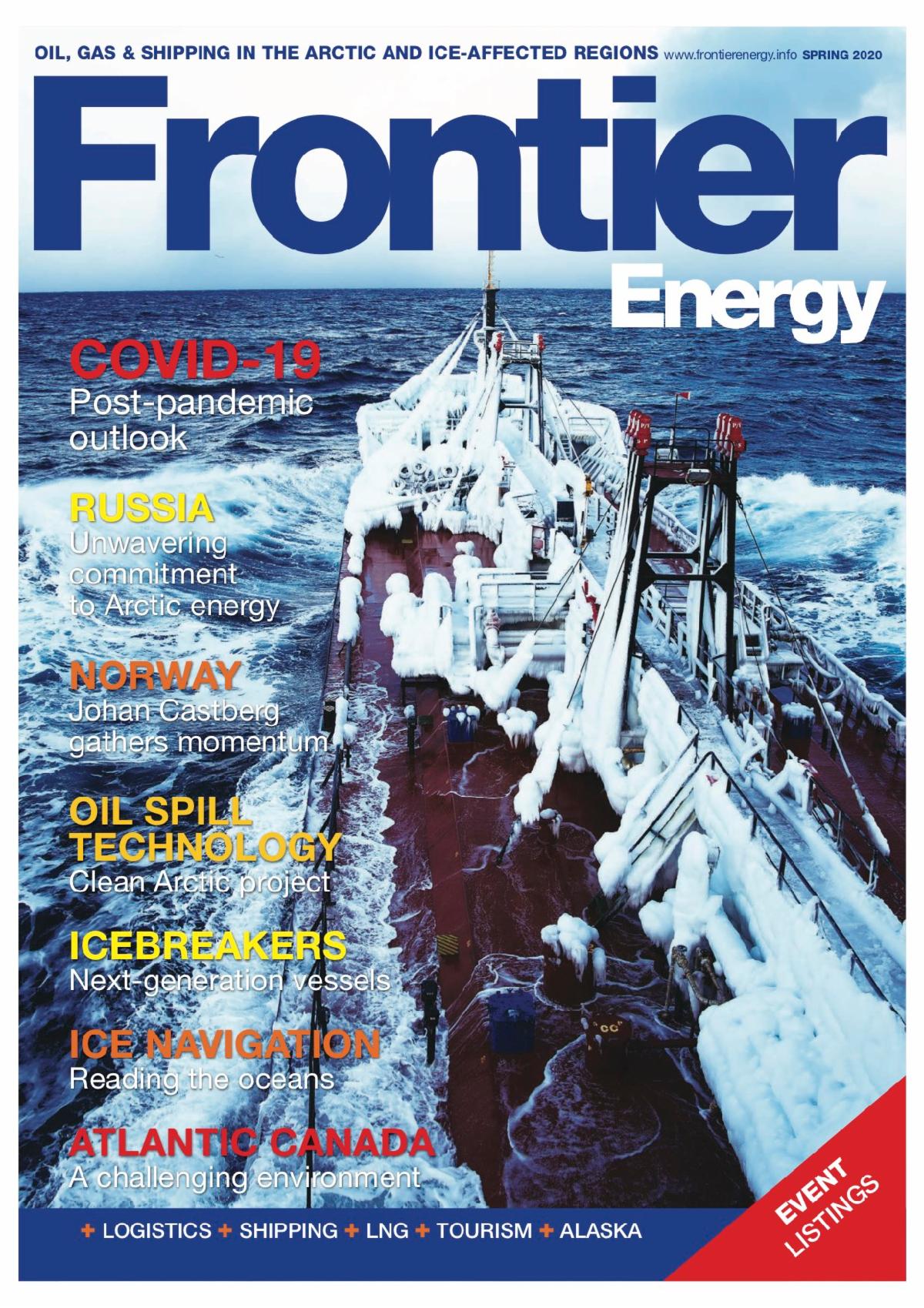
NEW ISSUE TODAY - Spring 2020
Unique news and features including ...
*
COVID 19 -
Post pandemic outlook
* RUSSIA - Unwavering commitment to Arctic
* ICEBREAKERS -
Next generation vessels
* NORWAY -
Johan Castberg gathers pace
* ICE NAVIGATION -
Reading the oceans
* ATLANTIC CANADA -
A challenging
environment
Click
HERE
to read the latest issue
of Frontier Energy magazine!
In the light of the Covid-19 pandemic, our industry is facing unprecedented challenges. We will continue to report on events and wish that you, your families and work colleagues stay well and healthy during these difficult times.
|
Spain's Repsol out of planned Arctic JV in Russia, reports
Spain's Repsol has pulled out of a planned joint venture to develop two Arctic oil blocks with Russia's Gazprom Neft and Royal Dutch Shell, a spokesman at Repsol said , reports Reuters.
Gazprom Neft, the oil arm of Russian gas giant Gazprom, Repsol and Shell signed a memorandum of understanding last June on establishing a joint venture to develop the Leskinsky and Pukhutsyayakhsky blocks on the Gydan Peninsula in northern Siberia, said the reports.
A deal on the venture, in which Gazprom Neft would hold a 50% stake and Repsol and Shell each own 25%, was expected to close this year.
"Its an option we had on a well we are choosing not to exercise," Repsol's spokesman said.
|
 |
St. Petersburg shipyard lays keel for icebreaker Yakutia
 |
|
|
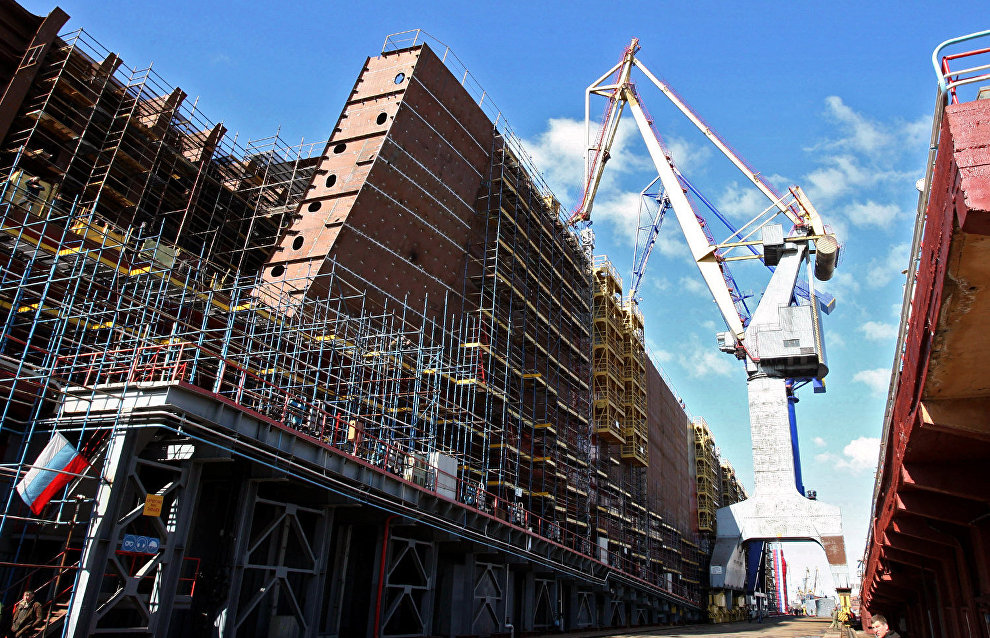
Keel laying att the Baltic Shipyard
|
The Baltic Shipyard in St. Petersburg (Joint Shipbuilding Corporation) has held a keel-laying ceremony for the nuclear icebreaker Yakutia, the fourth one all in all and the third one of Project 22220.
The name of the new vessel comes from the Atomflot tradition of naming its icebreakers after Northern Sea Route toponyms or after decommissioned legendary Arktika-class icebreakers. The
Yakutia will be equipped with a two-reactor propulsion unit, with the main steam source coming from the next-generation reactor system RITM-200 that has a capacity of 175 МWt, specially developed for the vessel. The future icebreaker will have a shaft power of 60 MWt, speed of 22 knots (in open water), length of 173.3 m (waterline length is 160 m), width of 34 m (waterline width is 33 m), height of 52 m, draft of 10.5 m/8.65 m, maximum icebreaking capability of 2.8 m, full displacement of 33,540 metric tons, and service life of 40 years.
|
 |
|
New method to retrieve data on Arctic sea ice
Climatologists at the Institute of Geography and the Obukhov Institute of Atmospheric Physics, both of the Russian Academy of Sciences (RAS) have developed a method to retrieve data on changes to Arctic sea ice before satellites and constant monitoring.
Continuous satellite monitoring of the Earth has only been carried out since 1978. Previously, the ice caps were monitored from the coast, or from ships and planes and from drifting buoys. Even earlier, before 1953, there were big gaps in the data on sea ice drifting patterns in the Arctic because the amplitude of fluctuation and length were relatively small. For example, during World War II, data were simply replaced with climatological indicators. However, such a dynamics of the ice caps in the first half of the 20th century do not concur with the strong climate warming trend in the Arctic in that period which could be compared with today's climate warming. Read more on the results of the research in the article, "Changes in Arctic Sea ice in the first half of the 20th century: Time and spatial reconstruction based on temperature data" published in the magazine "RAS Izvestiya: Atmosphere and Ocean Physics."
|
 |
PGS acquires three new surveys for eastern Canada in 2020
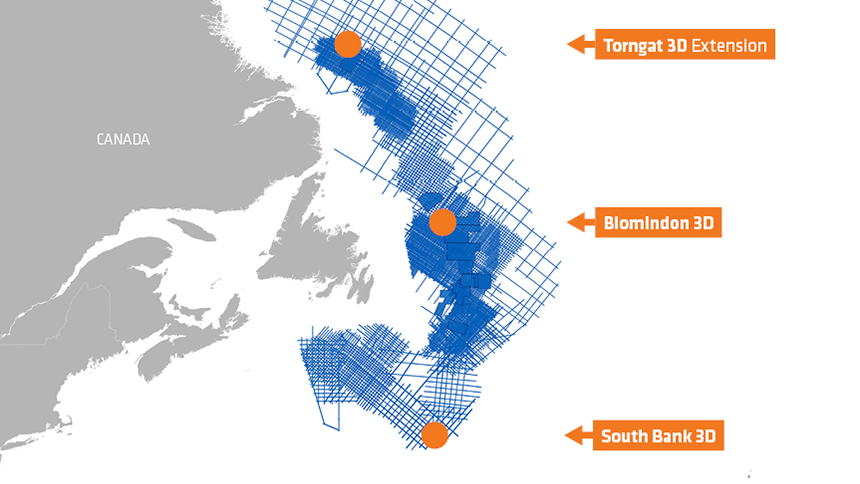
European-based seismic company PGS' is to acquire three ne
w surveys for offshore eastern Canada new Blomidon, South Bank, and Torngat Extension GeoStreamer surveys are all supported by industry funding. Together they will cover approximately 10 000 sq. km offshore Labrador and
|
|
|
PGS will survey these areas east of Canada |
Newfoundland.
The three new PGS marine seismic surveys will be acquired by the Ramform Atlas and Ramform Titan between early June and early September 2020. PGS will deliver fast-track results in 2020, and final imaging and interpretation products in early 2021.
"Canada remains a good investment for explorers and we experience significant interest for our MultiClient GeoStreamer data in the Newfoundland and Labrador area as GeoStreamer data continues to enhance understanding and unlock new potential," saidNeil Paddy, New Ventures Manager for Canada at PGS.
|
|
Guide launched for Arctic-specific risk assessment in shipping
A new Arctic-specific risk assessment tool for shipping has been released, something that the international experts behind it hope will become a building block for further knowledge sharing around maritime transportation in the North.
The Guideline for Arctic Marine Risk Assessment was put together by the Emergency Prevention, Preparedness and Response (EPPR) Working Group of the Arctic Council, an international forum made up of the world's eight circumpolar nations: Canada, Denmark, Finland, Norway, Sweden, Russia and the United States; and the six Arctic Indigenous groups; the Aleut International Association, the Arctic Athabaskan Council, the Gwich'in Council International, the Inuit Circumpolar Council, the Russian Association of Indigenous Peoples of the North and the Sami Council.
The Guideline for Arctic Marine Risk Assessment can be consulted here.
|
|
 |
Full integrity data available over open acreage in Barents Sea
Seismic giant PGS' Hammerfest Basin ultra-high-density high-resolution dataset is now available, said the company, and will be extended further this year. Full integrity data includes open acreage, and resolves the challenges in this complex area through an innovative combination of streamer setup and advanced imaging technologies.
Key features are revealed with this dataset that extends from the Finnmark Platform in the southwest into the Hammerfest Basin in the northeast, said the company:
- Deep marine sand deposits along the southern flank of the Hammerfest Basin show variable seismic amplitude anomalies
- The combination of densely recorded data and high-end imaging technologies result in a high-resolution seismic image. At Top Kolmule the tuning thickness is reduced down to approximately 8 m
- Clear identification of seismic amplitude anomalies within various stratigraphic units.
- Structural traps in the Realgrunnen sandstones and Triassic fluvial channel deposits in the Snadd and Kobbe formation.
|
|
News in Brief ...
* Ship traffic is increasing in the Arctic. The exploration and extraction of resources and increasing marine tourism combined with changing environmental, societal and economic patterns is leading to more shipping activity in the region and have brought a complex set of users to the maritime Arctic. To read the report, click
here.
* Russia is to start assembling three Arctic exploration satellites in 2021.
The Lavochkin Science and Production Association is going to sign a contract for the production of three Arktika-M remote-sensing satellites that will scan the Arctic region. The first weather satellite in the series is to lift off in late 2020. The second spacecraft which is now being assembled will follow in 2023.
*
The Russian Government has resolved to hold The Arctic: Territory of Dialogue International Arctic Forum in St. Petersburg in 2021. The Arctic: Territory of Dialogue International Arctic Forum, which has been held since 2010, is a major platform for the discussion of pressing problems and development prospects of the Arctic with foreign partners.
|
|
REACH YOUR TARGET MARKET VIA THIS eNEWSLETTER
|
Advertise on this unique eNewsletter and reach thousands of senior, decision-making oil, gas and shipping executives; government officials and energy policy makers!
CONTACT our team at
publisher@frontierenergy.info for further information, and other unique sponsorship opportunities.
|
|
Frontier Energy magazine is distributed to an international readership of key decision makers, senior oil company E&P and shipping company executives; contractors and suppliers; technologists; government policy makers and NGO officials; classification societies and consultants. It brings you focussed news, features, comment and key industry trends in a unique one-stop place for Arctic and ice-affected locations. Frontier Energy's magazine, website and eNewsletter connects you with independent, quality information to move your business forward! (c) 2016
|
|
|
|
Issue 379 Thursday
June 4, 2020
|
|
|
The global Covid-19 Pandemic crisis has caused many conferences to be cancelled or postponed. Please check with the organisers for any updates.
Arctic Shipping Forum
September
23-25
Helsinki, Finland
Arctic Shipping Forum is the world's largest and most influential event that brings together the who's who of the Arctic shipping industry from 15 maritime nations to learn and exchange strategic information on operations, ship technology, resource development and regulation, discuss the dynamics of global trade and the environmental impact on the Northern Sea Route.
For more information click
here.
xxxxx
Arctic Circle Assembly
Oct 9 - 11
Reykjavík, Iceland
The annual Arctic Circle Assembly is the largest annual international gathering on the Arctic, attended by more than 2000 participants from 60 countries. It is attended by heads of states and governments, ministers, members of parliaments, officials, experts, scientists, entrepreneurs, business leaders, indigenous representatives, environmentalists, students, activists and others from the growing international community of partners and participants interested in the future of the Arctic.
The Arctic Circle Japan Forum
November 21 - 23
Toyko, Japan
The Arctic Circle Japan Forum will be organized in association with the Third Arctic Science Ministerial Meeting (ASM3), which will be co-hosted by the Icelandic Ministry of Education, Science and Culture, and the Japanese Ministry of Education, Culture, Sports, Science and Technology (MEXT).
ASM3 follows the Second Arctic Science Ministerial Meeting, which was hosted by the Governments of Finland and Germany, and the European Union in 2018, and the White House Arctic Science Ministerial, hosted in Washington, D.C. in 2016.
Click
here for more information.
|
|
|