|
|
|
NEW ISSUE TODAY - Spring 2020
Unique news and features including ...
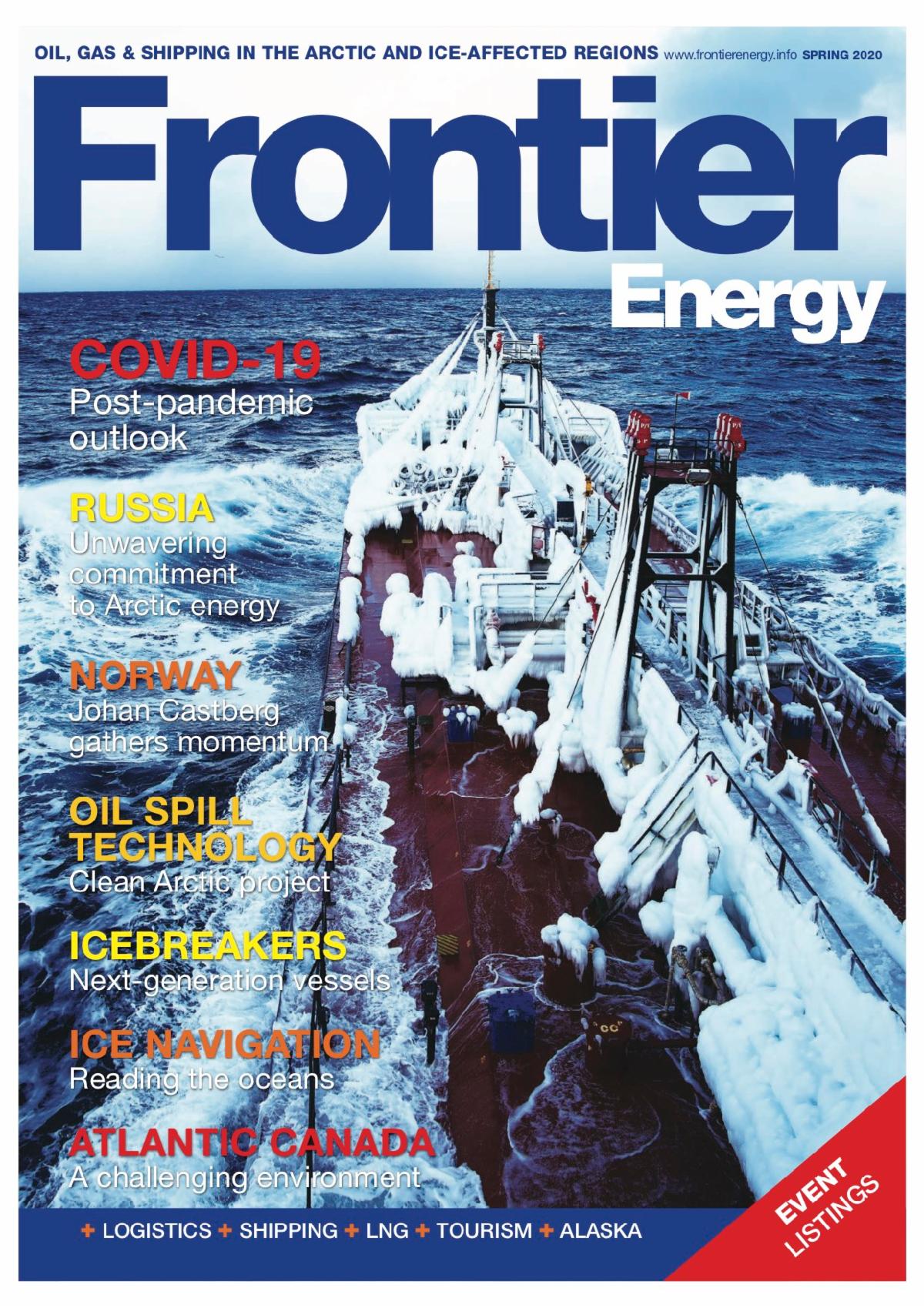
* COVID 19 - Post pandemic outlook
* RUSSIA - Unwavering commitment to Arctic
* ICEBREAKERS - Next generation vessels
* NORWAY - Johan Castberg gathers pace
* ICE NAVIGATION - Reading the oceans
* ATLANTIC CANADA - A challenging
environment
Click HERE to read the latest issue
of Frontier Energy magazine!
In the light of the Covid-19 pandemic, our industry is facing unprecedented challenges. We will continue to report on events and wish that you, your families and work colleagues stay well and healthy during these difficult times.
|
Wärtsilä to equip LNG gas-carriers for Arctic LNG-2 project
 |
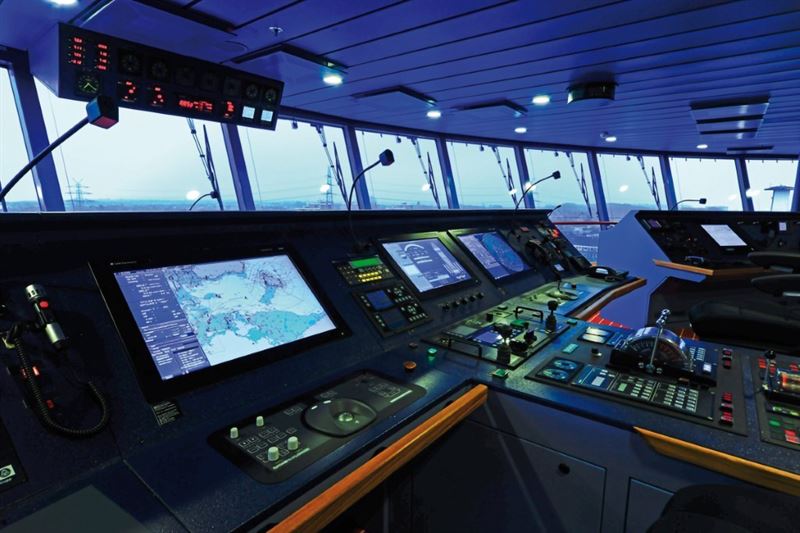
| | A Wartsila bridge system, earmarked for the Arctic |
Wärtsilä Voyage, the new business unit of Wärtsilä delivering digital solutions to improve safety and reliability, is to supply the systems complete bridge systems installation for five ice breaking LNG-fueled tankers to be constructed for the Arctic LNG-2 project. The navigational systems are delivered by Wärtsilä Voyage, the new business responsible for digital solutions and decision support tools to enhance safety and reliability of shipping operations.
The order with Wärtsilä Voyage was placed in the first quarter of 2020 and now is in process of execution, in partnership with Samsung Heavy Industries Co., Ltd shipyard.
Under the contract two equivalent bridges will be placed in vessels' superstructure; one of them is turned 180 degrees from the conventional position. This peculiar construction will allow icebreakers to move both forward and aft, thus ensuring safe vessels navigation under adverse climate conditions of the Arctic.
Both navigation bridges of all five LNG tankers will be equipped with the multifunction display system consisting of 12 multifunction workstations with a full set of basic applications, including ECDIS, Radar, Conning navigation information display system, BAMS alarm tracking system, and Navi-Planner for advanced route planning.
|
 |
Schottel propulsion selected for expedition cruise vessels
|
| | The Hondius Arctic ready cruise liner (artists impression) |
Following the delivery of the expedition cruise vessel Hondius in 2019, Oceanwide Expeditions has ordered a second vessel from Croatian shipyard Brodosplit.
Schottel has been selected to supply the main and auxiliary propulsion units. Hondius and its sister vessel Janssonius are said to be the first vessels in the world to be built according to the 'LR PC6' class, which meets the latest Lloyd's Register requirements for 'Polar Class 6' vessels.
The main propulsion system of the Janssonius will include a Schottel Controllable Pitch Propeller type SCP 109 4-XG (4,260 kW) with a propeller diameter of 3.6 metres. The SCP will be ice-strengthened according to Polar Class 6. One Schottel Transverse Thruster type STT 1 CP (440 kW) at the bow and one Transverse Thruster type STT 2 CP (500 kW) at the stern will provide maximum manoeuvrability.
The propulsion system will be powered by two diesel engines delivering 4,260 kW, enabling a service speed of up to 15 knots. A twin-in single-out gearbox will enable the main propulsion units to achieve propeller speeds of 160 rpm.
|
 |
Arctic Council calls for Best Practice to reduce pollution
The Arctic Council's Arctic Contaminant Action Program (ACAP) has completed a study on flaring of associated petroleum gas in the Russian Arctic. The report shows that significant economic and environmental gains can be achieved if Best Available Technology (BAT) and Best Environmental Practices (BEP) are applied. Application of BAT and BEP may decrease the volume of short-lived climate pollutant (SLCP) emissions from the current 25 to 7 million tons of carbon dioxide-equivalents by 2025 in the Russian Arctic region.
Industrial processes such as oil production generate gas as a by-product (also called Associated Petroleum Gas, APG), with the potent climate gas methane as a major component. A common way of eliminating this is by flaring, where the unwanted gas is burned off, even if solutions exist to avoid this. This practice, however, is controversial as it has shown to be a major environmental concern causing emissions of, for example, black carbon.
The Arctic Council's Arctic Monitoring and Assessment Program (AMAP) Working Group has indicated that flaring is one of the most important sources of black carbon emissions from Arctic States and that emissions that are released close to the Arctic have the strongest effect on sea ice melting. A significant share of emissions stem from oil and gas operations in the Arctic.
|
 |
Deutsche Bank revises fossil fuel strategy, including Arctic
Deutsche Bank, the Frankfurt-based bank has revised it investment strategy adopted its new Fossil Fuels Policy on Monday with strict limitations on future involvement in coal, oil and gas.
The bank which is the world's 17th largest, says it "will no longer finance any new projects in the Arctic region".
Deutsche Bank adds that it by the end of 2020 will additionally review all its existing business activities in the oil and gas sector and will stop investments in oil sands and fracking operations.
|
|
Concerns grow over retreating Arctic ice coverage
Ice covering the Arctic Ocean reached the lowest level since at least 1979 for July as temperatures spiked in the region, leaving large stretches of Russia's Siberian coast mostly ice-free, reports Bloomberg.
Sea ice extent in the Arctic last month was 27% below the average set between 1981 and 2020, the lowest level ever recorded, with the previous July low set in 2012, according to a monthly report by Europe's Copernicus agency. The Arctic, which is warming more than twice as fast as the rest of the planet, has endured a heatwave through spring and summer that saw record-high temperatures, an early start of the fire season and the opening up of usually frozen sea routes to shipping companies.
|
Shell boss expresses concern on oil demand recovery
The global economy will not see a v-shaped recovery in the wake of the coronavirus epidemic, which will curtail oil and gas demand for years, the Royal Dutch Shell chief executive said.
Ben van Beurden told an online interview with IHS Markit Chairman Dan Yergin that it was too early to know if demand for oil had peaked, reports Reuters.
"Energy demand, and certainty mobility demand, will be lower even when this crisis is more or less behind us. Will it mean that it will never recover? It is probably too early to say, but it will have a permanent knock for years," he said.
Shell is the world's largest LNG trader and had planned to increase its output in the coming years, including in North America, where natural gas has become abundant because of the shale gas revolution.
But van Beurden said that major gas projects such as North American LNG plants no longer look as strong as they did previously.
|
|
 |
Deep Panuke facility offshore Canada 'de-installed', says SBM
The Deep Panuke production platform has been de-installed, said SBM Offshore, the owner of the platform which leased it to the Canadian operator Encana. The facility has been successfully removed from the offshore gas field in Nova Scotia, named for the field, and will be recycled.
Deep Panuke was a jack-up production platform and was delivered 2011 by SBM Offshore. Production ceased in May, 2018 at the facility situated offshore the east coast of Canada.
Natural gas from the field, located offshore about 250 km southeast of Halifax, Nova Scotia, around 47 km west of Sable Island in 44 meters of water, was processed offshore and transported via a subsea pipeline to shore near Goldboro, Nova Scotia for distribution via the Maritimes & Northeast Pipeline.
SBM Offshore has also completed a US$450m of non-recourse senior secured debt by way of a US Private Placement (USPP) for the Deep Panuke Production Field Centre (PFC). The 3.5% fixed coupon bond is rated BBB- / BBB (low) by Fitch and DBRS respectively and carries a 7 year maturity.
|
|
News in Brief ...
* Russia's Emergencies Ministry is to create a multi-purpose emergency-and-rescue centre in Dikson, the northernmost village of the Krasnoyarsk Territory. It will be fitted out with new aviation, marine, fire-fighting, diving, rescue and other equipment, with due account of the extreme natural conditions typical for the region, complicated supply logistics and transport safety regulation in the extreme north.
* The Russian Defense Ministry will establish a replenishment tanker fleet to fuel military vessels in the Arctic. Construction of six ships is scheduled for 2028.
The ships will serve the Arctic coastal infrastructure, spending up to two months at sea. Each tanker can take on board up to 3,000 tonnes of fuel oil, 2,500 tonnes of diesel, 500 tonnes of aviation kerosene, 150 tons of lubricant oil, up to 1,000 tonnes of fresh water, and 100 tonnes of food and equipment.
* Anders Opedal has been names as new President & CEO of Equinor from November , 2020. Eldar Sætre will retire after six years as CEO and more than 40 years in the company. Opedal comes from the position as Executive Vice President Technology, Projects and Drilling. He joined Equinor as a petroleum engineer in 1997, and holds a Master's degree in Engineering from The Norwegian Institute of Technology (NTNU) and an MBA from Heriot-Watt University in Edinburgh.
|
|
REACH YOUR TARGET MARKET VIA THIS eNEWSLETTER
|
Advertise on this unique eNewsletter and reach thousands of senior, decision-making oil, gas and shipping executives; government officials and energy policy makers!
CONTACT our team at
publisher@frontierenergy.info for further information, and other unique sponsorship opportunities.
|
|
Frontier Energy magazine is distributed to an international readership of key decision makers, senior oil company E&P and shipping company executives; contractors and suppliers; technologists; government policy makers and NGO officials; classification societies and consultants. It brings you focussed news, features, comment and key industry trends in a unique one-stop place for Arctic and ice-affected locations. Frontier Energy's magazine, website and eNewsletter connects you with independent, quality information to move your business forward! (c) 2016
|
|
|
|
Issue 382 Thursday
August 13, 2020
| |
|
The global Covid-19 Pandemic crisis has caused many conferences to be cancelled or postponed. Please check with the organisers for any updates.
Arctic Shipping Forum
September 23-25
Helsinki, Finland
Arctic Shipping Forum is the world's largest and most influential event that brings together the who's who of the Arctic shipping industry from 15 maritime nations to learn and exchange strategic information on operations, ship technology, resource development and regulation, discuss the dynamics of global trade and the environmental impact on the Northern Sea Route.
For more information click here.
xxxxx
Arctic Circle Assembly
Oct 9 - 11
Reykjavík, Iceland
The annual Arctic Circle Assembly is the largest annual international gathering on the Arctic, attended by more than 2000 participants from 60 countries. It is attended by heads of states and governments, ministers, members of parliaments, officials, experts, scientists, entrepreneurs, business leaders, indigenous representatives, environmentalists, students, activists and others from the growing international community of partners and participants interested in the future of the Arctic.
Arctic Virtual Shipping Week October 27 -30
Bringing together the European and North American Arctic Shipping Forum series.
Focusing on the regulatory, strategic, operational and technological developments for the Arctic region. Live-streamed or available to watch on-demand from the comfort of your home or socially-distanced office.
For more information click here.
The Arctic Circle Japan Forum November 21 - 23 Toyko, Japan
The Arctic Circle Japan Forum will be organized in association with the Third Arctic Science Ministerial Meeting (ASM3), which will be co-hosted by the Icelandic Ministry of Education, Science and Culture, and the Japanese Ministry of Education, Culture, Sports, Science and Technology (MEXT).
ASM3 follows the Second Arctic Science Ministerial Meeting, which was hosted by the Governments of Finland and Germany, and the European Union in 2018, and the White House Arctic Science Ministerial, hosted in Washington, D.C. in 2016.
Click here for more information.
|
|
|