| |
|
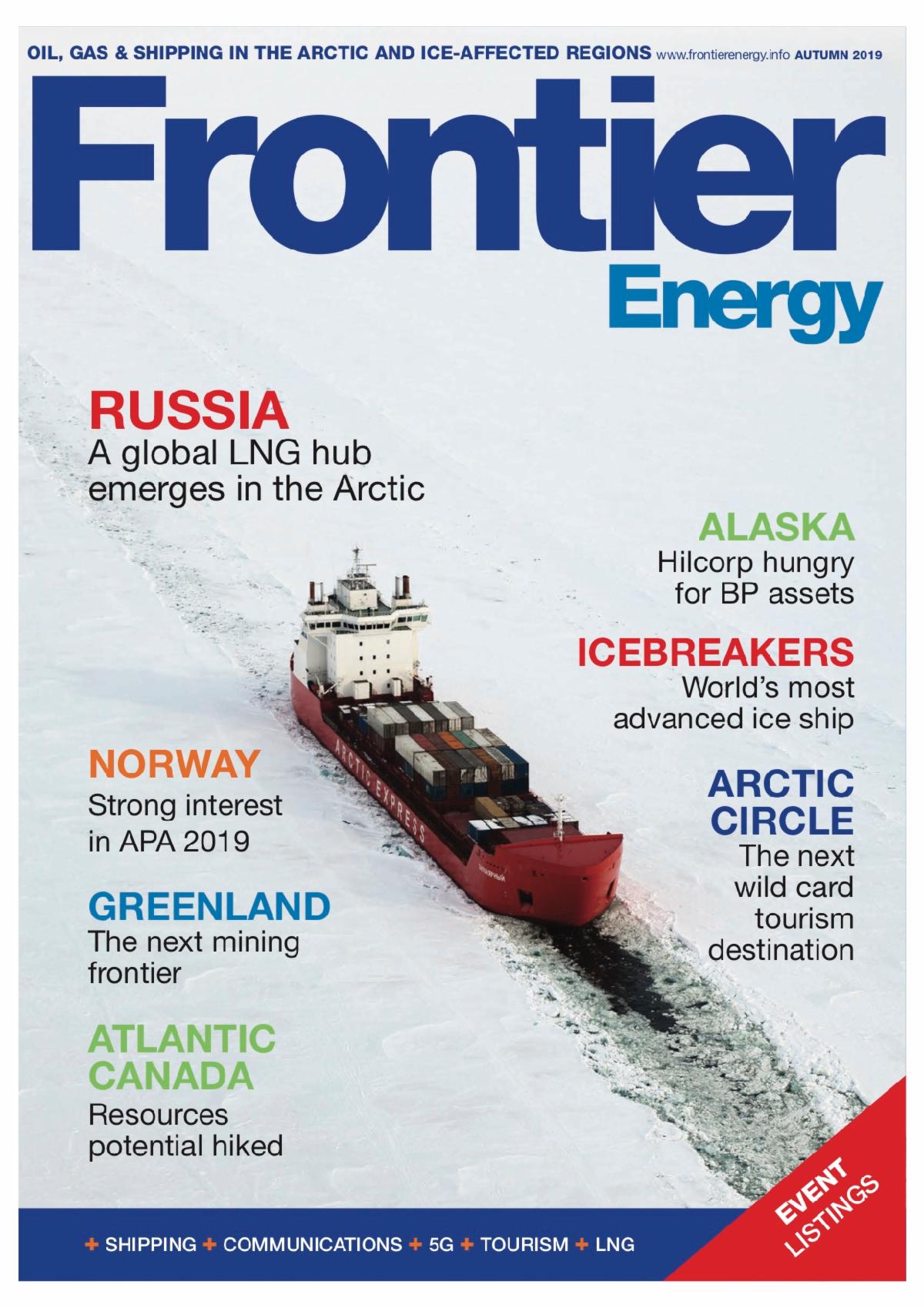
NEW ISSUE - Autumn 2019
Unique news and features including ...
*
RUSSIA -
New LNG hub in the Arctic
* ICEBREAKERS - M
ost advanced ice ship
*
NORWAY -
Strong interest in APA 2019
* ARCTIC CIRCLE
- The next wild card tourism destination
* GREENLAND -
The next mining frontier
Click
HERE
to read the latest issue
of Frontier Energy magazine!
|
 |
Gassco urges Norway to boost Arctic gas export capacity
Norway should construct a new pipeline or a second liquefied natural gas (LNG) unit to boost its gas exports from the Arctic Barents Sea, pipeline system operator Gassco said on Monday.
Natural gas represents about a quarter of Norway's overall exports, making the country Europe's second largest gas supplier behind Russia. There is sufficient gas to increase output, though the additional export infrastructure requires buy-in from oil and gas companies as well as Norwegian authorities, Gassco said, reports Reuters.
"We have concluded that gas exports could be profitable with current resources (without new gas discoveries)", Gassco Chief Executive Frode Leversund told Reuters.
While fields further south export gas through pipelines to Britain and the European continent, Barents Sea exports are dependent on a single LNG liquefaction unit at the Arctic town of Hammerfest.
Building a second LNG unit would cost between 5.9 billion and 9 billion Norwegian crowns ($664 million to $1 billion), while a pipeline would cost 12.5 billion crowns, Gassco said.
|
 |
|
Ambitions scaled back for Swedish oil firm Lundin
Swedish energy company Lundin Petroleum has scaled back proposals for two oil discoveries in the Norwegian Arctic, in a potential set-back to Norway's hopes that the remote region might help support its oil industry.
The Swedish company said it had cut resource estimate for the Alta oil discovery in the Barents Sea, and no longer reckoned Alta and the nearby Gohta find to be commercially viable for joint field development.
Instead, the two finds could in future be tied in as additional resources to another Barents Sea field, Equinor's Johan Castberg, or to another potential discovery in the region, Lundin said.
But that would mean the fields being developed later than originally envisaged.
Lundin said the estimated size of the Alta find had been reduced based on high-resolution seismic data as well as data and analysis from a well drilled for extended testing in 2018.
|
India could be the first non-Arctic state to produce Arctic oil
Russian-Indian cooperation in the oil and gas sector could make India the first non-Arctic state to extract resources in the Arctic, Foreign Minister Sergey Lavrov said in an interview with The Times of India.
"We are establishing cooperation in geological exploration and joint development of oil and gas fields in the territory of the two countries, including offshore projects, which will eventually allow India to become the first non-Arctic state extracting resources in the Arctic. Specifically, Indian companies are participating in the development of oil and gas fields under the Sakhalin-1 project, as well as the Vankor oil and gas condensate field," the minister said.
|
|
Norway awards 28 companies upstream search blocks
The Norwegian government has awarded 28 oil and gas companies a total of 69 offshore blocks to explore for petroleum in mature areas of its continental shelf, the Norwegian Petroleum Directorate said.
Shell, ConocoPhillips, Total and Equinor won blocks, as did DNO, Aker BP, Lundin Petroleum and Eni's Vaar Energi.
Private equity backed companies Chrysaor and Neptune Energy received stakes in eight and 13 blocks respectively.
Russia's Lukoil, which holds stakes in two licences, and wholly owned Rosneft subsidiary RN Nordic, a previous licence holder, were not awarded any blocks. A ministry spokesman declined to comment on the reason for their omission.
Of this year's 69 licences, 33 were in the North Sea, 23 in the Norwegian Sea and 13 in the Arctic Barents Sea.
|
HFO ban could be discussed at IMO pollution committee
Proposals seen by journalists destined to the International Maritime Organization's sub-committee on pollution suggests a ban on the use and carriage of heavy fuel oil in the Arctic Sea is edging closer, reports Lloyd's List.
Denmark, Finland, Norway and the US are among a group of countries will propose a ban on at the committee's meeting next month, but their call for a five-year delay for some ships may complicate international negotiations.
The sub-committee is a technical body where much of the legwork for the development of rules and regulations happens. But its decisions are not irreversible and the IMO's supreme environmental authority, the Marine Environment Protection Committee, is the group that has the final say.
Eleven countries are proposing an HFO ban on all shipping in Arctic waters, though vessels involved in search rescue operations would be exempt, reports the paper.
|
|
News in Brief ...
* During 2019, Russian energy company Novatek hydrocarbon production totaled 590.1 million barrels of oil equivalent (boe), including 74.70 billion cubic meters (bcm) of natural gas and 12,148 thousand tons of liquids (gas condensate and crude oil), resulting in an increase in total hydrocarbons produced by 41.0 million boe, or by 7.5% as compared with the twelve months 2018.
*
There are plans to conduct a comprehensive Arctic survey of polar bear, walrus, wild reindeer and ivory gull populations and their migration routes under a program of the Ecology national project. Russian oil giant Rosneft, which has signed an agreement with the Ministry of Natural Resources and Environment, will conduct the survey, according to the ministry's press service.
* Finland has obvious natural advantages that have helped it become an icebreaking powerhouse but the country's dominance in the field is startling. (Monocle) travelled to the Bay of Bothnia to bear witness to the beginning of the icebreaking season. Watch the video here.
|
|
REACH YOUR TARGET MARKET VIA THIS eNEWSLETTER
|
Advertise on this unique eNewsletter and reach thousands of senior, decision-making oil, gas and shipping executives; government officials and energy policy makers!
CONTACT our team at
publisher@frontierenergy.info for further information, and other unique sponsorship opportunities.
|
|
Frontier Energy magazine is distributed to an international readership of key decision makers, senior oil company E&P and shipping company executives; contractors and suppliers; technologists; government policy makers and NGO officials; classification societies and consultants. It brings you focussed news, features, comment and key industry trends in a unique one-stop place for Arctic and ice-affected locations. Frontier Energy's magazine, website and eNewsletter connects you with independent, quality information to move your business forward! (c) 2016
|
|
|
|
Issue 369 Thursday
January 16, 2020
|
|
|
2020
Arctic Frontiers
Jan 26 - 30,
Tromsø, Norway
The theme of the 2020 Arctic Frontiers conference is "Power of Knowledge".
For more information click here.
Arctic Oil & Gas Symposium
March 18-19
Hotel Arts,
Calgary, Canada
Building on a legacy of 20 successful years, this anticipated event brings together political leaders and senior decision makers from government and Northern communities, as well as executives from the resource industry for candid discussions on the future of oil and gas development in Canada's north.
Arctic Science Summit Week
Mar 27 - Apr 2
Akureyri, Iceland
The Arctic Science Summit Week (ASSW) and the 5th Arctic Observing Summit (AOS) will be arranged during March 27-30 and March 30 to April 2 in Akureyri, in the facilities of the University of Akureyri.
For more information click
here.
Neftegaz 2020
Moscow, Russia
April 13 - 16
20th Anniversary International Exhibition for Equipment and Technologies for Oil and Gas Industries.
Click here for more information.
|
|
|