|
Welcome
The JITI Journal is a bimonthly publication of the Japan International Transport Institute, USA (JITI), in which JITI shares information on transportation developments in Japan and elsewhere, as well as recent JITI programs. As a supplement to our regular events, we hope that the Journal likewise serves as a resource for the transportation community.
We hope this issue finds you well.
In this issue, JITI staff member Yoshitaka Araki writes a feature on rush hour in Japanese railways. In addition, staff member Tatsuya Izumi writes an article on the culture of taking your shoes off when entering a Japanese household.
|
|
JITI Events
UPCOMING:
JITI Public Transportation Seminar 2018:
Improving the Convenience of Public Transportation in a Cashless Society
Thursday, May 24th 2018
Sofitel Hotel Washington DC
2:00 PM - 5:00 PM (reception to follow)
Complete details to follow soon, please check back at our website
here.
PAST:
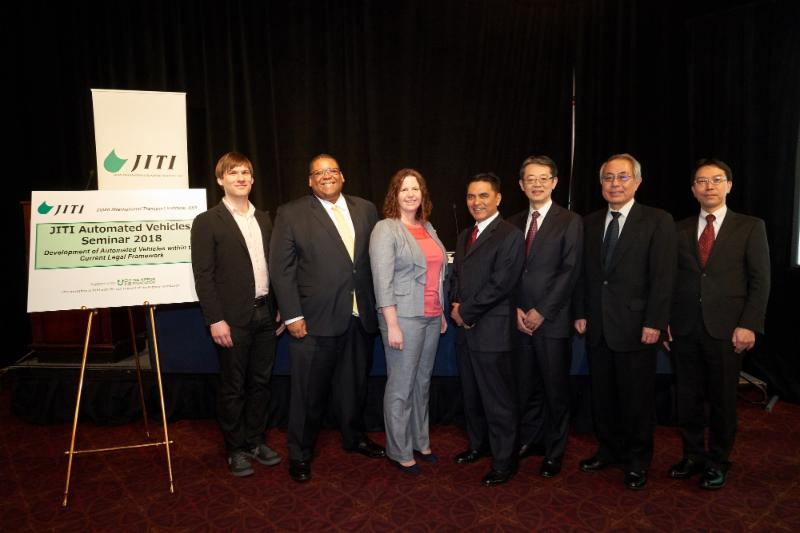
Automated driving has caught the attention of Congress. The House of Representatives passed the "SELF DRIVE Act" in September 2017, and the Senate Commerce Committee advanced the "AV START Act" in October. Both of these would significantly increase the number of vehicles that can be exempted from the Federal Motor Vehicle Safety Standards and encourage developers of highly automated vehicles to provide specific information on the safety of their vehicles.
Anticipation for highly automated vehicles has also been high in Japan. In view of the expected arrival of the automated & connected driving society in 2025, the Japanese government set a goal to commercialize highly automated and connected vehicles (Level 3 and above) and include them in the services market by 2020. Public-Private ITS Initiative/Roadmaps 2017 was released last year, laying out scenarios up to the year 2025 for realizing highly automated and connected driving and focusing on preparing the regulatory system with a view to strengthening and commercializing the technologies.
JITI USA invited experts on the subject, from both Japan and the U.S., who discussed the progress so far (especially milestones accomplished), as well as the future path toward automated vehicles.
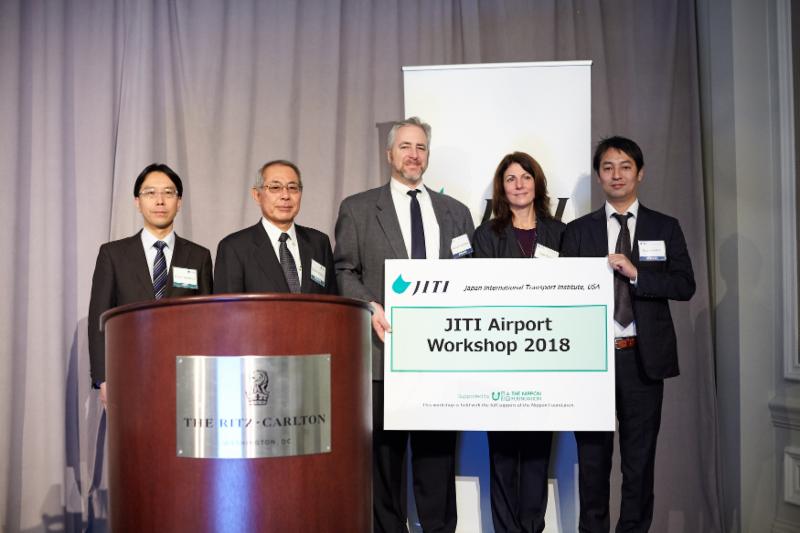
Airport Redevelopment Using Public Private Partnerships
The Trump administration's 1 trillion-dollar infrastructure plan has brought much attention to how infrastructure projects will be carried out in the coming years. As anticipation for updating and fixing the outdated transportation infrastructure - including the nation's airports - grows, many think that Public Private Partnerships (P3) could be the solution. Often capital improvement projects are challenging, given that most projects are costly, and the financial situation of the public sector tends to be constrained in capital to use in these projects.
JITI invited experts of airport management from Japan and the U.S. who discussed the challenges and benefits of P3 in airport redevelopment, lessons learned, and important takeaways for applications on future airport infrastructure projects.
|
|
Railway in Japan during Rush hour
|
|
b
y Yoshitaka Araki
|
|
◆
On-time operation during rush hour
In metropolitan areas such as Tokyo and Osaka, the terrible congestion of trains and people during the commuting rush-hour seems to be recognized as a kind of common feature for Japan.
I think there are rush-hours during common commuting times in every country. However, in Japan, especially in the metropolitan area which highly depend on the public transportation of railways and subways, there are some sections where the congestion rate exceeds 250%. This is such a high rate of congestion that passengers can't move at all.
On-time operation is essential for safety and quality of service, and this especially applies during rush hour. Each railway company in Japan has ways of mitigating the troubles caused by rush-hour commuters, as well as improving on-time operation. In this article, I'll introduce some of these methods.
|
|
◆
Facilities
Some features located around train facilities to aid on-time and safe train operations are listed below:
*Wide train doors
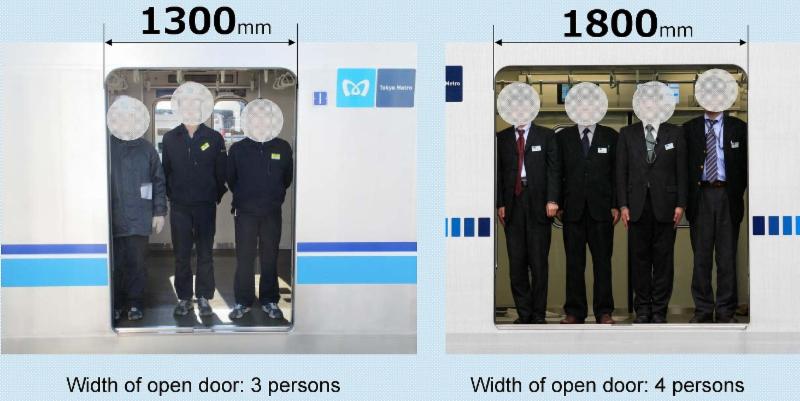
One of the reason for delays is the time it takes for passengers to get in and out of train cars. Some train cars have been adapted to have doors that are a shoulder-width wider than the standard, which makes it easier for passengers to get in and out of the trains more smoothly.
*Platform screen doors and Automatic operation
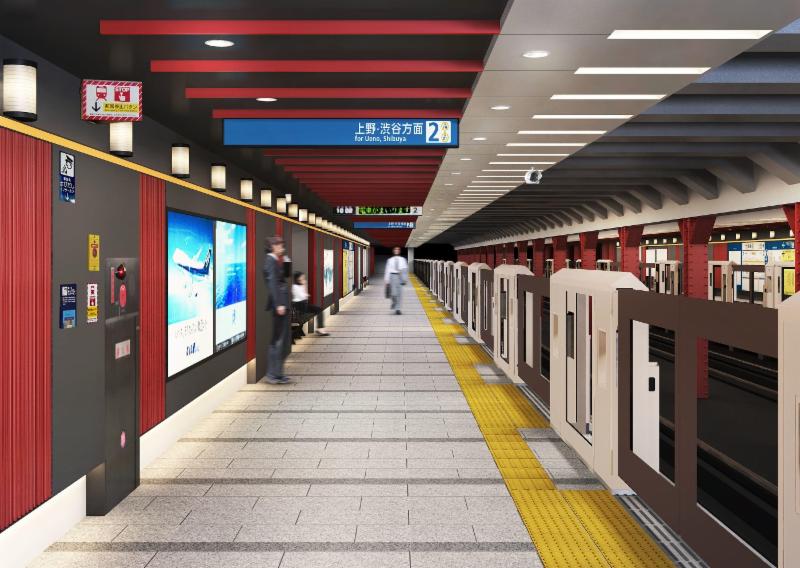
Platform screen doors doesn't have a direct relation to on-time operation, but it contributes to the reduction of risk of passengers falling onto the train tracks, which aids on-time trains and safety.
Furthermore, most of the screen doors contain Train Automatic Stopping Control systems, so that trains stop with precision at the right position. This system contributes to on-time operation as it shortens the amount of time necessary for braking, etc. .
*Train protection system - Speed control by ATC (Automatic Train Control)
During rush hour, it is necessary to increase the number of trains so that many passengers can be transported. For smooth operation in such situations, train protection systems, such as signals etc., are essential.
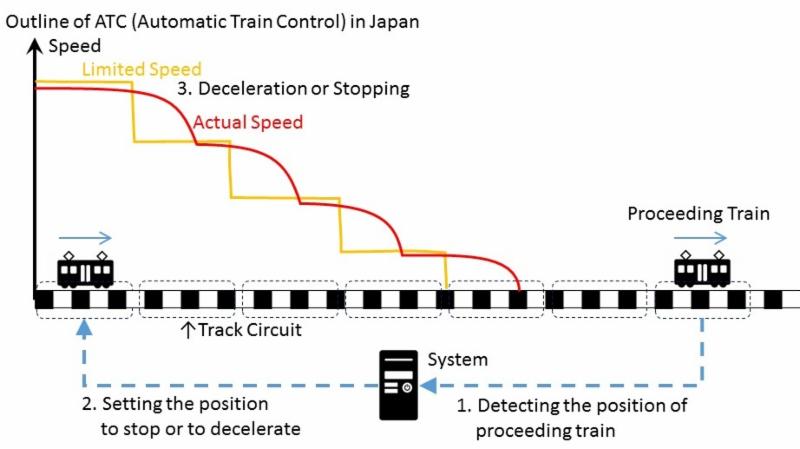
In Japan, most urban transit systems and the Shinkansen (Bullet Train) have ATC, or equivalent equipment, which enables high density transportation.
A quick explanation of ATC in Japan follows:
Most ATC has tracking circuits on the rails which recognize the spaces between trains and sets the speed limit. When trains exceed the speed limit, their speed is automatically reduced. This system also enables trains to stop with proper space between them and others.
ATC is different from the recently popular type of systems such as PTC, CBTC, etc., systems which use wireless communication. Most ATC systems were introduced prior to the recently developed digital wireless communication technology, so wireless protection systems are not as popular in Japan. Of course, these newer types of systems have more advantages than the current ones, so some railway companies in Japan are considering introducing them.
*Smooth ticket gate process
In Japan, as in other countries, the purchase of fares using IC cards has been increasing in recent years.
When passengers go through the ticket gate, they need to hold their IC card over the readers. If it takes a long time to read the card this can cause congestion in the station before even getting to the platform. The standard for IC cards for transportation in Japan requires that they can be read within 0.2 seconds. In this way, 60 passengers could go through the ticket gate per minute.
|
|
◆ Employees
The companies' activities toward rush hour traffic consists not only of the facilities, but also service by the employees.
*Controlling the distance between trains
Especially during rush hour, the Railway Control Center adjust the positions of the trains so that their distances will be equal. The main adjustment, especially in cases where the gap between trains has become wider than originally intended, is delaying the departure of preceding-train to shorten the distance between it and the following train.
If the timing of the trains is left widened, passengers at platform will be concentrated when boarding the following one, and that will cause further delays. In addition, the following-trains will have to stop before arriving at the platform to compensate for this delay and once the train stops, it takes time to restart, which can also cause more delays.
An effective countermeasure to prevent these types of issues is for employees to adjust the distance between trains equally.
*Part-time employees during rush hours on platforms
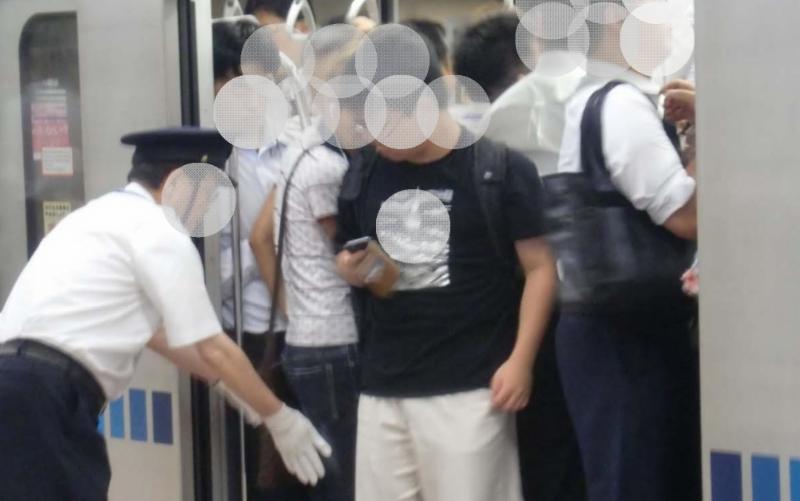
Have you ever gotten your body or belongings stuck in the door when getting on the train, when in a hurry, or just because you got caught in the crowd? There are platform employees positioned during morning rush hour to help support passengers so that they can get in and out of the train cars smoothly. Of course, they are not only there for when the doors open or close, they also are there to answer passenger questions.
|
|
◆
Cooperation by Passengers
In the above we discussed some of the ways that train companies are working to alleviate the problems associated with morning rush hour. Needless to say, it is also essential for smooth operations that train companies have the cooperation of riders. I would briefly like to discuss some of the requests made of rush hour commuters in metropolitan Tokyo.
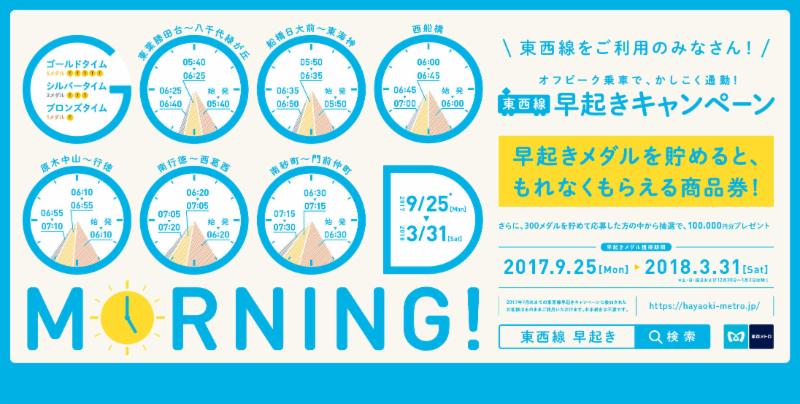
*Early Bird
Morning rush hour occurs according to ordinary business hours, so passengers can avoid the terrible crowds by taking a train 1 or 2 hours earlier than the rush will be. To promote this, train companies promote deals for those who are willing to be "early birds". For example, passengers can get rewards if they go through ticket gates before certain times, and they can redeem these points for their daily travels or for shopping.
*One-side Pedestrian Traffic on Concourses
Have you ever bumped into to someone when walking on the concourse because you were both walking on the same side? Many stations in Japan indicate in which direction to walk, right side or left side, to help aid the smooth flow of passengers.
*Manners
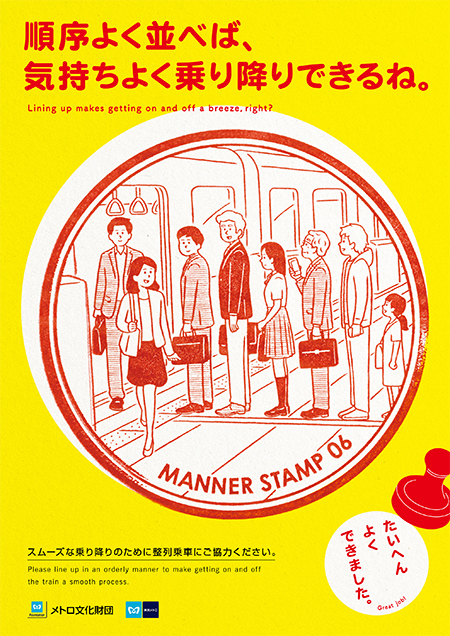
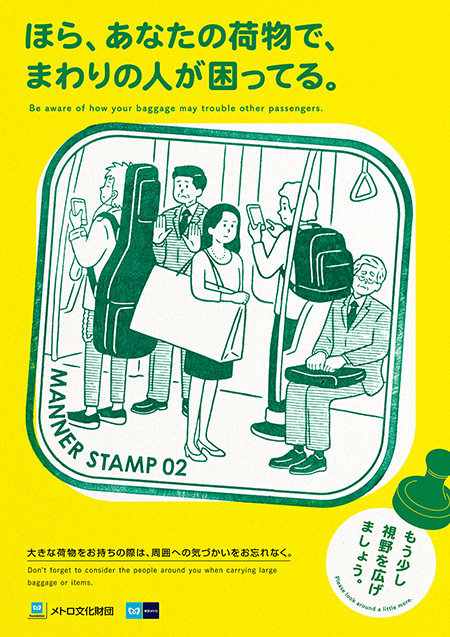
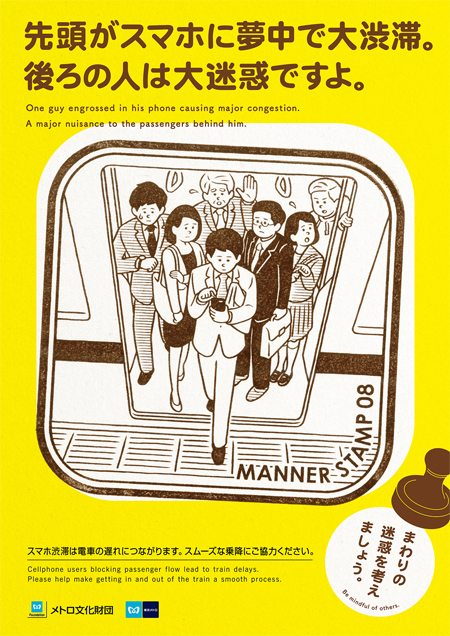
It is essential for passengers to cooperate when they're on the platform, concourse, and trains. Since it's not rules but manners that are necessary, the train companies ask for everyone's cooperation, and have devised content, such as posters. Example related to rush hour are below:
>>> Forming a line on the platform, Smooth boarding of trains
While waiting the next train, passengers are encouraged to form a line on the platform.
When getting in and out the train, have you ever had difficulty because of people standing near the door and not moving? In Japan, there are posters asking for cooperation in moving out of the way when the doors are opened.
>>>
Personal baggage in the trains
Have you ever been hit by someone else's baggage when standing or sitting on the train? I think many people have had this experience, especially when it is baggage on someone's back, such as backpacks.
Railway companies in Japan suggest that passengers carry their baggage on their front, even backpacks.
Carrying bags on your back can cause a bother for others in crowded cars but changing the way you carry them can improve flow in train cars.
>>>
Smartphones
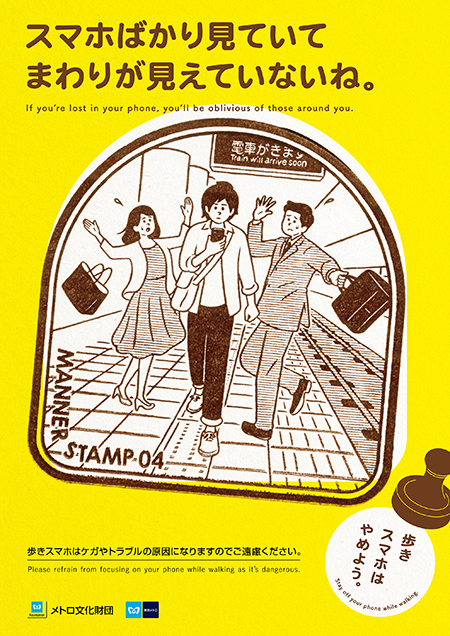
People with smartphones are increasing, and that can cause various problems in railway facilities. Railway companies ask passengers to observe some cellphone manners, such as refraining from talking in cars, turning off their cellphones near priority seats, and so on. Recently the issues resulting from walking while using smartphones are also increasing, such as people falling on the rails, hitting other passengers, blocking people who are trying to walk, and etc. The companies have asked passengers to be mindful of this while using their smartphones as well. Two examples of these posters follow:
|
|
◆
Conclusion
Recently, the diversity of types of work in increasing in Japan. Workers can choose short-time work, staggering their office hours, telecommuting, and so on.
However, at the same time, daily ridership in the metropolitan area is also increasing, as well as sales of commuter train passes.
Regular sales of the commuter passes indicate how many people work regularly in the downtown area of the city and it indicates the concentration of people and economic activities there.
The population in Japan is decreasing, and it's said that even in the metropolitan areas it will start to decline. In addition, the recent sharing economy for cars and bikes, development of autonomous vehicles, etc. are all threats to the vitality of the railway transportation industry. But, from the perspective of recent trends in the use of railways, railway companies will need to continue to solve issues related rush hour congestion.
|
|
Do you take off your shoes inside of your house?
|
|
by Tatsuya Izumi
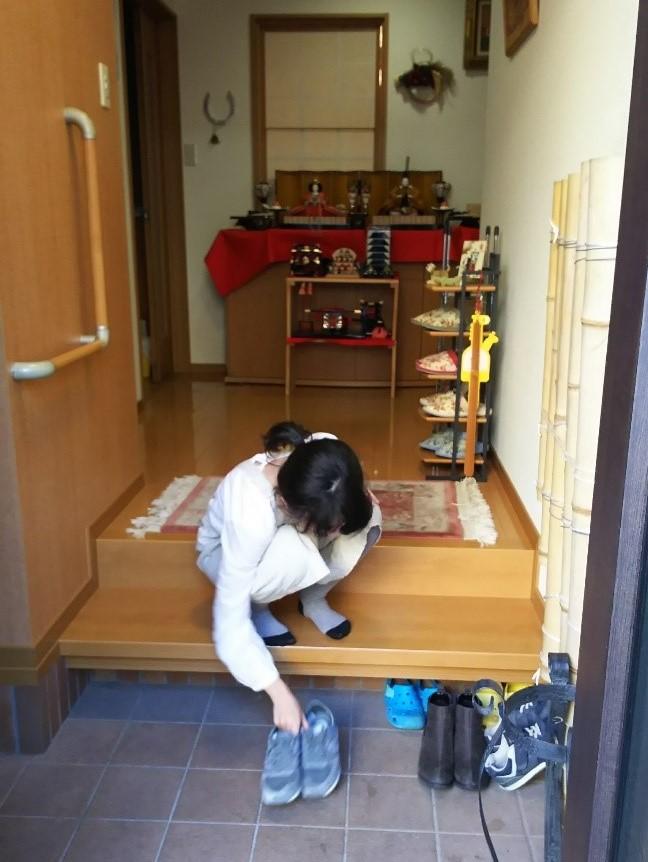
I take off my shoes at the entrance of my house. I even request that repair people and others take off their shoes when they enter my house. This is because I don't want to get germs or dirt that is clinging to the soles of people's shoes into my house.
I think that this custom is fundamentally based in Japanese culture. Far back into Japanese history, Japanese people have believed that the outside ground is unclean or unhallowed, while the inside of house should be kept clean and separate. The entrance of a Japanese house is always a step up, in other words there is a small level between the ground and the floor of the house. The gap is recognized as a kind of sacred boundary to prevent unclean things from coming into the house.
Putting your shoes neatly together is one of the important etiquette when you visit a Japanese house.
This custom supposedly originated because of the humid and warm climate in Japan. In the ancient era, Japanese people lived in primitive pit houses before houses with an elevated floor were developed. They quickly became popular and widely used because people were able to stay relatively cool in the humid and warm weather thanks to the ventilating capability of such houses. Along with the spread of this type of house, Japanese people supposedly started the custom of taking off their shoes, and even washing their feet, before entering the house in order to keep the floor clean.
These customs helped Japanese people maintain a hygienic house in the warm and humid atmosphere, which is rather germ-friendly. It also fostered the development of tatami culture. As a result, you can enjoy lying directly on tatami floors, without a couch or a mat, in a house in Japan.
However, this strict separation of inside/outside facilitates Japanese culture in keeping things extremely clean these days. Also, there is a risk to badly hurt your pinky toe by hitting the leg of a table or a corner of a wall, and you can get cold very easily on hard floors such as marble, tile, and wood-all of which are very common in the U.S.
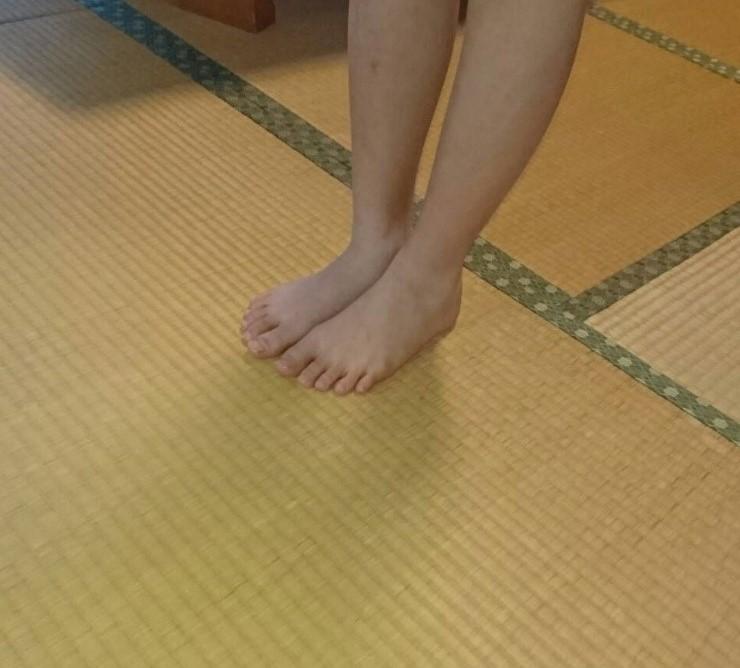
You can enjoy a sense of release with your feet on Tatami floor, but you should take care not to hit your pinky toe at leg of table. It hurts very badly!
Given the weather and what I have heard is the custom in the U.S. regarding shoes, I should maybe consider changing my mind and keeping my shoes on in my house. But I would have to ask my family before starting this new habit or I will definitely get in a serious trouble...
|
|
Stay in Touch with JITI
|
Please follow the Japan International Transport Institute Twitter feed at @JITIUSA or check back with our website to get the latest information on workshops and seminars.
|
| Thank you for reading the JITI Journal. Until the next issue, whatever your mode, travel safely! The JITI Team |
|
|
|