|
Welcome
The JITI Journal is a bimonthly publication of the Japan International Transport Institute, USA (JITI), in which JITI shares information on transportation developments in Japan and elsewhere, as well as recent JITI programs. As a supplement to our regular events, we hope that the Journal likewise serves as a resource for the transportation community.
We hope this issue finds you well.
In this issue JITI staff member Hiroki Sakamoto introduces and explains the State Safety Program (SSP), which is used nationally in Japan to ensure aviation safety. In addition, staff member Shuntaro Okimoto writes an article about the lesser known cousin of Kabuki, Takarazuka Revue, an all-female acting troupe.
|
|
JIT
I Eve
nts
UPCOMING:
High Speed Rail (HSR) has attracted worldwide attention as an energy efficient and environmentally friendly mass transport system. HSR projects have been planned or carried out in many countries including the United States and Japan.
Japanese high-speed rail systems feature various advantages, especially from the standpoints of safety, reliability, energy efficiency, and environmental sustainability. Furthermore, Japan's HSR has supported the economic development of Japan by smoothly dealing with the growth of the intercity transport demand. As Japan's HSR, or Shinkansen, system has 50 years' worth of history, Japan is well experienced in HSR projects based on their already learned knowledge and know-how of HSR technologies.
The development of HSR projects is progressing in Japan, such as the Hokuriku Shinkansen (between Nagano and Kanazawa) which started operation in 2015, and the Hokkaido Shinkansen (between Shin-Aomori and Shin-Hakodate-Hokuto) which opened in 2016. In addition, the Chuo Shinkansen project (between Tokyo and Nagoya), using the Superconducting Maglev system started construction with plans to open in 2027.
In the United States, several mega HSR projects are being planned or implemented, including the Texas High Speed Rail Project connecting Dallas to Houston, the Northeast Corridor SCMAGLEV Project connecting Washington D.C. to New York, the Bright Line Project in Florida, and the California High Speed Rail Project.
For this seminar, JITI USA has invited experts on the development of HSR from the U.S. and Japan to discuss the progress so far, especially milestones accomplished, as well as the future path for deploying high speed rail in the United States and Japan.
Please click
here
for complete information and to register.
PAST:
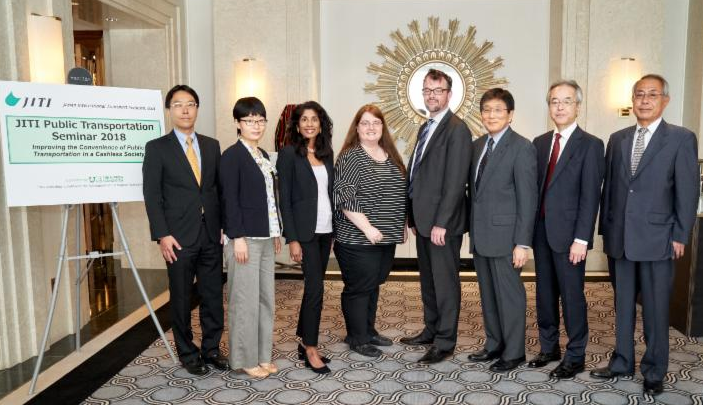
With recent advancements in ICT technology we have seen a rapid spread of cashless payments, in which our day-to-day transactions are accomplished through the use of credit cards, smartphones, and contactless payment cards called 'transportation IC cards'.
The growth of cashless societies has been rapid, especially in China. With the popularity of third-party smartphone payment applications operated by internet giants, mobile payment systems have spread widely in the day-to-day transactions of consumers. Based on the system's dominating presence in consumer markets, they are expanding their use to include public transportation, which is regarded as a key sector in enhancing user convenience.
In Japan, the first transportation IC card was introduced in 2001 and, since then, over 130 million contactless payment cards have been issued. The popularity of these transportation IC cards may be attributed to their multi-purpose use. They can be used not only for transit payments, such as railroad and bus travel, but also as electronic payments for shopping at many stores. In addition, these cards can be mutually utilized with multiple Japanese transit companies. Therefore, the use of transportation IC cards is expanding in many parts of Japan.
The United States has also been active in introducing contactless payment systems. The Chicago Transit Authority (CTA) introduced a contactless payment card called 'Ventra Card' in 2013, which promotes mobile payments on subways and buses. Also, the American Public Transportation Association (APTA) signed a collaboration agreement with the NFC Forum to jointly educate the industry on NFC (Near Field Communication) technologies, supporting the needs of public transportation operators. These are just two examples of the many uses of contactless payment cards in the transit industry in the States.
In this rapidly advancing cashless society, JITI USA invited experts on the subject from Japan, the U.S., and China, to discuss the progress so far, especially milestones accomplished, as well as the future path for improving the convenience of public transportation in a cashless society.
|
Please click
here
for complete information.
|
Strengthening Aviation Safety through SSP
|
|
b
y Hiroki Sakamoto
Ensuring safety is a central and fundamental issue in the civil aviation sector. While passenger deaths aboard specific Japanese air carriers have not occurred since 1986, efforts are being made to reinforce the safety management system adopted by airline companies and preventive safety measures are being promoted to appropriately deal with safety-related issues. For example, preliminary reviews are done upon the launch or expansion of domestic airline companies and strict (including unannounced) and systematic on-site safety inspections are properly conducted. Also, due to the increase of foreign airlines following the promotion of the open sky policy, monitoring of foreign airlines entering Japan has been strengthened with on-site safety inspections and other measures.
Since April 2014, the Civil Aviation Bureau
of Ministry of Land, Infrastructure, Transport and Tourism of Japan (or JCAB) has been implementing the "State Safety Program (SSP)", as the basic principle of aviation safety policy. It sets forth targets for civil aviation safety and measures to be taken for their attainment, in accordance with the Annex 19 of the Convention on International Civil Aviation. The fundamental structure of SSP is a clear division between Regulator (R) and Provider (P: such as airline companies, airport operators and air traffic control), with the Regulator (R) providing and enforcing safety oversight of the Provider (P).
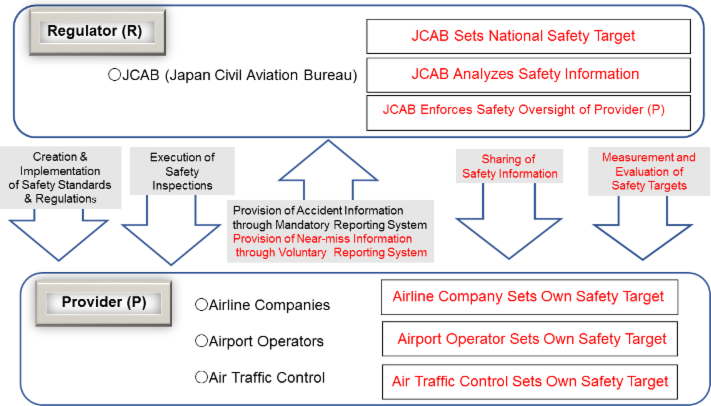
(Figure) Structure of the State Safety Program (SSP)
|
In FY2015, JCAB formulated "Medium-term policies for the administration of aviation safety," which outlines the policies and measures for the next five years. In FY2016, direction for further safety measures related to small aircraft was added in light of the frequent occurrence of accidents involving private, small aircraft in recent years.
SSP features three new measures: Safety Target, Voluntary Reporting System, and Analysis of Safety Information.
In order to secure SSP as an effective tool to strengthen aviation safety, JCAB creates a "SSP implementation plan" every year. Regarding this plan, JCAB
①
sets the safety target of the Japanese Government (once a year),
②
implements specific policies to achieve the safety target with coordination between airline companies, airport operators and
air traffic control, and
③
measures and evaluates the level of achievement of the safety target.
2) Voluntary Reporting System
"The Voluntary Information Contributory to Enhancement of the Safety (VOICES) program" has been operating since July 2014 in order to collect more detailed near-miss information relating to aviation safety that is not subject to the mandatory reporting system, and to harness such information for safety improvements. Recommendations such as improving airport operations have been obtained through this program. While dissemination activities have been yielding results and more reports were issued in FY2016 than in the preceding year, attempts will be made to further use the system through continued work to highlight the importance of safety information. Efforts will also be made to improve safety by making use of obtained recommendations.
3) Analysis of Safety Information
JCAB creat
ed three committees (airline companies, airport operators and air traffic control) comprised of scholars and experts. They hold meetings regularly to evaluate and analyze safety information from not only mandatory but also voluntary reporting system, compile and summarize information and publicize this information to
share it. They are utilized to create preventative measures for both the Regulator (R) and Provider (P) in civil aviation.
Strengthening safety measures is the top priority in the civil aviation sector. Continuous and effective efforts of both the Regulator (R) and Provider (P) through SSP are key in order to establish safe and secure air transport systems.
|
Takarazuka Revue : A Staple of Japanese Culture That is Known to Those in the Know
|
|
by Shunataro Okimoto
Do you know Kabuki? It is one of the most famous traditional performances in Japan. It began around 1500 AD. Accompanied by the sound of shamisen, fierce romances and fights between samurai are performed powerfully. Both male and female characters appear in the play, but all the parts are performed by male actors. Male actors who play women wear beautiful kimono, disguise themselves in makeup, and move and gesture in a feminine manner so that everyone can see them as women. There is a new theater, Kabuki-za, in Ginza, Tokyo that is dedicated to the art of Kabuki, so I recommend you go see a show there once if you have never visited.
I would like to introduce Takarazuka Revue at this time, which shares similar aspects of Japanese culture with Kabuki. Takarazuka Revue began about 100 years ago in Takarazuka City, which is located north of Osaka in Hyogo Prefecture. Although it is a newer type of performance than Kabuki, it was founded before the Second World War. A typical performance is three hours long and split into two parts. The first part is a theatrical play. Original romantic love stories or musicals that are popular worldwide are performed. Many of these works come from the United States, "Gone with the Wind" and "West Sid Story" being popular examples. The second part is a show. There are Japanese-style performances such as Japanese dances with all the actors wearing kimono, but other art forms from foreign countries are also performed.
The biggest feature of the Takarazuka Revue is that it is all performed by female actors, compared to Kabuki with its all-male cast. Women play the roles of male characters, but because they are portraying masculine movements such as in the ways men stand, walk, and sit, their movements are more masculine than real men. Fans of Takarazuka say that "they are cooler than real men." I think I might agree!
Also, another draw for audience members are the vibrant costumes and the theater itself, which is very beautiful. Do you think Japanese people only like things that reflect a spirit of Zen or just prefer simplicity? Well, these Takarazuka performers are dancing energetically, wearing colorful feather costumes in the form of peacocks on a stage where the electric decorations shine. Unfortunately, I cannot post images to show this due to copyright, but please look at the following official English website. I'm sure you will be surprised at the world that exists there.
I have been fascinated by Takarazuka Revue for a long time. After watching it on a television broadcast about twenty years ago, I became enthusiastic about it. I love the unique atmosphere created by about 70 actors on stage and 2,500 spectators. I lived next to the theater for two years in 2013 and 2014.
It was a wonderful two years living alongside the world of Takarazuka Revue.
If you want to experience this complex attraction, please go and witness a performance for yourself at least once.
The Takarazuka Revue has performed around the world, for example in New York, Honolulu, and London, but recently many of the performances occur throughout Asia due to an increased number of Asian fans. Those
in the United States may find it easiest to see a show in Japan. There are two theaters in Tokyo and Takarazuka, and you can buy tickets on the Revue's English website.
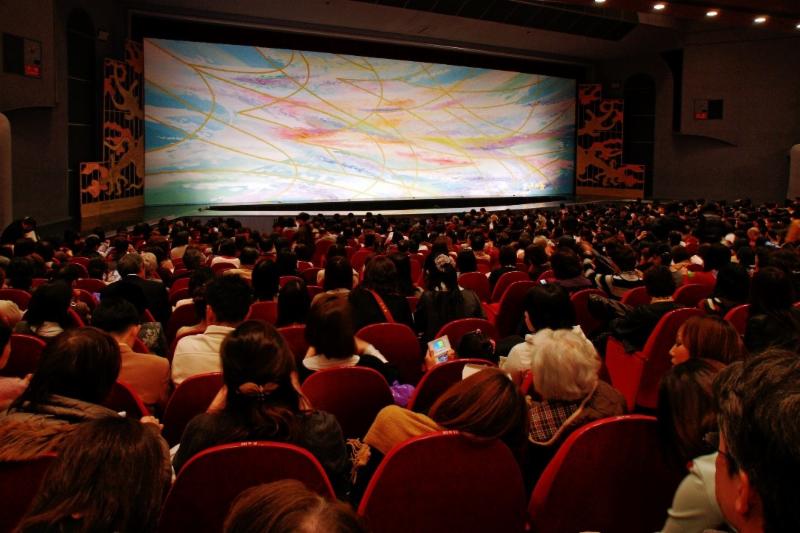
The theater before a performance
Takarazuka Revue's gorgeous stage
|
|
Stay in Touch with JITI
|
Please follow the Japan International Transport Institute Twitter feed at @JITIUSA or check back with our website to get the latest information on workshops and seminars.
|
| Thank you for reading the JITI Journal. Until the next issue, whatever your mode, travel safely! The JITI Team |
|
|
|