|
I don’t typically share stuff about my kids in my work newsletter, but children sometimes have a sweet way of affirming and reminding you of some of life’s most important lessons. In times like these, I thought a couple that have come up in our family recently were worth a share. If you don’t think so, feel free to skip to the next section for more work-related info!
Life lesson #1, courtesy of my teenager and 7-year-old: We have more in common than you think; love transcends culture and language.
Last Fall, my oldest daughter, Gillian, was selected to be a student ambassador for the Sebastopol World Friends program. Which meant that we recently had the opportunity to host a Japanese student for 10 days.
Mind you, the Japanese student arrives speaking hardly any English. We’d been practicing Japanese as a family but still knew, at best, a handful of phrases. The exchange student’s mom emailed us ahead of time warning us that she was shy; I replied that my daughter is, too. And? It didn’t matter. By the end of 10 days, our exchange student had become a bonus daughter/sister to us. And when she left, she left knowing she had new family in California and was welcome back anytime.
My daughter showed the family what inclusion looks like. She moved beyond awkward shy teenagehood and became a sister/friend/tour guide. My 7-year-old son reminded us that love has no boundaries. (And with this particular 7-year-old I do mean NO boundaries. The exchange student was hugged, heckled, tickled, and constantly invited to play.)
Afterwards, I told Gillian I was proud of her for overcoming her shyness. I told my son that it’s helpful he’s never shy.
“I *am* shy!” He protested. “That’s why I always act all crazy.”
Life lesson #2, courtesy of my middle child: it’s not whether you win, it’s how you play.
Last September, Addy broke her elbow at gymnastics practice. Her coaches thought she might be done for the season. She wasn’t able to return to full practices until December, and even then, couldn’t fully straighten her arm. BUT. She worked hard, overcame her fear, kept showing up at meets, kept improving. And ended up placing second (!!) all-around in her division at the CA State Championship in March. She earned a spot on the podium for every individual event award, too.
But that wasn’t what made me most proud.
At a big gymnastics meet, two different teams use the same apparatus at the same time. For this meet, there was Addy’s team, and one other girl from a different team… the only girl from that other team. In other words, this other girl had no teammates with her to wait with her, support her, or cheer her on. It was just her and the coach.
The other girl and Addy’s team started on vault. As soon as the other girl finished her vault, Addy reached out and gave her a high five. After the meet, I told Addy that the high five to her competitor meant more to me than the medals she came home with. And Addy told me about the other girl, because she had cheered her on and gotten to know her over the course of the meet.
So here are the life lessons my kids reminded me of:
Competition (or, more broadly, disagreement) is fine. But community and humanity is everything, and you don’t have to abandon community or humanity when you compete or disagree. Be the kind of person who cheers on others.
Culture and language — or even shyness — aren’t barriers to friendship or community. Be the kind of person who welcomes others; you never know when you might gain a new member of your family.
| |
Ok, enough family stuff! Now, let’s talk about Tuesday. For months, I’ve been working on two different Ad Hoc committees to try to create positive change in the County. That work finally comes before the Board of Supervisors in a big way tomorrow, Tuesday, April 7.
Immigrant Support Ad Hoc
Let’s start with the Immigrant Support Ad Hoc, a committee I serve on with Board Chair Rebecca Hermosillo. Since August, we’ve been meeting both with County staff and with immigrant community stakeholders, including the Sanctuary Coalition and service providers. Our goal is to protect and support our immigrant community, and we’re bringing two recommended actions to the board on the morning of April 7th.
We are bringing forward an ordinance to memorialize the county’s current policies and procedures to ensure continued support of civil rights, health and safety of immigrants and all residents and a recommendation for $1.5M in funding to support services for our immigrant community in light of unprecedented federal attacks.
The ordinance will not change current County practices. Why not? Because currently, we don’t cooperate with ICE.* (*Required attorney asterisk: unless compelled to by law.) We already have a policy about this.
In January 2025, the Board approved a Resolution that provided direction to safeguard our immigrant communities. The Ad Hoc worked closely to oversee the implementation of that Resolution with the County CEO and Department Heads. In other words, everything in the ordinance on the Board calendar on Tuesday has already been enacted. But the board item on Tuesday allows us to take a stand and make these policies official and ensure that they are memorialized into the future, beyond the tenure of this board and its current members.
Tuesday’s action will codify current practices, which means it would take a public vote of the board to undo this action. Putting this in an ordinance also makes it easier for the public to find the policies that apply to all County departments that aren’t led by an elected official. By law, we cannot adopt an ordinance that applies to elected department or agency heads.
Ag Support Ad Hoc
In the afternoon, we’re hosting a presentation developed by the Ag Ad Hoc, which consists of Supervisor James Gore and me.
Most ag sectors in Sonoma County are struggling. This has led to a loss of work for ag employees and threats to our local food system. We are bringing a workshop to the Board to brainstorm ways to support agriculture and our local food economy.
We’ll be hearing concerns and ideas directly from agricultural stakeholders. Potential policy options include: expanding the Williamson Act for small farms; low-impact camping on farms; streamlined permitting processes; delaying fee collection on replants to support near-term fallowing (a practice which is healthy for the soil and future crops); by-right permitting; enhanced Right to Farm; right to privacy ordinances; more affirmative ag easements; and expanded opportunities on Ag Residential parcels, among other options.
| | Community Survey: Mirabel Rd Crosswalk | | |
Community input is helping shape safer streets in Forestville—and we’d love to hear from you.
District 5 is gathering feedback on potential new crosswalk designs for Mirabel Road, following requests from neighbors who want a safer connection between the bus stops and pathways near Davis and Giusti. Public Infrastructure has developed three possible options, along with a fourth option that could be explored if there’s strong community interest.
Take a few minutes to review the options and share your thoughts—your feedback will directly inform the next steps for this important community improvement.
| | |
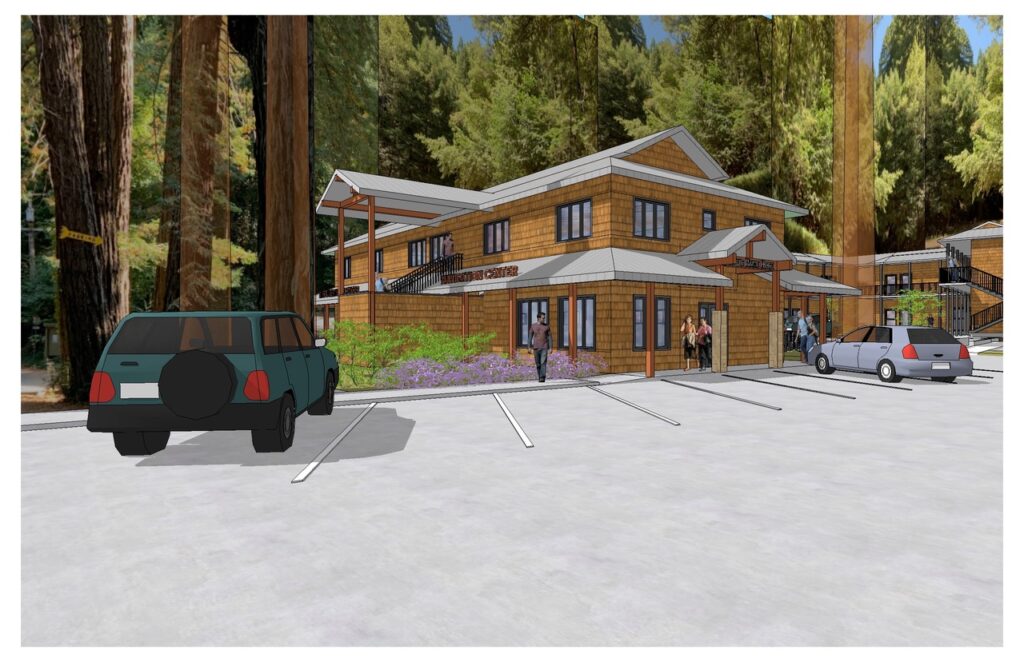
As we anticipate the opening of the George's Hideaway Permanent Supportive Housing community in late May, we’ve heard questions from neighbors about what this means. We have asked our County’s Homelessness Director to help explain:
Q: What is Permanent Supportive Housing (PSH)?
A: Permanent Supportive Housing is affordable housing for people who have experienced long-term homelessness and have health or disability-related challenges. It combines stable housing with supportive services to help residents stay housed. Individuals in Permanent Supportive Housing pay 30% of their income but are not required to have income.
Q: Is this a shelter?
A: No. This is not a shelter or temporary housing. Permanent Supportive Housing is made up of individual apartments where residents have their own lease and can stay long-term, as long as they meet basic lease requirements.
Q: Will the current shelter in Guerneville be closed as part of this project?
A: No. The current shelter will remain open and continue operating. This project is intended to expand housing options and services, not replace or eliminate existing shelter resources.
Q: Is Permanent Supportive Housing considered low-income housing?
A: Permanent Supportive Housing is often associated with low-income housing, but they are not the same thing. PSH is a specific type of housing that combines affordable housing for the chronically homeless with supportive services such as case management, healthcare access, and counseling.
Since this is a Project Homekey site, the State of California mandates that individuals living at George's Hideaway must meet the definition of chronic homelessness. Chronic homelessness is defined as a person with a disabling condition who has been unsheltered or living in shelters for an extended period (a year or more), or who has experienced repeated episodes of homelessness over the past three years.
Q: Who is eligible?
A: Unlike affordable housing where applications are open to anyone who qualifies based on income, PSH serves the chronically unhoused.
Q: How do people get placed there?
A: Residents are referred through the county’s Coordinated Entry system, which prioritizes those with the greatest need. This is a requirement of state funding.
Q: Will this location serve chronically homeless lower Russian River residents?
A. Burbank is coordinating closely with local service providers to ensure that all eligible local residents will be considered for placement. Folks from the Lower Russian River area are eligible as long as they are in the Coordinated Entry system and meet prioritization criteria.
Q: What services are provided?
A: Services include case management, assistance with employment and housing resources, connections to healthcare and mental health care, substance use support and help with daily living skills.
In addition to housing, a navigation center and peer behavioral health center will be established onsite to provide essential services to residents and community members experiencing homelessness.
There will be a flexible space within the navigation center to provide space for West County Health Centers and other partner agencies to provide specialized onsite services.
Q: Will the site be staffed?
A: Yes. Trained property management from Burbank Housing and supportive services staff from WCCS will be regularly present to support residents and maintain the property. The County works closely with service providers to address issues quickly if they arise.
Q: Are individuals required to participate in services?
A: No, individuals are not required to participate in services. Funding for George’s Hideaway comes from the State of California, and under California law, the site is required to utilize a Housing First approach in which services cannot be mandated.
| | Wohler Bridge Closure - Plan Ahead | | |
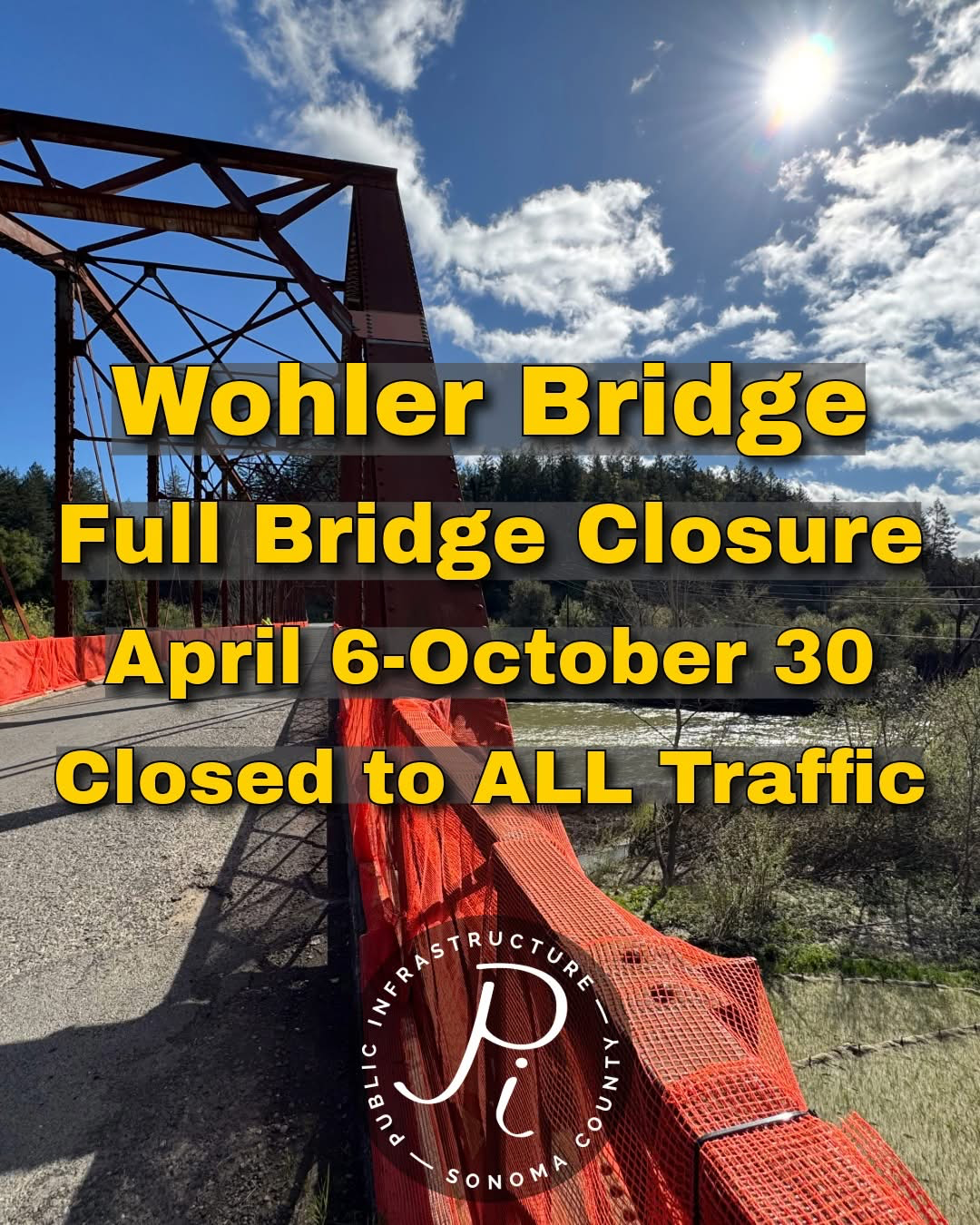
Beginning today, April 6, Wohler Bridge will be fully closed to all traffic through October 30 for major construction and safety improvements.
This is a full closure — no vehicles, bikes, or pedestrian access during this time.
The seven-month full closure is needed because there will be major repairs to the top part of the bridge (the driving surface and structure). Over the past two years, Public Infrastructure repaired the foundation underneath the bridge.
Now, Public Infrastructure is focusing on the deck (the road you drive on) and the supporting structure above it, which have been damaged over time by vehicle impacts, wear, and corrosion. This work requires removing and replacing the entire bridge deck and realigning it, which is a complex process that cannot be done safely while the bridge is open.
We know this is a significant impact for those who rely on the bridge, and we encourage everyone to plan alternate routes in advance. This work is necessary to strengthen the bridge and ensure it remains safe and reliable for years to come.
| | Stronger Preparedness Starts With You | | |
The Sonoma County Department of Emergency Management is conducting an Access and Functional Needs Community Survey, and your voice matters.
This survey helps us better understand the barriers, challenges, and needs our community members and community organizations face when receiving and responding to emergency information. Your feedback will directly support more inclusive, accessible, and effective emergency planning for everyone.
| | Building Belonging: Parks Initiative Focuses on Equity and Access | | Sonoma County Regional Parks has adopted a new, community-informed “Belonging Framework” to guide long-term improvements in park access and visitor experience. The framework centers on equity, accessibility and inclusion, with strategies to reduce barriers, reflect diverse community needs, and create more welcoming, culturally responsive parks and programs. It will help shape future planning, investments and partnerships to ensure everyone feels a sense of belonging in Sonoma County parks. | | |
Recology Bulky Item Pickup in
Unincorporated Sonoma County
| | |
Do you have an old couch, mattress, or appliance that needs to go? Recology Sonoma Marin offers four free bulky item pickups per year for residential customers in unincorporated Sonoma County. It’s an easy and responsible way to dispose of large household items that won’t fit in your regular collection bins.
Accepted items include furniture, mattresses, large household goods, and appliances. Commercial customers can also schedule bulky item pickups for a fee. To schedule a pickup, call 1-800-243-0291 or email RecologySonomaMarin@recology.com.
| | Upcoming Local Event Impacting Roads
Plan Travel Accordingly | | |
West County will see several community and athletic events this spring that may bring increased traffic, periodic delays, and temporary road impacts. We encourage residents to allow extra travel time and plan alternate routes when possible.
Levi's GranFondo
Saturday, April 25, 2026
This major cycling event draws riders countywide and will include CHP‑supported traffic control measures. Rural and coastal routes may see delays.
| | Upcoming Meetings & Events | | | | |
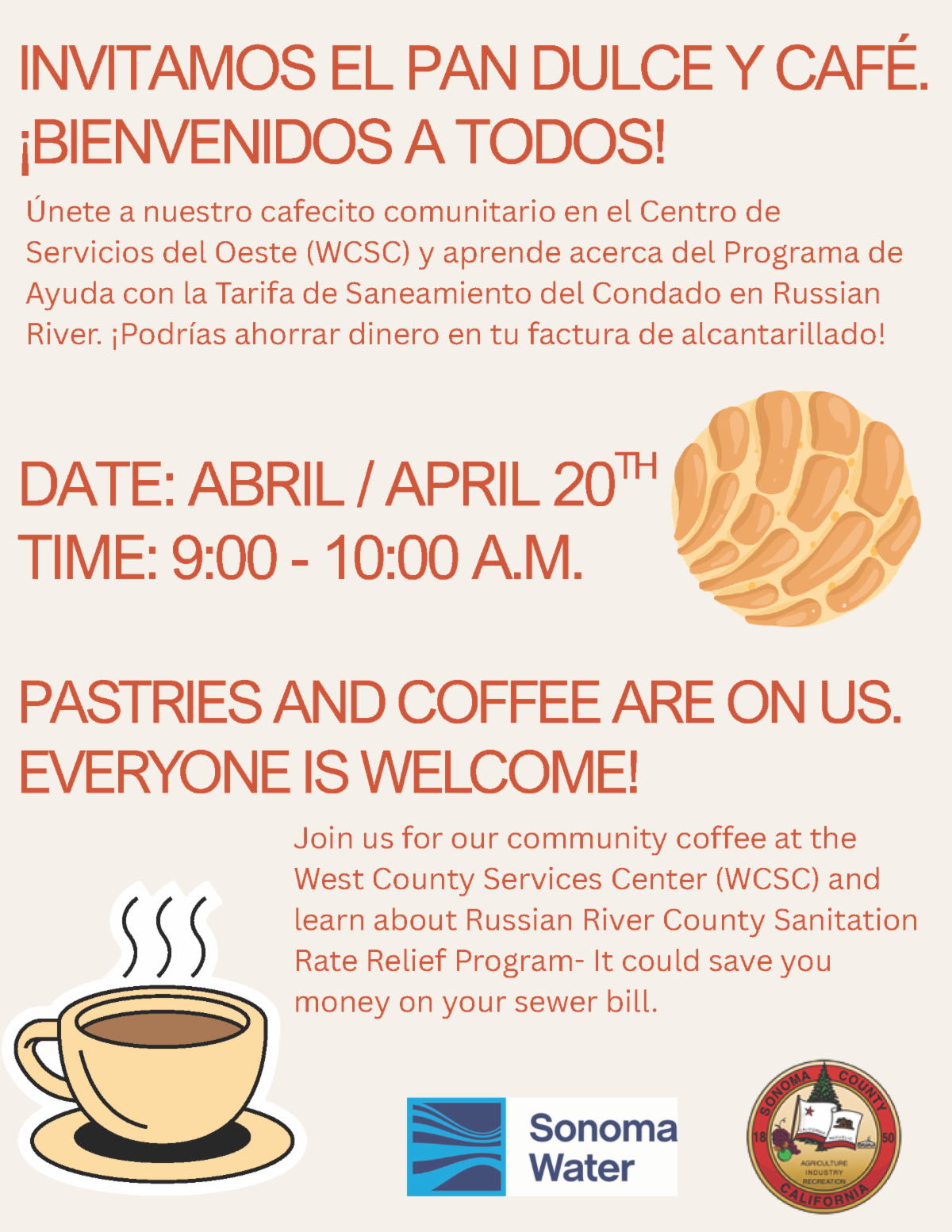
Community Coffee / Cafecito Comunitario
Monday, April 20, 9:00 - 10:00 AM
West County Services Center
16390 Main Street, Suite B, Guerneville
District 5 invites you to visit our "Cafecito" drop-in office hours on the third Monday of each month.
In April, Juan-Carlos Solis from Sonoma Water will join us to share information about the Russian River County Sanitation Rate Relief Program.
The Sanitation Rate Relief Program provides a discount on sewer service bills for low-income property owners within the districts and zones managed by Sonoma Water. The discounts can reduce the annual sewage charge on your property tax bill by up to 50%.
Nonprofit organizations that provide housing for low-income renters within the district or zone are eligible to participate in the program.
Sonoma Water will begin accepting applications from April 16 to July 10. Customers must apply every year for the Sanitation Rate Relief Program.
Participants in the PG&E CARE Program must submit a copy of their most recent PG&E bill as proof of participation in the CARE Program. Eligible customers should sign up for the PG&E CARE Program as soon as possible to facilitate qualification for the Sanitation Rate Relief Program. Learn more from Juan Carlos during this event and apply at SonomaWater.org/SRRP.
Everyone is welcome; we look forward to seeing you!
| | | | |
Sonoma Water | Russian River County Sanitation District Community Meeting
Thursday May 7, 5:30 - 7:30
West County Services Center
16390 Main Street, Suite B, Guerneville
Sonoma Water is sensitive to the financial strain rate increases may cause. To help offset capital project costs and reduce the burden on ratepayers, Sonoma Water is actively pursuing grants and loans.
Join us to learn about the sanitation rate setting process and infrastructure projects planned in the Russian River County Sanitation District.
| | | | |
Lower Russian River Municipal Advisory Council
May 14, 2026
5:30 PM
West County Services Center
16390 Main Street, Suite B, Guerneville
| The April 9 River MAC regular meeting is cancelled. Join us on May 14 for a panel discussion featuring Sonoma County Sheriff, Caltrans, CHP, and more. | | Representatives from the River MAC will be tabling at tthe West County Fix-it Fair on May 2. Stop by with your questions and / or feedback! | | | | |
Sonoma County Coast Municipal Advisory Council
Thursday May 28, 2026
5:30 PM
Coast MAC Meetings are hybrid - in person and via Zoom. Public comment may be made in either format. Agendas are published at the Coast MAC Meeting Calendar page no later than 72 hours before the meeting.
| |
|
Fifth District Supervisor Lynda Hopkins | County of Sonoma | 707-565-2241
Lynda.Hopkins@sonomacounty.gov
Not Subscribed? Sign up here to receive the newsletter.
¿No está suscrito? Suscríbase aquí para recibir el boletín.
| | | | |