Dear GWP Friends and Colleagues, | | |
Welcome to the GWP’s Quarterly Newsletter—your go-to for the latest knowledge resources, events, and recent exchanges from the field.
In South Africa, we had the pleasure of hosting over 60 participants from 22 GWP countries for a workshop on nature-based tourism, with sincere appreciation to Flora Mokgohloa (Department of Forestry, Fisheries and the Environment) and Sibusiso Bukhosini (iSimangaliso Wetland Park Authority) and their teams for graciously hosting and contributing their expertise to the workshop. A couple of weeks prior, the GWP joined forces with the World Bank’s PROGREEN and PROBLUE programs to host a webinar on new analytical work that measures the local economic benefits of nature-based tourism in Madagascar and Uganda. You can check out the recording for the webinar and links to these two reports below.
Elsewhere, we have concluded round one of our Twinning Initiative, with thanks to Colombia, Panama, Chad, South Africa, Bhutan, and Uganda for their collaborative spirit and participation. We are also excited to share our latest feature story, highlighting the role of five community champions in strengthening the resilience of the wildlife, nature, and communities they care for. Plus, we feature two new guidance notes—on jaguar conservation and camera trapping—fresh off the press from the GWP Ecuador team.
| | |
Warm regards,
The GWP Coordination Team
World Bank
| | GWP updates and resources | | GWP Twinning Exchanges Yield Insights on Collaboration | | |
The first round of the GWP Twinning Initiative concluded with successful exchanges involving six countries. These exchanges fostered peer learning, inspired replicable practices, and strengthened international collaboration, setting a strong precedent for future partnerships in wildlife conservation.
In April 2024, a delegation from the GWP Bhutan project visited Uganda on a self-initiated exchange to gain practical insights on conservation and ecotourism development. The Bhutan project team were particularly inspired by Uganda’s strong community engagement, benefit-sharing models, and use of local materials in eco-lodge development – insights that they hope to replicate in Bhutan.
In February 2025, teams from the GWP Chad and South Africa projects met in Pretoria to share experiences on institutional mandates for dispute resolution, relevant legal frameworks, and practical approaches to challenges such as pollution, poaching, and human–wildlife conflict. The Chad project team learned from South Africa’s environmental legislation and integrated multi-agency enforcement system. Equally, the South Africa project team gained insights from Chad’s experience in mitigating human–wildlife conflict and the role of judicial police officers in prosecuting environmental offenses. Both countries reaffirmed their commitment to collaboration, including plans to reactivate dialogue on the rhino reintroduction protocol.
In April 2025, a delegation from the GWP Colombia project visited Panama to learn about the project team’s experience with biocultural connectivity and human-jaguar conflict. The exchange generated concrete opportunities to strengthen collaboration, such as a proposed binational cooperation agreement.
These exchanges set a solid foundation for continued peer learning within the GWP network. As the Twinning Initiative moves into round two, we look forward to supporting collaboration that enhances knowledge and solutions for wildlife conservation.
| |
Nature-Based Tourism Workshop in iSimangaliso Wetland Park, South Africa
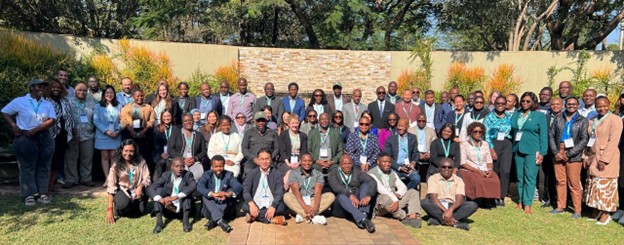
| | Participants of the workshop, “Building Blocks for a Thriving Nature-Based Tourism Sector,” in iSimangaliso Wetland Park, South Africa. | From June 2-5, 2025, 62 participants from 22 GWP countries travelled to iSimangaliso Wetland Park, South Africa, to take part in a workshop titled “Building Blocks for a Thriving Nature-Based Tourism Sector,” delivered in partnership with South Africa’s Department of Forestry, Fisheries and the Environment (DFFE) and the iSimangaliso Wetland Park Authority. The workshop aimed to foster knowledge sharing and learning on developing commercially viable tourism around protected areas that delivers benefits for conservation and communities. Participants discussed their progress and plans to integrate nature-based tourism into development strategies. They also explored the design and implementation of tourism products and value chains that support job creation. Stay tuned for a guidance note that will summarize insights from the workshop. | | New Reports on the Local Economic Impacts of Nature-based Tourism in Madagascar and Uganda | |
Did you know that in Madagascar, each tourist dollar generates $2.48 in local income near Nosy Tanikely National Marine Park — or that in Uganda, each tourist dollar generates $2.03 in local income near Queen Elizabeth National Park?
The LEWIE-LITE methodology for protected area tourism provides an accessible and user-friendly methodology to assess the impacts of tourist spending on local economies. With support from the Global Wildlife Program, PROGREEN, and PROBLUE, the World Bank has piloted LEWIE-LITE in Madagascar and Uganda.
| | What's new from GWP projects and partners | | |
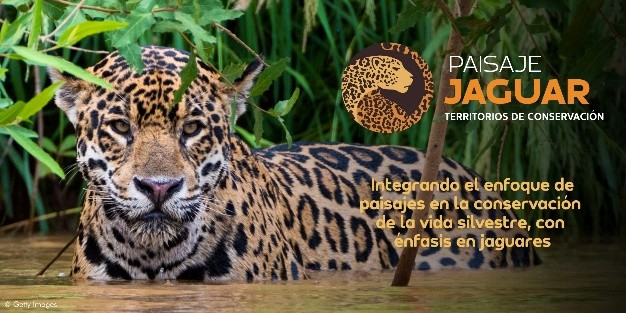
The GWP Ecuador project, executed by the Wildlife Conservation Society, is on a mission to protect Ecuador’s jaguars and the wildlife that share their habitats—preserving critical landscapes across the country for generations to come. The project has recently published two guidance notes (available in Spanish):
To stay updated on news about this project, visit: www.paisajejaguar.org.
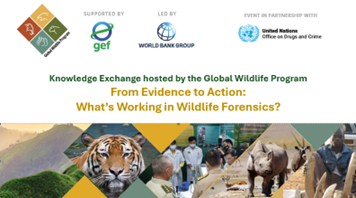
| | From Evidence to Action: What’s Working in Wildlife Forensics? | | |
Wildlife DNA forensics play a critical role in helping to address the global challenge of illegal wildlife trade, serving both as a robust tool within the criminal justice system and as a strategic resource for the disruption and prevention of transnational environmental crime.
In June 2025, the GWP and UNODC held a virtual session to share best practices in wildlife forensics and explore ways to expand efforts in the field. The workshop featured presentations from seven guest speakers who shared insights and case studies on the application of wildlife forensics across various countries. Some takeaways included:
- Wildlife forensics serves both criminal justice and crime disruption purposes. Despite their potential, these approaches remain underused and unevenly developed, especially in key IWT-affected countries.
- Beyond legal proceedings, wildlife forensic data can help uncover trafficking networks by combining evidence from seizures with other intelligence (e.g., financial flows, digital traces) to map routes, actors, and operations.
- Standardized methods are essential for accurate species identification and reliable forensic evidence.
| | Measuring the Economic Impacts of Nature-Based Tourism | |
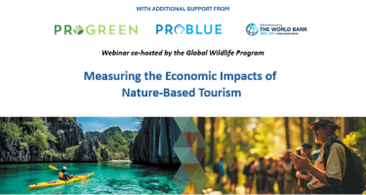
In May 2025, the GWP hosted a webinar that explored the local economic impacts of nature-based tourism on communities, with additional support provided by PROGREEN and PROBLUE. With participation from the International Labour Organization, Intrepid Travel, and UN Tourism, this event explored the latest data on the local economic benefits of nature-based tourism and how different stakeholders have been working to get communities and enterprises “tourism-ready”, improve nature-based tourism jobs, and harness its role for greater impact.
| Small Grants Make a Big Impact for Conservation and Development | | |
Small grants are a vital funding mechanism that support communities to lead conservation efforts while contributing to their livelihoods and the local economy.
Hosted in February 2025, this webinar explored lessons learned from the Small Grants Programme (SGP), funded by GEF and implemented by the United Nations Development Program (UNDP). The event included presentations from SGP representatives from Bhutan and Nigeria, and GWP Mozambique, which highlighted experiences from community-based management of small grants and recommendations for replication and scale.
| |
|
Past GWP Webinars can be found here and
summaries of Knowledge Events here.
| | | | |
To receive regular updates about virtual events email: gwp-info@worldbank.org
| | |
This newsletter is published by the GWP Coordination Team
We welcome your submissions of news, events, and publications at
gwp-info@worldbank.org
| | | | |