I hope this finds you well! Winter is in full swing in New England. For the most part, the loons have left our lakes and are on their wintering grounds on the ocean. If you are at the coast, keep your eye out for common and red throated loons!
|
|
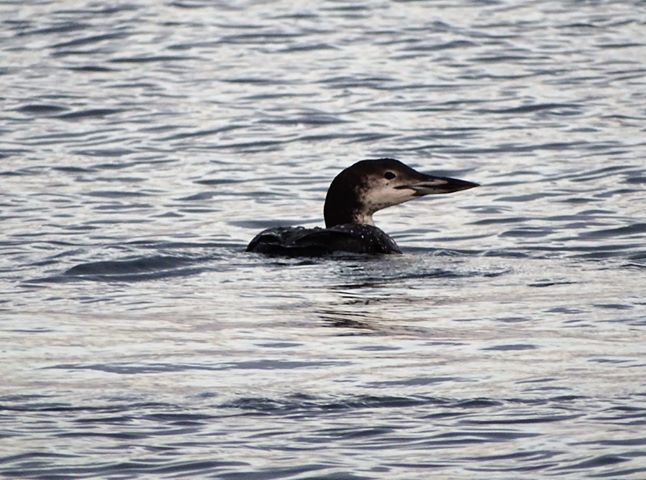
A wintering loon in Coastal Maine. Photo courtesy of Karen Grader.
|
|
Here in New Hampshire, temperatures have dipped in recent weeks. Many of our smaller lakes and ponds have already frozen over, and the ice is beginning to creep in on even our largest lakes. Although most loons have migrated to the ocean by now, a few have remained. This poses a problem, as loons remaining on lakes and ponds this late in the year risk becoming iced-in.
Because they are heavy bodied birds with relatively short and narrow wings, loons require up to a quarter mile of open water in order to take off. As ice forms on lakes, the amount of water available to be used for takeoff decreases. If they do not leave lakes before the ice comes in, loons risk becoming trapped and unable to fly to their wintering grounds.
|
|
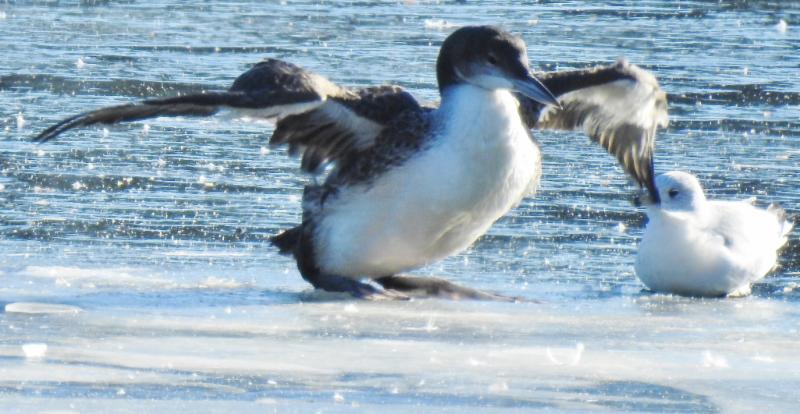
An iced in juvenile loon stretches its wings. Photo courtesy of Alan Murray.
|
|
Lake ice greatly restricts loon mobility. Iced-in loons often cannot dive because doing so puts them at risk of becoming trapped underneath and drowning. Being unable to dive means that loons cannot catch fish. If they aren't rescued, these birds run the risk of starvation. Iced in loons are also at greater risk of predation by eagles or other opportunistic animals, as their mobility is so restricted that they are often unable to escape.
|
|
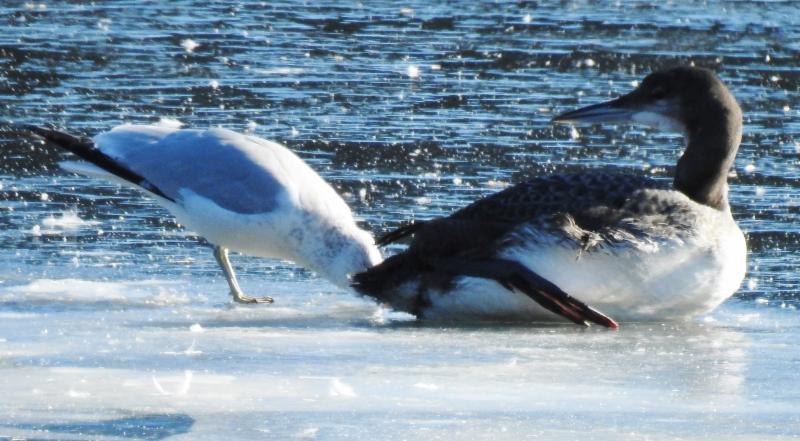
This juvenile loon became stuck on the ice on Willand Pond in early December. Because their legs are so far back on their bodies, loons are unable to walk well on land (or in this case, on ice). This puts iced-in loons at an elevated risk of predation by eagles or other opportunistic predators. Photo courtesy of Alan Murray.
|
|
This past Saturday, LPC Senior Biologist John Cooley performed LPC's first winter ice rescue of 2018 on Willand Pond in Dover/Somersworth, NH. With the help of some concerned members of the public, LPC had been monitoring the loon for a few days prior to the rescue. Though we hoped that the ice would break up enough that the loon could take off on its own, by Friday it became clear that a rescue was required. John attempted to rescue the loon on Friday afternoon, however there was just enough open water left that the loon was able to scoot off of the ice and evade him.
|
|
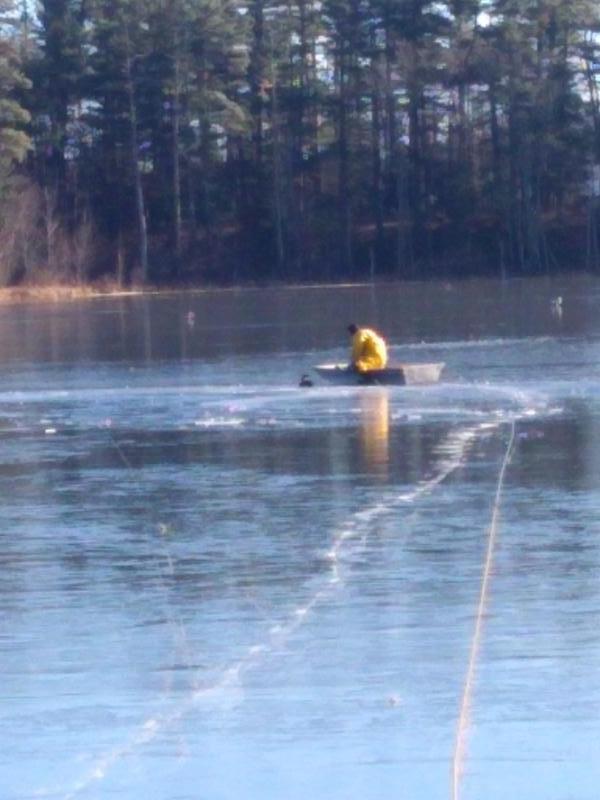
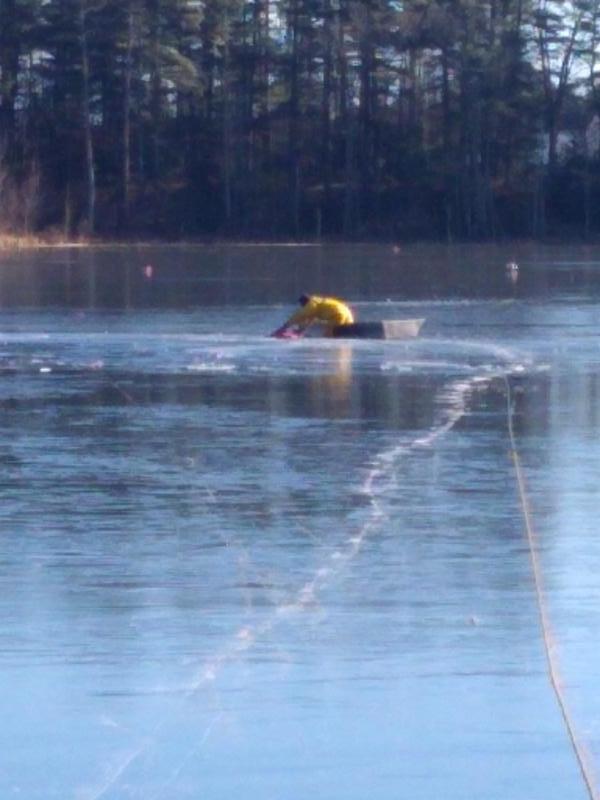
LPC Senior Biologist John Cooley carefully approaches the loon.
|
|
By Saturday, the pond had frozen over enough that it seemed likely that another rescue attempt would end in success. With backup from the Dover Fire Department, John made his way back out onto the ice. Fortunately, this time he was able to get close enough to the loon scoop it up.
|
|
Success! John was able to capture the loon and bring it to shore.
|
|
After getting the loon off of the ice, John and 2018 Seacoast Region Biologist Owen Brennick were able to assess it. They weighed the loon to make sure it was not underweight (a sign that there may be underlying problems) and tested its blood for lead and other signs of distress.
|
|
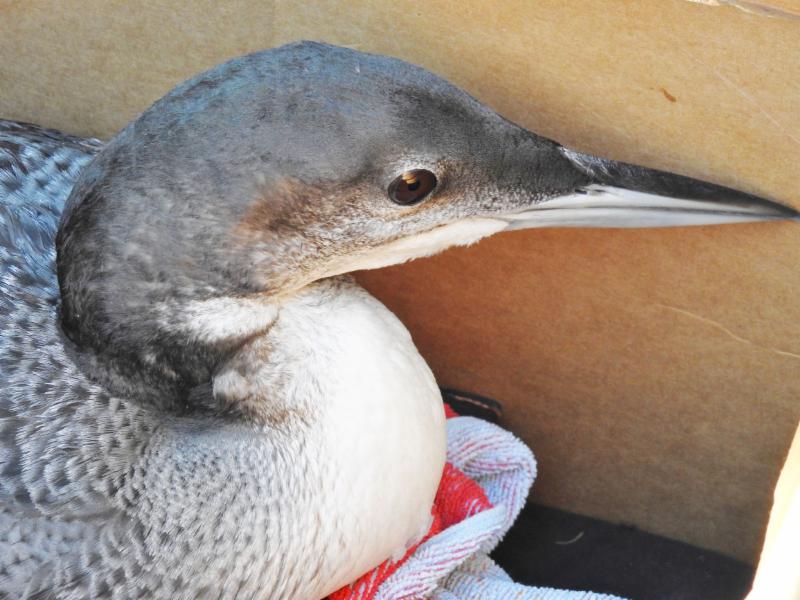
The juvenile rescued on Willand Pond. Photo courtesy of Alan Murray.
|
|
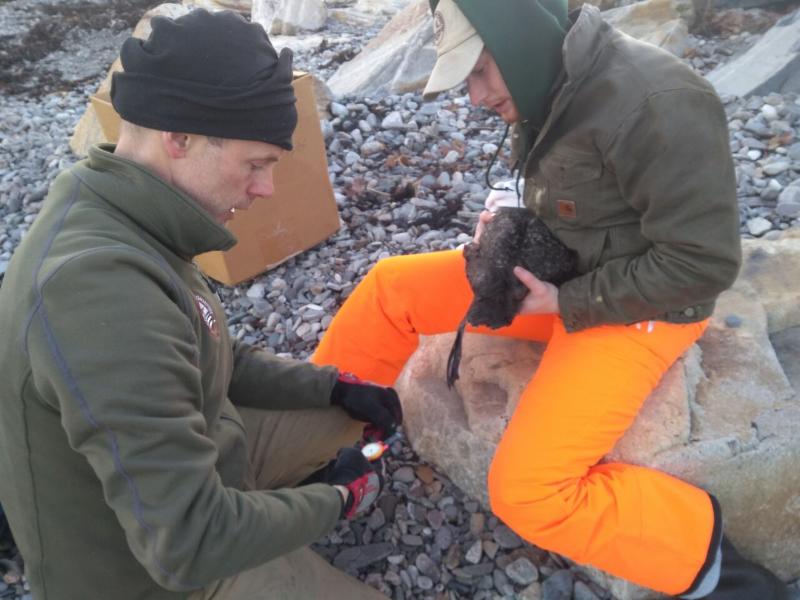
Because the blood test did not show elevated lead levels or any other abnormalities and because the loon was incredibly vigorous, John and Owen determined that it was fit to be released. They drove to Odiorne Point State Park, where they banded the loon before releasing it onto the ocean.
|
|
LPC's John Cooley and Owen Brennick fit the rescued loon for bands.
|
|
Once released, the loon immediately dove underwater and stayed under for over a minute. The ability to dive for such a long duration is a great sign-it indicates that the loon was in good condition, giving it higher chances of survival. See below for a video of the release!
|
|
LPC Senior Biologist John Cooley and former Seacoast Region Biologist Owen Brennick release the juvenile loon rescued at Willand Pond onto the ocean at Odiorne Point State Park.
|
|
Juvenile loons typically remain on the ocean for three years before returning to inland lakes to breed. Because of this, we will not be able to check in on this loon for at least a few years. However, if it does return to New Hampshire in the future, we will be able to identify it by its bands.
|
|
Although these ice rescues are a relatively new addition to LPC's population management, they have already proven to be effective at not only ensuring the survival of the affected loons but also at helping to grow the loon population. You may remember that in 2016, LPC rescued five loons that had become trapped on the ice on Lake Sunapee. Four of these five loons survived the rehabilitation process and were released (the fifth unfortunately succumbed to lead poisoning from ingested lead fishing tackle). In 2018, all four of the rescued Sunapee loons were resighted on New Hampshire lakes, with two of the four fledging chicks!
|
|
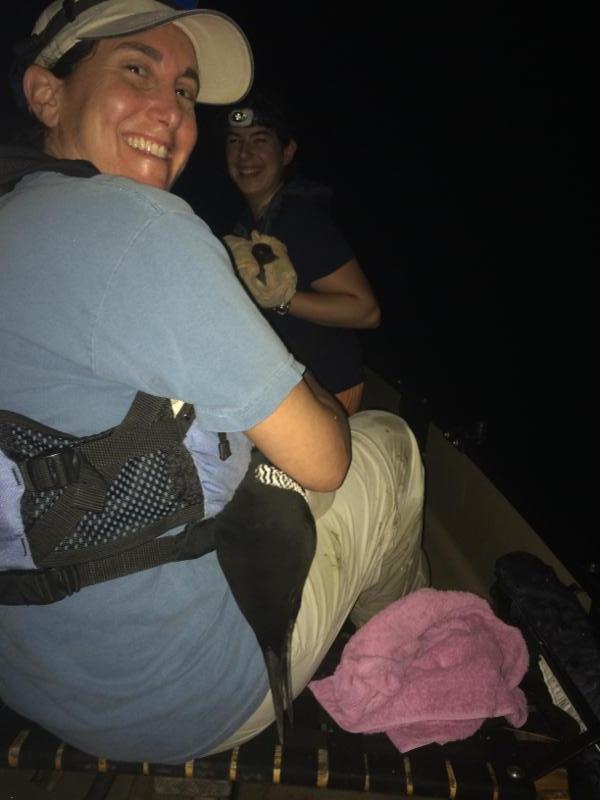
Former LPC Volunteer/Outreach Coordinator Susie Burbidge holds a loon during a night of banding in the summer of 2018. This loon was one of the five rescued from the ice on Sunapee Lake in 2016. It fledged a chick in 2018 (held by Tufts vet student Olivia Bolus in this photo), contributing to the recovery of New Hampshire's loon population.
|
|
With the help of volunteers, LPC is continuing to monitor a few other loons remaining on lakes in New Hampshire that may be in danger of becoming iced in. If you are aware of any loons that might be in this situation, please be sure to give us a call at (603)476-5666!
|
|
Wishing you a happy holiday season!
Best,
Caroline
Caroline Hughes
Volunteer/Outreach Coordinator
Loon Preservation Committee
|
|
Have a loon lover in your life? LPC's store has lots of loon-themed products that make great holiday gifts! Check out our inventory
here
!
|
|
Geology of the Lakes Region; January 17th, 7 PM-8:30 PM
|
|
Loon Preservation Committee | 603-476-LOON (5666) | www.loon.org
Loon Center Hours: Open Thursday through Saturday, 9 am to 5 pm
|
|
The Loon Preservation Committee is dedicated to restoring and maintaining a healthy population of loons throughout New Hampshire; monitoring the health and productivity of loon populations as sentinels of environmental quality; and promoting a greater understanding of loons and the natural world.
|
|
|
|
|
|
|