|
News and Research Findings from Across the ECHO Program
Welcome to the ECHO Connector! The Environmental influences on Child Health Outcomes (ECHO) Program is a research program in the Office of the Director at the NIH with the mission to enhance the health of children for generations to come. The ECHO Connector will keep you informed of program news and our latest research findings.
| | |
|
|
It has been a big year for the ECHO Program.
Among other successes, ECHO Cohort enrollment during pregnancy and during childhood has exceeded targets, and our pioneering work on preconception influences on child health is now off the ground. Our researchers continue to publish findings that inform programs, policy, and practice.
| | |
|
In this issue of the ECHO Connector, we highlight research into birth outcomes of pregnant women living in historically redlined neighborhoods, and the association between exposure to flame-retardants during pregnancy and childhood obesity risk. Don’t miss our ECHO Cohort Year in Review (summarized below) on ECHOchildren.org.
In the ECHO IDeA States Pediatric Clinical Trials Network (ISPCTN), the first phase of the Advancing Clinical Trials in Neonatal Opioid Withdrawal Syndrome (ACT NOW) Weaning trial*— which compares rapid with slow opioid weaning among newborns with NOWs who require medication treatment — is complete. Study teams are now following children through the age of 2 years to look at development and family functioning. Our investigators also published two new papers from the landmark ACT NOW Eat, Sleep, Console trial.
The Bronchiolitis Recovery and the Use of High Efficiency Particulate Air (HEPA) Filters (BREATHE) trial, which aims to determine the extent to which indoor air filtration improves respiratory symptoms in children under 12 months of age who have been hospitalized for bronchiolitis, is complete. The study staffs across the 17 sites not only recruited participants faster than we anticipated, but they also retained a very high number of them through 6 months of follow-up, thus enhancing validity of results. We await the primary findings of the Weaning and BREATHE trials.
Thank you for your continued support for the ECHO Program. Have a wondrous holiday season!
| |
|
Matthew Gillman, MD, SM
Director of the ECHO Program
*ACT NOW clinical trials represent a collaboration between the ECHO Program and the NIH’s Eunice Kennedy Shriver National Institute of Child Health and Human Development (NICHD), funded through the NIH Helping to End Addiction Long-term® Initiative (HEAL).
| |
|
As the year comes to a close, the ECHO Cohort Consortium is celebrating its progress in enhancing child health for generations to come.
In a special Year in Review page on ECHOchildren.org, we highlight the key numbers that defined 2024 for the ECHO Cohort, the arm of the ECHO Program engaged in observational research.
| |
|
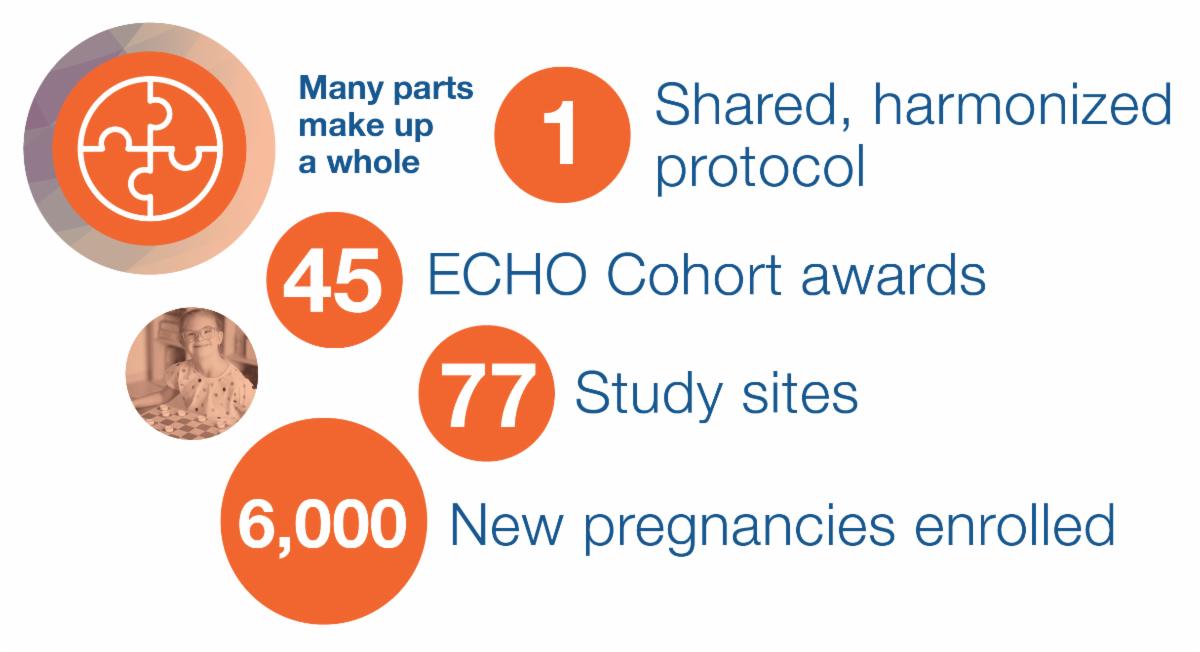
These ECHO Cohort numbers represent a year of growth, collaboration, and learning:
- At 77 study sites where participants are enrolled and data is collected, ECHO Cohort researchers and study participants are collecting the data that will help us continue to discover what influences early growth and development in one or more of five outcome areas.
- In the past year, these research teams have enrolled about 6,000 pregnancies on the way to the program’s goal of 30,000 new pregnant participants. As these babies are born, they join the 30,000 existing child participants in the ECHO Cohort.
- In late 2024, the ECHO Cohort protocol was updated to include collection of preconception information — ECHO Cohort investigators can now begin to follow several thousand women and their partners to examine how environmental factors even before pregnancy can affect their children.
- In 2024, data analyses by the ECHO Cohort Consortium led to 48 research articles published by peer-reviewed science and public health journals. Writing teams are currently working on more than 92 additional data-analysis proposals to answer important research questions with ECHO Cohort data.
- This year, we added 25 research summaries to the website. ECHO Cohort researchers presented 12 ECHO Discovery webinars and traveled far and wide to share the latest research through 22 presentations at major society meetings.
-
357 media outlets highlighted 14 different ECHO Cohort studies in news coverage.
| |
Coming Soon: Funding Opportunities for Fellows and Students | |
ECHO has issued Notices of Intent to Publish two funding opportunities inviting applications from postdoctoral fellows and dissertation students to study early environmental exposures and child health outcomes through the analysis of ECHO’s large longitudinal data set within the Eunice Kennedy Shriver National Institute of Child Health and Human Development (NICHD) Data and Specimen Hub (DASH) repository.
ECHO’s DASH dataset integrates de-identified longitudinal data from more than 63,000 participants across the U.S. The data include prenatal and child exposures of many kinds, and five primary pediatric outcome areas: pre-, peri-, and postnatal health, upper and lower airway health, obesity, neurodevelopment, and positive health.
| |
|
Recent Research Results
Stay up-to-date as ECHO researchers continue to share their data analyses and insights, including research summaries that reflect recently published ECHO research articles:
| |
ECHO Study Investigates Pollution Exposure and Birth Outcomes in Pregnant Women Living in Historically Redlined Neighborhoods | |
ECHO research led by Teresa Herrera, MPH and Akhgar Ghassabian, MD, PhD found that living in lower-graded or ungraded census tracts during pregnancy was associated with higher exposure to particulate matter (PM) 2.5. These women also tended to have babies with lower birth weights. | |
ECHO Study Investigates Exposure to Flame-Retardants During Pregnancy and Childhood Obesity Risk | Research led by Alicia K. Peterson, PhD and Assiamira Ferrara, MD, PhD found that children aged 5 to 10 years who were exposed to higher levels of dibutyl phosphate and di-isobutyl phosphate (DBUP/DIBP) during pregnancy had a 14% greater risk of developing obesity compared to those with the lowest exposure levels. | |
|
ECHO Discovery
ECHO Discovery is a monthly webinar series with educational presentations for the ECHO community and anyone else interested in environmental influences on child health.
| |
|
Join us for the next monthly ECHO Discovery webinars
On Dec. 11 at 1 pm ET, Isar P. Godreau Santiago, PhD and Mariluz Franco-Ortiz, PhD of University of Puerto Rico-Cayey will speak on “Applications of Skin Color Scales to the Study of Racial Inequality.”Godreau Santiago and Franco-Ortiz will discuss the application of utilizing skin color scales to study racial inequality and will discuss the contributions of studies that have applied this methodology to study racial inequalities among Latinxs in the U.S. and in Puerto Rico with a focus on health outcomes.
On Jan. 8 at 1 pm ET, Courtney K. Blackwell, PhD, EdM and Richard Gershon, PhD of Northwestern University Feinberg School of Medicine will present on the NIH Baby Toolbox. Blackwell and Gershon will review the NIH Infant and Toddler “Baby” Toolbox, which contains more than 30 assessments of Cognition, Motor, and Social-Emotional domains in one iPad app. The toolbox’s valid, reliable, and norm-referenced measures allow for assessment of children throughout infancy and early childhood (ages 0 to 42 months).
| |
|
November ECHO Discovery
Microbiomes of Pregnancy and Infancy: Implications for Child Health Outcomes
In November, Sarah Comstock, PhD of Michigan State University presented data from ECHO analyses of extant microbiome data and discussed the potential of ECHO microbiome data and samples to advance the fields of exposure science, child health, and human development.
| |
|
|
October ECHO Discovery
Multi-Omic Data Illuminates the Placenta’s Role as a Mediator Between Prenatal EDC Exposures and Preterm Birth
In October, Alison Paquette, PhD of the Center for Developmental Biology Seattle Children’s Research Institute discussed the placenta's role as a mediator between prenatal EDC exposure and preterm birth.
| | | | |