News and Research Findings
from Across the ECHO Program
| | | ECHO Cohort Year in Review 2025
ECHO Symposium 2025: Slides and Full VideoCast
ECHO Topic of Interest: Social and Neighborhood Factors | | Recent ECHO Results: Wildfire Smoke Exposure May be Linked to Higher Risk of Preterm Birth; PFAS Exposure During Pregnancy Not Associated with Behavior Issues in Children; Toddler Emotional and Behavioral Problems Decreased Slightly During Pandemic; PFAS Exposure Associated with Changes in Gut Microbiome During Pregnancy | | Past ECHO Discovery Webinars: December, October, November
News from NIH
With a Childlike Wonder | | | |
As we close out the year, I express my deep gratitude to our many ECHO partners who share our commitment to enhancing child health. As we look toward ECHO’s 10th anniversary in 2026, I have been reflecting on how far our research has come and how essential your partnership has been in shaping its impact.
Despite some challenges, this year saw sustained momentum across ECHO’s two components. The ECHO Cohort, now well into its second 7-year cycle as the nation’s largest longitudinal child health study, continues to answer solution-oriented questions about how a broad range of early environmental exposures affect child health and development. The Cohort Consortium now also examines influences on child health that begin even before conception, including exploring the role of fathers during this foundational period. The ECHO Cohort continues to make its data accessible to the wider scientific community through the DASH platform and the ancillary studies program, which we began earlier this year.
The IDeA States Pediatric Clinical Trials Network entered a new multiyear phase with several pilot studies underway. I’m pleased that, early in 2026, the Network will begin recruiting participants for a full-scale, FDA-monitored clinical trial evaluating the extent to which phentermine can safely and effectively reduce body mass index (BMI) among rural and underserved adolescents with obesity—a group for whom lifestyle modification alone is often insufficient and accessible pharmacologic options are limited. Phentermine is a potentially safe and accessible option approved by the FDA in 1959 for individuals 16 years old or older.
We were proud to host ECHO’s first annual Translating Science to Action Symposium in September 2025. The event brought together more than 1,000 child health researchers, clinicians, policymakers, advocates, community leaders, and families to bridge the gap between cutting-edge child health science and actionable solutions that can be implemented in real-world settings. Learn more here and watch this space for news about our 2026 Symposium.
Thank you for your continued support and partnership. I wish you and your loved ones a restorative holiday season and a bright start to the year ahead.
Matthew Gillman, MD, SM
Director of the ECHO Program
| | | |
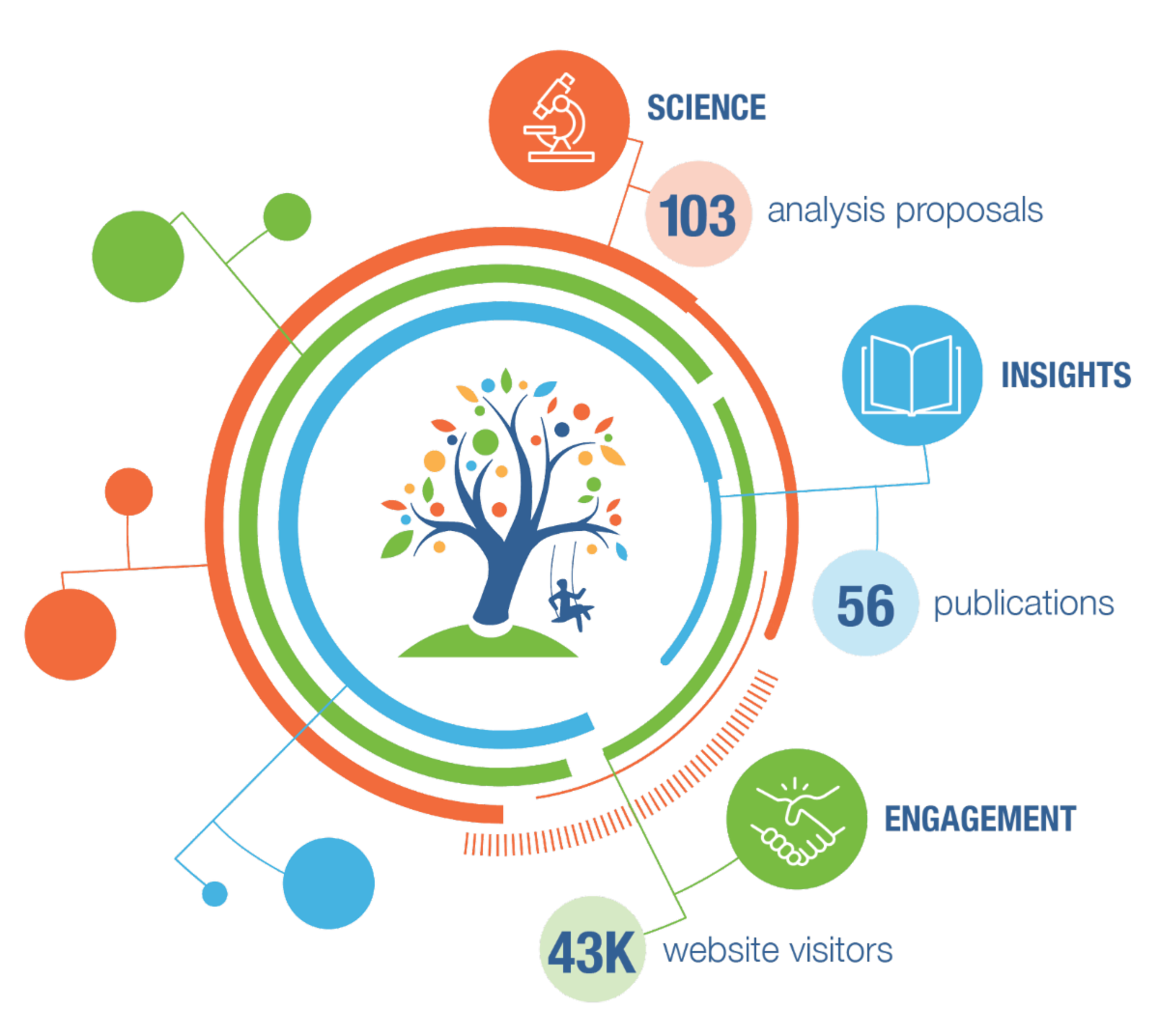
The 2025 ECHO Year in Review is now available on echochildren.org. The Review highlights ECHO's science, insights, engagement, and impacts in 2025. This year, the ECHO Cohort had 103 analysis proposals, 56 publications, and 43,000 website visitors.
It also features audio clip reflections from ECHO's Program Director, researchers, and participants.
ECHO will enter its tenth year in 2026; as 2025 wraps up, check out how far the Cohort has come!
| | ECHO Symposium 2025: Slides and FullVideoCast | | |
The NIH held its inaugural ECHO Symposium: Translating Science to Action on September 15, 2025, at the NIH campus in Bethesda, Maryland, and online. The Symposium included three sessions on the topics of Chemical Exposures, Social and Neighborhood Factors, and Community Experiences. The event brought together over 1,000 representatives of professional societies, advocacy groups, federal partners, state and local governments, research participants, and more.
Missed the event or want to revisit a session? The full VideoCast and presentation slides are now available.
| | ECHO's Social and Neighborhood Factors Research Topic Page | | |
ECHO investigates how factors such as access to housing, healthy food, transportation, parks, and education influence child health outcomes. As children are still developing, they may be more sensitive to their surroundings, which can affect their health throughout their lives. ECHO published several research articles and presented findings of its social and neighborhood factors research. Visit our website to view highlights of the many ECHO studies and publications about social and neighborhood factors.
| | Wildfire Smoke Exposure May be Linked to Higher Risk of Preterm Birth | |
The fine particulate matter in wildfire smoke may be more harmful than other kinds of ambient air pollution because of the chemicals it’s made of and how these chemicals interact with the body. Pregnant women and the developing fetus may be particularly sensitive to the effects of wildfire particles. This study included many participants from across the United States and looked closely at how the timing, intensity, or duration of wildfire smoke exposures affected birth outcomes. The study found that higher average wildfire smoke exposure during pregnancy was linked to a slight increase in risk for preterm birth. The connection was clearer in the Western U.S., especially with more intense or longer-lasting smoke events.
| PFAS Exposure During Pregnancy Not Associated with Behavior Issues in Children | |
Per- and polyfluoroalkyl substances (PFAS) are a class of thousands of man-made chemicals used in some products like cookware, stain-resistant fabrics, and foams used to fight fires. These substances are often referred to as “forever chemicals” because they don’t break down easily, causing them to build up in water, soil, and air. This study looked at the relationship between PFAS exposure during pregnancy and child behavior. Most of the PFAS detected in pregnant mothers were not clearly linked to behavior problems in their children overall. While most PFAS showed no association with behavioral problems, some relationships emerged, indicating that these exposures may influence brain development in complex and unexpected ways.
| Toddler Emotional and Behavioral Problems Decreased Slightly During Pandemic | |
Toddler-age children may have shown resilience despite the disruptions of the COVID-19 pandemic. This study found that children who experienced the pandemic had fewer emotional and behavioral problems compared to children born and assessed before the onset of the pandemic, based on results from the Preschool Child Behavior Checklist (CBCL). These findings could help identify potential protective factors that could have buffered the impact of the pandemic on child behavior and inform future interventions to support children's well-being during and after global crises.
| PFAS Exposure Associated with Changes in Gut Microbiome During Pregnancy | |
Prenatal PFAS exposure did not have a significant effect on the diversity of microbes in the maternal gut microbiome. However, there was a significant association between prenatal PFAS exposure and the relative abundance of specific types of bacteria in the maternal gut microbiome.
| |
ECHO Discovery
ECHO Discovery is a monthly webinar series of educational presentations for the ECHO community and anyone else interested in environmental influences on child health. Keep an eye on the ECHO Discovery webpage for upcoming webinars, as well as content from past ones.
| | Past ECHO Discovery webinars | | |
December
Air Pollution and Temperature as Spacial Factors Impacting Child Health
In December, Allan Just, PhD, of Brown University, presented on how air pollution and temperature act as spatial factors impacting child health, with a focus on advanced exposure modeling using satellite data and machine learning. He also highlighted opportunities within the ECHO Program to improve the accuracy of environmental health studies.
| | | |
November
Paternal Effects on Child Health and Development: Where are we Now, Where do we Need to be?
In November, Ricardo Bertolla, PhD, of Wayne State University’s School of Medicine, presented on what is currently known about paternal effects on obstetric outcomes that could influence child health and development and direct paternal effects that have been shown to impact child health and development. His presentation included research in both animals and humans.
| | | |
October
Where There's Smoke...There's Action? What ECHO Can do to Protect Children from Wildfire Smoke
In October, Christine Loftus, MS, MPH, PhD, of University of Washington’s Environmental and Occupational Health Sciences, presented how ECHO is studying the ways wildfire smoke exposure impacts around 12,000 ECHO participants and efforts to reduce negative outcomes. Loftus also discussed future research directions for the program with a focus on solution-oriented studies that leverage strengths of the ECHO Cohort.
| | | |
Pausing Requests to Use Teeth from ECHO Biorepository
The NIH ECHO Program Office has temporarily paused all requests to use children’s shed teeth from the ECHO Biorepository, including for ancillary studies.
While reviewing ancillary study requests, the Program Office recognized that many investigators are seeking to assay shed teeth; some of the assays destroy a whole tooth. If the Consortium conducted even a subset of these studies, demand would soon exceed the available supply.
In response, the Program Office plans to host a workshop in the near future to gather input from experts on the efficient use of shed teeth across multiple projects. The findings will help ECHO, and the broader scientific community, get the most data from this finite resource.
| | |
Who said you need to visit the Arctic Circle to see the Northern Lights? On the night of November 11, a geomagnetic storm brought the aurora to the United States. It was visible as far south as Texas and Florida. Check out these photos in NPR.
According to the National Oceanic and Atmospheric Administration (NOAA) Space Weather Prediction Center (that’s a thing?), a geomagnetic storm occurs due to disturbances in Earth’s magnetosphere. They’re caused by an efficient exchange of energy from solar wind into the space surrounding Earth. Though they produce beautiful auroras, these storms can also be disruptive, causing issues with navigation systems.
Be sure to keep an eye on the space weather forecast to catch the next geomagnetic storm!
| | |
The Northern Lights in Monroe, WI on the night of November 11, 2025.
Credit: NPR; Ross Harried/NurPhoto via Getty Images
| | | | |