|
Making ND transportation safer and more efficient
As planting season gets underway and our thoughts turn to summer recreation and travel, we recognize that a safe and efficient transportation system makes our work and play possible. The researchers and specialists at the Upper Great Plains Transportation Institute continue conducting research and outreach to help those who build and maintain that system.
In this issue of the newsletter, you'll learn how UGPTI researchers are working to complete the institute's local road and bridge needs study in time for the next legislative session. UGPTI also works with local road agencies to help them maintain the gravel roads across the state that provide such an important economic link for our ag producers, the energy sector, and rural residents. To better understand our transportation system and plan for its future, UGPTI researchers are collecting and analyzing data about freight movements and trucking. And also looking toward the future: UGPTI will hold its 3rd annual autonomous trucking conference in June. You are all invited to participate in this exciting event.
Over the winter, UGPTI's 19-member advisory council conducted strategic planning and developed a charter to clarify its mission and provide improved continuity as membership changes. The charter will also guide the advisory council's deliberations and discussions as it provides input into UGPTI's efforts so it can better address the transportation needs of North Dakota and its citizens.
At its meeting in May, the advisory council will review nominations for UGPTI's annual awards which honor those who have made significant contributions to the transportation system in the region. You may submit nominations by May 7. Awards will be made at the institute's annual awards banquet, October 15 at the Holiday Inn in Fargo.
If you missed the last issue of this newsletter, take a few minutes to take a look. The articles in these newsletters are only a small portion of the work going on at UGPTI. For more information, visit the webpages of UGPTI's programs and learn about the institute's efforts across the state and beyond.
If you have any questions about UGPTI and its programs, please contact me, UGPTI Director Denver Tolliver, or any of the UGPTI staff.
Best regards!
| |
Sheri Haugen-Hoffart
ND Public Service Commissioner
UGPTI Advisory Council Chair
| | | | Data collection wraps up for local road and bridge needs study | | |
UGPTI researchers are nearing the end of data collection and analysis for the latest version of a statewide local road and bridge investment needs study. A draft of the study final report will be issued this summer. Based on suggestions and feedback, a revised report will be released this fall prior to the ND Legislature’s 2027 session.
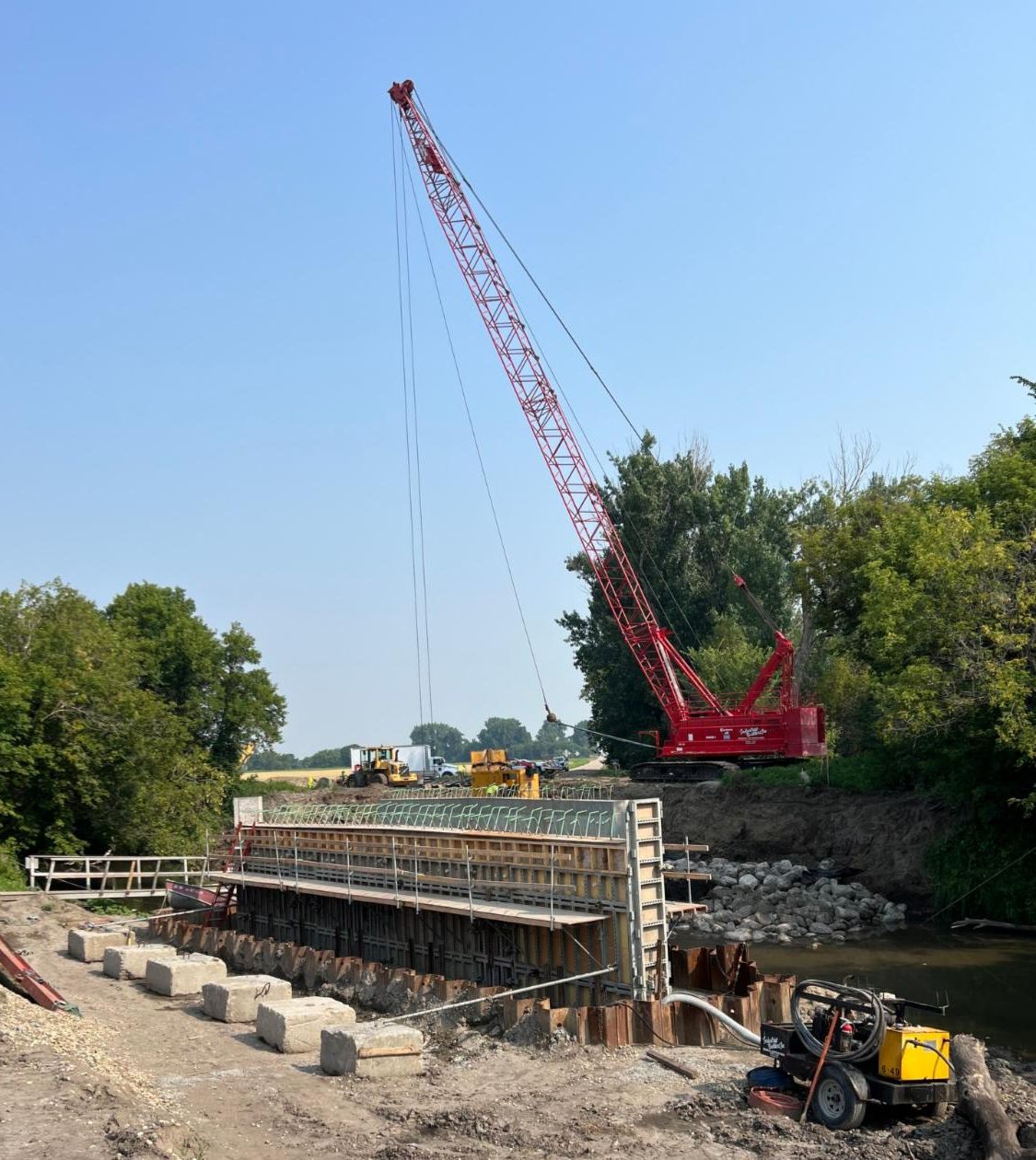
The researchers are completing the final calibration of a computerized traffic model that is used to project traffic across county, township, and tribal roads and bridges, noted Alan Dybing, a senior research fellow at UGPTI. They are also compiling road maintenance and construction cost data collected from a survey of counties and townships. They are also collecting and updating data on the state’s bridges and minor structures, including culverts and bridges under 20 feet in length.
“With each version of the study, we’ve added new data and information to make the study as complete as possible,” Dybing said. “The 20-year projection of road and bridge investment needs will allow decision makers across the state to better plan for investments to maintain and improve local infrastructure.”
Dybing further explained, “We compare traffic counts with outputs from the model to assure that our network assumptions and parameters are correct. If we can correctly model the base year, our projections will be more accurate.”
Over the past several months, Dybing met with ag processors and the North Dakota Division of Oil and Gas to examine how new developments in those fields may impact traffic patterns in the state. Those developments were factored into UGPTI's traffic model, which evaluates and predicts truck traffic across the state. Dybing said the model, one of the most complete models of local roads in the nation, focuses on truck traffic because it causes the most wear on local roads and bridges. It uses agricultural- and oil-related data to forecast truck traffic over the next 20 years.
Read more.
| | Helping maintain gravel roads to improve safety & cut costs | | |
With more than 65% of North Dakota’s 106,000 miles of roadways surfaced in gravel, it is no wonder that gravel road maintenance is an important focus of the UGPTI’s ND Local Technical Assistance Program (NDLTAP).
“We live in a rural state with about twice the number of registered vehicles as licensed drivers, noted NDLTAP Director Bryon Fuchs. “Consequently, North Dakota doesn’t have the revenue or the traffic volume to pave many of its roadways.” In fact, only about 17,000 miles of the state’s roads are hard surfaced. Of the remaining 89,000 miles, about 70,000 are gravel surfaced.
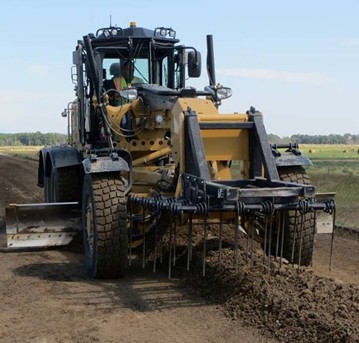
Those gravel roads need maintenance to keep them in safe driving condition. Washboards, raveling, float, excessive dust, and loss of aggregate into ditches are all concerns. In the past two years, NDLTAP held 27 training events across the state, where 364 participants learned about gravel quality, motor grader operator training, pulling gravel shoulders, and dust control to help their local counties and townships address those issues.
“Training local road agencies the proper way to maintain gravel surfaced roads and the importance of using quality gravel is improving safety and saving taxpayers money,” Fuchs said. “And that’s a win-win for the traveling public in North Dakota.”
Read more.
| | Gaining a more complete picture of ND freight transportation | | |
Freight transportation is a critical link in the ND economy, but data on freight transportation are scattered and incomplete. UGPTI researchers are working to remedy that.
Prompted by discussion during the 2023–2024 legislative session, UGPTI researchers Alan Dybing and Del Peterson are collecting and analyzing data on freight movements within the state. This information will be useful to policymakers, planners, and others interested in trends and changes in freight transportation in North Dakota.
“Freight movements are a substantial part of the state’s economy, supporting its location as a national crossroads and gateway for the United States,” Peterson said. “Freight modes, including truck, rail, pipeline, and air cargo, are crucial in transporting goods and commodities throughout the national and international supply chain. As the worldwide economy continues to evolve, it is vital that North Dakota maintain and improve upon its current freight network to compete in an ever-changing global marketplace. Our data and analysis support those efforts.”
Current efforts at UGPTI focus on 1) developing summaries on freight movement based on data from the U.S. Department of Transportation and U.S. Department of Agriculture data, 2) surveying agricultural processors to learn more about how they receive raw materials and ship their finished products, and 3) collecting information on farm and commercial trucks across the state.
Read more.
| Fargo conference will highlight trends and challenges as autonomous trucking shifts into high gear | |
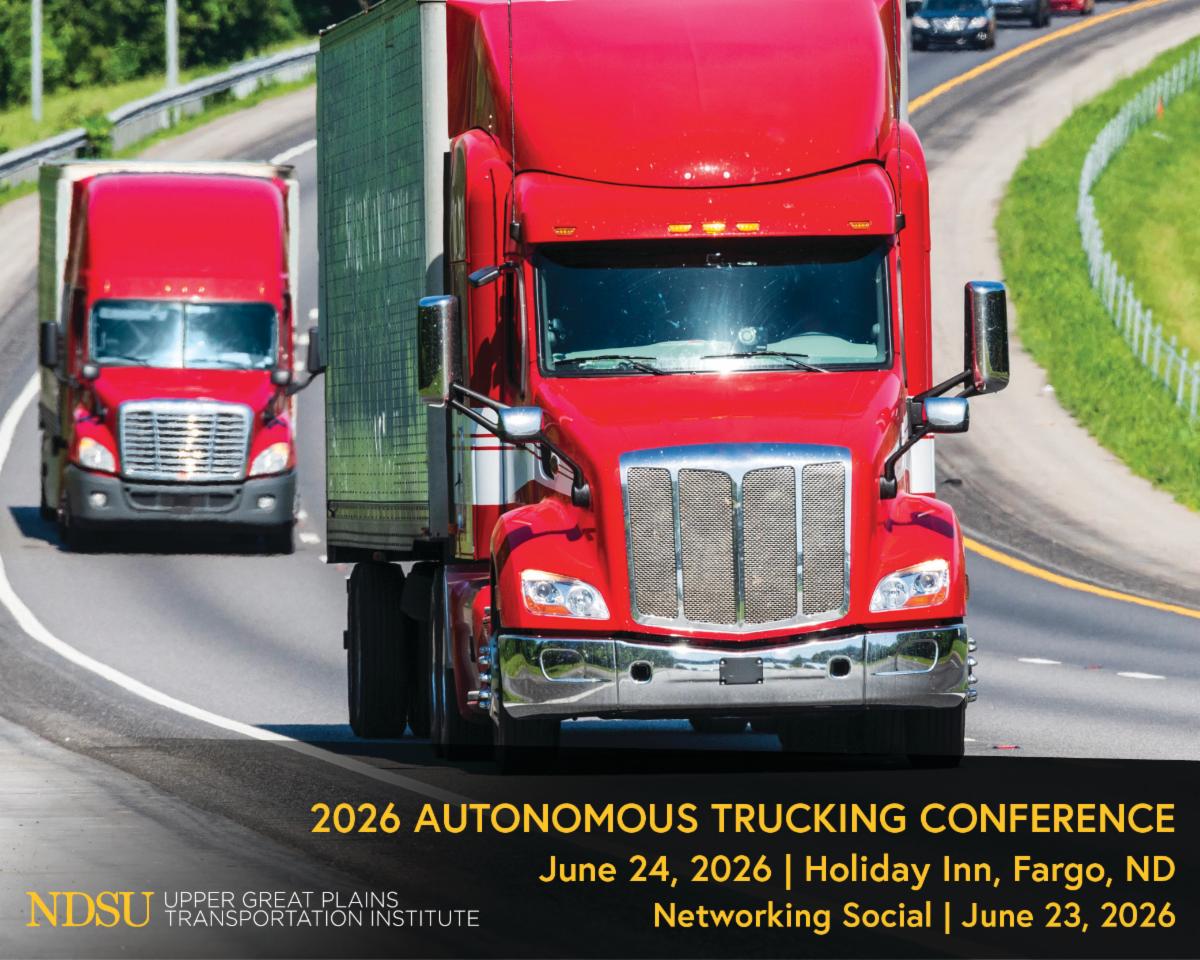
A third Autonomous Trucking Conference in North Dakota is scheduled for June 24 in Fargo and will highlight the industry’s shift from pilot projects to large-scale commercial deployments. The event will be hosted by the Upper Great Plains Transportation Institute (UGPTI) at North Dakota State University and funded in part by the Federal Motor Carrier Safety Administration.
“This will be a pivotal year for autonomous truck deployments in North America, as companies seek new revenue-service operations that lead to established business partnerships and operations,” said UGPTI Director Denver Tolliver. With the industry’s shift to large-scale deployments, this year’s conference will focus on interstate and multinational operations, multistate policy and regulator coordination, manufacturing and equipment trends, rapid expansion of middle-mile driverless freight operations, and growing adoption of leader-follower platooning. The event will also cover enhanced safety inspection and enforcement practices.
For more information and to register for the conference, visit the 2026 Autonomous Trucking Conference website. Some of the leading autonomous truck developers in the United States and Canada are expected to participate in the conference. In addition, the participant list will include representatives from the Commercial Vehicle Safety Alliance, state departments of transportation, state law enforcement agencies, original equipment manufacturers, and autonomous trucking industry partners.
Read more.
| | |
On the calendar:
-
National Tribal Road Maintenance Symposium, May 5-7, Rapid City, SD.
-
UGPTI Advisory Council Meeting, May 14, 11:30 a.m., NDACo, 1661 Capitol Way, Bismarck.
-
2026 Autonomous Trucking Conference, June 23-24, Holiday Inn, Fargo.
-
UGPTI Annual Awards Banquet, October 15, 2026, Holiday Inn, Fargo.
-
Western Regional Commercial Vehicle Safety Summit, January 27-28, 2027, Denver, CO.
| | The Upper Great Plains Transportation Institute (UGPTI) is a research, education, and outreach center at North Dakota State University which provides innovative transportation research, education, and outreach that promote the safe and efficient movement of people and goods. UGPTI is guided, in part, by an Advisory Council composed of representatives of various organizations, industries and agencies affecting or affected by transportation. | | North Dakota State University does not discriminate in its programs and activities on the basis of age, color, gender expression/identity, genetic information, marital status, national origin, participation in lawful off-campus activity, physical or mental disability, pregnancy, public assistance status, race, religion, sex, sexual orientation, spousal relationship to current employee, or veteran status, as applicable. Direct inquiries to Vice Provost, Title IX/ADA Coordinator, Old Main 100, 701-231-7708, ndsu.eoaa@ndsu.edu. | | | | |