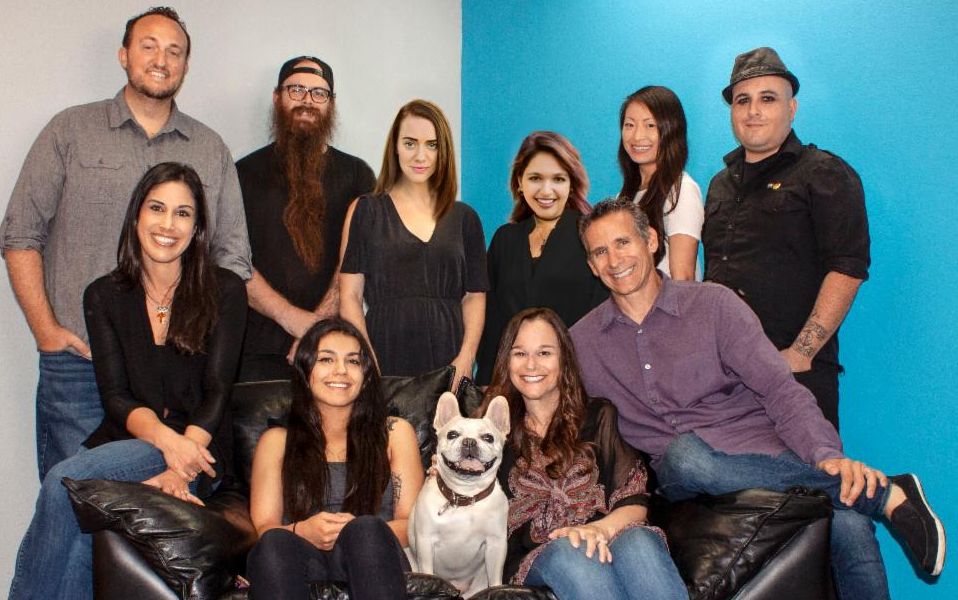
In an exclusive Q&A with Donald Zirlin, founder of LA-based Designworks (pictured above extreme right seated - with his team), a design agency specialising in entertainment marketing and advertising, Don discusses how he and his team interlock to create the key art to meet the needs of the American sales agents or producers to get the finished result for a film’s sales and marketing push.The key art and poster is the first representation of a film to a buyer and subsequently in some instances to the consumer, depending on the territory the film is sold to. The importance of the involvement of and working with a design agency from the start of production is often underestimated. One of only a handful of independent agencies in Los Angeles,
Designworks
created the poster which was chosen for American Film Market 2019.
THE BUSINESS OF FILM
:
Key art continues to be a Key element for the sale of a film. How has it evolved with changes in the marketplace for both domestic and international sales, and acceptance to the audience?
DONALD ZIRLIN:
When I started Designworks in 2001, there was a more market-driven, sales-oriented approach to creating key art. We were creating market sales sheets meant to showcase the 2-3 main actors (as large head shots) on front and big production stills on the back. This worked fine for the sales agencies back then, but flash forward to today – we’re always striving to make the key art as commercial looking and eye-catching as possible to attract the widest audience. Our goal is to have our artwork to eventually end up on Netflix or in Redbox. Audience perceptions change constantly which is why we are always evolving our design sensibilities to stay ahead. Because in today’s VOD (and ADHD) atmosphere, you have mere seconds to attract and capture an audience’s attention span.
TBOF:
How involved are you with making suggesting to your clients to get the finished result? Do you sometimes see the film or read the script? Do the campaigns need to be different for Domestic & International?
DZ:
My team and I try to get involved with a film project at its earliest stage of development. If there’s a script, we’ll read it. If there’s a screener, whatever stage the film is in, we’ll watch it. Ideally, we’re brought on board and discussing key art before the film goes into production. This allows us to lock down the concept of the poster and arrange for photographic elements that we need of the actors and locations to be taken while on set. This is the
best
-case scenario for the highest quality movie poster. Conversely, there is a preconceived notion that you can just simply pull images (a.k.a. frame grabs) from the finished film to make a poster. That couldn’t be further from the truth. It is critically important to have a photographer on set. That is one corner that should not be cut. I cannot stress this enough.
Regardless of what the initial assets look like, once we have all of the materials, our team collectively and creatively brainstorms on it. Then we develop a range of concepts that aim to distill the essence of a film into a single image. Ideally the same artwork will work for both domestic and international campaigns, but because different countries have different sensibilities that is not always the case. For that reason, revisions and/or new key art would need to be created.
TBOF
:
Has technology made working on campaigns easier or harder? Is the skill of the artist still an essential element or does using new tools give the same desired effect?
DZ:
Actually, it’s been a little bit of both. While technological advances have made things easier and faster for our Apple computer workflow to do some amazing Photoshop tricks, filters and effects, it also comes with higher expectations from clients that we can perform the same wizardry in far less time than it used to. To me, Photoshop is simply one of the many tools that we use to make key art and anyone can own it. Far and away, the skills and creativity of our amazing team of artists is what sets us apart.