GROWING TOMATOES
There are so many reasons to be a part of a CSA, shop your local farmers markets, and seek out the "Locally-Grown" signs at your grocery store. One of the highlights: tomatoes. There is almost nothing like the taste of a sun-ripened tomato, fresh off the vine, with a little olive oil, salt and pepper.
Tomato growing, however, is a pretty tough business. There are thousands of varieties to choose from, most of which are hybrids (natural crosses of tomatoes, not genetically modified), and some are heirloom varieties (think pure breed), and they all offer different benefits and drawbacks.
Tomatoes are generally split in two categories based on their market: Shippers/Packers & Fresh Market Tomatoes. Shippers/Packers are tomatoes that are selected for their uniform size, color, shape, and firmness: bright red, perfect globe, skin is smooth and sturdy, and the taste? Doesn’t matter quite as much. These tomatoes are ideal for rough handling and long hauling, and make up most of what you'll see in a grocery store, especially off-season.
Then there are Fresh Market Tomatoes, which are what local growers raise. They are generally not uniform in size, shape, or color, and they are more difficult to handle, but they’re not traveling too far and hopefully will be eaten very soon after they’re picked. Taste is a much more important factor for these tomatoes. However, even for our local, small growers it’s crucial to measure up taste with yield: it’s not a great idea to select a really tasty tomato plant with a poor yield, unless you’re not interested in making any money.
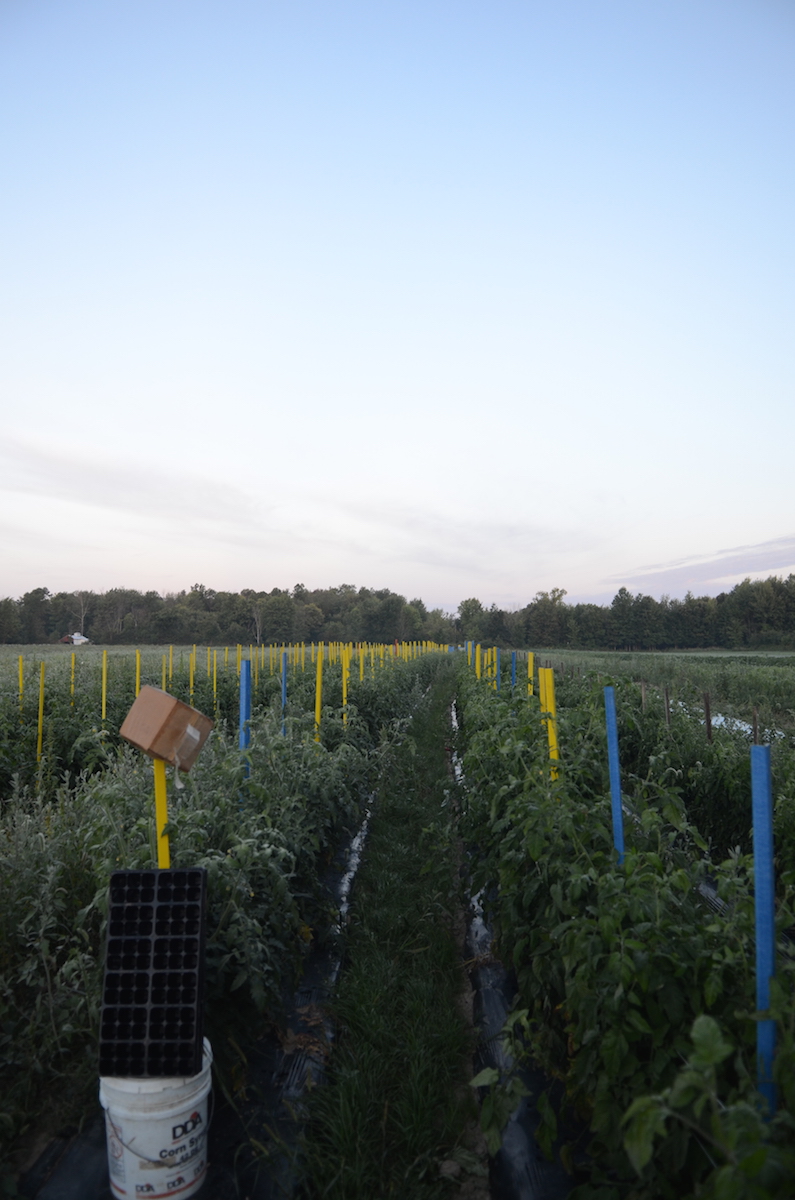
Below you'll see David Yoder’s Farm down in Homerville at the very beginning of tomato season: he can get about 4,000 plants on an acre, planted on raised beds, slid onto stakes and skirted with black plastic to control weeds. Before he can even harvest a single tomato, he has already invested about 300 hours of labor into the transplanting, staking, pruning, cultivating weeds, and fertilizing. Those 4,000 plants produce about 32,000 lbs of tomatoes that can be sold as #1 or #2s (for sale and for sauce, respectively), and everything else that's unsellable (overripe, damaged, etc.) is composted.
We send our trucks down to get the tomatoes as soon as they are harvested and then keep them cool at the warehouse to be redistributed for the routes. When you get to your stop, your Greeter will hand you a paper bag filled with the fruit of the labor: take a moment, open the bag and inhale deeply. That moment, along with your first bite, is why all that effort is worth it.