CSN eNewsletter

June 2, 2026

Facebook  X  LinkedIn  YouTube

Note from Our Director

Dear Partners,

Access to timely, reliable data is critical to advancing child and adolescent safety. The Children’s Safety Network supports Title V professionals and partners by translating complex data into clear, actionable insights for prevention planning and decision-making.


In this issue, we highlight our newly updated Child Safety Data Maps, featuring the most recent national and state-level data across several priority topics. These resources are designed to help programs understand current trends, identify areas of need, and strengthen data-informed strategies to improve outcomes for children and families.


The updated maps include new data on bullying victimization (2023), sudden unexpected infant deaths (2021 to 2024), unintentional motor vehicle traffic fatalities (2021 to 2024), and adolescent suicide deaths (2021 to 2024). Together, these topics reflect both longstanding and emerging priorities in injury and violence prevention, while highlighting variation in outcomes across states. For example, the adolescent suicide data show a national rate of 6.3 deaths per 100,000 youth ages 10 to 19, with more than twenty states exceeding this benchmark. The bullying victimization map indicates that nearly one in five high school students reported being bullied on school property in the past year.


Each data map presents clear state-level comparisons alongside national benchmarks, helping Title V professionals and partners identify trends, target interventions, and support strategic planning. Links to previous versions of each map are also included for those interested in comparing current data with earlier years.

You’ll find additional resources, tools, research, and upcoming events throughout this newsletter to support your prevention efforts. Resources from our CSN-A partners are highlighted in purple. CSN resources are highlighted in green.


Please share these resources widely with your networks. 


Kindly, 

Jennifer Leonardo 


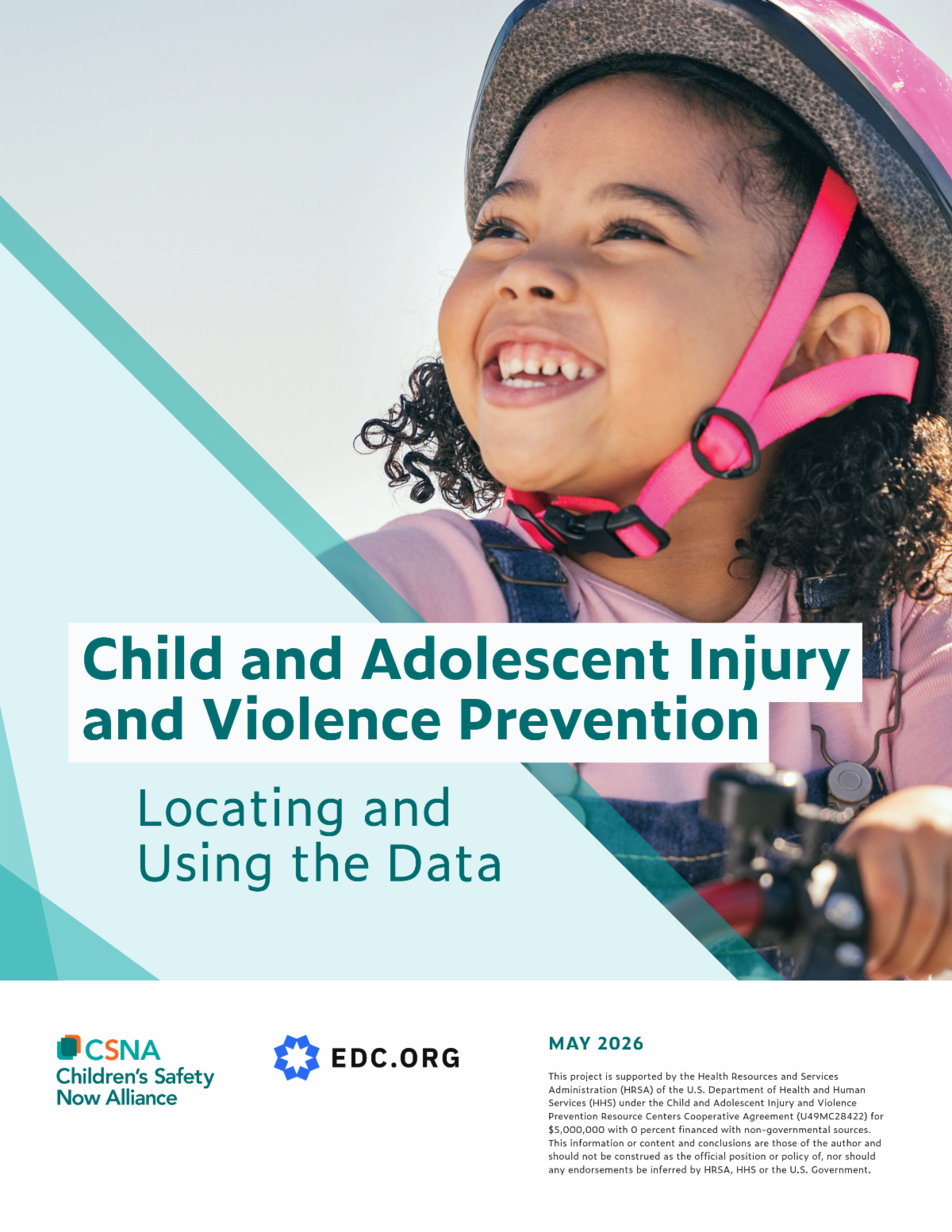
Child and Adolescent Injury and Violence Prevention: Locating and Using the Data

A new resource guide from the Children's Safety Now Alliance is available to help find and use national data on child and adolescent injuries and violence. Child and Adolescent Injury and Violence Prevention: Locating and Using the Data covers 12 national data systems across four categories, including fatality data, emergency department data, hospital data, and other key surveys and systems, explaining what each one captures, its strengths and limitations, and how to access it. Most are available at no cost.


With more than 37 percent of child and adolescent deaths in the United States in 2023 caused by injuries and violence, access to reliable data is essential to preventing these tragedies. This guide helps define the scope of the problem, identify where to focus prevention efforts, and understand how communities compare. Download the guide here.

IN THE MEDIA

Does Your Child Have a Concussion? These Are the Signs, Review Says | U.S. News & World Report

Is Baby Gear Getting Less Safe? The Truth Behind the Recent Surge in Recalls | What to Expect

Move Over, Cigarettes: Vapes Now the Leading Nicotine Danger for Kids | HealthDay

One Child Is Injured Every 35 Minutes by Cleaning Products, New Study Warns | HealthDay

Problematic Screen Use at Age 11-12 Associated With Poor Health Outcomes Later | AAP News

The High-Alcohol Drink Taking Over Gen Z | The New York Times

Youth Suicides Declined After Creation of National Hotline | The New York Times

JUNE EVENTS

National Safety Month | National Safety Council

June 1–30, 2026

Office Hours: Prevention in Action: Community Action Teams | National Center for Fatality Review and Prevention 

June 16, 2026 

12:00-1:00 PM ET 

Fireworks Safety Week | Prevent Blindness

June 28–July 4, 2026

UPCOMING EVENTS

Rural Road Safety Awareness Week | National Center for Rural Road Safety

July 13–17, 2026

Office Hours: Version 7.0 of the Pediatric NFR-CRS | National Center for Fatality Review and Prevention

July 21, 2026
12:00–1:00 PM ET

World Drowning Prevention Day | World Health Organization

July 25, 2026

RESOURCES

Bike Safety

Are Electric Bikes (E-Bikes) Safe for Children? | HealthyChildren.org

Cycling Safety Tips for Children and Families | SickKids

Child Maltreatment Prevention

Reports of Substantiated or Indicated Child Maltreatment in the United States Declined From 2020–2023 | Child Trends

Child Passenger Safety

Car Seat Crash Testing: To the Regulations and Beyond! | Safe in the Seat

Drowning Prevention

Drowning Prevention | Centers for Disease Control and Prevention

Search Water First: Autism and Drowning | National Center for Missing and Exploited Children

General

Death Scene Investigation Learning Series | National Center for Fatality Review and Prevention

Playground Safety

5 Playground Safety Tips for Parents | Children's Health

Poisoning Prevention

How Nicotine Affects the Teen Brain | National Institute on Drug Abuse

Sports Safety

3 Factors That Put Teens at Higher Risk for Running Injuries | Cincinnati Children's

Repetitive Head Impacts: The Risks, Health Outcomes, and Ways to Reduce Exposure | Children's Hospital of Philadelphia

Teen Driving Safety

Additional Challenges: Managing Distractions | Children's Hospital of Philadelphia

RESEARCH

Bike Safety

Pedestrian and Bicyclist Crashes With Motor Vehicles by the Childhood Opportunity Index | Pediatrics

Child Maltreatment Prevention

Childhood Trauma Assessed Using the Childhood Trauma Questionnaire and Its Influence on Pediatric Mood Disorders and Self-Harm: A Systematic Review and Meta-Analysis | Child Abuse & Neglect

Development of a Machine Learning-Based Prediction Model: Identifying High-Risk Households and Child Maltreatment Risk | Child and Youth Services Review

Sextortion and Suicide: Implications for Adolescent Image-Based Abuse | Child Abuse & Neglect

Drowning Prevention

Population-Based Study of Factors Associated With Severe Paediatric Drowning Events in Maryland | Injury Prevention

Firearm Safety

'I Never Thought to Ask:' A Cross-Sectional Study of U.S. Parents' Experiences Discussing Firearms With Other Caregivers | Academic Pediatrics

Pause to Protect: Partnering With Firearm Businesses in the USA to Promote Secure Storage and Prevent Injury and Death | Injury Prevention

Pedestrian Safety

Sensation Seeking and Gender: Impacts on Children's Judgement and Decision-Making in Road Crossing Scenarios | Journal of Transport & Health

Poisoning Prevention

Adolescent Cannabis Use After Cannabis Legalization and the COVID-19 Pandemic | JAMA Network Open

Early Onset of Cannabis Use and Risk for Opioid Use Disorder Across Two Decades in the United States | Addictive Behaviors

Investing in Infrastructure: A Mixed-Methods Cost Analysis of Implementation Strategies to Address Emerging Youth Drug Trends | Journal of Studies on Alcohol and Drugs

Rural & Farm Safety

Preferred Sources and Senders of Mental Health Information Among FFA Youth Residing on Farms | Journal of Agromedicine

Self-Harm and Suicide Prevention

Barriers to and Facilitators of Implementing Suicide Risk Screening in Pediatric Primary Care: A Qualitative Study | Academic Pediatrics

Development and Evaluation of Suicide Prevention for Child Welfare Involved Youth: An Asynchronous Online Curriculum for Prospective Child Welfare Workers | Child and Youth Services Review

Prospective Associations Between Early Adolescent Problematic Screen Use, Mental Health, Sleep, and Substance Use | American Journal of Preventive Medicine

Suicide Mortality Among Adolescents and Young Adults After Launch of a Suicide and Crisis Lifeline | JAMA

Sports Safety

Week-to-Week Changes in Training Were Not Prospectively Associated With Injuries Among Wisconsin High School Cross-Country Runners | Injury Prevention

Teen Driver Safety

Associations of Road and Visual Environment Characteristics With Speeding Behaviors Among High Risk Teen Drivers | Journal of Safety Research

Public Support for Logbooks During the Supervised Practice Driving Phase of Graduated Driver Licensing: A National Survey of Teens and Parents in the USA | Injury Prevention

Facebook  X  LinkedIn  YouTube

The Children's Safety Network is supported by the Health Resources and Services Administration (HRSA) of the U.S. Department of Health and Human Services (HHS) under the Child and Adolescent Injury and Violence Prevention Resource Centers Cooperative Agreement (U49MC28422) for $5,000,000 with 0 percent financed with non-governmental sources. This information or content and conclusions are those of the author and should not be construed as the official position or policy of, nor should any endorsements be inferred by HRSA, HHS or the U.S. Government.