VOLUME 1 | ISSUE 2 | AUTUMN 2025 | | The Old Forester's Almanac is a woodsy twist on the Old Farmer's Almanac, using humor, wisdom, and science to foster a connection to the culture around caring for Ohio Woods. | | | |
|
Changing of the Seasons: Autumn
Monday, September 22nd (the autumnal equinox in the northern hemisphere) marks the first day of autumn. Days grow shorter, nights grow longer, leaves turn from deep greens to brilliant reds and oranges, and temperatures dip as frost curls through the crisp air.
The first full moon to follow the equinox, known as the Harvest Moon, will rise on October 6th with the first frost likely to follow not long after. Autumn is a time for harvest and thanksgiving as the earth spins onwards towards winter. This issue of the Old Forester's Almanac centers how our forests are shifting away from the heat and humidity of Northeast Ohio summer and preparing for the cold and snow of the winter ahead.
| | |
The Working Woods Hub First Anniversary Open House
November date coming soon! | Working Woods Learning Forest, Holden Arboretum
FREE
Join the Working Woods Hub at Holden Arboretum to celebrate the culmination of their first year! There will be scheduled tours of the Working Woods Learning Forest, new interpretive signage, exhibits featuring Holden Arboretum Consulting Foresters, the Holden Seed Bank, and Holden Researchers, and a small woodland market with mushroom logs, seedlings, and Working Woods for sale.
| | |
|
Woodsy Wisecracks
humorous tidbits inspired by our woods
| | |
What's a lumberjack's favorite month?
Sep-timberrrrrr!
| |
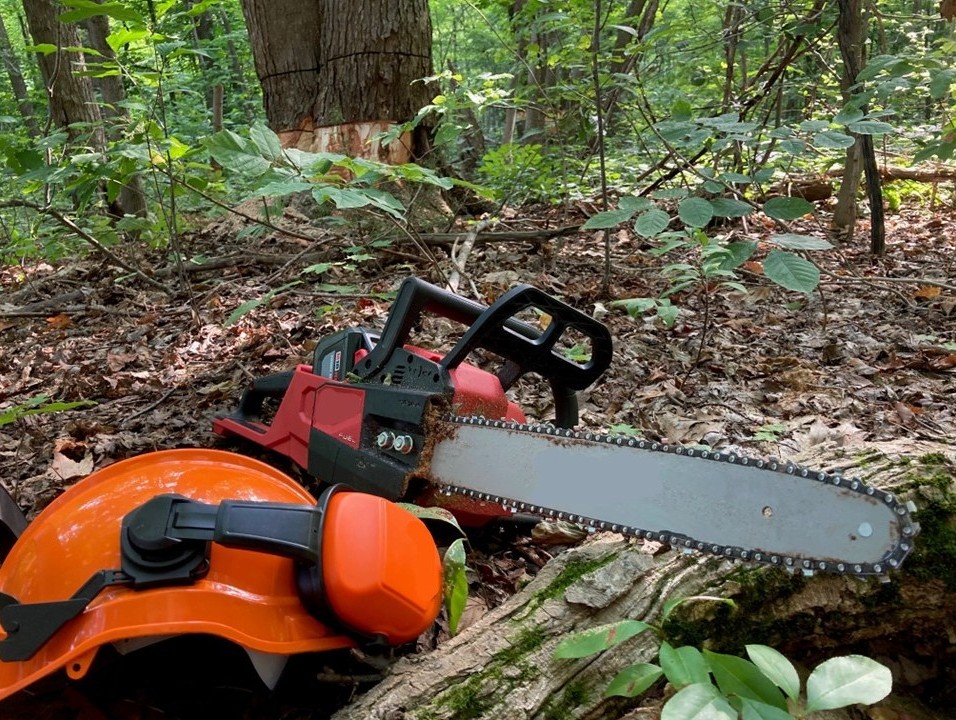
The harvest of standing timber is one of the many benefits offered by northeast Ohio forests. However, the way in which a harvest is done, and when it occurs, can have lasting impacts on your woodland.
Two species of bats which call Ohio home, the Indiana Bat (Myotis sodalis) which is state-endangered, and the Northern Long-Eared Bat (Myotis septentrionalis) which is state-threatened, rely on large stands of trees for summer roosts. With the onset of autumn and winter, these species move on to caves and abandoned mines. The NRCS (Natural Resource Conservation Service) advises that landowners only engage in timber harvests after September 30th to avoid harming any bats through the felling of trees that may serve as summer roosts.
Additionally, when considering the harvest and sale of timber, an important step before signing any contract, is to Call Before You Cut. A multi-partner program coordinated by the Ohio Department of Natural Resources Division of Forestry and the Ohio State University Extension, Call Before You Cut is designed to connect landowners with the information they need to make good forest management decisions at the time of a timber harvest. Through the program, landowners are able to connect with professionals, including ODNR Division of Forestry service foresters or consulting foresters, for assistance and guidance.
Find your ODNR service forester using this directory.
| |
Jessica Miller Mecaskey
Holden Arboretum Consulting Forester & Non-Timber Forest Products Specialist
| |
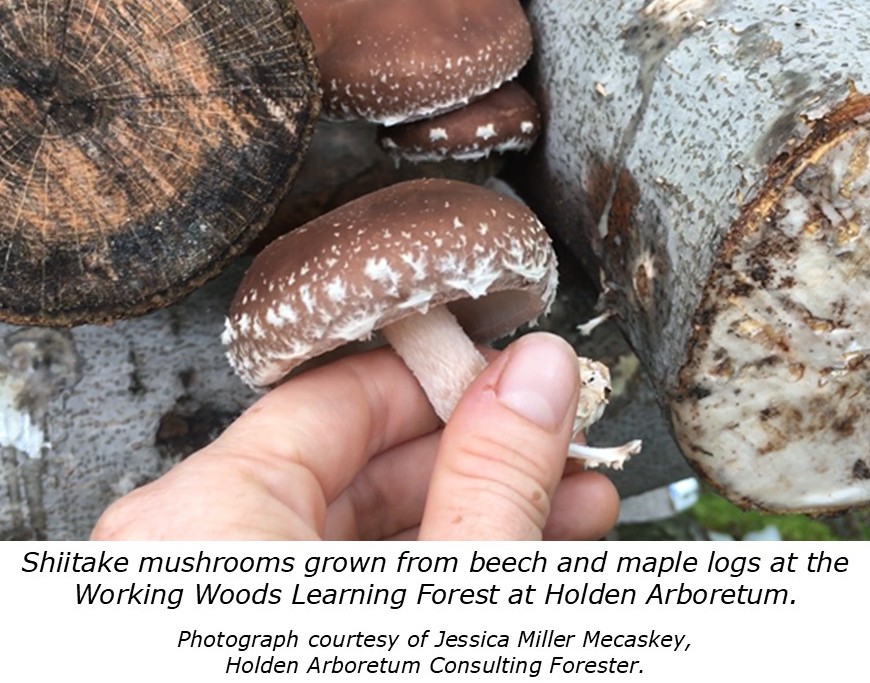
Autumn is a prime time to start a mushroom-growing hobby with hardwood logs cut from felled trees or reclaimed from those thrown down in storms. Mushroom spawn - comprised of substrate colonized by the vegetative part of mushrooms called mycelium - can be used to inoculate these logs, much like sowing seed in a garden.
Logs selected for mushroom growing should have a good amount of sapwood and be cut to a size that can be easily lifted and moved - 3.5 feet long and 6 inches diameter is a good rule of thumb. Each species of culinary mushroom has preferred log species - Oyster mushrooms pair best with Tulip Poplar, Cottonwood, and Ash, whereas Shiitake mushrooms grow well on Oak, Beech, and Sugar Maple.
Plug shaped spawn can be pounded into drilled holes or sawdust spawn can be layered, sandwich-style, between slices of log. A form of protection, like wax, can be used to seal everything off. Inoculated logs should be stored in the deep shade of the woods, or even a shady, protected north-side of a building can work well as a log laying yard. Proximity to water is also important so that logs can be soaked during dry spells to prevent the mycelium from dying.
Mycelium will colonize the log over winter and spring but the first mushrooms may not appear until the following summer or fall - patience pays off! A successfully-colonized log can continue to fruit with mushrooms for years to come.
| | |
Rebecah Troutman
Working Woods Hub Manager
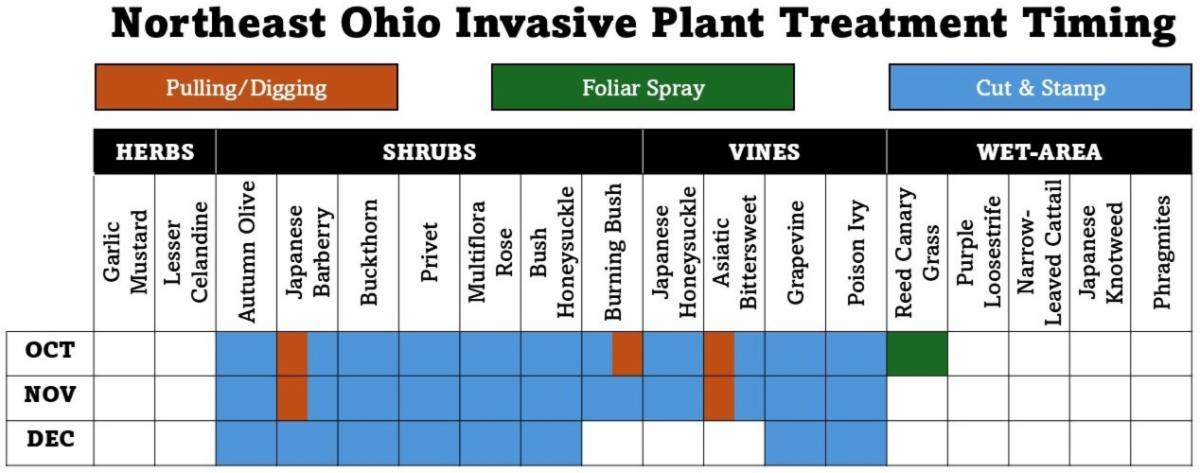
In the fall, we often think of plants winding down for the year—leaves dropping, flowers fading, and a slower season for land management. However, fall is actually one of the best times to tackle non-native invasive shrubs such as buckthorn, privet, and barberry. These species have a competitive advantage: they stay green longer than most of our native plants. By late in the season, the green you still see in the understory is often invasive. So if you notice a splash of green when all else has gone quiet, take a closer look to identify it. If it’s an invasive shrub, now is the ideal time to act—cut the stump and treat it with herbicide, or hand-pull smaller plants from the ground. Fall is not just for enjoying the color- it is prime time for spotting and stopping invasives!
|
| |
Valerie McCauley
Holden Seed Bank Technician
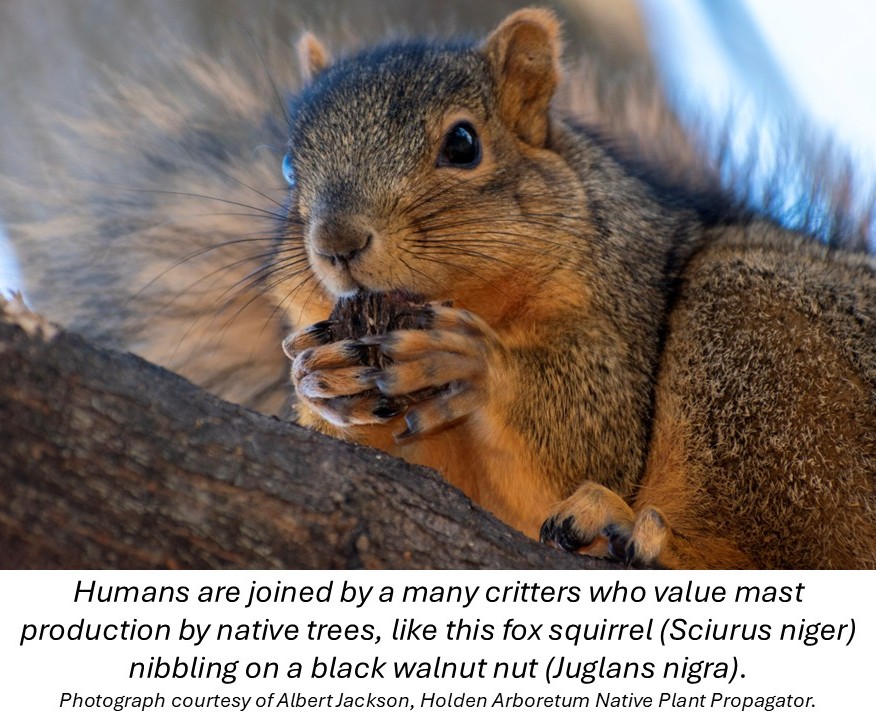
Autumn is the season when many native trees and shrubs begin to go to seed. Key species in our native forests like red oak (Quercus rubra), black walnut (Juglans nigra), and shagbark hickory (Carya ovata) are beginning to produce fruit, nuts, or seeds - referred to as mast. These fruits serve as critical food sources for wildlife, particularly through the winter months. Mast production varies greatly from year to year, with most species only producing fruit every few years. Since fruit production is so variable, collecting and replanting seeds from these valuable trees is a great way to expand their populations within your woods.
To store seeds until they are ready to be sown, it is best practice to keep seed cold and dry; however, collected seeds have to be processed depending on seed storage behavior. Seeds with orthodox seed storage behavior, like shagbark hickory and black walnut, are capable of being stored in cold, dry conditions for several years before they are sown, with the caveat that no seed lasts forever. However, red oak exhibits recalcitrant seed storage behavior: this means that their acorns cannot tolerate being dried completely and have to be sown shortly after collection. To sow acorns on your own, plant them 2 inches deep in bark-based soil mix over winter; seedlings should emerge in the spring!
| | |
Patrick O'Reilly
Holden Arboretum Consulting Forester & Timber Specialist
| |
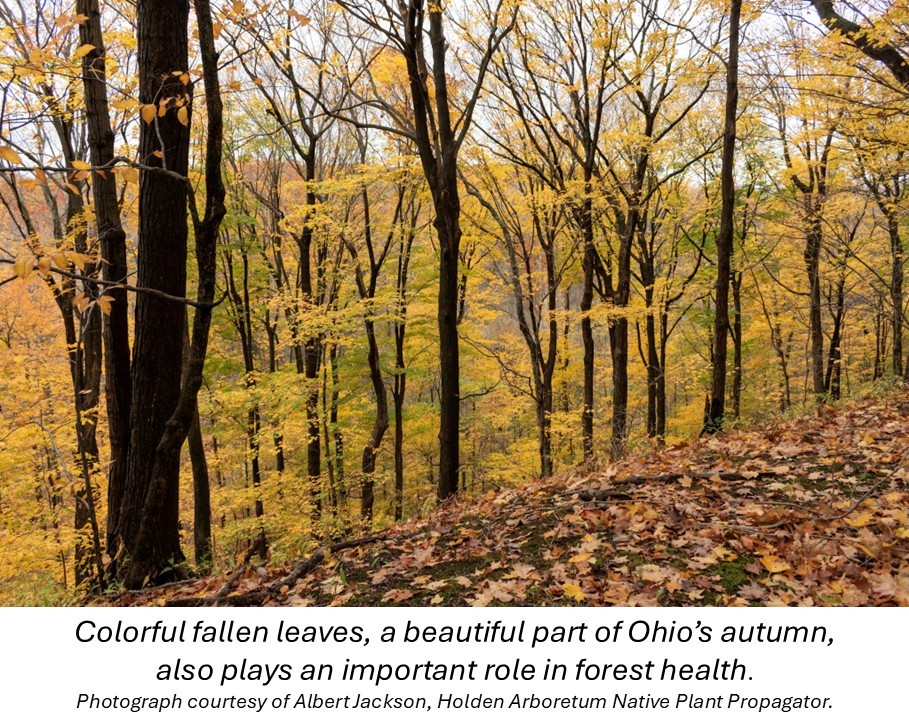
We’re all familiar with the colorful fall foliage of our Eastern hardwood forests this time of year. This seasonal characteristic of deciduous trees functions as much more than beautiful scenery, as once the leaves fall to the ground, the leaf litter they generate is a vital component of healthy forest soils. You can think of forest soils as a layered dip with the top layer consisting of fallen, partially decayed leaves, sticks, and other organic matter. This leaf layer is referred to as “duff” and functions in several ways to enrich and protect the soil.
As leaves in the duff layer decay, they return essential nutrients to the soils and act as a natural fertilizer for plant growth. This process of decomposition also contributes to forests’ ability to store carbon. Much of the carbon present in leaves becomes locked in organic matter as part of the soil composition. Sequestering carbon in soils is one of many ways forests can mitigate climate change by reducing atmospheric carbon dioxide.
Additionally, the leaf layer in forests provides a layer of protection over the soils which is necessary for healthy forest ecology. Duff provides suitable conditions for tree seedling regeneration, habitat for small organisms, and affects hydrology by slowing erosion and increasing moisture retention in soils.
Next time you are admiring the vibrant colors of a beautiful forest landscape, remember that the fall leaf drop is not only an aesthetic benefit of trees (or tedious chore around the yard), but also a key component of forest health.
| | |
Caitlin Stillisano
Lake County Soil & Water Conservation District Watershed Coordinator
Forested streams in Northeast Ohio play a critical role in protecting water quality. Tree roots stabilize streambanks, forest soils filter runoff, and shady canopies help keep water cool and clean. But when streambanks erode—often due to increased stormwater runoff from upstream development and the loss of native vegetation—sediment clouds the water, harming fish habitat and degrading water quality downstream.
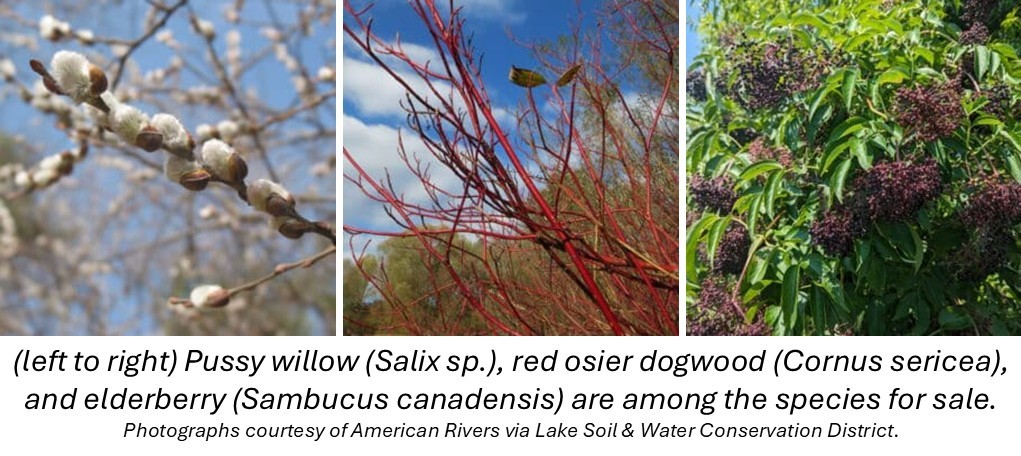
One simple, effective way to restore stream stability is by planting live stakes—dormant cuttings from native shrubs like silky dogwood, black willow, or elderberry— directly into eroding banks. These stakes take root quickly and grow into dense shrubs that hold soil in place and slow down stormwater. As they mature, they improve stream health by reducing sediment, filtering nutrients, providing shade and creating wildlife habitat.
November is a perfect time to plant live stakes in Northeast Ohio, when the shrubs are dormant and the soil is still workable. Paired with other good practices—like maintaining forested buffers and managing invasive species—live staking offers a low-cost, high-impact solution for protecting local waterways.
Interested in ordering live stakes for a fall planting?
| |
Lake County Soil & Water Conservation District has an autumn live stake sale!
Orders must be received by October 24th, and can be placed online at www.lakeconservation.org or via mail using this order form.
| | |
Chad Knisely
Holden Natural Areas Biologist
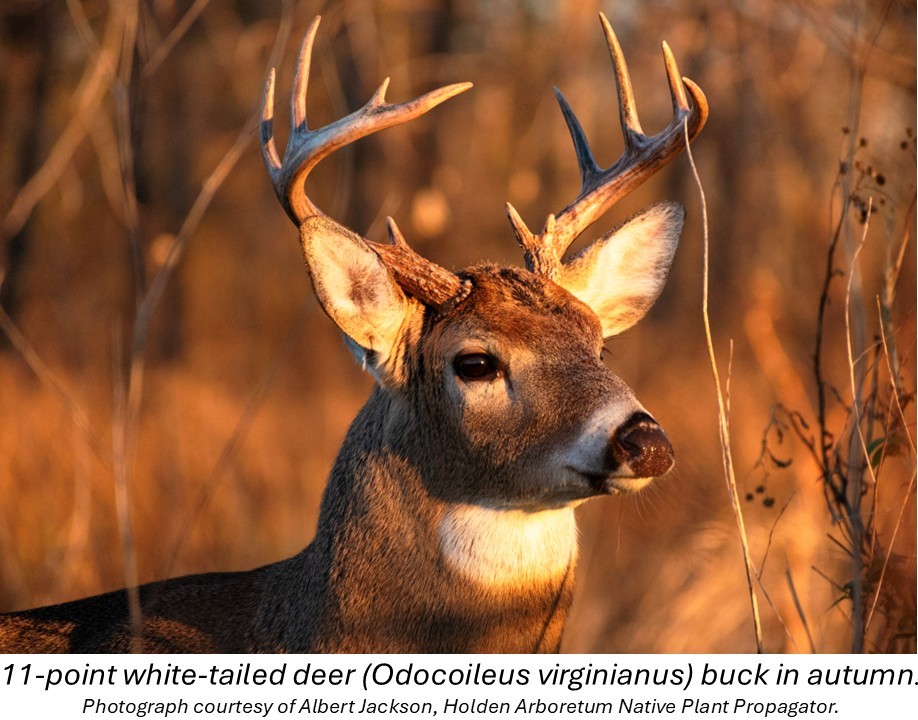
Each year, hunters harvest roughly 125,000 white-tailed deer during Ohio’s generous deer season, stretching from late September through early February with periods dedicated for archery, firearm, and muzzleloader hunting. Yet, despite the thousands of deer harvested across the state each year, trends monitored by the Division of Wildlife indicate that the statewide deer population is still growing.
Deer co-evolved with predators like wolves and cougars and developed a great ability to replace themselves. When these important predators were extirpated from the landscape in the 1800s, humans assumed the place at the top of the food chain. This, paired with changes in land use which created favorable habitat, has led to a nearly decade-long trend of growth in Ohio’s deer population.
Overabundant deer have a dramatic impact on the landscape – disrupting the process of forest regeneration by heavily browsing on native tree and shrub saplings, thus creating favorable conditions for invasive plants. These activities can disrupt forest regeneration and suppress native herbaceous plants like spring ephemerals.
The harvesting of deer, particularly the taking of does, is good for the forest, good for the health of the deer population, good for the local economy, and good for people. Harvested venison is meat in its purest form: wild, organic, from a known source, and highly sustainable. It is one that is earned, can be shared, and reminds us of our connection to the land. In our neck of the woods, good deer management is an integral part of good forest management.
| | | |
Woodland Wisdom
local & traditional knowledge about our woods
| | |
Count the woolly bear's bands, thirteen in a row,
brown means mild but black brings cold and snow.
| |
M Onion
Holden Arboretum Plant Propagator
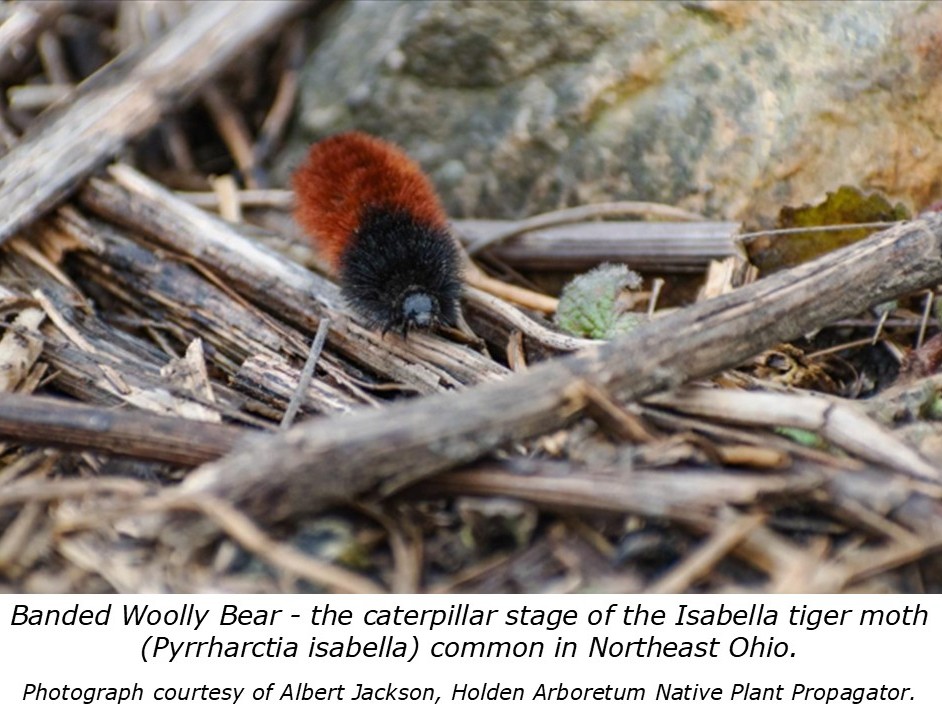
Sayings about the woolly bear's ability to predict the winter are common across the range of the Isabella tiger moth, known as the woolly bear (among other names) in its larval form. This moth has two generations per year, the second of which is commonly seen walking across sidewalks and lawns in the fall and is the one which is said to predict the weather.
As goes the saying, the more brown coloration a woolly bear has, the milder the winter is supposed to be. Of course, caterpillars do not concern themselves with our worries about the weather, but there is an indirect connection between their coloration and the changing of the seasons.
Woolly bears molt six times before pupating and with each molt, the brown section of their coat grows proportionally larger and larger. If they have access to plentiful, high-quality food, then they will grow and molt faster. If good food is scarce, the caterpillar grows more slowly. Like most other caterpillars, woolly bears are herbivorous and their food supply can be impacted not only by non-weather events such as herbivore competition, but also by seasonal changes such as drought and the early onset of autumn. So while no soothsayer about the upcoming winter, the woolly bear still has something to say about the hospitability of its environment - just in a retrospective, rather than predictive, way.
Interested in keeping local ecological knowledge alive? Keep an eye out for woolly bears making their way across the ground this fall and see how much brown they're wearing! Does it match with your perception of this summer's weather?
| | |
|
Our mission is to empower people to manage, protect, and
create resilient forests in Ohio.
| | |
Was this newsletter forwarded to you?
Interested in subscribing and receiving our future mailings?
Sign up HERE!
| | | | |