|
Road Trip
By Nancy Schuessler
Joan Nickum is on a mission. Her mission is saving dogs. She coordinates a network of volunteers who move dogs by car, truck, van, ferry, or even plane to cities and towns like Tucson where they can be adopted. Every hour of every day, dogs are being driven, flown, or ferried across the United States, each with its own story on how it became lost or abandoned. The volunteers who transport dogs for Southwest Oasis Labrador Rescue find the work especially rewarding, but it takes someone at the center, like Joan, to make it all possible.
“We call it ‘the underground railroad," says Joan, referring to how dogs are moved along the route from one volunteer to the next until a final destination is reached.
Joan relies on several of our SOLR volunteers to get dogs to Arizona, including Fred Rykwalder, Lisa Stubert, Jeannette Wahl, Bryce Anderson, and Terry Abrams. She calls Fred "The Road Warrior" because he'll drive anywhere to save a dog.
The work begins when Joan learns about a dog – or dogs – needing transport. It might be a rescue group like SOLR that contacts her, an owner, or a good Samaritan. “People find out I do this, and they contact me. It’s mostly word of mouth.” There might be several dogs in an overcrowded shelter about to be euthanized unless a rescuer can save them. The shelter might be in Memphis, but the dogs need to get to Tucson where a rescue group like SOLR has offered to take them and find homes. That’s where Joan comes in. She maps a route, secures drivers, and gets the dogs safely to their destination.
“There’s a driver I know in Tulsa who’s married to a veterinarian. She’s one of the individuals who might contact me. An owner might pass away, and the family asks if he can find the dog a new home. Right now, the veterinarian has a dog that needs help, and there is someone in Seattle who wants to adopt it. So next weekend, we will get the dog from Tulsa to Seattle.”
Before any dog can start its trip, Joan makes sure it has its vaccinations and whatever else it needs. If crossing state lines, health certificates are needed. “That’s non-negotiable.” The next step is mapping a route and securing drivers. She “posts” by email to the drivers who “work” the route she’s mapped, asking who is interested. She does not post on Facebook or other social media, yet she couldn’t do without the internet. “The internet has really enabled all this to happen,” says Joan, referring to the scale of transports happening nowadays. “You couldn’t transport all these dogs without it.” Once drivers are secured and the date set, the journey begins.
Each driver will complete a portion of the route, which is referred to as a “leg.” For example, getting a dog from Leonard, Texas to Tucson – a trip she organized last June for SOLR -- takes 13 legs, two days, and crosses one time zone.
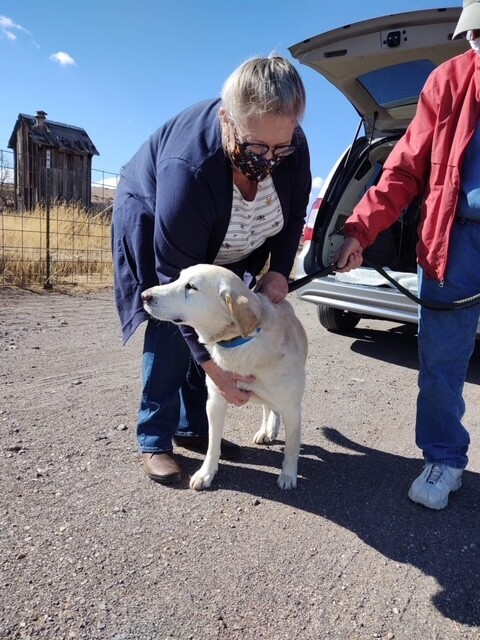
The drivers meet in truck stops, gas stations, parking lots, and exits along the interstate where they exchange their cargo – dogs. They are told where to meet, whom to meet, what time to arrive, and what vehicle the other driver is in.
One driver, Terry Abrams, describes the moment of “exchange” in colorful terms. To an uninformed observer, she claims it might look like something dark and shady was going on. “You pull into a parking lot, and you see all these cars with darkened windows just waiting there.” Suddenly, a windowless van might drive up, dogs are taken out and brought to another car which then drives off. Another vehicle arrives; another back door is opened; more dogs are removed, and two more cars drive away. The process repeats itself until the parking lot slowly empties. One vehicle might hold Labradors, another has beagles, another has poodles. Dogs of all breeds, shapes, sizes, and colors are carefully exchanged. Males and females, puppies and seniors, purebreds and mixes. Many are healthy, most are frightened, others need special tending, but good medical care, love, and forever families await them all.
According to Joan, hundreds of dogs are moved across the United States every weekend. They are taken from cities and towns where there is an oversupply of dogs to areas of the country where there is an abundance of homes. They are the special ones: The chosen ones. Picked from countless others whose fate is not so clear, who must wait in overcrowded shelters or continue to wander empty streets.
Joan has been helping SOLR and other rescue groups since 2001. A native of Kansas City, she learned her craft several years ago from a woman named Nancy Walker, whom she likes to call, “the Empress of Transport.” The most important thing she learned from Nancy was finding drivers. "If Nancy doesn’t know a driver in that area, it’s not a good route.”
Not a good route? “The most direct route is not always the easiest route because there aren’t always drivers for that route, especially in some states like Arizona, New Mexico, Texas. For example, I might have a dog that needs to get to Tucson from some southern area, like Austin, Texas. I can’t go the direct route. I have to take the dog up to I-40 and then down through Phoenix.”
Most weekends, Joan coordinates three transports. She has moved dogs to and from almost all fifty states except Hawaii. She’s brought them from the East Coast to the West, from the South to the North, even to Alaska and back. “There’s no good way to get to Alaska,” she complains. Alaska cannot be driven to but must be ferried or flown. She calls the eastern part of Southern California “no man’s land” because “you cannot find a driver in some areas.” Instead, she might find a pilot, who takes the dog to a place in California where she can pick up the route again by road.
And yet… even with all it involves, homeless dogs arrive at their destinations safely, where they are adopted, loved, and given new lives with new families. Some say that rescue dogs are grateful dogs. But none of it could happen without people like Joan and our selfless transport volunteers.
|