The Center for Work, Health, & Well-being is a multidisciplinary research center using a Total Worker Health® approach to advance the safety, health, and well-being of workers. | | Center for Work, Health, & Well-being Newsletter September 2025 | | With the beginning of a new academic year, our Center team has been busy! We’re excited to share updates on our research projects and dissemination activities, as we continue our efforts in support of worker health, safety, and well-being in multiple workforce sectors. | | |
Check out our new website!
Our updated and streamlined website is now available, redesigned to better meet the needs of researchers, practitioners, and employers. We encourage you to learn more about our Center’s current and previous work – our history and mission, our team, areas of research, outreach activities, resources, and publications. There’s much to explore!
| |
Glorian Sorensen is now Professor Emerita at Harvard Chan School of Public Health
Congratulations to Glorian Sorensen on her transition to Professor of Social and Behavioral Sciences Emerita at the Harvard Chan School of Public Health. Glorian’s extensive and impactful career has contributed to the scientific foundation integrating occupational safety and health with other worksite interventions to promote worker safety, health, and well-being. She continues to contribute to our Center’s work as Center Founding Director, in collaboration with Center Director Erika Sabbath and Center Associate Director Susan Peters.
| | |
New Health and Well-being Committee Guide for Managers
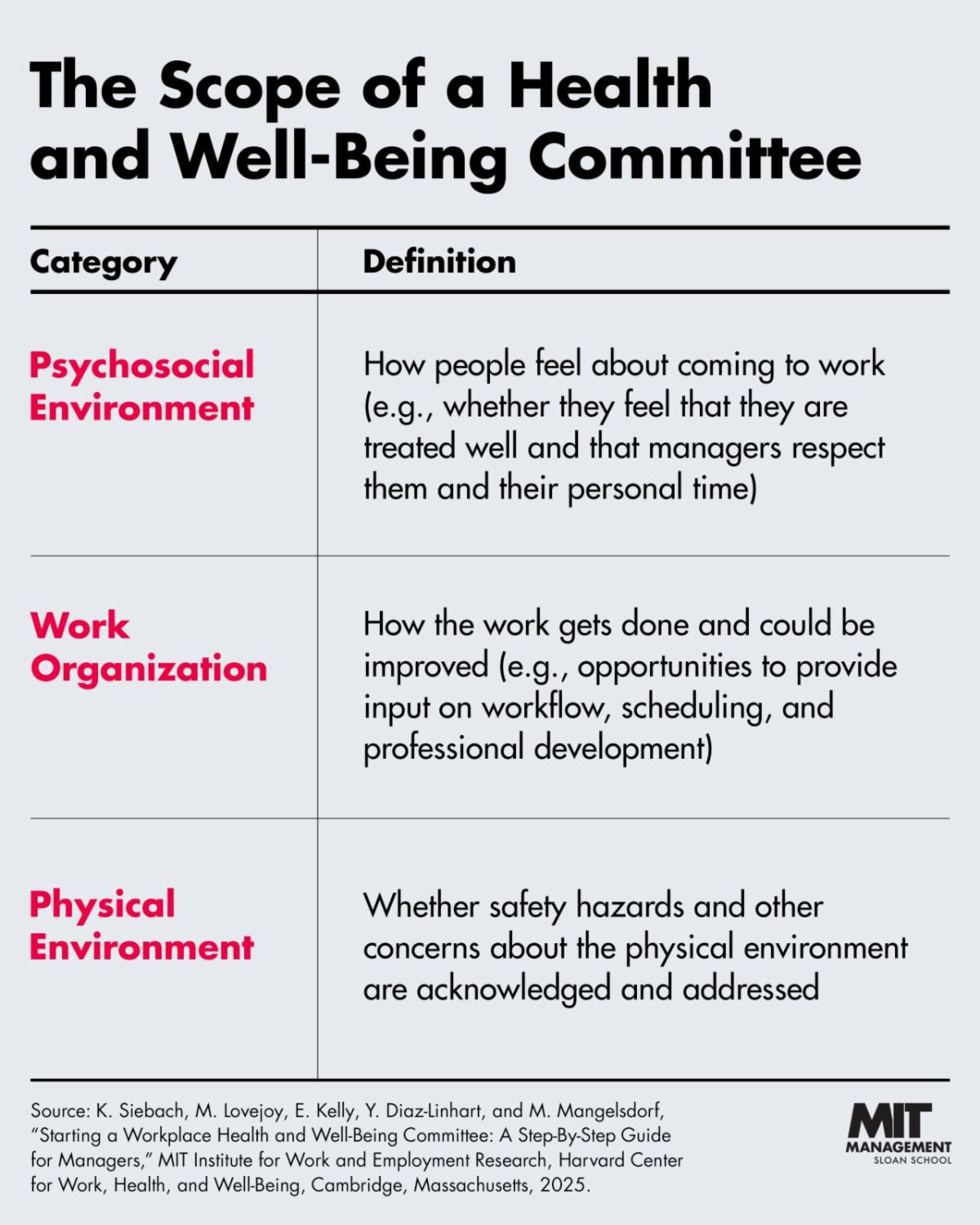
Our Fulfillment Center Intervention Study team, led by Erin Kelly of MIT and Lisa Berkman of Harvard, has recently published a guide for managers that explains how a workplace Health and Well-being Committee (HaWC) can reduce turnover and save money for employers. Starting a Workplace Health and Well-Being Committee: A Step-By-Step Guide for Managers includes information on how to prepare for, launch, and run a HaWC, as well as guidance on their structure and leadership and key strategies for success and sustainability. Our Center study implemented and tested the HaWC concept in a field experiment that took place in the e-commerce division of a retail organization. The results showed that HaWCs had positive impacts on employees’ mental health in the first six months after launch and reduced turnover by 20% over 12 months, all at a comparatively low cost.
| | |
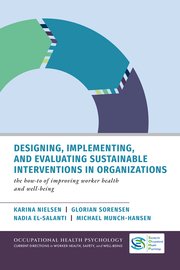
Designing, Implementing, and Evaluating Sustainable Interventions in Organizations:
The How-To of Improving Worker Health and Well-being
by Karina Nielsen, Glorian Sorensen, Nadia El-Salanti, and Michael Munch-Hansen
Now available from Oxford University Press as an e-book, and soon to be available in hard copy, this book offers a systematic approach to fostering worker health and well-being through participatory organizational interventions. It includes key principles and recommendations for undertaking successful participatory organizational interventions; provides an evidence-based and step-by-step process to plan, implement, and evaluate organizational change, promoting health and well-being; and illustrates concepts with two real-world case studies, giving readers concrete tools and methods for different contexts. This approach to build healthy organizational work environments is essential for improving well-being on the job. This book contributes significantly to the field of occupational health, and honors the memory of our friend and colleague Karina Nielsen, who passed away in September of 2024. Order your copy today!
| | |
Susan Peters and Greg Wagner contributed to a new book, Leadership for Flourishing. Their chapter describes how work shapes the extent to which workers thrive from their work, and delves into the importance of thriving from work as a necessary foundation for human flourishing. It includes a discussion of some of the challenges to achieving thriving from work that are faced in high-risk sectors and provides two examples of high-risk workplaces—in construction and healthcare. Read more about this book exploring the dynamic interplay between leadership and flourishing, edited by James L. Ritchie-Dunham, Katy E. Granville-Chapman, and Matthew T. Lee.
Research led by Susan Peters and Maren Voss is summarized in a recent Center publication which shows that the Thriving from Work Questionnaire is a robust, reliable, valid, and practically oriented tool for evaluating older workers’ well-being with utility across research, practice, and policy. This paper validates the Thriving from Work Questionnaire among older U.S. workers, identifying age-patterned differences that highlight actionable levers for occupational health age-sensitive policies and well-being interventions. Read more about this work.
Cal Halvorsen, a Center Affiliated Researcher and Associate Professor at the Brown School at Washington University in St. Louis, recently published an op-ed in The Conversation about the Senior Community Service Employment Program, a federal program that provides on-the-job training to people over the age of 55 who are unemployed and have incomes at or below 125% of the federal poverty level. Read more about what is at risk due to federal government funding disruptions.
| | |
Susan Peters, Center Associate Director and Principal Investigator of the Thriving Workers, Thriving Workplaces Study, presented as part of an invited session at the National Association of Women in Construction Annual Meeting in Boston, MA in August. The topic of her presentation was Thriving from the Ground Up.
Jack Dennerlein, a Center Senior Advisor and previously the Center’s Associate Director, participated in a panel discussion, Health and well-being: Do they really drive workplace competitiveness and productivity? on August 12, hosted by Mutual de Seguridad, a private, non-profit corporation that provides full coverage for accidents at work and develops risk prevention programs in Chile. The panel addressed strategies to implement health and well-being programs that enhance productivity, from an organizational leadership perspective, with the objective of positioning workplace health and well-being as strategic pillars for corporate competitiveness and sustainability. Approximately 150 general managers and senior executives from a variety of business sectors attended.
| | |
The Harvard T.H. Chan School of Public Health Center for Work, Health, & Well-being
The Center for Work, Health, & Well-being is one of ten Centers of Excellence funded by the NIOSH Total Worker Health Program. The Center is comprised of partnerships and collaborations with academic and healthcare institutions: Harvard T.H. Chan School of Public Health; Boston College School of Social Work; Brown School at Washington University in St. Louis; MIT Sloan School of Management; Mass General Brigham; Boston University School of Public Health; and HealthPartners/HealthPartners Institute in Minnesota.
Website: hsph.harvard.edu/research/center-for-work-health-and-well-being/
LinkedIn: Center for Work, Health, and Well-being
| | Total Worker Health® is a registered trademark of the U.S. Department of Health and Human Services (HHS). Participation by the Center for Work, Health, & Well-being does not imply endorsement by HHS, the Centers for Disease Control and Prevention, or the National Institute for Occupational Safety and Health. | | | | |