|
Dear Colleagues, Students, Alumni, and Community Partners,
During my PK-12 leadership days, I first served as Curriculum Coordinator and then Director of Curriculum and Instruction (C&I) for the Pleasanton Unified School District, located in the lovely Amador Valley—a part of the greater Bay Area in Northern California. Back then, our department, of which I was a founding member, consisted of three of us; today, that same department has seventeen individuals leading C&I for the district.
While as a site administrator, I had come to rely on my district office leaders for support with C&I and professional development (PD), as a district office administrator, I became part of a countywide consortium that worked closely with the Alameda County Office of Education (ACOE). Whether site or district office, our regional universities were our partners, and I had strong working relationships with many of the faculty in the College of Education and Allied Studies at California State University East Bay. The East Bay housed other colleges and universities—several independents and UC Berkeley—but CSUEB was the institution that we relied on for the nuanced marriage of theory and praxis that we needed in the real world of schools.
My years in school district leadership were boomtown years for C&I and PD in California, with a lot of state resources pouring into our county offices. Working in partnership with ACOE and CSUEB, we curriculum directors would scan the country’s top educator conferences and bring the leading names in coaching, literacy, ELA/ELD, STEM, pedagogy, and more to our county to provide professional development for our teachers and us. Deep learning and long-term commitment to PD were our signatures. The “learning by doing” concept of working in community—sometimes called communities of practice and more frequently today, professional learning communities—became a part of our culture as a group of county school leaders of very racially and ethnically diverse school districts serving Asian (33.8%), Black/African American (10.7%), Hispanic/Latino (22.4%), and White (29.2%) children and their families (US Census). We recognized that our schools and districts, county office, and university were stronger for our interdependence.
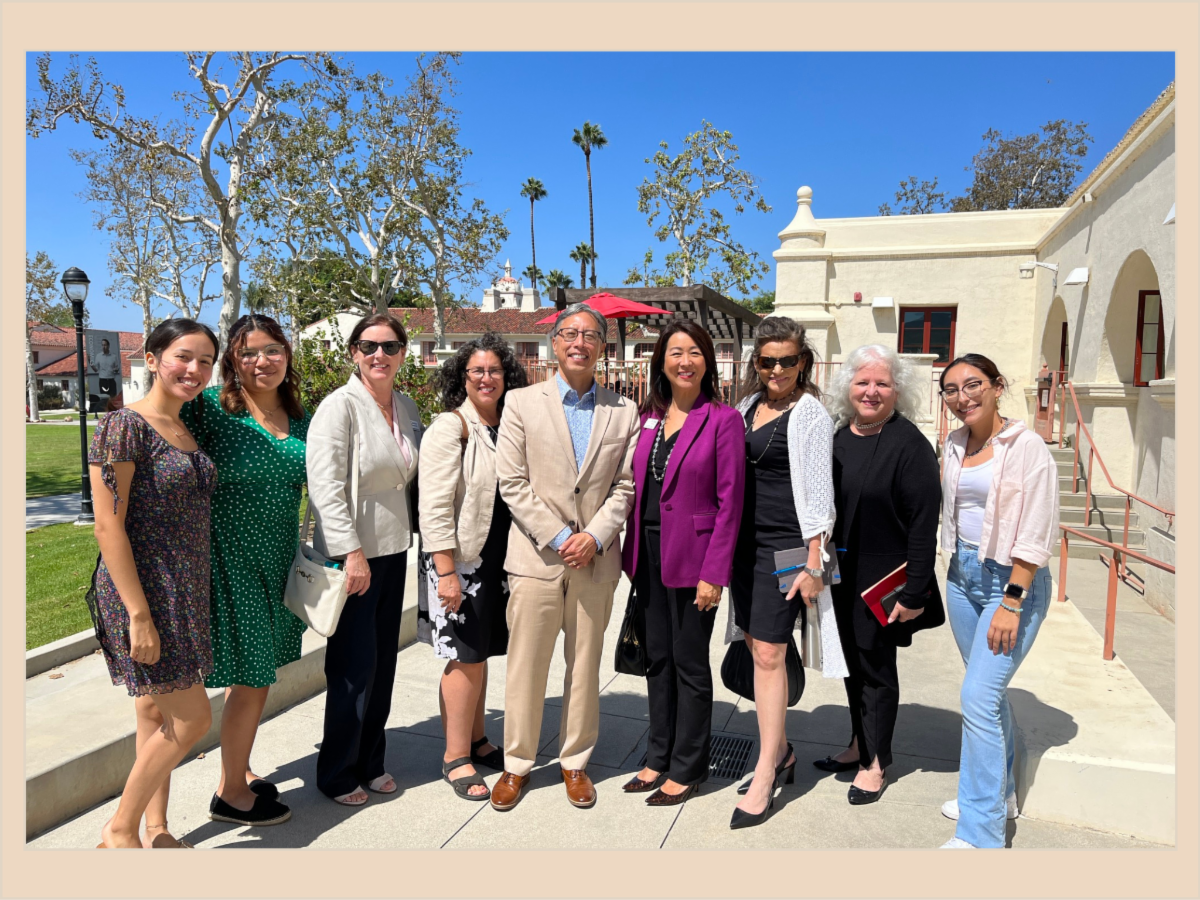
As a regional university, CSUCI and our School of Education serve both Santa Barbara and Ventura counties. On Friday, September 16, CSUCI’s Regional Director of Development Helene Schneider organized a visit during which we were pleased to host Santa Barbara County Superintendent of Schools, Dr. Susan Salcido, and two of her cabinet members, Ellen Barger (Assistant Superintendent of Curriculum and Instruction) and Camie Barnwell (Director of Communications). SOE colleagues Associate Dean and Director or Clinical Experiences & Partnerships, Dr. Kathy Howard; Early Childhood Education Chair and Professor Mari Riojas-Cortez; Credentials Chair and Associate Professor Kara Naidoo; Associate Professor of Educational Leadership Chuck Weis, and I discussed our current and future programs while we all considered alignment with Santa Barbara County’s and our strategic goals. Over lunch, President Richard Yao led us in conversation with three inspiring, first-generation students who are peer mentors and who will graduate from Channel Islands this year: Sandra Caballero, Natalie Lopez, and Melissa Torreblanca. They each shared the importance of taking risks—risks to come to CI, to engage, to strive to belong, to persist, and to thrive.
Each time I meet with our students, colleagues, and community partners, I am reminded of the research that Luis C. Moll, Cathy Amanti, Deborah Neff, and Norma Gonzalez published in the early 1990s on funds of knowledge, where they sought to establish partnerships with families by examining and capitalizing on the strengths they bring to the education project rather than the deficits so frequently used to characterize families of color. Moll and his colleagues provide a framework to partake of the richness that each of us contributes to the tapestry of our work.
Just as my former school district in Pleasanton made it declaration of interdependence, I likewise invite you to begin or continue your engagement with us. Our children deserve nothing less than an alliance of many that embodies the varied funds of knowledge we each offer to our ever-expanding professional learning community.
Looking forward,
Elizabeth
Elizabeth C. Orozco Reilly
|