AWARD WINNERS
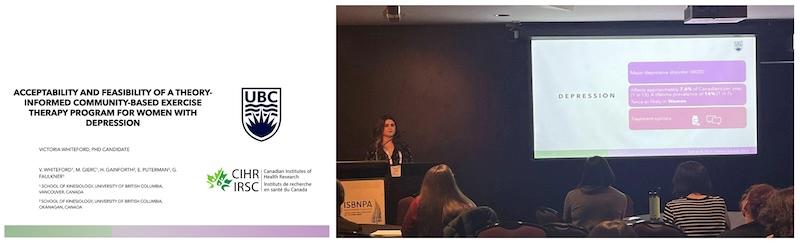
Victoria Whiteford, PhD candidate, The University of British Columbia
MH&W SIG Travel Fund and ISBNPA Best Student Presentation
“I presented on the final phase of my PhD; a project I have termed REACH. This involved a 12-week single-arm feasibility trial to test a free community-based exercise program for women with clinical depression. This was delivered within a community-based exercise clinic in Vancouver. To further support the women throughout the program I developed a behaviour change counselling manual, to guide delivery of behaviour change support. The behaviour change counselling manual was used during behaviour change counselling sessions, which were delivered by me. The program proved to be successful, and findings provide support for the plausibility of an antidepressant effect from participation in an exercise-based program among women with depression in a community-based setting. We found that self-reported depression improved considerably from baseline to post-program. All participants described the program as a positive and enjoyable experience, with all recommending the program to ‘other women like them’. Important program components identified by the women included having scheduled session times each week, the provision of behavioural support, the knowledge and expertise of exercise professionals, and free access to an exercise clinic.
I would also like to say a huge thank you to the Mental Health and Wellbeing SIG for awarding me with the Mental Health and Wellbeing Conference Travel Grant. This provided me with the opportunity to attend ISBNPA in Auckland, Aotearoa (New Zealand) 2025 for which I am very grateful."
Dr Sarah Hunter, Senior Research Fellow, Caring Futures Institute, Flinders University,
Best MH&W SIG Presentation: ‘Caring for Caregivers: A Prevention Program to Support Parent’s Mental Health and Wellbeing Needs’
“I presented on a project that aimed to co-design and implement an evidence-informed program to support caregiver mental health and wellbeing to improve parents’ capacity to care for themselves and their children, encourage self-care practices, and ultimately improve the food and movement opportunities for children and families. Two feasibility trials were conducted to determine whether implementing the co-designed program “Caring for Caregivers” into routine services is acceptable, feasible, and improves the wellbeing of caregivers. One was delivered as week 3 of the 4-week Child and Family Health Service Early Parenting Groups and the second was as a standalone antenatal class delivered at the Women’s and Children’s Hospital. Overall, the program was deemed acceptable and feasible and demonstrated capacity to improve the wellbeing of parents.
The key learnings from this project:
● Always best to co-design programs with consumers and service partners to ensure what is developed is feasible to deliver within routine services and aligns to the needs of the community
● Best to identify the needs of consumers first and then identify the best-evidence to meet those needs and tailor the evidence accordingly. Don’t start with the evidence!”
|