|
Regular readers will know…
… it takes little by way of excuse, given my experiences…
… for me to return to the subject of prostate cancer.
Unapologetically, I’m doing it this morning because something very odd is happening with prostate cancer testing.
There’s a quiet subterfuge. A slight of hand, whilst we are distracted by sand between our toes and Aperol Spritz.
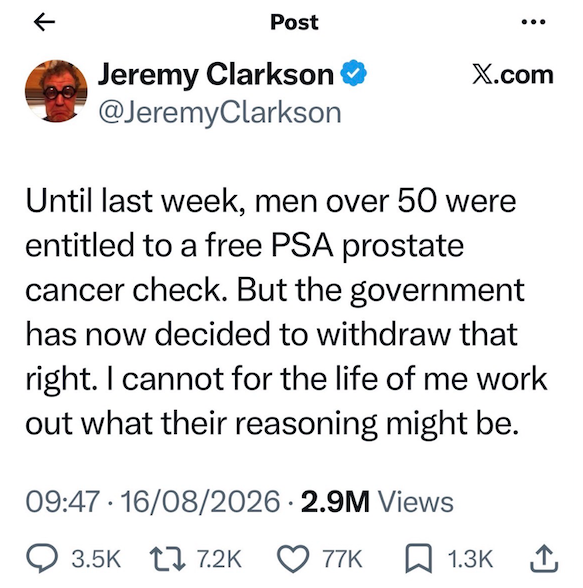
Until now, the position was reasonably clear.
There is no national PSA prostate screening programme, but …
… if a man over 50, without symptoms, talked it through with his GP, understood the limitations and still wanted a PSA test, NHS guidance supported his choice.
That was the principle… informed consent… patient choice. Mysteriously, and with no warning or consultation the balance has shifted.
In a letter sent to some clinicians and health organisations last Thursday, the Department of Health [said] the long-standing Prostate Cancer Risk Management Programme guidance had been withdrawn.
The new approach gives greater weight to the GP’s clinical judgement about whether PSA testing is appropriate.
That is not a minor administrative tidying-up. It changes who has the final say.
Yet, here is the extraordinary part. The public cannot see the letter, or rationale.
The Telegraph claim to have seen it and other news outlets followed their lead. Health organisations have received it.
Cancer Research UK confirms the programme has been retired and NHS and NICE guidance updated.
However, the man whose access to testing may be affected cannot readily read the document that explains what has changed, why it has changed or how the new judgement is supposed to be exercised.
That matters.
If government changes an important cancer-testing policy, surely the first requirement is clarity.
Publish the decision.
Publish the reasoning.
Publish the evidence.
Explain the consequences.
Instead, we have policy by correspondence.
That’s a disrespectful, shambolic way to make a change affecting millions of men.
There is a respectable case against population-wide PSA screening.
-
PSA is imperfect.
-
A raised result does not necessarily mean cancer.
-
A normal one does not guarantee there isn’t cancer.
-
Screening can lead to further investigation, anxiety, over-diagnosis and sometimes unnecessary treatment…
… fair enough, but …
…that is not the same argument as whether an informed man should be able to request a blood test.
Follow the money and the distinction becomes even clearer.
The PSA test itself costs the NHS about eight quid. Including the staff time involved, official economic modelling puts it under £24.
The expensive part is what may follow.
- MRI.
- Biopsy.
- Diagnosis.
- Treatment.
That explains why government may hesitate before inviting millions of men into a national screening programme, but...
... nobody was proposing that. The old arrangement was opportunistic testing…
- man asks.
- GP explains.
- man understands….
- he decides.
Now, the GP decides.
Here's a surprising fact. HMG’s own economic modelling cannot reliably distinguish PSA tests requested by asymptomatic men from those ordered because of symptoms, surveillance or other clinical reasons.
The economics may tell us something about mass screening. They tell us much less about the cost-effectiveness of an informed individual asking for a test.
Which brings us back to the obvious question. What problem is this change solving?
In the real world, very few GPs are likely to have a row with a determined 55-year-old over an eight quid blood test... most will probably agree.
What the change is more likely to create is variation and inequality.
-
One GP says yes.
-
Another says no.
-
One practice is relaxed.
-
Another cautious.
-
Confident patients push.
-
Others go away.
That matters because prostate cancer risk is not evenly distributed.
Black men are at substantially higher risk. Family history matters. Early prostate cancer often has no symptoms, and the old arguments against PSA come from a time when the diagnostic pathway was cruder.
Today, there is MRI, better risk assessment and active surveillance. A raised PSA no longer automatically means biopsy and radical treatment.
The policy needs to move with the medicine.
Instead, we have changed the balance of decision-making while further guidance is still being developed, and…
… announced the change in a letter the public can’t find. If you have a copy of the letter, please send it to me in confidence. We can make the author famous.
That is not transparency. It is not shared decision-making, and it is certainly not clarity.
If ministers want to change cancer-testing policy, they are entitled to do so, but they should do it in public.
The people affected should not have to read about their new rights, or lack of them…
…in a £walled newspaper.
-oOo-
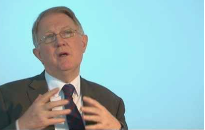
PS: By total coincidence, recorded before this news seeped into our world, our latest pod-cast features former Cancer Tsar and head-honcho of the cancer screening programme
Sir Mike Richards
talking about prostate screening.
Listen free here.
You be the judge.
|