Newton Climate News


April 7, 2026

Newton Climate Action Logo

Earth Month in Newton

Happy Earth Month! In April, "Earth Month" is celebrated with a broad focus on environmental protection, sustainability, and climate actionextending beyond the annual Earth Day on April 22nd.


The original Earth Day, on April 22, 1970, was an idea sparked by Senator Gaylord Nelson from Wisconsin who had witnessed the massive 1969 oil spill in Santa Barbara, CA. His goal was to channel the energy of student anti-war protests into a demonstration against the human health impacts of 150 years of industrial development, namely air and water pollution.


In the largest secular day of protest in history, Earth Day 1970 inspired 20 million Americans to participate. The event led to the creation of the US Environmental Protection Agency (EPA) and the passage of major environmental laws, such as the Clean Air Act and Clean Water Act.


The work of Earth Day's founders lives on globally, including here in Newton. Green Newton and the City's Sustainability Team are partnering to host Newton's annual Earth Day Festival, a celebration for the whole family of all things green. At this engaging educational event, you can learn from local nonprofits and businesses, enjoy thrifting, participate in nature-themed activities, and more. Mark your calendars for this fun and empowering festivalSunday, May 3, 12-3:30pm at Zervas Elementary School.

Image description: Flyer for Newton's Earth Day Festival, held at Zervas Elementary School on May 3, 12-3:30pm.

Upcoming Events

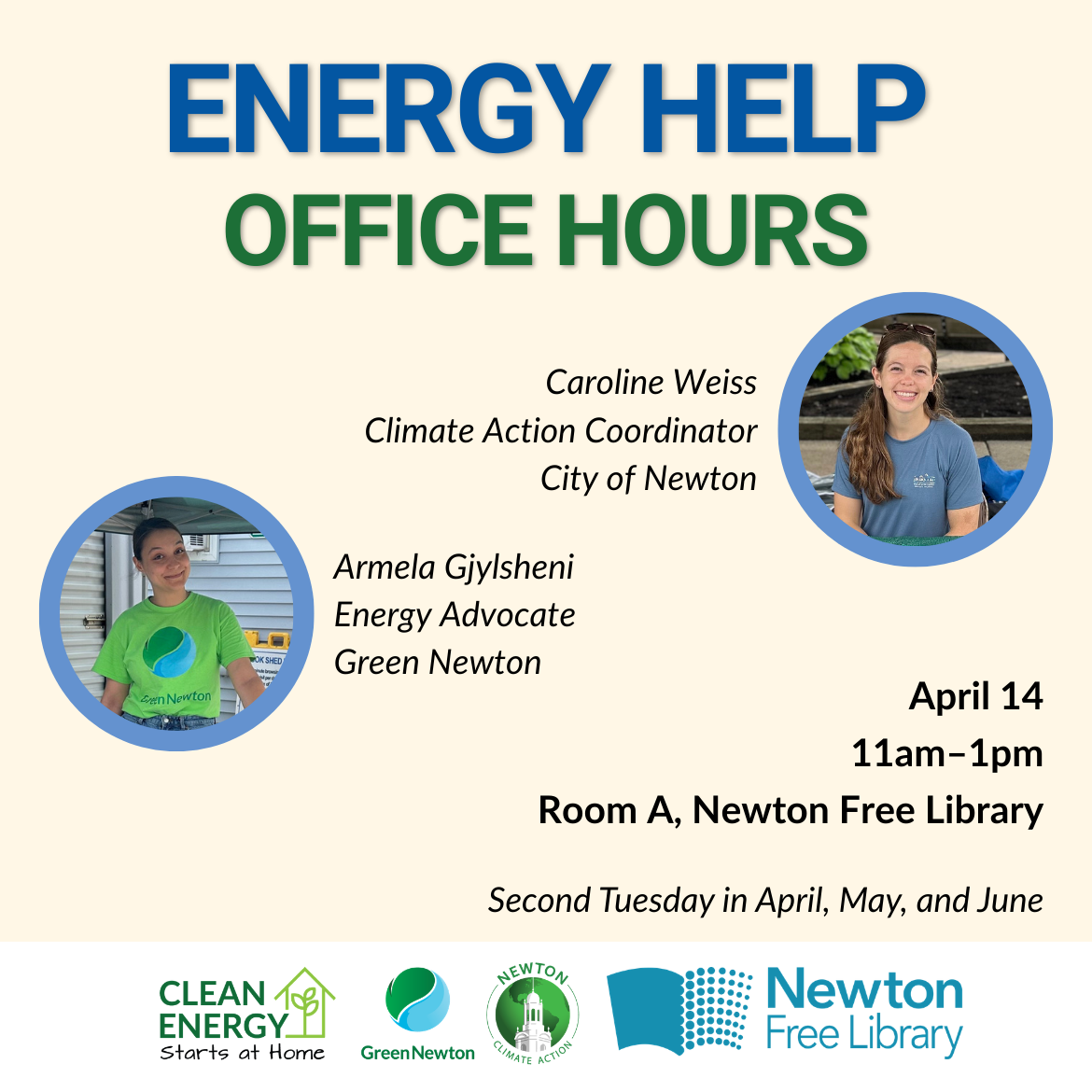
Image description: Flyers for Energy Help Office Hours and an Induction Cooking Demo.

In-person events


Living into Hotter Summers – Tuesday, Apr. 7, 6-7:30pm, Cambridge Public Library. Join City of Cambridge staff and regional experts for a conversation about how climate change is reshaping New England summers, who is at risk, and how cities are responding. Learn more here.


Energy Help Office Hours – Tuesday, Apr. 14, 11am-1pm, Newton Free Library (Room 1). Join the City of Newton's Climate Action Coordinator and Green Newton's Energy Advocate for drop-in energy office hours. Residents and local businesses can attend, ask questions, and bring their energy bills for a review. Find more information here. (This event is part of a series held on second Tuesdays; the next office hours will be held on May 12 from 5-7pm).


Guided Walks, Lectures, and Invasive Pulls – Various dates throughout April. Check out the Newton Conservators events page to find several spring opportunities.


Geothermal Solutions for Affordable Heating and Cooling – Wednesday, Apr. 15, 8:30am-12pm, Wellesley Village Church. This public event will explore the basics of geothermal and networked geothermal technologies and include a tour of Wellesley Village Church's new geothermal system. Learn more about the event and register here.


Fix-It Clinic – Saturday, Apr. 18, 10am-4pm, Newton Free Library. Bring in a broken household item and a Repair Coach will help guide you through diagnosing and repair. Sign up for a repair appointment here, or sign up to volunteer at the clinic here.


Induction Cooking Demo with Tea & Melted Chocolate – Thursday Apr. 23, 2-3:30pm, Newton Free Library. Learn about induction cooking and its benefits at this event, sponsored by the City's Sustainability Team, Green Newton, and Mothers Out Front.


Swap Shop Opening Day – Thursday, Apr. 23, Resource Recovery Center. The Swap Shop opens for the season on 4/23 and will be open on Thursdays, Fridays, and Saturdays from 7:30am-1:30pm.


Newton's Earth Day Festival 2026 – Sunday, May 3, 12-3:30pm, Zervas Elementary School. Come celebrate all things green for the whole family. Find more information here.

Online Events


Why Offshore Wind? Powering A Reliable, Affordable Future – Thursday, Apr. 9, 12pm. Join Green Energy Consumers Alliance for a discussion about offshore wind in MA and RI. Learn more about the webinar and register here.


Speak for the Trees – Wednesday, Apr. 22, 7pm. David Meshoulam, founder and executive director of Speak for the Trees, will speak about tree equity in Boston, the benefits of urban trees, as well as various programs for improving the city tree canopy. Read more about the event and register here.


Climate Change and the Future Flora of New England – Tuesday, April 28, 7-8:15pm. Learn from Jesse Bellemare, Plant Ecologist and Smith College Associate Professor, about how climate change is likely to impact plant diversity in New England and beyond, how species are adjusting (or failing to adjust), and the impact of biotic interactions. Register here for this presentation.

Image description: Clean Energy Starts at Home logo.

Join Our Climate Efforts:

Try Out Bluebikes, with a Credit!

Did you know that Bluebikes has 15 stations in Newton, and many more in the greater Boston area? Through this docked bikeshare system, you can check out a bike from one station dock and return it to any other station with available docks for fun and easy point-to-point travel.


For Earth Week, Bluebikes and Blue Cross MA are offering a $15 credit with the code BCBSEARTHWEEK26. This code will be live on Monday, April 20th, and $1 per ride (up to $10,000) will be donated to the Environmental League of Massachusetts.


Following the conclusion of Earth Week on April 25th, Bluebikes will be kicking off National Bike Month by offering a credit of $20 via the code BCBSBIKEMONTH26. This code will be live on Friday, May 1st. Learn more about Bluebikes here and consider using these credits to explore or continue riding with Bluebikes!

Image description: Flyer for $15 Bluebikes credits available during Earth Week.

High Energy Prices: Cutting Mass Save is Seriously Counterproductive (Op-Ed)

The following op-ed was submitted to The Boston Globe (but not published) by Co-Director of Sustainability Ann Berwick in response to an energy bill passed by the Massachusetts House in February (H.5151). The Boston Globe reported on this bill, which is currently being considered by the Senate, in their article "Massachusetts leaders have plans to reduce utility bills. Does their math add up?"


It’s not your imagination. Your energy bills have indeed skyrocketed. ISO New England, the regional electricity grid operator, reported in July that energy prices had increased 67% between 2024 and 2025 due to an unprecedented 112% rise in the price of natural gas, which is the primary resource providing the region’s electricity.  


It’s only natural to look for a scapegoat. That’s what the Massachusetts House of Representatives did recently, blaming the State’s Mass Save program. The House bill includes a crippling $1 billion cut to Mass Save’s $4.5 billion budget. That program helps residents and businesses save money by making energy efficient improvements.  


Cutting funds that will help households and businesses become more energy efficient is not a plausible strategy for reducing energy bills. In fact, economist Dorie Seavey estimates that every dollar spent on Mass Save returns $2.76 in benefits.  


Another frequent scapegoat for the rising energy costs is the State’s climate goal of net zero greenhouse gas emissions by 2050. But that is not the culprit either. A study released in August by Daymark Energy Advisors concludes that if 3,500 megawatts of contracted offshore wind had been operational during the winter of 2024/25, New England ratepayers could have saved $400 million while also significantly reducing greenhouse gas emissions. Other studies agree: offshore wind is a big money-saver. And it is more secure than fossil fuels. As both Bill McKibben and Paul Krugman point out, unlike oil and gas from the Middle East, neither solar power nor wind power has to traverse the Strait of Hormuz.  


Moreover, renewable energy technology for reducing energy bills will only improve. For example, the same House bill that reduces Mass Save provides a helpful framework for a “portable solar generation device,” also known as “balcony solar” or “plug-and-play solar.” In Europe, Ikea is already selling balcony solar systems, which are less expensive and less complicated to install than conventional solar systems. 


In fact, what actually accounts for the increases in electric and gas bills is the region’s dependence on natural gas, not the cost of Mass Save or the commitment to addressing climate change. New England relies on natural gas for about 50 percent of its electricity generation, and about 50 percent of households in Massachusetts depend on natural gas for heating.  


This reliance on natural gas leads to competition for gas for electricity and heating, which drives up winter energy bills. Further, gas prices vary with international gas market disturbances and extreme weather, both of which increase gas price volatility. Since the war in Ukraine began, higher gas prices in Europe have incentivized New England gas producers to ship gas to Europe, reducing domestic supply and thereby driving up gas prices here at home. The war in the Middle East will exacerbate this dynamic.  


Further, the winter of 2024-2025 was one of the coldest in recent years (the first in more than a decade with below-normal temperatures during the entire season). Having suffered through the last few months, readers of this newspaper likely need no reminder of this winter’s frigid weather.  


It is these challenges—overreliance on natural gas and the resulting vulnerability to international turmoil, as well as unusually cold weather—that have raised energy prices. Slashing the Mass Save budget does nothing to get to the root causes of high bills and, indeed, is seriously counterproductive. 


Like renewable power, energy efficiency has the further benefit of buffering us from chaos on the world stage. The Senate shouldn’t grasp at an easy scapegoat when it considers a decision regarding Mass Save. It should support Mass Save, not gut it. 

Other News

Managed charging is now available for Eversource electric customers in Massachusetts. This program rewards EV owners for shifting charging times to off-peak hours, helping reduce demand on the electric system. Learn more and enroll your charger here.


A State of MA press release reveals that Massachusetts residents lost more than $738 million through competitive electric supply contracts over the past 10 years. Read the full report here.


Balcony solar (also known as plug-in solar) legislation is advancing in all six New England states. Read more from Canary Media and see a map of the latest updates here.


From Canary Media, read about a California study that shows that many homes already have sufficient power to electrify.


Used EV models are more abundant and cheaper than ever, and buyers are noticing. Check out the full article from Canary Media.

QUICK LINKS

Facebook  Instagram

Together we can achieve Newton's goal of carbon neutrality by 2050.

climateplanning@newtonma.gov

newtonma.gov/climate