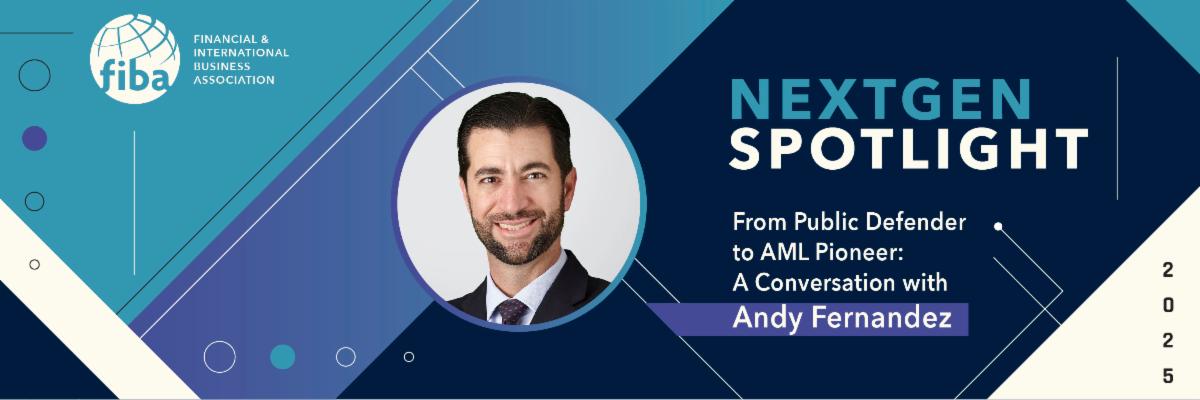
Hey there, FIBA NextGen community! 👋


Ever wonder how some of the biggest names in banking compliance found their way into this world of acronyms, sanctions, and high-stakes regulation?


Meet Andres “Andy” Fernandez, Partner at Holland & Knight LLP—a longtime FIBA member and one of the most respected voices in AML and sanctions law. From Miami courtrooms as a public defender to working with FinCEN, OFAC, and the DOJ, Andy’s journey is proof that the right turn can change everything.


In this exclusive interview, he shares how a Saturday breakfast reshaped his career, what it takes to thrive in this ever-evolving field, and the one piece of advice he’d give to future compliance leaders.

Whether you’re just starting out or already leading the way, Andy’s story shows that curiosity, hard work, and courage to pivot can take your career further than you ever imagined.


So grab your coffee ☕ and dive into this Q&A!

INTERVIEW:

ANDY FERNANDEZ

Partner, Holland & Knight LLP

How did you get your start and what was the pivotal moment that shaped your career path?


I began my legal career as a public defender in Miami-Dade County and spent three years in that role before moving to a private firm to focus on commercial litigation and white-collar defense. I genuinely thought I had found my path. After six years in practice, the training wheels were off and I felt confident in my skills.


The turning point came through a family friend, who asked me to meet with Clemente Vázquez-Bello—one of the early pioneers in AML. Over a Saturday breakfast, Clemente asked me, “how many lawyers do what you do?” I said, “thousands—commercial litigators and white-collar attorneys are everywhere.” He responded, “only a handful of lawyers do what I do.” That conversation sealed it. This was right after the USA Patriot Act amendments to the BSA, when AML was evolving quickly. The timing was perfect, and I jumped all in.


Who or what has been most influential in your career growth, and why?


Clemente. He recognized early that AML would become a distinct and critical specialty. He pivoted from traditional banking and licensing work into AML, taking on a few matters and eventually committing fully. He was deeply involved with FIBA from its early days—ultimately serving as its general counsel and as a member of its board of directors—and was instrumental in creating FIBA’s annual AML conference, now the premier AML conference in the region. His AML expertise made him a frequent speaker at leading regional, national and international forums, and an advisor to the U.S. Department of the Treasury as a member of the Bank Secrecy Act Advisory Group (BSAAG). Clemente saw the explosion of international banking in Miami and positioned himself—and his clients—at the forefront. He was nothing short of a pioneer in the field. His vision showed me how to build a practice around a developing regulatory landscape and how to serve institutions navigating that complexity.


What skills or personal qualities have been most important to your success?


Hard work. You don’t need to be the smartest person in the room, but you do need to be the hardest working. The regulatory rules, guidance and enforcement priorities are always changing. You have to immerse yourself in the materials—there are no shortcuts. Whether it’s a long-term project or a short engagement, you need to stay with it to the finish line, even when the road is complicated, uncertain and unpredictable. 

Consistency and effort are everything.


Is there a lesson you learned the hard way that you wish you’d known earlier?


Don’t hit “send” right away. Give important emails and responses time to breathe. When possible, step back, reflect and revisit with fresh eyes. The extra beat often leads to better judgment—and better outcomes.


How do you continue to learn and grow professionally at this stage of your career?


Speaking at conferences and providing trainings for our clients is my “secret sauce.” If you’re going to teach it, you have to truly know it. Public speaking forces you to stay current, go deep with the material, and test your understanding in front of knowledgeable audiences. It has also proven to be a great source for business development—when you educate the industry, you build trust and credibility. Committing to sharing my knowledge keeps me accountable to the latest developments.


If you could give one piece of advice to the next generation in our field, what would it be?


Bet on yourself. Trust that you have the skills and are the best person for the task. Also, don’t be afraid to make mistakes—a lesson I learned from my dad (and reinforced by Warren Buffett). The biggest mistakes are often those of omission, not commission. A missed opportunity often costs more than making a good-faith decision and learning from it. Work hard, and don’t let fear of imperfection hold you back.


What current trends or changes should NextGen professionals keep an eye on?


Technology is reshaping banking and the legal practice. We’ve moved from branch-based transactions and paper checks to fully digitized banking. Instant payments continue to be the next major shift. Consumers want immediacy, but compliance and legal controls are not inherently instantaneous.


OFAC compliance in an instant-payment environment is especially challenging. You need to understand the nature and purpose of a transaction, screen counterparties and sectors and apply sanctions logic—all in real time. That’s not straightforward. As a community—banks, fintechs, counsel and regulators—we need to evolve frameworks, tooling and expectations to manage compliance at instant speed. Adapting to that tension between speed and control will define the next phase of AML and sanctions compliance.


Brought to you by the NextGen Committee and NextGen Advisory Board. 


Interview by Kristen Jimenez and Maria Urribarri.


Facebook  Instagram  LinkedIn  Web  X