New Blog: Guide to OELA's 2024 Infographics and Fact Sheets | |
|
In 2024, OELA unveiled a wealth of new resources created to support ELs. These valuable tools, available on the National Clearinghouse for English Language Acquisition (NCELA) website, include webinars, podcasts, tip sheets, briefs, infographics, fact sheets, and more. With so much new content to explore, it’s easy to miss some of the releases.
To help, we've compiled a guide highlighting the latest infographics and fact sheets released this year, along with an overview of the key data they contain.
| |
State of Bilingual Education in U.S. Public Schools Data Visualization | |
|
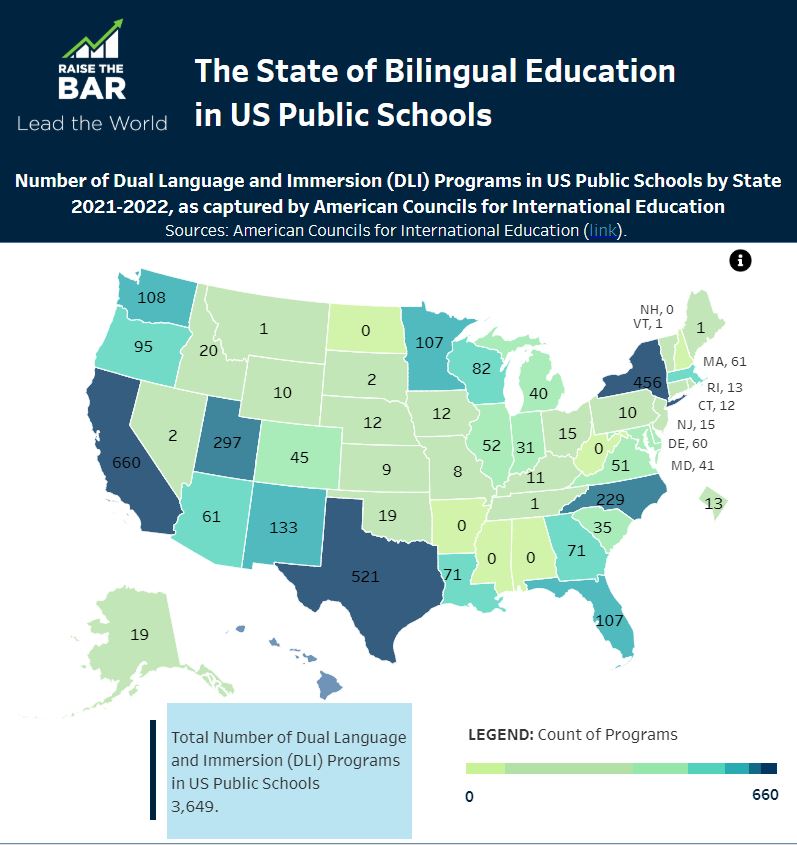
Data visualizations are now available that display the number of Dual Language and Immersion Programs in U.S. public schools as reported by the American Councils for International Education. Additional data shows the percentage of ELs served by different types of Title III EL instruction programs, including Transitional Bilingual, Newcomer, English as a Second Language, and Dual Language Immersion programs.
| |
English Learners with Disabilities Toolkit | |
|
The National Center on Educational Outcomes (NCEO) focuses on the inclusion of students with disabilities, ELs, and ELs with disabilities in instruction and assessments. Their English Learners with Disabilities Toolkit is designed to provide states and individualized education program (IEP) teams with tools they can use to better understand their students who are ELs with disabilities, determine in which state assessment (general or alternate) the students should participate, and discover whether accessibility features or accommodations are needed for their participation in any assessment.
-
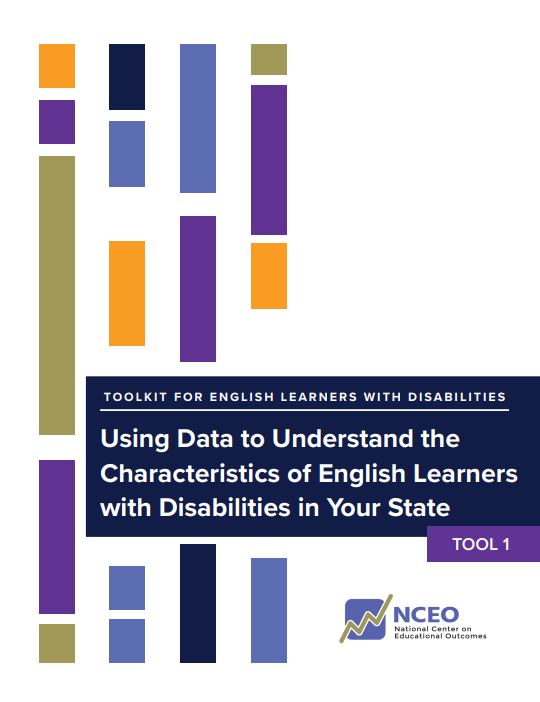
English Learners with Disabilities Toolkit: Using Data to Understand the Characteristics of English Learners with Disabilities in Your State (Tool 1) - This tool is designed to provide state educational agencies, particularly assessment staff, with templates to use to display data on the characteristics of ELs with disabilities.
-
English Learners with Disabilities Toolkit: State Assessments for English Learners with Disabilities: State Data Display Templates (Tool 2) - This State Data Display Templates tool is designed to provide state educational agencies with templates to use to display state assessment participation and student characteristics data for ELs with disabilities.
| |
60-Day Public Comment Period for the EDFacts Information Collection Package | |
|
The proposed EDFacts Information Collection package for school years 2025–26, 2026–27, and 2027–28 is now available for public review and comment. The announcement has been posted on the Federal Register and can be accessed here: FederalRegister.gov. To view the package, visit Regulations.gov. The public comment period closes on January 27, 2025.
EDFacts collects data on behalf of ED grant and program offices. The proposed package includes Pre-K–12 performance data about students, schools, staff, services, and educational outcomes at the state, district, and school levels. Approximately 170 data groups are included in the proposed package and respondents include all 50 states, Washington, DC, Puerto Rico, outlying areas and freely associated states, the Department of Defense Education Activity, and the Bureau of Indian Education.
The proposed package includes current and new data requirements, changes to existing collections, and deletions. The full package includes two supporting statements and six attachments:
-
Attachment A: Data Groups and Categories – Contains the list of all data to be collected. This attachment is an Excel spreadsheet that can be sorted and filtered.
-
Attachment B: Overview – Contains information about the collection including how the data are associated with schools and districts.
-
Attachment C-1: Metadata Collections – Contains all the metadata to be collected.
-
Attachment C-2: IDEA (Individuals with Disabilities Education Act) Metadata Collections – Contains previously collected IDEA Part B data collections in EMAPS.
-
Attachment D: Directed Questions – Contains questions to topics that the Department would like to learn more about during the public comment period.
-
Attachment E: Inclusion of IDEA Part C 618 – Contains the inclusion of currently cleared IDEA Part C 618 data collections into the EDFacts information collection request (ICR).
-
Supporting Statement Part A – Provides the justification for the collection of the data.
-
Supporting Statement Part B – Provides additional information about the collection including information on the statistical methodology.
We encourage sharing this information packet within the state, including with state superintendents, program offices, and local educational agencies. For questions related to collection activities or burden, please call Carrie Clarady at (202) 245-6347.
| |
FY 2025 Fulbright-Hays Seminars Abroad Program | |
|
ED’s International and Foreign Language Education office is excited to announce the launch of the FY 2025 Fulbright-Hays Seminars Abroad competition. The Seminars Abroad program provides short-term study abroad opportunities for groups of U.S. educators in the arts, social sciences, and humanities to enhance their understanding and knowledge of peoples and cultures in other countries.
Successful applicants will have their in-country expenses covered, including air transport, meals, and accommodation. This summer, ED will host a seminar in Greece and Türkiye for postsecondary educators and administrators, with applications accepted through January 7, 2025.
| |
Join the conference in the heart of Montgomery, Alabama, for AMTESOL 2025! This year’s theme, "Celebrating Cultural and Linguistic Kaleidoscopes," honors the rich cultural and linguistic diversity in teaching English to speakers of other languages. Attend the 2025 AMTESOL conference to be inspired, share insights, and connect with fellow educators! | |
The convention offers a wide range of engaging professional development opportunities to English language teaching (ELT) professionals at all levels from around the world. In lively interactive sessions, you'll develop a global perspective through the exchange of ideas, research, and practices. Gain knowledge about current trends in the field while developing your professional network. If you have questions about convention registration, please contact conventions@tesol.org. | |
Registration for the 2025 SCOLT Conference is now open! Don’t miss the chance to celebrate SCOLT’s 60th anniversary and learn with colleagues from across the region. The registration and payment deadline is March 1, 2025. After this date, all registrations must be completed on site at the conference. The 2025 conference will be held at the Sheraton Music City Hotel in Nashville, TN. | |
The In-Person Conference will be held at the Hyatt Regency, New Brunswick. You can register for 1, 2, or all 3 days with three exciting keynote speakers. There will also be a Video Library Conference featuring select library presentations, available for viewing from May 27 to August 21. Topics will cover General Interest, Content Area Instruction, Bilingual/ESL (Preschool–12), Higher Ed, Teacher Ed, Adult Ed, K–12 Administrators, and Dual Language/Biliteracy. | |
The MATSOL Conference, the largest gathering of EL and ML educators in Massachusetts, will take place May 28–30, 2025, at the Framingham Hotel and Conference Center. Join in person for 1 to 3 days or participate virtually via livestream. Registration opens January 8, 2025, with proposals due January 15, 2025. | |
|
October 27–30, 2025
2025 WIDA Annual Conference
Conference
| This conference, designed by teachers for teachers, is the leading event for Pre-K–12 educators of MLs. It provides an opportunity to share best practices and explore innovative classroom strategies, all under the theme "Igniting Innovation for Multilingual Learners." A curated virtual track will also be offered. The deadline to submit proposals for concurrent sessions, workshops, and sponsor sessions is January 21, 2025. | |
|
EdSource
California Must Put Money, Mandates Behind Promises of Bilingual Education, Researchers Say
Based on the recommendations made in a recently published report, California needs to expand bilingual education programs, prioritize enrollment of ELs in these programs, and invest more resources in teacher education programs. Other suggestions from the report include adopting the Texas example, where legislation has been passed requiring districts to offer bilingual education in cases of at least 20 speakers of the same language.
| |
|
The Hechinger Report
These Federal Policies Support Spanish-Language Child Care
Even though in the United States about a quarter of children are Hispanic, many of their families don’t have access to childcare services. This article provides information on the federal policies that contribute to the provision of Spanish-language child care in the United States.
| |
|
LA School Report
In Los Angeles, a Teacher Residency Program Creates Bilingual Teachers
This article outlines the challenges faced by California in creating a robust bilingual teacher workforce. Bilingual teachers are much needed in the state to serve a diverse and multilingual student body. One Los Angeles Charter School network partnered with other schools and a local university to launch the AVAMCE teacher residency program. The program pays candidates for training and helps them overcome other hurdles on the way to attaining their credentials.
| |
|
Subscribe to NCELA Nexus
Did you receive the Nexus from a colleague? You can subscribe via the form on our website.
| |
|
Submit Your News
Do you have news to share with the Nexus community?
Send your alerts, upcoming events, resources, and job postings to AskNCELA
by Monday, January 6, 2024, for inclusion in the next edition of Nexus.
| |
National Clearinghouse for English Language Acquisition (NCELA)
| |
Disclaimer: NCELA Nexus is intended to share information that can be of use to educators, parents, learners, leaders, and other stakeholders in their efforts to ensure that all students, including English learners, are provided with the highest-quality education and expanded opportunities to succeed. The information and materials presented in NCELA Nexus do not necessarily constitute or imply endorsement, recommendation, or partiality by NCELA, the Office of English Language Acquisition, or the U.S. Department of Education. | | | | |