NEW Blog: Supporting Early Literacy for English Learners | | |
In this new NCELA blog, explore high-quality early learning resources designed to support ELs. Early literacy instruction is a critical foundation, helping students build the reading, writing, and language skills needed for academic success, communication, and social-emotional growth. This blog also helps you reflect on your current practices and identify ways to strengthen them.
| | Now Available: English Learners in Rural Localities Infographic | | | | |
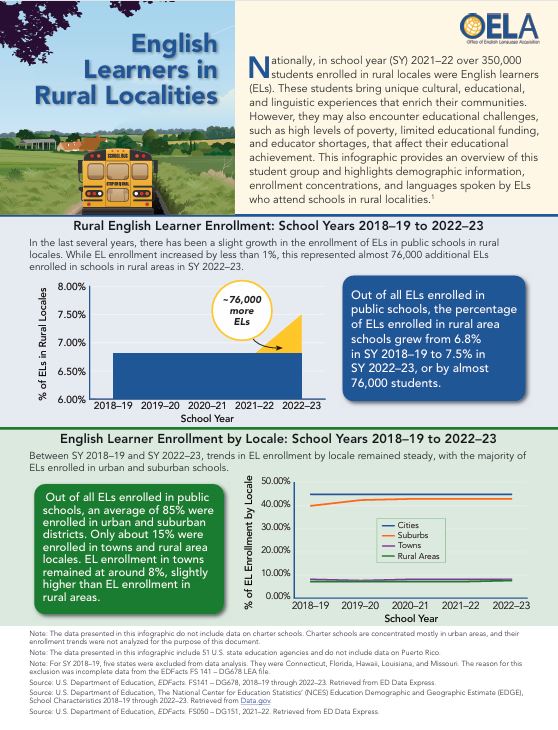
Nationally, in the 2021–22 school year, over 350,000 students enrolled in rural locales were ELs. These students bring unique cultural, educational, and linguistic experiences that enrich their communities. However, they may also encounter educational challenges, such as high levels of poverty, limited educational funding, and educator shortages, that affect their educational achievement.
This infographic provides an overview of this student group and highlights demographic information, enrollment concentrations, and languages spoken by ELs who attend schools in rural localities.
| | Information ELevated: Got Questions? Ask NCELA | | |
Have questions about NCELA resources and events or how to navigate the website? We’re just an email away. Contact us at askncela@manhattanstrategy.com, and we’ll point you in the right direction.
Check out the brief video below to learn how to get in touch—and share it with others who may find it helpful.
| |
Supporting the Future for Children of Farmworkers Nueva Generación Scholarship Program | | The 6th Annual Nueva Generación Scholarship is now accepting applications for students from farm-working families in California who are pursuing higher education. This program supports California Farmworker Foundation's (CFF) mission to uplift farmworker communities by expanding access to education and opportunity. Applicants must be students from farmworking families in California. The application closes on May 3, 2026. | | |
May 19–21, 2026
2026 NJTESOL/NJBE Spring Conference
In-Person Conference
| The In-Person Conference will be held at the Hyatt Regency, New Brunswick. You can register for 1, 2, or all 3 days, featuring keynote speakers Dr. Margarita Machado-Casas, Dr. Elsa Cárdenas-Hagan, and Dr. Sharroky Hollie. A Video Library Conference with select presentations will also be available from May 27 to August 20, covering topics across General Interest, Content Area Instruction, Bilingual/ESL (Pre-K–12), Higher Ed, Teacher Ed, and more. | | |
September 15–18, 2026
2026 WIDA Annual Conference
In-Person Conference
| “This conference, by teachers, for teachers, is the premier event for educators of pre-K through grade 12 multilingual learners, giving educators the opportunity to share best practices and discover innovative classroom strategies. The in-person conference will take place September 16–18, 2026, in St. Louis, Missouri, under the theme ‘Building Gateways to Colaboración.' A curated virtual track will also be available on September 15, 2026. Join the WIDA Annual Conference email list to stay up-to-date on call for proposals, registration details and more.” | | |
WRAL News
Several Harnett County Public Schools to shutter Dual Language Immersion program
This article highlights Harnett County Public schools, a district in North Carolina that made the decision to shut down its Dual Language Immersion programs. This change will affect about 1,000 students who will have to either move to different schools or remain at their schools without participating in Dual Language programs. Families and advocates are urging the district to reconsider this decision.
| | |
Learning Policy Institute
NEW RESOURCES: Teacher Turnover in the United States: Who Moves, Who Leaves, and Why
“This report describes the state of teacher turnover in the United States and examines individual- and school-level factors associated with turnover. It uses the most recent national-level data of public school teachers from the National Center for Education Statistics’ National Teacher and Principal Survey (2020–21) and Teacher Follow-Up Survey (2021–22) to provide estimates of turnover across all teachers and by key teacher subgroups. The findings complement prior state-level research on COVID-19 pandemic-induced challenges, highlighting that the challenges teachers faced prior to the pandemic still mattered during this period. The report concludes with policy considerations to reduce turnover and suggestions for future research.”
| |
Migration Policy Institute
NEW RESOURCE: Native Language Assessments for K-12 English Learners: A 2025 State-Level Snapshot
More than half of states in the United States offer at least one native language assessment to their ELs. This practice contributes to assessments’ ability to accurately measure ELs’ content area knowledge. This fact sheet addresses native language assessment practices and data in U.S. schools. It explains how states define significant languages for native language assessments, which native languages states assess ELs in, and what types of native language assessments states use.
| |
Language Magazine
TIPS FOR EDUCATORS: The Reciprocal Cycle of Reading
This article describes the strategy of the reciprocal reading cycle. The authors argue that the more traditional linear reading models often fall short because they don’t always account for the interaction of skill and knowledge. This resource provides instructional suggestions and practical strategies to implement the reciprocal cycle in reading instruction, arguing that once this cycle is established, the dynamic process where stages of the reading process interact with each other may strengthen the reading skills of many students.
| | |
Making Space for Students’ Home Languages in the Classroom
Edutopia highlights how educators can better support multilingual learners (MLs) by intentionally incorporating students’ home languages through translanguaging. It shares practical strategies like multilingual brainstorming, language pairing, and bilingual vocabulary supports to improve access and understanding. Overall, it emphasizes that valuing home languages strengthens both learning and belonging for MLs in the classroom.
| |
Blog: Advocating for Multilingual Learners With Disabilities
A newly released blog from WIDA helps deepen educators’ understanding of the legal rights of MLs with disabilities and how to ensure appropriate access to instruction and services. It also highlights practical strategies such as strengthening collaboration among educators, improving IEP processes, and engaging families as equal partners.
| | |
Subscribe to NCELA Nexus
Did you receive the Nexus from a colleague? You can subscribe via the form on our website.
| | |
Submit Your News
Do you have news to share with the Nexus community?
Send your alerts, upcoming events, resources, and job postings to AskNCELA
by Monday, May 4, 2026, for inclusion in the next edition of Nexus.
| |
National Clearinghouse for English Language Acquisition (NCELA)
| | Disclaimer: NCELA Nexus is intended to share information that can be of use to educators, parents, learners, leaders, and other stakeholders in their efforts to ensure that all students, including English learners, are provided with the highest-quality education and expanded opportunities to succeed. The information and materials presented in NCELA Nexus do not necessarily constitute or imply endorsement, recommendation, or partiality by NCELA, the Office of English Language Acquisition, or the U.S. Department of Education. | | | | |